Macroeconomics: Policy and Practice, 2e (Mishkin)
Chapter 16 Fiscal Policy and the Government Budget
16.1 The Government Budget
1) Federal government outlays include ________.
A) transfer payments, grants to states, interest payments on the national debt and income tax
revenues
B) grants to states, interest payments on the national debt, income tax revenues and government
purchases
C) interest payments on the national debt, income tax revenues, government purchases and
transfer payments
D) government purchases, transfer payments, grants to states and interest payments on the
national debt
2) Total spending by all levels of government in the United States in 2012 amounted to roughly
________ per person.
A) $20,000
B) $2,000
C) $200,000
D) $200
3) Which of the following is not a category of state and local government outlays?
A) purchases of goods and services
B) grants in aid
C) transfer payments
D) interest payments
4) In 2012, direct government purchases equaled ________ percent of federal outlays.
A) 42
B) 71
C) 26
D) 55
5) In 2012, direct government purchases equaled ________ percent of expenditures of all levels
of government.
A) 71
B) 42
C) 26
D) 55
6) The major component of federal government consumption is spending on ________.
A) Social Security, Medicare and Medicaid
B) foreign aid
C) capital goods, e.g. highways and schools
D) national defense
7) Transfer payments, like Social Security, are known as entitlements since ________.
A) they are locked up by earlier legislation
B) the individuals who receive these payments are poor and deserve our support
C) the individuals who receive these payments made payments to the federal government in
excess of the monies they draw from the system
D) these monies tend to rise in an economic downturn
8) At the federal level, transfer payments make up ________.
A) about 98 percent of total outlays
B) about half of total outlays
C) less than one percent of total outlays
D) the gap between government purchases and borrowing
9) The smallest component of federal outlays is ________.
A) government purchases
B) transfer payments
C) interest on government debt
D) grants to states
3
10) Among 33 major economies, government spending (relative to GDP) in the United States is
________.
A) relatively low
B) remarkably high
C) about average
D) lowest of all
11) The primary source of revenue for the federal government of the United States are taxes tied
to ________.
A) property values
B) rents and dividends
C) export and import flows
D) income
12) Tariffs are ________.
A) taxes levied on goods imported into the United States
B) levied by state and local governments
C) the primary source of federal revenues
D) taxes on goods exported from the United States
13) Income taxes were made constitutional in the United States by the ________.
A) Recovery Act of 2009
B) 16th Amendment to the U.S. Constitution
C) Sherman Anti-Trust Act of 1890
D) Gramm-Leach-Bliley Act of 1999
14) A federal government surplus is said to exist in the event that ________.
A) federal outlays are greater than federal revenues
B) federal outlays are equal to federal revenues
C) federal outlays are less than federal revenues
15) A federal government deficit is said to exist in the event that ________.
A) federal outlays are less than federal revenues
B) federal outlays are equal to federal revenues
C) federal outlays are greater than federal revenues
D) any of the above conditions exists
16) The government budget constraint says that ________.
A) the difference between spending and revenues must equal the amount of new bond issues
B) increases in spending must be matched by increases in revenue
C) interest on government debt must be paid before tax revenues are spent on goods and services
or disbursed as transfer payments
D) state and local governments, in aggregate, cannot spend more than the federal government
17) What is the formula for the government budget deficit? Why might it be appropriate for most
governments, most of the time, to have a deficit (rather than surplus)?
16.2 Size of the Government Debt
1) In the postwar era, the federal budget has typically been ________.
A) balanced
B) in surplus
C) in deficit
D) the largest component of Gross Domestic Product
2) One of the consequences of inflation between 1950 and the 1970s was ________.
A) a large increase in the federal deficit as a percentage of GDP
B) a relaxation of the government budget constraint
C) an increase in the dependency ratio
D) a reduction in the ratio of debt to GDP
5
3) The most recent U.S. President to preside over an annual federal budget surplus was
________.
A) George H. W. Bush (1989-1993)
B) Gerald Ford (1974-1977)
C) Dwight Eisenhower (1953-1961)
D) George W. Bush (2001-2009)
4) The pay-as-you-go system for the Social Security System entails. ________.
A) a transfer of payments from those currently working to retirees
B) taxing the import and export of goods and services into an out of the United States
C) a number of current retirees that exceeds the number of employed individuals
D) issuing additional government debt in the event of budget surplus
5) The ratio of retirees to workers who make contributions to the Social Security system
________.
A) has increased over the years
B) increased as a result of the baby boom following World War II, but has subsequently declined
C) has fallen with the decline in U.S. birth rates
D) determines the size of contributions to the system
6) In the next several decades, the dependency ratio relevant to the Social Security system is
expected to ________.
A) remain largely unchanged
B) rise
C) fall
D) fluctuate unpredictably
7) Federal transfers are expected to grow significantly in the coming decades, due especially to
increases in ________.
A) federal government consumption
B) federal deficits
C) Medicare and Medicaid
D) Social Security payments
6
8) As of 2011, government debt as a percentage of GDP was ________ in the United States,
compared to 29 other major economies.
A) higher than average
B) extremely low
C) highest
D) lower than average
9) The Congressional Budget Office projects that Social Security spending will rise from 5% of
GDP to 6% over the next four decades. Why is that a problem?
16.3 Sovereign Debt Crises
1) The term “sovereign debt crisis” applies when ________.
A) private businesses cannot borrow money because the government is borrowing so much
B) nations compete fiercely with each other to increase their borrowing
C) a government finds that the cost of borrowing is higher than it had anticipated
D) the debt of a particular government quickly loses value
2) Sovereign debt crises are triggered ________.
A) by innovations in subprime real estate markets
B) when a country’s debt-to-GDP ratio becomes excessively high
C) when austerity measures cause a sharp fall in the supply of government bonds
D) by the adoption of a common currency, such as the euro
7
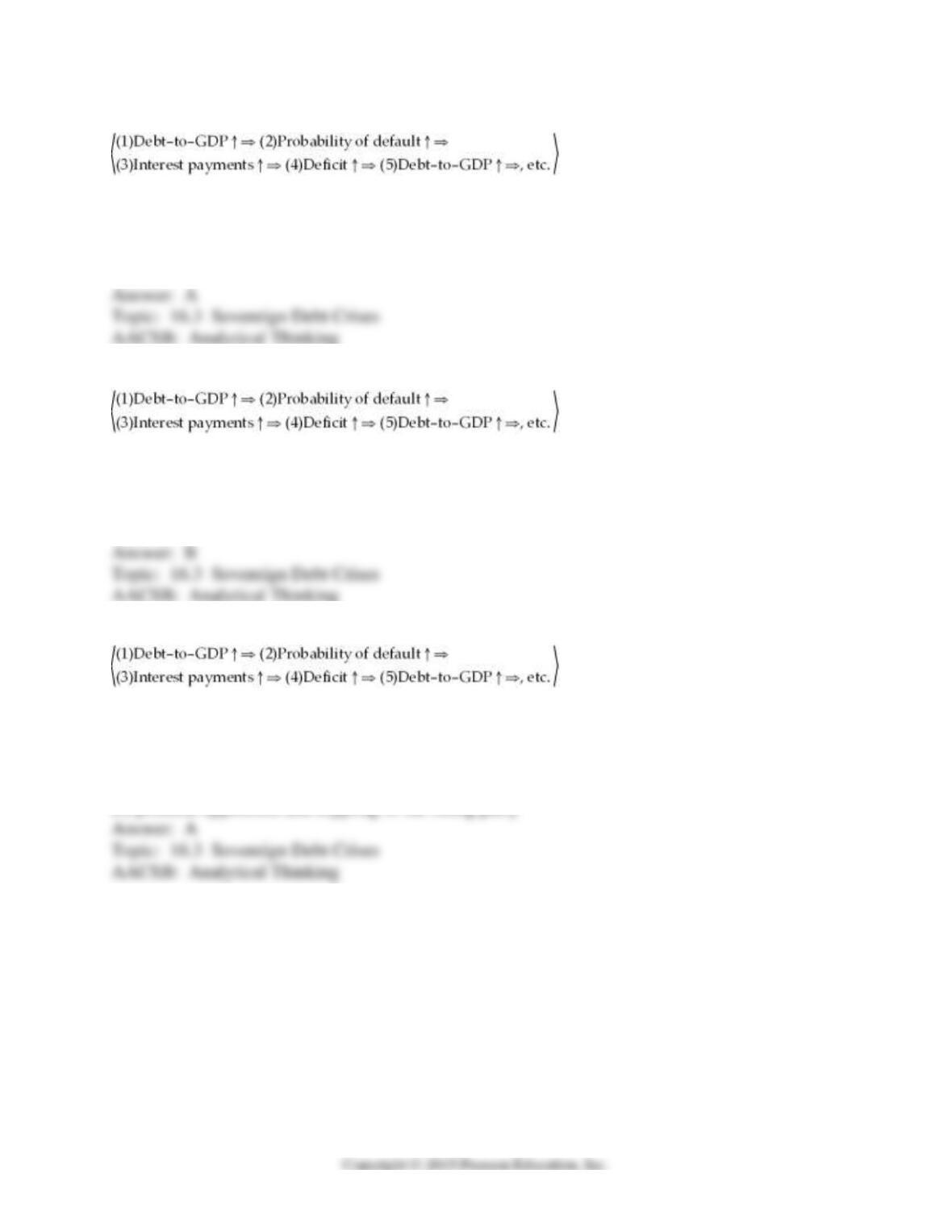
3) In this causal schematic of a sovereign debt crisis:
, austerity measures attempt to break
the adverse feedback loop at point ________.
A) 4
B) 3
C) 2
D) 5
4) In this causal schematic of a sovereign debt crisis:
, liquidity support from a central
bank attempts to break the adverse feedback loop at point ________.
A) 4
B) 3
C) 2
D) 5
5) In this causal schematic of a sovereign debt crisis:
, austerity measures designed to
reduce the government deficit (point 4) may have the undesired effect of intensifying the adverse
feedback loop at point 5. The source of this danger is ________.
A) contraction of the macroeconomy
B) income received by owners of the government debt is reduced
C) a sharp increase in the value of the government’s debt
D) political opposition and toppling of the ruling party
8
16.4 Fiscal Policy and the Economy in the Long Run
1) As of 2013, the debt of the U.S. government amounted to roughly ________ per person.
A) $50,000
B) $8 million
C) $500,000
2) Private saving + Government saving equals ________.
A) Taxes + Investment
B) Output minus Consumption
C) Government capital + human capital
D) Investment + Net exports
3) The negative impact of government debt on the economy is mitigated by ________.
A) the impact of the debt on national saving
B) government spending on schools and highways
C) the interest rate effects of government budget deficits
D) the phenomenon of crowding-out
4) Suppose total government spending is increased permanently by ten percent, with no change
in tax rates. In the long run, the resulting deficit will disappear, ________.
A) only if government spending is brought back down to the original level
B) if economic growth raises tax revenue by ten percent
C) if the government debt is sold to foreigners
D) unless the money is spent entirely on government consumption
5) Tax smoothing is intended to ________.
A) reduce income inequality
B) avoid fluctuations in the ratio of the government deficit to GDP
C) shift the burden from current taxpayers onto future generations
D) keep the tax wedge from shrinking
6) The phenomenon of crowding-out suggests that the positive impact of budget deficits on
economic activity are reduced by ________.
A) the impact produced by government spending on the environment
B) an increase in national savings
C) the interest rate effects associated with federal deficits
D) the increase in pork barrel projects deficit spending entails
7) ________ refers to a government’s failure to repay its debt.
A) Intolerance
B) Distortion
C) Seignorage
D) Repudiation
8) Sovereign debt crisis, a short-run phenomenon, may lead to the long-run consequence of debt
________.
A) intolerance
B) distortion
C) seignorage
D) repudiation
9) Sustained federal deficits tend, other things the same, ________.
A) to decrease income inequality in the United States
B) to decrease income inequality in Europe but not the United States
C) to increase income inequality in the United States
D) have little effect on the distribution of income in market economies
10) The policy of keeping tax rates stable as government spending fluctuates is known as
________.
A) Ricardian equivalence
B) tax smoothing
C) crowding-out
D) a tax smoothie
11) A tax wedge is ________.
A) the difference between the tax rate on income and capital gains
B) equal to the difference between what people earn before and after taxes are accounted for
C) the size of the decrease in labor force participation when labor income is taxed
D) the difference between the rate on Treasury securities and the income tax rate
12) When a government has decided on a permanent spending increase, a valid reason to
increase borrowing rather than taxes might be to ________.
A) to avoid an unnecessary stimulus to aggregate demand
B) to shift the burden from domestic taxpayers to foreign bond holders
C) to avoid distortions that might reduce long-run aggregate supply
D) to avoid an increase in income inequality
13) A government debt larger than the economy’s GDP ________.
A) is an example of debt repudiation
B) is a predictor of future large budget deficits
C) is a consequence of debt intolerance
D) is a possible consequence of tax smoothing
14) Most state governments in the United States operate under constitutional provisions that
severely restrict expenditures financed by borrowing. Suppose this were to change, so that state
governments’ access to credit markets was no different from the federal government. What
consequences would you predict for the nation’s aggregate debt burden?
11
15) A default in the past makes it much more likely that a government will default again, even if
the current government is a new regime with every intention of honoring its debts. Why might
that be?
16) In the wake of the financial crisis of 2007-2009, the debt-to-GDP ratio has risen in many
countries around the world. Should the expenditures enabled by this debt be considered
government consumption or government investment?
16.5 Fiscal Policy and the Economy in the Short Run
1) Fiscal policy is the responsibility of ________.
A) the Federal Reserve System
B) the Comptroller of the Currency
C) the President and U.S. Congress
D) High Commissioner for Refugees
2) Fiscal policy involves manipulating ________.
A) the supply of money
B) consumption spending
C) federal subsidies and minimum wage values
D) government spending and taxes