43) An indirect effect of monetary policy is that as the money supply
A) increases, interest rates fall, and borrowing and spending increase.
B) increases, interest rates rise, and borrowing and spending decrease.
C) decreases, interest rates fall, and borrowing and spending increase.
D) decreases, interest rates rise, and borrowing and spending increase.
44) Suppose the Fed increases the money supply. As a result of this, people go out and spend
more money on consumer goods, increasing aggregate spending. This is known as a(n)
A) direct effect of monetary policy.
B) indirect effect of monetary policy.
C) direct effect of fiscal policy.
D) indirect effect of fiscal policy.
45) Suppose the Fed increases the money supply. As a result of this, people deposit excess funds
into their bank accounts, causing banks to have excess reserves. As a result, the banks lower the
interest rates that they charge on loans, and investment rises, causing an increase in aggregate
spending. This is known as a(n)
A) direct effect of monetary policy.
B) indirect effect of monetary policy.
C) direct effect of fiscal policy.
D) indirect effect of fiscal policy.
46) An expansionary monetary policy results in lower interest rates, which in turn
A) increases foreign demand for U.S. financial instruments, raising the international price of the
dollar and reducing net exports.
B) increases the foreign demand for U.S. financial instruments, lowering the international price
of the dollar and decreasing net exports.
C) reduces the international price of the dollar and increases net exports.
D) reduces the foreign demand for U.S. financial instruments and reduce net exports.
47) An appreciation of the U.S. dollar is most likely a result that
A) the Fed has pursued an expansionary monetary policy.
B) U.S. interest rates have increased.
C) U.S. bond prices have increased.
D) more dollars are required to obtain foreign currencies.
48) As the world economy becomes more integrated through globalization
A) the Fed will find it easier to conduct monetary policy.
B) the Fed will have a more difficult time reaching its money supply growth rate targets.
C) the Fed will rely less on open market operations and more on changing the required reserve
ratio when conducting monetary policy.
D) U.S. interest rates will determine world interest rates.
49) A contractionary monetary policy causes
A) higher interest rates, which increases the international price of the dollar and decreases net
exports.
B) higher interest rates, which decreases the foreign demand for U.S. financial instruments,
raising the international price of the dollar and increasing net exports.
C) lower interest rates, which decreases the foreign demand for U.S. financial instruments,
raising the international price of the dollar and increasing net exports.
D) higher interest rates, which increases the foreign demand for U.S. financial instruments,
which causes interest rates to decrease. There is no effect on net exports.
50) It has been observed that a change in monetary policy in the United States
A) impacts net exports.
B) has little or no effect on foreign markets.
C) leads to corresponding changes in other countries.
D) has only short run influences.
51) An appreciation of the U.S. dollar occurs when
A) the international price of the dollar falls.
B) the international price of the dollar rises.
C) the U.S. demand for foreign currencies increases.
D) the supply of dollars in international markets increases.
52) When the U.S. dollar appreciates
A) foreign residents demand more of U.S. goods, and U.S. residents desire to purchase more
foreign goods.
B) foreign residents demand more of U.S. goods, and U.S. residents desire to purchase fewer
foreign goods.
C) foreign residents demand fewer of U.S. goods, and U.S. residents desire to purchase more
foreign goods.
D) foreign residents demand fewer of U.S. goods, and U.S. residents desire to purchase fewer
foreign goods.
53) An appreciation of the U.S. dollar
A) makes our exports more expensive in terms of foreign currency and imports cheaper in terms
of the dollar, increasing net exports.
B) makes our exports less expensive in terms of foreign currency and imports cheaper in terms of
the dollar, increasing net exports.
C) makes our exports less expensive in terms of foreign currency and imports cheaper in terms of
the dollar, decreasing net exports.
D) makes our exports more expensive in terms of foreign currency and imports cheaper in terms
of the dollar, decreasing net exports.
54) A depreciation of the U.S. dollar
A) makes U.S. exports more expensive in terms of foreign currency and imports less expensive
in terms of the dollar, increasing net exports.
B) makes U.S. exports less expensive in terms of foreign currency and imports more expensive
in terms of the dollar, increasing net exports.
C) makes U.S. exports less expensive in terms of foreign currency and imports more expensive
in terms of the dollar, decreasing net exports.
D) makes U.S. exports more expensive in terms of foreign currency and imports less expensive
in terms of the dollar, decreasing net exports.
55) As a result of contractionary monetary policy
A) interest rates fall, the dollar depreciates, and domestic goods become cheaper, thereby
reducing net exports.
B) interest rates rise, the dollar appreciates, and domestic goods become more expensive, thereby
reducing net exports.
C) interest rates rise, the dollar appreciates, and domestic goods become cheaper, thereby
reducing net exports.
D) interest rates rise, the dollar appreciates, and domestic goods become cheaper, thereby
increasing net exports.
56) The net-export effect of contractionary monetary policy is
A) the depreciation of the value of the dollar and a resulting increase of U.S. net exports.
B) the depreciation of the value of the dollar and a resulting decrease of U.S. net exports.
C) the appreciation of the value of the dollar and a resulting increase of U.S. net exports.
D) the appreciation of the value of the dollar and a resulting decrease of U.S. net exports.
57) What effect does a contractionary monetary policy in the U.S. have on the foreign trade
sector?
A) The lower value of the dollar will decrease exports and increase imports.
B) The lower value of the dollar will decrease imports and increase exports.
C) The higher value of the dollar will decrease exports and increase imports.
D) The higher value of the dollar will decrease imports and increase exports.
58) What effect does an expansionary monetary policy in the U.S. have on the foreign trade
sector?
A) The lower value of the dollar will decrease exports and increase imports.
B) The lower value of the dollar will decrease imports and increase exports.
C) The higher value of the dollar will decrease exports and increase imports.
D) The higher value of the dollar will decrease imports and increase exports.
59) Which of the following would NOT be a result of a contractionary monetary policy?
A) Interest rates would rise.
B) Foreign goods would become more expensive to U.S. residents.
C) Net exports would decline.
D) Imports would rise.
60) The net-export effect of expansionary monetary policy is a(n)
A) depreciation of the value of the dollar and the increase of U.S. net exports.
B) depreciation of the value of the dollar and the decrease of U.S. net exports.
C) appreciation of the value of the dollar and the increase of U.S. net exports.
D) appreciation of the value of the dollar and the decrease of U.S. net exports.
61) The net-export effect of contractionary monetary policy is a(n)
A) depreciation of the value of the dollar and the increase of U.S. net exports.
B) depreciation of the value of the dollar and the decrease of U.S. net exports.
C) appreciation of the value of the dollar and the increase of U.S. net exports.
D) appreciation of the value of the dollar and the decrease of U.S. net exports.
62) As global financial markets become more intertwined, the Fed has
A) less control over monetary policy.
B) more control over monetary policy.
C) more control over fiscal policy.
D) less control over fiscal policy.
63) Which of the following is associated with a contractionary monetary policy?
A) lowering the differential between the discount rate and the federal funds rate
B) selling bonds
C) lowering the required reserve ratio
D) raising bond prices
64) The Fed would be pursuing a contractionary monetary policy if it was
A) lowering the differential between the discount rate and the federal funds rate.
B) lowering the reserve requirement.
C) selling dollars in foreign exchange markets.
D) selling bonds in the open market.
68
65) The Federal Open Market Committee engages in contractionary monetary policy by
A) lowering interest rates.
B) creating excess reserves.
C) selling bonds.
D) buying bonds.
66) What are the direct and indirect effects of an increase in the money supply?
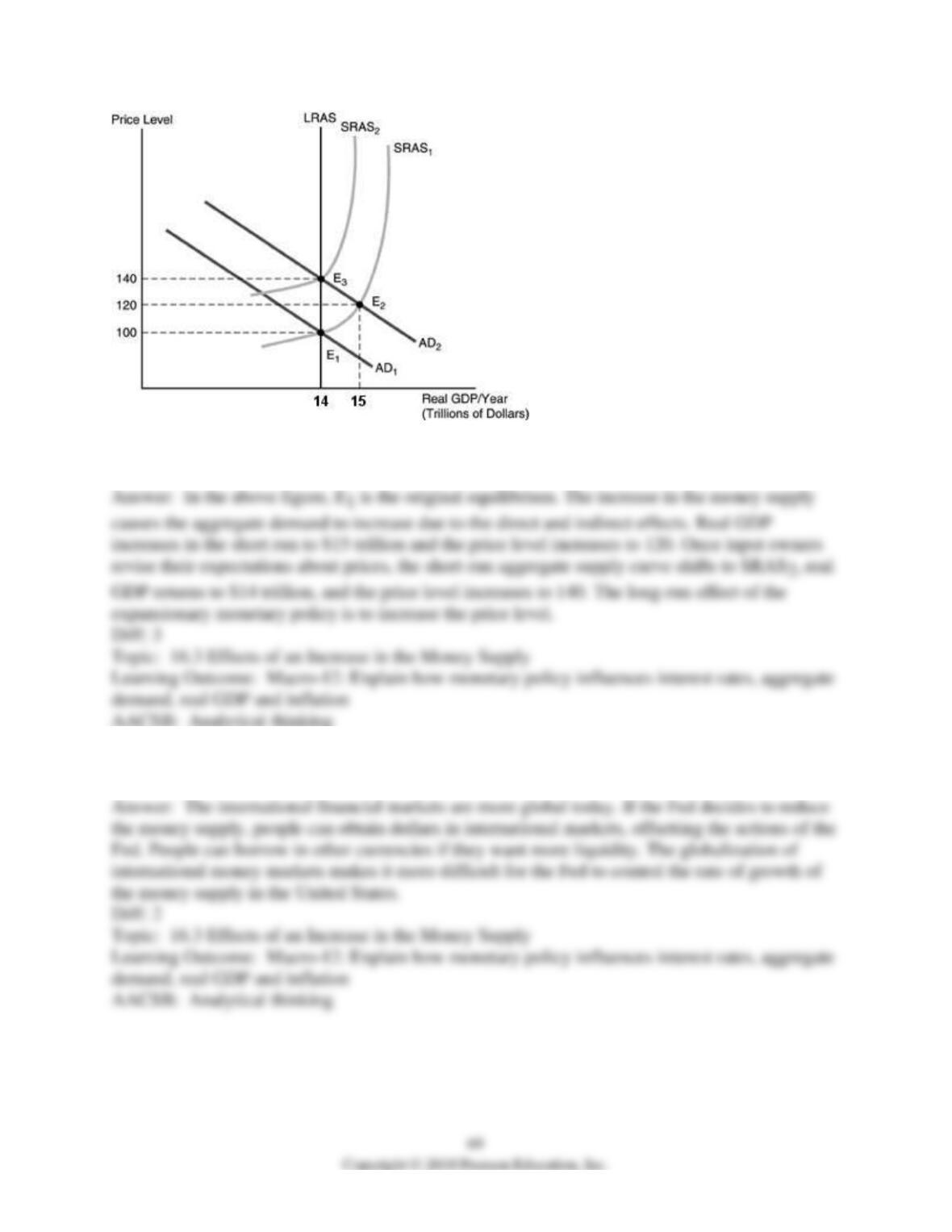
67) Using a graph above, show the short-run and long-run effects of an expansionary monetary
policy.
68) Why is it more difficult for the Fed to control the money supply today than it was fifty years
ago?
16.4 Monetary Policy and Inflation
1) According to the equation of exchange, if M = $800, P = 8, and Y = $200, then V equals
A) 100.
B) 2.
C) 32.
D) 4.
2) According to the equation of exchange, if M = $500, V = 4, and Y = $200, then P equals
A) 100.
B) 62.5.
C) 10.
D) 25.
3) Which of the following best represents the equation of exchange?
A) M * P = V * Y
B) M * V = P * Y
C) M * Y = P * V
D) M * Y * V = P
4) The hypothesis that changes in the money supply lead to an equiproportional change in the
price level is called
A) the quantity theory of money.
B) the classical theory of money.
C) the Keynesian theory of money.
D) the fractional theory of money.
5) According to the quantity theory of money, the price level decreases in equal proportion to
A) an increase in the income velocity of money.
B) a decrease in the nominal interest rate.
C) an increase in the real interest rate.
D) a decrease in the money supply.
6) Other things being equal, the quantity theory of money suggests that any increase in the
money supply
A) causes a reduction in the demand for money.
B) results in a decrease in the aggregate price level.
C) causes the aggregate level of nominal Gross Domestic Product (GDP) to fall.
D) results in a proportionate increase in the price level.
7) According to the quantity theory of money, increases in the money supply lead to
A) decreases in nominal Gross Domestic Product (GDP).
B) increases in the price level.
C) decreases in the price level.
D) increases in taxes.
8) According to the quantity theory of money
A) a change in the money supply can lead only to a proportionate change in the price level.
B) the velocity of money is the least stable factor in monetary analysis.
C) the rate of inflation is not related to changes in the money supply.
D) price level changes can best be explained by Keynesian analysis.
9) The formula of the equation of exchange is
A) MS = Y.
B) MS = V*P*Y.
C) MS*V = P*Y.
D) MS/P = Y.
10) According to both the equation of exchange and the quantity theory of money
A) an increase in the money supply will increase real Gross Domestic Product (GDP).
B) an increase in the money supply will decrease real Gross Domestic Product (GDP).
C) a decrease in the money supply will decrease the velocity of money.
D) a decrease in the money supply will decrease the price level.
11) The velocity of money
A) is, according to the equation of exchange, equal to P/M.
B) indicates the number of times per year a dollar is spent on final goods and services.
C) is, according to the equation of exchange, equal to M/Y.
D) indicates the speed with which the U.S. Treasury can mint new coins.
12) According to the equation of exchange, if V = 10, P = 3, and Y = $100, then the money
supply equals
A) $10.
B) $15.
C) $30.
D) $150.
13) According to the quantity theory of money, an excess quantity of money supplied will lead to
A) a reduction in spending and higher interest rates.
B) a reduced level of real Gross Domestic Product (GDP).
C) a higher level of employment.
D) a higher price level.
14) A decrease in the supply of money will, according to the quantity theory of money, lead to
A) a higher price level.
B) a higher nominal Gross Domestic Product (GDP).
C) a lower real Gross Domestic Product (GDP).
D) a lower price level.
15) The income velocity of money is
A) the time it takes to produce money.
B) the time lag from when the Fed decides to increase the money supply until the effect takes
place.
C) the number of times per year a dollar is spent on final goods and services.
D) the time it takes for monetary policy to have an effect on world financial markets.
16) According to the equation of exchange, if real Gross Domestic Product (GDP) is $25 billion,
the money supply is $10 billion, and the price index equals 2, then the income velocity of money
is
A) 5.
B) 10.
C) 25.
D) 50.
17) The equation of exchange is
A) an assumption that is not always true.
B) true in the short run but not always in the long run.
C) an accounting identity and therefore is always true.
D) a theory developed at the Federal Reserve.
18) An assumption used in the quantity theory of money is that
A) the price level is constant.
B) velocity is constant.
C) nominal Gross Domestic Product (GDP) is constant.
D) the money supply is constant.
19) According to the quantity theory of money
A) real Gross Domestic Product (GDP) is directly related to changes in the money supply in the
long run.
B) velocity varies indirectly with the rate of growth of the money supply.
C) a proportionate increase in the money supply leads to a less than proportionate increase in real
Gross Domestic Product (GDP), at least in the long run.
D) a given proportionate increase in the money supply leads to an equal proportionate increase in
the price level.
20) An increase in the money supply, other things being constant
A) causes interest rates to rise.
B) generates an increase in the demand for money.
C) causes the price level to increase.
D) causes the purchasing power of money to increase.
21) The income velocity of money is the absolute number of times, on average, that
A) people purchase goods and services during a year.
B) each monetary unit is spent on final goods and services.
C) each unit of real GDP is produced by business firms.
D) each one-unit increase in the price level occurs.
22) Empirical evidence across numerous countries indicates that changes in the ________ are
associated with nearly equiproportional changes in ________.
A) money supply, real GDP per year
B) money supply, price level
C) price level, money supply
D) real GDP per year, income velocity of money
23) The number of times per year, on average, that a dollar is spent on final goods and services is
known as
A) the money supply.
B) the equation of exchange.
C) the price of money.
D) the income velocity of money.
24) According to the equation of exchange, nominal GDP equals
A) the amount of actual money balances times the income velocity of money.
B) the amount of actual money balances divided by the income velocity of money.
C) the price level divided by the income velocity of money.
D) the price level times the income velocity of money.
25) The equation of exchange is a formula indicating that the number of monetary units times
A) the number of times each monetary unit is spent on final goods and services is identical to the
price level times real GDP.
B) the price level is identical to the number of times each monetary unit is spent on final goods
and services times real GDP.
C) real GDP is identical to the price level times the number of times each monetary unit is spent
on final goods and services.
D) nominal GDP is identical to the price level times the number of times each monetary unit is
spent on final goods and services.
26) The identity stating that the total amount spent on final output equals the amount received for
final output is known as the
A) fundamental law of economics.
B) circular flow identity.
C) equation of exchange.
D) identity equation.
27) In words, the equation of exchange says that
A) the total amount spent on final output equals the amount received for final output.
B) the amount of money in circulation equals the velocity of the price level.
C) changes in the money supply will have no impact on the amount spent on final output.
D) when velocity equals 1, nominal GDP equals the price level.
28) If the total money supply is $3 trillion, real GDP is $9 trillion and the price level is 2, then
the equation of exchange tells us that velocity equals
A) 0.25.
B) 1.5.
C) 6.
D) 13.5.
29) If velocity is equal to 1, this means that
A) the rate of growth of the money supply is 1.
B) each dollar of the money supply is spent on the average one time per year.
C) for every 2 dollars of the money supply, nominal GDP will increase by 1.
D) an increase in the money supply will lead to an increase in aggregate supply of 1.
30) If nominal GDP is $5 trillion and velocity is 5, then
A) actual money balances held by the nonbanking public are $5 trillion.
B) actual money balances held by the nonbanking public are $1 trillion.
C) real GDP equals $100 trillion.
D) real GDP equals $500 trillion.
31) The equation of exchange is an ________ while the quantity theory of money is a theory that
________.
A) accounting identity; assumes the money supply is constant
B) accounting identity; assumes velocity is held constant
C) accounting theory; assumes the price level is constant
D) accounting theory; economists use to explain changes in real GDP
32) The quantity theory of money is based on the formula that
A) V = P*Y*Ms.
B) Y = P*V/Ms.
C) Ms= P*V/Y.
D) P = Ms*V/Y.
33) The quantity theory of money and prices assumes
A) velocity is constant.
B) real output is constant.
C) the price level is constant.
D) the price level is increasing at a constant rate.
34) The quantity theory of money and prices
A) is derived from the equation of exchange assuming that prices remain constant.
B) shows how a change in the price level leads to a change in the money supply.
C) shows how the demand for money is inversely related to the price level.
D) is the hypothesis that changes in the money supply leads to proportional changes in the price
level.