26) Which of the following is a TRUE statement about the relationship between the price of
bonds and the interest rate?
A) The prices of bonds are directly related to the interest rate.
B) The prices of bonds increase when the interest rates rise.
C) The prices of bonds are unrelated to the interest rate.
D) The prices of bonds are inversely related to the interest rate.
27) The Fed engages in open market operations and sells government securities. The result is
A) lower interest rates.
B) higher interest rates.
C) interest rates remain unchanged since there is no reason to think bond prices changed.
D) uncertain since more information is needed.
28) How does the Fed increase the level of reserves in the banking system?
A) by lowering interest rates
B) by raising interest rates
C) by selling bonds
D) by buying bonds
29) When the Fed purchases federal government bonds in the open market
A) there is no change in the money supply.
B) the money supply expands.
C) the money supply contracts.
D) the demand for money expands.
30) When interest rates in the bond market go up
A) there is no impact on the price of existing bonds.
B) the price of existing bonds goes up.
C) the price of stocks goes up.
D) the price of existing bonds goes down.
31) The prices of all fixed-income assets (bonds)
A) vary directly with the interest rate.
B) are independent of the interest rate.
C) vary inversely with the interest rate.
D) are determined by the U.S. Treasury.
32) The asset demand for money is
A) greater at high interest rates as investors can earn more on their investments.
B) greater at low interest rates, because the opportunity cost of holding money is low.
C) greater at low interest rates, because the opportunity cost of holding money is high.
D) lower at low interest rates, because the opportunity cost of holding money is high.
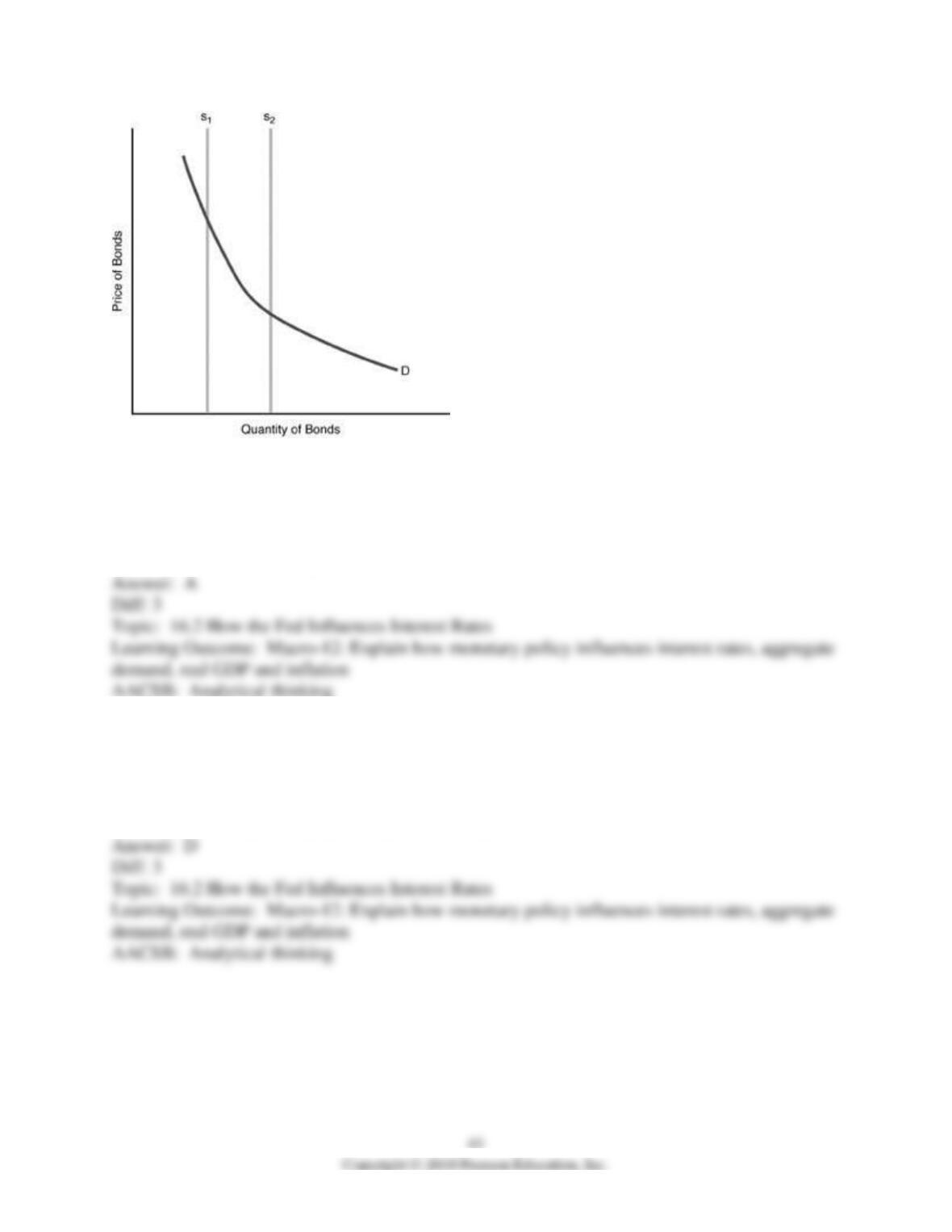
33) In the above figure, if we begin at S1 and the Fed sells bonds
A) the price of bonds falls, and the interest rate rises.
B) the price of bonds falls, and so does the interest rate.
C) the price of bonds rises, and so does the interest rate.
D) the price of bonds rises, and the interest rate falls.
34) In the above figure, if we begin at S2 and the Fed buys bonds
A) the price of bonds falls, and the interest rate rises.
B) the price of bonds falls, and so does the interest rate.
C) the price of bonds rises, and so does the interest rate.
D) the price of bonds rises, and the interest rate falls.
35) Suppose the Fed conducts an open market sale of bonds. This monetary policy action will
tend to cause
A) the price of bonds to increase and the interest rate to increase.
B) the price of bonds to increase and the interest rate to decrease.
C) the price of bonds to decrease and the interest rate to increase.
D) the price of bonds to decrease and the interest rate to decrease.
36) If the Fed sells U.S. government securities, the
A) money supply increases, and the money supply curve shifts to the right.
B) money supply increases, and the money supply curve shifts to the left.
C) money supply decreases, and the money supply curve shifts to the right.
D) money supply decreases, and the money supply curve shifts to the left.
37) Suppose the Fed conducts an open market purchase of bonds. This monetary policy action
will tend to cause
A) the price of bonds to increase, and the interest rate to increase.
B) the price of bonds to increase, and the interest rate to decrease.
C) the price of bonds to decrease, and the interest rate to increase.
D) the price of bonds to decrease, and the interest rate to decrease.
38) What happens to the price of bonds when the Fed is selling bonds? What happens to the
interest rate? What happens to the money supply?
39) Describe and explain the relationship between the price of bonds and the interest rate.
16.3 Effects of an Increase in the Money Supply
1) Other things being equal, an increase in the supply of money
A) reduces the amount of money balances.
B) increases the price level.
C) reduces aggregate demand.
D) generates significant changes in relative prices.
2) The direct effect of an increase in the money supply is to
A) raise interest rates as people increase their saving.
B) increase interest rates as people anticipate higher inflation in the future.
C) increase aggregate demand as people try to spend their excess money balances.
D) decrease aggregate demand as people anticipate future economic problems.
3) The short-run effect of an increase in the supply of money is
A) an increase in both real Gross Domestic Product (GDP) and the price level.
B) an increase in the price level but not in real Gross Domestic Product (GDP).
C) an increase in real Gross Domestic Product (GDP) but not in the price level.
D) an increase in the price level, a decrease in real Gross Domestic Product (GDP), but an
increase in nominal national income.
4) The indirect effect of an increase in the money supply is to
A) raise interest rates so people will save more.
B) lower interest rates, which stimulates both investment and consumption spending.
C) put more cash in people’s pockets, thereby increasing aggregate demand.
D) pay off a portion of the public debt.
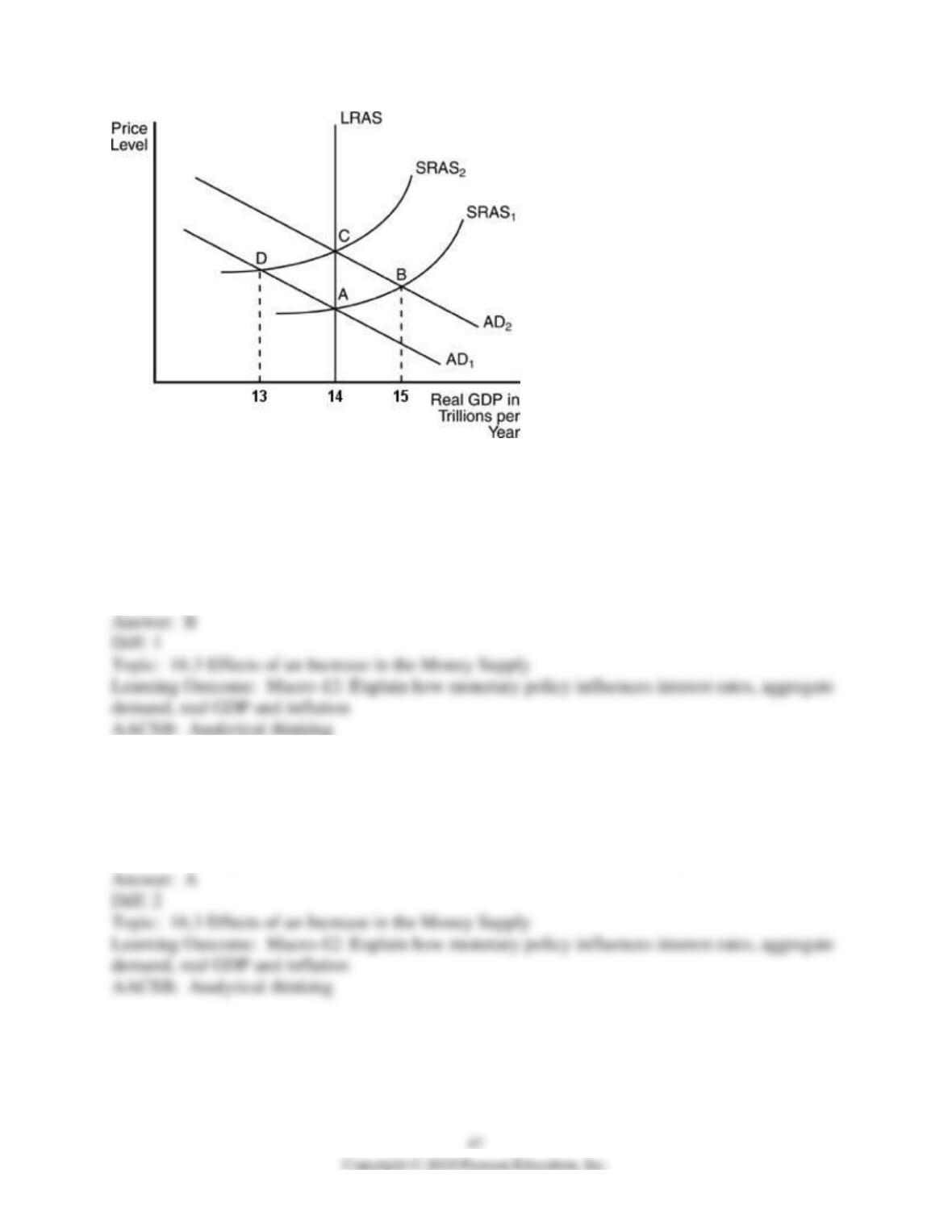
5) Look at the above figure. Suppose the economy was initially in equilibrium at point A. What
point would represent the short-run equilibrium if the Fed makes an open market purchase of
bonds?
A) A
B) B
C) C
D) D
6) In the long run, the effect of a reduction in the money supply is to
A) decrease the price level only.
B) decrease real Gross Domestic Product (GDP) only.
C) decrease both the price level and real Gross Domestic Product (GDP).
D) decrease the price level and increase real Gross Domestic Product (GDP).
7) To close a recessionary gap, the Fed would
A) decrease the money supply.
B) increase interest rates.
C) sell bonds.
D) increase the money supply.
8) Expansionary monetary policy during periods of underutilized resources can cause
A) real Gross Domestic Product (GDP) to increase without an increase in the price level.
B) real Gross Domestic Product (GDP) to increase with a decrease in the price level.
C) real Gross Domestic Product (GDP) to increase with an increase in the price level.
D) nominal Gross Domestic Product (GDP) to increase but cannot affect real Gross Domestic
Product (GDP).
9) If the economy is underutilizing its economic resources, the Fed should
A) discourage investment spending.
B) expand the money supply to increase aggregate demand.
C) decrease aggregate supply.
D) contract the money supply to decrease aggregate demand.
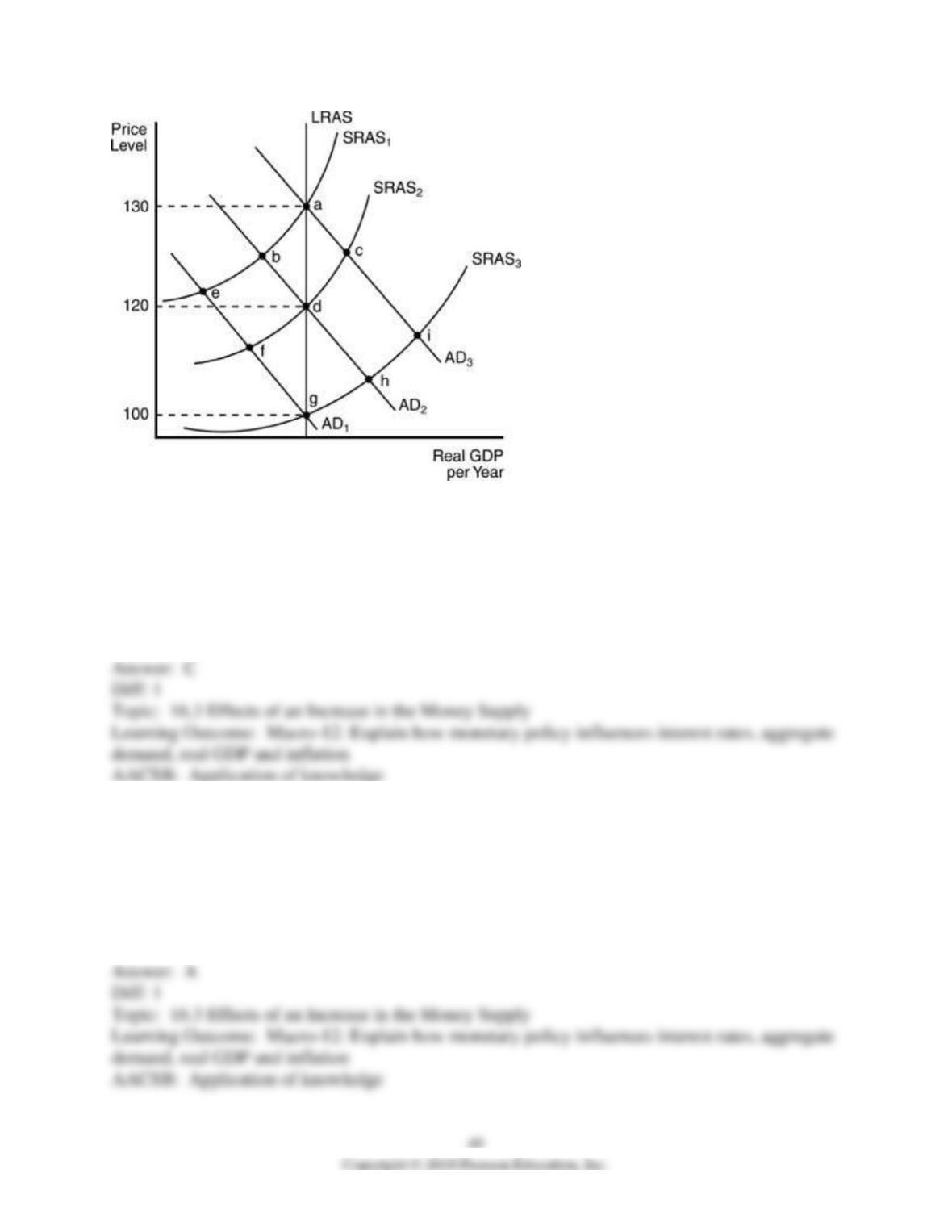
10) In the above figure, assume the economy starts out in equilibrium at point d. If the Fed
increases the money supply so that the new aggregate demand curve is AD3, then the new short-
run equilibrium will be at point
A) a.
B) b.
C) c.
D) i.
11) In the above figure, assume the economy starts out in equilibrium at point d. If the Fed
increases the money supply so that the new aggregate demand curve is AD3, then the long-run
equilibrium will be at point
A) a.
B) b.
C) c.
D) i.
12) In the above figure, assume the aggregate demand of the economy is AD2 and the Fed
actions move aggregate demand to AD1. In this situation, the Fed has practiced
A) contractionary monetary policy.
B) expansionary monetary policy.
C) irresponsible fiscal policy.
D) Keynesian fiscal policy.
13) In the above figure, assume the economy is in equilibrium at point d. Then the Fed decreases
the money supply so that the new aggregate demand curve is AD1. In the long run, the new price
level will be
A) 100.
B) 120.
C) 130.
D) 110.
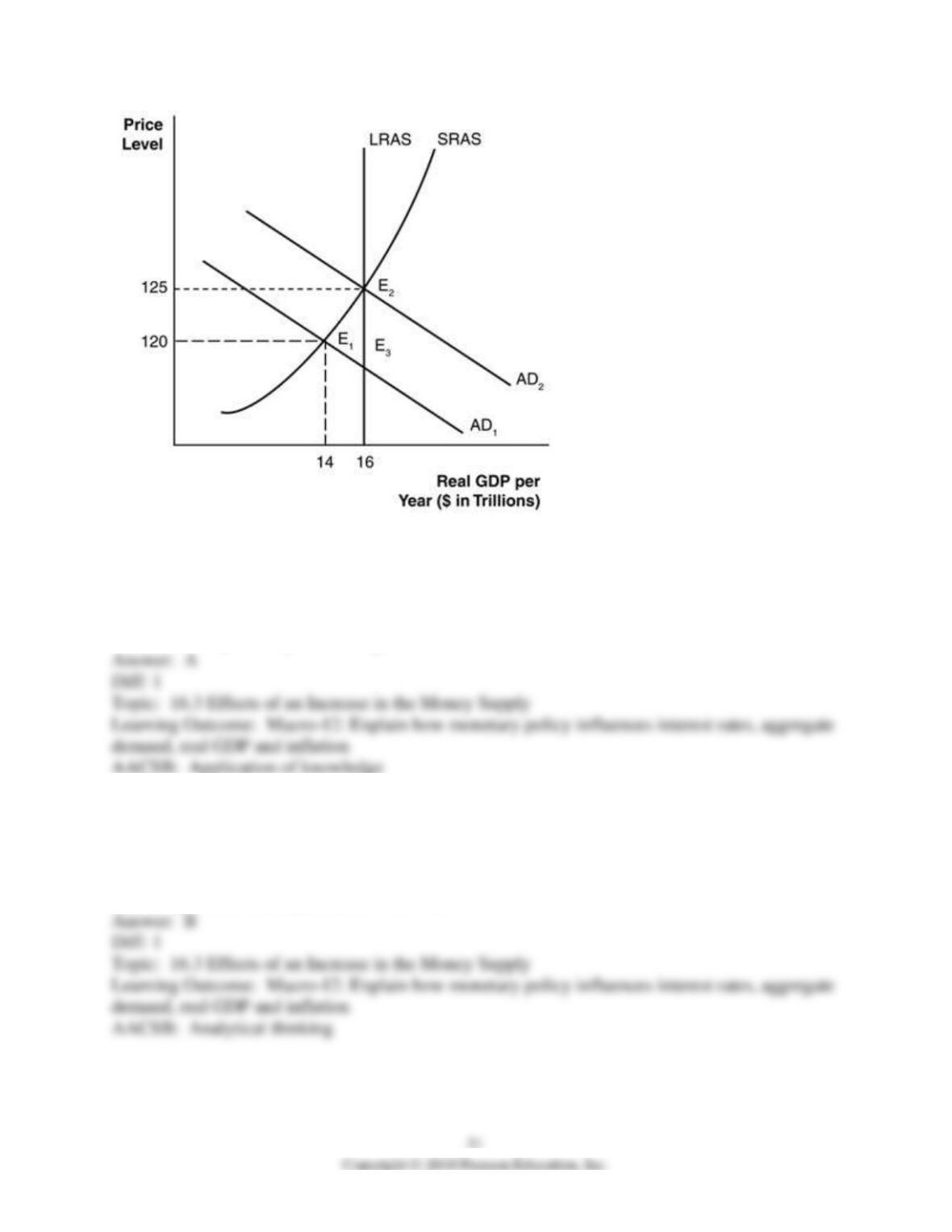
14) In the above figure, if the economy is in equilibrium at E1, then
A) the economy is producing below its potential long-run equilibrium at full employment.
B) the economy is producing above its potential long-run equilibrium at full employment.
C) there is an inflationary gap in the economy.
D) the economy is in a period of high inflation.
15) In the above figure, if the economy is at equilibrium at E1, the Fed would most likely
A) adopt a contractionary monetary policy.
B) adopt an expansionary monetary policy.
C) attempt to lower the aggregate demand in the economy.
D) attempt to lower the price level below 120.
16) In the long run, an increase in the money supply will
A) decrease real Gross Domestic Product (GDP).
B) increase real Gross Domestic Product (GDP).
C) increase the price level.
D) decrease the price level.
17) One result of a contractionary monetary policy would be
A) a decline in the price level.
B) an increase in the money supply.
C) an increase in business investment.
D) lower interest rates.
18) The “direct effect” of an increase in the money supply is to
A) increase aggregate demand as people spend their excess money balances.
B) increase aggregate demand as interest rates fall and investment spending increases.
C) increase aggregate supply as producers anticipate higher future profits.
D) decrease the rate of inflation.
19) The “indirect effect” of an increase in the money supply is to
A) increase aggregate demand as people try to spend their excess money balances.
B) increase aggregate demand as interest rates fall and investment spending increases.
C) increase aggregate supply as firms anticipate future profits.
D) decrease the price level.
53
20) Which of the following will NOT occur in the short run when the money supply decreases?
A) People will buy fewer goods and services.
B) The interest rate will increase.
C) Aggregate supply decreases.
D) The price level decreases.
21) An increase in the money supply will
A) increase aggregate supply.
B) decrease aggregate supply.
C) increase aggregate demand.
D) decrease aggregate demand.
22) The short-run effect of an increase in the money supply is to
A) increase real GDP only.
B) increase the price level only.
C) increase both real GDP and the price level.
D) increase nominal GDP but decrease the price level.
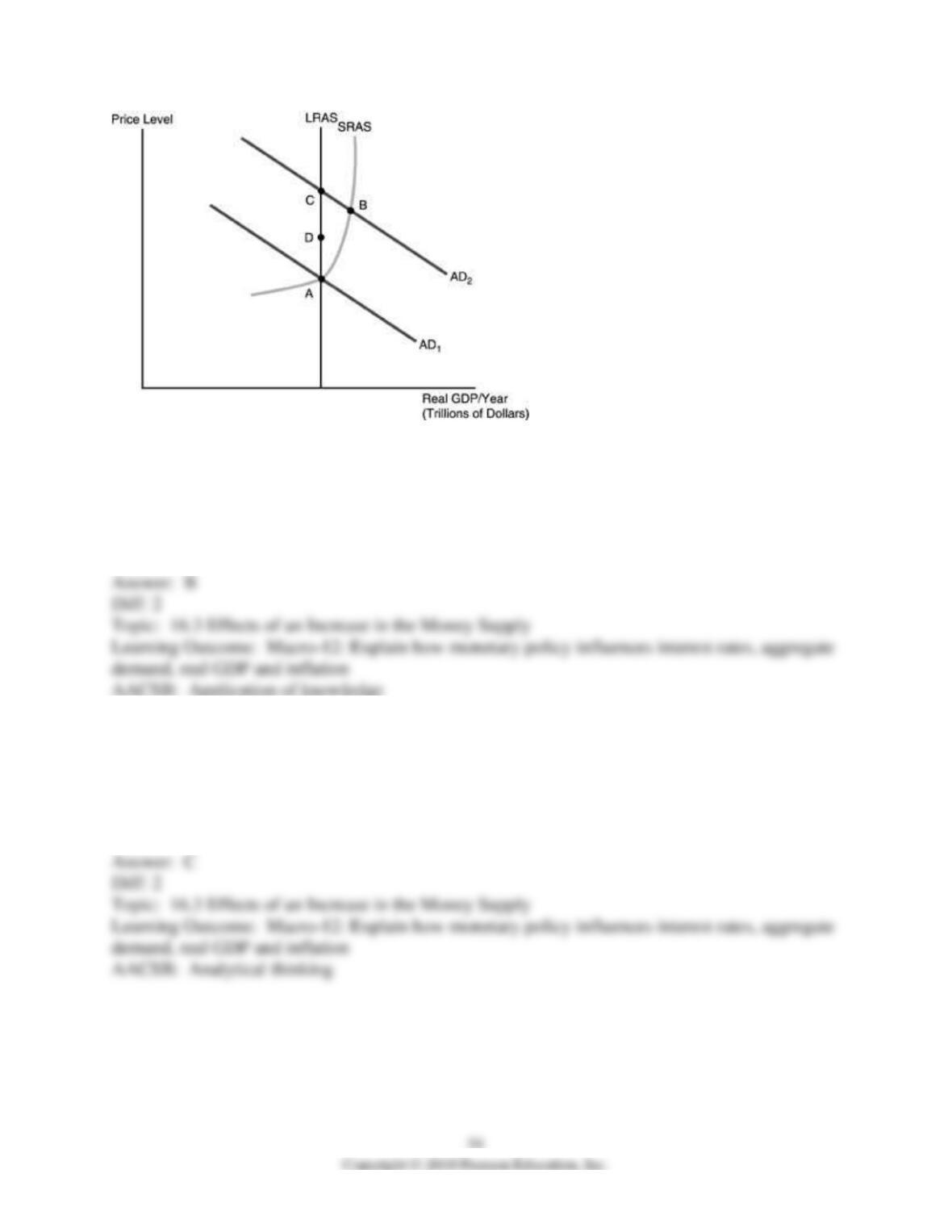
23) Refer to the above figure. Suppose point A is the original equilibrium. If there is an increase
in the money supply, the new short-run equilibrium is given by point
A) A.
B) B.
C) C.
D) D.
24) Refer to the above figure. Suppose point A is the original equilibrium. If there is an increase
in the money supply, the new long-run equilibrium is given by point
A) A.
B) B.
C) C.
D) D.
25) The long-run effect of an increase in the money supply when starting from full employment
is to
A) increase real GDP only.
B) increase the price level only.
C) increase both real GDP and the price level.
D) increase real GDP as the price level increases too.
26) An expansionary monetary policy is one that
A) stimulates aggregate supply.
B) reduces aggregate supply and aggregate demand.
C) stimulates aggregate demand.
D) reduces aggregate demand while stimulating aggregate supply.
27) Suppose the economy currently has some underutilized resources. The Fed engages in
expansionary monetary policy. The impact of expansionary monetary policy will be to
A) increase aggregate demand, increase prices and increase real GDP.
B) increase aggregate demand, increase prices and decrease real GDP.
C) increase short-run aggregate supply, decrease in prices and decrease in real GDP.
D) increase short-run aggregate supply, decrease prices and increase real GDP.
28) Suppose the economy currently has an inflationary gap. The Fed engages in contractionary
monetary policy. The impact of contractionary monetary policy will be to
A) increase short-run aggregate supply, decrease in prices and decrease in real GDP.
B) increase short-run aggregate supply, decrease prices and increase real GDP.
C) decrease aggregate demand, decrease prices, and increase real GDP.
D) decrease aggregate demand, decrease prices, and decrease real GDP.
29) When the Federal Reserve conducts open market purchases to increase bank reserves without
trying to alter the interest rate that is already close to zero, the policy action is called
A) qualitative easing.
B) quantitative easing.
C) qualitative tightening.
D) quantitative tightening.
30) If the economy is operating below its full employment level, the Fed can
A) increase aggregate demand by increasing the rate of growth of the money supply.
B) increase aggregate demand by stimulating the demand for money.
C) increase aggregate demand by selling bonds and raising interest rates.
D) increase aggregate supply by raising the price level.
31) Suppose the economy has a recessionary gap. By using an expansionary monetary policy, the
Fed can
A) raise real GDP without increasing the price level.
B) raise real GDP and the price level.
C) raise real GDP and decrease the price level.
D) raise the price level alone, but cannot increase real GDP.
32) Suppose the economy is operating below its full employment level. The Fed
A) is powerless to affect either aggregate demand or aggregate supply. Fiscal policy is needed.
B) can move the economy toward the full employment level by expanding the money supply to
increase aggregate supply.
C) can move the economy toward the full employment level by expanding the money supply to
increase aggregate demand and to hold prices constant.
D) can move the economy toward the full employment level by expanding the money supply to
increase aggregate demand through both its direct and its indirect effects.
33) Quantitative easing refers to a policy action in which a central bank
A) sells government securities to directly decrease bank reserves.
B) buys government securities to directly increase bank reserves.
C) increases interest rates directly without altering bank reserves.
D) decreases interest rates directly without altering bank reserves.
34) The Federal Reserve conducted the policy of quantitative easing primarily when
A) the interest rate was close to zero.
B) the interest rate was relatively high.
C) the interest rate was too erratic to be controlled.
D) the interest rate was very sensitive to the change in the money supply.
35) During a period of contractionary monetary policy
A) the price level is increased, which leads to an increase in the money supply.
B) the price level is decreased, which leads to a decrease in the money supply.
C) the rate of growth of the money supply is increased, leading to an increase in the price level.
D) the rate of growth of the money supply is reduced, leading to a decrease in the price level.
36) During a period of expansionary monetary policy
A) the price level is increased, which leads to an increase in the money supply.
B) the price level is decreased, which leads to a decrease in the money supply.
C) the rate of growth of the money supply is increased, leading to an increase in the price level.
D) the rate of growth of the money supply is reduced, leading to a decrease in the price level.
37) As a result of an increase in the money supply, some banks may end up with excess reserves.
What is the likely result?
A) Banks will make more loans, thereby contributing to an increase in aggregate demand.
B) Banks will make more loans, thereby contributing to a decrease in aggregate demand.
C) Banks will raise interest rates.
D) Banks will spend the excess reserves by paying their employees more.
38) How is the effect of expansionary monetary policy depicted in an aggregate supply-
aggregate demand graph?
A) The aggregate supply curve shifts leftward.
B) The aggregate supply curve shifts rightward.
C) The aggregate demand curve shifts rightward.
D) The equilibrium level of income increases, but neither curve shifts.
39) In the real world, contractionary monetary policy would be used to
A) combat a recession.
B) reduce the rate of inflation.
C) increase nominal GDP.
D) increase long-run aggregate supply.
40) How would expansionary monetary policy affect the AD curve?
A) It would shift to the right.
B) It would shift to the left.
C) It would become more static.
D) It would fall.
41) The appropriate monetary policy in the event of a recessionary gap would be to
A) increase the difference between the discount rate and the federal funds rate.
B) engage in an open market purchase of U.S. government securities.
C) increase the difference between the federal funds rate and the required reserve ratio.
D) raise the required reserve ratio.
42) The direct effect of an increase in the money supply is
A) people will spend the extra money, causing the aggregate demand curve to shift to the right
and prices to rise, and causing the economy to go into recession.
B) people will save the money, causing an increase in bank deposits, causing interest rates to fall,
and loans to expand.
C) people will save more money, causing a decrease in economic activity and a fall in prices.
D) people will spend the extra money, causing the aggregate demand curve to shift to the right,
creating an increase in economic activity.