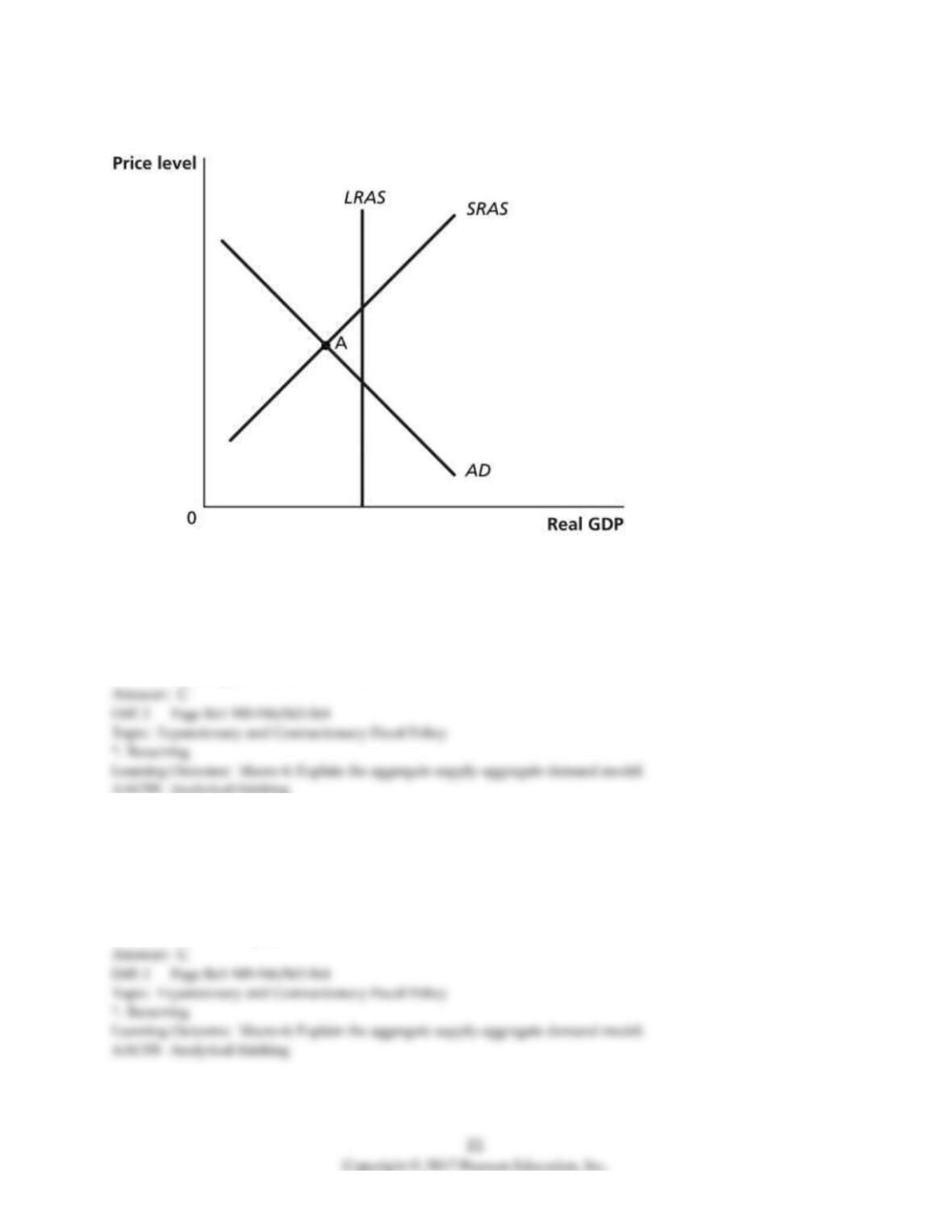
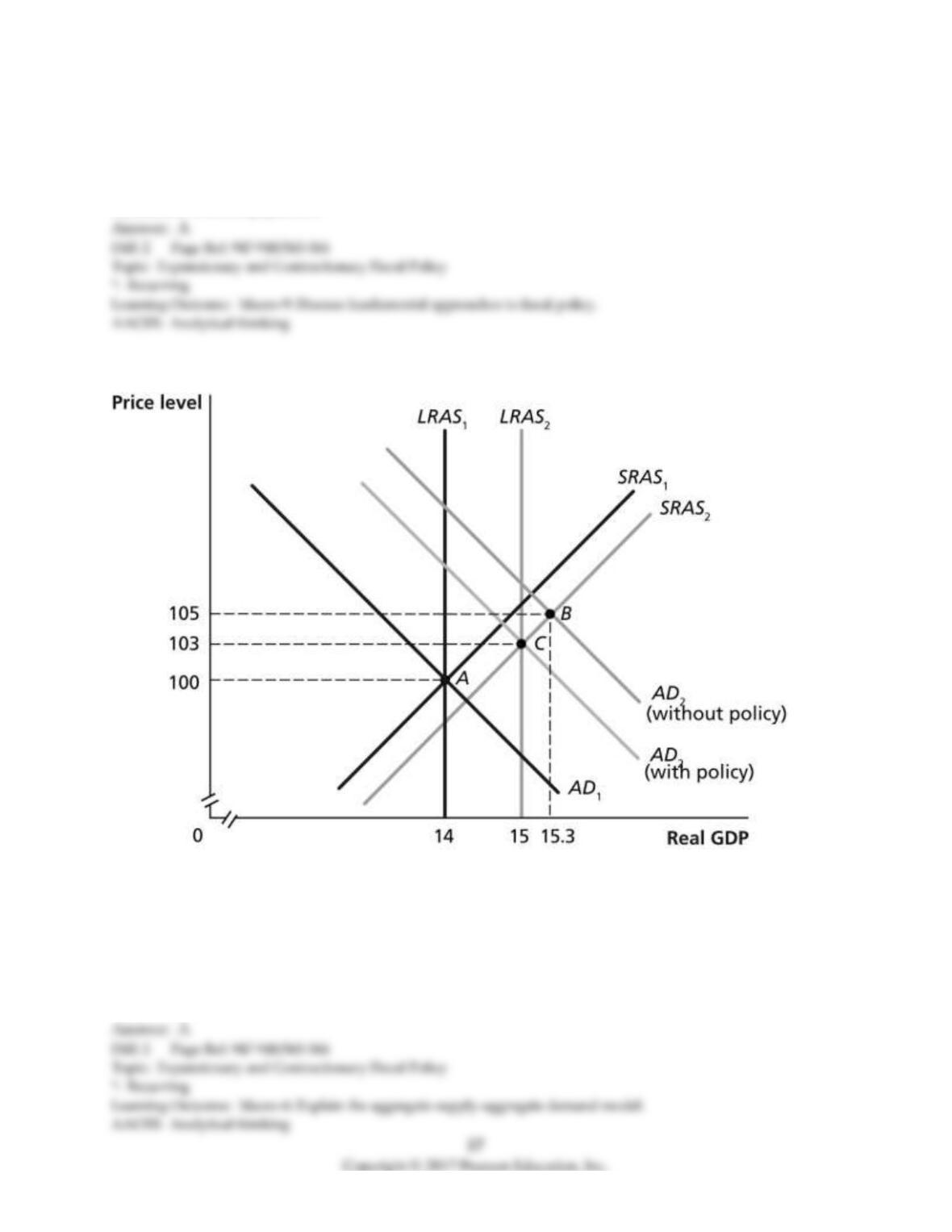
Figure 16-2
26) Refer to Figure 16-2. In the graph above, if the economy is at point A, an appropriate fiscal policy by
Congress and the president would be to
A) lower the discount rate of interest.
B) execute an open market sale of government securities.
C) increase government transfer payments.
D) increase marginal income tax rates.
27) Refer to Figure 16-2. In the graph above, if the economy is at point A, an appropriate fiscal policy by
Congress and the president would be to
A) decrease the required reserve ratio.
B) sell government securities.
C) increase government expenditures.
D) decrease transfer payments.
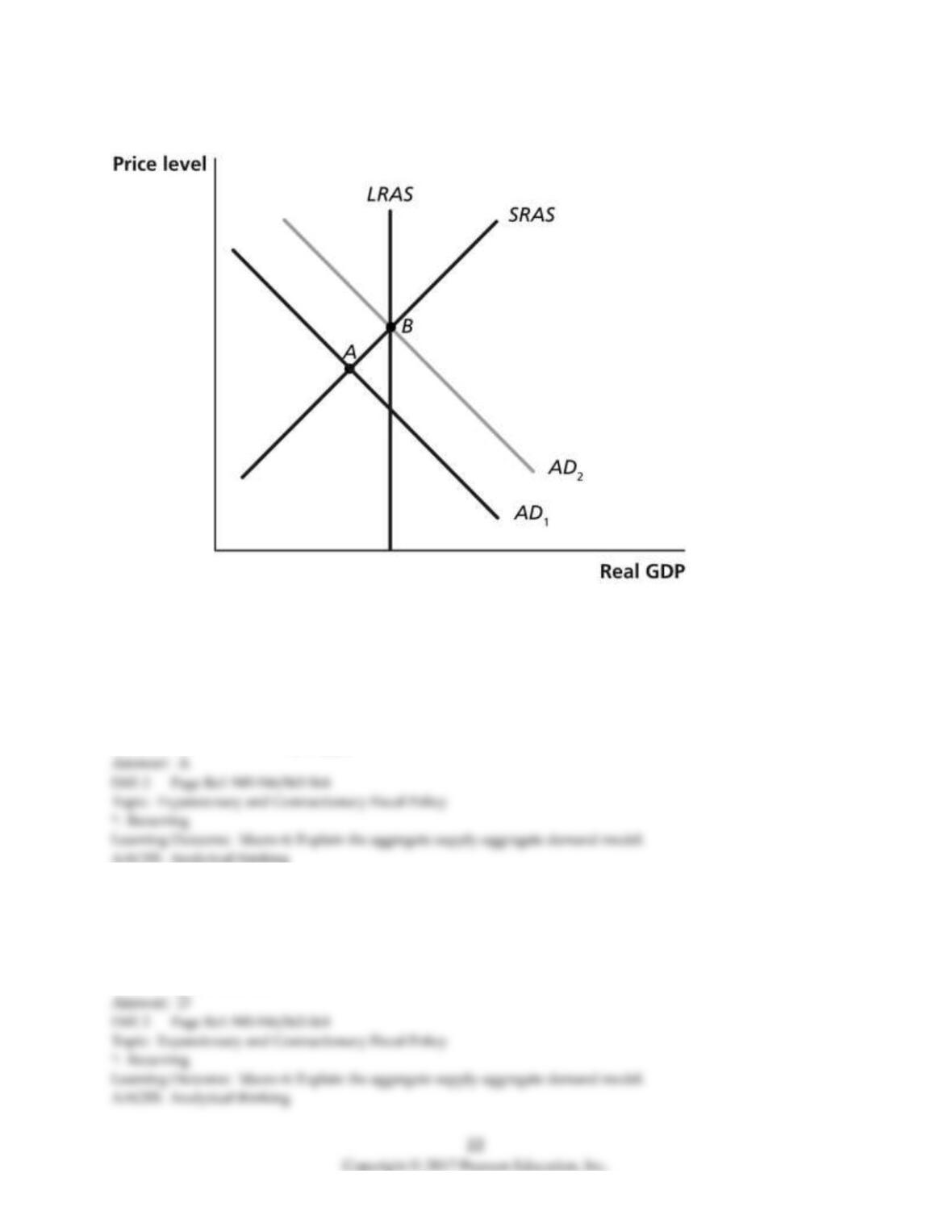
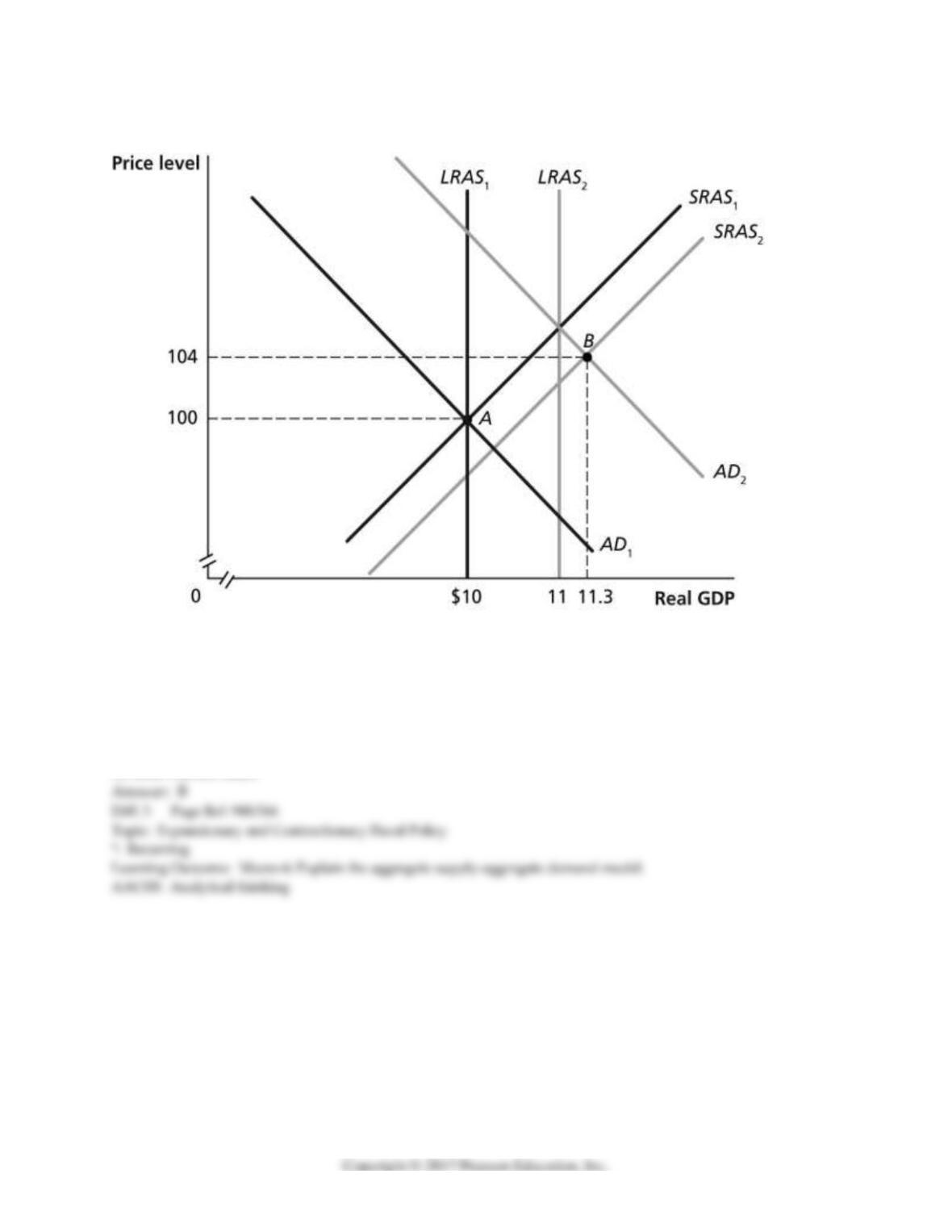
Figure 16-3
28) Refer to Figure 16-3. In the graph above, suppose the economy is initially at point A. The movement
of the economy to point B as shown in the graph illustrates the effect of which of the following policy
actions by Congress and the president?
A) a decrease in income taxes
B) a decrease in interest rates
C) a decrease in government purchases
D) an increase in the money supply
29) Decreasing government spending ________ the price level and ________ equilibrium real GDP.
A) decreases; increases
B) increases; decreases
C) increases; increases
D) decreases; decreases
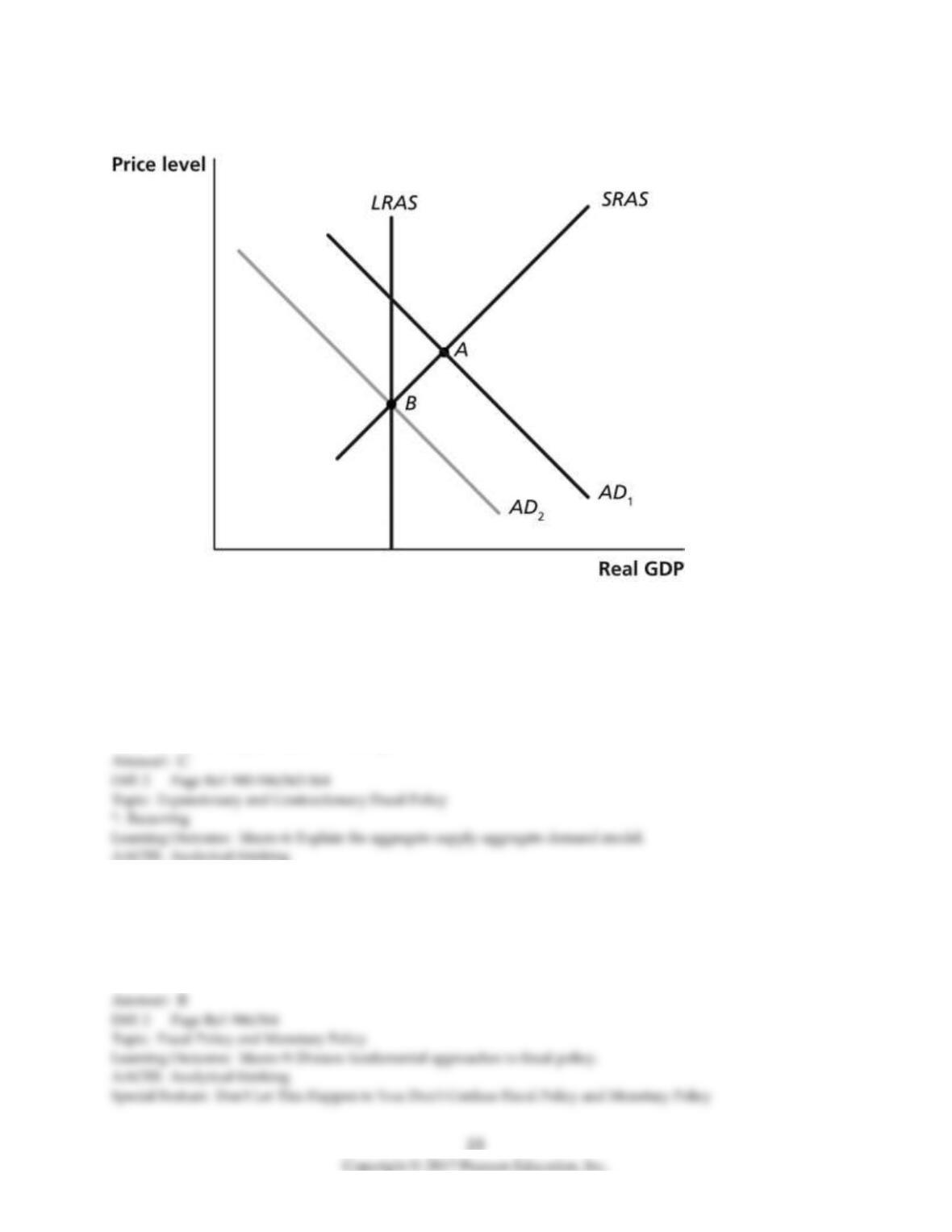
Figure 16-4
30) Refer to Figure 16-4. In the graph above, suppose the economy is initially at point A. The movement
of the economy to point B as shown in the graph illustrates the effect of which of the following policy
actions by Congress and the president?
A) an increase in transfer payments
B) an increase in interest rates
C) an increase in the marginal income tax rate
D) an open market purchase of Treasury bills
31) The problem causing most recessions is too little
A) money (currency plus checking accounts).
B) spending.
C) unemployment.
D) taxes.
32) Expansionary fiscal policy involves increasing government purchases or increasing taxes.
33) Contractionary fiscal policy is used to decrease aggregate demand in an attempt to fight rising
inflation.
34) Lowering the individual income tax rate will increase household disposable income and
consumption spending.
35) Contractionary fiscal policy involves decreasing government purchases or increasing taxes.
36) Expansionary fiscal policy is used to increase aggregate demand in an attempt to fight rising
inflation.
37) An increase in government spending increases the supply of money in our economy.
38) What is expansionary fiscal policy? What is contractionary fiscal policy?
39) Does expansionary fiscal policy directly increase the money supply? Isn’t it true that the president
and Congress fight recessions by spending more money?
40) The problem typically during a recession is not that there is too little money, but too little spending.
If the problem was too little money, what would be its cause? If the problem was too little spending,
what could be its cause?
41) How does expansionary monetary policy increase spending in the economy compared to how
expansionary fiscal policy increases spending in the economy?
42) Consider the following statement, “The Federal Reserve fights recessions by increasing the money
supply so people will have more money to spend.” What is wrong with the statement and how can it be
corrected?
43) Identify each of the following as (i) part of an expansionary fiscal policy, (ii) part of a contractionary
fiscal policy, or (iii) not part of fiscal policy.
a. The personal income tax rate is lowered.
b. Congress cuts spending on defense.
c. College students are allowed to deduct tuition costs from their federal income taxes.
d. The corporate income tax rate is lowered.
e. The state of Nevada builds a new tollway in an attempt to expand employment and ease traffic in Las
Vegas.
16.3 Fiscal Policy in the Dynamic Aggregate Demand and Aggregate Supply Model
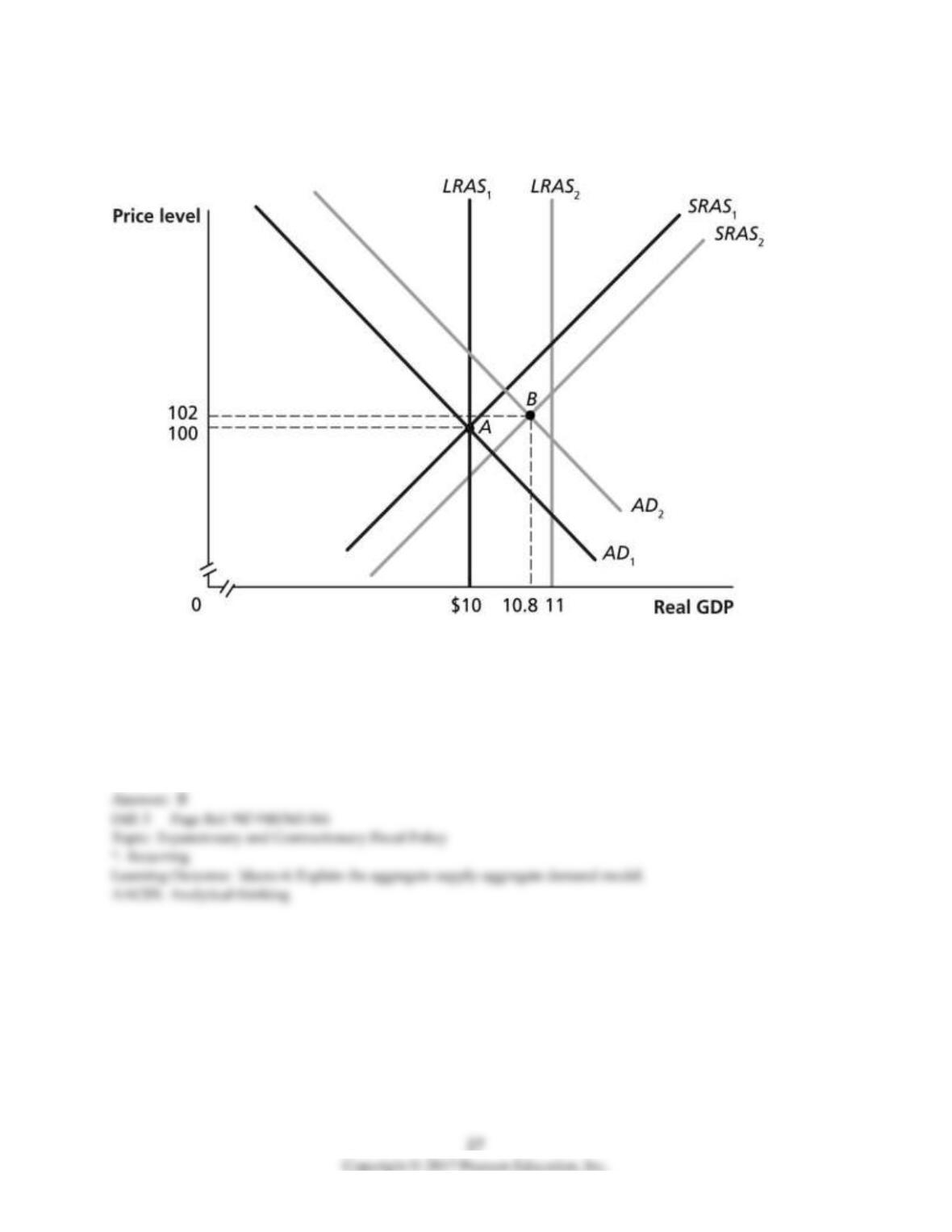
Figure 16-5
1) Refer to Figure 16-5. In the dynamic model of AD–AS in the figure above, if the economy is at point A
in year 1 and is expected to go to point B in year 2, Congress and the president would most likely
A) decrease government spending.
B) increase government spending.
C) increase oil prices.
D) increase taxes.
E) lower interest rates.
2) Refer to Figure 16-5. In the dynamic model of AD–AS in the figure above, if the economy is at point A
in year 1 and is expected to go to point B in year 2, and no fiscal or monetary policy is pursued, then at
point B
A) the unemployment rate is very low.
B) firms are operating below capacity.
C) the economy is above full employment.
D) income and profits are rising.
E) there is pressure on wages and prices to rise.
3) Refer to Figure 16-5. In the dynamic model of AD–AS in the figure above, if the economy is at point A
in year 1 and is expected to go to point B in year 2, Congress and the president would most likely
pursue
A) expansionary fiscal policy.
B) contractionary fiscal policy.
C) expansionary monetary policy.
D) contractionary monetary policy.
E) contractionary automatic stabilizers.
4) From an initial long-run equilibrium, if aggregate demand grows more slowly than long-run and
short-run aggregate supply, then Congress and the president would most likely
A) increase the required reserve ratio and decrease government spending.
B) decrease government spending.
C) decrease oil prices.
D) decrease taxes.
E) lower interest rates.
5) Which of the following would be most likely to induce Congress and the president to conduct
expansionary fiscal policy? A significant
A) decrease in investment spending.
B) decrease in oil prices.
C) increase in consumption spending.
D) increase in net exports.
6) If real GDP exceeded potential real GDP and inflation was increasing, which of the following would
be an appropriate fiscal policy?
A) a decrease in the money supply and an increase in the interest rate
B) an increase in government spending
C) an increase in taxes
D) an increase in oil prices
7) From an initial long-run equilibrium, if aggregate demand grows faster than long-run and short-run
aggregate supply, then Congress and the president would most likely
A) decrease the required reserve ratio.
B) decrease government spending.
C) decrease oil prices.
D) decrease tax rates.
30
8) Contractionary fiscal policy to prevent real GDP from rising above potential real GDP would cause
the inflation rate to be ________ and real GDP to be ________.
A) higher; higher
B) higher; lower
C) lower; higher
D) lower; lower
31
Figure 16-6
9) Refer to Figure 16-6. In the dynamic model of AD–AS in the figure above, if the economy is at point A
in year 1 and is expected to go to point B in year 2, Congress and the president would most likely
A) increase the money supply and decrease the interest rate.
B) increase taxes.
C) increase government spending.
D) increase oil prices.
E) raise interest rates.
10) Refer to Figure 16-6. In the dynamic model of AD–AS in the figure above, if the economy is at point
A in year 1 and is expected to go to point B in year 2, and no fiscal or monetary policy is pursued, then
at point B
A) the unemployment rate is very low.
B) firms are operating at below capacity.
C) the economy is below full employment.
D) income and profits are falling.
E) there is pressure on wages and prices to fall.
11) Refer to Figure 16-6. In the dynamic model of AD–AS in the figure above, if the economy is at point
A in year 1 and is expected to go to point B in year 2, Congress and the president would most likely
pursue
A) expansionary fiscal policy.
B) contractionary fiscal policy.
C) expansionary monetary policy.
D) contractionary monetary policy.
E) expansionary automatic stabilizers.
12) Which of the following would be most likely to induce Congress and the president to conduct
contractionary fiscal policy? A significant
A) decrease in oil prices.
B) decrease in real GDP.
C) increase in inflation.
D) increase in labor productivity.
13) If the economy is slipping into a recession, which of the following would be an appropriate fiscal
policy?
A) an increase in the money supply and a decrease in interest rates
B) a decrease in government purchases
C) a decrease in taxes
D) a decrease in oil prices
Figure 16-7
14) Refer to Figure 16-7. Given that the economy has moved from A to B in the graph above, which of
the following would be the appropriate fiscal policy to achieve potential GDP?
A) increase taxes
B) increase government spending
C) contractionary fiscal policy
D) decrease interest rates
15) Expansionary fiscal policy ________ the price level and ________ equilibrium real GDP.
A) decreases; increases
B) increases; decreases
C) increases; increases
D) decreases; decreases
16) If policymakers are concerned that the economy is in danger of rising inflation because aggregate
demand is increasing faster than aggregate supply, the appropriate fiscal policy response is to
A) increase taxes.
B) increase government spending.
C) use expansionary fiscal policy.
D) increase interest rates.
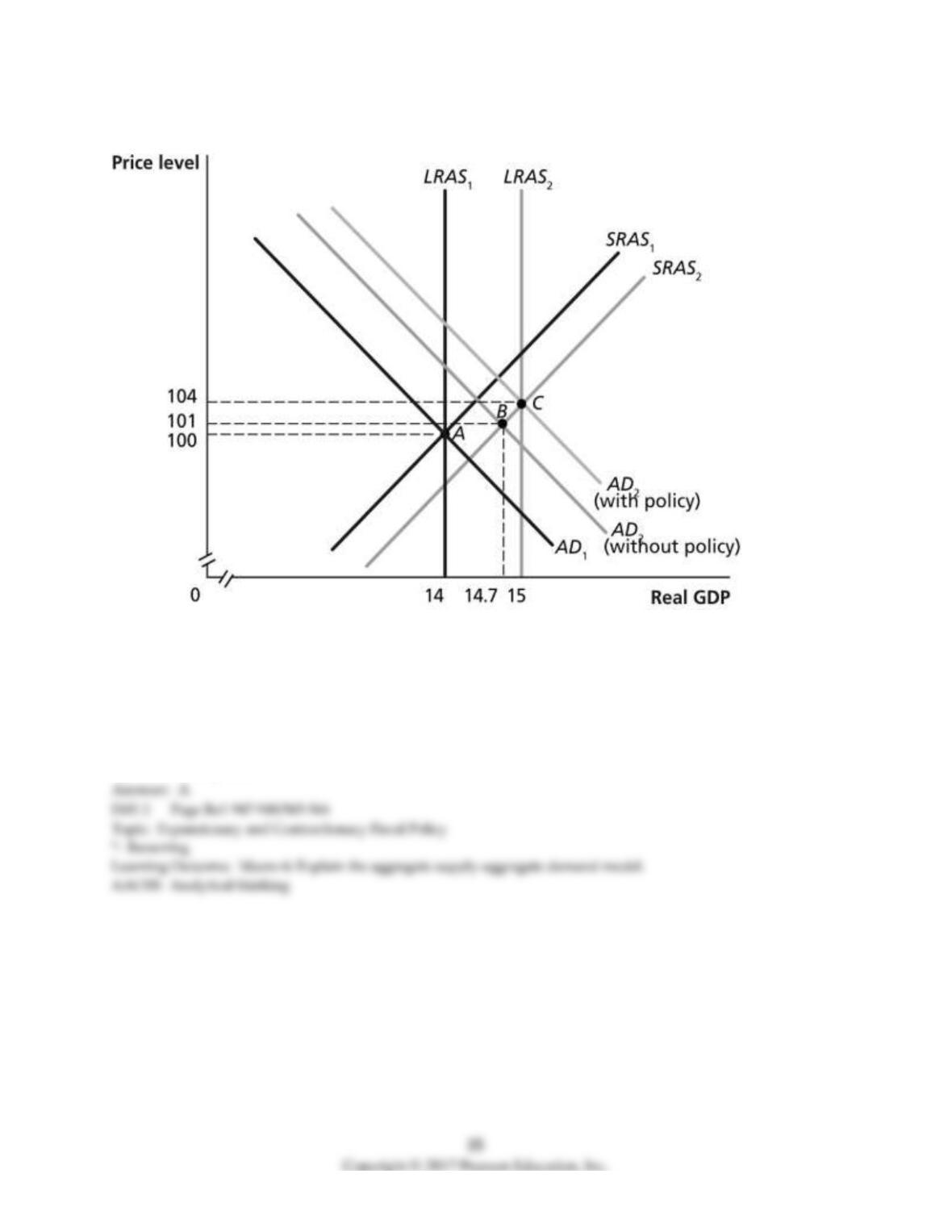
Figure 16-8
17) Refer to Figure 16-8. In the graph above, suppose the economy in Year 1 is at point A and is expected
in Year 2 to be at point B. Which of the following policies could Congress and the president use to move
the economy to point C?
A) increase government purchases
B) decrease government purchases
C) increase income taxes
D) sell Treasury bills
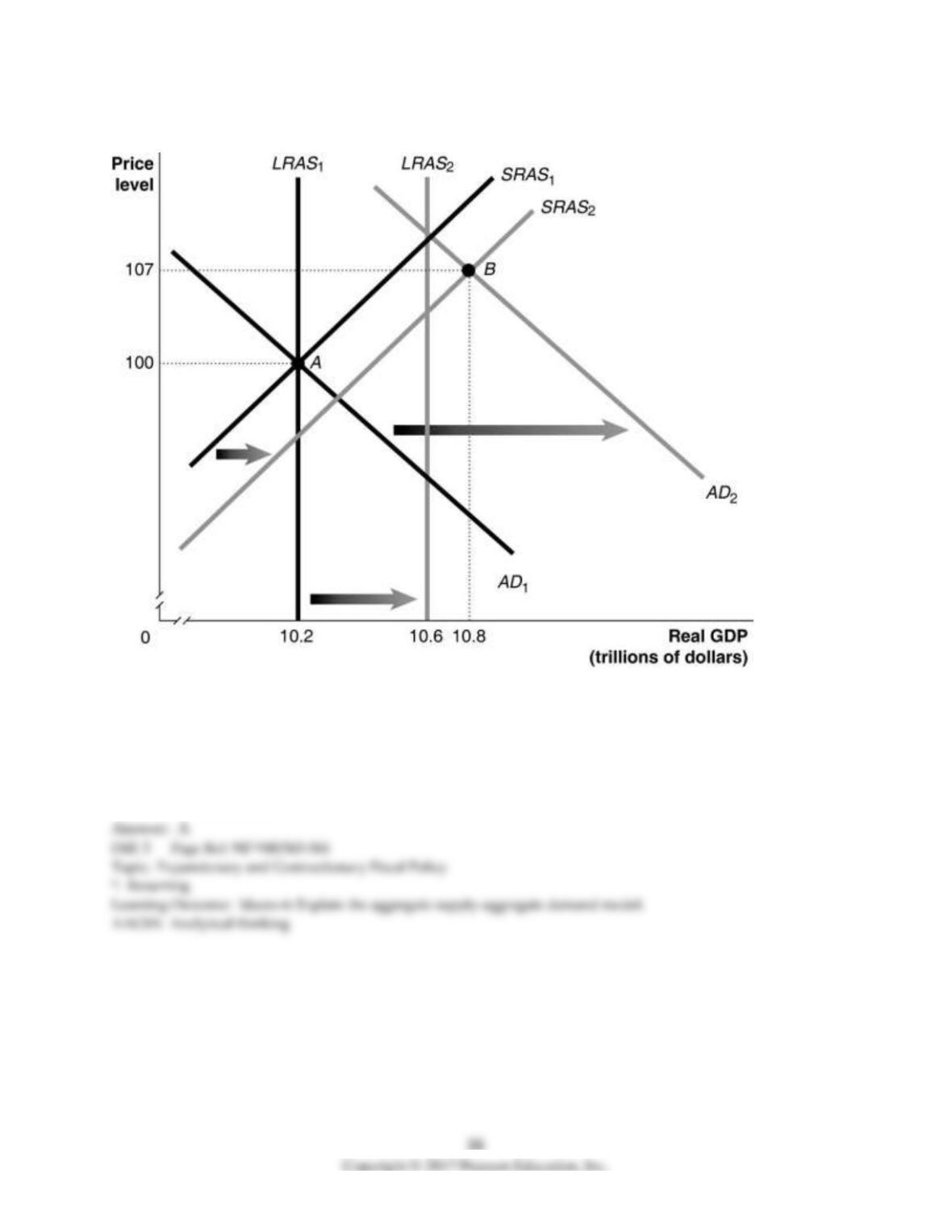
Figure 16-9
18) Refer to Figure 16-9. Given that the economy has moved from point A to point B in the graph above,
which of the following would be the appropriate fiscal policy to achieve potential GDP?
A) increase taxes
B) increase government spending
C) decrease the money supply
D) increase interest rates
19) To combat inflation, Congress and the president should
A) decrease government spending.
B) decrease taxes.
C) raise interest rates.
D) increase transfer payments.
Figure 16–10
20) Refer to Figure 16-10. In the graph above, suppose the economy in Year 1 is at point A and is
expected in Year 2 to be at point B. Which of the following policies could Congress and the president
use to move the economy to point C?
A) increase income taxes
B) increase government spending
C) buy Treasury bills
D) decrease the discount rate
Table 16-1
Year
Potential Real GDP
Real GDP
Price Level
2016
$18.0 trillion
$18.0 trillion
150
2017
18.5 trillion
18.2 trillion
152
21) Refer to Table 16-1. Consider the hypothetical information in the table above for potential real GDP,
real GDP, and the price level in 2016 and in 2017 if Congress and the president do not use fiscal policy.
If Congress and the president want to keep real GDP at its potential level in 2017, they should
A) decrease income taxes.
B) decrease government purchases.
C) decrease the money supply.
D) increase the level of interest rates.
Table 16-2
Year
Potential Real GDP
Real GDP
Price Level
2016
$18.0 trillion
$18.0 trillion
150
2017
18.5 trillion
18.8 trillion
154
22) Refer to Table 16-2. Consider the hypothetical information in the table above for potential real GDP,
real GDP, and the price level in 2016 and in 2017 if Congress and the president do not use fiscal policy.
If Congress and the president want to keep real GDP at its potential level in 2017, they should
A) buy Treasury securities.
B) conduct expansionary fiscal policy.
C) decrease government purchases.
D) decrease the discount rate.
Table 16-3
Year
Potential Real GDP
Real GDP
Price Level
2016
$18.0 trillion
$18.0 trillion
150
2017
18.5 trillion
18.2 trillion
152
23) Refer to Table 16-3. Consider the hypothetical information in the table above for potential real GDP,
real GDP, and the price level in 2016 and in 2017 if Congress and the president do not use fiscal policy.
If Congress and the president use fiscal policy successfully to keep real GDP at its potential level in
2017, which of the following will be higher than if Congress and the president had taken no action?
A) real GDP and the unemployment rate
B) real GDP and the inflation rate
C) real GDP and potential GDP
D) potential GDP and the inflation rate
Table 16-4
Year
Potential Real GDP
Real GDP
Price Level
2016
$18.0 trillion
$18.0 trillion
150
2017
18.5 trillion
18.8 trillion
154
24) Refer to Table 16-4. Consider the hypothetical information in the table above for potential real GDP,
real GDP, and the price level in 2016 and in 2017 if Congress and the president do not use fiscal policy.
If Congress and the president use fiscal policy successfully to keep real GDP at its potential level in
2017, which of the following will be lower than if Congress and the president had taken no action?
A) real GDP and the unemployment rate
B) real GDP and the inflation rate
C) real GDP and potential GDP
D) potential GDP and the inflation rate
25) An appropriate fiscal policy response when aggregate demand is growing at a slower rate than
aggregate supply is to cut taxes.
26) If real equilibrium GDP is above potential GDP, expansionary fiscal policy should be pursued.
27) An appropriate fiscal policy response when aggregate demand is growing at a faster rate than
aggregate supply is to decrease the money supply.
28) To complement actions by the Fed to reduce inflation, Congress and the President can cut spending
and/or raise taxes.
29) What are the key differences between how we illustrate an expansionary fiscal policy in the basic
aggregate demand and aggregate supply model and in the dynamic aggregate demand and aggregate
supply model?