37. Certainty Equivalent Method. Saddie Hawkins, a management analyst with Mobile Telephone Services,
Inc., has collected the following information about three investment projects undertaken by the firm during the
past six month period. Hawkins wishes to use this information as a backdrop against which to evaluate the
attractiveness of a recent investment proposal put forth by the quality control department. In that proposal,
dubbed Project X, the quality control department proposes to spend $100,000 to modify transmission equipment
at the Colorado Springs, Colorado facility. Annual expected cost savings of $25,000 per year over the 10-year
2005-2014 period have been projected, and verified as reasonable by Hawkins.
Expected Cash Flows Per Year
Year
Project X
Project Y
Project Z
2008
$ 25,000
$ 50,000
$ 7,500
2009
25,000
45,000
12,500
2010
25,000
40,000
17,500
2011
25,000
35,000
22,500
2012
25,000
30,000
27,500
2013
25,000
25,000
32,500
2014
25,000
20,000
37,500
2015
25,000
15,000
42,500
2016
25,000
10,000
47,500
2017
25,000
5,000
52,500
PV of Cash Flow @ 8%
?
$205,620
$180,210
2007 Investment:
$100,000
$100,000
$100,000
A.
Calculate the present value of anticipated cost savings using an 8% discount rate as a reasonable estimate of the risk-free cost of capital.
B.
In light of the $100,000 investment required for each of these projects, and the discounted present value of future benefits, calculate the
certainty equivalent adjustment factor a implicit in the decision to fund each of these investment projects.
C.
Assume that the a’s implicit in the decisions to fund projects Y and Z represent the upper limits for investment projects of this type.
Would a decision to fund project X be consistent or inconsistent with the firm’s decision to fund projects Y and Z?
PV of Benefits
= $25,000 ´ PVIFA (i = 0.08, n = 10),
= $167,752.50.
38. Probability Analysis. Tex-Mex, Inc. is a rapidly growing chain of Mexican-food restaurants. The company
has a limited amount of capital for expansion, and must carefully weigh available alternatives. Currently, the
company is considering opening restaurants in Phoenix and/or Tucson, Arizona. Projections for the two
potential outlets are:
City
Outcome
Annual Profit Contribution
Probability
Phoenix
Failure
$200,000
0.5
Success
$300,000
0.5
Tucson
Failure
$100,000
0.5
Success
$500,000
0.5
Each restaurant would involve a capital expenditure of $1.5 million, plus land acquisition costs of $500,000 for Phoenix and $1,050,000 for Tucson.
The company uses the 10% yield on riskless U.S. Treasury bills to calculate the risk-free annual opportunity cost of investment capital.
A.
Calculate the expected value, standard deviation, and coefficient of variation for each outlet’s profit contribution.
B.
Calculate the minimum certainty equivalent adjustment factor for each restaurant’s cash flows that would justify investment in each
outlet.
C.
Assuming the management of Tex-Mex is risk averse, and uses the certainty equivalent method in decision making, which is the more
attractive outlet? Why?
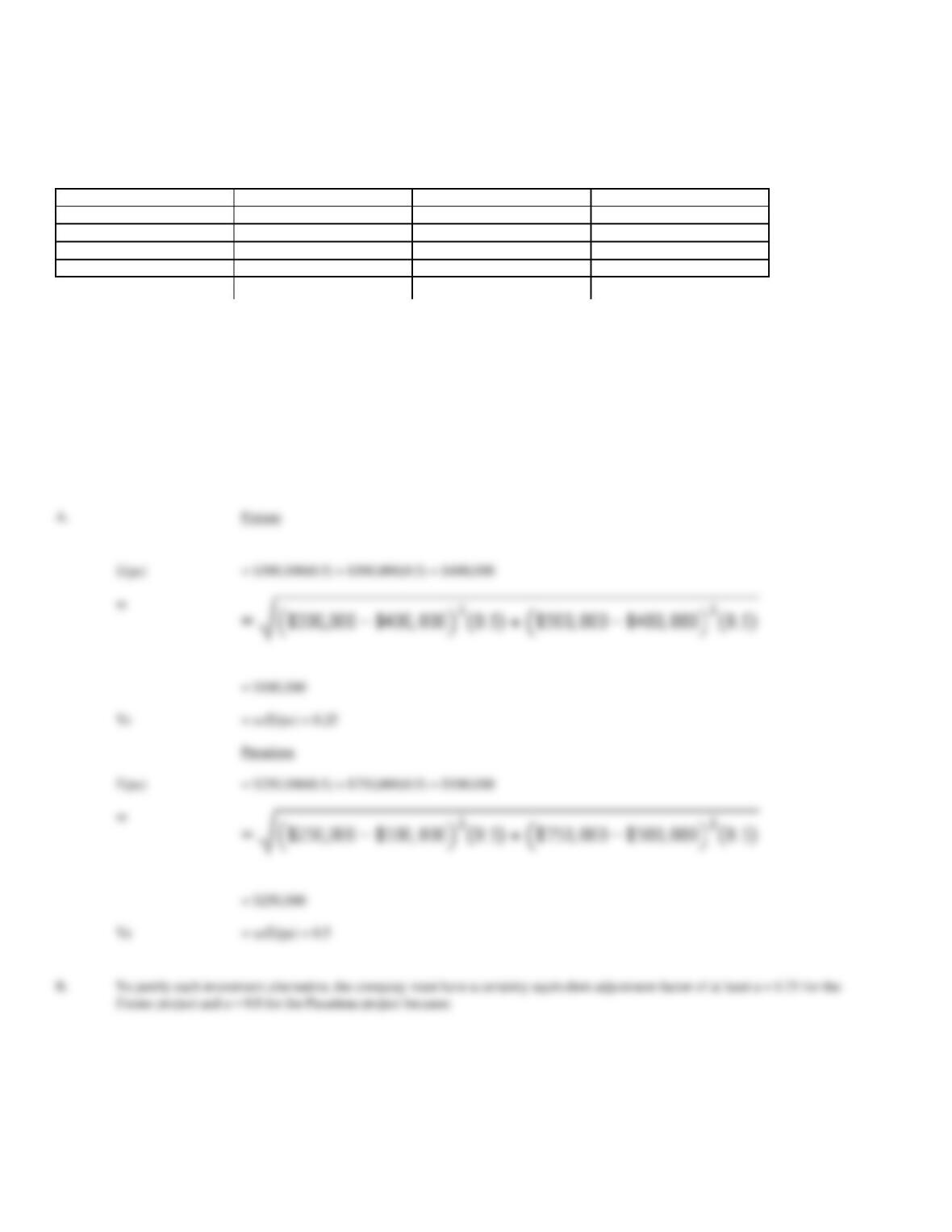
A.
Phoenix
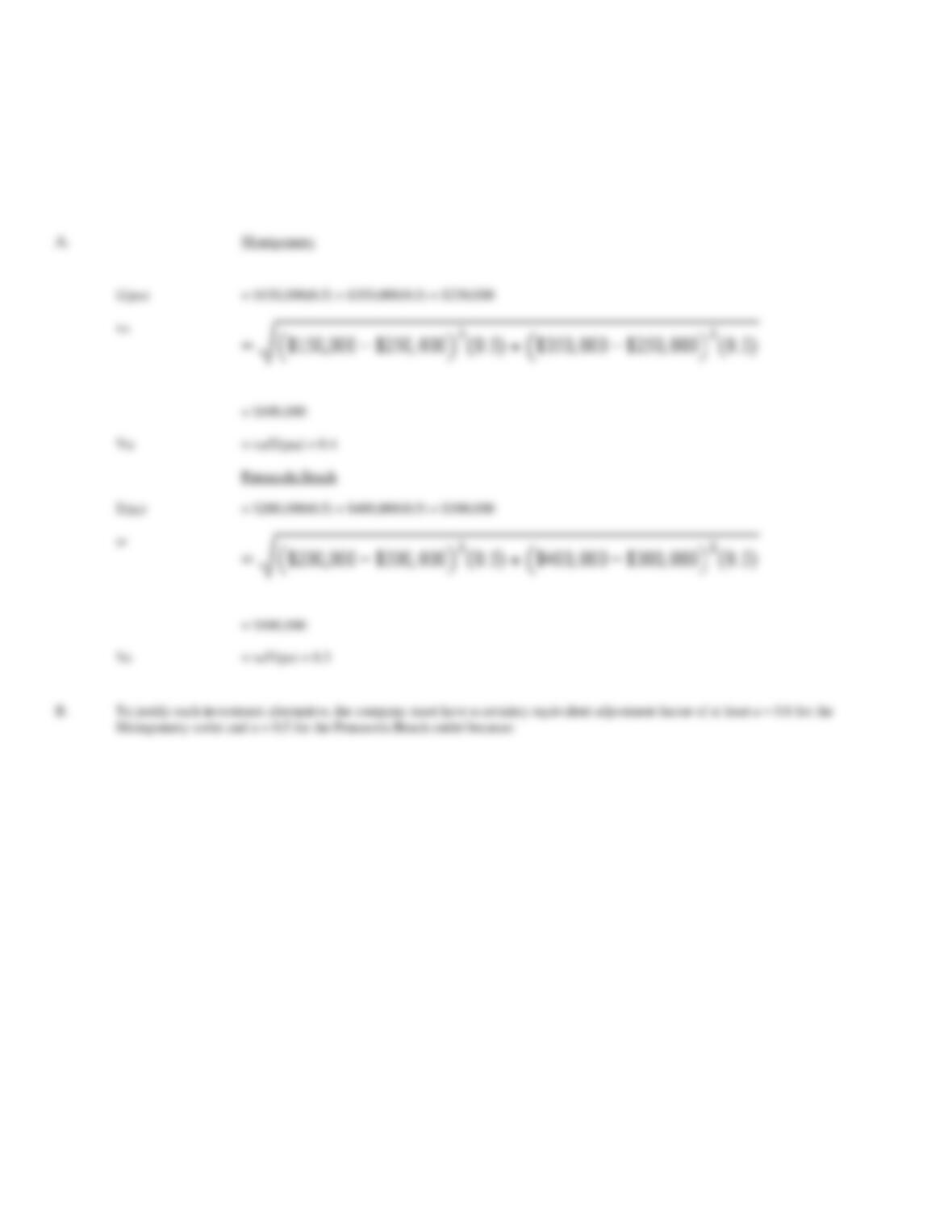
= $200,000(0.5) + $300,000(0.5) = $250,000
= $50,000
= sP/E(pP) = 0.2
Tucson
= $100,000(0.5) + $500,000(0.5) = $300,000
= $200,000
= sT/E(pT) =
B.
To justify each investment alternative, the company must have a certainty equivalent adjustment factor of at least a = 0.8 for the
39. Certainty Equivalents. Rabbit Food, Inc., is a rapidly growing chain of health food restaurants. The
company has a limited amount of capital for expansion, and must carefully weigh available alternatives.
Currently, the company is considering opening restaurants in Fresno and/or Pasadena, California. Projections
for the two potential outlets are:
City
Outcome
Annual Profit Contribution
Probability
Fresno
Failure
$300,000
0.5
Success
$500,000
0.5
Pasadena
Failure
$250,000
0.5
Success
$750,000
0.5
Each restaurant would involve a capital expenditure of $2.5 million, plus land acquisition costs of $500,000 for Fresno and $1.5 million for Pasadena.
The company uses the 10% an estimate of a minimal risk-free annual opportunity cost of investment capital.
A.
Calculate the expected value, standard deviation, and coefficient of variation for each outlet’s profit contribution.
B.
Calculate the minimum certainty equivalent adjustment factor for each restaurant’s cash flows that would justify investment in each
outlet.
C.
Assuming the management of Rabbit Food is risk averse, and uses the certainty equivalent method in decision making, which is the
more attractive outlet? Why?
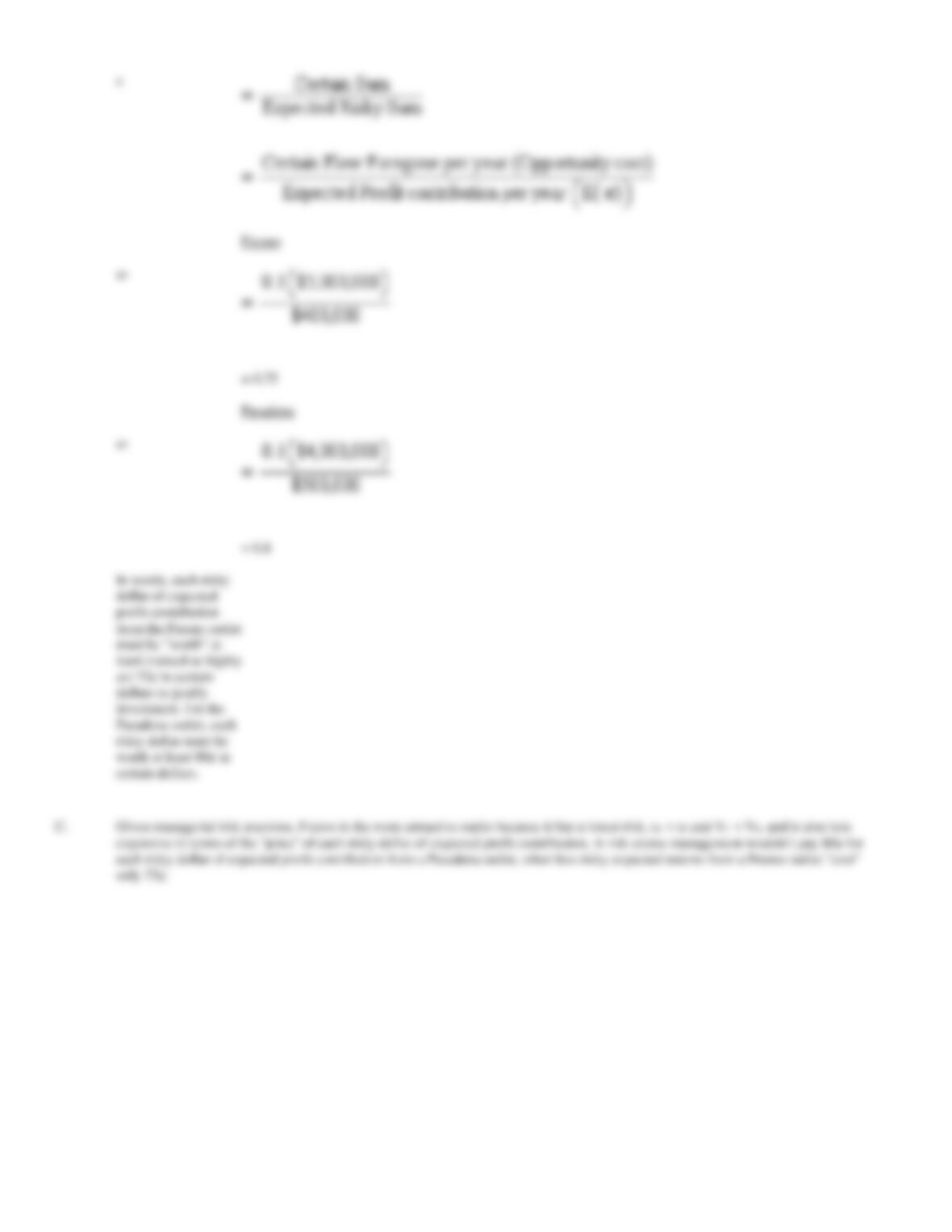
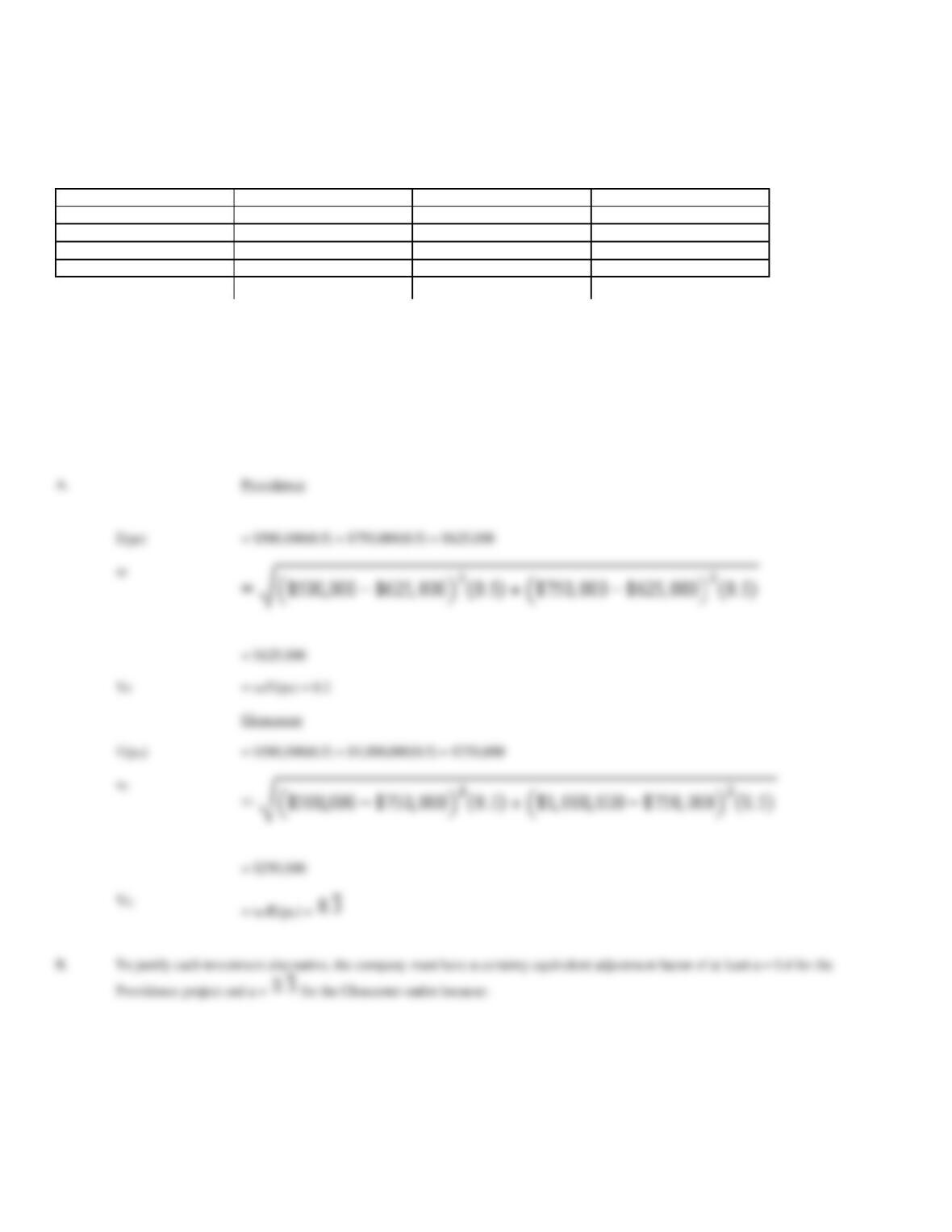
A.
Fresno
= $300,000(0.5) + $500,000(0.5) = $400,000
= $100,000
= sF/E(pF) = 0.25
Pasadena
= $250,000(0.5) + $750,000(0.5) = $500,000
= $250,000
= sP/E(pP) = 0.5
B.
To justify each investment alternative, the company must have a certainty equivalent adjustment factor of at least a = 0.75 for the
40. Certainty Equivalents. Pier-4, Inc. is a rapidly growing chain of sea-food restaurants. The company has a
limited amount of capital for expansion, and must carefully weigh available alternatives. Currently, the
company is considering opening restaurants in Providence, Rhode Island and/or Gloucester, Massachusetts.
Projections for the two potential outlets are:
City
Outcome
Annual Profit Contribution
Probability
Providence
Failure
$500,000
0.5
Success
$750,000
0.5
Gloucester
Failure
$500,000
0.5
Success
$1,000,000
0.5
Each restaurant would involve a capital expenditure of $2.5 million, and the company uses the 10% yield on risk-free U.S. Treasury bills to calculate
the risk-free annual opportunity cost of investment capital.
A.
Calculate the expected value, standard deviation, and coefficient of variation for each outlet’s profit contribution.
B.
Calculate the minimum certainty equivalent adjustment factor for each restaurant’s cash flows that would justify investment in each
outlet.
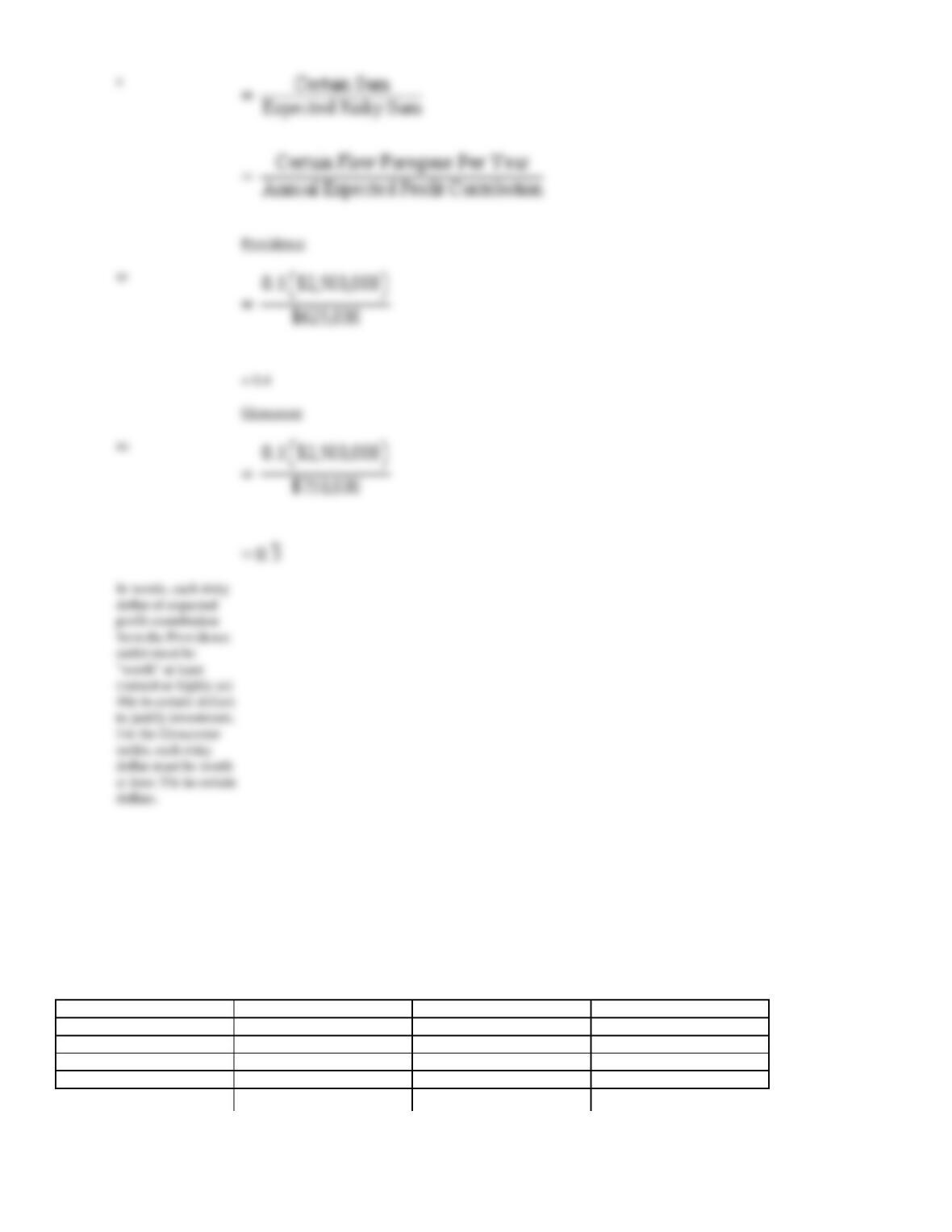
A.
Providence
= $500,000(0.5) + $750,000(0.5) = $625,000
= $125,000
= sP/E(pP) = 0.2
Gloucester
= $500,000(0.5) + $1,000,000(0.5) = $750,000
= $250,000
= sG/E(pG) =
Providence project and a = for the Gloucester outlet because:
41. Certainty Equivalents. Rajun Cajun’s, Ltd., is a rapidly growing chain of Cajun-style cuisine restaurants.
The company has a limited amount of capital for expansion, and must carefully weigh available alternatives.
Currently, the company is considering opening restaurants in Montgomery, Alabama and/or Pensacola Beach,
Florida. Projections for the two potential outlets are:
City
Outcome
Annual Profit Contribution
Probability
Montgomery
Failure
$150,000
0.5
Success
$350,000
0.5
Pensacola Beach
Failure
$200,000
0.5
Success
$400,000
0.5
Providence
= 0.4
Gloucester
Each restaurant would involve a capital expenditure of $1.5 million, and the company uses the 10% yield on risk-free U.S. Treasury bills to calculate
the risk-free annual opportunity cost of investment capital.
A.
Calculate the expected value, standard deviation, and coefficient of variation for each outlet’s profit contribution.
B.
Calculate the minimum certainty equivalent adjustment factor for each restaurant’s cash flows that would justify investment in each
outlet.
A.
Montgomery
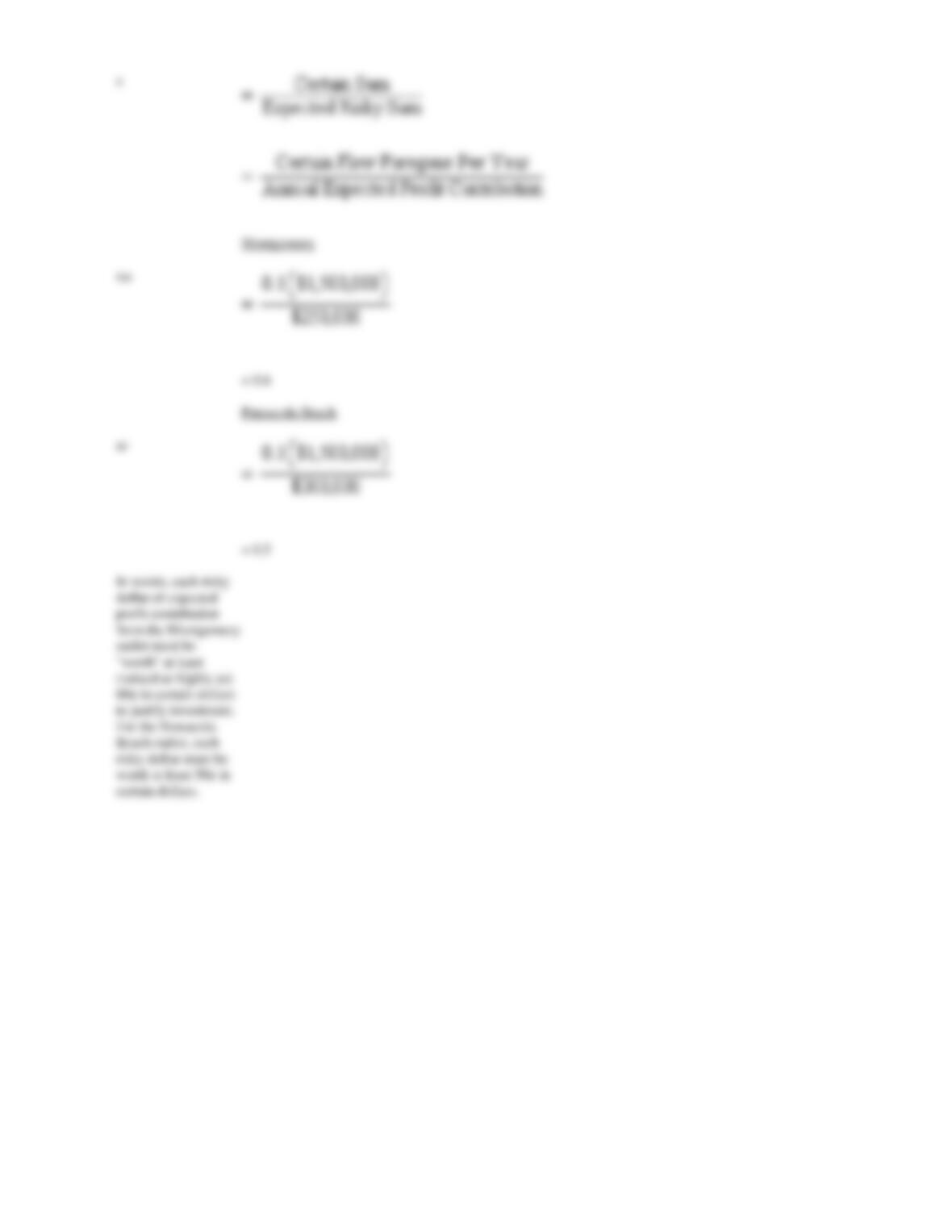
= $150,000(0.5) + $350,000(0.5) = $250,000
= $100,000
= sM/E(pM) = 0.4
Pensacola Beach
= $200,000(0.5) + $400,000(0.5) = $300,000
= sP/E(pP) = 0.3
B.
To justify each investment alternative, the company must have a certainty equivalent adjustment factor of at least a = 0.6 for the
42. Decision Trees. Atlanta Corporation has been supplying Raleigh Manufacturing, Inc. with electronic
control systems, and Raleigh is satisfied with their performance. However, Raleigh has just received a
competing bid from Brahmin, Inc., a firm that is aggressively marketing its products. Brahmin has offered to
supply systems for a price of $237,500, or $12,500 below the $250,000 price for the Atlanta system. In addition
to an attractive price, Brahmin offers a money-back guarantee. That is, if Brahmin’s systems do not match
Atlanta’s quality, Raleigh can reject them and return them for a full refund. However, if it must reject the
machines and return them to Brahmin, Raleigh will suffer a manufacturing delay costing the firm $50,000.
A.
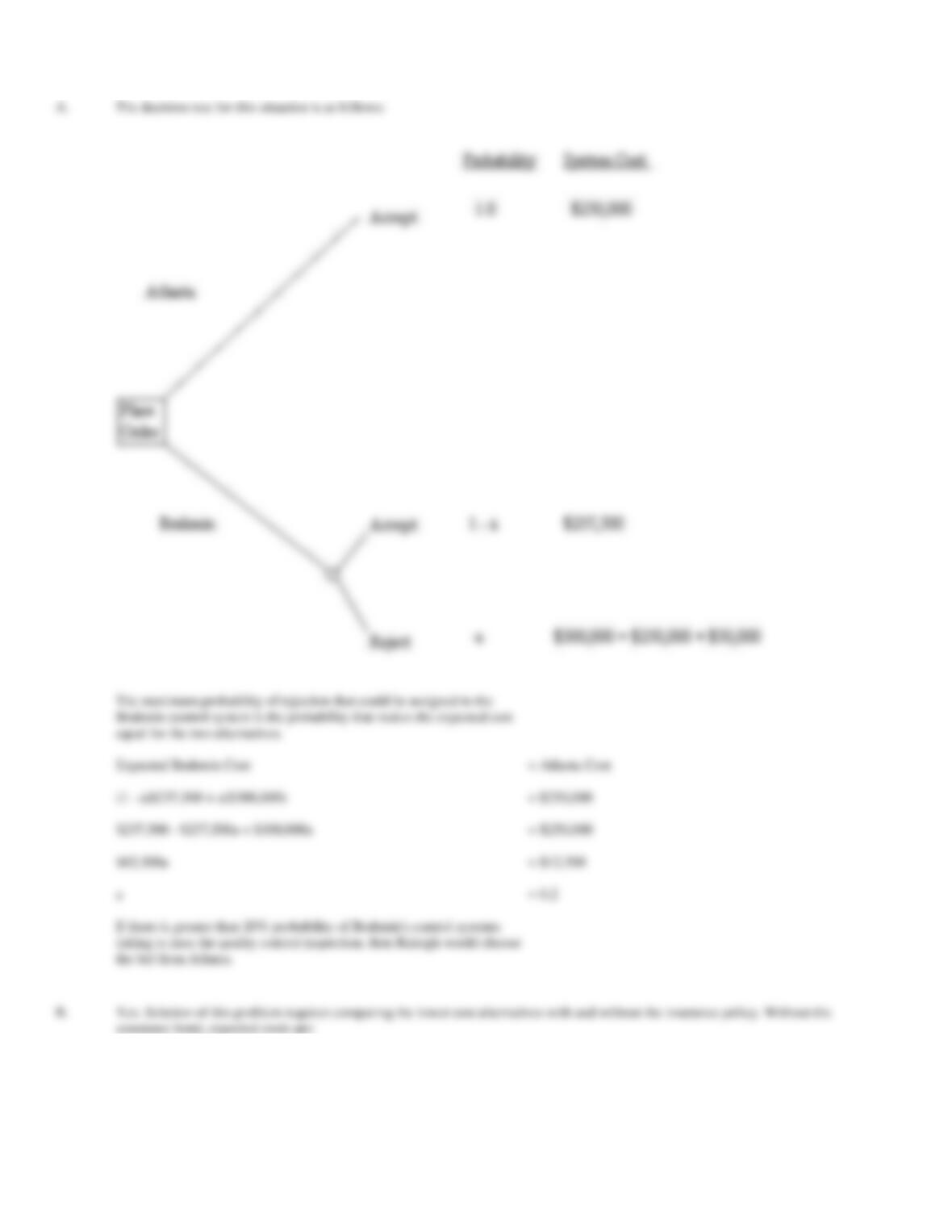
Construct a decision tree for this problem and determine the maximum probability Raleigh can assign to rejection of the Brahmin
system before it would reject the offer, assuming it decides on the basis of minimizing expected costs.
B.
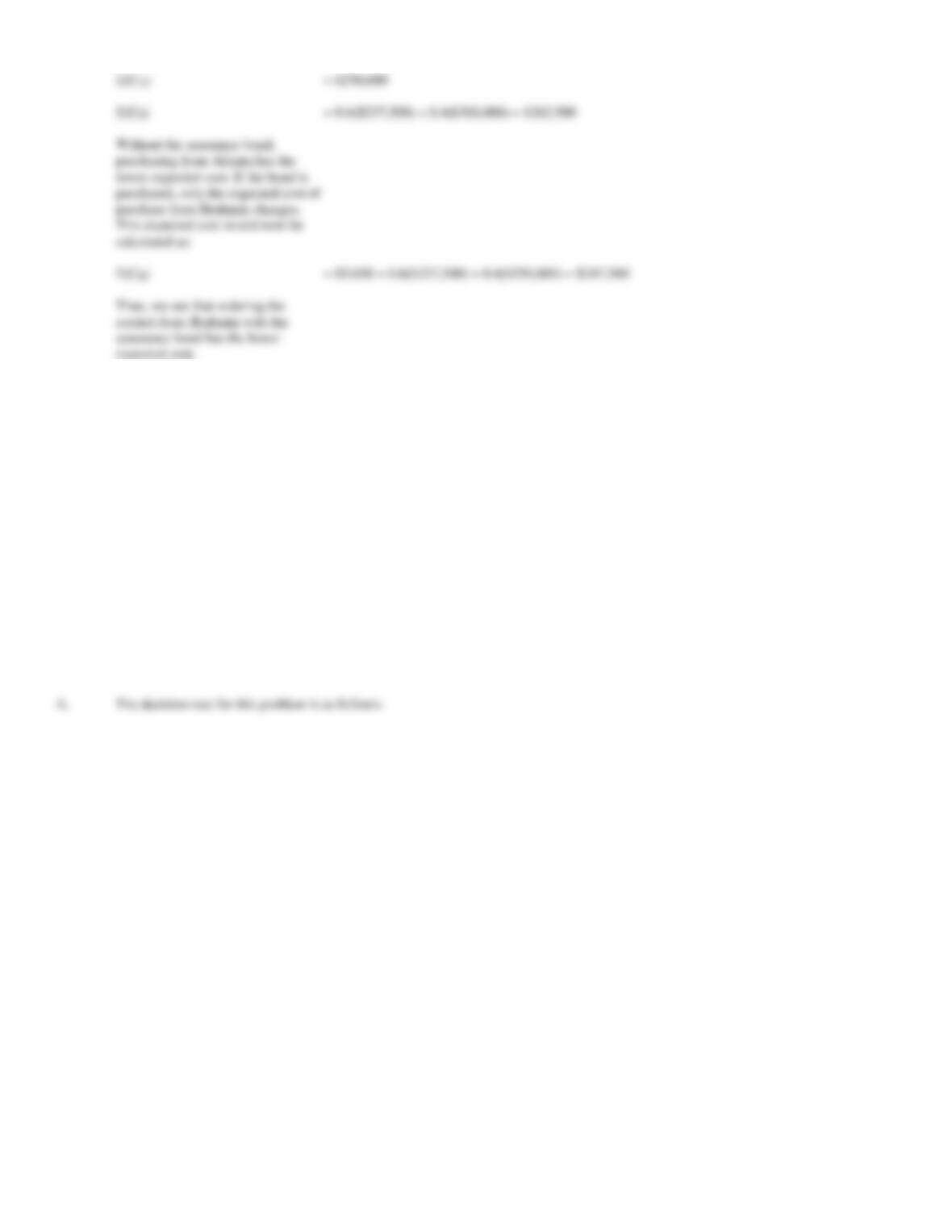
Assume that Raleigh assigns a 40% probability of rejection of the Brahmin controls. Would Raleigh be willing to pay $5,000 for an
assurance bond that would cover manufacturing delay costs if the Brahmin controls fail the quality check? (Use the same objective as in
part A above.) Explain.
43. Decision Trees. Arnie Becker, an attorney with Dewey, Cheetum & Howe in Los Angeles, California, must
serve a subpoena to an individual in New York, New York by 10:00 a.m. tomorrow morning. If the subpoena is
delivered late, Becker stands to lose $5,000 in fees. The subpoena can be delivered by mail at a cost of $25, or
by courier at a cost of $225. Based on passed experience, Becker assigns a 99% change of on-time delivery
using the courier service. Because Express Mail is a relatively new service, Becker does not know the
probability of on-time delivery using this service.
A.
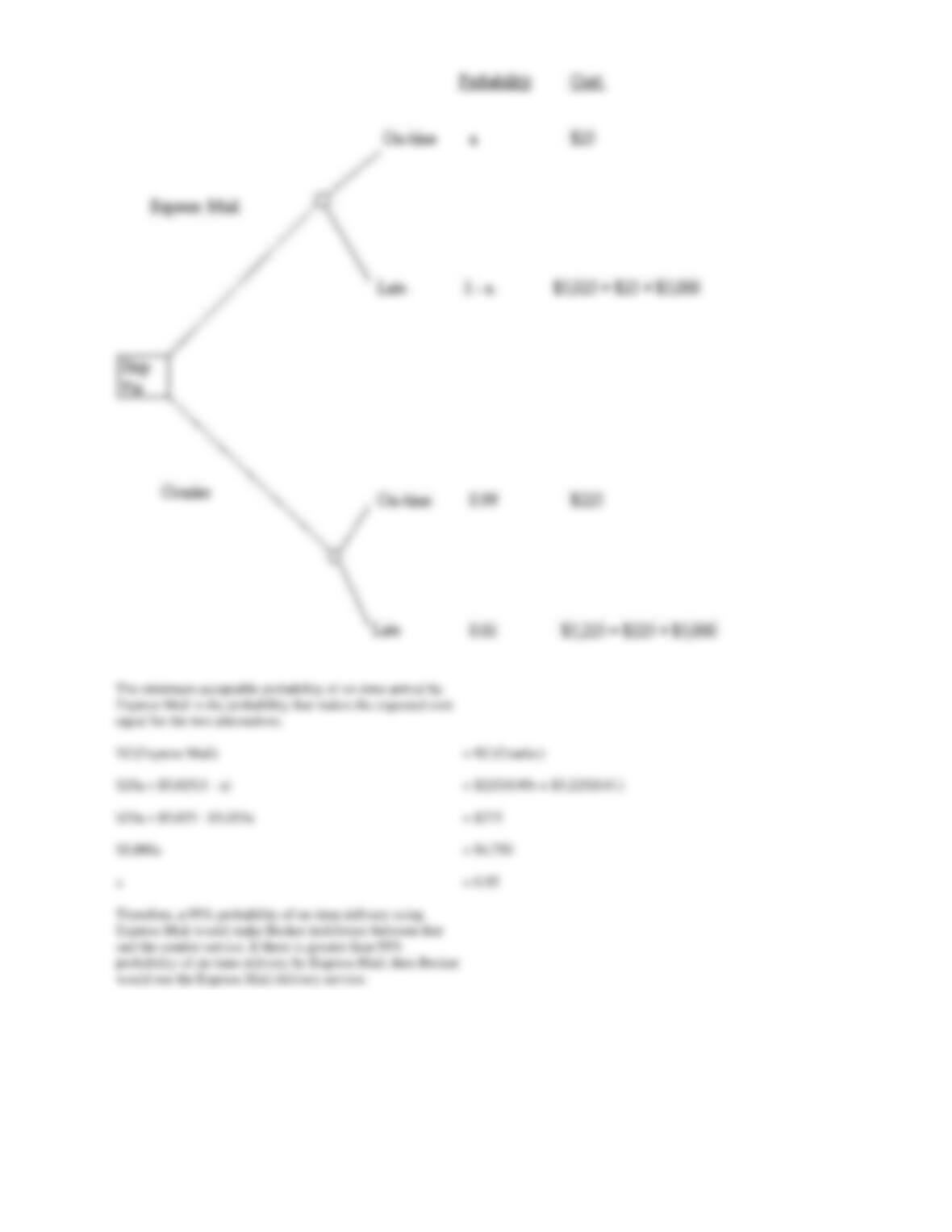
Construct a decision tree for this problem and calculate the minimum probability of on-time delivery for Express Mail that would make
Becker indifferent to the two delivery services.
44. Standard Normal. A leading company in the freight forwarding business offers Overnight Letter delivery
service with a record of on-time delivery for 99% of shipped parcels. The price of this service is $15. Express
Mail, offered by a leading competitor for $10, has an on-time delivery record of 95%.
A.
Calculate the cost incurred due to late delivery that would make shippers indifferent to these deliver service alternatives.
B.
Which delivery alternative is preferred if a $100 cost would be incurred due to late delivery?
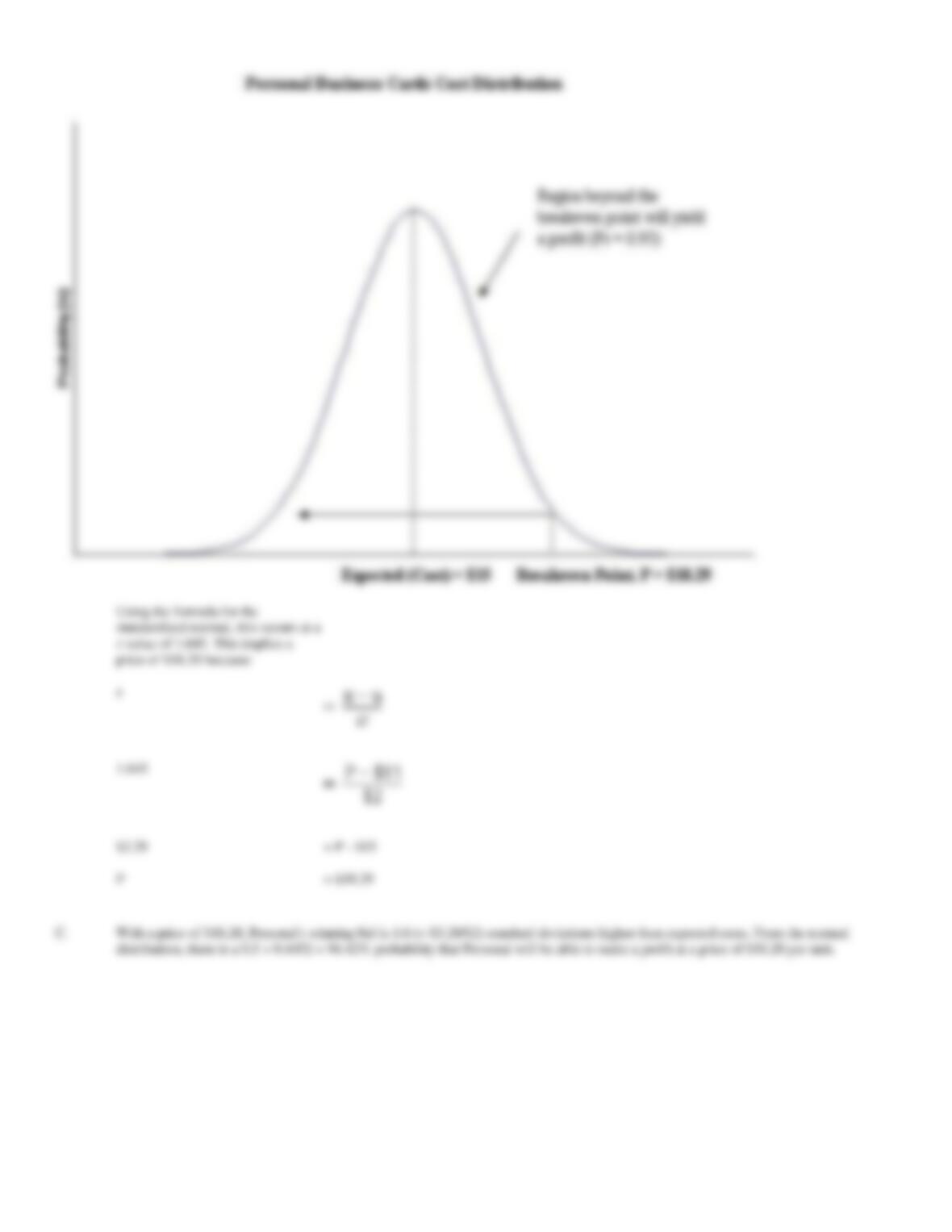
45. Standard Normal. Personal Business Cards, Inc. supplies customized business cards to commercial and
individual customers. Although paper, ink, and other costs cannot be determined precisely, Personal anticipates
that costs will be normally distributed around a mean of $15 per unit (each 500-card order) with a standard
deviation of $2 per unit.
A.
What is the probability that Personal would make a profit at a price of $15 per unit?
B.
Calculate the unit price necessary to give Personal a 95% chance of making a profit on the order.
C.
If Personal submits a successful bid of $18.20 per unit, what is the probability that it will make a profit?
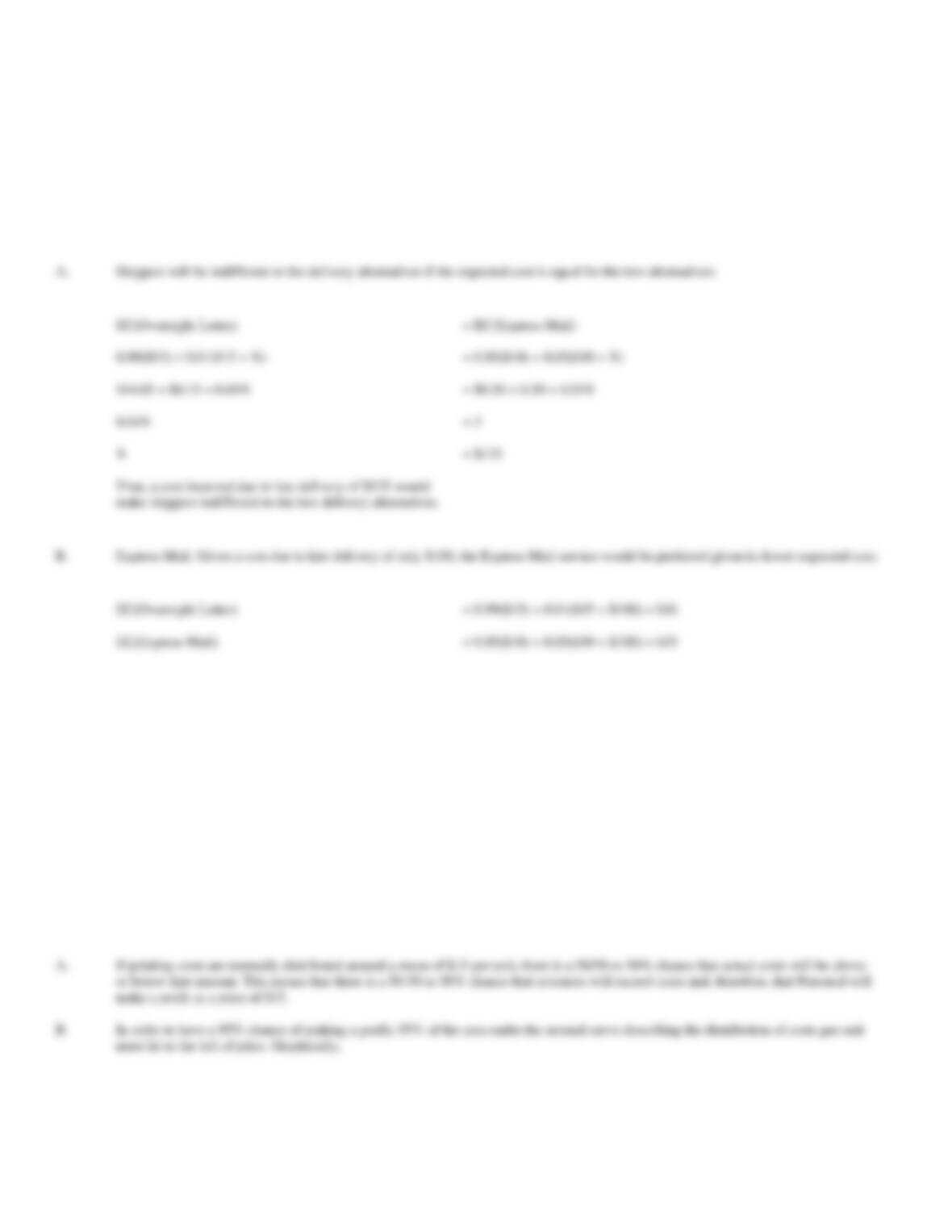
Shippers will be indifferent to the delivery alternatives if the expected cost is equal for the two alternatives:
EC(Overnight Letter)
= EC(Express Mail)
0.99($15) + 0.01($15 + X)
= 0.95($10) + 0.05($10 + X)
$14.85 + $0.15 + 0.01X
= $9.50 + 0.50 + 0.05X
0.04X
= 5
X
= $125
B.
Express Mail. Given a cost due to late delivery of only $100, the Express Mail service would be preferred given its lower expected cost:
EC(Overnight Letter)
= 0.99($15) + 0.01($15 + $100) = $16
EC(Express Mail)
= 0.95($10) + 0.05($10 + $100) = $15
46. Standard Normal. Chip Technologies, Inc. supplies wafer-thin computer chips to industrial customers.
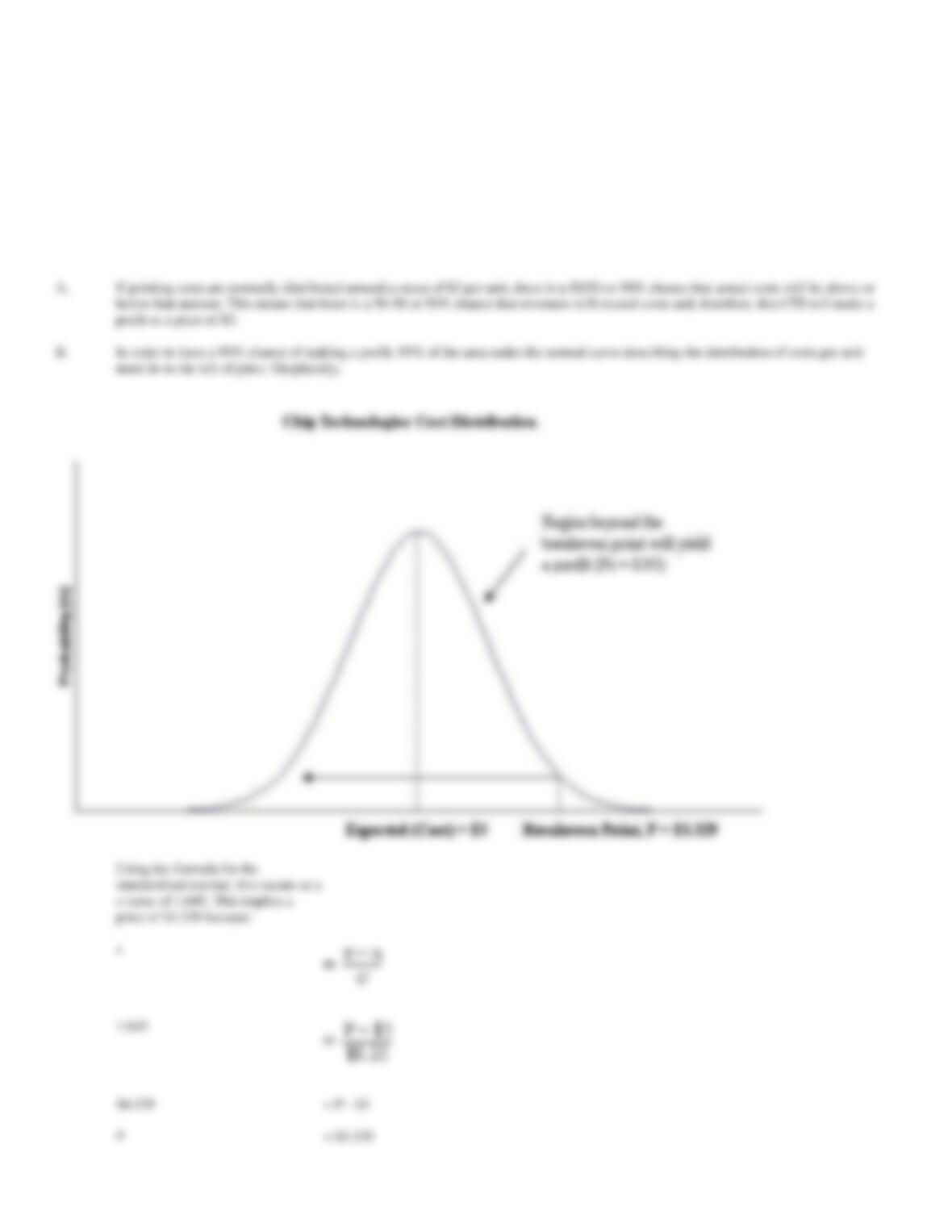
Although labor and material costs cannot be determined precisely, CTI anticipates that costs will be normally
distributed around a mean of $3 per unit with a standard deviation of 20¢ per unit.
A.
What is the probability that CTI would make a profit at a price of $3 per unit?
B.
Calculate the unit price necessary to give CTI a 95% chance of making a profit on the order.
C.
If CTI signs a contract to supply chips at a price of $3.20 per unit, what is the probability that it will make a profit?
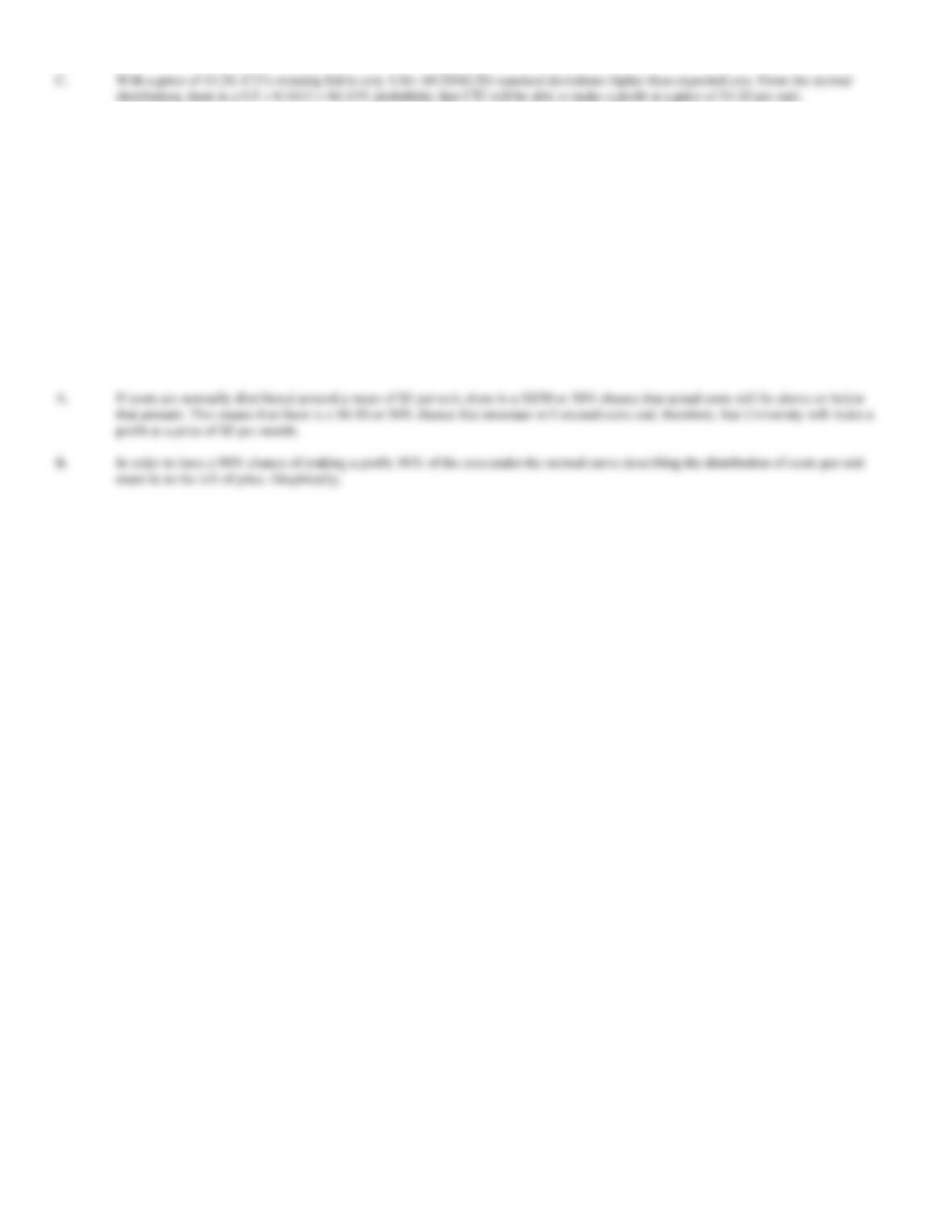
$0.329
= P – $3
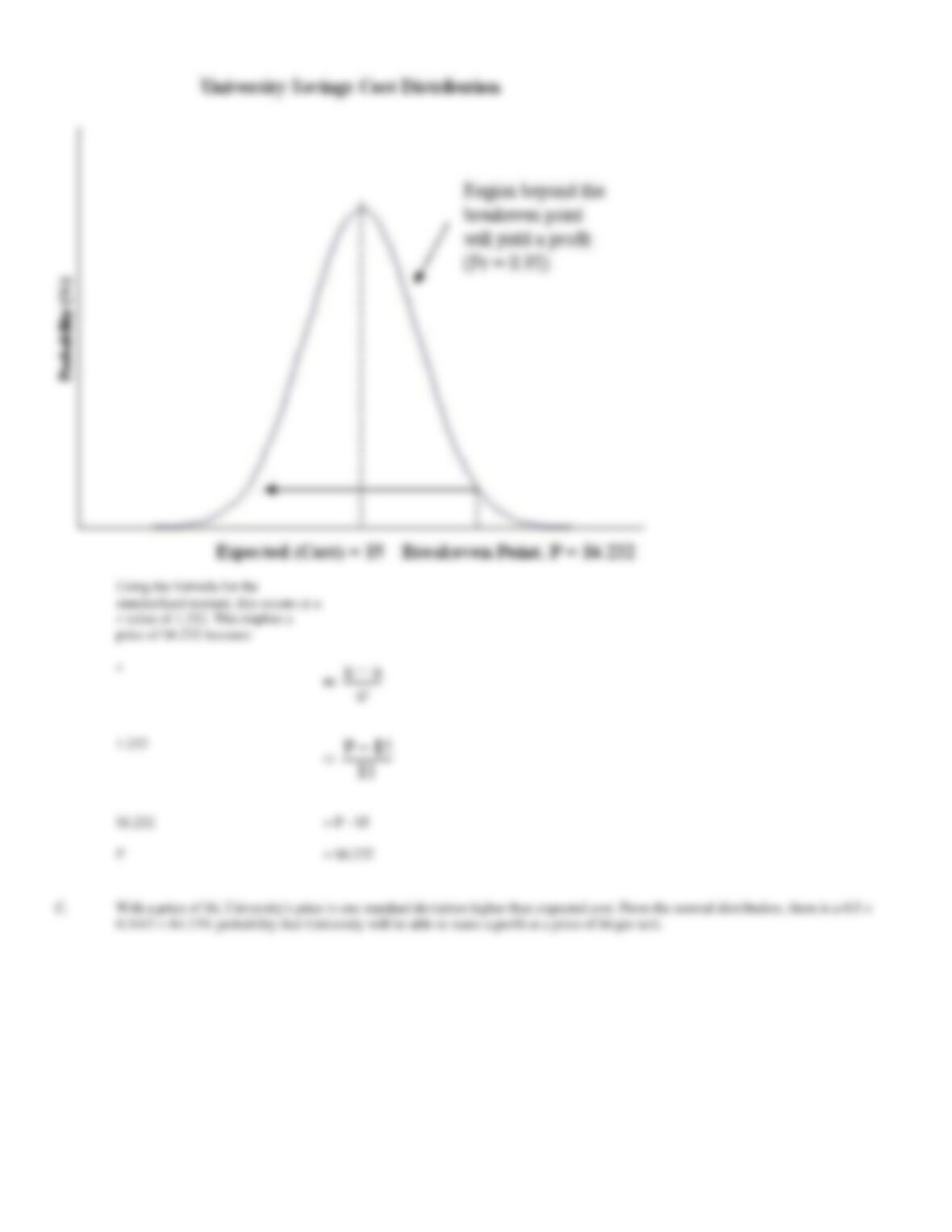
47. Standard Normal. University Savings, Inc offers personal checking accounts to commercial and individual
customers. Although unit costs cannot be determined precisely, University anticipates that monthly costs will be
normally distributed around a mean of $5 per unit with a standard deviation of $1 per unit.
A.
What is the probability that University would make a profit at a checking price of $5 per unit?
B.
Calculate the unit price necessary to give University a 90% chance of making a profit on an individual checking account.
C.
If University offers its accounts at a price of $6, what is the probability that it will make a profit?
48. Game Theory. Catskill Mountain Bike, Inc. is a producer and wholesaler of rugged bicycles designed for
mountain touring. The company is considering upgrading its current line by making standard high-grade
Chromalloy frames. Of course, the market response to this upgrade in product quality would depend on the
competitor response, if any. The company’s comptroller projects the following annual profits (payoffs)
following resolution of the upgrade decision.
States of Nature
Catskill’s Decision Alternatives
Competitor Upgrade
No Competitor Upgrade
Upgrade
$2,500,000
$3,500,000
Don’t upgrade
$1,500,000
$5,000,000
A.
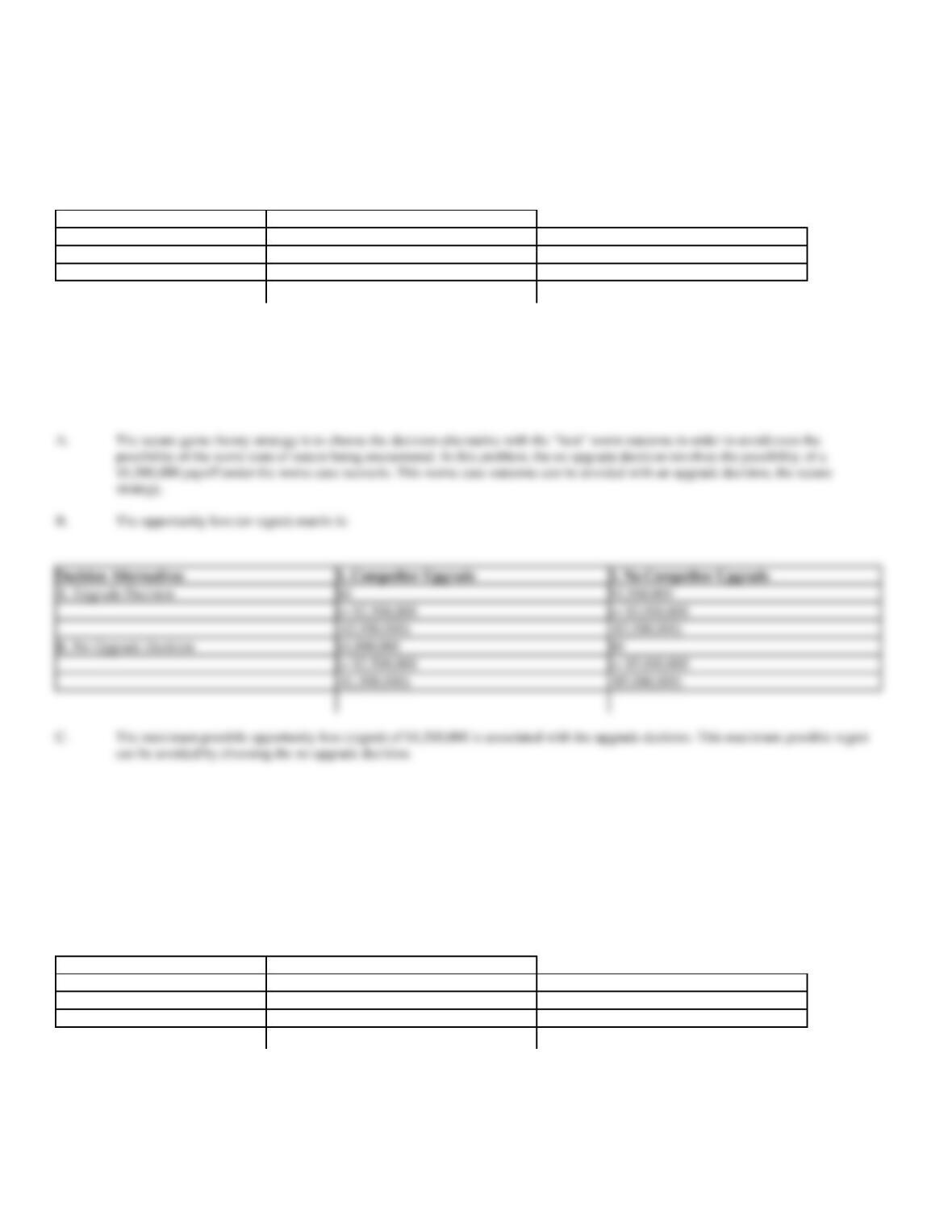
Which decision alternative represents Catskill’s secure strategy? Explain.
B.
Calculate the opportunity cost (or regret) matrix.
C.
Which decision alternative would Catskill choose if the company seeks to minimize opportunity cost? Explain.
49. Game Theory. Jessica’s, a local retailer of women’s clothing is considering adoption of new Sunday hours
between 12:00 PM and 6:00 PM. Jessica’s is closed on Sundays. Of course, the consumer response to this
extension in hours depends on the competitor response, if any. The following annual profit contributions
(payoffs) are expected:
States of Nature
Jessica’s Decision Alternatives
Competitor Open
Competitor Closed
Open Sundays
$75,000
$100,000
Closed Sundays
$50,000
$150,000
A.
Which decision alternative would Jessica’s choose given a secure strategy criterion? Explain.
B.
Calculate the opportunity loss (or regret) matrix.
C.
Which decision alternative would Jessica’s choose if the company seeks to minimize opportunity cost? Explain.
strategy.
B.
The opportunity loss (or regret) matrix is:
A. Upgrade Decision
$1,500,000
(= $2,500,000
(= $5,000,000
-$2,500,000)
-$3,500,000)
B. No Upgrade Decision
$1,000,000
(= $2,500,000
(= $5,000,000
-$1,500,000)
-$5,000,000)
50. Game Theory. F&M Manufacturing, Inc., a diversified manufacturer of packaging products, is considering
upgrading its current line by making available a new line of coated paper products. Of course, the market
response to this upgrade in product quality would depend on the competitor response, if any. The company’s
comptroller projects the following annual profits (payoffs) following resolution of the upgrade decision.
States of Nature
F&M’s Decision Alternatives
Competitor Upgrade
No Competitor Upgrade
Upgrade
$5 million
$7.5 million
Don’t upgrade
$4 million
$8 million
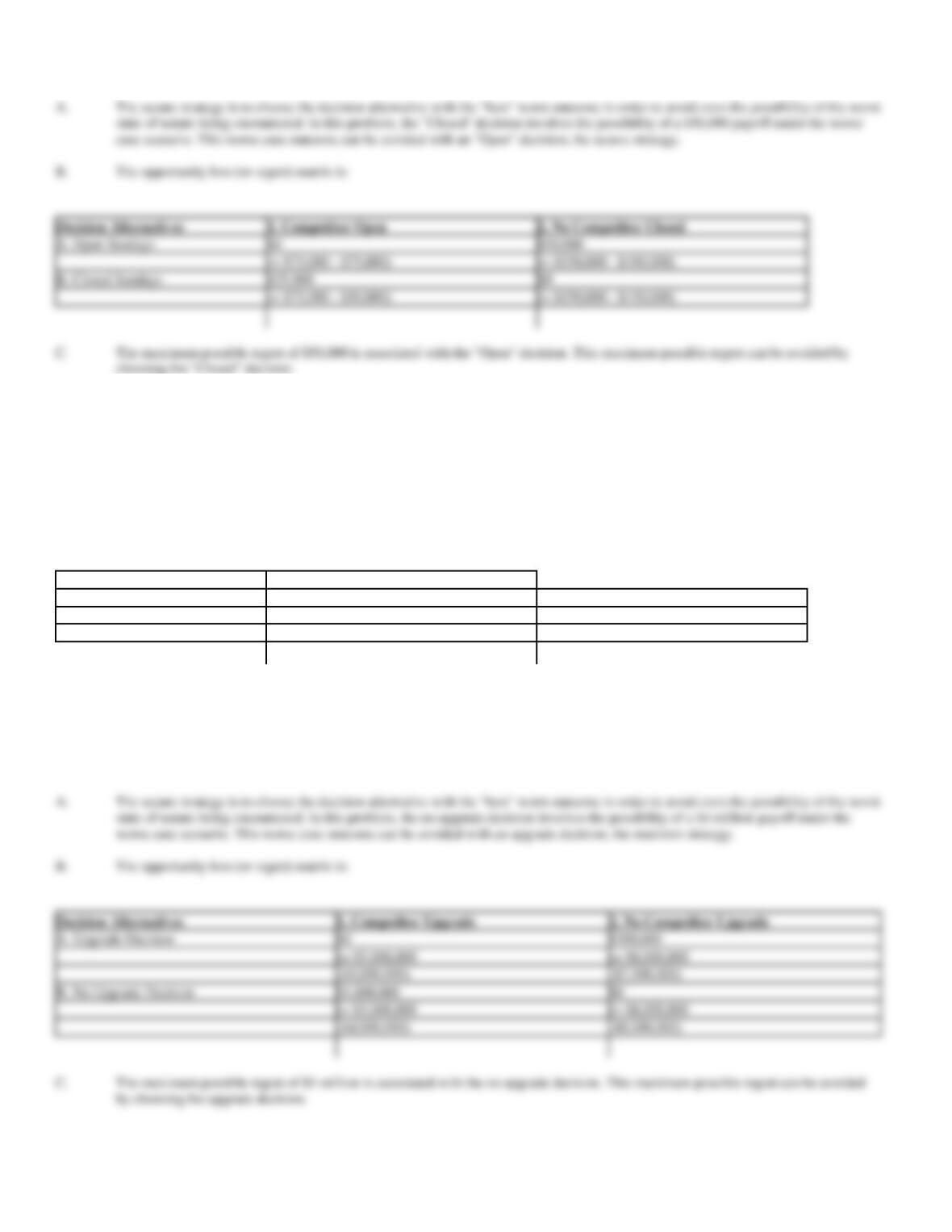
A.
Which decision alternative would F&M choose given a secure strategy criterion? Explain.
B.
Calculate the opportunity loss or regret matrix.
C.
Which decision alternative would F&M choose if the company seeks to minimize opportunity cost? Explain.
B.
The opportunity loss (or regret) matrix is:
Decision Alternatives
1. Competitor Upgrade
2. No Competitor Upgrade
A. Upgrade Decision
$500,000
(= $5,000,000
(= $8,000,000
-$5,000,000)
-$7,500,000)
B. No Upgrade Decision
$1,000,000
(= $5,000,000
(= $8,000,000
-$4,000,000)
-$8,000,000)
B.
The opportunity loss (or regret) matrix is:
Decision Alternatives
1. Competitor Open
2. No Competitor Closed
A. Open Sundays
$50,000
(= $75,000 – $75,000)
(= $150,000 – $100,000)
B. Closed Sundays
$25,000
(= $75,000 – $50,000)
(= $150,000 – $150,000)