30) What are the key differences between how we illustrate a contractionary fiscal policy in the basic
aggregate demand and aggregate supply model and in the dynamic aggregate demand and aggregate
supply model?
42
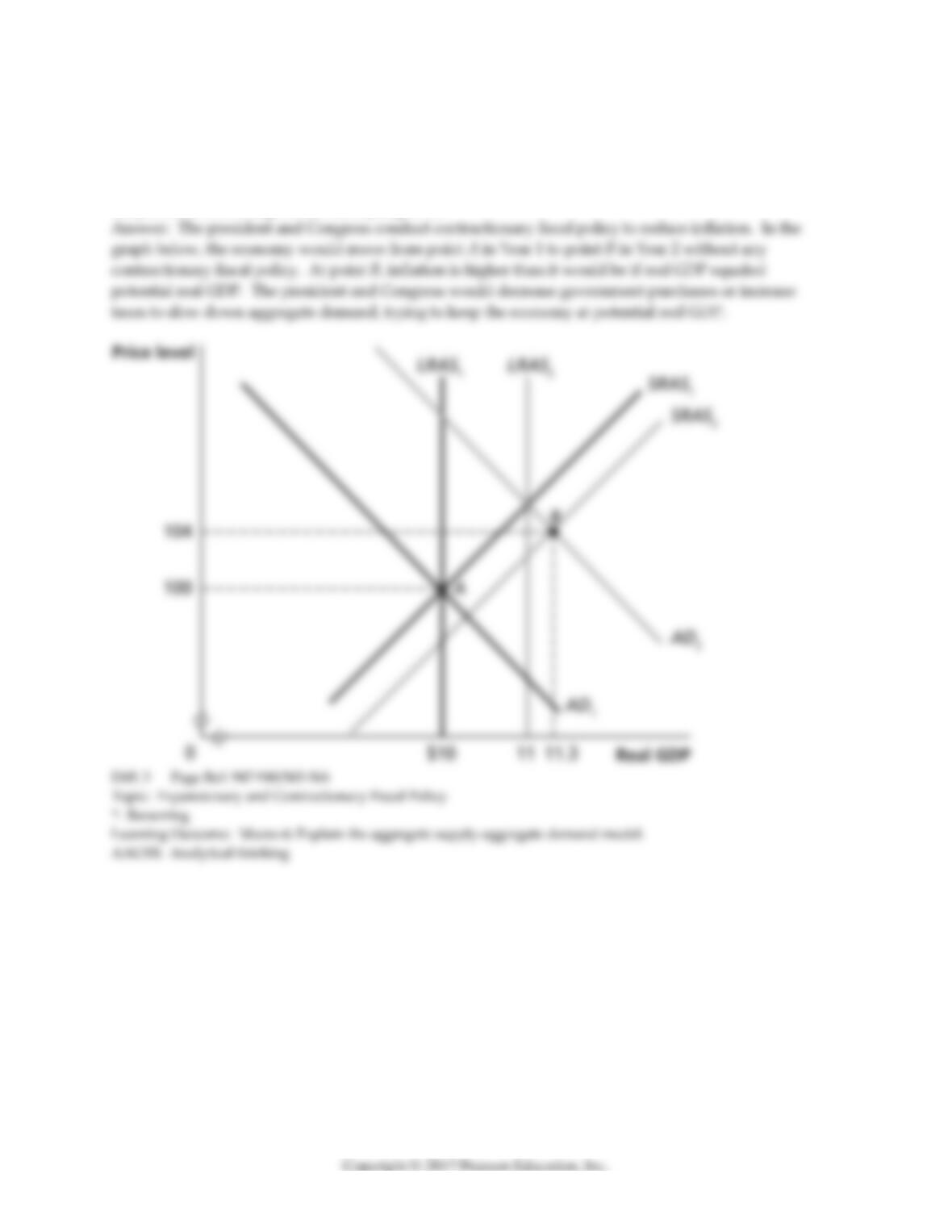
31) Use the dynamic aggregate demand and aggregate supply model and start with Year 1 in a long-run
macroeconomic equilibrium. For Year 2, graph aggregate demand, long-run aggregate supply, and
short-run aggregate supply such that the condition of the economy will induce the president and
Congress to conduct contractionary fiscal policy. Briefly explain the condition of the economy and what
the president and Congress are attempting to do.
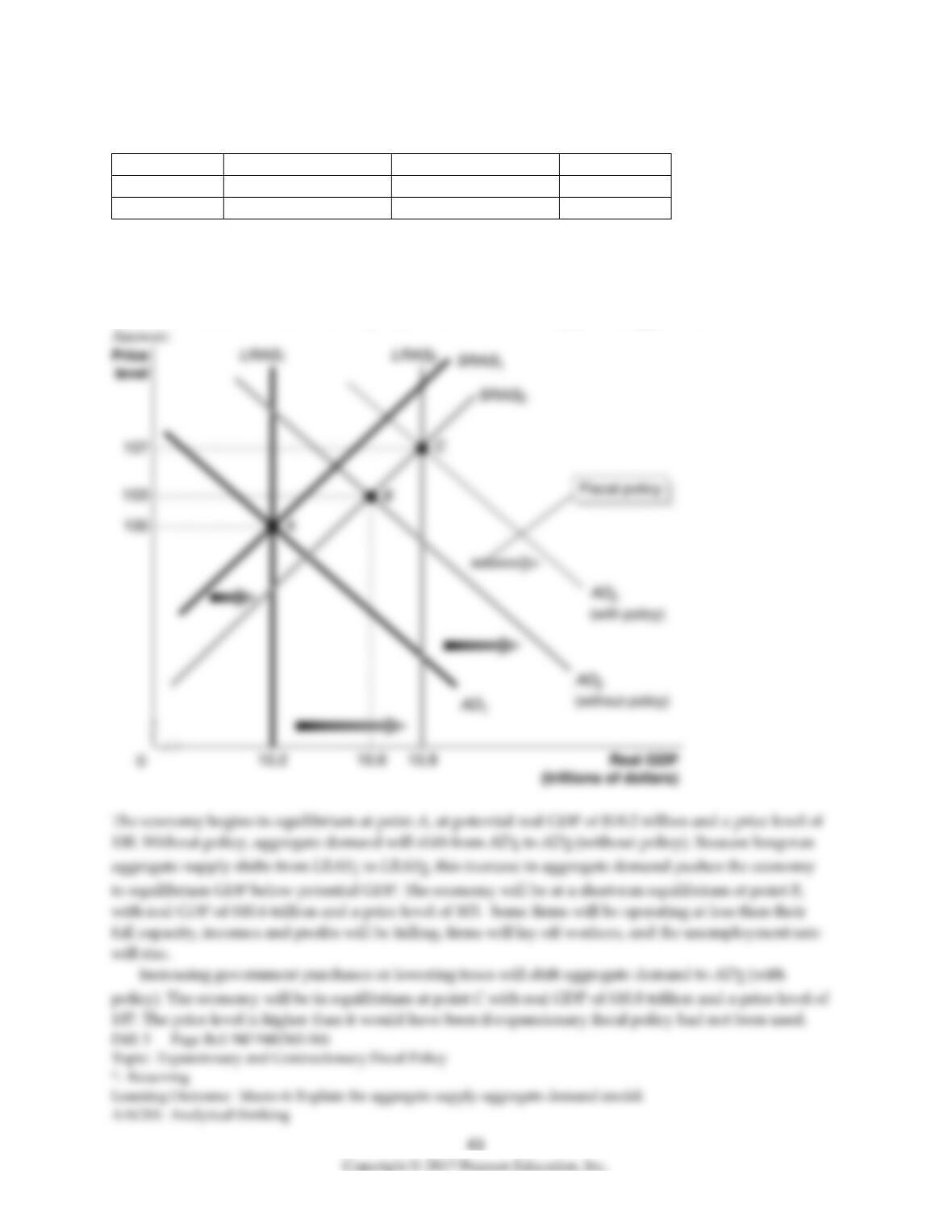
Table 16-5
Year
Potential Real GDP
Real GDP
Price Level
1
$10.2 trillion
$10.2 trillion
100
2
10.8 trillion
10.6 trillion
103
32) Refer to Table 16-5. The economy is in the state described by the table above. Draw the dynamic
aggregate demand and aggregate supply diagram to illustrate the state of the economy in year 1 and
year 2, assuming that no policy is pursued. Then illustrate and explain the appropriate fiscal policy to
use in this situation. Assume that the policy results in the economy producing potential GDP.
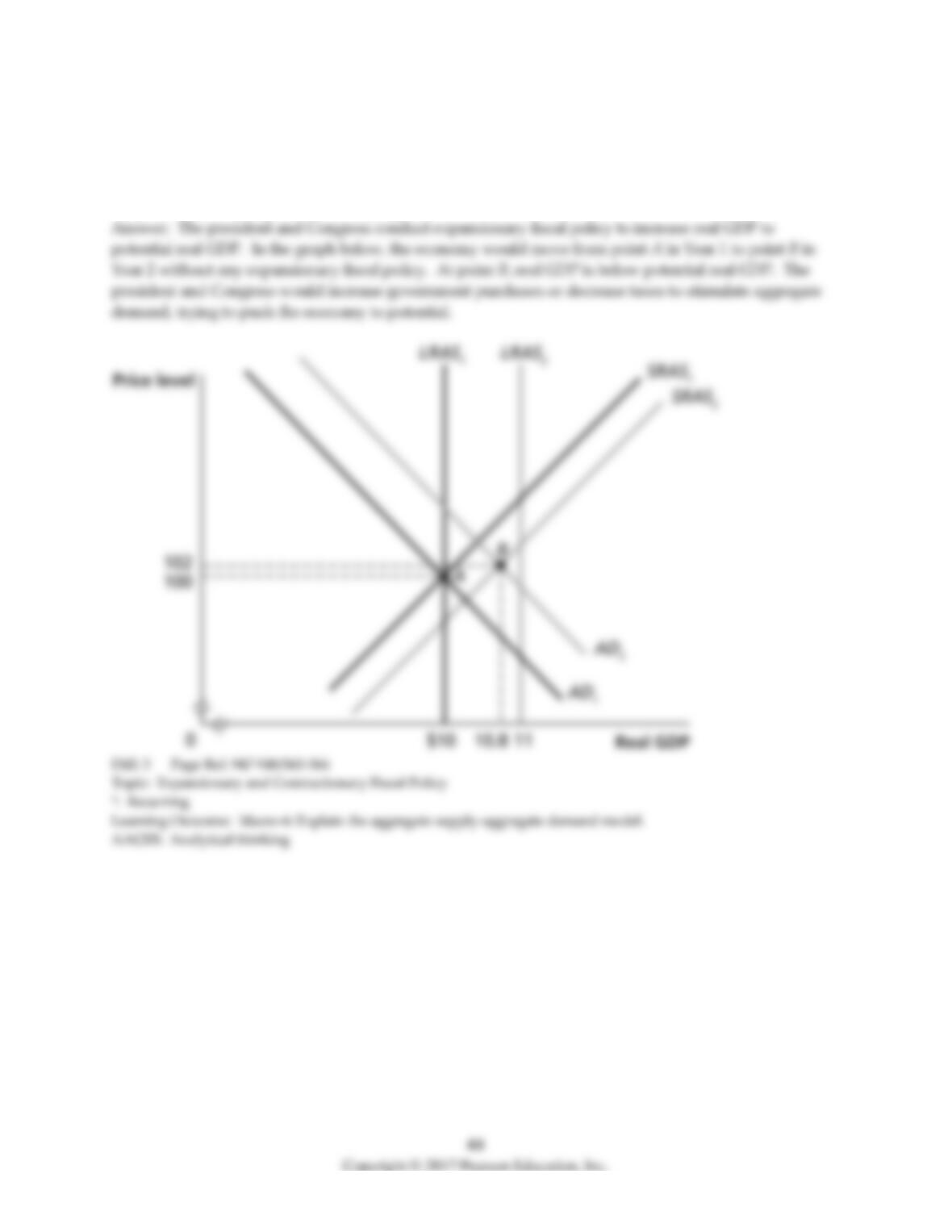
33) Use the dynamic aggregate demand and aggregate supply model and start with Year 1 in a long-run
macroeconomic equilibrium. For Year 2, graph aggregate demand, long-run aggregate supply, and
short-run aggregate supply such that the condition of the economy will induce the president and
Congress to conduct expansionary fiscal policy. Briefly explain the condition of the economy and what
the president and Congress are attempting to do.
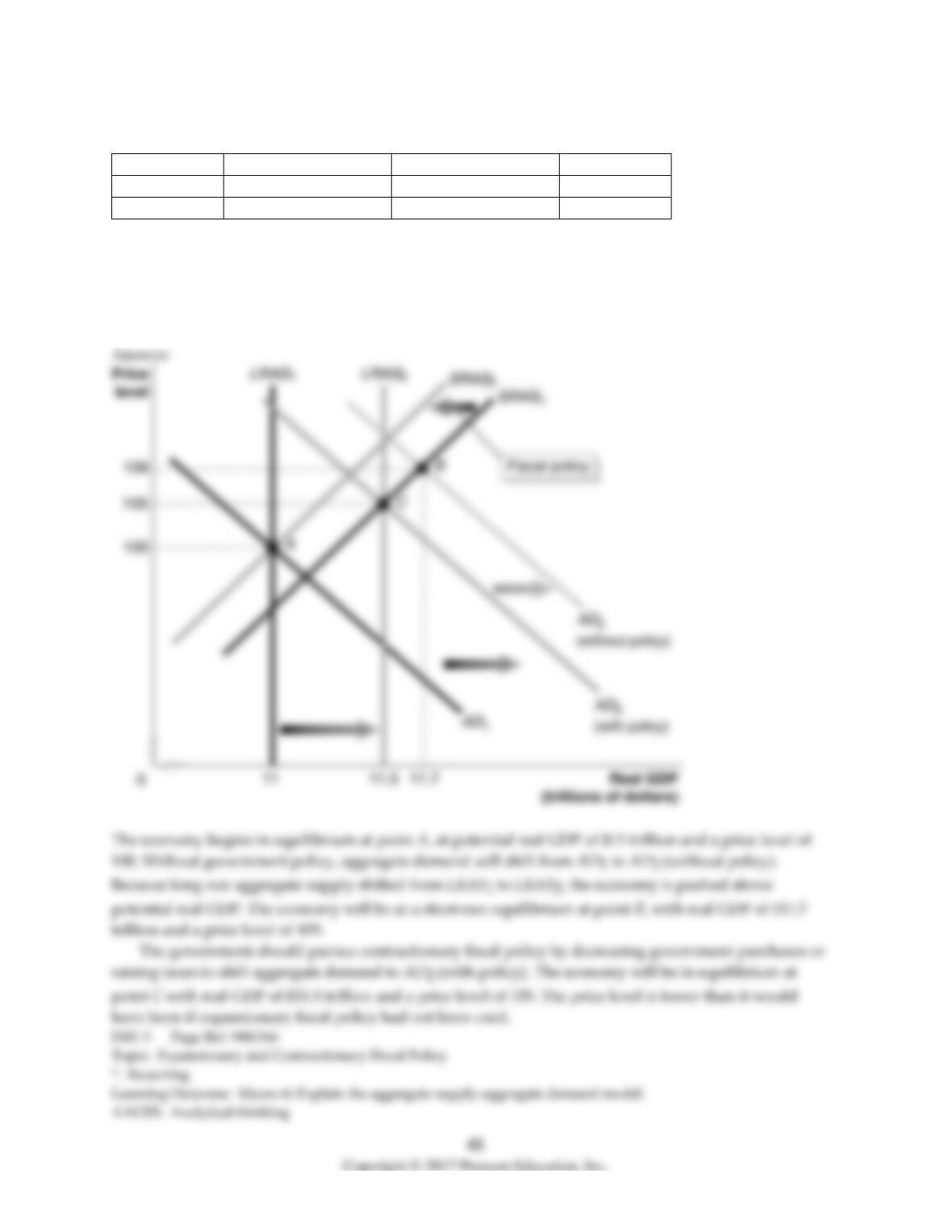
Table 16-6
Year
Potential Real GDP
Real GDP
Price Level
1
$11.0 trillion
$11.0 trillion
100
2
11.5 trillion
11.7 trillion
109
34) Refer to Table 16-6. Suppose the economy is in the state described by the table above. What problem
will occur in the economy if no policy is pursued? What fiscal policy tools could be used to combat the
problem? Draw a dynamic aggregate demand and aggregate supply diagram to illustrate the
appropriate fiscal policy to use in this situation.
16.4 The Government Purchases and Tax Multipliers
1) Economists refer to the series of induced increases in consumption spending that result from an
initial increase in autonomous expenditures as the ________ effect.
A) multiplier
B) expenditure
C) consumption
D) aggregate demand
2) The multiplier effect refers to the series of
A) autonomous increases in consumption spending that result from an initial increase in induced
expenditures.
B) induced increases in consumption spending that result from an initial increase in autonomous
expenditures.
C) autonomous increases in investment spending that result from an initial increase in induced
expenditures.
D) induced increases in investment spending that result from an initial increase in autonomous
expenditures.
3) The aggregate demand curve will shift to the right ________ the initial increase in government
purchases.
A) by less than
B) by more than
C) by the same amount as
D) sometimes by more than and other times by less than
4) The aggregate demand curve will shift to the left ________ the initial decrease in government
purchases.
A) by less than
B) by more than
C) by the same amount as
D) sometimes by more than and other times by less than
5) The aggregate demand curve will shift to the right ________ the initial decrease in taxes.
A) by less than
B) by more than
C) by the same amount as
D) sometimes by more than and other times by less than
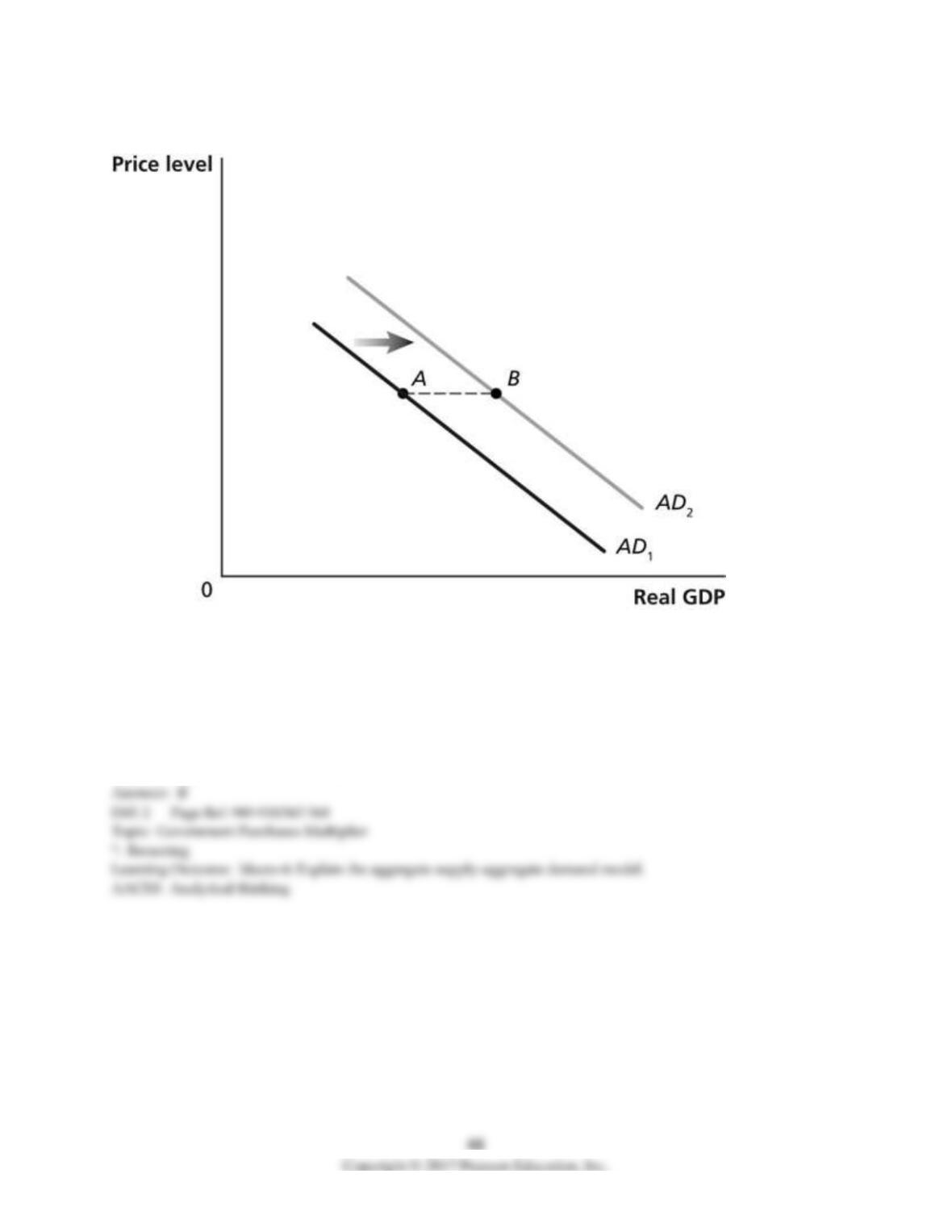
Figure 16-11
6) Refer to Figure 16-11. In the graph above, the shift from AD1 to AD2 represents the total change in
aggregate demand. If government purchases increased by $50 billion, then the distance from point A to
point B ________ $50 billion.
A) would be equal to
B) would be greater than
C) would be less than
D) may be greater than or less than
7) Refer to Figure 16-11. If government purchases increase by $100 billion and lead to an ultimate
increase in aggregate demand as shown in the graph, the difference in real GDP between point A and
point B will be
A) $100 billion.
B) less than $100 billion.
C) more than $100 billion.
D) There is insufficient information given here to draw a conclusion.
8) A change in consumption spending caused by income changes is ________ change in spending, and a
change in government spending that occurs to improve roads and bridges is ________ change in
spending.
A) an induced; an autonomous
B) an expansionary; a contractionary
C) an autonomous; an induced
D) a contractionary; an expansionary
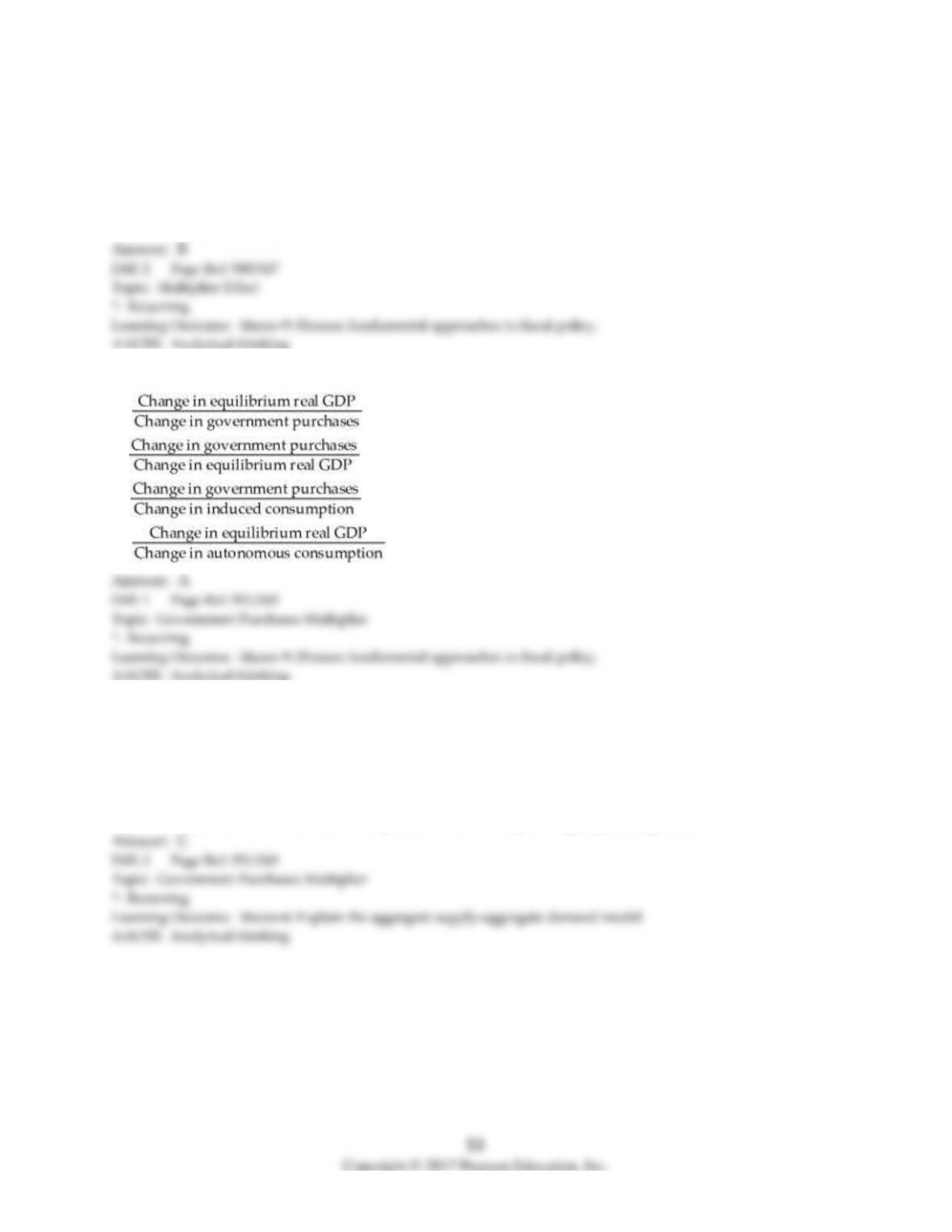
9) The government purchases multiplier equals the change in ________ divided by the change in
________.
A) government purchases; equilibrium real GDP
B) equilibrium real GDP; government purchases
C) government purchases; consumption spending
D) consumption spending; government purchases
10) The tax multiplier equals the change in ________ divided by the change in ________.
A) taxes; equilibrium real GDP
B) equilibrium real GDP; taxes
C) taxes; consumption spending
D) consumption spending; taxes
11) Which of the following would increase the size of the government purchases multiplier?
A) an increase in the tax rate
B) an increase in the quantity of imports purchased by households from an increase in income
C) a decrease in the amount of consumption spending by households from an increase in income
D) a decrease in the amount saved by households from an increase in income
12) If the tax multiplier is -1.5 and a $200 billion tax increase is implemented, what is the change in GDP,
holding everything else constant? (Assume the price level stays constant.)
A) a $300 billion decrease in GDP
B) a $300 billion increase in GDP
C) a $30 billion increase in GDP
D) a $133.33 billion decrease in GDP
E) a $133.33 billion increase in GDP
13) Suppose the government spending multiplier is 2. The federal government cuts spending by $40
billion. What is the change in GDP if the price level is not held constant?
A) an increase of less than $80 billion
B) an increase equal to $80 billion
C) an increase of greater than $80 billion
D) a decrease of less than $80 billion
E) a decrease of more than $80 billion
14) The tax multiplier is smaller in absolute value than the government purchases multiplier because
some portion of the
A) decrease in taxes will be saved by households and not spent, and some portion will be spent on
imported goods.
B) decrease in taxes will be saved by households and not spent, and some portion will be spent on
consumer durable goods.
C) increase in government purchases will be saved by households and not spent, and some portion will
be spent on imported goods.
D) increase in government purchases will be saved by households and not spent, and some portion will
be spent on consumer durable goods.
15) A decrease in the tax rate will ________ the disposable income of households and ________ the size
of the multiplier effect.
A) increase; increase
B) decrease; increase
C) increase; decrease
D) decrease; decrease
E) increase; not change
16) Suppose Congress increased spending by $100 billion and raised taxes by $100 billion to keep the
budget balanced. What will happen to real equilibrium GDP?
A) Real equilibrium GDP will fall.
B) Real equilibrium GDP will rise.
C) There will be no change in real equilibrium GDP.
D) Real equilibrium GDP will initially rise, but then fall below its previous equilibrium value.
17) Suppose real GDP is $12.6 trillion and potential GDP is $12.4 trillion. To move the economy back to
potential GDP, Congress should
A) lower government purchases by an amount less than $200 billion.
B) lower government purchases by $200 billion.
C) raise taxes by $200 billion.
D) lower taxes by $200 billion.
E) raise taxes by an amount more than $200 billion.
18) Suppose real GDP is $12.1 trillion and potential GDP is $12.6 trillion. To move the economy back to
potential GDP, Congress should
A) lower taxes by an amount less than $500 billion.
B) raise government purchases by $500 billion.
C) raise government purchases by more than $500 billion.
D) lower taxes by $500 billion.
E) lower government purchases by $500 billion.
19) The multiplier effect is the series of ________ increases in ________ expenditures that result from an
initial increase in ________ expenditures.
A) induced; investment; autonomous
B) induced; consumption; autonomous
C) autonomous; consumption; induced
D) autonomous; investment; induced
20) The government purchases multiplier is defined as
A) .
B) .
C) .
D) .
21) An increase in government purchases of $200 billion will shift the aggregate demand curve to the
right by
A) $200 billion.
B) less than $200 billion.
C) more than $200 billion.
D) None of the above are correct. This policy shifts the long-run aggregate supply curve.
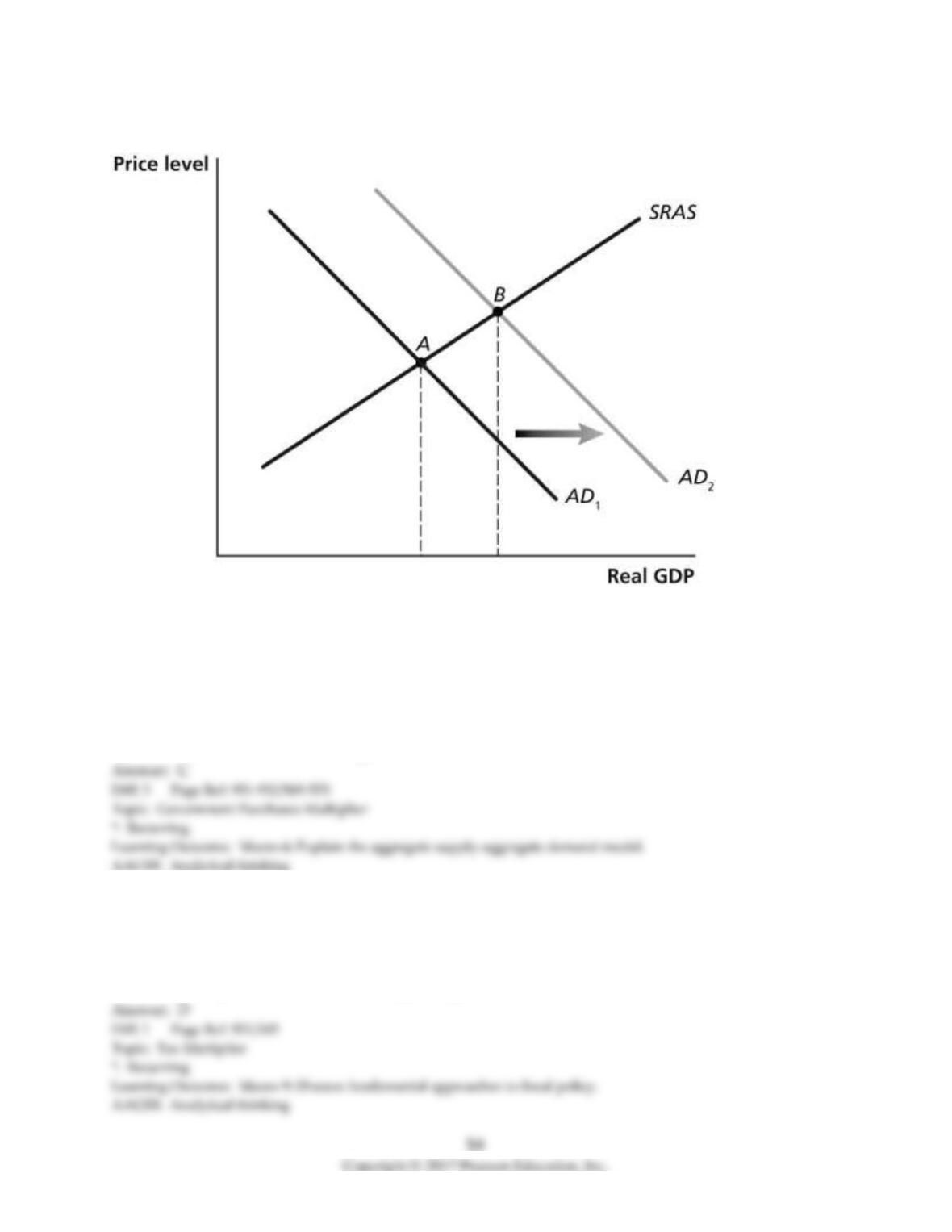
Figure 16-12
22) Refer to Figure 16-12. An increase in government purchases of $200 billion causes aggregate demand
to shift ultimately from AD1 to AD2. Assuming a constant price level, the difference in real GDP
between point A and point B will be ________ $200 billion.
A) equal to
B) less than
C) greater than
D) There is insufficient information given here to draw a conclusion.
23) Cutting taxes
A) will lower disposable income and lower spending.
B) will raise disposable income and lower spending.
C) will lower disposable income and raise spending.
D) will raise disposable income and raise spending.
24) The tax multiplier
A) is negative.
B) is larger in absolute value as compared to the government spending multiplier.
C) is a measure of how much taxes will fall when income is falling.
D) is always less than one.
25) A change in tax rates
A) has a less complicated effect on GDP than does a tax cut of a fixed amount.
B) has a larger multiplier effect the smaller the tax rate.
C) will not affect disposable income.
D) will not affect the size of the multiplier.
26) A cut in tax rates effects equilibrium real GDP through two channels: ________ disposable income
and consumer spending, and ________ the size of the multiplier effect.
A) decreasing; increasing
B) decreasing; decreasing
C) increasing; increasing
D) increasing; decreasing
27) If Congress wanted to counteract the effects of a recession it could
A) increase tax rates.
B) increase taxes by a fixed amount.
C) increase government purchases.
D) decrease defense spending.
28) An equal increase in government purchases and taxes will cause
A) an increase in real GDP.
B) no change in real GDP.
C) an increase in the budget surplus.
D) a reduction in cyclically adjusted budget surplus.
29) A permanent tax cut would likely ________ consumption spending ________ than would a tax
rebate like the one issued in 2008.
A) increase; more
B) increase; less
C) decrease; more
D) decrease; less
30) Suppose real GDP is $13 trillion, potential real GDP is $13.5 trillion, and Congress and the president
plan to use fiscal policy to restore the economy to potential real GDP. Assuming a constant price level,
Congress and the president would need to increase government purchases by
A) $500 billion.
B) less than $500 billion.
C) more than $500 billion.
D) None of the above are correct. Congress must act to decrease government purchases in this case.
31) Suppose real GDP is $13 trillion, potential real GDP is $13.5 trillion, and Congress and the president
plan to use fiscal policy to restore the economy to potential real GDP. Assuming a constant price level,
Congress and the president would need to decrease taxes by
A) $500 billion.
B) less than $500 billion.
C) more than $500 billion.
D) None of the above are correct. Congress should raise taxes in this case.
32) Suppose real GDP is $14 trillion and potential real GDP is $14.4 trillion. An increase in government
purchases of $400 billion would cause real GDP to ________ potential real GDP (assuming a constant
price level).
A) equal
B) be less than
C) be more than
D) There is insufficient information given here to draw a conclusion.
33) If the government purchases multiplier equals 2, and real GDP is $14 trillion with potential real GDP
$14.5 trillion, then government purchases would need to increase by ________ to restore the economy to
potential real GDP.
A) $7.25 trillion
B) $1 trillion
C) $500 billion
D) $250 billion
34) If the absolute value of the tax multiplier equals 1.6, real GDP is $13 trillion, and potential real GDP
is $13.4 trillion, then taxes would need to be cut by ________ to restore the economy to potential real
GDP.
A) $250 billion
B) $400 billion
C) $640 billion
D) None of the above are correct. Taxes should be increased in this case.
35) A tax rebate by the government would
A) increase your pretax income, but not your disposable income.
B) increase your disposable income, but not your pretax income.
C) decrease your pretax income, but not your disposable income.
D) decrease your disposable income, but not your pretax income.
36) A government tax rebate of $1,000 would ________ your disposable income by ________.
A) increase; less than $1,000
B) increase; $1,000
C) decrease; less than $1,000
D) decrease; $1,000
37) A one-time tax rebate, which is not expected to be extended in future years, will
A) have a moderately positive effect on consumption and aggregate demand.
B) have no effect on consumption and aggregate demand.
C) have a significant positive effect on consumption and aggregate demand, with aggregate demand
growing by a multiple of the tax rebate.
D) increase aggregate supply and aggregate demand.
38) A tax rebate, which is expected to be offered in this and all future years, will
A) have a small positive effect on consumption and aggregate demand.
B) have no effect on consumption and aggregate demand.
C) have a significant positive effect on consumption and aggregate demand, with aggregate demand
growing by a multiple of the tax rebate.
D) increase aggregate supply and aggregate demand.
39) The multiplier effect following an increase in expenditure is generated by induced increases in
consumption expenditure as income rises.
40) In absolute value, the tax multiplier is greater than the government purchases multiplier.
41) If government increases taxes by the same amount it increases government spending, there will be
no effect on aggregate demand: the increase in government spending is offset by an equal decrease in
consumption spending by households.
42) The tax multiplier is calculated as “one minus the government purchases multiplier.”
43) Suppose real GDP is $13 trillion and potential real GDP is $13.5 trillion. If Congress and the
president increase government purchases by $500 billion, then the economy will be brought to
equilibrium at potential real GDP.
44) In the case of an upward-sloping aggregate supply curve, the change in real GDP brought about by
a change in government spending will be less than that predicted by the simple government purchases
multiplier.
45) Suppose Political Party A proposes a tax cut on business income to stimulate the economy. Political
Party B opposes the tax cut on business income asserting that it would only help businesses, not the
average working man and woman. If you were hired as an economist for Political Party A, explain how
the tax cut on business income would help the average working man and woman.
46) Why would a higher tax rate lower the government purchases multiplier? What does the tax rate
have to do with the government purchases multiplier?