12) If we include consideration of potential effects of a proposed tax reduction and simplification on the
labor supply, we would expect crowding out of investment and net exports brought about by the tax
cut to be
A) less than it would be without the supply-side effects.
B) increased as aggregate real income and output rise in the long run.
C) unaffected by the shifting long-run aggregate supply curve.
D) dependent upon the impact of this tax change on consumer disposable income.
13) Consider a tax cut which affects not only consumer disposable income, but also after-tax earnings
from labor supplied to labor markets and from financial assets acquired through saving. In the long run
we would expect this tax cut to
A) decrease both the price level and increase real GDP.
B) increase both the price level and the level of real GDP.
C) increase the level of real GDP.
D) increase the price level.
14) A study by Edward Prescott found that the ________ marginal tax rates in the United States relative
to Europe resulted in a ________ quantity of labor supplied in the United States.
A) higher; larger
B) lower; larger
C) higher; smaller
D) lower; smaller
15) An increase in the tax wedge associated with a given economic activity will decrease the level of that
activity.
16) The level of crowding out associated with a tax cut will be smaller if the tax change has a supply-
side effect than it will be if it only has a demand-side effect.
17) The double taxation problem occurs because households pay taxes on dividends and capital gains
from stock and corporations pay taxes on corporate profits.
18) Raising taxes on interest and dividend income will increase the level of investment and economic
growth.
19) What is the “tax wedge”?
20) How can tax simplification be beneficial to the economy?
21) President Bush lowered taxes on capital gains and dividends in 2003. Explain how this might
increase aggregate supply.
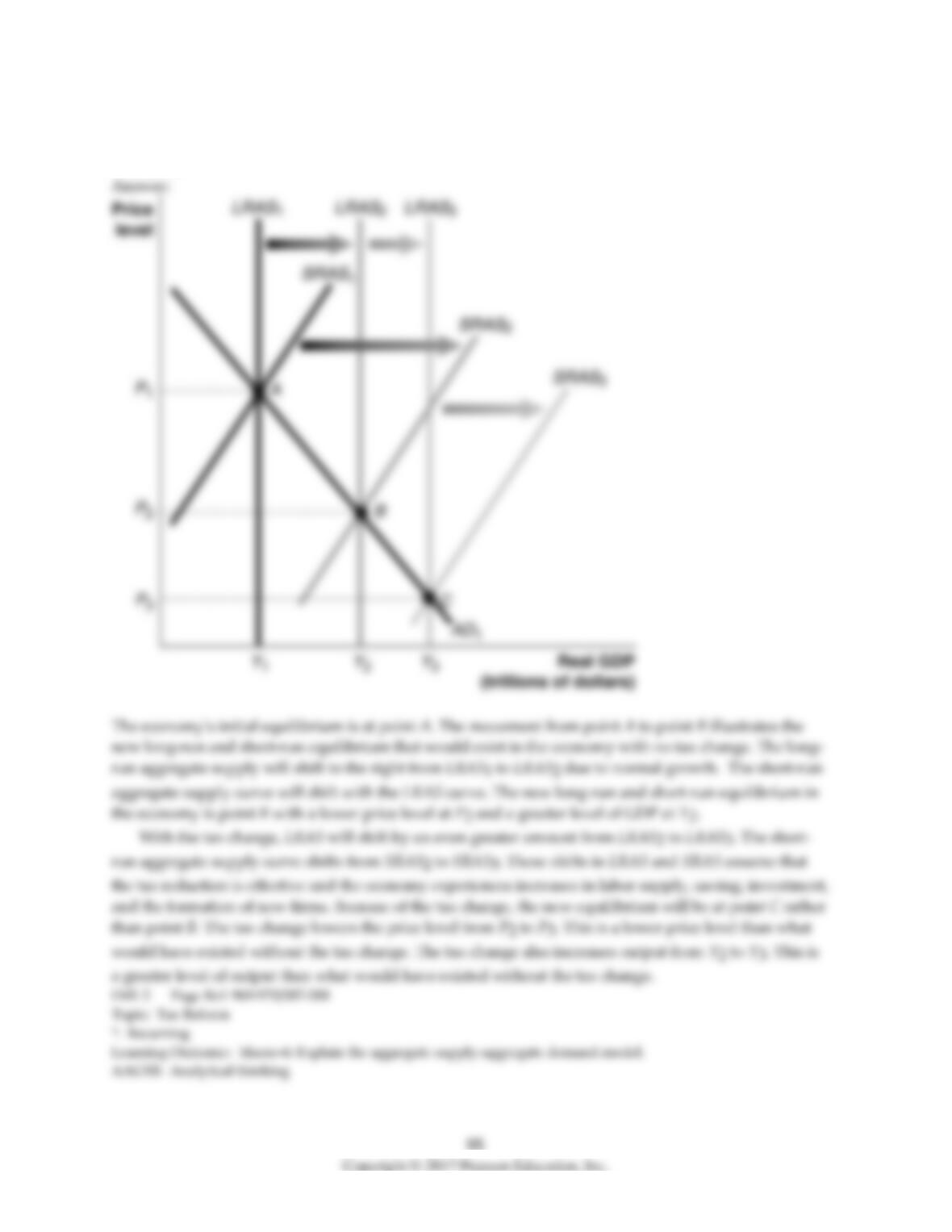
22) Illustrate and explain the effects of tax reduction and simplification using the dynamic aggregate
demand and supply model. To simplify the analysis, assume that aggregate demand is not affected by
the tax cut.
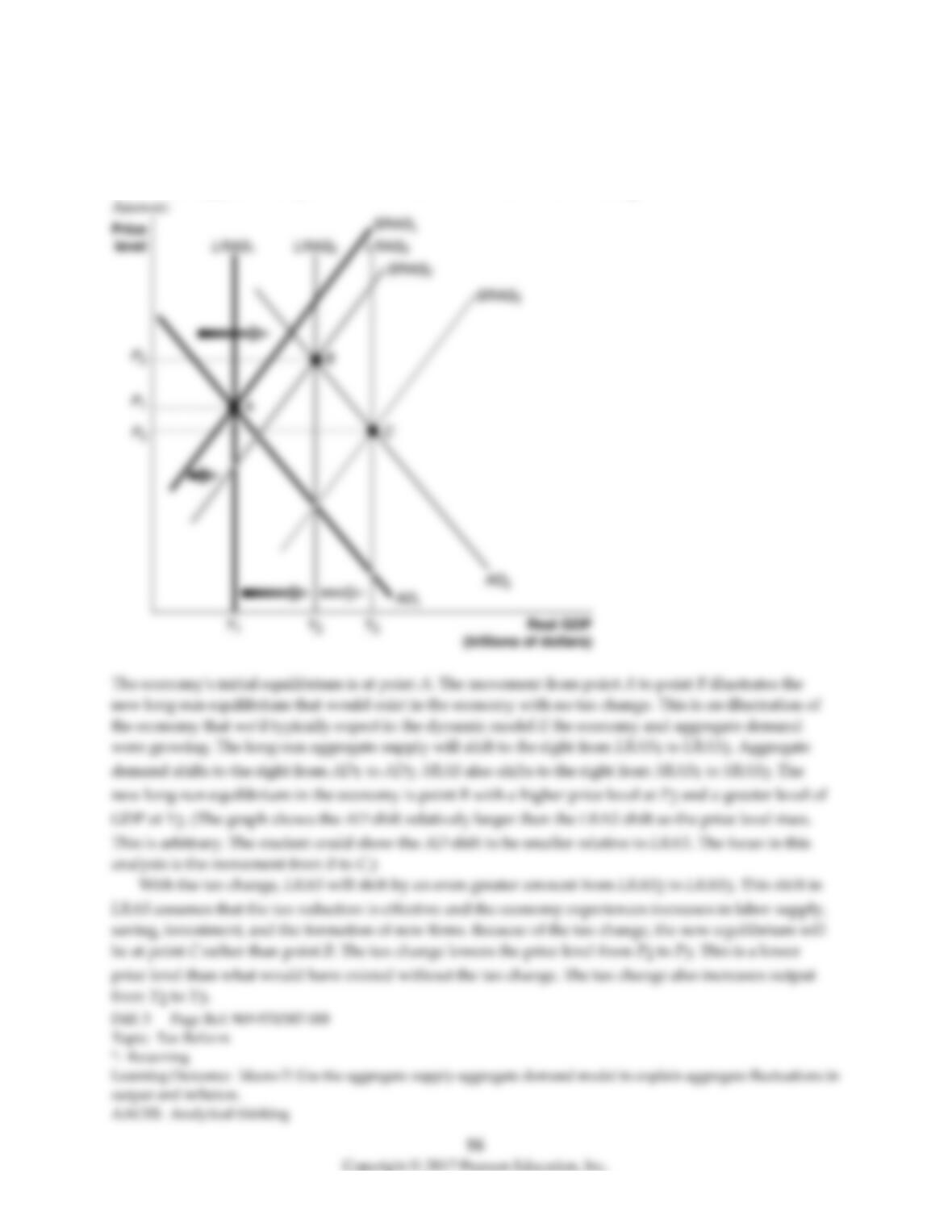
23) Show the impact of tax reduction and simplification using the dynamic aggregate demand and
aggregate supply model. Clearly show and identify the impact of the tax change. Assume that
aggregate demand and short-run aggregate supply shift as they typically do in the dynamic model.
Show what happens to the price level and real GDP because of the tax change.
16.8 Appendix: A Closer Look at the Multiplier
1) In an open economy, the government purchases multiplier will be smaller the
A) smaller the marginal propensity to import.
B) larger the tax rate.
C) larger the marginal propensity to consume.
D) All of the above are correct.
2) Assume a closed economy with fixed taxes and the marginal propensity to consume is equal to 0.9.
What is the government spending multiplier?
A) 10
B) 9
C) 5
D) 1
3) Suppose that Congress allocates $5 billion to an “energy-efficient appliance rebate” program. It also
raises taxes by $5 billion to keep the deficit from growing. If the marginal propensity to consume is 0.8,
what is the effect on equilibrium GDP?
A) GDP does not change.
B) GDP increases by $25 billion.
C) GDP increases by $4 billion.
D) GDP increases by $5 billion.
4) Suppose the president is successful in passing a $10 billion tax increase. Assume that taxes are fixed,
the economy is closed, and the marginal propensity to consume is 0.8. What happens to equilibrium
GDP?
A) There is a $50 billion increase in equilibrium GDP.
B) There is a $50 billion decrease in equilibrium GDP.
C) There is a $40 billion increase in equilibrium GDP.
D) There is a $40 billion decrease in equilibrium GDP.
5) What is the government purchases multiplier if the tax rate is 0.2 and the marginal propensity to
consume is 0.8? Assume the economy is closed.
A) 2.78
B) 5
C) 6.25
D) 100
6) In an open economy, the government purchases multiplier will be
A) larger as the marginal propensity to import decreases.
B) smaller as the marginal propensity to import decreases.
C) smaller as the marginal propensity to tax decreases.
D) larger as the marginal propensity to consume decreases.
7) Calculate the government purchases multiplier if the marginal propensity to consume equals 0.75, the
tax rate is 0.2, and the marginal propensity to import equals 0.3.
A) 1.43
B) 1.6
C) 3.33
D) 4
8) In an open economy, the government purchases multiplier will be larger the
A) smaller the marginal propensity to import.
B) smaller the marginal income tax rate.
C) larger the marginal propensity to consume.
D) All of the above are correct.
9) Assume a closed economy, that taxes are fixed, and the marginal propensity to consume is equal to
0.8. What is the government spending multiplier?
A) 10
B) 5
C) 4
D) 3
10) Suppose that Congress allocates $1 billion to clean up after hurricanes in 2016. It also raises taxes by
$1 billion to keep the deficit from growing. If the marginal propensity to consume is 0.9, what is the
effect on equilibrium GDP?
A) GDP does not change.
B) GDP increases by $10 billion.
C) GDP increases by $900,000.
D) GDP increases by $1 billion.
11) Suppose the president is successful in passing a $5 billion tax increase. Assume that taxes are fixed,
the economy is closed, and the marginal propensity to consume is 0.75. What happens to equilibrium
GDP?
A) There is a $20 billion increase in equilibrium GDP.
B) There is a $20 billion decrease in equilibrium GDP.
C) There is a $15 billion increase in equilibrium GDP.
D) There is a $15 billion decrease in equilibrium GDP.
12) What is the government purchases multiplier if the tax rate is 0.1 and the marginal propensity to
consume is 0.9? Assume the economy is closed.
A) 5.3
B) 10
C) 11.1
D) 100
13) In an open economy, the government purchases multiplier will be
A) larger as the marginal propensity to import increases.
B) smaller as the marginal propensity to import increases.
C) larger as the marginal propensity to tax increases.
D) smaller as the marginal propensity to consume increases.
14) Calculate the government purchases multiplier if the marginal propensity to consume equals 0.8, the
tax rate is 0.1, and the marginal propensity to import equals 0.2.
A) 2.1
B) 1.9
C) 1.7
D) 1.4
15) The government purchases multiplier will be larger if the marginal income tax rate decreases.
16) The larger the marginal propensity to import, the larger the government purchases multiplier.
17) In a closed economy with fixed or autonomous (non-income dependent) taxes, the balanced budget
government purchases multiplier is negative.
18) Assuming a fixed amount of taxes and a closed economy, calculate the value of the government
purchases multiplier, the tax multiplier, and the balanced budget multiplier if the marginal propensity
to consume equals 0.5.
19) Calculate the value of the government purchases multiplier if the marginal propensity to consume
equals 0.9, the tax rate equals 0.25, and the marginal propensity to import equals 0.15.
20) Assuming a fixed amount of taxes and a closed economy, calculate the value of the government
purchases multiplier, the tax multiplier, and the balanced budget multiplier if the marginal propensity
to consume equals 0.75.
21) Calculate the value of the government purchases multiplier if the marginal propensity to consume
equals 0.8, the tax rate equals 0.2, and the marginal propensity to import equals 0.05.