35) According to the quantity theory of money and prices, a 2 percent increase in the money
supply ultimately leads to
A) a 2 percent increase in real GDP.
B) a 2 percent increase in wages.
C) a 2 percent increase in the price level.
D) a 2 percent increase in velocity.
36) An increase in the price level means that
A) long-run aggregate supply has increased.
B) monetary policy has been contractionary.
C) the value of the dollar has increased.
D) the purchasing power of money has fallen.
37) Which of the following is a variable in the equation of exchange?
A) the price level.
B) the money supply.
C) the velocity of money.
D) real GDP.
E) all of the above.
38) The equation of exchange can be written as
A) MsP = VY.
B) MsV = PY.
C) MsY = VP.
D) None of the above are correct.
39) The “V” in the equation of exchange MsV = PY refers to
A) a variable.
B) income velocity of money.
C) the velocity of inflation.
D) a vector that links P to Y.
40) If V is constant and Y is fixed, any change in M
A) leads to a smaller change in P.
B) leads to a larger change in P.
C) leads to a proportionate change in P.
D) does not lead to change in P.
41) By saying that the equation of exchange is an accounting identity, we mean that
A) it is useful for accountants, but not for economists.
B) it identifies the key national income accounts.
C) it is always true.
D) it explains the effect of questionable accounting practices on macroeconomic performance.
42) The quantity theory of money and prices asserts that
A) increases in the money supply lead to inflation.
B) increases in the money supply lead to an increase in the velocity of money.
C) increases in the money supply lead to a decrease in the velocity of money.
D) increases in the money supply will increase real GDP.
43) The quantity theory of money and prices rests on the assumption that
A) the velocity of money is constant.
B) the minimum wage is constant.
C) the nominal interest rate is constant.
D) the foreign exchange rate is constant.
44) The number of times per year that a dollar is spent on final goods and services defines
A) the money supply.
B) the income velocity of money.
C) the price index.
D) GDP.
45) Which of the following best describes the income velocity of money?
A) V = PMs
B) V = Y
C) V = PY/Ms
D) V = Ms/PY
46) According to the simple quantity theory of money, which of the following variables are
considered either constant or relatively stable?
A) V and Y
B) Y and Ms
C) P and Ms
D) P and Y
47) The hypothesis that changes in the money supply lead to proportional changes in the price
level is called
A) the equation of exchange.
B) the Keynesian multiplier.
C) the theory of empirical relativity.
D) the quantity theory of money and prices.
48) The equation of exchange specifies that
A) MsV = PY.
B) velocity and money supply are directly related.
C) MsP = VY.
D) Ms = PVY.
49) In an economy that is at full employment, an increase in money supply will result in
inflation, unless
A) velocity increases.
B) velocity decreases.
C) real GDP falls.
D) tax reduction is proportional to increases in the money supply.
50) In the equation of exchange, if the money supply is $3 billion, the price level is 2, and the
real GDP is $6 billion, the velocity is
A) 1.
B) 2.
C) 4.
D) 36.
51) If we assume that velocity is constant, and if the money supply increases by 2 percent, we
would expect, ceteris paribus, that the price level would
A) increase by 1 percent.
B) increase by 2 percent.
C) decrease by 1 percent.
D) decrease by 2 percent.
52) If both nominal and real GDP are increasing when the money supply is constant, than we can
conclude that
A) velocity has increased.
B) velocity has decreased.
C) interest rate has fallen.
D) interest rate has increased.
53) If a nation’s nominal GDP is $40 billion, its money supply is $8 billion, and its price level is
2, then the velocity of money is
A) 16.
B) 2.
C) 5.
D) 10.
54) What is the equation of exchange? How can the equation of exchange be converted into the
quantity theory of money?
16.5 Monetary Policy Transmission and Credit Policy at Today’s Fed
1) In the interest-rate-based transmission mechanism, a decrease in the money supply will
A) increase the price level.
B) reduce the rate of interest and the level of investment.
C) reduce investment, shift the aggregate demand function inward, and lower real Gross
Domestic Product (GDP).
D) shift the aggregate supply function inward and increase real Gross Domestic Product (GDP).
2) The monetary transmission mechanism that assumes that money supply growth stimulates the
economy primarily by encouraging investment is
A) the interest-rate-based transmission mechanism.
B) the classical transmission mechanism.
C) the post-Keynesian transmission mechanism.
D) pre-Keynesian transmission mechanism.
3) The linkages of the interest-rate-based transmission mechanism of monetary policy are
summarized as follows:
A) change in the money supply → change in speculative balances → change in transactions
balances → change in planned investment → change in aggregate demand.
B) change in the money supply → change in planned investment → change in government
spending → change in aggregate demand.
C) change in the money supply → change in interest rates → change in planned investment →
change in aggregate demand.
D) change in the money supply → change in interest rates → change in transactions balances →
change in government spending → change in aggregate demand.
4) Assume (other things constant) that the Fed increases the money supply. The mechanism
through which aggregate demand increases is, according to interest-rate-based transmission
mechanism, summarized as follows:
A) the money supply increases → there is a drop in money balances held → interest rates
increase → planned investment spending decreases → aggregate demand increases.
B) increase in money supply → increase in money balances held → decrease in interest rates →
decrease in planned investment spending → increase in aggregate demand.
C) increase in money supply → decrease in money balances held → decrease in interest rates →
increase in planned investment spending → increase in aggregate demand.
D) increase in money supply → decrease in interest rates → increase in planned investment
spending → increase in aggregate demand.
5) According to the interest-rate-based monetary policy transmission mechanism
A) an increase in money supply will increase interest rates.
B) an increase in money supply will decrease interest rates.
C) a decrease in money supply will decrease interest rates.
D) a decrease in money supply will not change interest rates.
6) According to the interest-rate-based monetary policy transmission mechanism
A) an increase in the required reserve ratio will lower interest rates.
B) a decrease in the required reserve ratio will lower interest rates.
C) a decrease in the required reserve ratio will not affect interest rates.
D) an increase in the required reserve ratio will not affect interest rates.
7) The interest-rate-based transmission mechanism assumes that the Fed can stimulate
investment by
A) selling bonds.
B) buying bonds.
C) raising the discount rate relative to the federal funds rate.
D) raising the required reserve ratio.
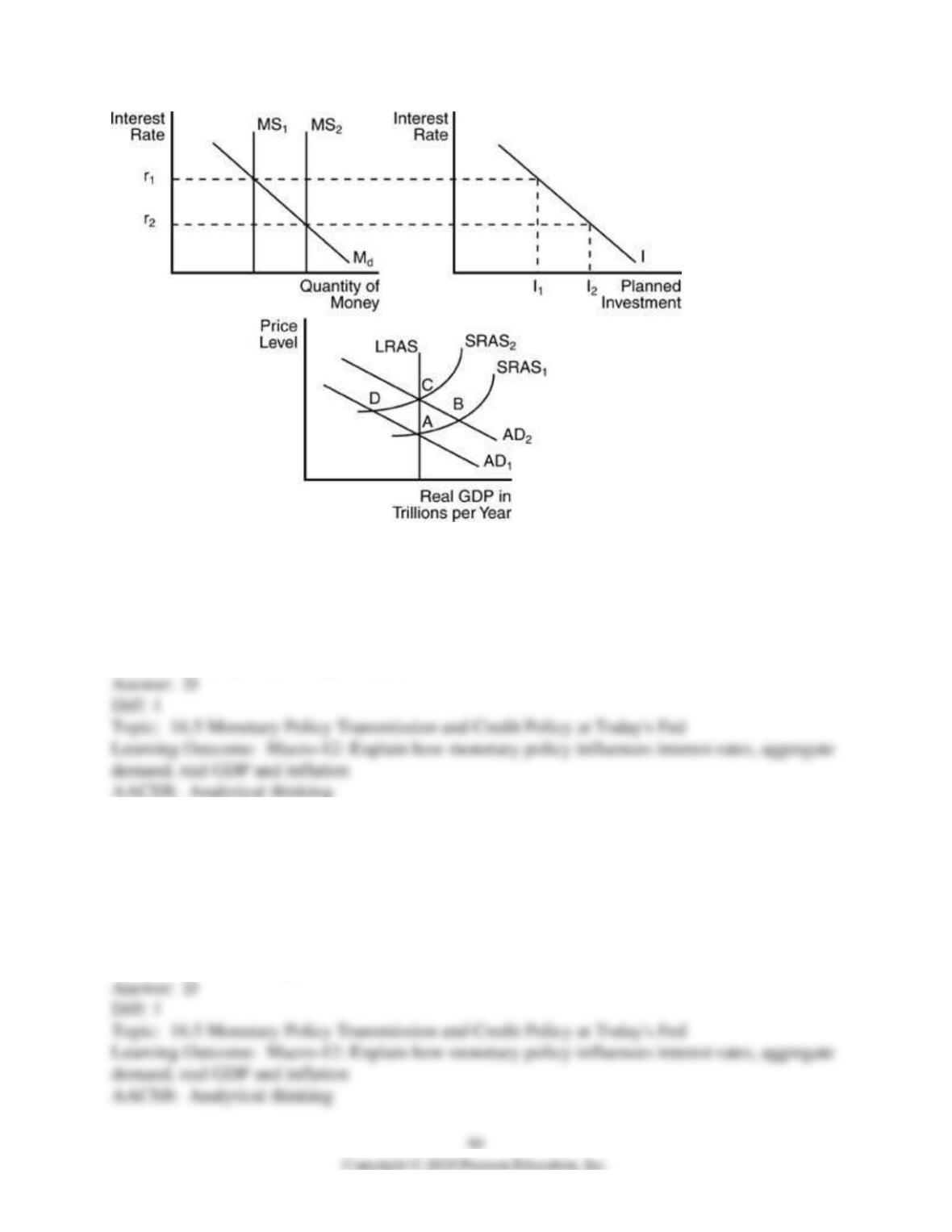
8) In the above figure, suppose the economy is in short-run equilibrium at point D. Which of the
following is the best policy option for the Fed?
A) Increase the required reserve ratio.
B) Increase government spending.
C) Increase taxes.
D) open market purchase of government securities
9) In the above figure, suppose the economy is at a short-run equilibrium at point B and the
interest rate is r2. Which of the following policy options for the Fed will help solve the short-run
situation?
A) lowering the differential between the discount rate and the federal funds rate
B) open market purchase of government securities
C) lowering the required reserve ratio
D) open market sale of government securities
10) In the above figure, if the economy is initially at an equilibrium output at point A and the
interest rate is r1, then an open market purchase of bonds by the Fed will
A) cause interest rates to increase and output to decline.
B) cause interest rates to decline to r2, investment to increase to I2, and the AD curve to shift
upward to the right.
C) cause interest rates to decline to r2, investment to decline, and aggregate demand to shift
inward to the left.
D) not have any impact on short- or long-run equilibrium real Gross Domestic Product (GDP).
11) According to proponents of the interest-rate-based monetary policy transmission mechanism,
any increase in the money supply
A) is effective in increasing Gross Domestic Product (GDP) only if it causes an outward shift of
the aggregate supply curve.
B) will increase Gross Domestic Product (GDP) only if interest rates fall and investment is
sensitive to decreasing interest rates.
C) causes velocity to increase, and so in the short run nominal Gross Domestic Product (GDP)
must increase.
D) will move the economy from the “liquidity trap” during times of recession if interest rates fall
enough to stimulate private investment.
12) Proponents of the interest-rate-based monetary policy transmission mechanism argue that
when the Federal Reserve buys bonds, there will be
A) an increase in investment spending.
B) a decrease in the money supply.
C) a decrease in nominal Gross Domestic Product (GDP), but not in real income.
D) a decrease in the price of outstanding bonds.
13) The interest-rate-based monetary policy transmission mechanism argues that an increase in
the money supply
A) has no effect on aggregate demand but reduces long-run aggregate supply.
B) has no effect on aggregate demand but increases short-run aggregate supply.
C) causes interest rates to fall, which causes an increase in planned investment, and an increase
in aggregate demand.
D) causes the inflation rate to decline, which causes an increase in household consumption
spending and an increase in aggregate demand.
14) The interest-rate-based monetary policy transmission mechanism emphasizes the
A) indirect effect of a change in the money supply that operates via a change in total planned
expenditures generated by a change in the interest rate.
B) direct effect of a change in the money supply that operates via a change in total planned
production generated by a change in the price level.
C) direct effect of a change in the money supply that operates via a change in total planned
expenditures generated by a change in the interest rate.
D) indirect effect of a change in the money supply that operates via a change in total planned
production generated by a change in the price level.
15) Which of the following statements is FALSE?
A) Both monetary and interest rate targets cannot be pursued simultaneously.
B) A reduction in the required reserve ratio increases the money supply and pushes down the
equilibrium interest rate.
C) An open market purchase reduces the money supply and pushes down the equilibrium interest
rate.
D) An open market sale decreases the money supply and pushes up the equilibrium interest rate.
16) A key causal link in the interest-rate-based transmission mechanism for monetary policy is
from
A) investment to the interest rate.
B) the money supply to excess reserves.
C) a monetary policy action to excess reserves.
D) real GDP to investment.
17) If the source of economic instability is generally variations in spending, then the Fed should
A) set money supply targets.
B) print more money.
C) buy gold.
D) raise taxes.
18) According to the interest-rate-based monetary policy transmission mechanism, an increase in
the money supply generates
A) lower interest rates, which causes an increase in planned real investment spending and an
increase in aggregate demand.
B) increased spending on consumer goods and services directly, which causes an increase in
aggregate demand.
C) an increase in nominal GDP and a change in the price level, but no change in real GDP.
D) an increase in aggregate supply since the supply of money is part of aggregate supply.
19) Which of the following is NOT a reason the Fed alters the rate of growth of the money
supply?
A) to influence aggregate demand
B) to shift the demand for money curve
C) to influence the amount of consumption
D) to influence the amount of investment
20) The interest-rate-based approach to the monetary policy transmission mechanism says that a
change in the money supply influences aggregate demand by
A) a change in interest rates, which changes investment.
B) a change in interest rates, which changes the money supply.
C) changing consumer consumption behavior as they adjust to a change in the number of dollars
available.
D) leading to shifts of the short-run aggregate supply curve.
21) According to the interest-rate-based monetary policy transmission mechanism, an increase in
the money supply will
A) lead to a decrease in investment spending and an increase in real GDP that is equal to the
decrease in investment spending.
B) lead to a decrease in investment spending and an increase in real GDP which is greater than
the decrease in investment spending.
C) lead to an increase in investment spending and a decrease in real GDP that is equal to the
increase in investment spending.
D) lead to an increase in investment spending and an increase in real GDP which is greater than
the increase in investment spending.
22) According to the interest-rate-based transmission mechanism, a decrease in the money
supply will
A) lead to a decrease in investment spending and an increase in real GDP that is equal to the
decrease in investment spending.
B) lead to a decrease in investment spending and a decrease in real GDP which is greater than
the decrease in investment spending.
C) lead to an increase in investment spending and a decrease in real GDP that is equal to the
increase in investment spending.
D) lead to an increase in investment spending and a decrease in real GDP which is greater than
the increase in investment spending.
23) An increase in the money supply will affect aggregate demand
A) only if the increase in the money supply causes interest rates to rise.
B) only if the increase in the money supply causes people to buy less goods and services.
C) only if the increase in the money supply causes people to increase their saving.
D) if the increase in the money supply causes interest rates to fall and/or causes people to buy
more goods and services.
24) According to the interest-rate-based perspective on the monetary policy transmission
mechanism
A) key channels of monetary policy indirectly ultimately relate money supply changes to total
planned spending through indirect effects on planned investment.
B) changes in the money supply have little influence on macroeconomic variables.
C) monetary policy leads to increases in the price level but will have no effect on the rate of
output.
D) inflation is always caused by excessive monetary growth and changes in the money supply
offset aggregate demand only directly.
25) The interest-rate-based approach to monetary policy says that a change in the money supply
influences aggregate demand by
A) a change in interest rates which changes investment.
B) following the monetary rule.
C) changing consumer consumption behavior as they adjust to a change in the number of dollars
available.
D) leading to shifts of the short-run aggregate supply curve.
26) According to the interest-rate-based monetary policy transmission mechanism, an increase in
the money supply will
A) lead to a decrease in investment spending and an increase in real GDP that is equal to the
decrease in investment spending.
B) lead to a decrease in investment spending and an increase in real GDP which is greater than
the decrease in investment spending.
C) lead to an increase in investment spending and a decrease in real GDP that is equal to the
increase in investment spending.
D) lead to an increase in investment spending and an increase in real GDP which is greater than
the increase in investment spending.
27) According to the interest-rate-based monetary policy transmission mechanism, a decrease in
the money supply will
A) lead to a decrease in investment spending and an increase in real GDP that is equal to the
decrease in investment spending.
B) lead to a decrease in investment spending and a decrease in real GDP which is greater than
the decrease in investment spending.
C) lead to an increase in investment spending and a decrease in real GDP that is equal to the
increase in investment spending.
D) lead to an increase in investment spending and a decrease in real GDP which is greater than
the increase in investment spending.
28) If the Fed has announced that it plans on lowering the interest rate it will
A) engage in expansionary open market operations, thereby decreasing the money supply.
B) engage in expansionary open market operations, thereby increasing the money supply.
C) engage in contractionary open market operations, thereby decreasing the money supply.
D) engage in contractionary open market operations, thereby increasing the money supply.
29) If the Fed has announced that it plans on increasing the interest rate it will
A) engage in expansionary open market operations, thereby decreasing the money supply.
B) engage in expansionary open market operations, thereby increasing the money supply.
C) engage in contractionary open market operations, thereby decreasing the money supply.
D) engage in contractionary open market operations, thereby increasing the money supply.
30) According to the interest-rate-based transmission mechanism for monetary policy, an
increase in the money supply will cause the
A) interest rate to fall, causing planned real investment spending to rise and leading to a decrease
in aggregate demand.
B) interest rate to rise, causing planned real investment spending to rise and leading to a decrease
in aggregate demand.
C) interest rate to fall, causing planned real investment spending to rise and leading to an
increase in aggregate demand.
D) interest rate to fall, causing planned real investment spending to fall and leading to an
increase in aggregate demand.
31) According to the interest-rate-based transmission mechanism for monetary policy, a decrease
in the money supply will cause the
A) interest rate to fall, causing planned real investment spending to rise and leading to a decrease
in aggregate demand.
B) interest rate to rise, causing planned real investment spending to rise and leading to a decrease
in aggregate demand.
C) interest rate to fall, causing planned real investment spending to rise and leading to an
increase in aggregate demand.
D) interest rate to rise, causing planned real investment spending to fall and leading to a decrease
in aggregate demand.
32) The interest-rate-based transmission mechanism for monetary policy in the Keynesian
system indicates that
A) increases in the money supply lead to decreases in the interest rate, which decreases
investment, which decreases the level of real GDP.
B) decreases in the money supply lead to increases in the interest rate, which increases
investment, which increases the level of real GDP.
C) increases in the money supply cause people to spend more, leading to increases in real GDP.
D) increases in the money supply lead to decreases in the interest rate, which increases
investment, which increases the level of real GDP.
33) According to the interest-rate-based monetary policy transmission mechanism, which of the
following monetary policies would result in an increase in the level of planned real investment
spending?
A) contractionary
B) expansionary
C) reactionary
D) Monetary policy has no effect on investment.
34) The interest-rate-based monetary policy transmission mechanism suggests that the changes
in the money supply affect aggregate spending
A) indirectly through interest rates and planned investment spending.
B) directly through interest rates and planned consumption spending.
C) indirectly through tax rates and planned consumption spending.
D) directly through interest rates and planned government spending.
35) Suppose the economy is initially in long-run and short-run equilibrium. If the Fed decides to
pursue a contractionary monetary policy, we will see
A) bond prices fall, interest rates fall, aggregate demand remains unchanged as consumption
spending decreases, but investment spending increases. GDP remains constant in both the short
run and the long run, but the price level falls in both.
B) bond prices fall, interest rates rise, aggregate demand falls as investment and consumption
spending decrease, and real GDP and the price level decreasing in the short-run, but only the
price level decreasing in the long run.
C) bond prices fall, interest rates rise, aggregate demand falls as investment spending decreases
and consumption spending remains unchanged, and real GDP and the price level decrease in the
short run, but only the price level falls in the short run.
D) interest rates rise but no change in bond prices. Aggregate demand falls as consumption
spending and investment spending decrease, and the price level and real GDP fall in both the
short run and the long run.
36) Suppose there is an increase in the money supply, but that people’s demand for money
balances increases by a greater amount at the same time. The net effect would be
A) a lower price level in the long run.
B) no change in aggregate demand or aggregate supply.
C) an increase in aggregate demand due to the increase in the money supply, but a decrease in
aggregate supply due to the increase in the demand for money.
D) lower interest rates, greater real GDP, and a higher price level as aggregate demand increases
because of the indirect effect of the increase in the money supply.
37) The interest rate that the Fed charges banks to borrow funds from the Fed is the
A) discount rate.
B) federal funds rate.
C) money market rate.
D) nominal interest rate.
38) One of the tools of monetary policy is to change the discount rate. Since 2003
A) the Fed has not changed the discount rate.
B) the Fed has pegged the discount rate to the reserve requirement.
C) the Fed has kept the discount rate a fixed amount above the federal funds rate.
D) the Fed has kept the federal funds rate one percentage point above the discount rate.