16) How is the efficient quantity of public goods determined?
17) What is the principle of minimum differentiation?
18) How does the principle of minimum differentiation relate to the free-rider problem?
19) What is rational ignorance?
20) Explain why some amount of ignorance can be rational.
21) Why is it rational for individuals to be ignorant about public goods but not about private
goods?
22) Under what conditions will the political process provide an inefficient amount of a public
good?
6 Numeric and Graphing Questions
Quantity
(cars on duty)
Paul’s marginal
benefit
(dollars per car)
Art’s marginal
benefit
(dollars per car)
1
50
90
2
40
75
3
30
60
4
20
45
5
10
30
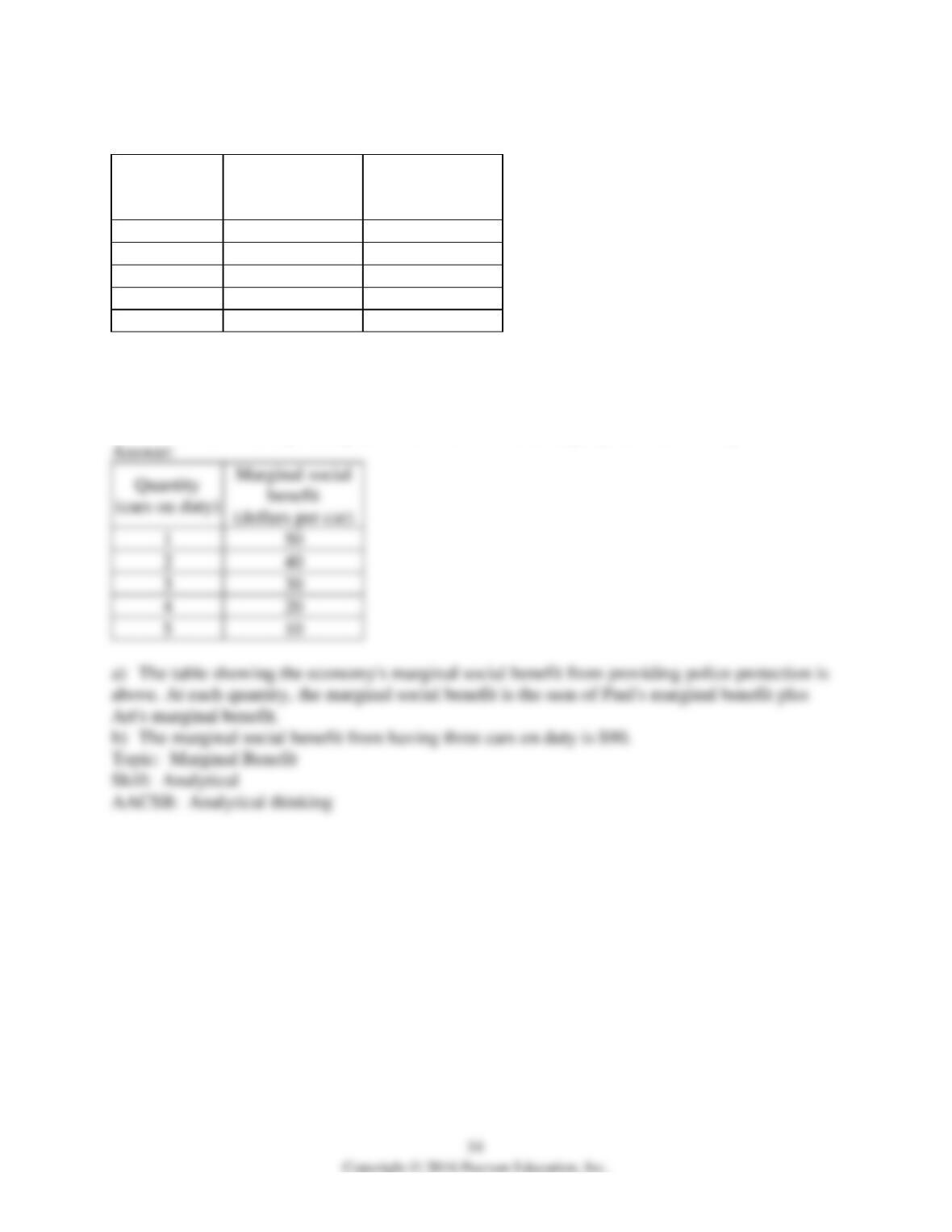
1) The table above shows the marginal benefit that arises from providing police protection in an
economy of two people, Paul and Art. Police protection is a public good.
a) Construct a table of the economy’s marginal social benefit from providing police protection.
b) What is the economy’s marginal social benefit from having 3 police cars on duty?
Quantity
(cars on duty)
benefit
(dollars per car)
1
50
2
40
3
30
4
20
5
10
Number of
police cars on
duty
Jake’s
marginal
benefit
(dollars)
Elwood’s
marginal
benefit
(dollars)
1
45
20
2
35
16
3
25
12
4
15
8
5
5
4
2) The table above shows the marginal benefit from providing police protection in a community
of two people, Jake and Elwood. Police protection is a public good.
a) What is the marginal social benefit to community from the 4th police car on duty?
b) If the marginal social cost of a police car on duty is $37, what is the efficient number of cars
on duty?
c) If the marginal social cost of a police car on duty is $70, what is the efficient number of cars
on duty?
Quantity
(street lights
per block)
Marginal
social benefit
(dollars per
year)
Marginal
social cost
(dollars per
year)
0
0
0
1
14
4
2
12
7
3
10
10
4
8
13
5
6
16
6
4
19
3) The table above provides information about the marginal social cost and marginal social
benefit of street lights, which are a public good.
a) What quantity would a private company provide? Why?
b) What is the efficient quantity?
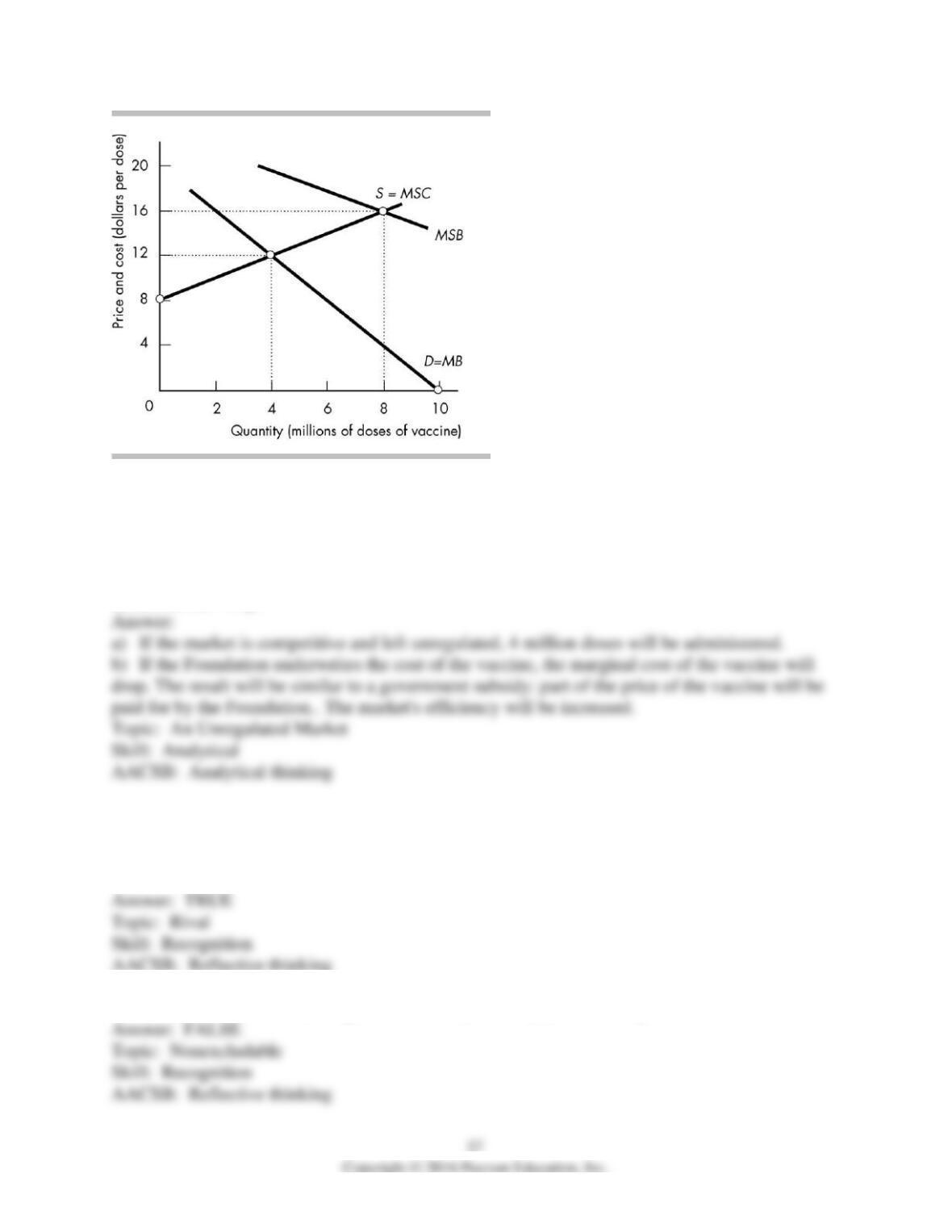
4) The figure above shows the market for polio vaccination in Africa.
a) If the market is competitive and left unregulated, how many doses of vaccine will be
administered?
b) If the Melinda and Bill Gates Foundation underwrites the cost of the vaccine by paying for a
large fraction of the preparation and delivery cost, what will happen to the number of doses
administered? Why?
7 True or False
1) If the consumption of a good decreases the quantity available for another person, the good is
rival.
2) If people can benefit from a good even if they do not pay for it, the good is nonrival.
3) Cable television is an example of a public good.
4) An example of a public good is national defense services.
5) A common resource is nonrival but excludable.
6) Free riding is possible if the good is nonexcludable.
7) A free rider is a person who consumes a good without paying for it.
8) A free rider problem is created by private goods.
9) Because of free riders, a private, unregulated market would not produce the efficient quantity
of a public good.
10) The marginal social benefit curve from a public good is found by horizontally summing the
marginal benefit curves of all individuals.
11) The efficient quantity of a public good is the quantity that has the highest possible marginal
social benefit.
12) The efficient quantity of a public good is the quantity that sets the marginal social benefit
from the good equal to the good’s marginal social cost.
13) If a voter is ignorant of some of the issues that affect public policy, then the voter is
definitely behaving irrationally.
14) The concept of rational ignorance can explain why the government might provide more than
the efficient quantity of a public good.
15) Because of voter rational ignorance, the government might not produce the efficient quantity
of a public good.
16) If voters are rationally ignorant, then the interest of the bureaucracy to maximize its budget
will result in an oversupply of a public good.
8 Extended Problems
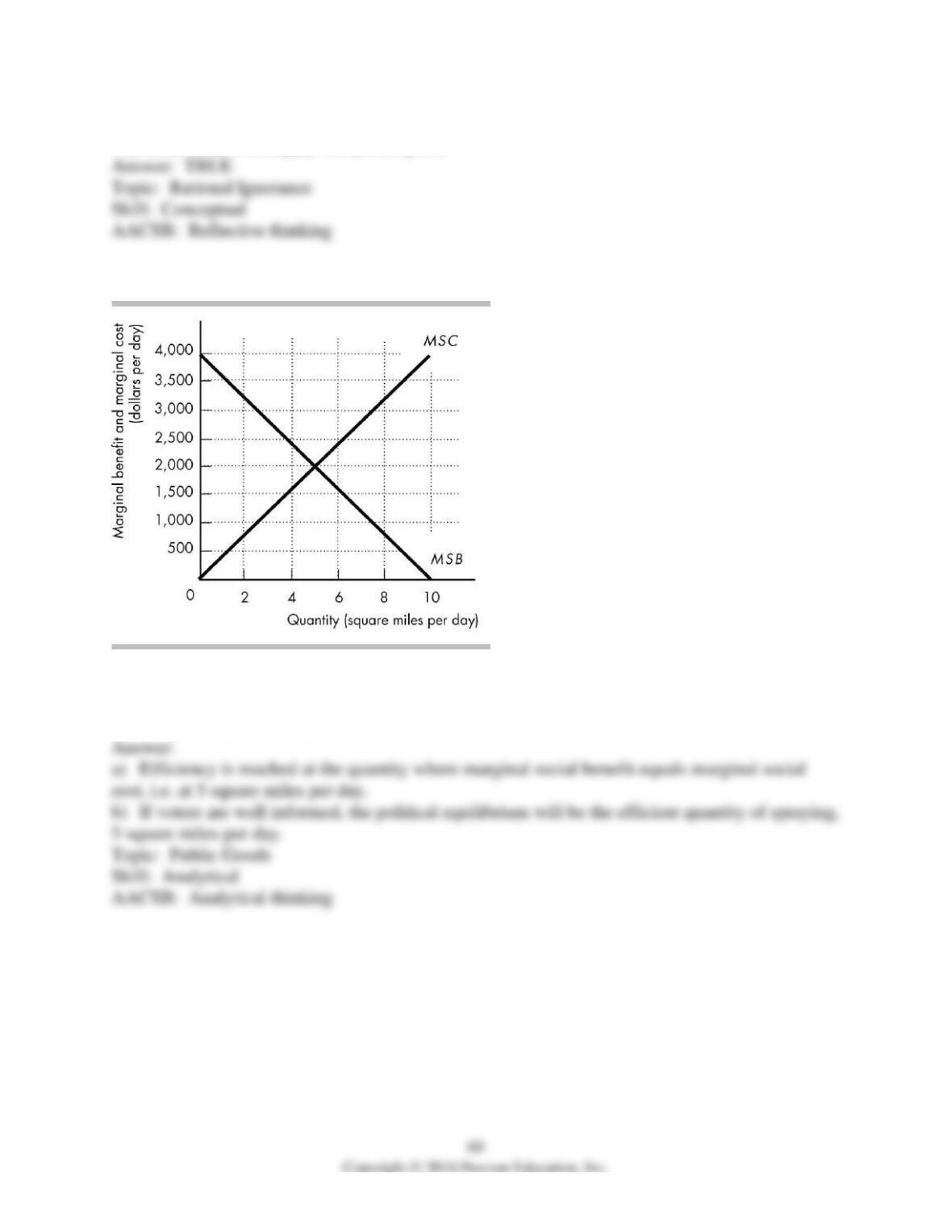
1) The graph shows costs and benefits of a mosquito control program, which is a public good:
a) What is the quantity of spraying that achieves efficiency?
b) What is the political equilibrium if voters are well informed?
61
Capacity
(millions of
gallons per
month)
Total cost
(thousands of
dollars per
month)
Marginal benefit
to a resident
(cents per 1,000
gallons)
1.5
550
1.2
3.0
1,060
1.0
4.5
1,630
0.8
6.0
2,260
0.6
7.5
2,950
0.4
9.0
3,700
0.2
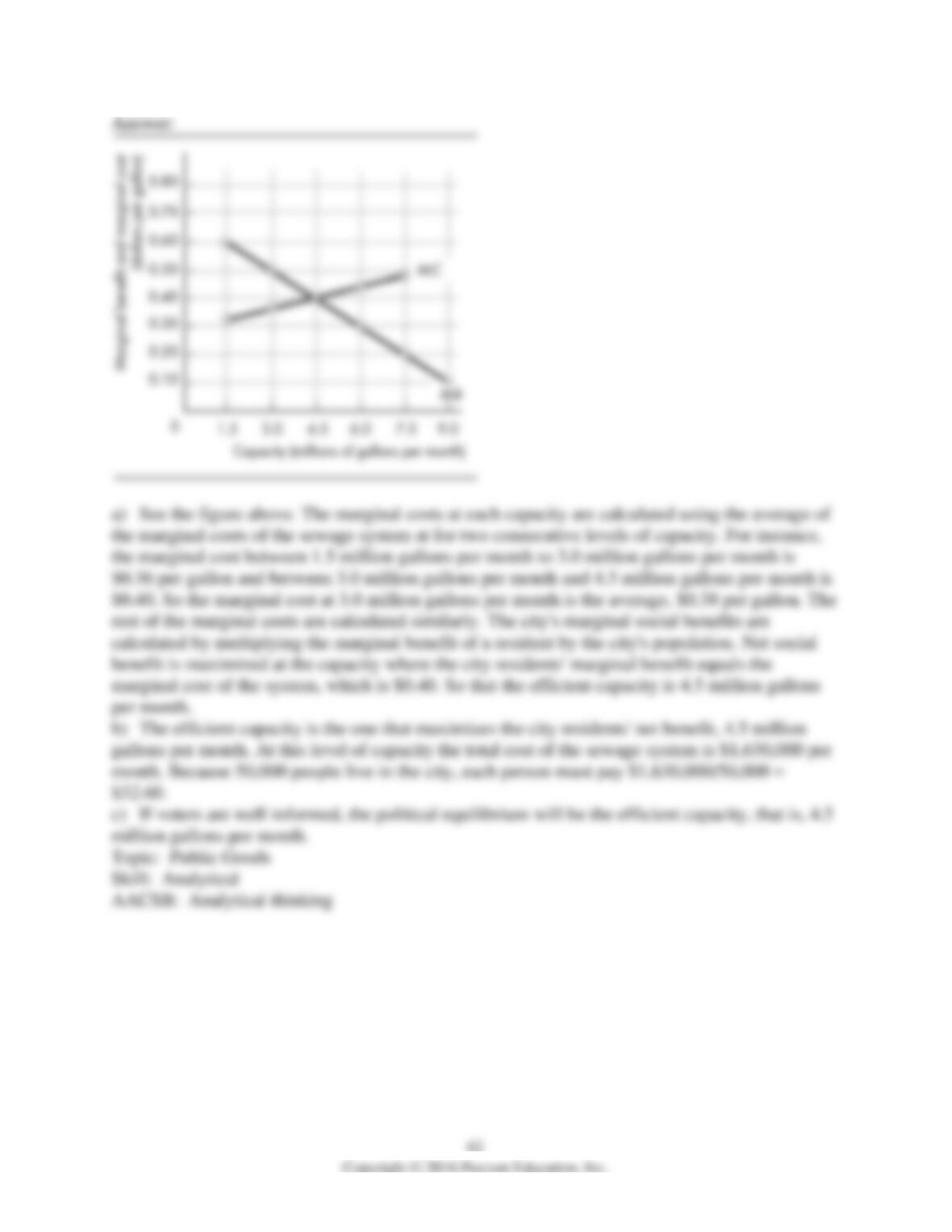
2) A city of 50,000 people is considering installing a sewage disposal system. The total fixed
cost of the system is $100,000 per month. The marginal benefit to an average city resident from
the first thousand gallons of capacity is 1.4 cents. The table shows the relationship between the
system’s capacity, its total cost, and the marginal benefit received by an average city resident:
a) Draw the marginal social cost curve of the sewage system and the residents’ marginal social
benefit curve. What is the capacity that achieves maximum net benefit?
b) How much will each person have to pay in taxes to support the efficient capacity level?
c) What is the political equilibrium if voters are well informed?