7) In a single payer model of healthcare, the government pays for all healthcare. Because patients
access healthcare at a zero or low cost, the quantity of healthcare services demanded exceeds the
quantity provided.
A) Both sentences are false.
B) The first sentence is false; the second sentence is correct.
C) The first sentence is correct; the second sentence is false.
D) Both sentences are correct.
8) In the United States, the smallest source of expenditure on healthcare is
A) government expenditure.
B) private insurance expenditure.
C) out-of-pocket expenditure.
D) unknown.
9) The United States uses a single payer model of healthcare in which the government pays for
all healthcare. Because a single payer model of health care creates no deadweight loss, most
economists agree that the U.S. system of health care is efficient..
A) Both sentences are false.
B) The first sentence is false; the second sentence is correct.
C) The first sentence is correct; the second sentence is false.
D) Both sentences are correct.
10) In Obamacare (the Affordable Care Act) gives low-income families
A) vouchers for healthcare.
B) subsidies to buy private healthcare insurance.
C) full access to Medicaid.
D) full access to Medicare..
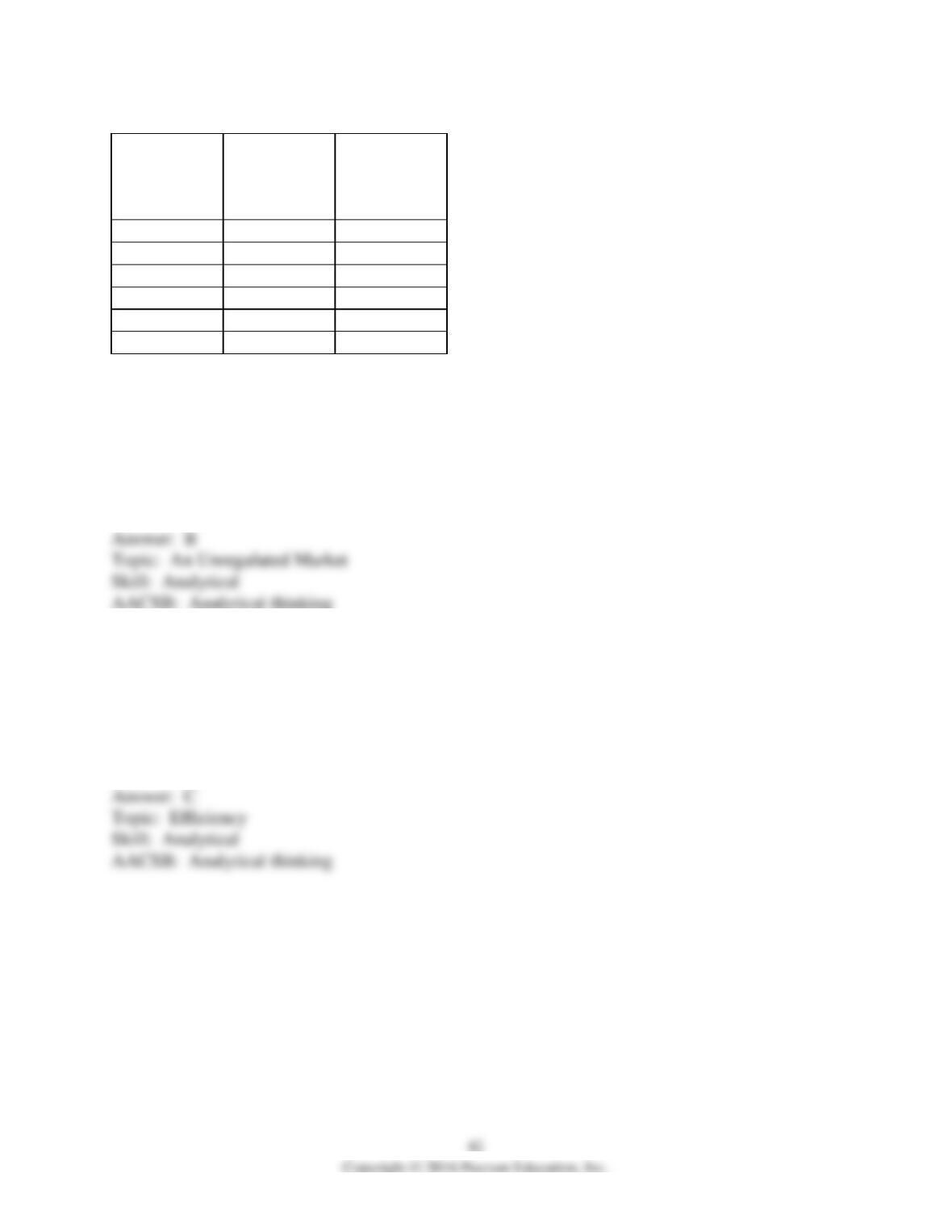
Quantity
(millions of
vaccinations)
Marginal
perceived
benefit
(dollars)
Marginal
social benefit
(dollars)
1
12
18
2
11
16
3
10
14
4
9
12
5
8
10
6
7
8
11) The table above gives information on the marginal perceived private benefit and marginal
social benefit associated with vaccination against varicella (chicken pox). If the marginal cost of
a varicella vaccination is $10, then the unregulated competitive equilibrium will have
A) 2 million vaccinations.
B) 3 million vaccinations.
C) 4 million vaccinations.
D) 5 million vaccinations.
12) The table above gives information on the marginal perceived private benefit and marginal
social benefit associated with vaccination against varicella (chicken pox). If the marginal cost of
a varicella vaccination is $10, then the efficient quantity of vaccinations is
A) 3 million vaccinations.
B) 4 million vaccinations.
C) 5 million vaccinations.
D) 6 million vaccinations.
13) The table above gives information on the marginal perceived private benefit and marginal
social benefit associated with vaccination against varicella (chicken pox). If the marginal cost of
a varicella vaccination is $10, to achieve an efficient quantity of vaccinations, the government
could provide a subsidy of
A) $4 per vaccination.
B) $3 per vaccination.
C) $2 per vaccination
D) $1 per vaccination.
14) In the above figure, the competitive unregulated equilibrium is producing and consuming
________ vaccinations per year at a price of ________.
A) 30 thousand; $40
B) 30 thousand; $30
C) 30 thousand; $20
D) 50 thousand; $30
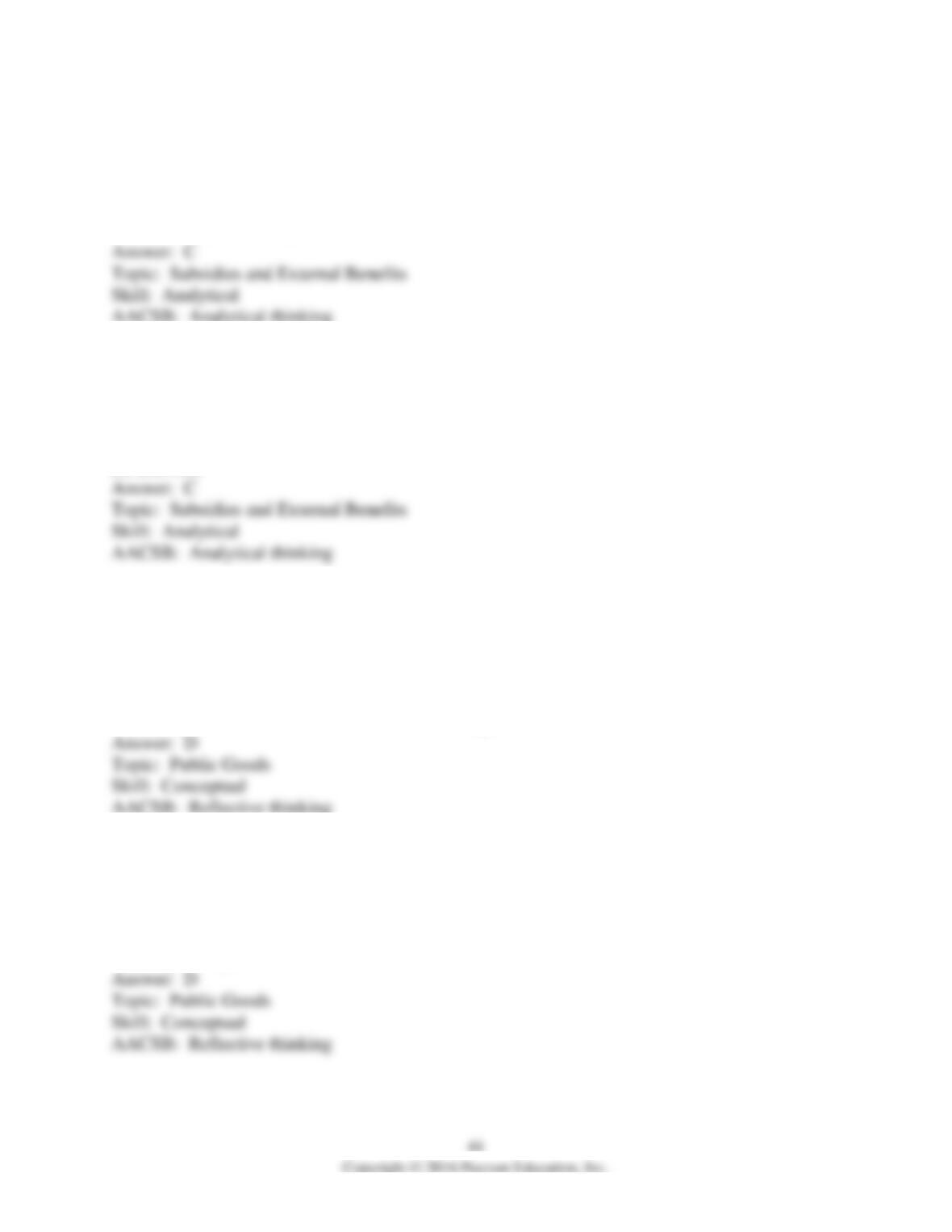
15) If the government regulates the market in the above figure in a way to achieve efficiency,
then ________ vaccinations will be produced and consumed.
A) 0
B) 30 thousand
C) 50 thousand
D) None of the above answers is correct.
16) In the above figure, to achieve efficiency the government could offer a subsidy to producers
of ________ per vaccination so that consumers would pay ________ per vaccination.
A) $20; $20
B) $30; $10
C) $20; $10
D) $30; $40
4 News Based Questions
1) Which of the following would most likely be a public good?
A) Sirius Satellite Radio is accessed through a subscription.
B) iTunes sells songs through their website.
C) a Mariah Carey CD
D) Michigan Radio is the state’s most listened-to public radio service.
2) Michigan Radio is the state’s most listened-to public radio service, attracting approximately
400,000 listeners each week. How would Michigan public radio best be classified?
A) as a private good
B) as a common resource
C) as a natural monopoly
D) as a public good
3) Which of the following would most likely be a private good?
A) a Mariah Carey CD
B) Sirius Satellite Radio is accessed through a subscription.
C) Michigan Radio is the state’s most listened-to public radio service.
D) iTunes sells songs through their website.
4) Rock climbing areas are often on public lands. These areas, which are often crowded, are
classified as
A) rival and excludable.
B) non-rival and excludable.
C) rival and non-excludable.
D) non-rival and non-excludable.
5) Every year as the clock nears midnight on December 31st, the eyes of the world turn to Times
Square in New York City to watch the famous ball drop at midnight. The event is open to
everyone, but it is advised you arrive early to participate because the square quickly becomes
crowded with no space left for latecomers. This celebration can be classified as
A) rival and excludable.
B) non-rival and non-excludable.
C) non-rival and excludable.
D) rival and non-excludable.
6) Every year as the clock nears midnight on December 31st, the eyes of the world turn to Times
Square in New York City to watch the famous ball drop at midnight. The event is open to
everyone, but it is advised you arrive early to be able to participate because the square quickly
becomes crowded with no space left for latecomers. This celebration is most like a
A) common resource.
B) public good.
C) private good.
D) natural monopoly.
7) Which of the following would most likely be provided by a natural monopoly?
A) Michigan Radio is the state’s most listened-to public radio service.
B) Sirius Satellite Radio is accessed through a subscription.
C) X96 is an alternative radio station out of Salt Lake City.
D) a Mariah Carey CD
8) Michigan Radio is the state’s most listened-to public radio service, attracting approximately
400,000 listeners each week and is funded through listener donations. Listeners can access Sirius
satellite radio through a subscription to the service. Michigan Radio is a ________ and Sirius
satellite radio is a ________.
A) common resource; natural monopoly
B) public good; natural monopoly
C) natural monopoly; private good
D) public good; common resource
9) Michigan Radio is the state’s most listened-to public radio service, attracting approximately
400,000 listeners each week. The on-air fundraiser, which ran during October 2010, generated
over 7400 pledges from donors. The money raised helps pay for programming costs at the
station, with membership support being the single largest source of income. The 392,600
listeners who did not call and donate can be classified as what?
A) free riders
B) marginal beneficiaries
C) rival consumers
D) rationally ignorant
10) Michigan Radio is the state’s most listened-to public radio service, attracting approximately
400,000 listeners each week and is funded through listener donations. If Michigan Radio suffers
from the free-rider problem then the market would provide an ________ quantity of the public
good.
A) efficiently small
B) efficiently large
C) inefficiently small
D) inefficiently large
11) Because Jess didn’t have the time to understand the issue, she did not vote on the amendment
about clean energy. Jess’s behavior demonstrates the economic principle of ________.
A) diminishing marginal utility
B) voting preferences
C) rational ignorance
D) minimum differentiation
12) In 2010, the Center for Disease Control has recommended that every child between the ages
of 6 months and 18 years be vaccinated, except those with a serious egg allergy. Dr. Berreman
states,”By protecting ourselves from flu, we also protect our families and neighbors.” Which is a
solution that could be used to achieve a more efficient allocation of resources in the presence of
this externality?
A) The government could tax the producers of the flu vaccine.
B) The government could tax the consumers of the flu vaccine.
C) The government could offer a free flu vaccine clinic.
D) The government could increase the price of flu vaccines.
5 Essay Questions
1) What does it mean for a good to be “nonexcludable”? Are private goods nonexcludable? Are
public goods nonexcludable? Are common resources nonexcludable?
2) What is a nonrival good? Give an example.
3) When describing goods and services, what is meant by the terms “rival” and “nonrival?” Are
private goods rival or nonrival? Are public goods rival or nonrival? Are common resources rival
or nonrival?
4) Some years ago The Wall Street Journal reported that the government of Thailand “plans to
launch a chain of more than 3,000 Thai restaurants world-wide over the next five years, with the
largest number, more than 1,000, slated for the United States.” The Thai government will have a
30 percent minority stake in the restaurants and the rest will be given to Thai owners. The
country’s deputy commerce minister explains that the government will play an active role in
drawing up menus, making sure that genuine Thai food is served and ensuring that 70 percent of
supplies for the restaurants are imported from Thailand. Because the Thai government will be
part owner of these restaurants, are these restaurants public goods?
5) Is a sailboat purchased in Victoria, British Columbia, a private good or a public good?
6) What are the differences between public goods and private goods?
7) You are studying with a friend and your friend says, “Private goods are excludable and
nonrival, while public goods are nonexcludable and rival.” Do you agree?
8) Some resources are private and others are common. Define a common resource, explain the
definition, and provide an example of a private resource and a common resource.
9) “The Internet is nonrival, which means it’s a public good.” Do you agree or disagree? Explain.
10) What is the free-rider problem? What results from the free-rider problem? What is a solution
to the free-rider problem?
11) “To find the economy’s marginal social benefit curve for a public good, we sum the
individual marginal benefit curves horizontally.” True or false? Explain.
12) Why is society’s marginal social benefit curve for a public good found by vertically summing
individual marginal benefit curves and not by horizontal summation as is the case for private
goods?
13) “The principle of increasing marginal cost does not apply to public goods.” Is this statement
correct or not?
14) Why isn’t national defense provided by free markets?
15) Protection of rivers in Idaho is a public good. If the marginal social cost of protecting rivers
in Idaho exceeds the marginal social benefit of river protection, is there more than, less than, or
the efficient amount of river protection taking place?