22) John receives a marginal benefit of $80 from one missile. Nick receives a marginal benefit of
$50 from one missile. Christina receives a marginal benefit of $65 from one missile. John, Nick,
and Christina are the only people in the economy. What is the economy’s marginal social benefit
from one missile?
A) $50
B) $65
C) $80
D) $195
23) The efficient quantity of a public good is provided when the economy’s
A) total benefit from the good equals its total cost.
B) total benefit from the good is less than its total cost.
C) marginal social benefit from the good equals its marginal social cost.
D) marginal social benefit from the good is greater than its marginal social cost.
24) Efficiency in the provision of a public good is achieved when its
A) total social benefit equals its total social cost.
B) average social benefit equals its average social cost.
C) marginal social benefit equals its marginal social cost.
D) marginal social benefit equals zero.
25) Long Beach Island, off the coast of New Jersey, is considering building a system of satellite
towers that will enhance communication during emergencies such as hurricanes. The efficient
quantity of satellite towers is definitely the quantity of such that the
A) marginal social cost is equal to the marginal social benefit.
B) marginal private cost is equal to the marginal social benefit.
C) marginal social cost is less than the marginal social benefit.
D) marginal private cost is less than the marginal social benefit.
26) There are four lighthouses on the island of Sand. If this is the efficient quantity of
lighthouses, ________.
A) the marginal social benefit of the fourth lighthouse equals its marginal social cost
B) total social benefit is zero
C) marginal social benefit minus marginal social cost is a maximum
D) Both answers A and C are correct.
27) If the marginal social benefit of a city’s sewage system is less than the marginal social cost,
then the city will achieve an efficient use of resources if it ________.
A) decreases the capacity of the sewage system
B) does not change the capacity of the sewage system
C) increases the capacity of the sewage system
D) increases the sewerage charge that the residents pay
28) Long Beach Island, off the coast of New Jersey, is considering enhancing its system of
satellite towers to help communication during emergencies such as hurricanes. A study showed
that in Superstorm Sandy the existing number of satellite towers resulted in the marginal social
cost of a satellite tower being less than the marginal social benefit. To achieve efficiency, this
study indicates that the
A) system should be left as is because the quantity of satellite towers is efficient.
B) system should be reduced in size because the quantity of satellite towers is more than the
efficient quantity.
C) system should be expanded because the quantity of satellite towers is less than the efficient
quantity.
D) None of the above because the study erred in comparing the marginal social cost to the
marginal social benefit since it should have compared the marginal private cost to the marginal
private benefit.
29) Public goods are
A) under provided by the private market because the marginal cost of production is too high.
B) under provided by the private market because the marginal benefits of consumption are too
low.
C) under provided by the private market because people’s willingness to pay for the good is less
than the marginal benefit of the good.
D) over provided by the private market because the marginal benefits of consumption are too
high.
30) Which of the following is TRUE about public goods?
A) Consumption is rival and nonexcludable.
B) Consumption is nonrival and excludable.
C) Efficient provision occurs at the level of output at which total benefit is equal to total cost.
D) Unregulated private markets produce less than the efficient quantity of a public good.
31) Why will a private market be unable to produce the efficient quantity of public goods?
A) because the good’s marginal cost is too low
B) because the good is nonexcludable, so there is the free rider problem
C) because the good is rival, so no one will want to pay the producer for it
D) All of the above answers are correct.
32) Private markets will not provide the efficient quantity of a public good because
A) of the principle of minimum differentiation.
B) public goods are rival and excludable.
C) of rational ignorance.
D) of the free-rider problem.
33) If a public good was left to be provided by the private sector
A) more than the efficient quantity would be produced.
B) less than the efficient quantity would be produced
C) the efficient quantity would be produced
D) the good would be provided at a very low price.
34) The quantity of a public good supplied by a private market is
A) smaller than the efficient quantity.
B) equal to the efficient quantity.
C) larger than the efficient quantity.
D) the quantity that maximizes total public benefit.
35) The free-rider problem with a public good leads to
A) inefficiency if the good is provided by only private markets with no government action.
B) overproduction if the good is provided by private markets.
C) underproduction if the good is provided by the government.
D) None of the above answers is correct.
Quantity
Pat’s marginal
benefit
(dollars)
Al’s marginal
benefit
(dollars)
Marginal cost
(dollars)
1
10.00
4.00
0.50
2
7.00
3.00
1.00
3
4.00
2.00
1.50
4
2.00
1.00
2.00
5
1.00
0.00
2.50
6
0.00
0.00
3.00
36) If the good in the table above is a public good and Pat and all are the only members of
society, then the efficient quantity to produce is
A) 2 units.
B) 3 units.
C) 4 units.
D) 5 units.
Quantity
(lamps)
Marginal
benefit for
Mike
Marginal
benefit for Joe
Marginal
benefit for
Sam
0
1
4
8
5
2
3
6
4
3
2
4
3
4
1
2
2
5
0
0
0
37) Mike, Joe, and Sam are roommates. They need lamps for their common living room. Lamps
in their living room are a public good for these roommates. The marginal benefit that each
individual receives from varying numbers of lamps in the living room is given in the table above.
The marginal benefit for the second lamp to this group of roommates taken as a whole is
A) 10.
B) 13.
C) 9.
D) 17.
38) Mike, Joe, and Sam are roommates. They need lamps for their common living room. Lamps
in their living room are a public good for these roommates. The marginal benefit that each
individual receives from varying numbers of lamps in the living room is given in the table above.
If the marginal cost of a lamp is 9, what is the efficient number of lamps for the roommates to
purchase?
A) 1
B) 2
C) 3
D) 4
39) Mike, Joe, and Sam are roommates. They need lamps for their common living room. Lamps
in their living room are a public good for these roommates. The marginal benefit that each
individual receives from varying numbers of lamps in the living room is given in the table above.
If the marginal cost of a lamp is 13, what is the efficient number of lamps for the roommates to
purchase?
A) 2
B) 5
C) 0
D) 1
Quantity
(hours per
day)
Marginal cost
(dollars per hour)
Marginal benefit
for Pooh
(dollars per hour)
Marginal benefit
for Piglet
(dollars per hour)
0
1
6
10
20
2
12
8
16
3
18
6
12
4
24
4
8
5
30
2
4
40) Suppose two individuals, Pooh and Piglet, desire protection (provided by Tigger) for their
community, The Hundred Acre Wood, from heffalumps. Protection is a public good. The
marginal cost of protection as well as Piglet’s and Pooh’s marginal benefits from protection are in
the table above. What is the quantity of protection that achieves the maximum net benefit?
A) 1 hour per day
B) 2 hours per day
C) 3 hours per day
D) 4 hours per day
Katie Bobby
Quantity
Marginal
benefit
(dollars per
submarine)
Quantity
Marginal
benefit
(dollars per
submarine)
1
100
1
150
2
75
2
100
3
50
3
50
4
25
4
10
5
0
5
0
41) The above table shows the marginal benefit from submarines for the only two citizens of a
country. Submarines are a public good. If submarines cost $100 a piece to produce, what is the
efficient quantity of submarines?
A) 0
B) 1
C) 2
D) 3
42) The above table shows the marginal benefit from submarines for the only two citizens of a
country. Submarines are a public good. If submarines cost $175 a piece to produce, what is the
efficient quantity of submarines?
A) 0
B) 1
C) 2
D) 3
43) The above table shows the marginal benefit from submarines for the only two citizens of a
country. Submarines are a public good. If submarines cost $300 a piece, what is the efficient
quantity to produce?
A) 0
B) 1
C) 2
D) 3
44) The above table shows the marginal benefit from submarines for the only two citizens of a
country. Submarines are a public good. If submarines cost $25 a piece to produce, who would
vote for the purchase of four submarines?
A) both Katie and Bobby
B) Katie only
C) Bobby only
D) nobody
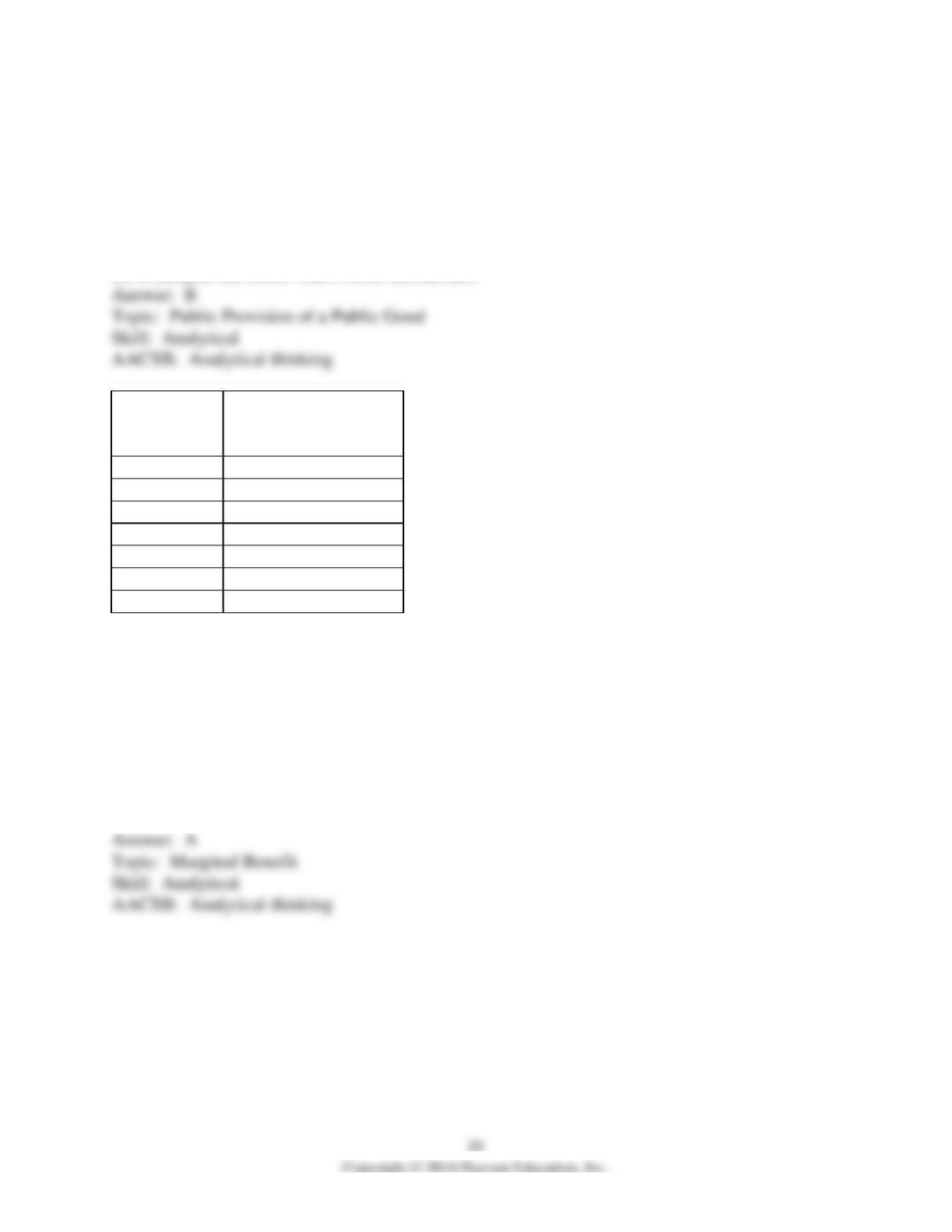
45) The above table shows the marginal benefit from submarines for the only two citizens of a
country. Suppose submarines cost $175 a piece. Politician A proposes 2 submarines while
politician B proposes 4. Assuming that both Bobby and Katie pay one half of the resulting taxes
and neither is rationally ignorant, which politician will win the election?
A) A because she offers voters a lower tax bill.
B) A because she offers voters a greater net benefit.
C) B because she offers voters a greater total benefit.
D) B because she offers voters more submarines.
Number of
police officers
Marginal benefit
(dollars from the last
officer)
1
8.00
2
7.20
3
6.40
4
5.60
5
4.80
6
4.00
7
3.20
46) Broomfield city council is deciding how many police officers the city needs. Broomfield’s
population is 10,000 people. The marginal cost of a police officer is $60,000 per year. The
marginal benefit schedule of an average city resident from police protection is shown in the table
above. Police protection is a public good. The marginal benefit for all of Broomfield from hiring
the 4th police officer is
A) $56,000.
B) $5.60.
C) $8,000.
D) $6.00.
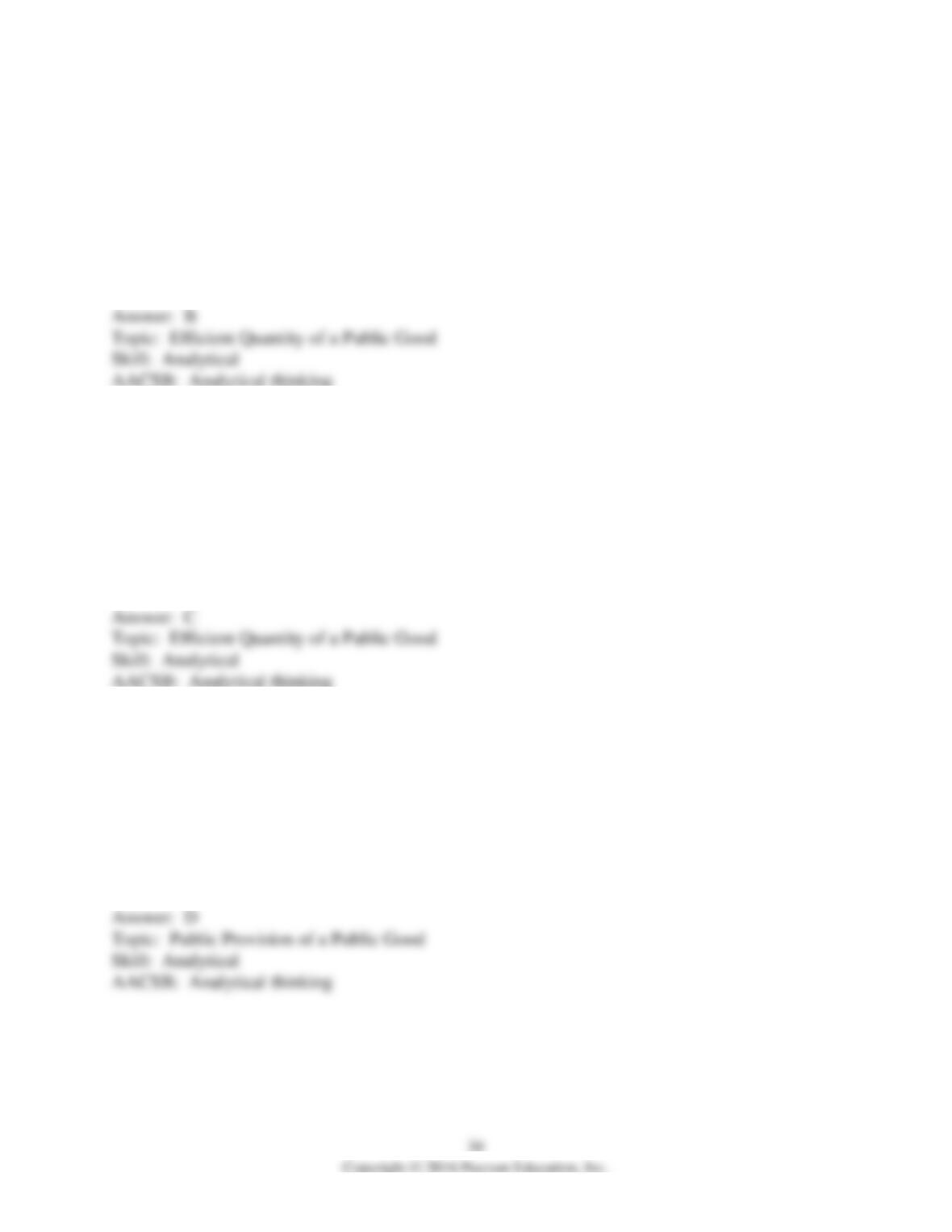
47) Broomfield city council is deciding how many police officers the city needs. Broomfield’s
population is 10,000 people. The marginal cost of a police officer is $60,000 per year. The
marginal benefit schedule of an average city resident from police protection is shown in the table
above. Police protection is a public good. The efficient number of police officers in Broomfield
is
A) 2.
B) 3.
C) 4.
D) 6.
48) Broomfield city council is deciding how many police officers the city needs. Broomfield’s
population is 10,000 people. The marginal cost of a police officer is $60,000 per year. The
marginal benefit schedule of an average city resident from police protection is shown in the table
above. Police protection is a public good. To support the efficient number of police officers, each
resident of Broomfield will have to pay ________ per year in taxes.
A) $36
B) $6.40
C) $18
D) $60
49) Broomfield city council is deciding how many police officers the city needs. Broomfield’s
population is 10,000 people. The marginal cost of a police officer is $60,000 per year. The
marginal benefit schedule of an average city resident from police protection is shown in the table
above. Police protection is a public good. If voters in Broomfield are well informed and know
what is best for them, the political equilibrium is that ________ police officers will be hired.
A) 2
B) 4
C) 6
D) 3
50) Broomfield city council is deciding how many police officers the city needs. Broomfield’s
population is 10,000 people. The marginal cost of a police officer is $60,000 per year. The
marginal benefit schedule of an average city resident from police protection is shown in the table
above. Police protection is a public good. If voters in Broomfield are rationally ignorant and the
police department achieves the highest attainable budget, the political equilibrium is ________
police officers.
A) 6
B) 7
C) 4
D) 3
51) Broomfield city council is deciding how many police officers the city needs. Broomfield’s
population is 10,000 people. The marginal cost of a police officer is $60,000 per year. The
marginal benefit schedule of an average city resident from police protection is shown in the table
above. Police protection is a public good. If voters in Broomfield are rationally ignorant and the
police department achieves the highest attainable budget, each resident of Broomfield will pay
________ per year in taxes.
A) $18
B) $36
C) $4
D) $60
Quantity
(satellites)
Tom’s
marginal
benefit
(dollars)
Jerry’s
marginal
benefit
(dollars)
1
50
40
2
40
32
3
30
24
4
20
16
5
10
8
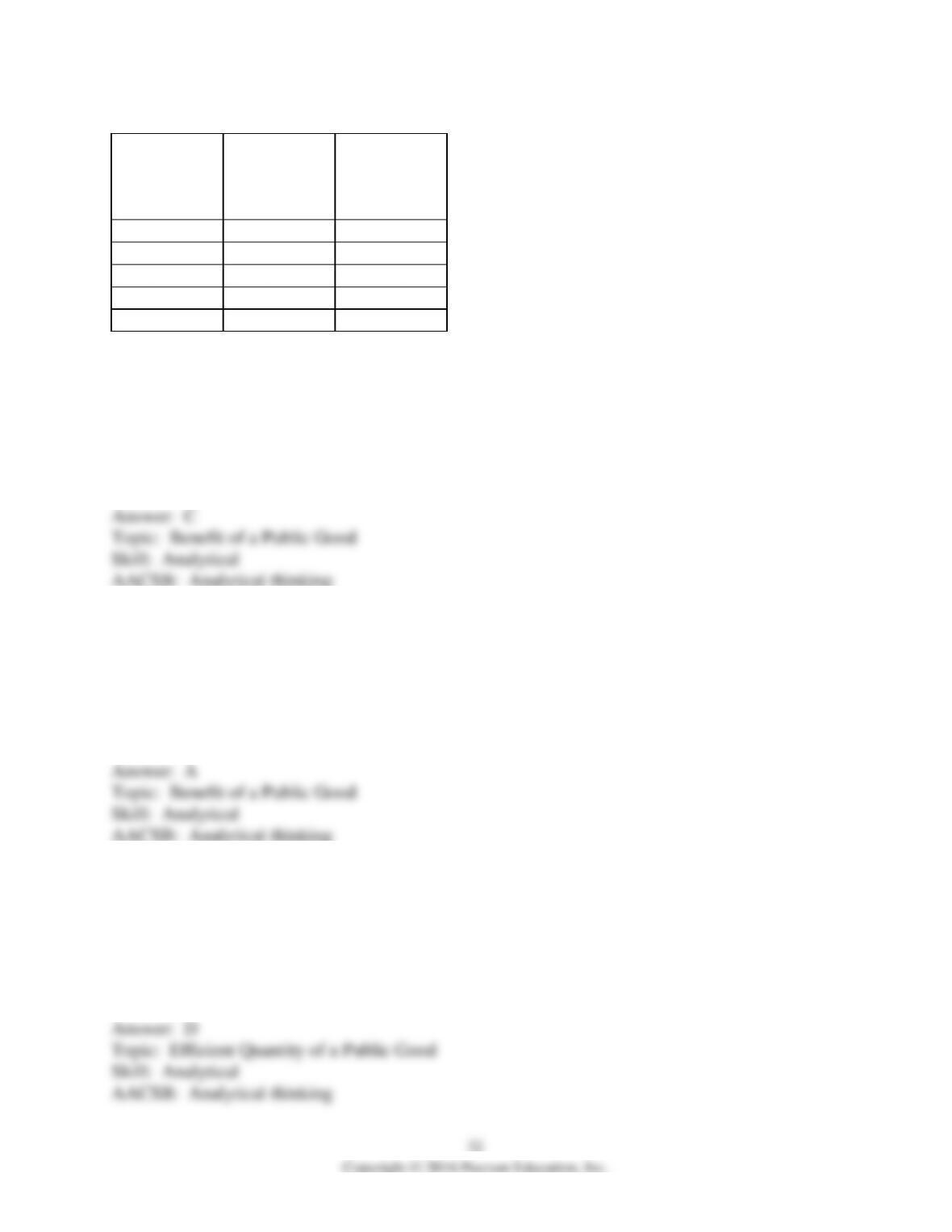
52) Tom and Jerry are the only members of society. The table above shows their marginal
benefits from defense satellites, a public good. What is the marginal benefit to society from the
third satellite?
A) $30
B) $27
C) $54
D) $6
53) Tom and Jerry are the only members of society. The table above shows their marginal
benefits from defense satellites, a public good. What is the marginal benefit to society from the
fourth satellite?
A) $36
B) $20
C) $18
D) $4
54) Tom and Jerry are the only members of society. The table above shows their marginal
benefits from defense satellites, a public good. If the marginal social cost of a satellite is $36, the
efficient quantity of satellites is
A) 1.
B) 2.
C) 3.
D) 4.
55) Tom and Jerry are the only members of society. The table above shows their marginal
benefits from defense satellites, a public good. If the marginal social cost of a satellite is $54, the
efficient quantity of satellites is
A) 0.
B) 1.
C) 2.
D) 3.
56) Tom and Jerry are the only members of society. The table above shows their marginal
benefits from defense satellites, a public good. If the marginal social cost of a satellite is $54, the
quantity of satellites provided by a competitive market is
A) 0.
B) 1.
C) 2.
D) 3.
57) Tom and Jerry are the only members of society. The table above shows their marginal
benefits from defense satellites, a public good. If the marginal social cost of a satellite is $95, the
efficient quantity of satellites is
A) 0.
B) 1.
C) 2.
D) 3.
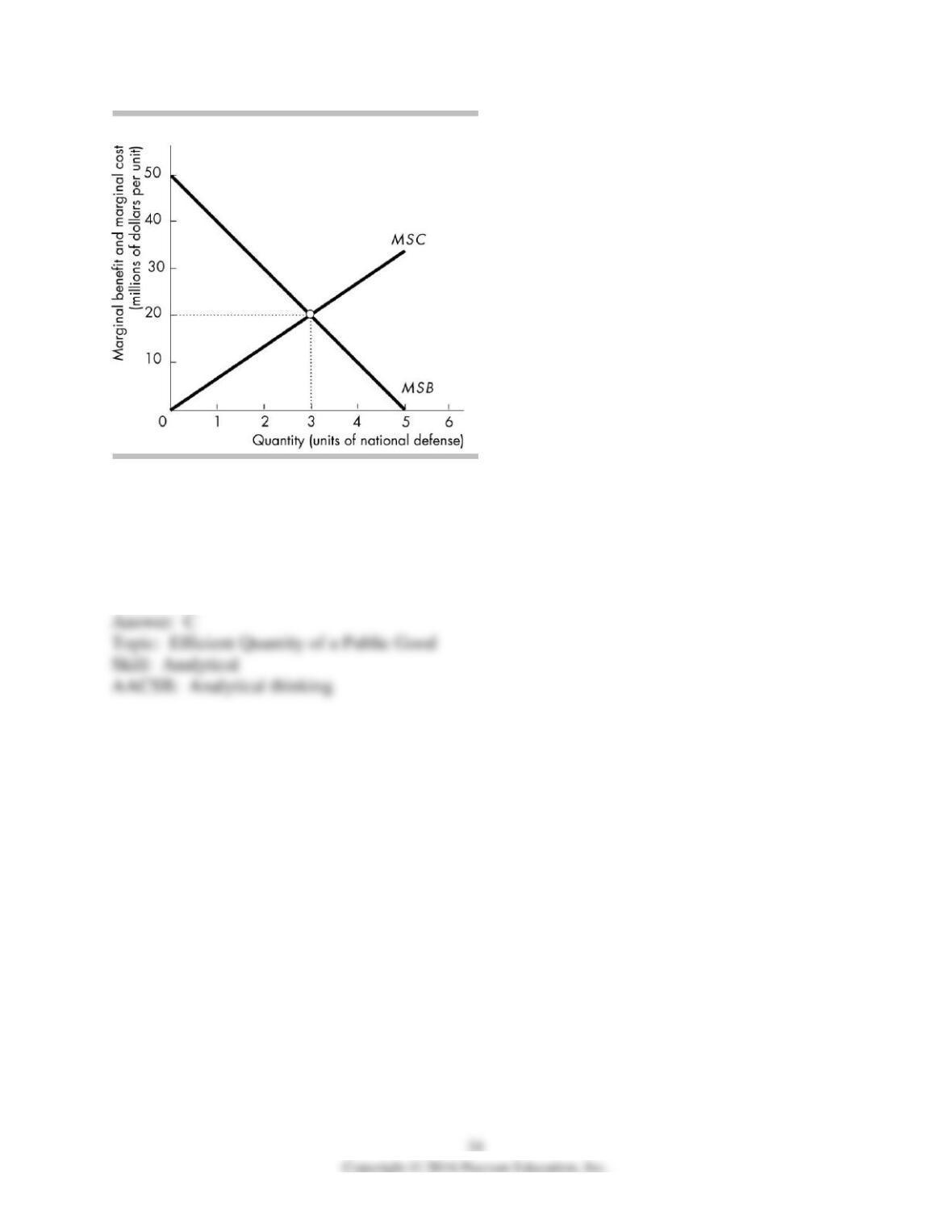
58) The figure above illustrates the marginal benefit and marginal cost of different quantities of
national defense. What is the political equilibrium if voters are well informed?
A) 0 units
B) between 0 and 3 units
C) 3 units
D) 5 units
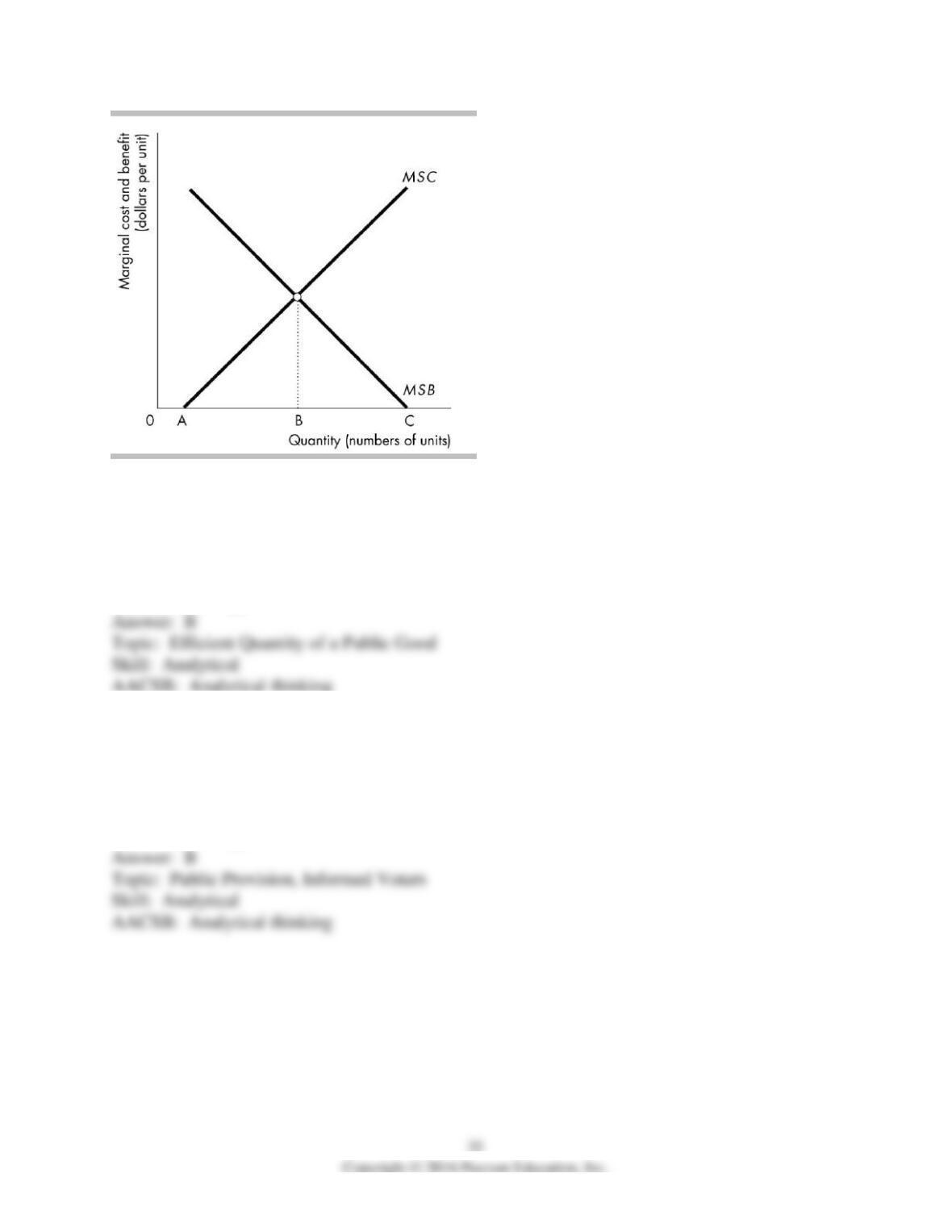
59) The above figure shows the marginal benefit and marginal cost curves for a public good. The
efficient quantity is
A) A.
B) B.
C) C.
D) zero units supplied.
60) The above figure shows the marginal benefit and marginal cost curves for a public good. The
quantity that has the best prospect of winning in an election by well-informed voters is
A) A.
B) B.
C) C.
D) zero units supplied.
61) The principle of minimum differentiation reflects the
A) tendency for firms to produce at minimum marginal cost in order to compete with one
another.
B) tendency for political parties to make themselves identical to appeal to the median voter.
C) concept of minimizing the difference between total benefit and total cost to produce
efficiently.
D) attempt to minimize the free-rider problem.
62) The principle of minimum differentiation suggests that competitors
A) try to distinguish themselves by offering highly different products.
B) try to gain the largest market share by differentiating a popular product.
C) tend to make identical goods in order to appeal to the largest number of consumers.
D) try to decrease costs by minimizing the differences in the types of resources used.
63) The principle of minimum differentiation
A) results in political parties proposing very similar or possibly identical policies.
B) refers to the tendency of competitors to make themselves different in order appeal to the
maximum number of clients or voters.
C) explains why Burger King, Wendy’s, and other fast food restaurants tend to locate far away
from each other.
D) None of the above answers are correct.
64) Two candidates are running for election as mayors of New York City that was recently
impacted by Superstorm Sandy. In their election platforms, both candidates supported spending
very similar amounts on hurricane protection. This similarity is most likely the result of
A) both candidates necessarily having the same preferences towards risk and protection.
B) the Principle of Minimum Differentiation.
C) both the candidates realize that hurricane protection is a public good.
D) politicians only take efficiency into account and hence all candidates will suggest the efficient
outcome.
65) Rational ignorance says that voters will
A) understand the technology before voting on defense.
B) vote on issues without having complete information.
C) gather information on issues that are not important.
D) not vote on issues that they do not understand.
66) The decision not to acquire information because the cost of acquiring the information
exceeds the expected benefit from the information is known as
A) rational ignorance.
B) the principle of minimum differentiation.
C) public choice theory.
D) inefficient provision.
67) Rational ignorance means
A) ignorance is rationed.
B) the benefit from some information is not worth the cost of collecting it.
C) some people do not understand rationality.
D) the information is unavailable.
68) “I know that my vote alone will not influence whether or not any new foreign trade
legislation is enacted, so I have decided not to spend the time learning about various legislative
proposals.” This quote reflects an example of
A) the free-rider problem.
B) government failure.
C) rational ignorance.
D) voter inefficiency.
69) Rational ignorance about the efficient quantity of a public good can result in
A) the principle of minimum differentiation.
B) excludable goods.
C) bureaucratic overprovision of a good.
D) the vertical summation of individual’s marginal benefit curves.
70) Rational ignorance suggests that voters will
A) be ignorant about all issues.
B) be ignorant about issues that are of no special interest to them.
C) pursue information on all issues before voting.
D) avoid voting if they have no information.
71) Bureaucratic overprovision of a public good could occur because
A) of a failure of minimum differentiation.
B) of rational ignorance among voters.
C) voters want more of the good than do bureaucrats.
D) bureaucrats attempt to maximize efficiency.
72) Suppose that the marginal social benefit from another unit of a public good is less than the
marginal social cost of producing it. Then
A) the principle of minimum differentiation means that production should be decreased.
B) the number of free riders is at its efficient amount.
C) less of the product should be produced because its provision exceeds the efficient level.
D) more of the product should be produced because its provision is less than the efficient level.
73) In the political market place, typical voters
A) support policies that they think will make the poor better off.
B) fire bureaucrats who support efficient policies.
C) are fully informed.
D) are sometimes rationally ignorant about a policy.
74) The fact that you may not know who your congressional representative is represents
A) rational ignorance on your part.
B) the rival nature of information.
C) inefficient oversupply of public servants.
D) the use of the median voter theorem.
3 The Economics of Health Care
1) For health care, the perceived marginal benefit ________ the marginal social benefit.
A) is less than
B) is greater than
C) is equal to
D) cannot be compared to
2) In an unregulated market, healthcare consumers often
A) overestimate its benefit.
B) cannot afford the care they need.
C) overestimate their future need.
D) All of the above are correct.
3) In an unregulated market for healthcare, the quantity produced ________ the efficient
quantity.
A) is less than
B) is greater than
C) is equal to
D) cannot be compared to
4) In an unregulated market for healthcare, the equilibrium quantity is that at which ________
and the efficient quantity is that at which ________.
A) D = S; MB = MSC
B) D = S; MSB = MSC
C) D = MSC; MB = MSC
D) MSB = S; MB = S
5) In an unregulated market for healthcare, there is
A) a deadweight loss from over-providing healthcare.
B) a deadweight loss from under-providing healthcare.
C) no deadweight loss.
D) Any of the above could be correcting depending on how the marginal cost paid by producers
compares to the marginal social cost.
6) Which of the following nations spends more per person on healthcare?
A) Switzerland
B) United Kingdom
C) Germany
D) None of the above nations spend more on healthcare.