Chapter 16 – Public Finance: Expenditures and Taxes
347
18. Why are payroll taxes regressive?
19. Answer the next three questions on the basis of the following data:
Taxable
income
Total tax
$10,000 $ 0
20,000 1,000
30,000 3,000
40,000 6,000
50,000 10,000
60,000 15,000
(a) What type of tax is represented by the tax schedule?
(b) What will your average tax rate be if your taxable income is $50,000?
(c) If your taxable income increases from $30,000 to $40,000, what will your marginal tax rate be?
20. Answer the next three questions on the basis of the following data:
Taxable
income
Total tax
$ 5,000 $ 0
10,000 500
15,000 1000
20,000 2000
25,000 4000
30,000 8000
(a) What type of tax is represented by the tax schedule?
(b) What will your average tax rate be if your taxable income is $25,000?
(c) If your taxable income increases from $15,000 to $20,000, what will your marginal tax rate be?
Chapter 16 – Public Finance: Expenditures and Taxes
348
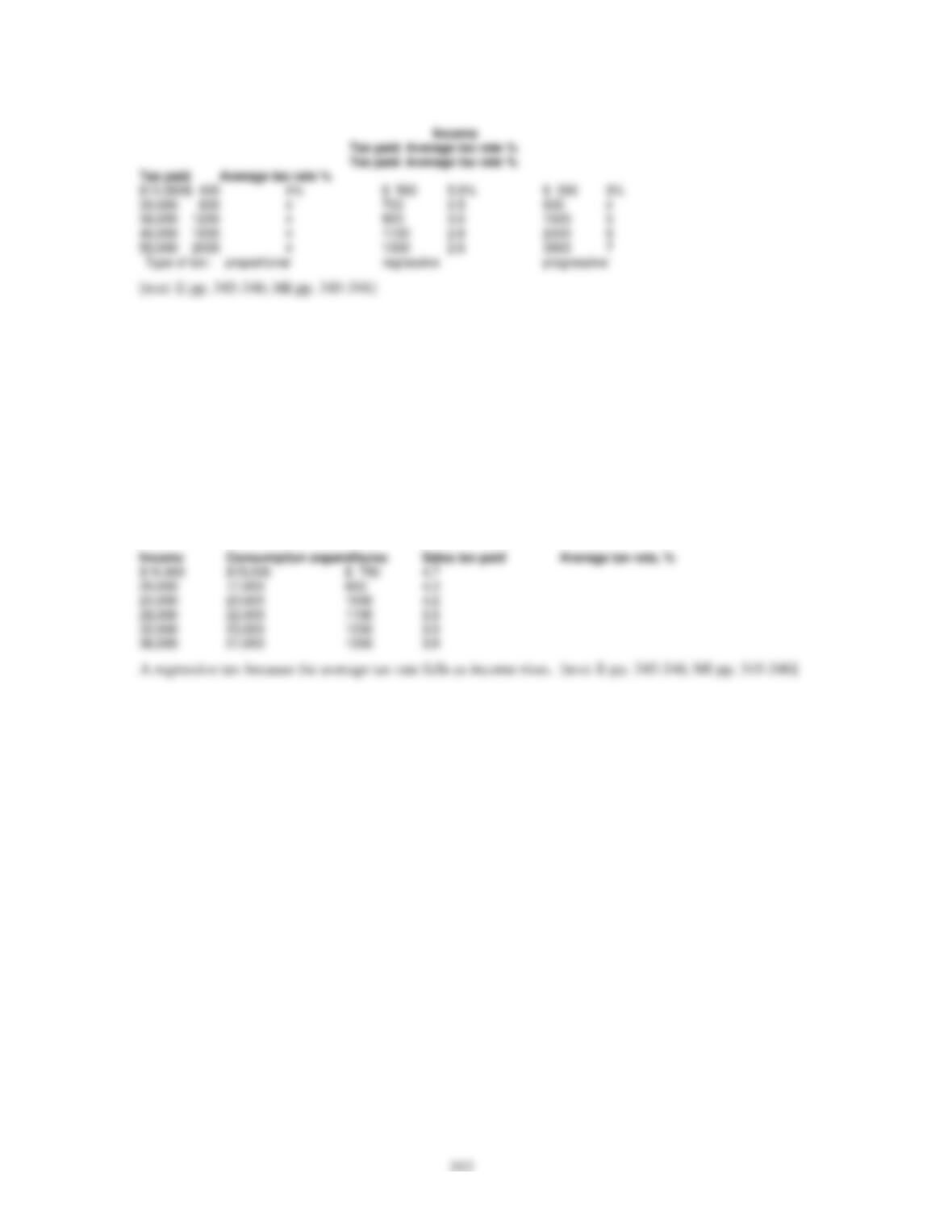
21. In the following table are five levels of taxable income and the amount that would be paid at each of the
five levels under three tax laws: X, Y, and Z. Compute for each of the three tax laws the average rate of
taxation at each of the four remaining income levels and indicate whether the tax is regressive,
proportional, or progressive.
Chapter 16 – Public Finance: Expenditures and Taxes
349
Tax X Tax Y Tax Z
Chapter 16 – Public Finance: Expenditures and Taxes
350
Income
Tax paid Average tax rate %
Tax paid Average tax rate %
Tax paid Average tax rate %
$10,000 $ 400 4% $ 500 5% $ 300 3%
20,000 800 _____ 700 _____ 800 _____
30,000 1200 _____ 900 _____ 1500 _____
40,000 1600 _____ 1100 _____ 2400 _____
50,000 2000 _____ 1300 _____ 3500 _____
Type of tax: ____________________ ____________________ ____________________
Chapter 16 – Public Finance: Expenditures and Taxes
351
Tax X Tax Y Tax Z
Chapter 16 – Public Finance: Expenditures and Taxes
22. Assume a state government levies a 5% sales tax on all consumption expenditures. Consumption
expenditures at six income levels are shown in the table below. Compute the sales tax paid and the average
tax rate at these incomes in the table.
Income Consumption expenditures Sales tax paid Average tax rate, %
$16,000 $15,000 $750 4.7
20,000 17,000 850 4.3
24,000 20,000 _____ _____
28,000 22,000 _____ _____
32,000 25,000 _____ _____
36,000 27,000 _____ _____
What type of tax is the sales tax in this case? Why?
Chapter 16 – Public Finance: Expenditures and Taxes
353
23. (Consider This) What are the advantages and disadvantages to the value-added tax (VAT)?
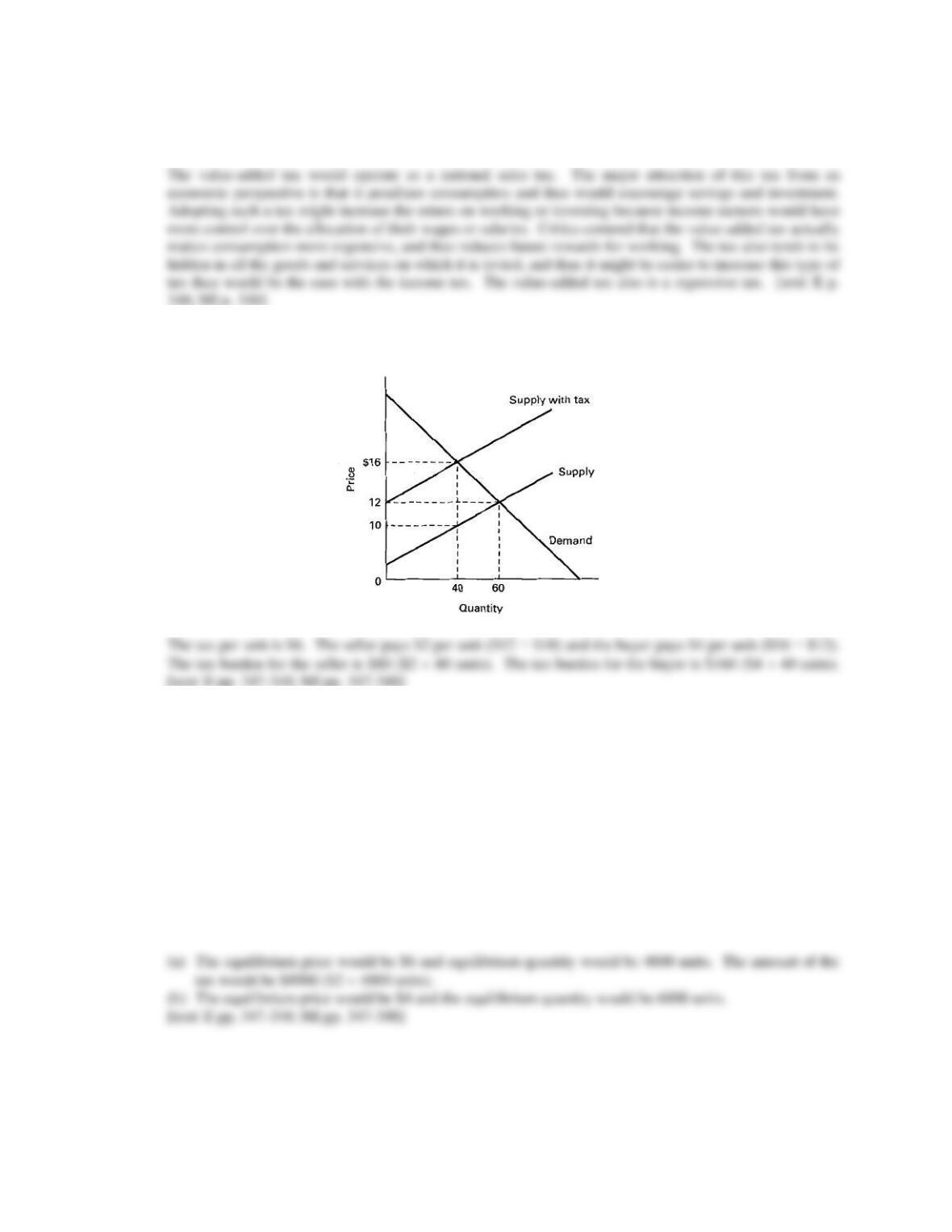
24. In the graph below, if the government imposes an excise tax as shown, what is the tax burden to the seller?
And to the buyer? Explain.
25. Answer the next two questions on the basis of the following demand and supply data for a competitive
market:
Quantity demanded
Price Quantity supplied
3000 $7 7000
4000 6 6000
5000 5 5000
6000 4 4000
7000 3 3000
(a) If government levies a per unit excise tax of $2 on suppliers of this product, what would the
equilibrium price and quantity be? How much tax will be paid?
(b) If government has instead provided a per unit subsidy of $2 to suppliers of this product, what would
the equilibrium price and quantity be?
Chapter 16 – Public Finance: Expenditures and Taxes
354
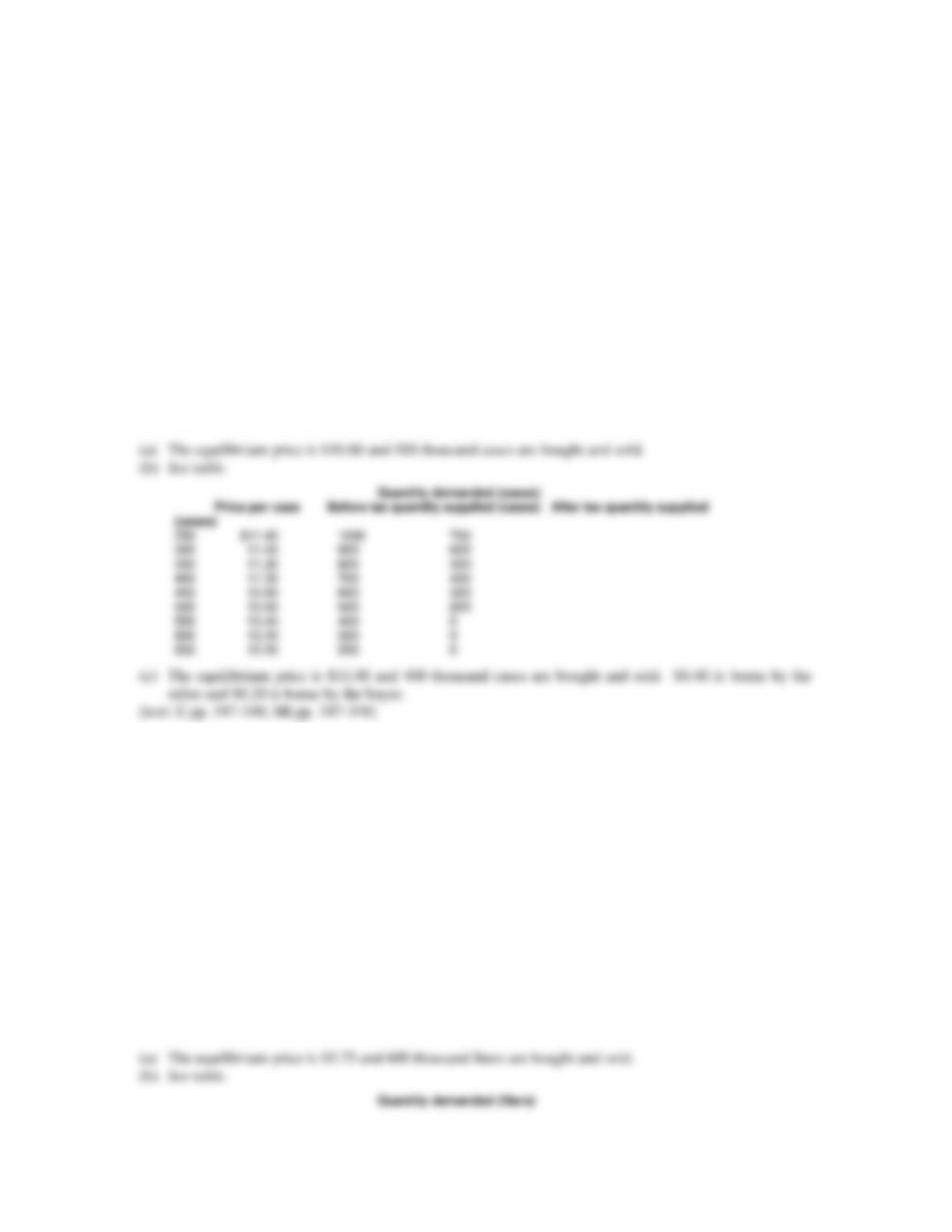
26. In the table below are the demand and supply schedules for beer in thousands of cases in a state.
Quantity demanded (cases)
Price per case Before tax quantity supplied (cases) After tax quantity supplied
(cases)
250 $11.60 1000 _____
300 11.40 900 _____
350 11.20 800 _____
400 11.00 700 _____
450 10.80 600 _____
500 10.60 500 _____
550 10.40 400 0
600 10.20 300 0
650 10.00 200 0
(a) What is the equilibrium price and quantity before a tax is imposed?
(b) If state government now imposes an excise tax of $0.60 per case of beer, what is the after-tax supply
schedule?
(c) What is the equilibrium price of beer after the tax is imposed? How much of the $0.60 is borne by the
buyer and how much by the seller?
27. In the table below are the demand and supply schedules for rum in thousands of liters in a state.
Quantity demanded (liters)
Price per liter Before tax quantity supplied (liters) After tax quantity supplied
(liters)
100 $7.00 1100 _____
200 6.75 1000 _____
300 6.50 900 _____
400 6.25 800 _____
500 6.00 700 _____
600 5.75 600 _____
700 5.50 500 0
800 5.25 400 0
900 5.00 300 0
(a) What is the equilibrium price and quantity before a tax is imposed?
(b) If state government now imposes an excise tax of $1.00 per liter of rum, what is the after-tax supply
schedule?
(c) What is the equilibrium price of rum after the tax is imposed? How much of the $1.00 is borne by the
buyer and how much by the seller?
Chapter 16 – Public Finance: Expenditures and Taxes
355
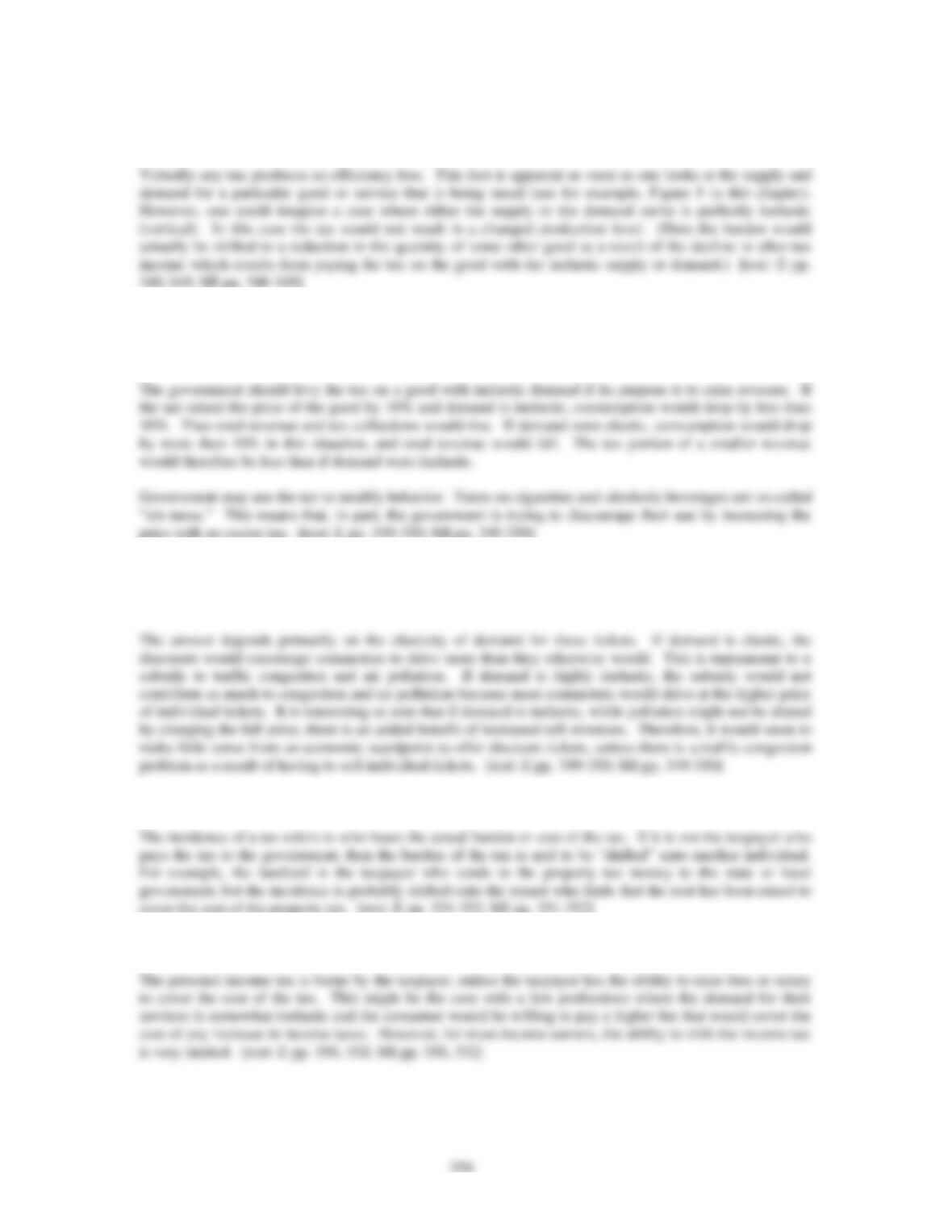
28. The next four questions refer to the below supply and demand graph for a product on which the
government imposes an excise tax.
(a) What is the amount of the tax per unit?
(b) What is the total amount of the excise tax paid by the consumer? By the producer?
(c) What is the total tax revenue for government?
(d) What is the efficiency loss of the tax?
Chapter 16 – Public Finance: Expenditures and Taxes
29. Can you imagine graphically a case where the efficiency loss from a tax would equal zero? Explain.
30. Assuming the basic purpose is to raise additional revenue, should government levy an excise tax on
cigarettes whose demand is highly inelastic or on a product whose demand is highly elastic? Are there any
other reasons to levy such a tax?
31. In many large cities auto commuters are given quantity discounts on tickets to use bridges, tunnels, and toll
roads. Some argue that these discounts are a subsidy to traffic congestion and air pollution. Do you agree?
Explain.
32. What is the meaning of the incidence of a tax? Give an example using a landlord and tenants.
33. What is the probable incidence of the personal income tax?
Chapter 16 – Public Finance: Expenditures and Taxes
34. Explain the probable incidence of a general sales tax imposed by a state.
35. A state decides to pass a new law raising the excise tax on cigarettes. What would be the probable
incidence of this new tax?
36. Discuss probable incidence of a local tax on business property.
37. Is the tax structure of the United States progressive at the Federal level, the state and local level, and
combined? How do transfer payments affect the distribution of income?
38. (Last Word) Who pays taxes and who receives government spending? Explain.