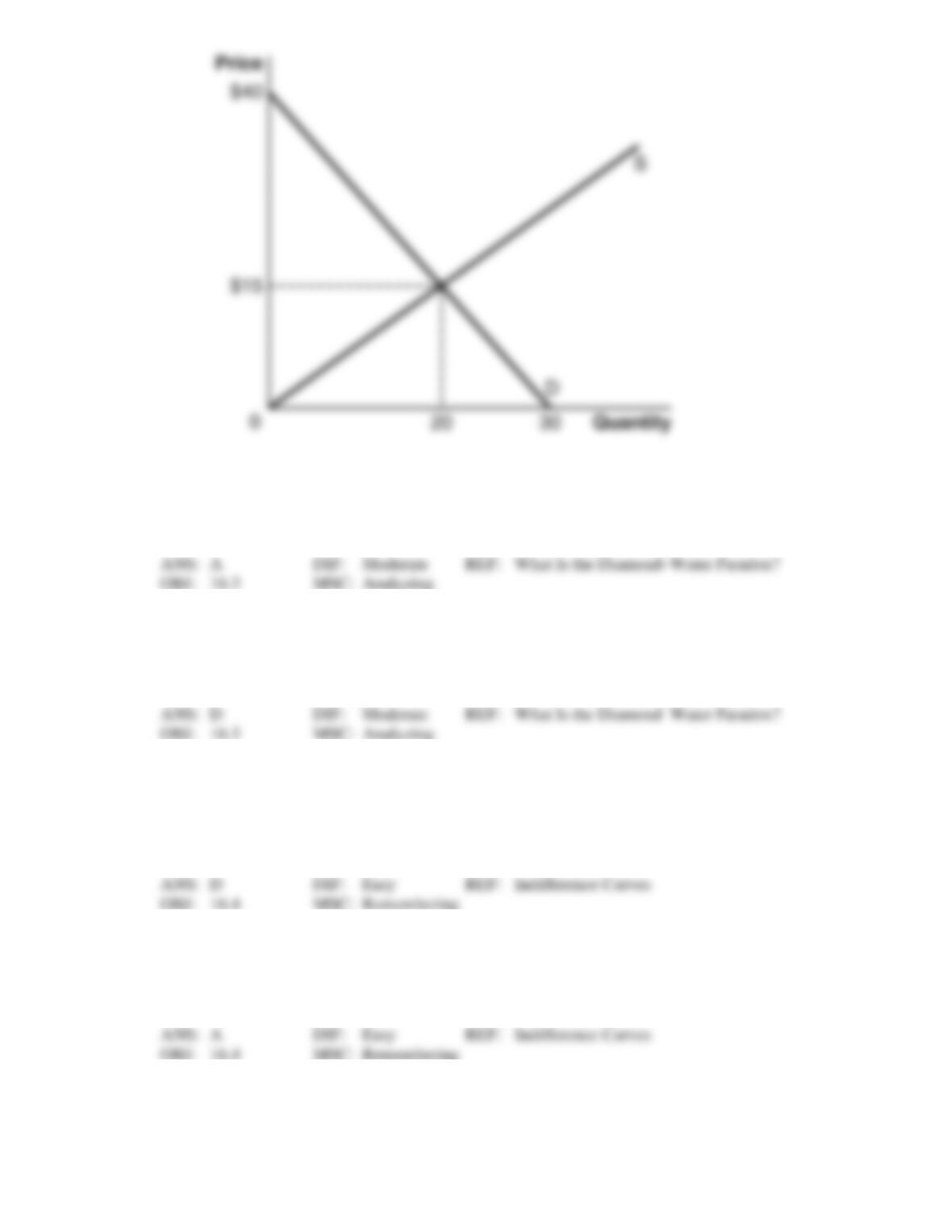
92. The product’s total utility in dollars is equal to
a. $250. d. $15.
b. $500. e. $20.
c. $150.
93. The product’s marginal utility in dollars is equal to
a. $250. d. $15.
b. $500. e. $20.
c. $150.
94. A(n) ________ represents the various combinations of two goods that yield the same level of
satisfaction or utility.
a. maximization point d. indifference curve
b. economic good e. budget constraint
c. economic bad
95. Indifference curves visually lead upward to a point called the ________ point.
a. maximization d. satisfaction
b. total utility e. maximum consumption
c. maximum utility
96. Refer to the following figure. Which is the most affordable path to the highest utility?
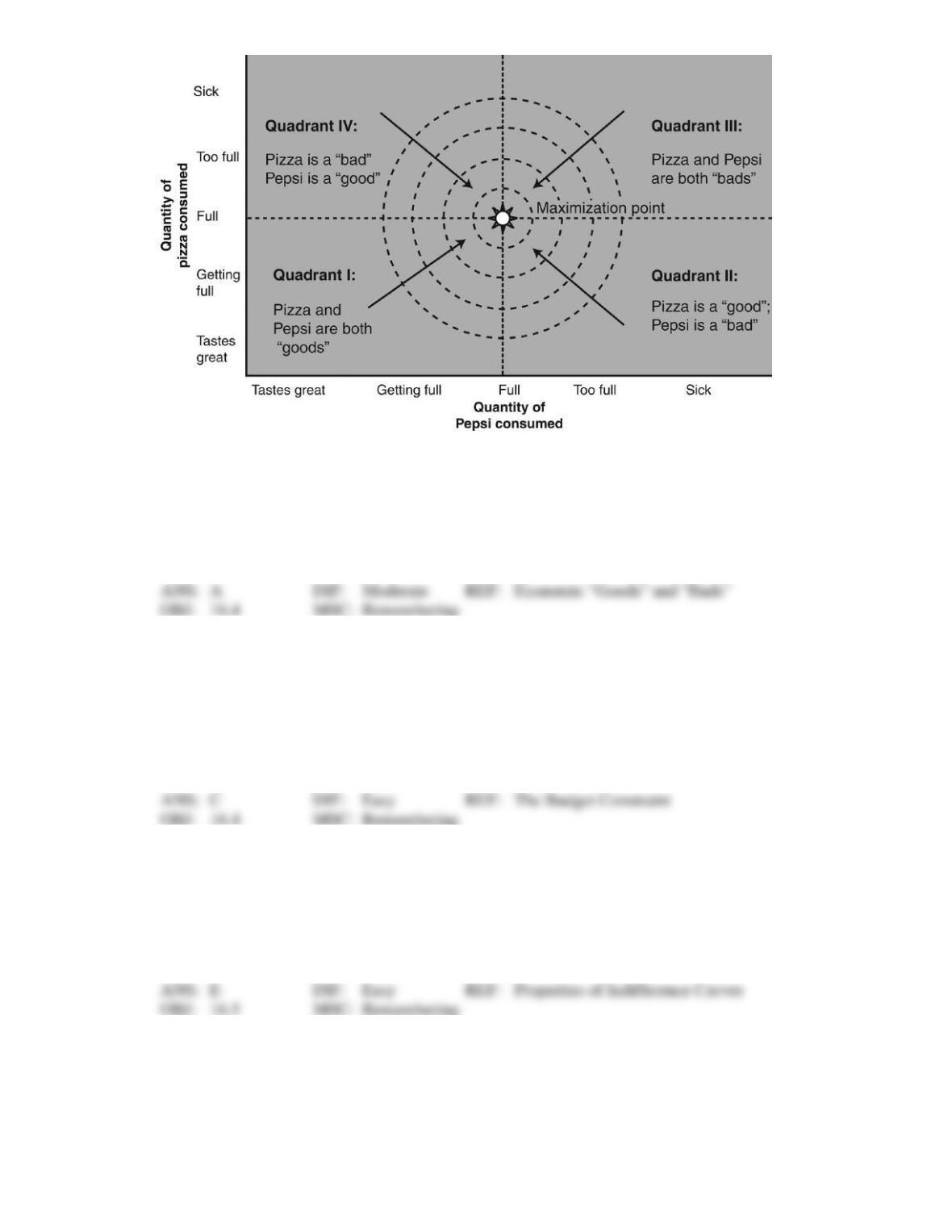
a. Quadrant I
b. Quadrant II
c. Quadrant III
d. Quadrant IV
e. All four quadrants are equally affordable paths to the highest utility.
97. Budget constraint is the
a. set of consumption bundles that represents the amount the consumer cannot afford.
b. set of consumption bundles that represents the minimum amount the consumer can afford.
c. set of consumption bundles that represents the maximum amount the consumer can afford.
d. set of consumption bundles facing a consumer with an unlimited budget and no opportunity
costs.
e. price at which an economic “good” becomes an economic “bad.”
98. It is NOT true that indifference curves
a. represent the various combinations of two goods that yield the same level of utility.
b. are typically bowed inward.
c. cannot be thick.
d. cannot intersect.
e. are modeled based on the assumption that people make irrational decisions.
99. Indifference curves are typically
a. vertical.
b. horizontal.
c. bowed inward.
d. bowed outward.
e. either vertical or horizontal, depending on the consumer.
100. The rate at which a consumer is willing to purchase one good instead of another is called
a. the maximization rate. d. the marginal rate of substitution.
b. opportunity cost. e. the budget constraint.
c. the total rate of substitution.
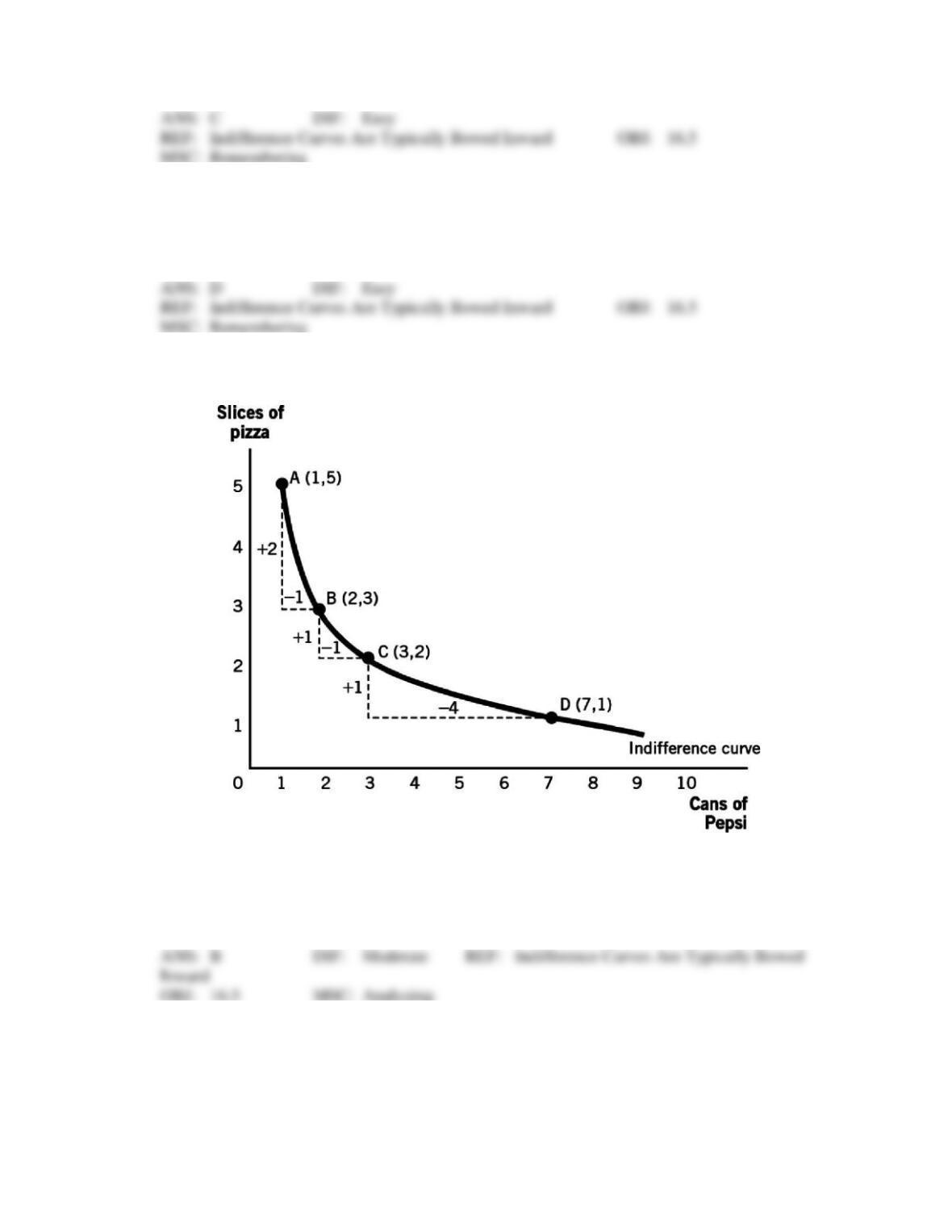
101. Refer to the following indifference curve. The marginal rate of substitution (MRS) between points
A and B is
a. −1 d. 1/2
b. −2 e. 1
c. −1/2
102. What are the two exceptions to convex indifference curves?
a. imperfect substitutes and imperfect complements
b. perfect substitutes and perfect complements
c. imperfect substitutes and perfect complements
d. perfect substitutes and imperfect complements
e. There are no exceptions to convex indifference curves.
103. Indifference curves for ________ are drawn as straight lines, while indifference curves for
________ are drawn as right angles.
a. perfect substitutes; perfect complements
b. perfect complements; perfect substitutes
c. economic “goods”; economic “bads”
d. economic “bads”; economic “goods”
e. imperfect substitutes; imperfect complements
104. The power of indifference curve analysis is its ability to display how ________ changes affect
________ choices.
a. input; pricing d. price; consumption
b. price; input e. supply; consumption
c. consumption; pricing
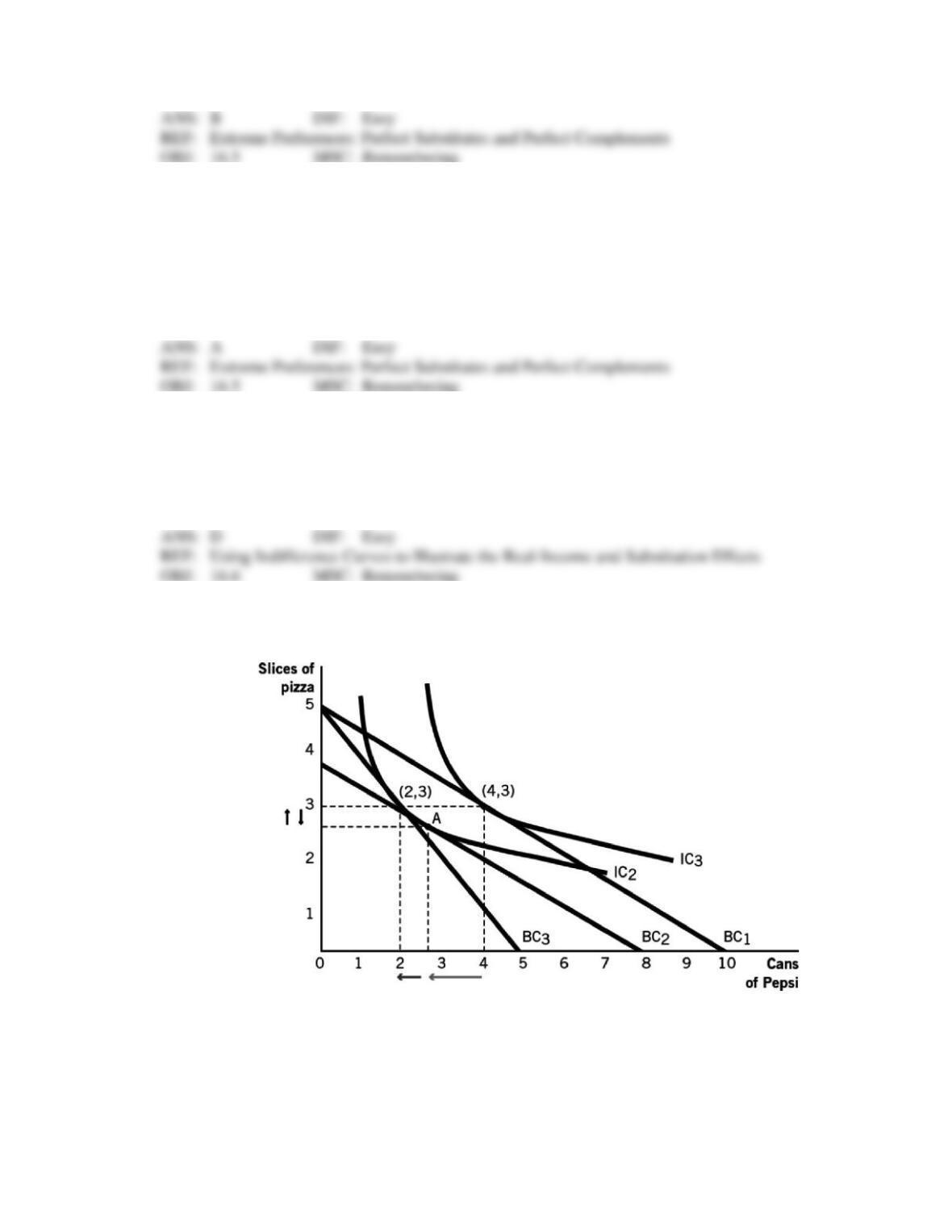
105. According to the following figure, the movement from point (4,3) to point A is a function of
________, while the subsequent movement from point A to point (2,3) results from ________.
a. an increase in the price of pizza; a decrease in the price of Pepsi
b. a decrease in the price of pizza; an increase in the price of Pepsi
c. a combination of the substitution and real-income effects; a decrease in the price of pizza
d. the substitution effect alone; the real-income effect alone
e. the real-income effect alone; the substitution effect alone
106. A(n) ________ is a quantification of relative satisfaction.
a. number d. marginality
b. util e. model
c. enjoyment
107. Freda and Stefano are presented with two dessert options: ice cream or cookies. Freda values ice
cream at 5 utils and cookies at 10 utils. For Stefano, it’s 10 and 5, respectively. What can we
assume with certainty?
a. Stefano prefers cookies over ice cream.
b. Freda prefers ice cream of over cookies.
c. Freda’s preference for ice cream is equal in magnitude to Stefano’s preference for cookies.
d. Freda’s preference for cookies is equal in magnitude to Stefano’s preference for ice cream.
e. Freda prefers cookies, and Stefano prefers ice cream.
108. Utility is a balance between ________ and ________ factors.
a. transitive; intransitive d. production; consumption
b. capital; labor e. good; bad
c. economic; personal
109. ________ is the sum of the satisfaction gained from all additional units of consumption.
a. Marginal utility d. Diminishing utility
b. Total utility e. Consumptive utility
c. Partial additive utility
110. The change in utils for each change in units consumed is known as the
a. total utility. d. unity of utility.
b. slope. e. marginal utility.
c. diminishing marginal utility.
111. As marginal utility decreases, total utility
a. decreases by the same amount.
b. increases by the same amount.
c. increases by the inverse of marginal utility.
d. increases at a decreasing rate.
e. decreases at an increasing rate.
112. As marginal utility increases, total utility
a. increases by the same amount.
b. decreases by the same amount.
c. increases by a multiplicative of marginal utility.
d. decreases at an increasing rate.
e. increases at an increasing rate.
113. In many competitive eating contests, participants must keep their food “down” in order to have a
chance to win. If competitors are unable to meet this qualification, it is probable that marginal
utility is
a. negative. d. decreasing.
b. positive. e. slowing.
c. zero.
114. Diminishing marginal utility is a decline in ________ with each additional ________.
a. units consumed; utility d. satisfaction; unit
b. utility; util e. utils; increase
c. unit; satisfaction
115. The concept of diminishing marginal utility means that a graph representing marginal utility will
be
a. downward-sloping.
b. upward-sloping.
c. impossible to generalize without a data set.
d. downward-facing concave.
e. upward-facing concave.
116. The concept of diminishing marginal utility means that a graph representing total utility will be
a. downward-sloping.
b. upward-sloping.
c. impossible to generalize without a data set.
d. downward-facing concave.
e. upward-facing concave.
117. Someone who is not a “morning person” is often heard saying, “I’m cranky until I’ve had a cup of
coffee.” After that first cup of coffee (and a mood improvement), the person experiences the
uncommon phenomenon of ________. That is, of course, until the stress of a typical day takes its
toll.
a. increasing marginal utility d. rare utility
b. decreasing marginal utility e. rebounding utility
c. constant marginal utility
118. When a consumer maximizes utility, economists say that he or she has
a. become satisfied. d. rationalized.
b. efficiently allocated. e. marginalized.
c. optimized.
119. ________ constraints add a layer of complexity to decisions involving multiple goods. They force
an individual to assemble a consumer optimum that maximizes utility while remaining within the
imposed limitations.
a. Budget d. Marginal
b. Brand e. Satisfaction
c. Utility
120. When comparing two goods for purchase, it is useful to acknowledge the marginal utility and the
dollar price. The optimizing decision requires choosing the good with the
a. higher total utility per dollar. d. higher marginal utility.
b. higher marginal utility per dollar. e. equivalent marginal and dollar prices.
c. lower marginal price.
121. Is considering marginal utility a natural process experienced by humans?
a. No. Only economists engage in this sort of “bean counting” involving utils.
b. No. Humans don’t all think the same way, so it follows that decision making is also relative.
c. Maybe. Good consumers consider marginal utility, while poor consumers don’t.
d. Yes. Conscious calculations involving utils are a part of every decision.
e. Yes. Humans have an instinct, as self-interested, rational beings, to seek the most satisfaction.
122. The reality of consumer optimum means making choices in countless purchases in order to enjoy
a. the same standard of living.
b. the same level of satisfaction in each.
c. increasing degrees of satisfaction.
d. a balanced budget.
e. roughly the same utility per dollar spent.
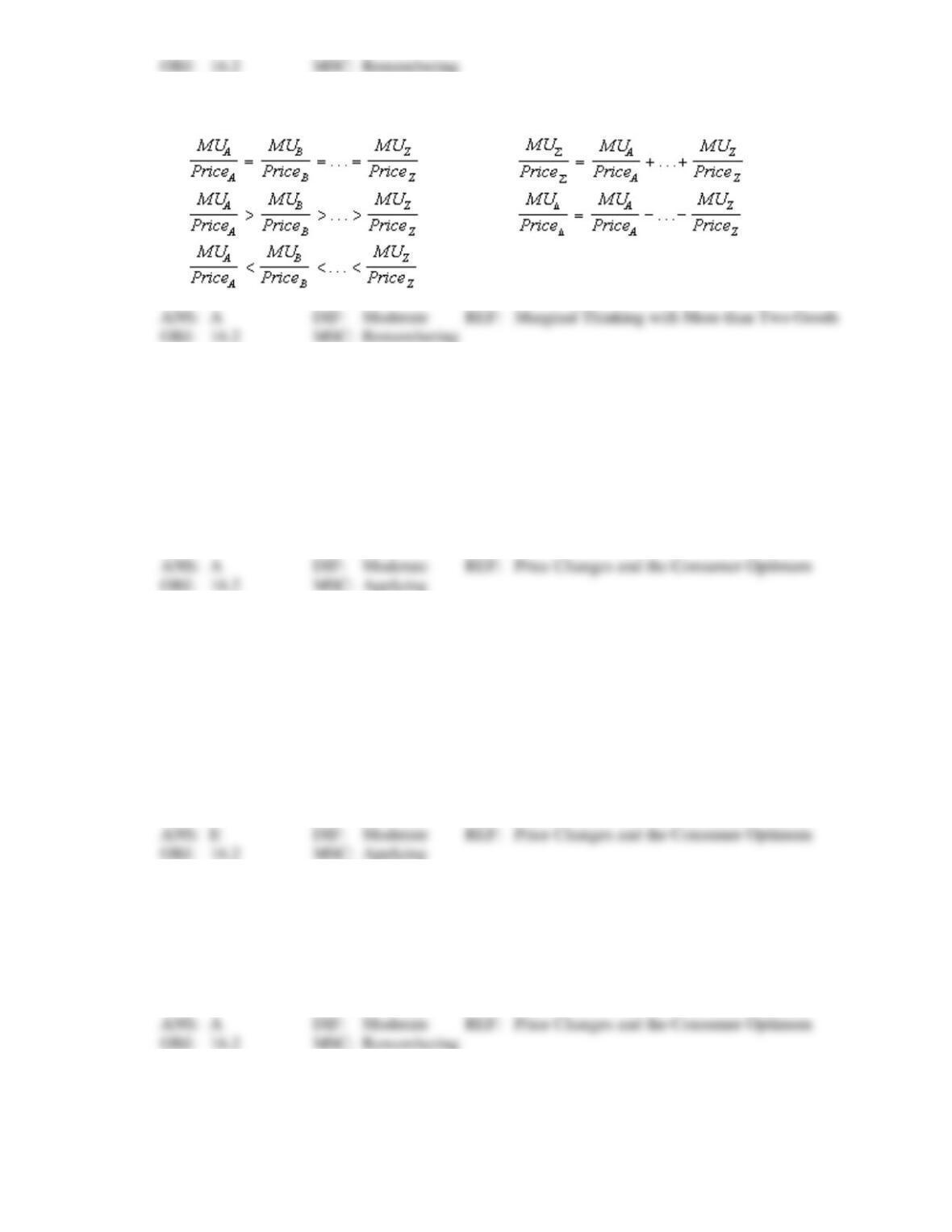
123. When making purchase decisions over the course of a year, a consumer adheres to which of the
following relationships?
a. d.
b. e.
c.
124. Sharon has eaten a lot of pizza in the past few years. In fact, she’s growing tired of pizza. Recently,
she realized that pizza no longer brings her the same satisfaction, falling from 12 utils to 7 utils.
Benefiting from higher productivity, Sharon’s favorite pizzeria also lowered prices from $2 to $1
per slice. What happens to Sharon’s marginal utility per dollar spent?
a. It increases.
b. It decreases.
c. It stays the same.
d. The rate of change decreases.
e. There is not enough information to determine.
125. After reading the nutritional label on the box of his favorite cookies, Ernesto was shocked to
discover the high sugar content. As a result, cookies don’t bring him the same satisfaction
anymore, falling from 25 utils to 12 utils. Benefiting from more efficient machinery, Ernesto’s
favorite cookie manufacturer also lowered the price per box. What happens to Ernesto’s marginal
utility per dollar spent?
a. It increases.
b. It decreases.
c. It stays the same.
d. The rate of change decreases.
e. There is not enough information to determine.
126. When does a change in price produce a real-income effect?
a. only if purchasing power is impacted significantly
b. only if purchasing power is impacted negatively
c. only if there is a substitution effect
d. only if there is an optimum effect
e. always
127. When does an increase in price produce a substitution effect?
a. only if purchasing power is impacted significantly
b. only if there is a real-income effect
c. only if marginal utility per dollar decreases relative to another good
d. only if marginal utility per dollar increases relative to another good
e. always
128. A friend of Dylan’s is operating a concession stand for a youth sporting league and wants Dylan’s
advice on pricing. He plans to sell popcorn for $4, but is unsure of the price to charge for peanuts.
Popcorn provides Dylan with 36 utils, while peanuts provide 27 utils. Dylan offers his personal
preference as a suggestion, so what is the maximum price Dylan is willing to pay for peanuts?
a. $9 d. $3
b. $7 e. $1.50
c. $4
129. When presented with two choices for afternoon entertainment, Riana has a clear favorite: going to
the movies provides her with 40 utils, while attending a baseball game provides 32 utils. The price
for both tickets is $5, causing Riana to choose the movies. What price for a baseball game ticket
would cause Riana to choose that instead?
a. $3.99
b. $4.00
c. $4.01
d. $1.60
e. The ticket price is irrelevant because the marginal utility will always be greater.
130. Consuming past the maximization point produces a(n) ________ marginal utility.
a. indifferent d. equal
b. positive e. increasing
c. negative
131. A(n) ________ is a line of equal utility.
a. maximization point d. indifference curve
b. interference point e. substitution curve
c. consumer optimum
132. The point at which a certain combination of two goods yields the most utility is the
a. interference point. d. maximization point.
b. indifference point. e. intersection curve.
c. balance point.
133. Why is the preferred path to the highest utility one in which both items are economic “goods”?
a. Since indifference curves are not thick, there is only one path to the highest utility.
b. “Goods” produce an upward-sloping curve and is the only way up to the maximization point.
c. “Goods” reduce economic “bads” and permit movement to the maximization point from all
four directions.
d. People are unlikely to willingly pay in order to feel worse.
e. The combination of “goods” produces both an upward– and a downward-sloping curve that
converge at the maximization point.
134. The ________ line, and the area underneath, contain all of the possible combinations that a
consumer can afford.
a. indifference d. redaction
b. Maginot e. budget constraint
c. optimization
135. In producing a budget constraint line for combinations of staples and paper clips, which are sold by
the box, a student labels the points (0,5) and (10,0) along the line. Staples occupy the vertical axis,
while paper clips are situated on the horizontal axis. Therefore, boxes of
a. staples cost twice as much as boxes of paper clips.
b. paper clips cost twice as much as boxes of staples.
c. staples cost $10.
d. paper clips cost $5.
e. staples cost the same as boxes of paper clips.
136. If a combination of items exists to the right of the budget constraint line, the consumer
a. must consume less of one item in order to afford.
b. cannot afford.
c. must increase the variety of items in the combination.
d. must decrease the variety of items in the combination.
e. will be able to afford sometime in the future.
137. The marginal rate of substitution is obtained from two points ________ the indifference curve.
a. along d. tangent to
b. to the right of e. above and below
c. to the left of
138. Since two goods are subject to diminishing marginal utility, the marginal rate of substitution is
a. constant.
b. always decreasing.
c. always increasing.
d. the inverse slope of the indifference curve.
e. variant.
139. A consumer cannot be indifferent about two combinations that yield disparate levels of utility.
Therefore, an indifference curve cannot be
a. flat. d. thick.
b. linear. e. segmented.
c. thin.
140. Each point along an indifference curve indicates a combination at which a consumer does not have
a preference. Two divergent indifference curves can produce at least two points where there are
distinct preferences. Therefore, indifference curves CANNOT
a. trend toward zero. d. trend toward infinity.
b. bisect either axes. e. intersect one another.
c. be parallel to one another.
141. Perfect substitutes produce an indifference curve with a(n) ________ marginal rate of substitution.
a. increasing d. constant
b. decreasing e. right-angle
c. inverse
142. ________ exist(s) when a consumer is completely indifferent between two goods.
a. Perfect complements d. Imperfect selection
b. Perfect substitutes e. Improper preference
c. Perfect indifference
143. ________ exist(s) when a consumer is interested in consuming two goods in fixed proportions.
a. Perfect substitutes d. Unit complements
b. Ratio complements e. Complementary rigidity
c. Perfect complements
144. A typical indifference curve that reflects the trade-off between two goods that are not ________ or
________ has a marginal rate of substitution that falls between these two extremes.
a. “goods”; “bads”
b. perfect substitutes; perfect complements
c. opportunity costs; utility costs
d. right angles; straight lines
e. intersections; intrasections
145. The slope of the indifference curve for perfect substitutes
a. is either positive or 0.
b. is always positive.
c. is always negative.
d. varies based on the marginal rate of substitution.
e. varies based on the marginal rate of utility.
146. The maximization point is the location at which an indifference curve and the budget constraint
line
a. parallel each other.
b. completely overlap.
c. are tangent to one another.
d. are secant to one another.
e. intersect a second indifference curve.
147. A change in price results in a(n) ________ of the budget constraint line.
a. rotation d. narrowing
b. shift e. widening
c. stretch
148. Graphing only a change in price for a good does not distinguish the contribution of the ________
from the ________.
a. substitution effect; real-income effect
b. perfect substitute; perfect complement
c. indifference curve; maximization point
d. rotation; shift
e. consumer optimum; marginal rate of substitution
149. For a low-priced good, the ________ is generally negligible and the substitution effect tends to
________.
a. maximization point; disappear d. real-income effect; dominate
b. maximization point; magnify e. complement effect; increase
c. real-income effect; yield
150. A new ________ that is parallel to the first one, but just tangent to the new indifference curve, will
reveal the real-income effect.
a. maximization point d. budget constraint line
b. perfect substitute curve e. indifference curve
c. perfect complement curve
SHORT ANSWER
1. Anon is a graduate student at Lock Haven University studying human behavior. Three subjects,
Felicity, Terrance, and Lola, listed their utility for pineapple and watermelon. Anon believes he
will be able to tell which subject likes pineapple the most by referring to the levels of utility each
one reported. His adviser, Dr. Util, tells him his research is flawed. Explain why Dr. Util feels this
way.
2. Ronnie’s favorite dessert is apple pie. After eating apple pie for three days in a row, he decides he
wants banana crème pie instead of apple pie for dessert. Using utility theory, explain why Ronnie
would make this consumption decision.
3. Refer to the following figure: