34) For the utility function U = Wa, what values of “a” correspond to being risk averse, risk neutral, and
risk loving?
35) What type of risk behavior does the person exhibit who is willing to pay $5 for the chance to bet $60
on a game where 20% of the time the bet returns $100, and 80% of the time returns $50? Explain.
36) Describe how the risk premium for a person with a convex utility function is determined.
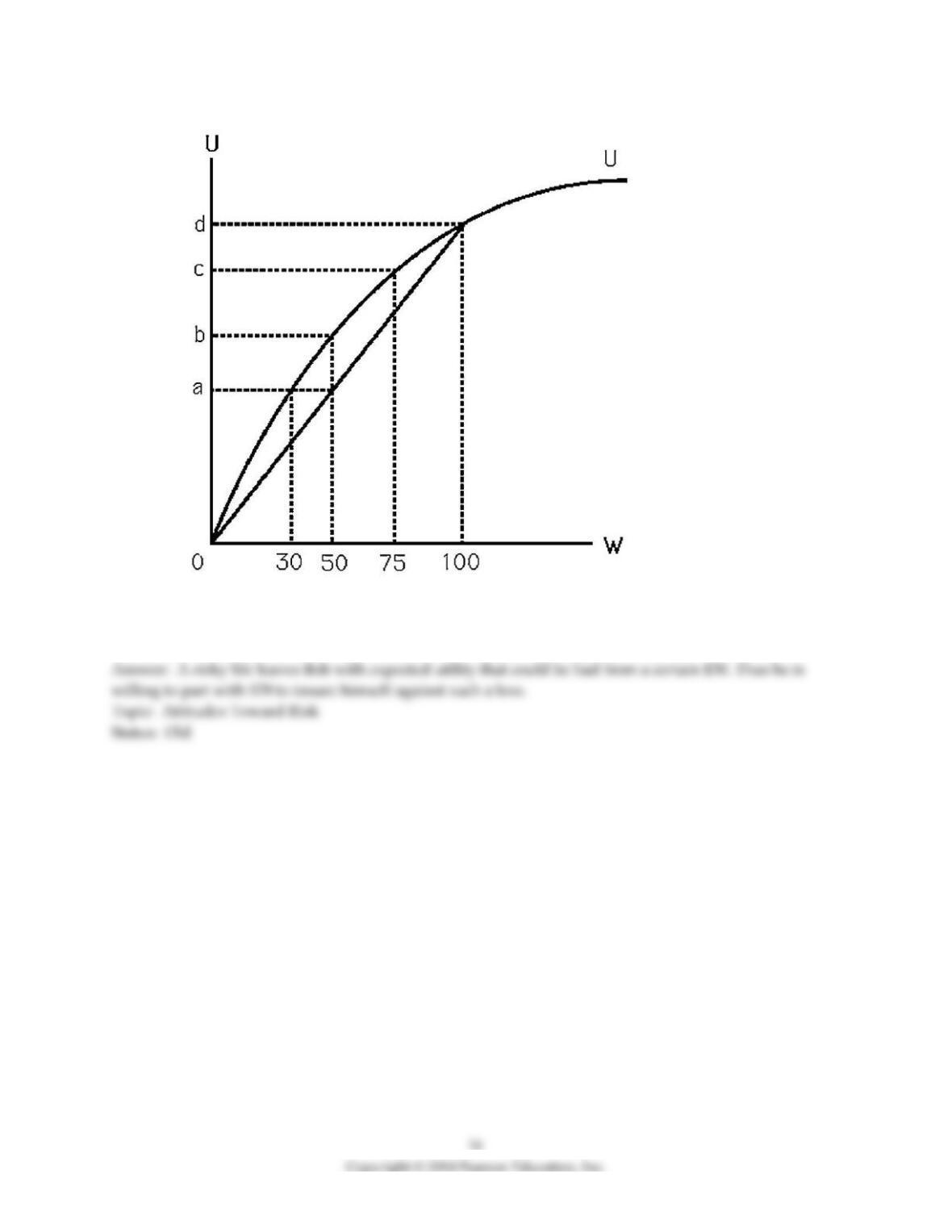
37) Bob’s utility function is shown in the above Figure. He currently has $100 worth of property, but there
is a 50% chance that all of it will be stolen. An insurance company offers to reimburse Bob for his loss if
the money is stolen. What is the most that Bob would pay for such a policy? Explain.
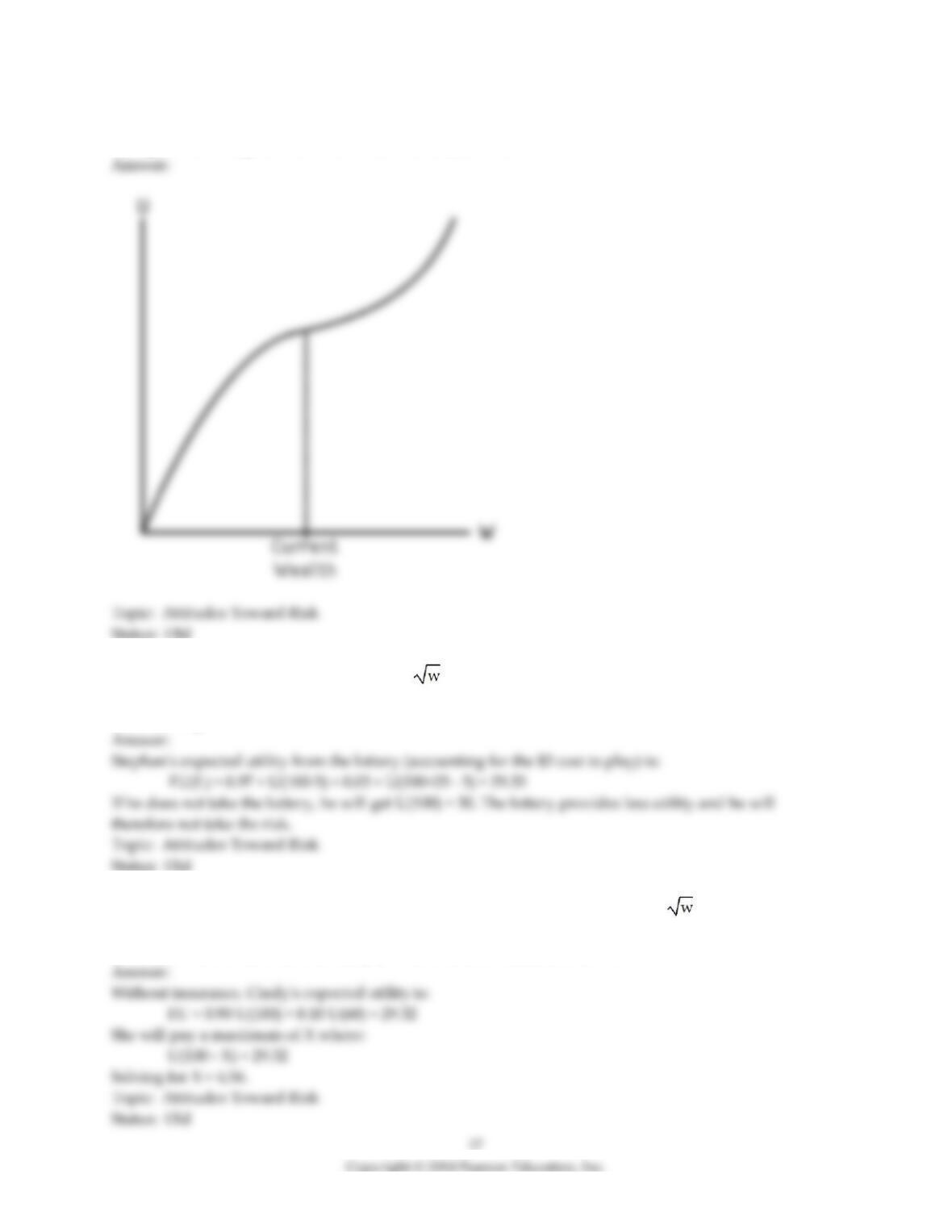
38) Steven currently has wealth of $10,000. He is risk averse about losing any of his wealth, but risk
loving about adding to his wealth. Draw his utility function.
39) Stephan has the utility function U(w) = 3 , where w is his wealth. Initially, Stephan has w = $100.
Would Stephan pay $5 to take the following gamble: With probability 0.03 he wins $25; otherwise, he
wins nothing.
40) Cindy’s attitudes towards risk are summarized by the utility function U(w) = . Cindy has an initial
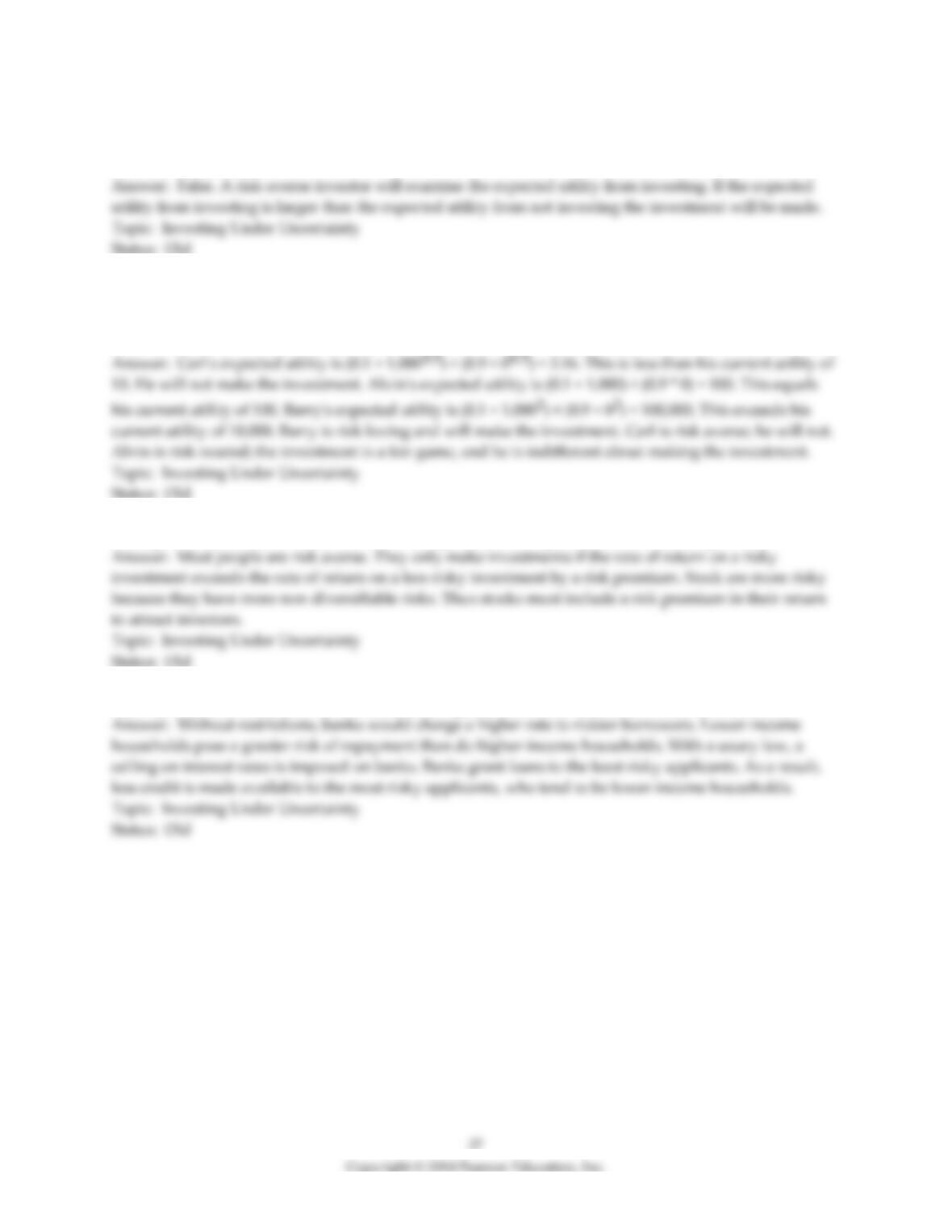
wealth of $100. There is a 10% chance that her home will sustain flood damage next year costing her $40
in repairs. What is the most she will pay to for a full $40 of flood insurance?
41) For each of the following statements, state whether the statement is true, false, or uncertain and
explain why.
i. A risk neutral person is indifferent to a gamble and the expected value of the gamble.
ii. A risk-averse person will never accept a gamble.
iii. A risk-loving person will accept any gamble.
42) Bob has an initial wealth of $1200 but faces a 50% chance of losing $800 to doctors’ bills in the coming
year. Insurance is available at a rate of 60¢ per $1 of coverage. This means that if Bob purchases $X in
coverage, it costs 6X¢ and pays $X towards Bob’s doctors’ bills. If Bob’s utility function is U(w) = 2 ,
how much insurance (X) will Bob purchase?
43) An individual has an initial wealth of $35,000 and might incur a loss of $10,000 with probability p.
Insurance is available that charges $gK to purchase $K of coverage. What value of g will make the
insurance actuarially fair? If she is risk averse and insurance is fair, what is the optimal amount of
coverage?
44) A deductible is an amount of a claim not covered by insurance. A deductible is a fixed portion of the
accident cost that the insured person must pay in order to make a claim to their insurer (this is similar to
a co-pay in which you must pay a portion of the medical costs in the case you get sick). For example, if I
break my arm, I have to pay a $50 deductible to the insurance company in order to get them to cover the
rest of my medical costs from the accident.
Rosa has a 10% chance of getting sick in the next year. If she gets sick, her medical bills will amount to
$500. She has a wealth of $1,000. Suppose she has the utility function U(X) = X0.5 where x is her net
wealth at the end of the year.
Suppose Rosa can purchase insurance. The insurance company provides two plans for Rosa to select
from, both providing $500 of coverage in the case that Rosa gets hurt. Plan A has zero deductibles (good!)
but charges a high premium (bad!). Specifically, Plan A charges $55 for $500 of coverage. Plan B has a
deductible of $K, where K<500, but charges a premium of just $(55 – .11K).
a. Suppose K = $100. Will Rosa purchase insurance and if so, which plan? Show this mathematically.
b. If Rosa can choose the deductible, K, what amount of deductible will she choose?
c. Suppose Rosa knows her chance of getting sick is really just 5%. How will this affect the deductible
she chooses? You only need to provide intuition (in words) for this part, not explicit computation.
45) Sarah has the utility function U(x) = 1 – 1/x, where x is the present value of her lifetime income. Sarah
is trying to select a career. If she goes into teaching, she will make x=5 with certainty. If she pursues
acting, she will make x=400 if successful or x=2 if unsuccessful (and therefore ends up waiting tables). The
chance of succeeding in acting is 1% if she pursues acting.
a. Determine which career Sarah will choose. Is she choosing the career with the higher expected value?
Explain.
b. An acting career expert charges 0.01 to determine if a person will succeed at acting. By going to an
expert, Sarah can choose the best career according to her skills. Assuming that the expert is able to
correctly determine if Sarah will be a successful actor, will she pay for this service?
46) Derive the Arrow-Pratt measure of risk aversion for the following utility functions. Which represents
the greatest level of risk aversion according to the measure?
a. U(X) =
b. U(X) = -e-x
c. U(X) = 1 – 1/X

16.3 Reducing Risk
1) Searching the Internet for information to help select a product that is more reliable is most likely to be
done by a
A) risk-averse person.
B) risk-neutral person.
C) risk-preferring person.
D) This cannot be determined with the information provided.
2) Which of the following helps to reduce risk?
A) abstain from risk taking
B) obtain more information
C) diversify
D) All of the above.
3) Buying a diversified mutual stock fund allows you to
A) completely avoid all types of risk.
B) avoid only random, unsystematic risk.
C) avoid only systematic risk.
D) avoid risk only when all the stock prices are perfectly correlated.
4) In terms of the stock market, systematic risk refers to the fact that
A) some stocks have higher returns than others.
B) some stocks’ returns have a higher variance than others.
C) all stock prices are correlated with the health of the economy.
D) most stock prices are perfectly negatively correlated.
5) The ability of diversification to reduce risk
A) is greater the more negatively correlated the two events are.
B) is greater the more positively correlated the two events are.
C) is greater the more uncorrelated the two events are.
D) is greater the more risk averse the individual is.

6) If two events are perfectly positively correlated, then
A) diversification is not necessary since there is no risk.
B) diversification eliminates all risk.
C) diversification does not reduce risk at all.
D) diversification only cuts the risk in half.
7) A person is betting a coin will come up heads or tails. The coin always lands on one of these two
outcomes. This person can bet to
A) eliminate only the systematic risk.
B) eliminate only the random risk.
C) eliminate all risk.
D) All of the above.
8) Many people do not fully insure against risk because
A) they are risk averse.
B) the insurance companies are all crooks.
C) the insurance offered is less than fair.
D) the insurance offered is more than fair.
9) If fair insurance is offered to a risk-averse person, she will
A) buy enough insurance to eliminate all risk.
B) not buy any insurance because it is overpriced.
C) not buy any insurance since the marginal utility of the amount of the payment is positive.
D) buy enough insurance to cover about half of the possible loss.
10) Which of the following losses to an individual would an insurance company NOT cover?
A) The person’s automobile is stolen.
B) Fire destroys the person’s home.
C) The person’s father dies.
D) The person’s country is invaded.
11) Insurance companies do not cover losses that would
A) happen to all of the policyholders at once.
B) happen with a very low probability.
C) happen to just a handful of policyholders.
D) happen with uncertainty.
12) If insurance is fairly priced, a risk-averse individual will purchase enough insurance to cover the full
amount of the possible loss.
13) Why does diversification fail to reduce risk when the returns of the two investments purchased are
perfectly positively correlated?
14) Distinguish between risk that can be reduced through diversification and risk that cannot be reduced
through diversification.
15) Explain why insurance companies usually do not offer earthquake insurance.

16.4 Investing Under Uncertainty
1) Risk-averse individuals make risky investments
A) never.
B) when the investment’s return exceeds the return on a non-risky investment.
C) when the investment’s return adequately compensates for the risk.
D) only when they are feeling irrational.
2) A risk-neutral person will invest in a project by examining if
A) the expected utility associated with the project is positive.
B) the marginal utility associated with the project is positive.
C) the expected net present value is positive.
D) All of the above.
3) If an individual makes her investment decisions based solely on the Net Present Value criterion, one
can conclude that she is
A) risk averse.
B) risk neutral.
C) risk loving.
D) extremely wealthy.
4) A risk-neutral individual will make investment decisions purely based on net present value because
A) she doesn’t care about utility.
B) because utility is a linear function of wealth.
C) she loves to take risk.
D) net present value is always more than expected utility.
5) The rate of return on bonds is lower than on stocks over time because
A) bond holders cannot diversify.
B) bonds have a lower standard deviation in returns.
C) stocks have less non-diversifiable risks than bonds.
D) bonds are subject to more random risks than stocks.

6) Which of the following statements is CORRECT?
A) Compared to stocks, bonds have a higher return.
B) Compared to stocks, bond returns have a higher standard deviation.
C) Compared to bonds, stock returns have a lower standard deviation.
D) Compared to bonds, stock returns have a higher standard deviation.
7) Concerning an investment project, which of the following is TRUE?
A) A risk-neutral individual is more likely to invest than a risk-averse individual.
B) A risk-neutral individual is more likely to invest than a risk-loving individual.
C) A risk-neutral individual is more less likely to invest than a risk-averse individual.
D) Not enough information.
8) Empirical evidence suggests that usury laws
A) help poor consumers by lowering the interest rate they pay.
B) hurt poor consumers by limiting their ability to borrow.
C) keep interest rates low.
D) limit the amount borrowed by wealthier consumers.
9) Usury laws result in banks making less credit available to lower-income households because
A) higher-income households will pay a higher interest rate than lower-income households.
B) loans made to higher-income households have no risk.
C) loans to lower-income households are riskier than loans to higher-income households.
D) the regulated interest rate does not adequately compensate the bank for the risk of the loan to a lower–
income household.
10) Without usury laws, banks will
A) charge very high interest rates to all borrowers.
B) charge higher interest rates to riskier borrowers than to safer borrowers.
C) charge very low interest rates to all borrowers.
D) face no demand for loans.
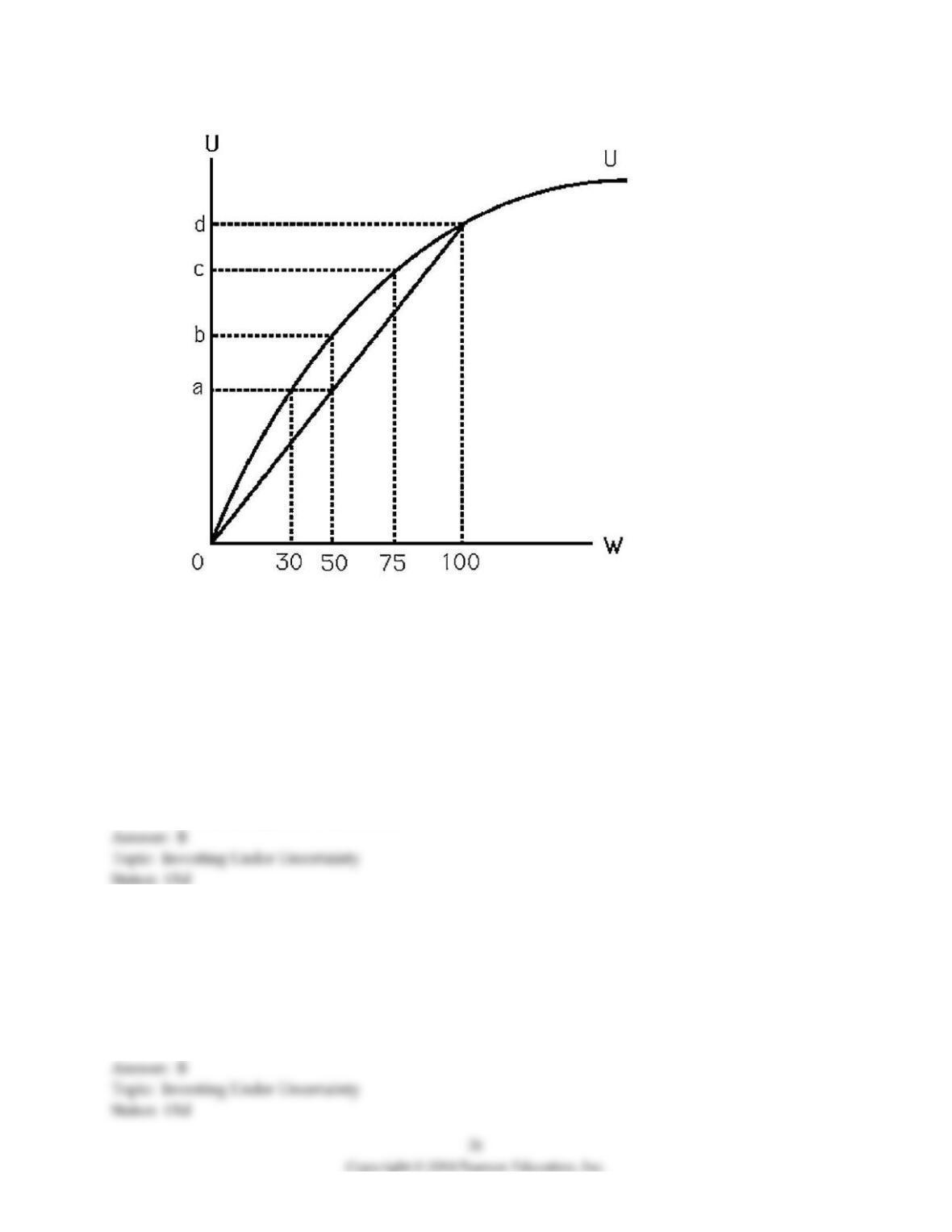
11) The above figure shows Bob’s utility function. He currently has $50 and is considering investing all of
it in an investment that has a 50% chance of being worth $100 and a 50% chance of being worth $0. Bob
will
A) definitely make the investment because the expected utility of the investment exceeds the utility of his
$50.
B) definitely not make the investment because the expected utility of the investment is less than the utility
of his $50.
C) definitely make the investment because he is indifferent between having $50 and having an
investment with an expected value of $50.
D) definitely not make the investment because he is indifferent between having $50 and having an
investment with an expected value of $50.
12) The above figure shows Bob’s utility function. He currently has $50 and is considering an investment
that has a 50% chance of being worth $100 and a 50% chance of being worth $0. Bob will make the
investment
A) if it costs less than $50.
B) if it costs less than $30.
C) if it is a fair game.
D) under no circumstances.
For the following, please answer “True” or “False” and explain why.
13) A risk-averse investor will decide whether or not to invest by determining if the expected value of the
investment is positive.
14) Alvin’s utility function is U = W. Barry’s utility function is U = W2. Carl’s utility function is U = W0.5.
Each has wealth of only $100. An investment of that $100 has a 10% chance of netting $1,000 and a 90%
chance of netting a loss of that $100. Who among the three will make the investment?
15) Explain why the rate of return from investing in stocks is higher than from investing in bonds.
16) Why would a usury law result in banks making less credit available to low–income households?
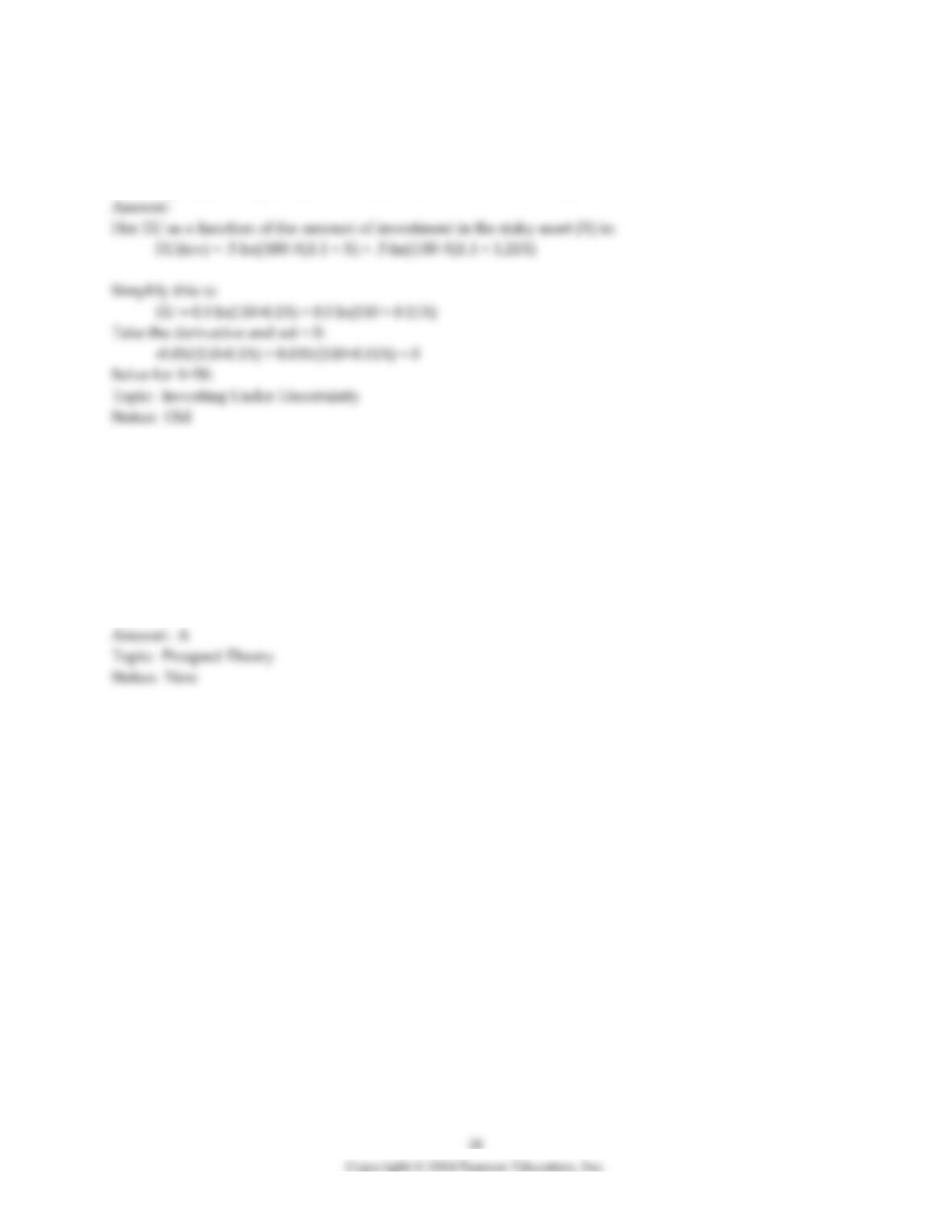
17) Suppose an individual has $100 to invest. Two assets are available. One asset will yield a return of
10%, while the other risky asset will yield 0% with probability .5 and 21% with probability .5. Suppose the
investor’s utility function is given by U(x) = ln(x) where x is the wealth after investing (assume she is
investing for just one period). How much will she invest in the risky asset?
16.5 Behavioral Economics and Uncertainty
1) Which of the following is a property of an S–shaped curve that corresponds to the prospect theory
value function?
A) The curve passes through the reference point at the origin.
B) Both sections of the curve are convex to the horizontal, outcome axis.
C) The curve is symmetric with respect to gains and losses.
D) None of the above.