Microeconomics: Theory and Applications with Calculus, 3e (Perloff)
Chapter 16 Uncertainty
16.1 Assessing Risk
1) Although he is very poor, Al plays the million-dollar lottery every day because he is certain that one
day he will win. Al makes this calculation based upon
A) the frequency of past outcomes.
B) subjective probability.
C) knowledge of all possible outcomes.
D) tossing a coin.
2) Your friend Dimitre tells you that he thinks that his favorite basketball team has a 70% chance of
winning the next game. This is an example of
A) an objective probability.
B) a subjective probability.
C) a risk-averse statement.
D) Friedman-Savage preferences.
3) You draw colored balls out of a bag. You draw a red ball 30% of the time and a blue ball 70% of the
time. For each draw, the blue outcome and the red outcome are
A) mutually exclusive.
B) exhaustive.
C) Both A and B.
D) None of the above.
4) If there are 10,000 people in your age bracket, and 10 of them died last year, an insurance company
believes that the probability of someone in that age bracket dying this year would be
A) 0.
B) .001.
C) .0001.
D) 1,000.
5) People in a certain group have a 0.3% chance of dying this year. If a person in this group buys a life
insurance policy for $3,300 that pays $1,000,000 to her family if she dies this year and $0 otherwise, what
is the expected value of a policy to the insurance company?
A) $0
B) $300
C) $3,000
D) $3,300
6) In a small town, it snowed 10 times on Christmas Eve during 25 years. What is the frequency of
snowing on Christmas Eve in that small town?
A) 10
B) 25
C) 2.5
D) 0.4
7) Expected value represents
A) the actual payment one expects to receive.
B) the average of all payments one would receive if one undertook the risky event many times.
C) the payment one receives if he or she makes the correct decision.
D) the payment that is most likely to occur.
8) On any given day, a salesman can earn $0 with a 40% probability, $100 with a 40% probability, or $300
with a 20% probability. His expected earnings equal
A) $0.
B) $100 because that is the most likely outcome.
C) $100 because that is what he will earn on average.
D) $200 because that is what he will earn on average.
9) On any given day, a salesman can earn $0 with a 30% probability, $100 with a 20% probability, or $300
with a 50% probability. His expected earnings equal
A) $0.
B) $100.
C) $150.
D) $170.
10) On any given day we know a salesman can earn $0 with a 40% probability, $100 with a 20%
probability or $300 with 40% probability. His expected earnings equal
A) $0.
B) $140.
C) $300.
D) It cannot be determined from the available information.
11) Assume the following. In location A yearly temperatures range from -30°F to 100°F and in location B
yearly temperatures range from 55°F to 75°F. In both locations the average yearly temperature equals
65°F. We can conclude that
A) temperature in location A has a higher variance.
B) temperature in location B has a higher standard deviation.
C) temperature in location A has a lower standard deviation.
D) temperatures in both locations have the same standard deviation but different variances.
12) Sarah buys little stuffed animals for $5 each. They come in different varieties. If the producer stops
making (retires) a certain variety, a stuffed animal of that variety will be worth $100; otherwise it is worth
$0. There is 50% chance that any variety will be retired. When Sarah buys her next stuffed animal, the
expected profit is
A) $50.
B) $47.50.
C) $45.
D) $0.
13) Sarah buys little stuffed animals for $5 each. They come in different varieties. If the producer stops
making (retires) a certain variety, a stuffed animal of that variety will be worth $100; otherwise it is worth
$0. There is 50% chance that any variety will be retired. What is the value to Sarah of knowing ahead of
time whether a variety will be retired?
A) $50
B) $5
C) $2.50
D) $0
14) Lisa runs a local flower shop. If it rains on Valentine’s Day and she opens the shop, she will lose $200.
If it does not rain on Valentine’s Day, she will earn $500 dollars as profits. What is Lisa’s expected profit
on Valentine’s Day if she only knows that there is a 30% chance of rain that day?
A) $350
B) $290
C) $200
D) $150
15) Lisa runs a local flower shop, if it rains on Valentine’s Day and she opens the shop, she will lose $200.
If it does not rain on Valentine’s Day, she will earn $500 dollars as profits. The chance of rain is 30%, what
is Lisa’s gain from perfect information about weather conditions on the forthcoming Valentine’s Day?
A) 50
B) 60
C) 90
D) 150
16) Lisa runs a local flower shop, if it rains on Valentine’s Day and she opens the shop, she will lose $200.
If it does not rain on Valentine’s Day, she will earn $500 dollars as profits. The chance of rain is 30%, the
standard deviation of the profits Lisa could earn on Valentine’s Day is
A) 198.17.
B) 135.61.
C) 432.43.
D) 290.
17) If a payout is certain to occur, then the variance of that payout equals
A) zero.
B) one.
C) the expected value.
D) the expected value squared.
18) A lottery game pays $500 with .001 probability and $0 otherwise. The variance of the payout is
A) 15.8.
B) 249.50.
C) 249.75.
D) 499.
19) All else held constant, as the variance of a payoff increases, the
A) expected value of the payoff increases.
B) risk of the payoff increases.
C) expected value of the payoff decreases.
D) risk of the payoff decreases.
For the following, please answer “True” or “False” and explain why.
20) Expected value represents the average of all outcomes if one were to undertake the risky event many
times over and over again.
21) For a given expected value, the smaller the standard deviation of the expected value, the larger the
risk.
22) On any given day, a salesman can earn $0 with a 20% probability, $100 with a 40% probability, or $300
with a 20% probability. Calculate the expected value and variance of his earnings, and interpret.
23) Explain why the variance of an investment is a useful measure of the risk associated with it.
24) Sarah buys little stuffed animals for $5 each. They come in different varieties. If the producer stops
making (retires) a certain variety, a stuffed animal of that variety will be worth $100; otherwise it is worth
$0. There is 25% chance that any variety will be retired. For the purchase of an individual animal, what is
the value to Sarah of knowing ahead of time whether or not that variety will be retired?
16.2 Attitudes Toward Risk
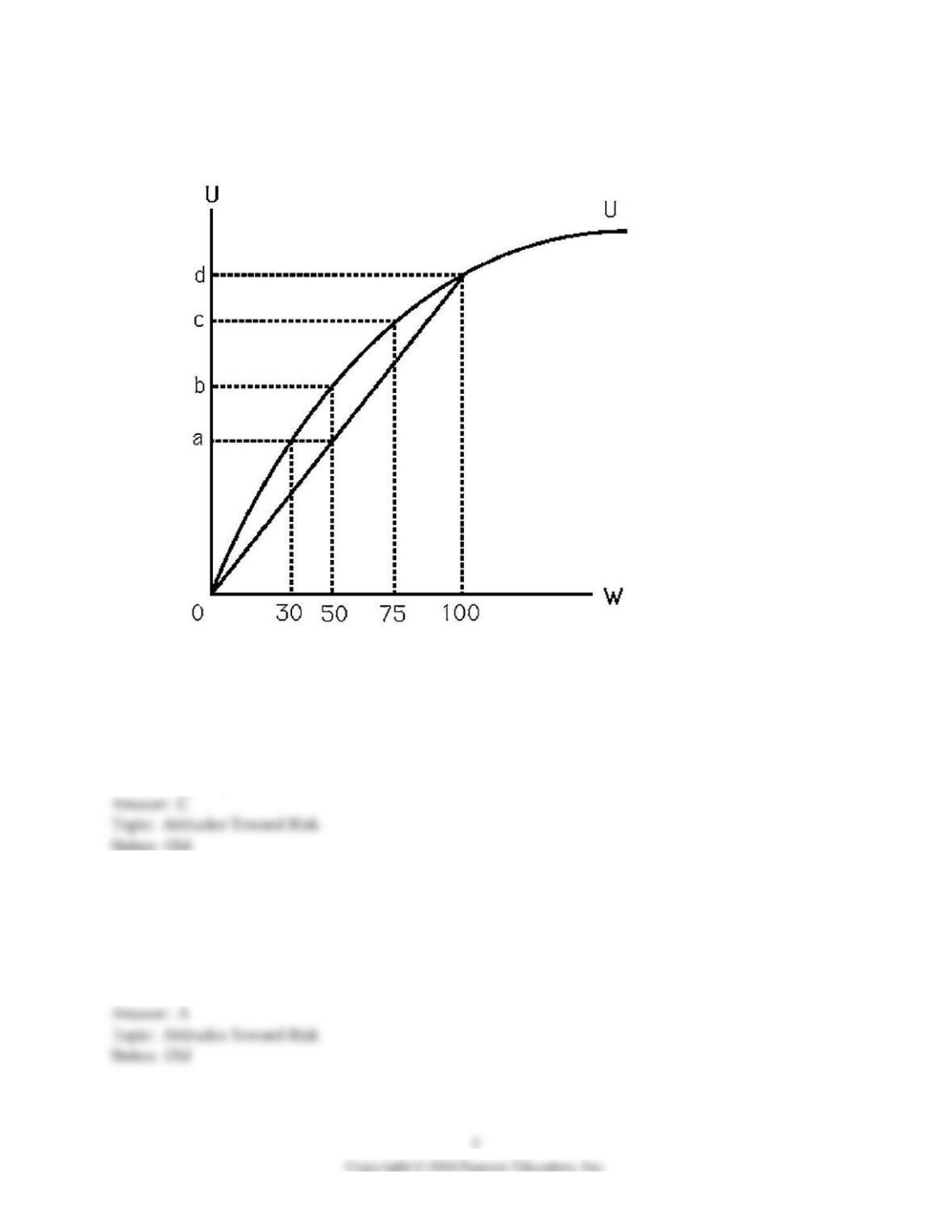
1) The above figure shows Bob’s utility function. He currently has $100 of wealth, but there is a 50%
chance that it could all be stolen. The midpoint of the chord that runs from zero and intersects the utility
function where wealth is 100, represents Bob’s
A) risk premium.
B) expected utility of receiving $50 with certainty.
C) expected utility of receiving $0 50% of the time and $100 50% of the time.
D) risk neutrality.
2) The above figure shows Bob’s utility function. He currently has $100 of wealth, but there is a 50%
chance that it could all be stolen. Bob’s expected utility is
A) a.
B) b.
C) c.
D) d.
3) The above figure shows Bob’s utility function. He currently has $100 of wealth, but there is a 50%
chance that it could all be stolen. Bob is
A) risk averse.
B) risk neutral.
C) risk loving.
D) risk premium.
4) The above figure shows Bob’s utility function. He currently has $100 of wealth, but there is a 50%
chance that it could all be stolen. Bob’s expected wealth is
A) $0.
B) $50.
C) $75.
D) $100.
5) The above figure shows Bob’s utility function. He currently has $100 of wealth, but there is a 50%
chance that it could all be stolen. To reduce the chance of theft to zero, Bob is willing to pay
A) $20.
B) $50.
C) $70.
D) $80.
6) The above figure shows Bob’s utility function. He currently has $100 of wealth, but there is a 50%
chance that it could all be stolen. Over and above the price of fair insurance, what is the risk premium
Bob would pay to eliminate the chance of theft?
A) $0
B) $20
C) $30
D) $50
7) The above figure shows Bob’s utility function. He currently has $100 of wealth, but there is a 50%
chance that it could all be stolen. Living with this risk gives Bob the same expected utility as if there was
no chance of theft and his wealth was
A) $0.
B) $20.
C) $30.
D) $50.
8) The above figure shows Bob’s utility function. He currently has $100 of wealth, but there is a 50%
chance that it could all be stolen. What is the most Bob would pay for insurance that would replace his
$100 should it be stolen?
A) $30
B) $50
C) $70
D) $75
9) The above figure shows Bob’s utility function. He currently has $100 of wealth, but there is a 50%
chance that it could all be stolen. If Bob could keep $50 with certainty, his utility would be
A) a.
B) b.
C) c.
D) d.
10) The above figure shows Bob’s utility function. He currently has $100 of wealth, but there is a 50%
chance that it could all be stolen. Bob is risk averse because
A) his utility function is concave.
B) he has diminishing marginal utility of wealth.
C) he is willing to pay a premium to avoid a risky situation.
D) All of the above.
11) The above figure shows Bob’s utility function. He currently has $100 of wealth, but there is a 50%
chance that it could all be stolen. Bob is risk averse because
A) his utility function is convex.
B) he has negative marginal utility of wealth.
C) he is willing to pay a premium to avoid a risky situation.
D) All of the above.
12) The above figure shows Bob’s utility function. He currently has $100 of wealth, but there is a 50%
chance that it could all be stolen. Bob will buy theft insurance to cover the full $100
A) as long as it does not cost more than $25.
B) as long as it does not cost more than $50.
C) as long as it does not cost more than $70.
D) at any price.
13) If a person is entertained by gambling, then
A) she is not risk averse.
B) she does not understand the concept of a fair game.
C) she may gamble even if it is an unfair game.
D) she will definitely not buy automobile insurance.
14) A risk-preferring person is willing to pay
A) a risk premium.
B) a fee to make a fair bet.
C) to obtain decreasing marginal utility.
D) None of the above.
15) If a person is risk neutral, then she
A) is indifferent about playing a fair game.
B) will pay a premium to avoid a fair game.
C) has a horizontal utility function.
D) has zero marginal utility of wealth.
16) For a risk-neutral person, the expected utility associated with various levels of wealth
A) is above the person’s utility function.
B) is below the person’s utility function.
C) is equal to the person’s utility function.
D) does not exist.
17) Which of the following games involving the roll of a single die is a fair bet?
A) Bet $1 and receive $1 if 3 or 4 comes up.
B) Bet $1 and receive $1 if 3, 4, or 5 comes up.
C) Bet $1 and receive $4 if six comes up.
D) None of the bets is a fair bet.
18) John derives more utility from having $1,000 than from having $100. From this, we can conclude that
John
A) is risk averse.
B) is risk loving.
C) is risk neutral.
D) has a positive marginal utility of wealth.
19) John’s utility from an additional dollar increases more when he has $1,000 than when he has $10,000.
From this, we can conclude that John
A) is risk averse.
B) is risk loving.
C) is risk neutral.
D) has a negative marginal utility of wealth.
20) Bob invests $50 in an investment that has a 50% chance of being worth $100 and a 50% chance of
being worth $0. From this information we can conclude that Bob is NOT
A) risk loving.
B) risk neutral.
C) risk averse.
D) rational.
21) Bob invests $75 in an investment that has a 50% chance of being worth $100 and a 50% chance of
being worth $0. From this information we can conclude that Bob is
A) risk loving.
B) risk neutral.
C) risk averse.
D) irrational.
22) Catherine is risk-averse. When faced with a choice between a gamble and a certain level of wealth, she
will
A) always prefer the gamble.
B) always prefer the certain level of wealth.
C) prefer the gamble if the expected utility from it is higher than the utility from the certain level of
wealth.
D) prefer the certain level of wealth if the expected utility from the gamble is higher than the utility of the
certain level of wealth.
23) Bob invests $25 in an investment that has a 50% chance of being worth $100 and a 50% chance of
being worth $0. From this information we can conclude that Bob is
A) risk loving.
B) risk neutral.
C) risk averse.
D) Any one of the three above.
24) The Friedman-Savage utility function can explain why
A) people buy automobile insurance.
B) somebody becomes addicted to gambling.
C) people become more risk averse as their wealth increases.
D) people place small bets to have a chance at winning a large amount.
25) The Arrow-Pratt measure of risk aversion is
A) negative if a person is risk averse.
B) greater than one if a person is risk averse.
C) negative if a person is risk loving.
D) None of the above.
26) If Ann’s utility function is U = W0.5, and she invests in a business which can yield $6,400 with
probability 1/5, and $3600 with probability 4/5, then her expected utility is
A) 80.
B) 76.
C) 64.
D) 60.
27) If Ann’s utility function is U = W0.5, and she invests in a business which can yield $6,400 with
probability 1/5, and $3600 with probability 4/5, then her expected wealth is
A) $1280.
B) $2880.
C) $4160.
D) $5840.
28) If Ann’s utility function is U = W0.5, and she invests in a business which can yield $6,400 with
probability 1/5, and $3600 with probability 4/5, then her risk premium to avoid bearing this risk is
A) $36.
B) $41.6.
C) $64.
D) $100.
29) If Ann’s utility function is U =3W0.5, and she invests in a business which can yield $6,400 with
probability 1/5, and $3600 with probability 4/5, then her Arrow-Pratt measure of risk aversion is
A) 0.5/w.
B) 1/w.
C) 1.5w.
D) 3/w.
For the following, please answer “True” or “False” and explain why.
30) If a person is risk averse, then she has negative marginal utility of wealth.
31) A fair game is a game in which the chances are 50-50 that you win or lose.
32) If a person willingly plays an unfair game that is not in his favor, he is risk loving.
33) Johnny owns a house that would cost $100,000 to replace should it ever be destroyed by fire. There is
a 0.1% chance that the house could be destroyed during the course of a year. Johnny’s utility function is
U = W0.5. How much would fair insurance cost that completely replaces the house if destroyed by fire?
Assuming that Johnny has no other wealth, how much would Johnny be willing to pay for such an
insurance policy? Why the difference?