Chapter 16 Test Bank KEY
1. In general, economists place all factors of production into which three categories?
2. The ingredients that go into making any good or service are called the:
3. The factors of production are the:
4. The factor of production called “labor” can be defined as the:
5. The factor of production called “land” can be defined as the:
16-2
6. The factor of production called “capital” refers to:
7. The demand for factors of production is referred to as:
8. Derived demand:
9. The demand for factor inputs:
10. If the demand for a good increases, it is likely that the demand for the factors of production used as
inputs will:
11. If the demand for hand-sewn leather shoes increases, it is highly likely the demand for:
12. If the demand for hand-sewn leather shoes increases, it is likely the demand for leather will:
13. If the demand for oranges falls, as a result, it is highly likely that the demand for:
14. If the demand for pizza increases, then as a result, it is highly likely that the demand for:
15. If the demand for baseballs increases, then as a result, it is highly likely that the demand for:
16. The relationship between the quantity of inputs and the quantity of outputs is called a:
17. A production function represents the:
18. The marginal product of any input into the production process is the:
19. The increase in output that is generated by an additional unit of input is called the:
20. Graphically, we can think of the marginal product of a factor as the:
21. Holding other things constant, diminishing marginal productivity happens to:
22. All factors of production usually experience:
23. A profit-seeking firm will choose the combination of inputs that maximizes profit, based on the:
24. A profit-seeking firm will choose the combination of inputs that:
25. Which of the following industries would be considered to have a labor intensive production process?
26. Which of the following industries would be considered to have a labor intensive production process?
27. Which of the following industries would be considered to have a capital intensive production process?
28. Which of the following industries would be considered to have a capital intensive production process?
29. Which of the following has a production process that would be considered capital intensive?
30. Which of the following has a production process that would be considered labor intensive?
31. A labor intensive production process is one in which:
32. A capital intensive production process is one in which:
33. Farming in poor countries is considered to be:
34. Farming in poor countries is considered to be ___________ intensive because __________.
35. In the market for labor:
36. In the graph of supply and demand in the market for labor:
37. The question of how much labor a firm will hire comes down to:
38. The question of how much labor a firm will hire comes down to:
39. The marginal product generated by an additional unit of input times the price of the output is called:
40. The value of the marginal product is the:
41. For a competitive firm, the marginal revenue product is:
42. For a competitive firm, the value of the marginal product:
43. For a competitive firm, the value of output ___________ and the marginal product of labor
___________ with each additional worker hired.
44. By comparing the value of marginal product with the marginal cost per input, a firm can find the:
45. Graphing the value of marginal product against the quantity of a given input hired looks like which of
the following curves?
46. The curve formed by plotting the value of the marginal product for workers against quantity of labor
is:
47. The competitive firm’s profit-maximizing quantity of labor is the quantity where the:
48. When the competitive firm’s value of the marginal product of labor intersects the market-wage level,
the firm:
49. At the competitive firm’s profit-maximizing quantity of labor:
50. In the market for labor:
51. When individuals are debating whether to supply labor, they think about all of the following except:
52. We think about the cost of supplying labor as the:
53. In economics, the term “leisure” refers to:
54. A person will choose to work another hour if the benefit of another hour of work is:
55. A worker will become indifferent between spending the next hour on work or leisure if the benefit of
another hour of work is:
56. When the benefit of another hour of work is greater than the opportunity cost, we would expect the
worker to work:
16–12
57. Sadie is getting ready to go to work where she earns $70 a day as a day laborer. Her friend Caroline
calls her and asks her to go swimming with sharks for the day. Sadie decides to go with her. Sadie’s
choice implies that her opportunity cost of working is:
58. Claire is on her way to her job at a call center where she was planning on spending three hours. She
can drop in and work any hour she wants to and earn $12 per hour. Her friend calls and invites her to
spend the next three hours bungee jumping. Claire decides to go with her friend, which tells us Claire’s
opportunity cost of working for three hours is:
59. Grace is headed to work at a catering business as a waitress for $100. Her sister Paige calls and
asks her to go horseback riding instead. Grace decides to go to work, which implies Grace’s opportunity
cost of working is:
60. Eli is headed to his job harvesting grapes at a local vineyard. He earns $8 every hour he works there.
His friend calls him and asks him to go mountain biking for the next 2 hours instead. Eli cannot decide
between the two activities. His indecision implies he values riding his mountain bike for two hours:
61. Eli is headed to his job harvesting grapes at a local vineyard. He earns $8 every hour he works there.
He could also earn $7 an hour working as a bagger at the local grocery. Assuming Eli can only choose
between these 2 jobs and that the benefits of each job are the same. Eli’s opportunity cost every hour
he decides to work at his harvesting job is:
62. Eli can decide between two jobs. One job is harvesting grapes at a local vineyard. He would earn $8
every hour he works there. He could also earn $7 an hour working as a bagger at the local grocery.
Assuming Eli can only choose between these 2 jobs and that the benefits of both jobs are the same. If Eli
decides to work at the grocery store as a bagger the opportunity cost every hour he decides to work at
the grocery is:
63. In general, as wages go up:
64. In general, as wages increase:
65. Which of the following would be considered a “leisure” activity by economists?
66. Which of the following would not be considered a “leisure” activity by economists?
67. Which of the following would be considered a “leisure” activity by economists?
68. The market labor-supply curve is:
69. The market labor-supply curve has all of the following properties except it:
70. The labor supply could decrease when wages increase only if the:
71. The labor-supply curve will be downward sloping if the:
72. The price effect describes the:
73. The increase in the quantity of labor supplied in response to a higher wage is called the:
74. The income effect describes the:
75. The decrease in the quantity of labor supplied due to the greater demand for leisure caused by a
higher income is called the:
76. A decrease in the quantity of labor supplied in response to a higher wage would be due to the:
77. If the price effect outweighs the income effect of a wage increase, the quantity of labor supplied will:
78. If the price effect outweighs the income effect of a wage increase, the labor-supply curve will:
79. If the income effect outweighs the price effect of a wage increase, the quantity of labor supplied will:
80. If the income effect outweighs the price effect of a wage increase, the labor-supply curve will:
81. Sadie works at a factory for $15 an hour and typically works 40 hours a week. Sadie gets a pay raise
and now earns $20 an hour. She decides to work 45 hours a week at $20 an hour. Her response:
82. Sadie works at a factory for $15 an hour and typically works 40 hours a week. Sadie gets a pay raise
and now earns $20 an hour. She decides to work 45 hours a week at $20 an hour. Her response to the
pay increase demonstrates the:
83. Julie works at a local hat factory for $12 an hour and typically works 40 hours a week. The company
threatens layoffs, so Julie and the others agree to a pay cut. Julie now earns $10 an hour and works
every hour over 40 that her boss will let her. Julie’s response to this pay cut was to work:
84. Wes works as a delivery man and can work as many hours as he likes for $12 an hour. He typically
works 40 hours a week. Recently, his pay has been cut, and Wes decides to work:
85. If Donald receives a pay raise and the income effect outweighs the price effect on his labor supply
decisions, he will work:
86. If Jay receives a pay cut and the price effect outweighs the income effect on his labor supply
decisions, he will work:
87. If Tony receives a pay raise and the price effect outweighs the income effect on his labor supply
decisions, he will:
88. If Sam receives a pay cut and the income effect outweighs the price effect on his labor supply
decision, he will:
89. In general in the real world labor market the:
90. We assume an upward sloping supply curve because:
91. A worker deciding how many hours to work can be represented:
92. An individual labor-supply curve represents:
93. A firm deciding how many hours to hire can be represented:
94. An individual labor-demand curve represents:
95. In order to see how the labor market works as a whole, we need to add up all the:
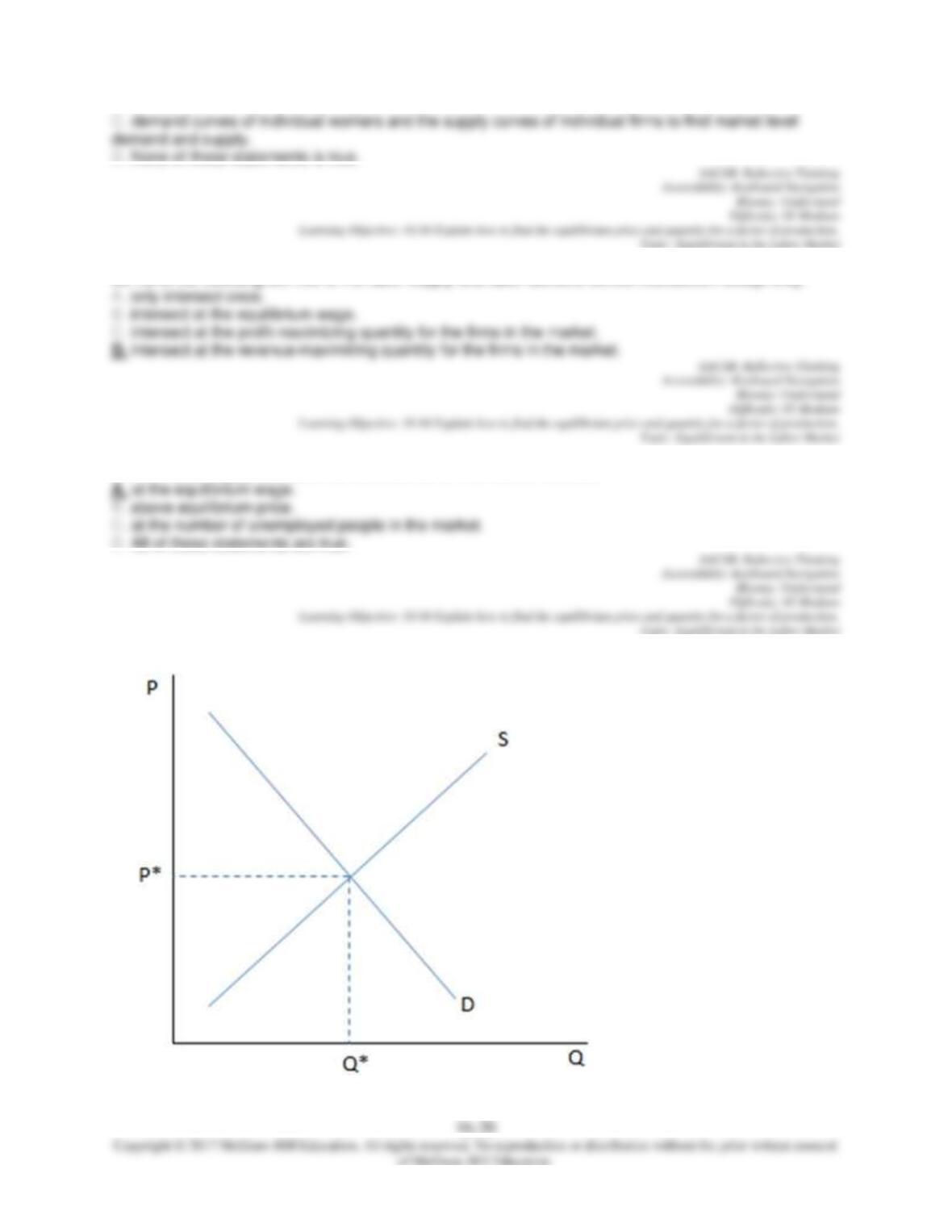
96. All of the following are true of the labor-supply and labor-demand curves intersection except they:
97. The labor-supply and labor-demand curves for the market intersect:
98.