CHAPTER 16: Consumer Choice
MULTIPLE CHOICE
1. A measure of the relative levels of satisfaction that consumers enjoy from the consumption of
goods and services is called
a. consumer optimum. d. the substitution effect.
b. the real-income effect. e. the diamond–water paradox.
c. utility.
2. Utility theory seeks to measure
a. supply. d. profits.
b. costs. e. satisfaction.
c. ability.
3. American consumers make thousands of purchasing decisions each year. These decisions
a. involve several trade-offs.
b. are always consistent with economic theory.
c. do not depend on the consumers’ budgets.
d. are called utils.
e. always maximize utility.
4. When making personal buying decisions, two important issues to consider are the
a. satisfaction you receive from the choices that you make and the satisfaction others receive
from your choices.
b. satisfaction others receive from your choices and the constraints of a limited budget.
c. shape of your indifference curve and the satisfaction you receive from the choices that you
make.
d. satisfaction you receive from the choices that you make and the constraints of a limited budget.
e. satisfaction you receive from the choices that you make and the future value of the purchases
that you make.
5. Which of the following statements is true about utility?
a. Economists measure utility with a unit they refer to as an utte.
b. Utility is easy to compare across individuals.
c. All products produce the same utility.
d. Everyone receives the same level of satisfaction from the same good or service.
e. Some products produce more utility than others.
6. Which of the following statements is true about utility?
a. Economists measure utility with a unit they refer to as a util.
b. Utility is easy to measure across individuals.
c. All products produce the same level of utility.
d. Everyone receives the same level of satisfaction from the same good or service.
e. Economists measure utility with a unit they refer to as an utte.
7. Which of the following statements is true about utility?
a. Economists measure utility with a unit they refer to as an utte.
b. Everyone receives different levels of satisfaction from the same good or service.
c. All products produce the same level of utility.
d. Everyone receives the same level of satisfaction from the same good or service.
e. Utility is easy to measure across individuals.
8. Economists expect the firm to maximize ________, the laborer to accept the best ________, and
the consumer to find the combination of goods that gives the most ________.
a. utility; profits; offers d. profits; utility; offers
b. utility; offer; profit e. offers; profits; utility
c. profit; offer; utility
9. A big concern with trying to measure utility is that
a. individuals cannot place utility values on different goods and services.
b. it is difficult to measure marginal utility.
c. there is no distinction between utility for goods and utility for services.
d. to measure utility, you need monetary values of the goods and services.
e. each individual has a unique personal scale for his or her utility measures.
10. Jenna and Walter are on a road trip across the country. They both say that they get 25 utils from
peanut butter sandwiches and 25 utils from trail mix. Knowing this, we can conclude that Jenna
a. gets the same satisfaction from peanut butter sandwiches that Walter does.
b. gets more satisfaction from trail mix than Walter does.
c. gets more satisfaction from trail mix than from peanut butter sandwiches.
d. and Walter are both indifferent between other food than peanut butter sandwiches or trail mix.
e. and Walter will consume the same amount of peanut butter sandwiches and trail mix on the
road trip.
11. Umberto gets 20 utils from consuming guacamole and 15 utils from consuming salsa; Fabian gets
30 utils from the same guacamole and 15 utils from salsa. Given this information, a researcher can
conclude that
a. Fabian gets more satisfaction from both guacamole and salsa.
b. Umberto will get more satisfaction from consuming one more unit of guacamole than Fabian
will.
c. Umberto and Fabian prefer to consume a combination of guacamole and salsa.
d. Umberto and Fabian both prefer guacamole to salsa.
e. Umberto will get more satisfaction from consuming one more unit of salsa than Fabian will.
12. Marginal utility
a. occurs when total utility declines as consumption increases.
b. is the additional satisfaction derived from consuming one more unit of a good or service.
c. is the combination of goods and services that maximizes utility for a given income.
d. occurs when a consumer buys more of a good as a result of a relative price change.
e. occurs when there is a change in purchasing power as a result of a change in the price of a
good.
13. The additional satisfaction derived from consuming one more unit of a good or service is called
a. diminishing marginal utility. d. the substitution effect.
b. the real-income effect. e. the consumer optimum.
c. marginal utility.
14. When marginal utility is positive, total utility
a. increases. d. stays the same.
b. decreases. e. equals zero.
c. can increase or decrease.
15. When marginal utility is negative, total utility
a. increases. d. stays the same.
b. decreases. e. is equal to zero.
c. can increase or decrease.
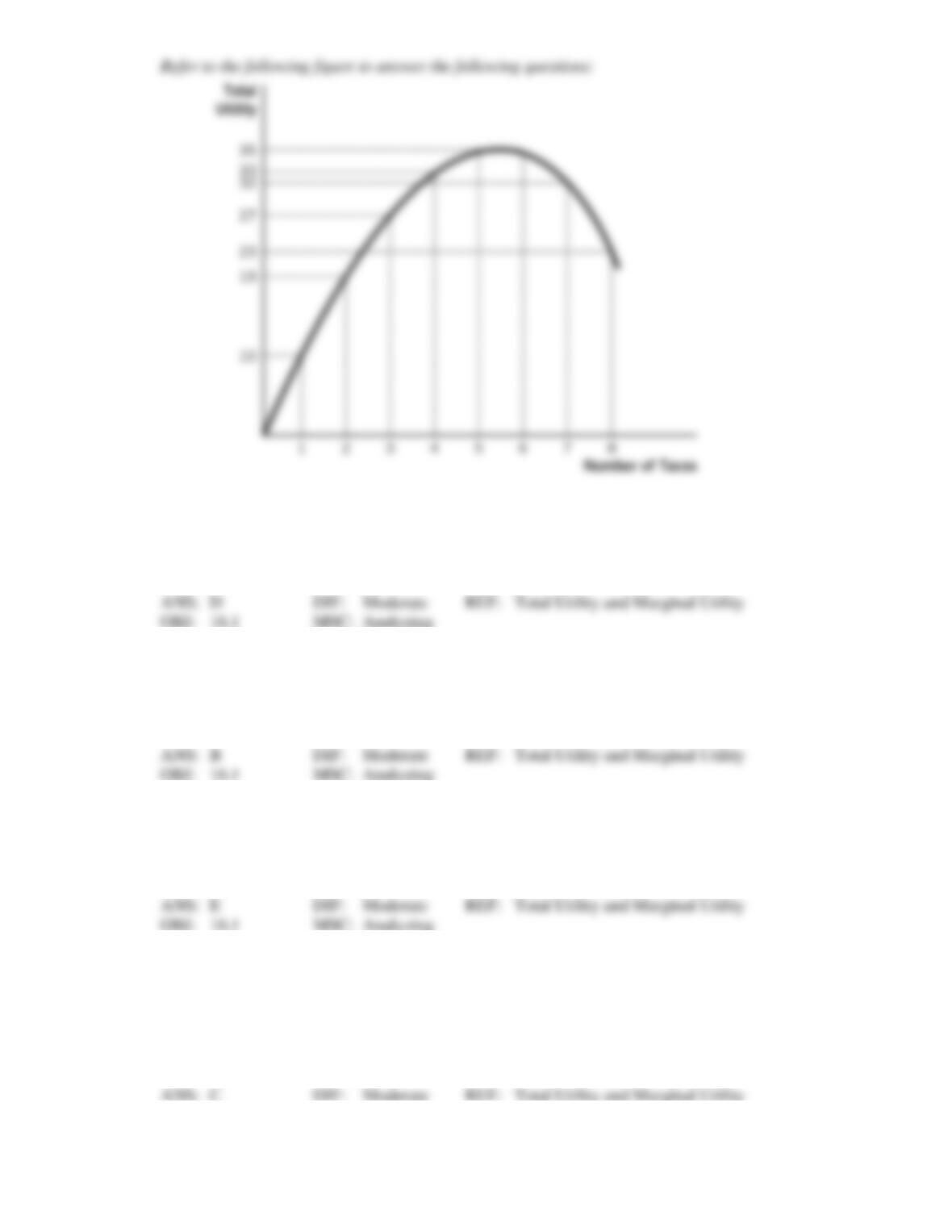
16. The marginal utility experienced from consuming the third taco is
a. 10 utils. d. 8 utils.
b. 6 utils. e. 23 utils.
c. 27 utils.
17. The marginal utility experienced from consuming the sixth taco is
a. 35 utils. d. −12 utils.
b. 0 utils. e. −3 utils.
c. 27 utils.
18. The marginal utility experienced from consuming the seventh taco is
a. 32 utils. d. –12 utils.
b. –9 utils. e. –3 utils.
c. 27 utils.
19. Total utility is negative
a. at all levels of consumption.
b. from this consumer’s sixth taco on.
c. at no time.
d. for this consumer’s fifth and sixth tacos only.
e. when marginal utility is positive.
20. Marginal utility is negative
a. at all levels of consumption.
b. from this consumer’s sixth taco on.
c. never.
d. for this consumer’s fifth and sixth tacos only.
e. when marginal utility is positive.
21. This consumer experiences diminishing marginal utility
a. over all levels of consumption.
b. up until she consumes her fifth taco.
c. up until she consumes her sixth taco.
d. from her sixth taco on.
e. for her fifth and sixth tacos only.
22. The marginal utility of the third unit is
a. utils. d. 20 utils.
b. 80 utils. e. 10 utils.
c. 90 utils.
23. The marginal utility of the fifth unit is
a. −15 utils. d. 20 utils.
b. 75 utils. e. 0 utils.
c. 90 utils.
24. The marginal utility of the eighth unit is
a. −30 utils. d. 20 utils.
b. 30 utils. e. 0 utils.
c. 50 utils.
25. Marginal utility is negative
a. at all levels of consumption.
b. from the sixth soda on.
c. never.
d. for the fifth and sixth sodas only.
e. when marginal utility is positive.
26. This consumer experiences diminishing marginal utility
a. over all levels of consumption.
b. up until she consumes her fifth soda.
c. up until she consumes her sixth soda.
d. from her sixth soda on.
e. for her fifth and sixth sodas only.
27. Total utility after the second cupcake is
a. 30 utils. d. 5 utils.
b. 25 utils. e. 50 utils.
c. 55 utils.
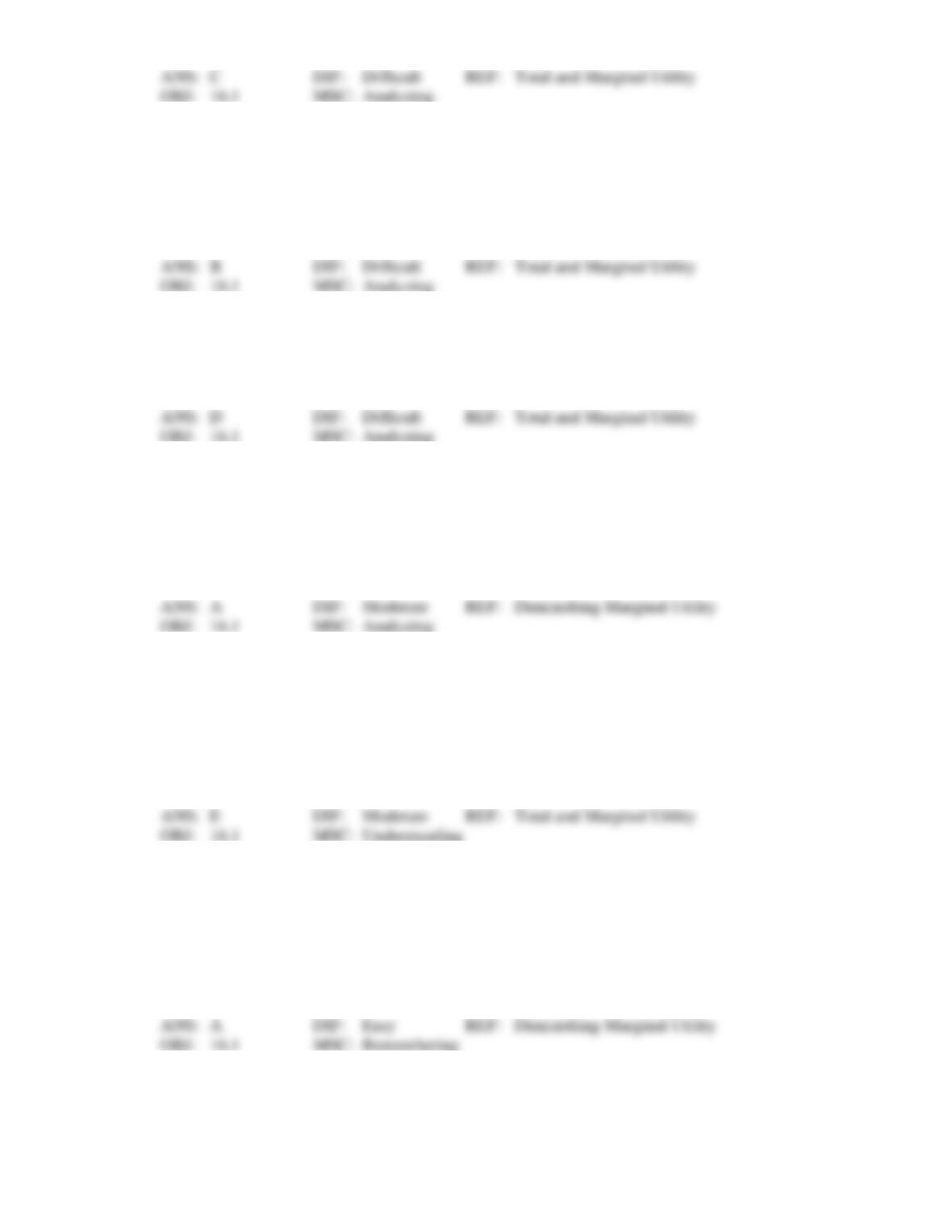
28. Marginal utility is negative
a. at all levels of consumption.
b. from the consumer’s eighth cupcake on.
c. never.
d. for the consumer’s fifth and sixth cupcakes only.
e. when marginal utility is positive.
29. Total utility is highest at the ________ cupcake.
a. first d. seventh
b. eighth e. sixth
c. ninth
30. This consumer experiences diminishing marginal utility
a. across all levels of consumption.
b. until he consumes his fifth cupcake.
c. until he consumes his seventh cupcake.
d. from his seventh cupcake on.
e. for his fifth and sixth cupcakes only.
31. When given the marginal utility of the first five units of a product, we can calculate the total utility
by
a. finding the difference between the fourth and fifth units.
b. finding the difference between the first and fifth units.
c. looking at the marginal utility of the fifth unit.
d. adding the fourth and fifth units.
e. adding the marginal utilities of the first five units.
32. Diminishing marginal utility
a. occurs when the additional utility for each good declines as consumption increases.
b. is the additional satisfaction derived from consuming one more unit of a good or service.
c. is the combination of goods and services that maximizes utility for a given income.
d. occurs when a consumer buys more of a good as a result of a relative price change.
e. occurs when there is a change in purchasing power as a result of a change in the price of a
good.
33. When marginal utility declines as consumption increases, the consumer is experiencing
a. diminishing marginal utility. d. the substitution effect.
b. the real-income effect. e. the consumer optimum.
c. marginal utility.
34. Individuals who haven’t studied economics may not understand how all-you-can-eat buffets
manage to make money. This can be explained by the concept of ________, which makes each trip
to the buffet line less satisfactory than the previous one.
a. real-income effect d. the substitution effect
b. marginal utility e. the consumer optimum
c. diminishing marginal utility
35. In July 2012, it cost $125 to purchase a ticket to visit the parks at Disneyland for one day. A
five-day pass to the same parks cost only $290. Disneyland charges less for the additional days
because of
a. the real-income effect. d. the substitution effect.
b. diminishing marginal utility. e. the consumer optimum.
c. marginal utility.
36. A company in Irvine, California, is interested in buying season tickets to the local baseball team.
Tickets for scheduled games are sold individually for $12 each, but season tickets are only $4 each.
The reason why the local baseball team has to charge less for season tickets can be explained by
a. the real-income effect. d. the substitution effect.
b. the consumer optimum. e. diminishing marginal utility.
c. marginal utility.
37. Cell phone companies rely on the ________ of conversation to make unlimited night and weekend
minutes on cell phone plans profitable.
a. real-income effect d. diminishing marginal utility
b. consumer optimum e. substitution effect
c. marginal utility
38. The consumer optimum
a. occurs when utility declines as consumption increases.
b. is the additional satisfaction derived from consuming one more unit of a good or service.
c. is the combination of goods and services that maximizes utility for a given income.
d. occurs when a consumer buys more of a good as a result of a relative price change.
e. occurs when there is a change in purchasing power as a result of a change in the price of a
good.
39. The combination of goods and services that maximizes utility for a given income is called
a. diminishing marginal utility. d. the substitution effect.
b. the real-income effect. e. the consumer optimum.
c. marginal utility.
40. Maximizing utility
a. requires that consumers get the most satisfaction out of every dollar they spend.
b. is very easy for consumers to achieve.
c. always requires that consumers spend more money than they have.
d. requires that the marginal utility of each good consumed is equal, no matter the price of each
good consumed.
e. requires that the price of each good is equal.
41. To maximize one’s satisfaction when deciding between two goods
a. one must consume at the point where the marginal utility of each good is equal, no matter the
price of each good.
b. one does not need to consider opportunity costs.
c. one must spend more money than one has.
d. one must get the most satisfaction out of every dollar spent.
e. the price of each good considered must be equal.
42. The old saying “getting the biggest bang for your buck” means that
a. consumers never experience diminishing marginal utility.
b. consumers maximize their utility.
c. consumers spend every dollar in their budget.
d. the real-income effect is equal to the substitution effect.
e. consumers stop consuming when the marginal utilities of each good are equal regardless of the
prices of each good.
43. Which of the following statements is always true when determining the consumer optimum?
a. Maximizing utility does not take budget restraints into consideration.
b. Maximizing utility is easy if you are considering only two goods.
c. Maximizing utility requires the marginal utility per dollar to be equal for each good consumed.
d. Maximizing utility requires the total utility per dollar to be equal for each good consumed.
e. Maximizing utility requires the marginal utility to be equal for each good.
44. Emilia is trying to figure out what combination of bags of peanuts and bags of popcorn she should
buy with her $13 budget. The price of peanuts is currently $3 per bag and the price of popcorn is
currently $2 per bag. Emilia is currently deciding whether to purchase one more bag of peanuts or
one more bag of popcorn. She should choose the
a. peanuts every time.
b. popcorn every time.
c. peanuts, if the marginal utility of peanuts is greater than popcorn.
d. popcorn, if the marginal utility of popcorn is greater than peanuts.
e. peanuts, if the last bag she consumed was popcorn, and vice versa.
45. Assume that Thomas can afford to buy as many candy bars and ice cream cones as he wants. He
would continue to consume both candy bars and ice cream until the
a. marginal utility of each decreases.
b. marginal utility of each becomes negative.
c. total utility of each becomes negative.
d. marginal utility of candy bars and ice cream bars is equal.
e. total utility of candy bars and ice cream bars is equal.
46. Timothy is trying to figure out what combination of bags of peanuts and bags of popcorn he should
buy with his $15 budget. The price of peanuts is currently $5 per bag and the price of popcorn is
currently $2 per bag. If Timothy’s marginal utility from consuming his third bag of peanuts is 15
utils and his marginal utility from consuming his second bag of popcorn is 6 utils, Timothy should
a. consume more bags of popcorn.
b. consume more bags of peanuts.
c. not change his consumption.
d. consume fewer bags of peanuts.
e. consume fewer bags of popcorn.
47. Eating a steak gives Greta satisfaction equal to 55 utils, whereas eating a hamburger gives her a
satisfaction of 25 utils. Greta should
a. always choose to eat steak over hamburger.
b. always choose to eat hamburger over steak.
c. eat steak only if it is cheaper than hamburger.
d. eat hamburger only if she has recently eaten steak.
e. eat hamburger only if it is cheaper per util than steak.
48. Kati-Lyn has to choose between eating Chinese food and Indian food. Both Chinese food and
Indian food cost the same. Which of the following equations, where MU is marginal utility and U
is total utility, will lead to the optimal level of consumption?
a. MUChinese MUIndian d. UChinese = UIndian
b. MUChinese MUIndian e. UChinese UIndian
c. MUChinese = MUIndian
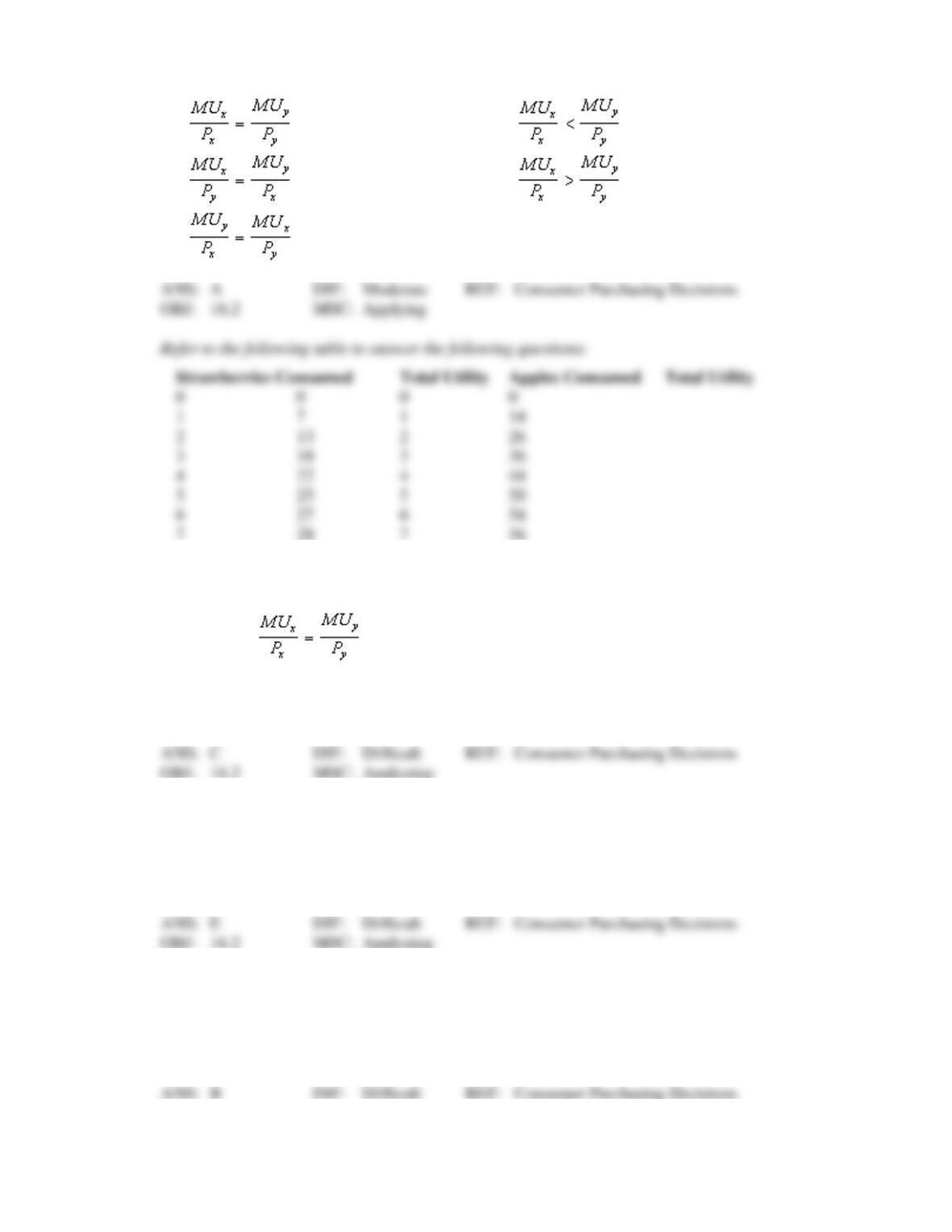
49. The combination of Good X and Good Y that will maximize your utility will have which of the
following properties?
a. d.
b. e.
c.
50. Assume that strawberries cost $1 and apples cost $2. Which of the following combinations of
strawberries and apples satisfies the following rule?
a. 2 strawberries and 4 apples. d. 3 strawberries and 2 apples.
b. 6 strawberries and 5 apples. e. 6 strawberries and 7 apples.
c. 5 strawberries and 5 apples.
51. Assume that strawberries cost $1 and apples cost $2. If a consumer has $8, the bundle of goods
that would maximize her utility per dollar and remain within her budget would be
a. 0 strawberries and 4 apples. d. 4 strawberries and 2 apples.
b. 6 strawberries and 5 apples. e. 2 strawberries and 3 apples.
c. 6 strawberries and 1 apple.
52. Assume that strawberries cost $1 and apples cost $2. If a consumer has $16, the bundle of goods
that would maximize his utility per dollar and remain within his budget would be
a. 2 strawberries and 7 apples. d. 4 strawberries and 2 apples.
b. 6 strawberries and 5 apples. e. 7 strawberries and 7 apples.
c. 4 strawberries and 6 apples.
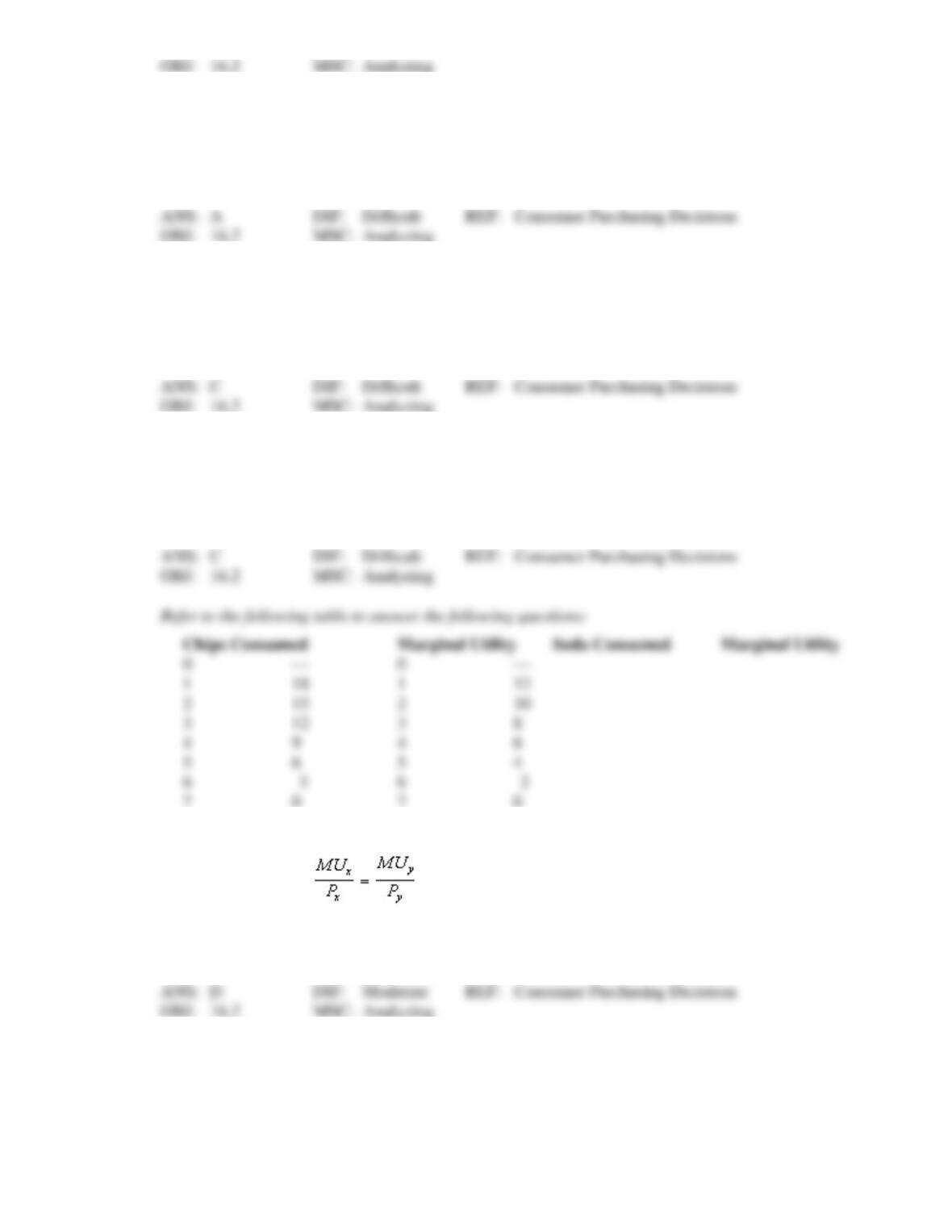
53. Assume that strawberries cost $1 and apples cost $2. If the consumer has $8, the bundle of goods
that would maximize his utility per dollar leads to a utility equal to ________ utils.
a. 49 d. 66
b. 84 e. 46
c. 77
54. Assume that strawberries cost $1 and apples cost $2. If the consumer has $16, the bundle of goods
that would maximize her utility per dollar leads to a utility equal to ________ utils.
a. 48 d. 66
b. 84 e. 46
c. 77
55. If the purchase of 5 strawberries and 5 apples maximizes your utility per dollar, the price of
strawberries must be ________ if the price of apples is $3.00.
a. $1.00 d. $2.50
b. $2.00 e. $3.00
c. $1.50
56. Assume that chips cost $1 and soda costs $2.Which of the following combinations of chips and
soda satisfies the rule ?
a. 2 chips and 4 sodas d. 5 chips and 1 soda
b. 6 chips and 5 sodas e. 6 chips and 7 sodas
c. 5 chips and 4 sodas
57. Assume that chips cost $1 and soda costs $2. If the consumer has $7, the combination of goods
that would maximize her utility per dollar and remain within her budget would be
a. 0 chips and 4 sodas. d. 4 chips and 2 sodas.
b. 6 chips and 5 sodas. e. 2 chips and 3 sodas.
c. 5 chips and 1 soda.
58. Assume that chips cost $1 and soda costs $2. If the consumer has $14, the combination of goods
that would maximize his utility per dollar and remain within his budget would be
a. 2 chips and 7 sodas. d. 4 chips and 2 sodas.
b. 6 chips and 4 sodas. e. 7 chips and 7 sodas.
c. 4 chips and 6 sodas.
59. Assume that chips cost $1 and soda costs $2. If the consumer has $7, the combination of goods
that would maximize her utility per dollar leads to a utility equal to ________ utils.
a. 72 d. 66
b. 90 e. 46
c. 54
60. Assume that chips cost $1 and soda costs $2. If the consumer has $14, the combination of goods
that would maximize his utility per dollar leads to a utility equal to ________ utils.
a. 72 d. 9
b. 84 e. 99
c. 77
61. For 2 chips and 5 sodas to be a combination of goods that maximizes someone’s utility per dollar,
the price of chips must be ________ if the price of soda is $1.00.
a. $2.00 d. $3.50
b. $3.00 e. $3.75
c. $2.50
62. Joanna is deciding between consuming Good X and Good Y. At her current level of consumption,
her marginal utility per dollar for Good X is greater than the marginal utility per dollar for Good Y.
To achieve the consumer optimum, Joanna needs to
a. consume more of Good Y until the marginal utility per dollar for Good Y is greater than the
marginal utility for Good X.
b. consume more of Good X until the marginal utility per dollar for Good Y is greater than the
marginal utility for Good X.
c. consume more of both Good X and Good Y until the marginal utility per dollar for Good Y is
greater than the marginal utility for Good X.
d. consume more of Good X or less of Good Y until the marginal utility per dollar for Good X
and Good Y is equal.
e. continue at her current level of consumption.
63. Peter is deciding between consuming Good X and Good Y. At his current level of consumption,
his marginal utility per dollar for Good X is less than the marginal utility per dollar for Good Y. To
achieve the consumer optimum, Peter needs to
a. consume more of Good Y until the marginal utility per dollar for Good X is greater than the
marginal utility for Good Y.
b. consume less of Good X or more of Good Y until the marginal utility per dollar for Good X
and Good Y is equal.
c. consume more of both Good X and Good Y until the marginal utility per dollar for Good Y is
greater than the marginal utility for Good X.
d. consume less of both Good X and Good Y until the marginal utility per dollar for Good Y is
greater than the marginal utility for Good X.
e. continue at his current level of consumption.
64. To reach the consumer optimum for two goods, the
a. ratio of marginal utility to price for both goods must be equal.
b. marginal utility for both goods must be equal.
c. total utility for both goods must be equal.
d. ratio of total utility to price for both goods must be equal.
e. price of both goods must be equal.
65. Lower prices
a. lower the marginal utility per dollar spent and cause consumers to buy less of a good.
b. increase the marginal utility per dollar spent and cause consumers to buy less of a good.
c. do not change the marginal utility per dollar.
d. lower the marginal utility per dollar spent and cause consumers to buy more of a good.
e. increase the marginal utility per dollar spent and cause consumers to buy more of a good.
66. Higher prices
a. lower the marginal utility per dollar spent and cause consumers to buy less of a good.
b. increase the marginal utility per dollar spent and cause consumers to buy less of a good.
c. do not change the marginal utility per dollar.
d. lower the marginal utility per dollar spent and cause consumers to buy more of a good.
e. increase the marginal utility per dollar spent and cause consumers to buy more of a good.
67. When a price changes, there are two effects: the ________ effect and the ________effect.
a. real-income; consumer optimum d. marginal utility; substitution
b. substitution; marginal utility e. consumer optimum; substitution
c. real-income; substitution
68. The substitution effect
a. occurs when utility declines as consumption increases.
b. is the additional satisfaction derived from consuming one more unit of a good or service.
c. is the combination of goods and services that maximizes utility for a given income.
d. occurs when a consumer buys more of a good as a result of a relative price change.
e. occurs when there is a change in purchasing power as a result of a change in the price of a
good.
69. When a consumer buys more of a good as a result of a relative price change, economists call it
a. diminishing marginal utility. d. the real-income effect.
b. the substitution effect. e. the consumer optimum.
c. marginal utility.
70. The real-income effect
a. occurs when utility declines as consumption increases.
b. is the additional satisfaction derived from consuming one more unit of a good or service.
c. is the combination of goods and services that maximizes utility for a given income.
d. occurs when a consumer buys more of a good as a result of a relative price change.
e. occurs when there is a change in purchasing power as a result of a change in the price of a
good.
71. When there is a change in purchasing power as a result of a change in the price of a good,
economists call it
a. the real-income effect. d. diminishing marginal utility.
b. the substitution effect. e. the consumer optimum.
c. marginal utility.
72. The substitution effect and the real-income effect are two effects that happen when
a. marginal utility increases. d. a price changes.
b. marginal utility decreases. e. total utility increases.
c. total utility decreases.
73. If the price of a good increases, the marginal utility per dollar spent ________ and consumers buy
________ of the good.
a. remains the same; more d. decreases; less
b. remains the same; less e. increases; more
c. decreases; more
74. If the price of a good decreases, the marginal utility per dollar spent ________ and consumers buy
________ of the good.
a. remains the same; more d. increases; less
b. remains the same; less e. increases; more
c. decreases; more
75. Lower prices increase the marginal utility per dollar spent and cause consumers to buy more of a
good. On the other hand, higher prices lower the marginal utility per dollar spent and cause
consumers to buy less of a good. This is a way of restating ________ in terms of marginal utility.
a. diminishing marginal utility d. the law of supply
b. satisfaction e. the real-income effect
c. the law of demand
76. For a consumer, which of the following statements about the real-income effect is true?
a. It matters only when prices change enough to cause a measurable effect on the purchasing
power of a consumer’s income.
b. It can be observed for any price change.
c. It occurs when a consumer buys more of a good as a result of a relative price change.
d. It matters only when prices change enough to cause a consumer to purchase more of the good
whose price changed.
e. The purchasing power of your income increases when the price of a good increases.
77. Which of the following statements about the real-income effect and the substitution effect is true?
a. The real-income effect always exists, but the substitution effect does not always exist.
b. The real-income effect and the substitution effect always exist.
c. The real-income effect does not always exist, but the substitution effect always exists.
d. The real-income effect and the substitution effect cannot occur at the same time.
e. The real-income effect and the substitution effect occur only with an increase in price.
78. If a decrease in price results in only a small amount in savings, the enhanced purchasing power is
effectively
a. equal to the substitution effect. d. negative.
b. large. e. zero.
c. greater than the substitution effect.
79. If the price of attending a soccer game changes from $20 to $25, the marginal utility per dollar
spent for the fifth game changes from
a. 3.75 to 3.00. d. 3.00 to 3.75.
b. 4.00 to 3.00. e. 18.75 to 15.00.
c. 5.00 to 4.00.
80. If the price of attending a soccer game changes from $25 to $20, the marginal utility per dollar
spent for the fifth game changes from
a. 2.50 to 2.00. d. 2.00 to 2.50.
b. 3.00 to 3.75 e. 20 to 25.
c. 3.75 to 3.00.
81. Suppose Annabelle’s favorite ice cream flavor, strawberry, costs $1.50 per cone and chocolate
costs $1.00 per cone. If she receives 10 utils when she eats chocolate ice cream, how many
additional utils would she need to get from eating strawberry ice cream to make her indifferent
between purchasing the two flavors of ice cream?
a. 15 d. 5
b. 10 e. 20
c. 25
82. Suppose Tamara’s favorite arcade game, PAC-MAN, costs $1 to play and her second-favorite
arcade game, Street Fighter, costs 50 cents to play. If she receives 10 utils when she plays Street
Fighter, what is the least number of utils she must receive from PAC-MAN to play PAC-MAN
over Street Fighter?
a. 15 d. 5
b. 10 e. 20
c. 25
83. The fact that water, which is essential to life, is inexpensive, whereas diamonds, which do not
sustain life, are expensive can be explained by the
a. law of diminishing marginal utility.
b. diamond–water paradox.
c. diamond–water theory.
d. diamond–water comparison.
e. law of demand.
84. The diamond–water paradox explains why
a. water, which is essential to life, is inexpensive, whereas diamonds, which do not sustain life,
are expensive.
b. water, which is essential to life, is expensive, whereas diamonds, which do not sustain life, are
inexpensive.
c. the demand for diamonds, which do not sustain life, is greater than the demand for water,
which is essential to life.
d. the total utility in society for diamonds, which do not sustain life, is greater than the total
utility in society for water, which is essential to life.
e. diamonds and water are usually purchased in separate transactions.
85. The diamond–water paradox unfairly compares the
a. amount of marginal utility a person receives from a small quantity of something rare with the
total utility from a small quantity of something after already consuming a large amount.
b. amount of total utility a person receives from a small quantity of something rare with the
marginal utility from a small quantity of something after already consuming a large amount.
c. amount of marginal utility a person receives from a small quantity of something rare with the
marginal utility from a small quantity of something after already consuming a large amount.
d. price of water with the price of diamonds.
e. law of demand with the prices of water and diamonds.
86. One explanation for the existence of the diamond–water paradox is that
a. the demand for diamonds is greater than the demand for water.
b. people fail to recognize that demand and supply are both equally important in determining the
value of a product.
c. the supply of diamonds is greater than the supply of water.
d. people fail to recognize that demand and supply do not matter in determining the value of a
product.
e. people fail to recognize that the marginal utility of diamonds is less than the marginal utility of
water.
87. Graphically, total utility can be determined by the amount of
a. deadweight loss enjoyed from a transaction.
b. producer surplus enjoyed from a transaction.
c. consumer surplus enjoyed from a transaction plus the amount of producer surplus enjoyed
from a transaction.
d. consumer surplus enjoyed from a transaction.
e. consumer surplus enjoyed from a transaction minus the amount of producer surplus enjoyed
from a transaction.
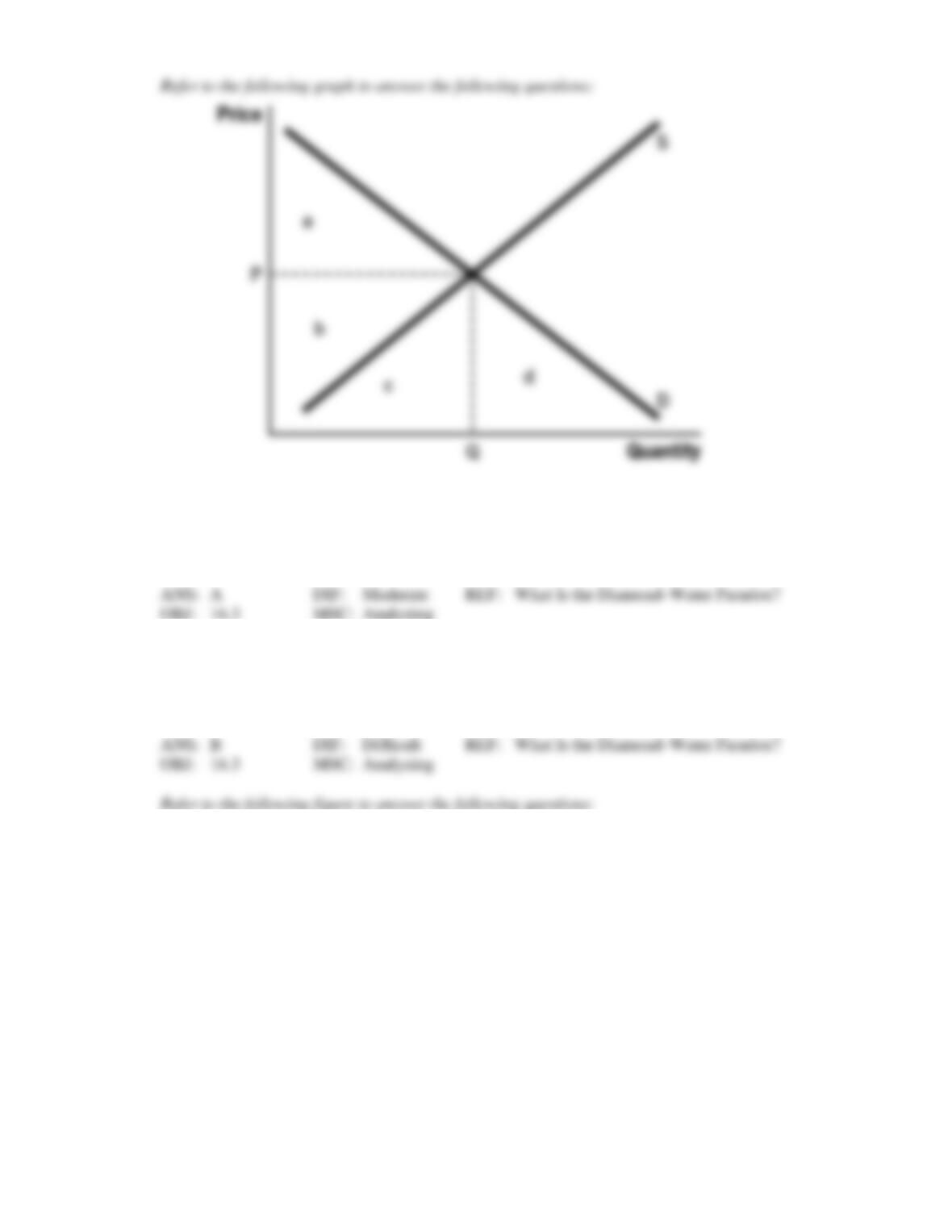
88. The area that represents total utility is
a. a. d. d.
b. b. e. a + b.
c. c.
89. The marginal utility is represented by the
a. area a. d. quantity Q.
b. price P. e. area c.
c. area b.
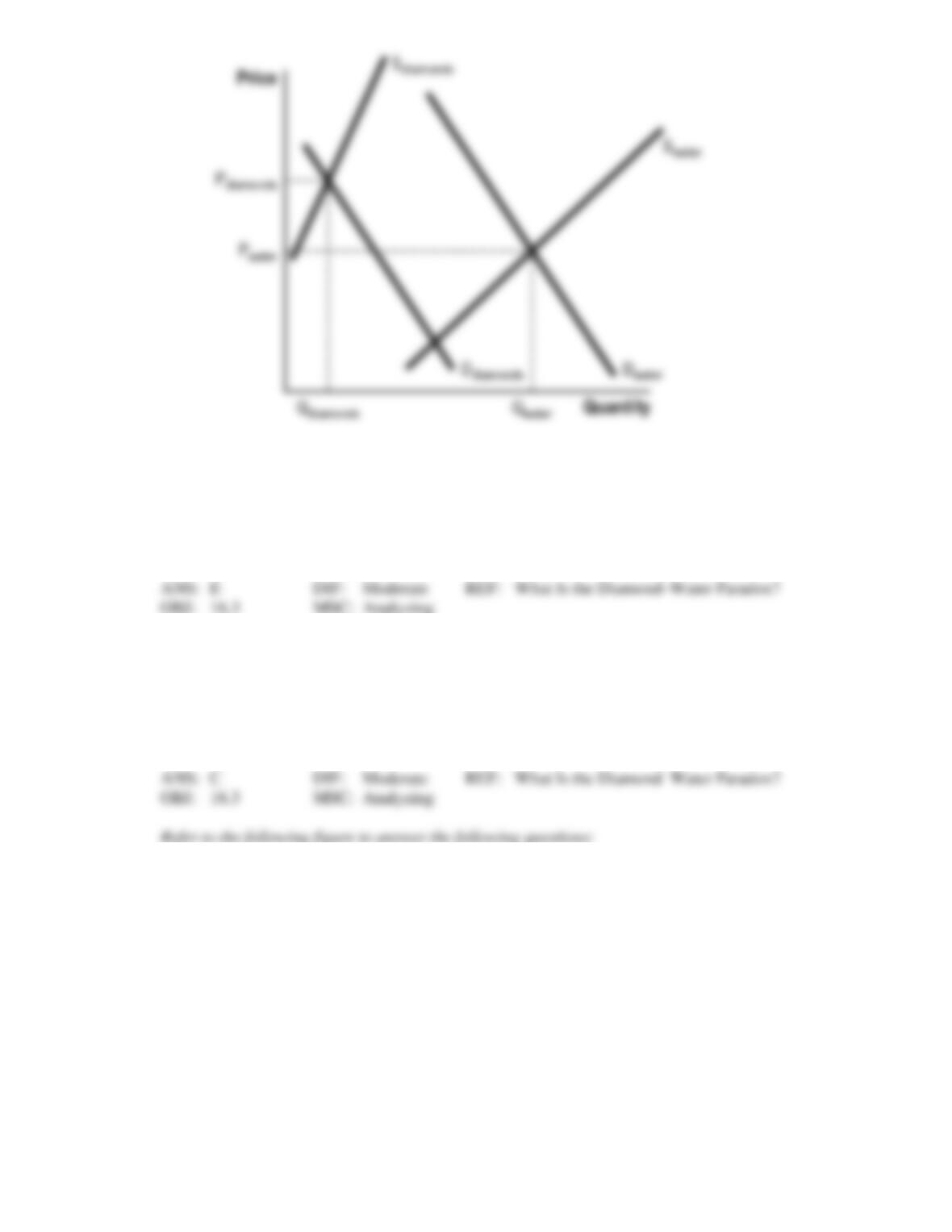
90. Which of the following statements is true?
a. Water costs more than diamonds.
b. The total utility of diamonds is greater than the total utility of water.
c. The marginal utility of water is greater than the marginal utility of diamonds.
d. The diamond–water paradox does not exist.
e. The total utility of water is greater than the total utility of diamonds.
91. Which of the following statements is true?
a. Water costs more than diamonds.
b. The total utility of diamonds is greater than the total utility of water.
c. The marginal utility of diamonds is greater than the marginal utility of water.
d. The diamond–water paradox does not exist.
e. The marginal utility of water is greater than the marginal utility of diamonds.