Chapter 15 – Natural Resource and Energy Economics
1. The key demand-side factors that affect the depletion of finite natural resources are:
2. The period since the Industrial Revolution has been extraordinary because despite
unprecedented:
Chapter 15 – Natural Resource and Energy Economics
3. In his Essay on the Principles of Population, Thomas Malthus argued that:
4. Which one of the following statements is true? The fertility rates for major industrialized
countries in recent years show that Malthus’s theory regarding population is:
5. The “replacement rate” is the birthrate necessary to:
Chapter 15 – Natural Resource and Energy Economics
6. The total fertility rate of a nation is the:
7. Taking into account infant and child mortality, the total fertility rate that is necessary to
keep a country’s population from falling over time is:
8. According to the fertility rate calculations for major industrialized countries, their
populations are expected to decline significantly in the coming years because the:
Chapter 15 – Natural Resource and Energy Economics
9. Which of the following countries had the highest fertility rate in 2009?
10. The demographers predict that the worldwide total fertility rate will decline to one birth
per woman per lifetime. If this happens, then:
11. The world’s population increased so rapidly from 1800 to the present day because of
higher:
Chapter 15 – Natural Resource and Energy Economics
12. Consider the following textbook statement. The reduction in death rates “causes a
temporary population explosion because parents – initially unaware that such a revolutionary
change in death rates has taken place – for a while keep having six or more childrento
ensure that at least two will survive to adulthood.” For which major industrialized country
could this statement be used to explain its current population trend?
13. Demographers predict that declines in birthrates are in part due to:
14. In modern economies, the cost of raising children has:
Chapter 15 – Natural Resource and Energy Economics
15. According to Paul Ehrlich’s 1968 prediction in The Population Bomb, population growth
would result in:
16. The 1968 prediction of Paul Ehrlich proved to be wrong because population growth:
17. Economic data show a dramatic long-run decline in 25 important commodity prices from
1850 to 2009. This decline primarily occurred because the:
Chapter 15 – Natural Resource and Energy Economics
18. The real cost of buying a market basket of 25 important commodities in 2009 compared
with the 1845-1850 base period is:
19. The long-run fall of commodity prices implies that commodity supplies have grown:
20. The long-run total demand for commodity resources is driven by which of the following
forces?
Chapter 15 – Natural Resource and Energy Economics
21. Future shortages in natural resources are not expected due to:
22. Data on total water use in the United States since 1950 show that it has:
23. Data on per capita energy use in the United States since 1950 show that it has:
Chapter 15 – Natural Resource and Energy Economics
24. Data on per capita trash generation in the United States indicate that since 1990 it has:
25. The primary focus of energy economics is how:
26. In recent years, per capita energy use in developed countries such as the United States
has:
Chapter 15 – Natural Resource and Energy Economics
27. From 1950 to 2008, the ratio of real GDP to energy consumption in the United States has
been:
28. A decreasing value of real GDP per million Btu of energy consumption indicates that:
29. Better technology means that more output in the U.S. economy can be produced:
Chapter 15 – Natural Resource and Energy Economics
30. To control production costs, electricity companies often:
31. Energy efficiency requires that we employ:
32. About what percentage of U.S. electricity was generated by coal–fired plants in 2008?
Chapter 15 – Natural Resource and Energy Economics
33. About what price per barrel of oil is necessary for biodiesel to become economically
viable as an alternative energy source?
34. Which one of the following is a correct description of the relationship between the price of
oil and the production of alternative energy sources?
35. If predictions that the world will run out of oil or petroleum in the next century become
Chapter 15 – Natural Resource and Energy Economics
36. Negative externalities from energy production should be considered when comparing the
cost of an energy source because they:
37. The primary focus of natural resource economics is to develop policies for harvesting or
extracting natural resources that:
38. An example of a renewable resource would be:
Chapter 15 – Natural Resource and Energy Economics
39. An example of a nonrenewable resource would be:
40. The key to optimally managing renewable and nonrenewable resources is to design
incentive structures that:
41. An increase in interest rates:
Chapter 15 – Natural Resource and Energy Economics
42. A decrease in interest rates:
43. An oil producer discovers an oil supply in Texas that can be pumped for a profit of $50
per barrel now, $60 per barrel in three years, $80 per barrel in five years, or $90 a barrel in
seven years. The current market rate of interest is 3 percent. When should the oil producer
extract the oil to obtain the most profit per barrel in present value terms?
44. A farmer discovers a natural gas reserve on his property. He can extract the natural gas for
a profit of $40 per unit now, $55 per unit in one year, $57 per unit in two years, and $60 in
three years. The current market rate of interest is 6 percent. When should the farmer extract
the natural gas to obtain the most profit per unit in present value terms?
Chapter 15 – Natural Resource and Energy Economics
45. A Middle Eastern country has an oil reserve that it can extract for a profit of $60 a barrel
today, $65 a barrel in two years, $70 a barrel in three years, and $75 in four years. The current
market rate of interest is 7 percent. When should this country tap into its oil reserve to obtain
the most profit per barrel in present value terms?
46. An oil company has the opportunity to extract oil from a reserve in three years with a per
barrel profit of $70 per barrel. The current market rate of interest is 4 percent. The present
value of this future extraction is about:
47. A mining company has the opportunity to extract from a coal reserve this year for a profit
of $40 per pound. The current market rate of interest is 5 percent. The present value of this
future extraction is:
Chapter 15 – Natural Resource and Energy Economics
48. An electricity company has the opportunity to use natural gas to generate electricity at a
cost of $30 per unit in 2 years. The current market rate is 4 percent. The present value of this
cost is about:
49. A logging company is considering logging an area for a current cost of $500 per acre to
obtain a profit the next year for $600 per acre. The market rate of interest is 10 percent.
Should the company make the investment?
50. An electricity company is considering damming a small river to generate electricity at a
cost of $160,000 and a profit of $200,000 in 5 years. The current market rate is 5 percent.
Should the company make the investment?
Chapter 15 – Natural Resource and Energy Economics
51. An oil company is considering drilling in the Gulf at a current cost of $300,000 with an
expected profit of $500,000 in three years. The current market rate is 10 percent. Should the
company make the investment?
52. An energy company has recently discovered a natural gas reserve. The company can tap
this reserve at a cost of $350,000 and obtain a profit of $450,000 in three years. The current
market rate is 15 percent. Should the company make the investment?
53. The use of present value calculations in valuing natural resources is important because it:
Chapter 15 – Natural Resource and Energy Economics
54. The user cost of nonrenewable resources is:
55. A mining company’s extraction costs curve is:
56. At any level of a mining firm’s output, total cost will be equal to extraction costs:
Chapter 15 – Natural Resource and Energy Economics
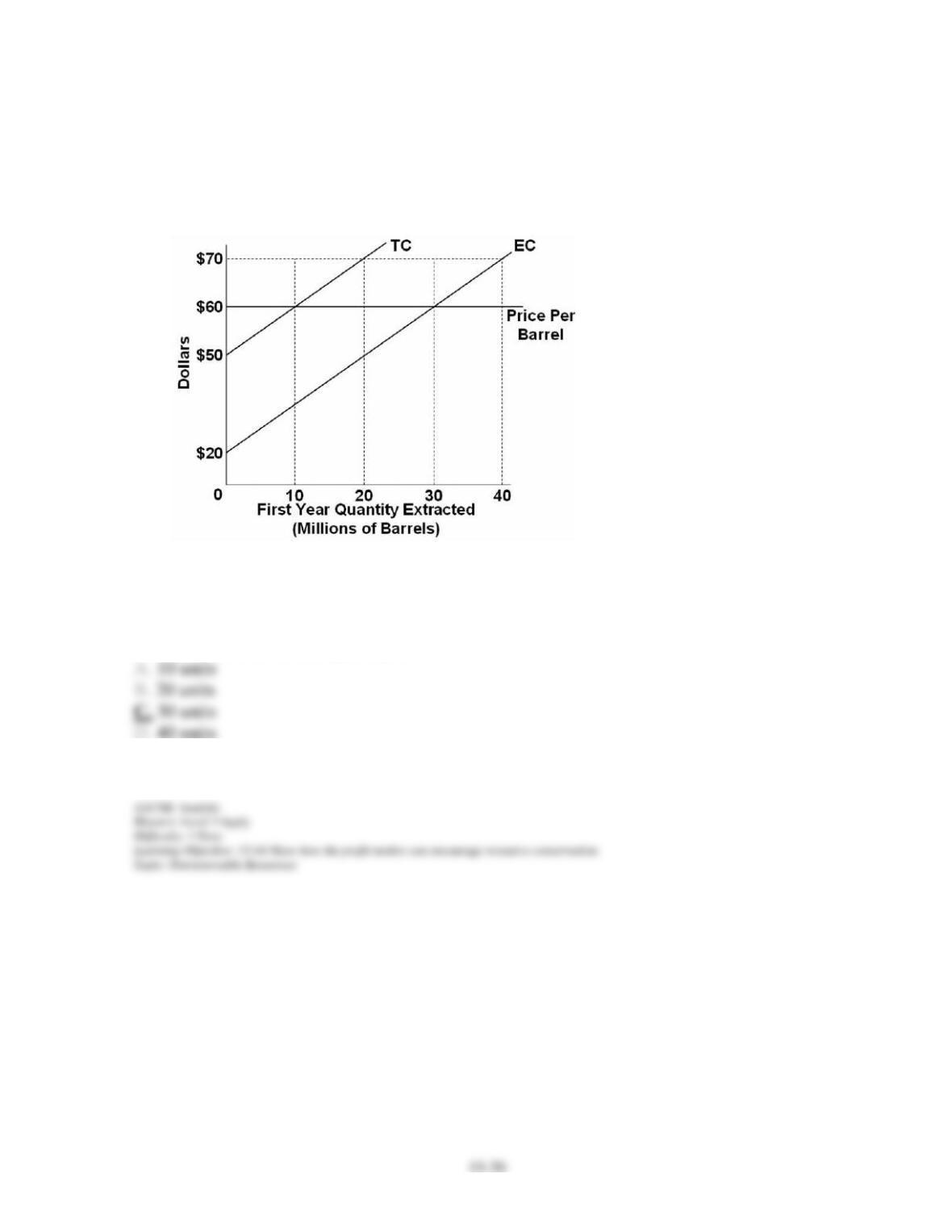
It shows the extraction costs for TX Oil Company in the first year in a situation where it will
extract oil from a reserve over two years.
57. Refer to the above graph. If the current market price is $60 and user costs are not
considered, the extraction quantity is: