1. Which of the following macroeconomic schools of thought has dominated the economics profession from the 1940s
through the 1960s?
a.
New classical economics
b.
Classical economics
c.
Keynesian economics
d.
Rational economics
e.
Positive economics
2. Which of the following schools of thought stressed on a fixed-price model for macroeconomic equilibrium?
a.
Traditional Keynesians
b.
New Keynesians
c.
Monetarists
d.
Classical economists
e.
New classical economists
Easy
MACR.BOYE.16.79 – ch. 15, 1
Models
Keynesian Economics
Knowledge
3. In traditional Keynesian economics:
a.
the aggregate supply curve is vertical.
b.
the aggregate supply curve is horizontal.
c.
the aggregate supply curve is upward-sloping.
d.
the aggregate demand curve is horizontal.
e.
the aggregate demand curve is vertical.
b
Easy
Easy
MACR.BOYE.16.79 – ch. 15, 1
Models
Keynesian Economics
Revised
4. In the fixed-price Keynesian model, what would be the impact of an increase in aggregate expenditure on the aggregate
demand curve and real GDP?
a.
The aggregate demand curve would shift rightward and real GDP would increase.
b.
The aggregate demand curve would shift leftward and real GDP would decrease.
c.
The aggregate demand curve would shift rightward and real GDP would decrease.
d.
The aggregate demand curve would shift leftward and real GDP would increase.
e.
The aggregate demand curve and real GDP would both remain constant.
MACR.BOYE.16.79 – ch. 15, 1
Keynesian Economics
5. _____ school of thought would most likely be associated with the statement: “When wages are rigid, changes in output
result in small changes in goods market prices and a relatively flat aggregate supply curve.”
a.
The traditional Keynesian
b.
The modern Keynesian
c.
The Monetarist
d.
The classical
e.
The new classical
MACR.BOYE.16.79 – ch. 15, 1
Keynesian Economics
6. Which of the following thoughts do the Keynesian and the new Keynesian economists share?
a.
The belief that wages and prices are not flexible in the short run
b.
The belief that the aggregate supply curve is always a horizontal line
c.
The belief that the government’s role in the economy should be minimized
d.
The belief that the natural rate of unemployment in an economy is always zero
Keynesian Economics
e.
The belief that prices are constant and that changes in aggregate expenditures determine equilibrium real GDP
7. Which of the following is true of Simple Keynesian model?
a.
Price level increases with an increase in aggregate demand.
b.
The aggregate supply curve is assumed to be perfectly inelastic.
c.
The aggregate demand curve is assumed to be perfectly elastic.
d.
Price level is solely determined by the aggregate demand curve.
e.
Changes in aggregate demand determines equilibrium real GDP.
MACR.BOYE.16.79 – ch. 15, 1
Keynesian Economics
8. If the traditional Keynesian views turn out to be accurate, an increase in government spending would:
a.
increase the price level.
b.
decrease the level of investment.
c.
increase the equilibrium level of real GDP.
d.
decrease the level of consumption.
e.
decrease the money supply.
MACR.BOYE.16.79 – ch. 15, 1
Keynesian Economics
MACR.BOYE.16.79 – ch. 15, 1
9. Traditional Keynesians argued that when wages are rigid, changes in output result in:
a.
small changes in goods market prices and a flat aggregate supply curve.
b.
large changes in goods market prices and a flat aggregate supply curve.
c.
large changes in goods market prices and a steep aggregate supply curve.
d.
small changes in goods market prices and a steep aggregate demand curve.
e.
small changes in goods market prices and a horizontal aggregate demand curve.
10. The flat region of the aggregate supply curve reflects the Keynesian belief that:
a.
both inflation and unemployment does not exist.
b.
high growth rate of money supply poses problems in the economy.
c.
unemployment is usually experienced amidst high real GDP.
d.
government intervention in the economy aggravates the problems of inflation and unemployment.
e.
inflation is not a problem when unemployment is high.
MACR.BOYE.16.79 – ch. 15, 1
Keynesian Economics
11. Which of the following schools of thought reject the simple fixed-price model in favor of a model in which the
aggregate supply curve is relatively flat at low levels of real GDP and slopes upward as real GDP approaches its potential
level?
a.
The new Keynesian
b.
The monetarist
c.
The traditional classical
d.
The new classical
e.
The Marxist
MACR.BOYE.16.79 – ch. 15, 1
Keynesian Economics
12. The new Keynesians believe that the economy is not always in equilibrium because:
a.
of the existence of voluntary unemployment.
b.
the Federal Reserve policy is too restrictive.
c.
government intervention destabilizes the economy.
d.
of the existence of wage and price rigidities.
e.
the rate of inflation is too high.
1
1.a
Keynesian Economics
Knowledge
13. Which of the following would explain wage rigidities?
a.
Inflexible long-term contracts
b.
Inflation
c.
The liquidity of financial assets
d.
The reluctance of firms to lay off workers
e.
High worker productivity
1
Moderate
MACR.BOYE.16.79 – ch. 15, 1
Keynesian Economics
Comprehension
14. The new Keynesian economists believed that:
a.
wages and prices are flexible in the short run.
b.
wages are flexible but prices are not flexible in the long run.
c.
wages are not flexible but prices are flexible in the short run.
1.a
MACR.BOYE.16.79 – ch. 15, 1
Keynesian Economics
Knowledge
d.
wages and prices are not flexible in the short run.
e.
wages and prices are not flexible in the long run.
15. Which of the following is true from the perspective of the New Keynesian school of thought?
a.
Fluctuations in private spending does not affect aggregate demand in an economy.
b.
Investment spending remains relatively constant irrespective of the supply shocks.
c.
Fluctuations in aggregate demand are not the primary source of problem for policymakers.
d.
The government should limit its role to administrative functions.
e.
Monetary and fiscal policies often fail to restore macroeconomic equilibrium.
MACR.BOYE.16.79 – ch. 15, 1
Keynesian Economics
16. In the Keynesian region of the aggregate supply curve:
a.
increases in aggregate demand are associated with decreases in output, but not with increases in prices.
b.
decreases in aggregate demand are associated with increases in prices, but not with increases in output.
c.
increases in aggregate demand are associated with increases in output, but not with increases in prices.
d.
decreases in aggregate demand are associated with increases in output, but not with increases in prices.
e.
increases in aggregate demand are associated with increases in prices, but not with increases in output.
MACR.BOYE.16.79 – ch. 15, 1
17. According to new Keynesian economics:
a.
the aggregate supply curve is horizontal at relatively low levels of real GDP and becomes negatively sloped, as
more and more industries reach their full capacity level of output.
b.
the aggregate supply curve is negatively sloped at relatively low levels of real GDP and becomes horizontal, as
more and more industries reach their full capacity level of output.
c.
the aggregate supply curve is horizontal at relatively low levels of real GDP and becomes positively sloped, as
more and more industries reach their full capacity level of output.
d.
the aggregate supply curve is positively sloped at relatively low levels of real GDP and becomes horizontal, as
more and more industries reach their full capacity level of output.
e.
the aggregate supply curve is positively sloped at relatively low levels of real GDP and becomes negatively
sloped, as more and more industries reach their full capacity level of output.
MACR.BOYE.16.79 – ch. 15, 1
United States – Understanding and Applying Econo – Understanding and Applying Economic
Keynesian Economics
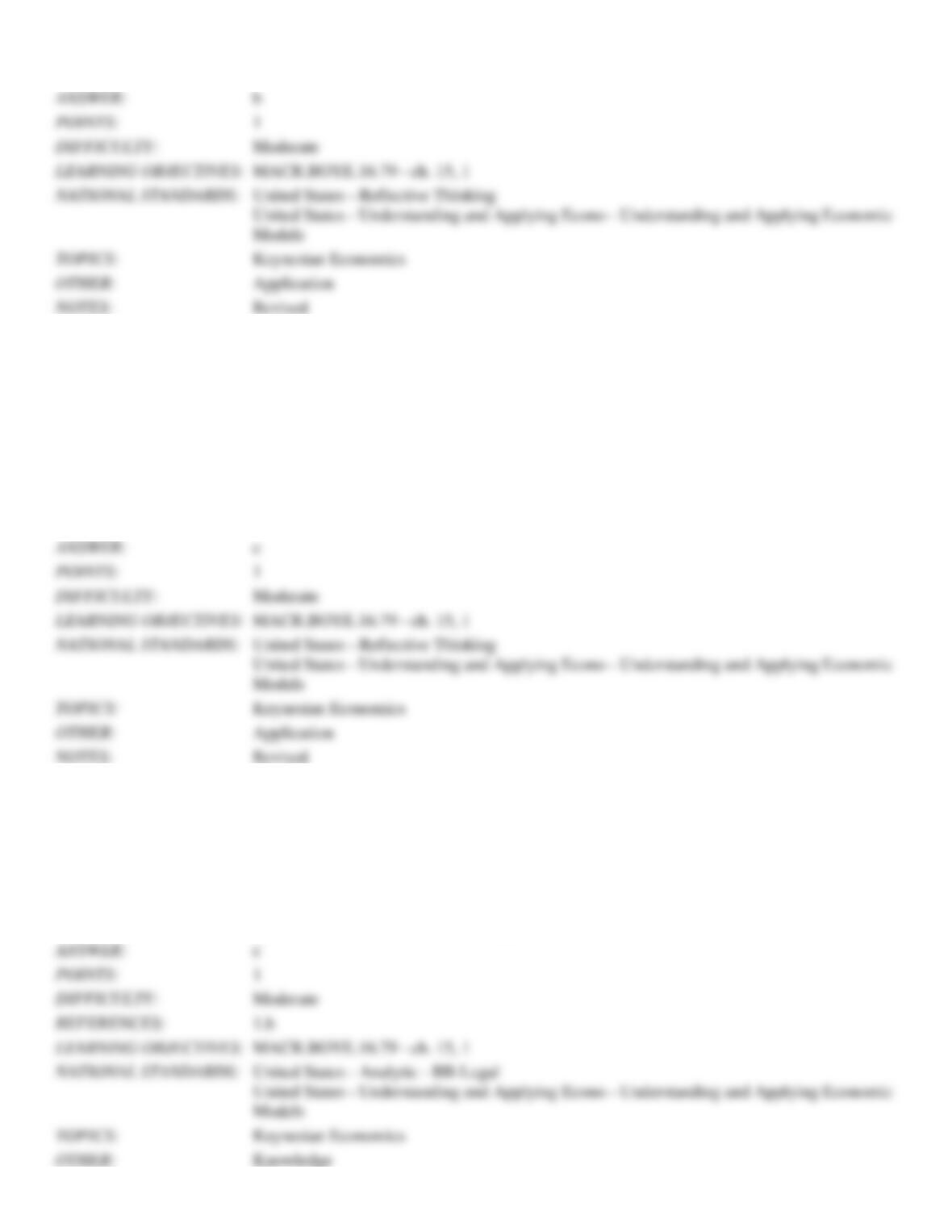
The figure given below shows the supply curves with different slopes.
Figure 15.1
18. Refer to Figure 15.1. Which of the following supply curves represent the supply curve in the simple Keynesian
model?
a.
S1
b.
S2
c.
S3
d.
S4
e.
S5
19. Refer to Figure 15.1. Which of the following supply curves represent the supply curve described by the modern
Keynesians?
a.
S2
b.
S5
c.
S3
d.
S1
e.
S4
MACR.BOYE.16.79 – ch. 15, 1
Keynesian Economics
20. Traditional Keynesian economists believed that:
a.
the aggregate supply curve is a vertical line at a fixed level of prices.
b.
an increase in aggregate demand would cause a change in the price level.
c.
the government should take an active role in the economy to restore equilibrium.
d.
changes in aggregate demand does not determine equilibrium real GDP.
e.
the private sector is not an important source for shifts in aggregate demand.
MACR.BOYE.16.79 – ch. 15, 1
Keynesian Economics
MACR.BOYE.16.79 – ch. 15, 1
Keynesian Economics
21. “The market is not a self-regulating mechanism because prices are not flexible and nothing ensures that planned
leakages will be offset by planned injections. To bring the economy out of depression and end high unemployment, some
way of stimulating aggregate demand is required. This can be best achieved by a combination of government deficit
spending and regulation of tax rates.” Which school of thought does this statement best represent?
a.
Utopian economics
b.
Monetarist economics
c.
Classical economics
d.
Keynesian economics
e.
Marxist economics
22. According to the traditional Keynesian school of thought, expansionary fiscal and monetary policy will:
a.
increase interest rates, thereby shifting the investment function to the right.
b.
reduce both consumption and investment spending, thereby eliminating all inflationary
pressures.
c.
reduce investment spending, thereby stabilizing the aggregate supply shocks.
d.
stimulate both consumption and investment spending, thereby increasing
aggregate demand.
e.
shift the aggregate demand curve to the left, thereby reducing the unemployment rate.
MACR.BOYE.16.79 – ch. 15, 1
United States – Understanding and Applying Econo – Understanding and Applying Economic
Keynesian Economics
23. According to the new Keynesians:
a.
prices adjust to equate demand and supply in every market simultaneously.
b.
random variations in the money supply are the original source of economic fluctuations.
c.
unemployment is voluntary.
d.
aggregate supply shocks can be a prime source of economic instability.
e.
government policy cannot stabilize the economy.
MACR.BOYE.16.79 – ch. 15, 1
Models
Keynesian Economics
24. Who is the leading proponent of the monetarist theory?
a.
John Maynard Keynes
b.
Paul Volcker
c.
Adam Smith
d.
Milton Friedman
e.
Alan Greenspan
MACR.BOYE.16.80 – ch. 15, 2
Monetarist Economics
25. Which of the following schools of thought emphasize the role of money supply in determining equilibrium real GDP
and price level?
a.
Traditional Keynesian economics
b.
New Keynesian economics
c.
New classical economics
d.
Classical economics
e.
Monetarist economics
MACR.BOYE.16.80 – ch. 15, 2
Monetarist Economics
26. Monetarists believe that in the short run:
MACR.BOYE.16.79 – ch. 15, 1
Keynesian Economics
a.
the natural rate of unemployment cannot be changed.
b.
expansionary monetary policy is ineffective in raising real GDP.
c.
a change in the money supply is fully reflected in a change in the interest level.
d.
contractionary monetary policy will decrease unemployment.
e.
there is a tradeoff between unemployment and inflation.
27. According to the monetarists, deliberate government intervention:
a.
will stabilize the economy if the money supply is increased during recessions and decreased during
expansions.
b.
will effectively reduce the unemployment rate below its natural rate.
c.
will stabilize the economy if the money supply is reduced during recessions and increased during expansions.
d.
will destabilize the economy only if the government uses fiscal policy to change equilibrium income.
e.
will destabilize the economy and cause a business cycle of its own, regardless of whether fiscal or monetary
policy is used.
MACR.BOYE.16.80 – ch. 15, 2
Models
Keynesian Economics
28. Monetarists think that the government:
a.
should take an active role in the economy.
b.
should change the money supply growth rate regularly to achieve low inflation.
c.
should actively intervene in the economy, but only by decreasing the fiscal expenditure.
d.
should intervene in the economy as little as possible.
e.
should consciously set out to achieve full employment.
MACR.BOYE.16.80 – ch. 15, 2
MACR.BOYE.16.80 – ch. 15, 2
29. Which of the following events challenged Keynesian views, and led to the popularity of Milton Friedman’s ideas?
a.
The hippie community started advocating socialist values.
b.
Hard-core republicans came into office.
c.
The U.S. economy faced high levels of inflation and unemployment simultaneously.
d.
The oil crisis exploded.
e.
Countries that followed Friedman’s ideas performed better.
MACR.BOYE.16.80 – ch. 15, 2
United States – Understanding and Applying Econo – Understanding and Applying Economic
Economic Insight – Milton Friedman
30. Monetarists believe that:
a.
the government should follow a fixed rule to change money supply in response to
business cycles.
b.
the government should not use discretionary monetary policy to achieve its goals of
economic growth and low inflation.
c.
government intervention should be well thought out and should be used only during recessions.
d.
government intervention in the economy makes business cycles disappear.
e.
government intervention policies have only long-run effects.
MACR.BOYE.16.80 – ch. 15, 2
United States – Understanding and Applying Econo – Understanding and Applying Economic
Monetarist Economics
31. Milton Friedman in his book on consumption function, discussed the importance of _____, rather than _____, to
understand consumer spending.
a.
savings; expenditure
b.
permanent income; current income
c.
money supply; real output
d.
wages; savings
United States – Understanding and Applying Econo – Understanding and Applying Economic
e.
real output; prices
32. Monetarists believe that changes in monetary policy would have:
a.
only short-term effect on the price level.
b.
only short-term effect on real GDP.
c.
only long-term effect on real GDP.
d.
no effect on price level and real GDP.
e.
both short-term and long term effect on real GDP.
MACR.BOYE.16.80 – ch. 15, 2
Monetarist Economics
33. _____ have faith in the free market (price) system that leads them to favor minimal government intervention.
a.
New Keynesian economists
b.
Traditional Keynesian economists
c.
Monetarist economists
d.
Traditional classical economists
e.
New classical economists
MACR.BOYE.16.80 – ch. 15, 2
Monetarist Economics
34. The recognition lag refers to the:
MACR.BOYE.16.80 – ch. 15, 2
Economic Insight – Milton Friedman
a.
time taken for changes in the money supply to be translated into changes in real
GDP.
b.
time taken by policymakers to formulate an appropriate policy to solve an
economic problem.
c.
time taken by policies to have an impact on the different macroeconomic variables.
d.
time taken by policymakers to recognize that an economic problem exists.
e.
natural difference between monetary policy timing and fiscal policy timing.
35. The time it takes for a particular monetary policy to change income is called the _____.
a.
recognition lag
b.
data lag
c.
reaction lag
d.
effect lag
e.
action lag
MACR.BOYE.16.80 – ch. 15, 2
Monetarist Economics
36. “The dramatic reduction of the money supply during the 1930s was responsible for the Great Depression. The
macroeconomy is intrinsically stable if left alone by the prying hand of government. The Federal Reserve Board, instead
of tightening money during booms and loosening money during recessions (policies that are ineffective due to time lags),
should simply increase the supply of money at a steady rate of 3 to 5 percent per year.” This statement reflects which
school of thought?
a.
The traditional Keynesians
b.
The monetarists
c.
The traditional classicals
d.
The new Keynesians
e.
The new classicals
MACR.BOYE.16.80 – ch. 15, 2
Monetarist Economics
37. What is the main difference between new Keynesian economists and monetarists?
a.
Monetarists support a fixed-price model, whereas new Keynesians believe that prices
fluctuate.
b.
Monetarists reject the idea that government intervention can stabilize the economy,
whereas new Keynesians support this notion.
c.
Monetarists believe that the aggregate supply curve is always horizontal, whereas new
Keynesians believe that the aggregate supply curve is always vertical.
d.
Monetarists believe that an increase in the money supply changes real GDP
instantaneously, whereas new Keynesians assume that economic policy operates with
a long and variable lag.
e.
Monetarists believe that deficit spending helps stimulate economic growth, whereas new Keynesians advocate
a balanced budget.
b
1
Moderate
2.b
MACR.BOYE.16.80 – ch. 15, 2
United States – Understanding and Applying Econo – Understanding and Applying Economic
Models
Monetarist Economics
Knowledge
Revised
38. _____ believe that a government that takes an active role in the economy may do more harm than good because
economic policy operates with a long and variable lag.
a.
Traditional Keynesians
b.
Keynesians
c.
Monetarists
d.
Classical economists
e.
New classical economists
1
Moderate
2.b
MACR.BOYE.16.80 – ch. 15, 2
2.b
MACR.BOYE.16.80 – ch. 15, 2
United States – Analytic – BB-Legal
United States – Understanding and Applying Econo – Understanding and Applying Economic
Monetarist Economics
Comprehension
39. The school of thought that assumes that real GDP is determined by aggregate supply, whereas the equilibrium price
level is determined by aggregate demand is known as _____.
a.
neoclassical economics
b.
classical economics
c.
new Keynesian economics
d.
Keynesian economics
e.
Marxist economics
MACR.BOYE.16.81 – ch. 15, 3
New Classical Economics
40. In case of the classical model, increase in aggregate expenditure would:
a.
shift the aggregate demand curve upward leading to an increase in real GDP and prices.
b.
shift the aggregate demand curve downward leading to an increase in real GDP and prices.
c.
shift the aggregate demand curve upward leading to a decrease in real GDP and prices.
d.
shift the aggregate demand curve downward leading to a decrease in real GDP and prices.
e.
shift the aggregate demand curve upward leading to an increase in prices and no change in real GDP.
MACR.BOYE.16.81 – ch. 15, 3
New Classical Economics
41. _____ is the theory that was popular before _____ changed the face of economics post Great Depression in the 1930s.
a.
Classical economics; Milton Friedman
b.
Keynesian economics; Monetarists
c.
Classical economics; Keynes
d.
Monetarist economics; Adam Smith
e.
Keynesian economics; Milton Friedman
42. Which of the following is true of the classical model?
a.
Changes in aggregate demand does not have any impact on the aggregate price level.
b.
The aggregate supply curve is perfectly elastic.
c.
An increase in aggregate demand increases the price level, output remaining unchanged.
d.
Changes in aggregate demand determines the equilibrium output of the economy.
e.
Real GDP and price level remain unchanged irrespective of changes in aggregate demand and supply.
MACR.BOYE.16.81 – ch. 15, 3
United States – Understanding and Applying Econo – Understanding and Applying Economic
New Classical Economics
43. The main reason why the traditional classical school ceased to be widely accepted was that:
a.
it did not reflect the realities of the modern economy.
b.
when Keynes received the Nobel Prize, the academic establishment started believing
his ideas.
c.
it could not explain the persistence of the high levels of unemployment seen during the Great Depression.
d.
it was too abstract to be completely understood.
e.
it could not explain the relationship between inflation and unemployment.
United States – Understanding and Applying Econo – Understanding and Applying Economic
New Classical Economics
44. Traditional classical economists believe that:
a.
wage rates are perfectly flexible.
b.
people do not have perfect information about the economy.
c.
prices are fixed for long periods of time.
d.
the price of resources, technology, and expectations cannot influence the equilibrium
MACR.BOYE.16.81 – ch. 15, 3
New Classical Economics
level of real GDP.
e.
changes in aggregate demand change only the real GDP.
45. According to classical economics:
a.
real GDP is determined by aggregate demand, while the equilibrium price level is determined by aggregate
supply.
b.
both real GDP and price level are determined by aggregate demand.
c.
both real GDP and price level are determined by aggregate supply.
d.
real GDP is determined by aggregate supply, while the equilibrium price level is determined by aggregate
demand.
e.
price level cannot be changed as prices and wages are perfectly rigid.
d
1
Easy
3
MACR.BOYE.16.81 – ch. 15, 3
United States – Understanding and Applying Econo – Understanding and Applying Economic
New Classical Economics
Knowledge
46. The _____ aggregate supply curve assumed by classical economists means that the equilibrium level of _____ is
determined only by the aggregate supply curve.
a.
vertical; output
b.
horizontal; price
c.
upward-sloping; price
d.
horizontal; output
e.
downward-sloping; price
1
Easy
3
MACR.BOYE.16.81 – ch. 15, 3
1
Easy
3
MACR.BOYE.16.81 – ch. 15, 3
New Classical Economics
Knowledge
47. An economist from which of the following schools of thought would most likely say – “An increase in government
expenditure will only increase inflation, because the aggregate supply curve is vertical”?
a.
Neoclassical economics
b.
Traditional classical economics
c.
New Keynesian economics
d.
Keynesian economics
e.
Marxist economics
MACR.BOYE.16.81 – ch. 15, 3
New Classical Economics
48. Which of the following economic theories take into account the rational expectations of people in the economy?
a.
Traditional Keynesian economic theory
b.
Monetarist economic theory
c.
New classical economic theory
d.
Classical economic theory
e.
New Keynesian economic theory
MACR.BOYE.16.81 – ch. 15, 3
New Classical Economics
49. Suppose the central bank increases the money supply in an economy unexpectedly during a year. If the current
inflation rate in this country is 3.4 percent, then according to new classical economists, the expected inflation rate for the
following year would be:
a.
3.4 percent.
b.
less than 3.4 percent.
c.
2.4 percent, because people form their expectations adaptively.
d.
around 6.8 percent.
New Classical Economics
e.
greater than 3.4 percent.
50. New classical economists believe that:
a.
market failure on a large scale is possible.
b.
disequilibrium in commodity markets demand government intervention.
c.
people are completely aware and informed about everything that is happening.
d.
wages are fixed in the short run.
e.
people purposefully substitute non-labor activities for work during recession.
1
3.a
MACR.BOYE.16.81 – ch. 15, 3
New Classical Economics
51. The new classical school holds that:
a.
macroeconomic equilibrium is achieved only through active government intervention.
b.
unemployment is only temporary, because the economy tends naturally toward equilibrium.
c.
rigid prices and wages prevent the economy from achieving equilibrium.
d.
macroeconomic equilibrium cannot occur as long as the aggregate supply curve is
vertical.
e.
rational expectations result in involuntary unemployment and prolonged periods of macroeconomic
disequilibrium.
1
Moderate
MACR.BOYE.16.81 – ch. 15, 3
New Classical Economics
Comprehension
Moderate
MACR.BOYE.16.81 – ch. 15, 3
New Classical Economics
Analysis