191) Which of the following is a time deposit with a fixed maturity date offered by banks and
other financial institutions?
A) savings deposit
B) money market deposit account
C) time deposit
D) small-denomination certificate of deposit
192) Small-denomination time deposits are less than
A) $1 million.
B) $100,000.
C) $10,000.
D) $1,000.
193) U.S. paper currency is issued by the
A) United States Mint.
B) Federal Reserve System.
C) U.S. Treasury.
D) national commercial banks.
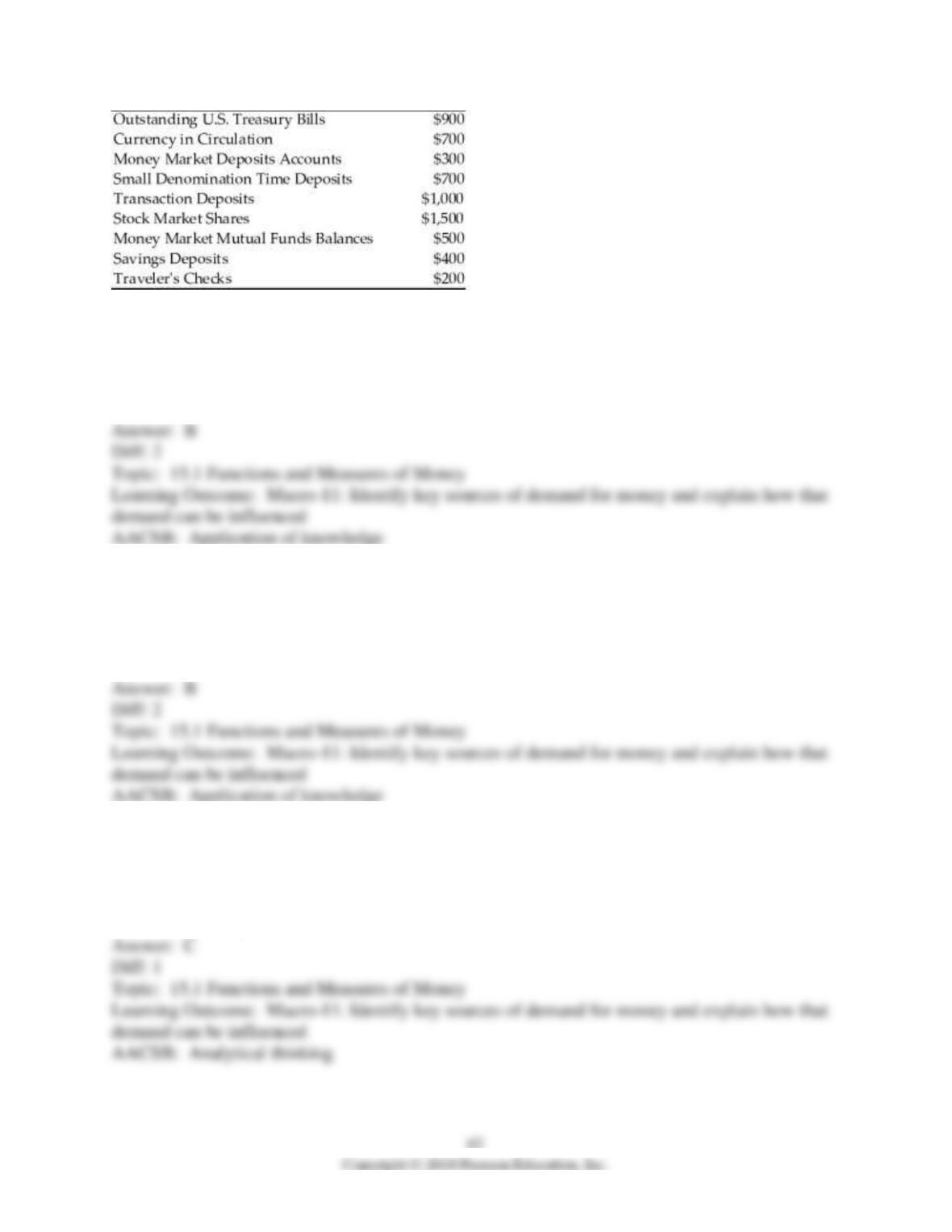
194) Based on the information in the above table, the value of M1 is
A) $2,200.
B) $1,900.
C) $3,000.
D) $3,100.
195) Using the information in the above table, the value of M2 is
A) $3,600.
B) $3,800.
C) $4,600.
D) $5,500.
196) The M1 definition of the money supply includes all of the following EXCEPT
A) currency.
B) transaction deposits.
C) savings accounts.
D) travelers checks.
197) In defining money as M1, economists exclude time deposits because
A) they have no intrinsic value.
B) they do not directly serve as a medium of exchange.
C) they are not recognized as legal tender.
D) they earn an interest for their holders.
198) If people withdraw $1,000 from the nation’s money market mutual funds and redeposit the
funds in various checkable and debitable accounts, then
A) M1 and M2 will remain unchanged.
B) M1 will increase, M2 will remain unchanged.
C) M1 will increase, M2 will decrease.
D) M1 and M2 will increase.
199) In defining money according to the transactions approach, you would want to include
A) those assets that are used as a store of value.
B) those assets that are used as a medium of exchange.
C) those assets that are used as a unit of account.
D) those assets that are used as a standard of deferred payment.
200) Which one of the following is TRUE?
A) Transaction deposits are counted in M2 but are not included in M1.
B) Most of the U.S. currency in existence circulates outside U.S. borders.
C) Traveler’s checks are not considered to be money because they are not valid unless signed.
D) Balances in money market deposit accounts are counted in M1 but are not included in M2.
201) The M1 measure of money is suggested by the ________ approach to measuring money.
A) investment
B) liquidity
C) transactions
D) speculative
202) The M2 measure of money is suggested by the ________ approach to measuring money.
A) investment
B) liquidity
C) transactions
D) speculative
203) Which one of the following is included in M2 but NOT in M1?
A) coins and currency
B) transaction deposits
C) a savings deposit
D) large-denomination time deposits
204) Which of the following is NOT included in the M1 money supply?
A) currency
B) passbook savings accounts
C) checkable and debitable accounts
D) traveler’s checks
205) Which of the following is included in M2 but NOT in M1?
A) small-denomination time deposits
B) transaction deposits
C) currency
D) traveler’s checks
206) The M2 money supply is equal to the M1 money supply plus
A) small time deposits, savings deposits, and retail money market mutual fund shares.
B) all credit card balances and retail money market mutual fund shares.
C) large time deposits and retail money market mutual fund shares.
D) every account held by commercial banks.
207) Small-denomination certificates of deposits are
A) included in M1 but not M2.
B) included in M1 and M2.
C) included only in M1.
D) included in M2 but not M1.
208) The narrowest definition of the money supply is
A) M1.
B) M2.
C) the difference between M2 and M1.
D) the sum of M1 and M2.
209) Money market mutual funds are funds pooled by
A) a group of people to buy shares of stocks.
B) a group of people to buy stock market funds.
C) a group of people to buy short maturity credit instruments.
D) a group of people to buy U.S. Treasury bonds.
210) For a small-denomination certificate of deposit to be included in M2 it must be a
denomination of less than
A) $2,500,000.
B) $100,000.
C) $1 trillion
D) $1,000.
211) Which of the following assets are counted in M1?
A) transaction deposits
B) mutual funds accounts
C) bonds
D) line of credit
212) Which of the following assets are counted in M2?
A) gold
B) balances in retail mutual funds accounts
C) value of outstanding bonds
D) lines of credit offered by commercial banks
213) Suppose your $1,000 certificate of deposit matures and you transfer the funds to your
checking account. This causes
A) M1 to decrease by $1,000 and M2 to increase by $1,000.
B) M1 to increase by $1,000 and M2 to remain the same.
C) both M1 and M2 to increase by $1,000.
D) no change to either M1 or M2.
214) Which of the following is NOT included in M1?
A) transaction deposits
B) currency
C) small time deposits
D) travelers checks
215) The largest component of M1 is
A) transaction deposits.
B) currency and coins.
C) travelers checks.
D) savings accounts.
216) Checking account deposits are included in
A) money market account.
B) currency.
C) lines of credit.
D) M1.
217) A checking account balance in a commercial bank is
A) part of the currency supply.
B) a time deposit.
C) not liquid enough to be considered money.
D) an asset readily usable for most transactions.
218) A transaction deposit is
A) a fiduciary monetary system.
B) a checkable and debitable account.
C) opportunity cost.
D) the liquidity approach.
219) Federal Reserve notes are
A) paper currency.
B) savings bonds.
C) checks issued by the U.S. government.
D) backed by gold.
220) The term “depository institution” refers to
A) commercial banks only.
B) credit unions only.
C) savings and loan associations only.
D) commercial banks, credit unions, and savings and loan associations.
221) Financial institutions that receive most of their funds from the savings of the public are
A) the fiduciary monetary system.
B) the world index fund.
C) universal banking.
D) thrift institutions.
222) What is money?
223) Why is money as a medium of exchange important in an economy?
224) What are the functions of money?
225) What is liquidity? Why is money the most liquid of all assets? What is the cost of this
liquidity?
226) What is a fiduciary monetary system?
227) Savings accounts, certificates of deposit, and bonds pay interest and stocks pay dividends.
Why does anyone hold on to currency or other forms of money and lose this extra income?
228) For the United States, what is money based on the transactions approach to measuring
money?
229) How does the liquidity approach to measuring the money supply differ from the transaction
approach?
15.2 Financial Intermediation and Banks
1) The financial institutions in our banking system are all in the business of transferring funds
from savers to investors. This process is known as
A) the circular flow.
B) direct financing.
C) money laundering.
D) financial intermediation.
2) Suppose you place your savings in a time deposit at the bank, and that bank lends some of
those funds to a business that desires a loan. This is an example of
A) direct finance.
B) indirect finance.
C) credit rationing.
D) adverse selection.
3) An item to which a business holds legal claim is called a(n)
A) asset.
B) liability.
C) loan.
D) time deposit.
4) A checkable and debitable banking account is
A) a liability to a commercial bank.
B) an asset to a commercial bank.
C) a liability to the household or firm that has the account.
D) an asset for the Federal Reserve System.
5) Financial institutions participate in which of the following activities?
A) financial intermediation
B) indirect finance
C) the issuance of loans
D) all of the above
6) Financial intermediation is best defined as the process by which
A) inflation is controlled.
B) corporations issue new stock.
C) liabilities are liquidated.
D) financial institutions accept savings from savers and make loans to investors.
7) Financial intermediaries are institutions that
A) produce money for the federal government.
B) regulate the activities of stock and bond markets.
C) act as middlemen in the process of directing funds from savers to investors.
D) oversee the activities of government institutions such as the Federal Reserve.
8) Financial intermediaries are important because
A) they bring lenders and borrowers together in a way that lowers transaction costs.
B) they provide large funds to the stock market.
C) they employ large numbers of people.
D) they increase costs for banks.
9) Suppose that a new customer opens a checking account and a saving account, placing
$250,000 in each. Later, the bank makes a loan of $500,000 to a business firm. For this bank
A) assets increased by $250,000 because the saving account is an asset, while liabilities
increased by $250,000 because the checking account is a liability.
B) assets increased by $500,000 because the checking and saving accounts are assets, and
liabilities increased by $500,000 because the loan is a liability.
C) assets increased by $500,000 because the loan is an asset, and liabilities increased by
$500,000 because the checking and saving accounts are liabilities.
D) assets remained unchanged but liabilities increased by $500,000 because of the loan.
10) Which of the following is NOT an example of a financial intermediary?
A) a credit union
B) a pension fund
C) the U.S. Treasury Department
D) an insurance company
11) A business owner applies for a bank loan to launch a fairly low-risk project. After receiving
the loan, she cancels the low-risk project and instead uses the borrowed funds for a high-risk
venture. This is an example of
A) financial intermediation.
B) the transactions approach.
C) moral hazard.
D) capital controls.
12) If knowledge possessed by one party in a financial transaction is NOT known to the other
party, ________ exists.
A) disintermediation
B) asymmetric information
C) fraud
D) no financial intermediation
13) Who benefits from the process of financial intermediation?
A) savers only
B) borrowers only
C) both savers and borrowers
D) There is no benefit, because money does not create wealth.
14) Asymmetric information is a situation in which
A) information possessed by one party in a transaction is not known by another party.
B) information possessed by one party in a transaction is also known by another party.
C) the government has information that it chooses to pass along to private firms.
D) private firms have information that they choose to pass along to the government.
15) The process in which financial institutions accept savings from businesses, households, and
governments and lend the funds to other businesses, households, and governments is called
A) central banking system.
B) financial intermediation.
C) moral hazard.
D) adverse selection.
16) A central bank is
A) the largest bank in the country.
B) the same as the government.
C) a banker’s bank.
D) an international bank.
17) Financial intermediaries are institutions that
A) create money.
B) provide checking accounts.
C) set interest rates.
D) transfer funds in the form of loans from savers to investors.
18) All of the following are examples of financial intermediaries EXCEPT
A) credit unions.
B) insurance companies.
C) retirement funds.
D) stock exchanges.
19) Possession of information by one party in a financial transaction but not by the other party is
A) asymmetric information.
B) symmetric information.
C) informational hazard.
D) financial intermediation.
20) Two people are involved in a borrower/lender situation, and one person has superior
knowledge of its own current and future prospects over the other person. This is known as
A) preventable information.
B) symmetric information.
C) asymmetric information.
D) deceptive knowledge.
21) The likelihood that individuals who seek to borrow money may use the funds for unworthy,
high-risk projects is
A) asymmetric information.
B) adverse selection.
C) moral hazard.
D) financial intermediation.
22) The possibility that a borrower might engage in riskier behavior after a loan has been
obtained is
A) asymmetric information.
B) adverse selection.
C) moral hazard.
D) financial intermediation.
79
23) Russia borrowed funds from the International Monetary Fund in 1989 in exchange for
agreeing to undertake certain changes. However, after receiving the funds, Russia spent the funds
on other things, making the loan repayment more unlikely to occur. This situation is referred to
as
A) adverse selection.
B) moral hazard.
C) asymmetric information.
D) deceptive knowledge.
24) The process by which financial institutions accept savings from businesses, households and
governments and lend the savings to other businesses, households and governments is
A) asymmetric information.
B) adverse selection.
C) moral hazard.
D) financial intermediation.
25) When you deposit funds in a bank and then the bank lends these funds to a borrower, the
bank is engaged in
A) fiduciary investment.
B) fraudulent behavior.
C) universal banking.
D) financial intermediation.
26) Which of the following is NOT an asset of commercial banks?
A) consumer loans
B) business loans
C) savings deposits
D) home mortgages
27) People with savings often deposit their funds in a commercial bank, rather than investing
them directly with business enterprises, in order to
A) avoid the problems associated with financial intermediation.
B) avoid the problems associated with asymmetric information.
C) earn the highest possible return for taking on the riskiest investments.
D) All of the above are correct.
28) From an accounting point of view, a checking account should be considered part of a bank’s
A) assets.
B) liabilities.
C) profits.
D) reserves.
29) Which of the following is NOT a description of indirect finance?
A) You take out a student loan from your bank.
B) An insurance company lends funds to Tesla.
C) You borrow $500 from your parents.
D) You buy shares in a mutual fund.