Macroeconomics, 12e (Parkin)
Chapter 15 International Trade Policy
1 How Global Markets Work
1) The fundamental force that drives international trade is
A) absolute advantage.
B) comparative advantage.
C) law of diminishing returns.
D) law of increasing costs.
2) The fundamental force that drives international trade is
A) comparative advantage.
B) absolute advantage.
C) countries’ desire to increase their trade surplus.
D) cheap labor in countries like China or India.
3) Comparative advantage implies that a country will
A) import those goods in which the country has a comparative advantage.
B) export those goods in which the country has a comparative advantage.
C) find it difficult to conclude free trade agreements with other nations.
D) export goods produced by domestic industries with low wages relative to its trading partners.
4) Comparative advantage implies that a country will
A) import those goods in which the country has a comparative advantage.
B) export those goods in which the country has a comparative advantage.
C) import those goods in which the country has an absolute advantage compared to its trading
partner.
D) export those goods in which the country has an absolute advantage compared to its trading
partner.
5) Prior to international trade, if country A has a lower price of good X than does country B, then
we know definitely that
A) country B has an absolute advantage in the production of good X.
B) country B has a comparative advantage in the production of good X.
C) country A has an absolute advantage in the production of good X.
D) country A has a comparative advantage in the production of good X.
6) When the principle of comparative advantage is used to guide trade, then a country will
specialize by producing only
A) goods with the highest opportunity cost.
B) goods with the lowest opportunity costs.
C) goods for which production takes fewer worker-hour than another country.
D) goods for which production costs are more than average total costs.
7) The United States decides to follow its comparative advantage and specialize in the
production of airplanes. Which of the following will occur?
A) More airplanes will be produced in the United States.
B) There will be no change in the price of airplanes in the United States.
C) The world price of airplanes will increase.
D) The quantity of airplanes demanded in the United States will increase.
8) A country specializes in the production of goods for which it has a comparative advantage.
We find that
A) some producers and consumers win, some lose, but overall the gains exceed the losses.
B) all producers win.
C) all consumers win.
D) producers win, consumers lose, but overall the gains exceed the losses.
3
9) Consider a market that sells some of its goods as exports. Who does NOT benefit?
A) domestic consumers
B) domestic producers
C) workers in the industry
D) foreign consumers
10) Who benefits from imports?
A) domestic consumers
B) domestic producers
C) foreign consumers
D) domestic workers in the industry
11) Consider a market that, with no international trade, is initially in equilibrium with quantity
demanded equal to quantity supplied at a price of $20. If the world price of the good is $10 and
the country opens up to international trade then in this market
A) imports will increase, price will fall, and quantity supplied will fall.
B) exports will increase, price will be unchanged, and quantity supplied will increase.
C) imports will increase, price will decrease, and the supply curve will shift to the left.
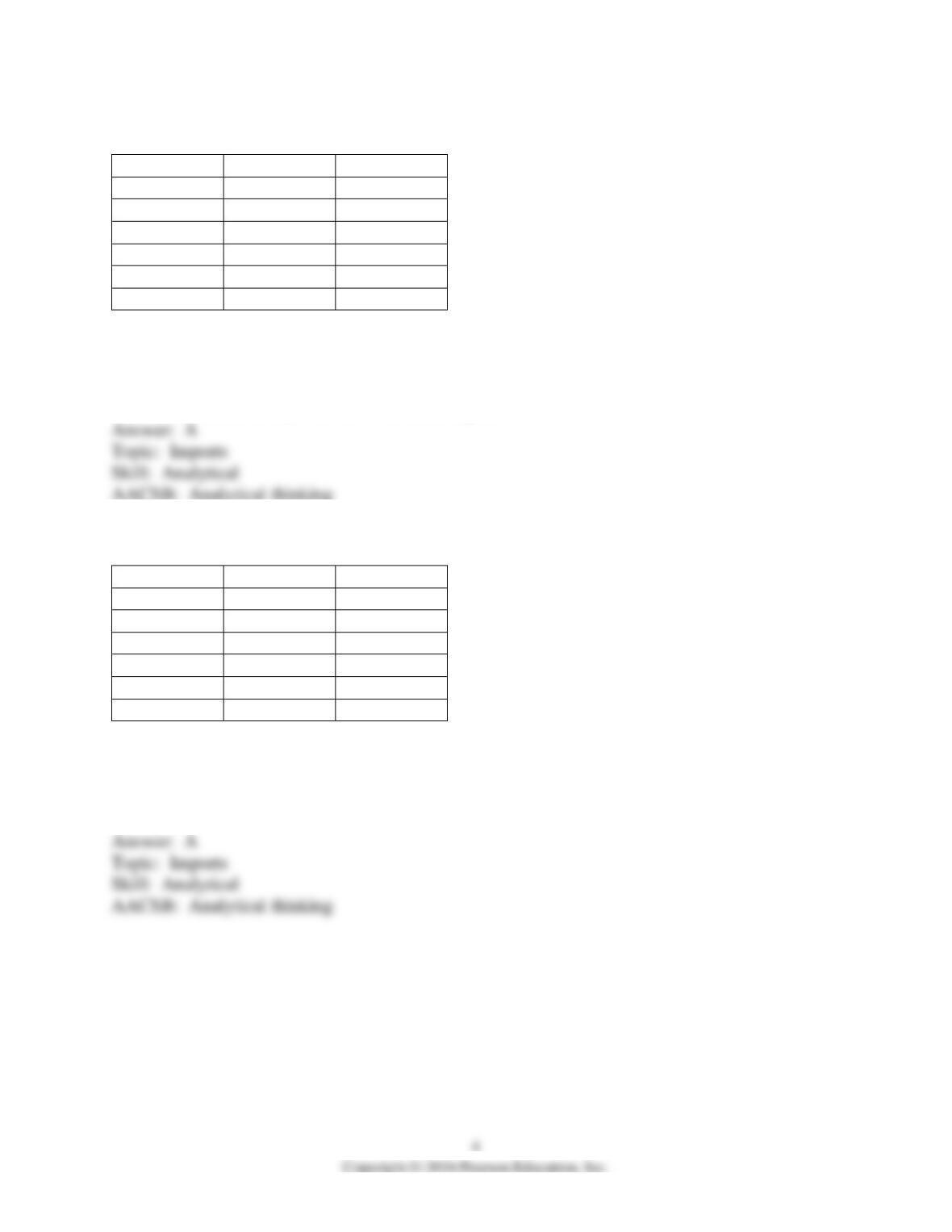
12) Based on the table below, at what world price would the country import the good?
Price
Q Demanded
Q Supplied
2
100
70
4
95
75
6
90
80
8
85
85
10
80
90
12
75
95
A) all prices below $8
B) at exactly $8
C) all prices above $8
D) it is impossible to say from the information given
13) Suppose the world price of a good is $4. Based on the table below, the country will
Price
Q Demanded
Q Supplied
2
100
70
4
95
75
6
90
80
8
85
85
10
80
90
12
75
95
A) import 20 units.
B) export 20 units.
C) import 10 units.
D) export 10 units.
14) In a market open to international trade, at the world price the quantity demanded is 150 and
quantity supplied is 200. This country will
A) export 50 units.
B) import 50 units.
C) export 200 units.
D) import 150 units.
15) Based on the table below, at what world price would the country export?
Price
Q Demanded
Q Supplied
2
100
70
4
95
75
6
90
80
8
85
85
10
80
90
12
75
95
A) all prices above $8
B) at only $8
C) all prices below $8
D) It is impossible to say from the information given.
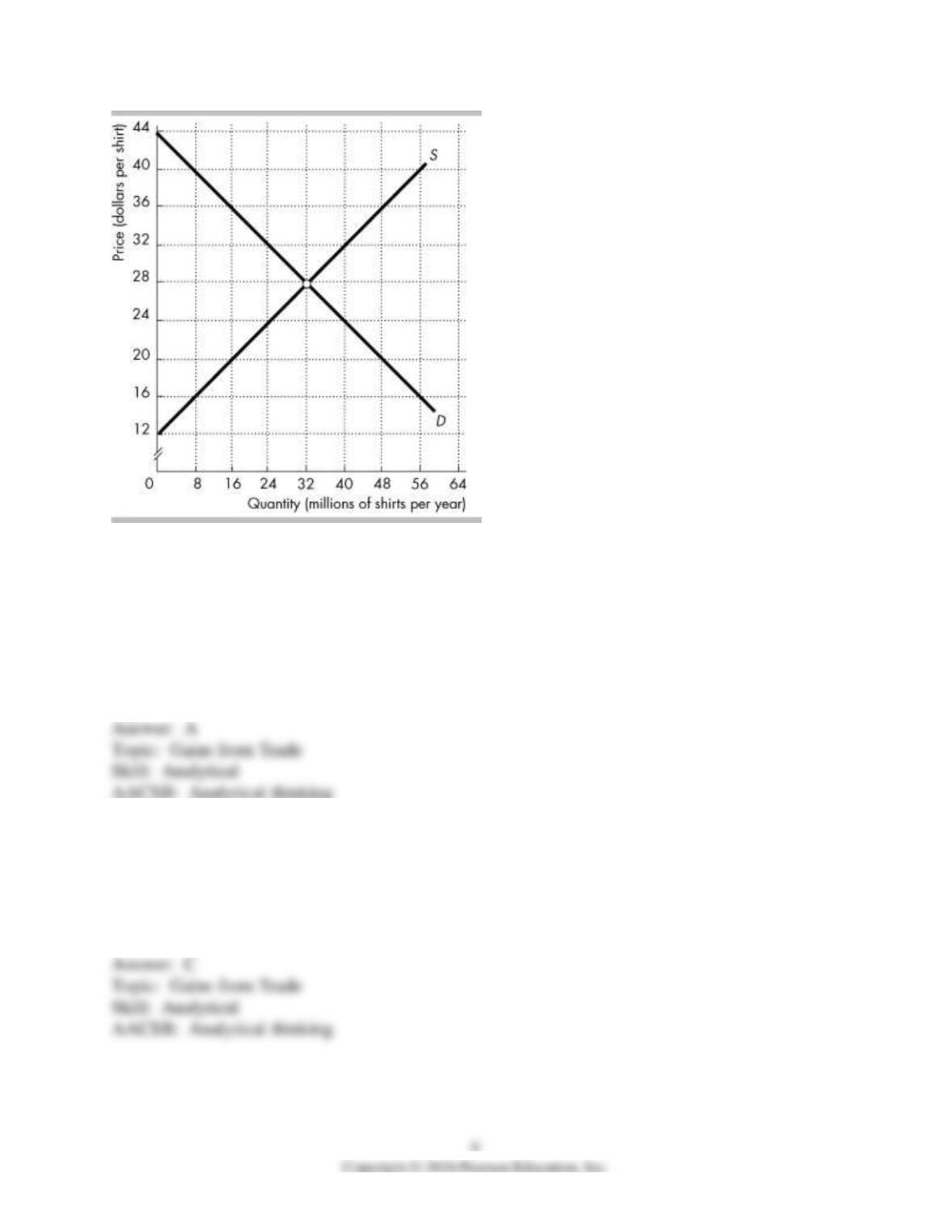
The figure shows the market for shirts in the United States, where D is the domestic demand
curve and S is the domestic supply curve. The world price is $20 per shirt.
16) In the figure above, with international trade Americans buy ________ million shirts per year.
A) 48
B) 32
C) 16
D) 24
17) In the figure above, with international trade ________ million shirts per year are produced in
the United States.
A) 48
B) 32
C) 16
D) 20
18) In the figure above, with international trade the United States ________ million shirts per
year.
A) imports 32
B) imports 48
C) exports 16
D) exports 32
The figure shows the market for helicopters in the United States, where D is the domestic
demand curve and S is the domestic supply curve. The United States trades helicopters with the
rest of the world at a price of $36 million per helicopter.
19) In the figure above, with international trade U.S. companies buy ________ helicopters per
year.
A) 240
B) 480
C) 720
D) 360
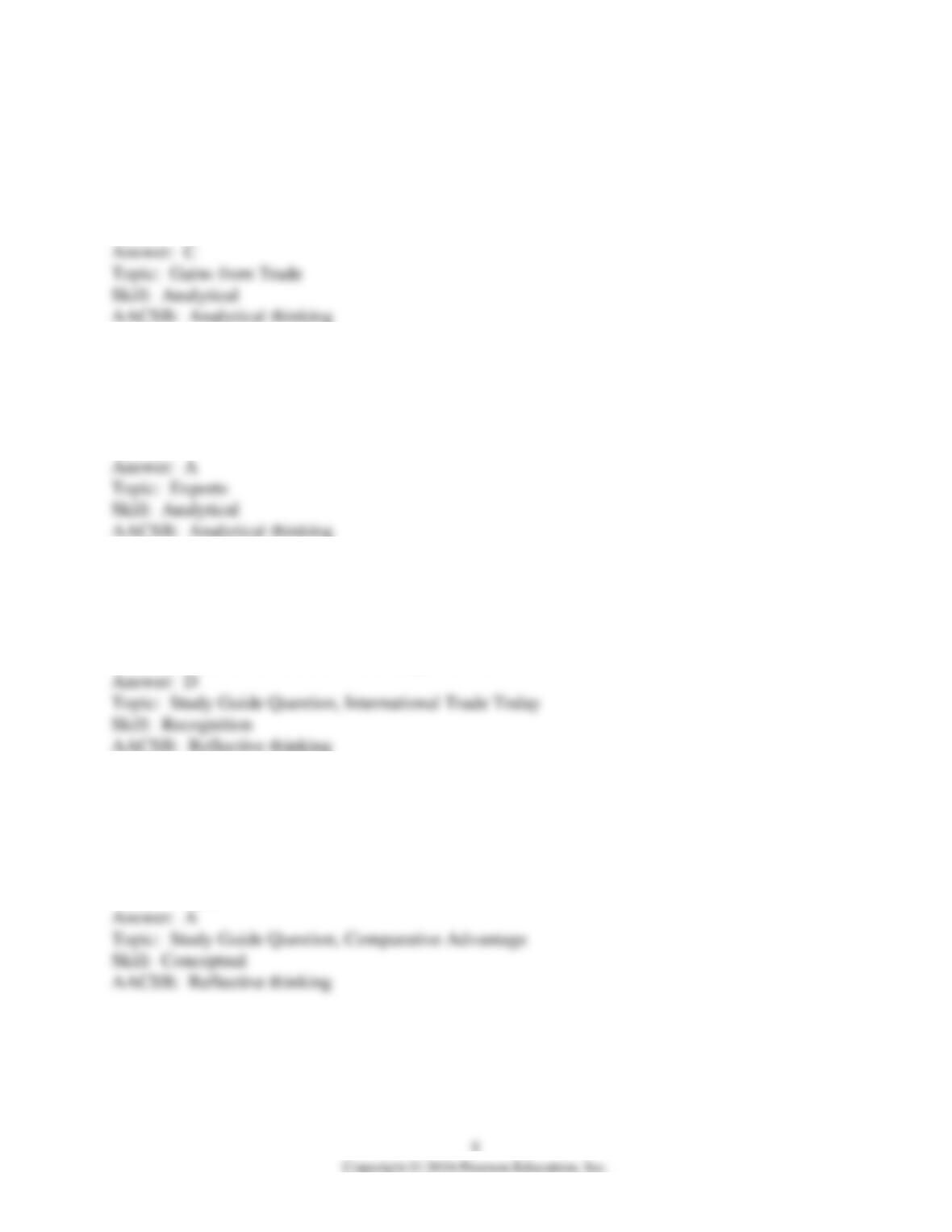
20) In the figure above, with international trade ________ helicopters per year are produced in
the United States.
A) 360
B) 480
C) 720
D) 240
21) In the figure above, the United States ________ helicopters per year.
A) exports 480
B) exports 720
C) imports 480
D) imports 240
22) Which of the following statements about U.S. international trade in 2013 is CORRECT?
A) The value of U.S. exports exceeded the value of U.S. imports.
B) The value of U.S. exports was about 33 percent of the value of total U.S. production.
C) The United States imported only goods.
D) The United States was the world’s largest trader.
23) The United States has a comparative advantage in producing cotton if the U.S. price of
cotton before international trade is ________ the world price.
A) less than
B) equal to
C) greater than
D) not comparable to
24) Compared to the situation before international trade, after the United States exports a good ,
then production in the United States ________ and consumption in the United States ________.
A) increases; increases
B) increases; decreases
C) decreases; increases
D) decreases; decreases
25) Compared to the situation before international trade, after the United States imports a good,
then production in the United States ________ and consumption in the United States ________.
A) increases; increases
B) increases; decreases
C) decreases; increases
D) decreases; decreases
1) A tariff is a
A) tax on an exported good or service.
B) tax on an imported good or service.
C) subsidy on an exported good.
D) subsidy on an imported good.
2) A tariff
A) is a tax imposed on imported goods.
B) is a tax imposed on exported goods.
C) encourages worldwide specialization according to the principle of comparative advantage.
D) has no effect on prices paid by domestic consumers even though it increases the revenue
collected by domestic producers.
3) A tariff is
A) a licensing regulation that limits imports.
B) a tax on an exported good.
C) a tax on an imported good.
D) an agreement to restrict the volume of exports.
4) A tax that is imposed by the importing country when an imported good crosses its
international boundary is called
A) an import quota.
B) dumping.
C) a voluntary export restraint.
D) a tariff.
5) A major purpose of tariffs is to
A) encourage imports.
B) encourage exports.
C) discourage imports.
D) discourage exports.
6) Tariffs and import quotas differ in that
A) one is a form of trade restriction, while the other is not.
B) one is a tax, while the other is a limit in quantity.
C) one is imposed by the government, while the other is imposed by the private sector.
D) one is legal, while the other is not.
7) Tariffs and import quotas both result in
A) lower levels of domestic production.
B) the domestic government gaining revenue.
C) lower levels of imports.
D) higher levels of domestic consumption.
8) If the United States imposes a tariff on imported cars, the
A) U.S. demand curve shifts rightward.
B) U.S. demand curve shifts leftward.
C) U.S. supply curve shifts rightward.
D) price in the United States rises but neither the U.S. demand curve nor the U.S. supply curve
shift.
9) Suppose the country of Atlantica imposes a tariff on foreign-produced cars. As a result of the
tariff
A) tariff revenue collected by the government in the Atlantica increases.
B) there is an increase in the number of imported cars.
C) the gains from trade rise.
D) there are more efficient trade agreements between Atlantica and its trade partners.
10) Which of the following statements concerning tariffs is NOT true?
A) A tariff results in a loss for domestic consumers of the good.
B) A tariff creates revenue for the government.
C) A tariff decreases international trade.
D) A tariff leaves the price of imports unchanged.
11) If a country imposes a tariff on an imported good, the tariff ________ the price in the
importing country and ________ the quantity of imports.
A) raises; decreases
B) raises; increases
C) raises; does not change
D) lowers; does not change
12) A tariff ________ the quantity of the good imported and ________ the domestic price of the
imported good.
A) decreases; decreases
B) decreases; increases
C) increases; lowers
D) does not change; increases
13) A tariff imposed by the United States on Japanese cars ________ the price of cars in the
United States and ________ the quantity of Japanese cars imported into the United States.
A) raises; increases
B) raises; decreases
C) lowers; increases
D) lowers; decreases
14) If a tariff is imposed, the price paid by domestic consumers will ________ and the amount
imported will ________.
A) increase; decrease
B) increase; not change
C) not change; increase
D) increase; increase
15) If the United States imposes a tariff of $1 per imported shirt, the higher tariff
A) raises the price of a shirt to U.S. consumers.
B) benefits U.S. shirt consumers.
C) increases imports of shirts into the United States.
D) none of the above.
16) If the United States imposes a tariff on imported steel, the tariff will
A) raise the U.S. price of imported steel.
B) decrease the U.S. production of steel.
C) increase the total U.S. consumption of steel.
D) decrease employment in the U.S. steel industry.
17) Suppose the country of Mooland imposes tariffs on imported beef from the country of
Aqualand. As a result of the tariffs, the
A) price of beef in Mooland falls.
B) quantity of beef exported by Mooland increases.
C) quantity of beef imported by Mooland decreases.
D) quantity of beef imported by Mooland increases.
18) Lowering the tariff on good X will
A) increase domestic employment in industry X.
B) increase the domestic imports of good X.
C) increase the domestic price of good X.
D) have no effect unless the nation’s trading partner also lowers its tariff on good X.
19) Reducing a tariff will ________ the domestic production of the good and ________ the total
domestic consumption of the good.
A) increase; increase
B) increase; decrease
C) decrease; increase
D) decrease; decrease
20) In 2013 the United States reduced the tariff on ethanol. This tariff reduction ________ the
U.S. production of ethanol and ________ the total U.S. consumption of ethanol.
A) increased; increased
B) increased; decreased
C) decreased; increased
D) decreased; decreased
21) Increasing a tariff will ________ the domestic quantity consumed of the good, while
________ the domestic production of the good.
A) increase; increasing
B) increase; decreasing
C) decrease; increasing
D) decrease; decreasing
22) A U.S. tariff on textiles would ________ U.S. prices on clothing and ________ the number
of jobs in the U.S. textile industry.
A) reduce; decrease
B) reduce; increase
C) raise; decrease
D) raise; increase
23) Tariffs
A) generate revenue for consumers.
B) generate revenue for the government.
C) encourage domestic consumers to buy more imports.
D) encourage domestic producers to produce less.
24) The United States imports cars from Japan. If the United States imposes a tariff on cars
imported from Japan, American
A) consumers will lose and Japanese producers will gain.
B) tariff revenue will equal the loss inflicted on American consumers.
C) consumers will lose and American producers will gain.
D) car manufacturers will gain revenue equal to the revenue lost by Japanese car manufacturers.
25) The winners from a tariff on imports are
A) producers and government.
B) producers.
C) consumers.
D) consumers, producers, and government.
26) In 2013 the United States reduced the tariff on ethanol. The winners from the tariff reduction
are
A) U.S. producers and the U.S. government.
B) U.S. producers only.
C) U.S. consumers only.
D) U.S. consumers, U.S. producers, and the U.S. government.
16
27) In 2013 the United States was considering imposing a tariff on solar panels imported from
China. Which of the following groups would gain from this tariff?
I. U.S. consumers of solar panels
II. U.S. producers of solar panels
III. Chinese producers of solar panels
A) I only
B) I and II only
C) II only
D) I and III only
28) A tariff is imposed on a good. The tariff will ________ quantity supplied, ________ quantity
demanded, and ________ the price of the good in the home country.
A) increase; decrease; increase
B) increase; leave unchanged; leave unchanged
C) increase; increase; increase
D) increase; decrease; decrease
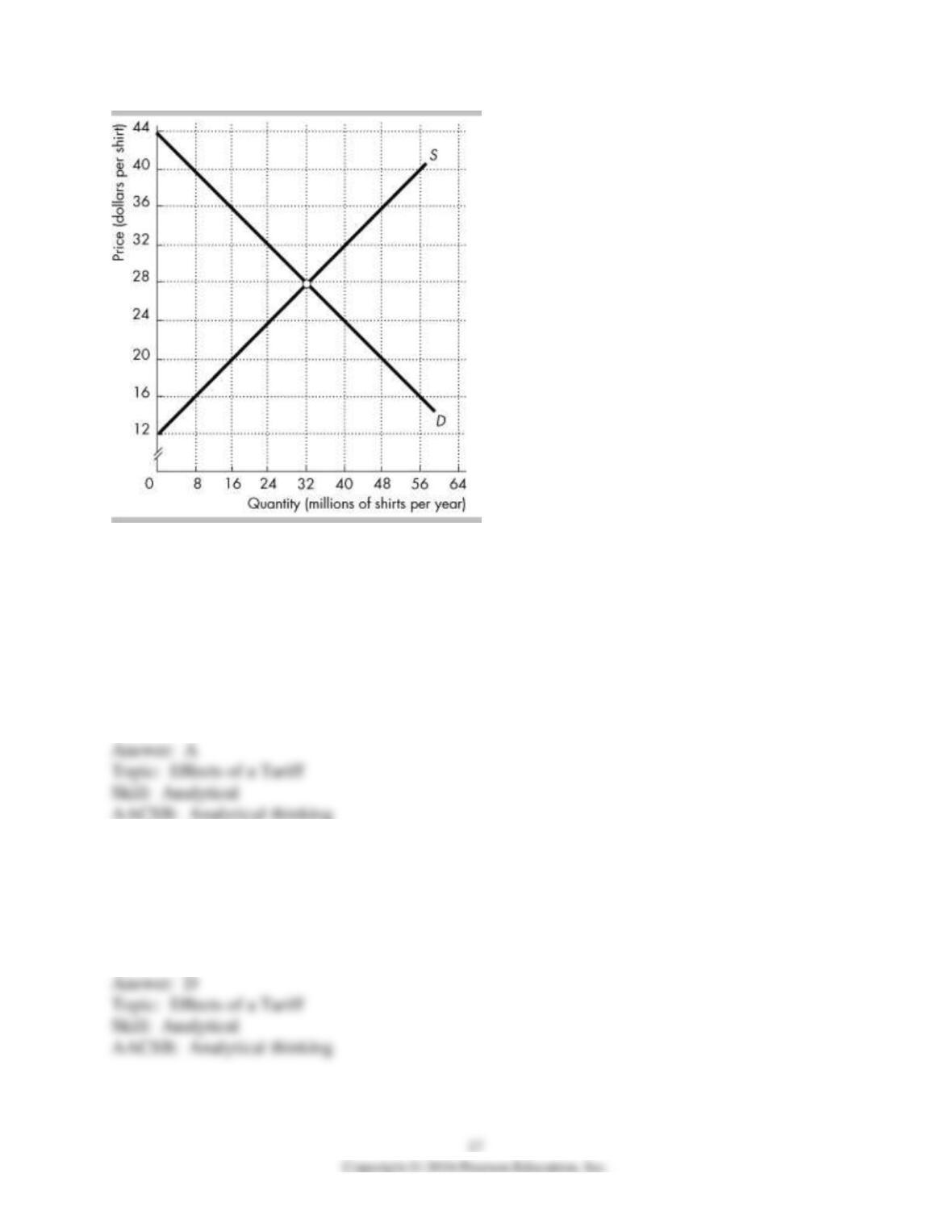
The figure shows the market for shirts in the United States, where D is the domestic demand
curve and S is the domestic supply curve. The world price is $20 per shirt. The United States
imposes a tariff on imported shirts, $4 per shirt.
29) In the figure above, with the tariff Americans buy ________ million shirts per year.
A) 40
B) 48
C) 32
D) 16
30) In the figure above, with the tariff the United States imports ________ million shirts per
year.
A) 24
B) 8
C) 32
D) 16
31) In the figure above, the tariff ________ U.S. imports of shirts by ________ million shirts per
year.
A) decreases; 16
B) decreases; 8
C) increases; 8
D) increases; 4
32) In the figure above, the tariff ________ the domestic production of shirts in the United States
by ________ per year.
A) increases; 8 million
B) decreases; 16 million
C) increases; 4 million
D) decreases; 8 million
33) In the figure above, the U.S. government’s revenue from the tariff is ________.
A) $64 million
B) $32 million
C) $128 million
D) $48 million
34) During the Great Depression in the 1930s, the average tariff level in the United States peaked
at about
A) zero.
B) 6 percent.
C) 20 percent.
D) 100 percent.
35) Average tariff levels in the United States in the last decade are
A) about equal to the average since 1930.
B) above the average since 1930.
C) positive, but below the average since 1930.
D) zero, as there are no longer any tariffs in the United States.
36) The Smoot-Hawley Act was enacted in
A) 1980.
B) 2000.
C) 1930.
D) 1950.
37) The Smoot-Hawley Act introduced
A) opportunities for expanding U.S. foreign trade.
B) the highest tariffs set by the United States in the last 80 years.
C) a framework promoting international free trade.
D) revenue tariffs as a major source of U.S. government revenues.
38) The Smoot-Hawley Act
A) made most tariffs illegal.
B) greatly raised tariffs.
C) gave the President the right to broker trade deals with other nations.
D) recognized Congress’s right to deny trade authorization powers to the President.
39) U.S. tariffs peaked in
A) 1992.
B) 1961.
C) 1940.
D) 1933.
40) Since the 1930s, tariff levels in the United States have
A) declined overall.
B) steadily risen.
C) increased during expansions.
D) decreased during recessions.
41) Of the following, in which decade were U.S. tariffs at their lowest level?
A) 2000s
B) 1970s
C) 1950s
D) 1930s
42) Which of the following best describes the history of tariffs in the United States over the past
70 years?
A) Tariffs were at their highest level in the 1970s and now average just over 10 percent.
B) Tariffs have declined overall since the early 1930s and now average just over 10 percent.
C) Tariffs reached a maximum in the early 1930s and now average less than 5 percent.
D) Average tariff rates have not changed much since the early 1930s and are less than 5 percent.