52. The monetarist assumption that monetary policy cannot change long-run equilibrium income is based on the idea that:
a.
the long-run aggregate supply curve is horizontal.
b.
the long-run Phillips curve is vertical.
c.
the price level in the long run is fixed.
d.
the aggregate demand curve cannot shift.
e.
the long-run Phillips curve is upward-sloping.
53. According to new classical school of economics, the aggregate supply curve is:
a.
horizontal in both the short run and the long run.
b.
vertical in the short run and upward-sloping in the long run.
c.
upward-sloping in both the short run and the long run.
d.
vertical in both the short run and the long run.
e.
upward-sloping in the short run and vertical in the long run.
MACR.BOYE.16.81 – ch. 15, 3
New Classical Economics
54. New classical economists contend that an unexpected increase in the money supply will:
a.
increase the unemployment rate in the short run.
b.
reduce the unemployment rate in the short run.
c.
cause no short-run change in the unemployment rate.
d.
reduce the unemployment rate in the long run.
e.
increase the unemployment rate in the long run.
MACR.BOYE.16.81 – ch. 15, 3
New Classical Economics
55. Assume that workers have perfect information about changes in inflation. Which of the following statements is true in
this context?
a.
Wage rates will not adjust immediately to the price level on account of the fixed contracts.
b.
The aggregate supply curve of the economy will become perfectly elastic.
c.
The aggregate supply curve will shift to the right.
d.
Nominal wage rates will always exceed the real wage rate.
e.
The economy will continue to produce at the potential level of real GDP.
MACR.BOYE.16.81 – ch. 15, 3
New Classical Economics
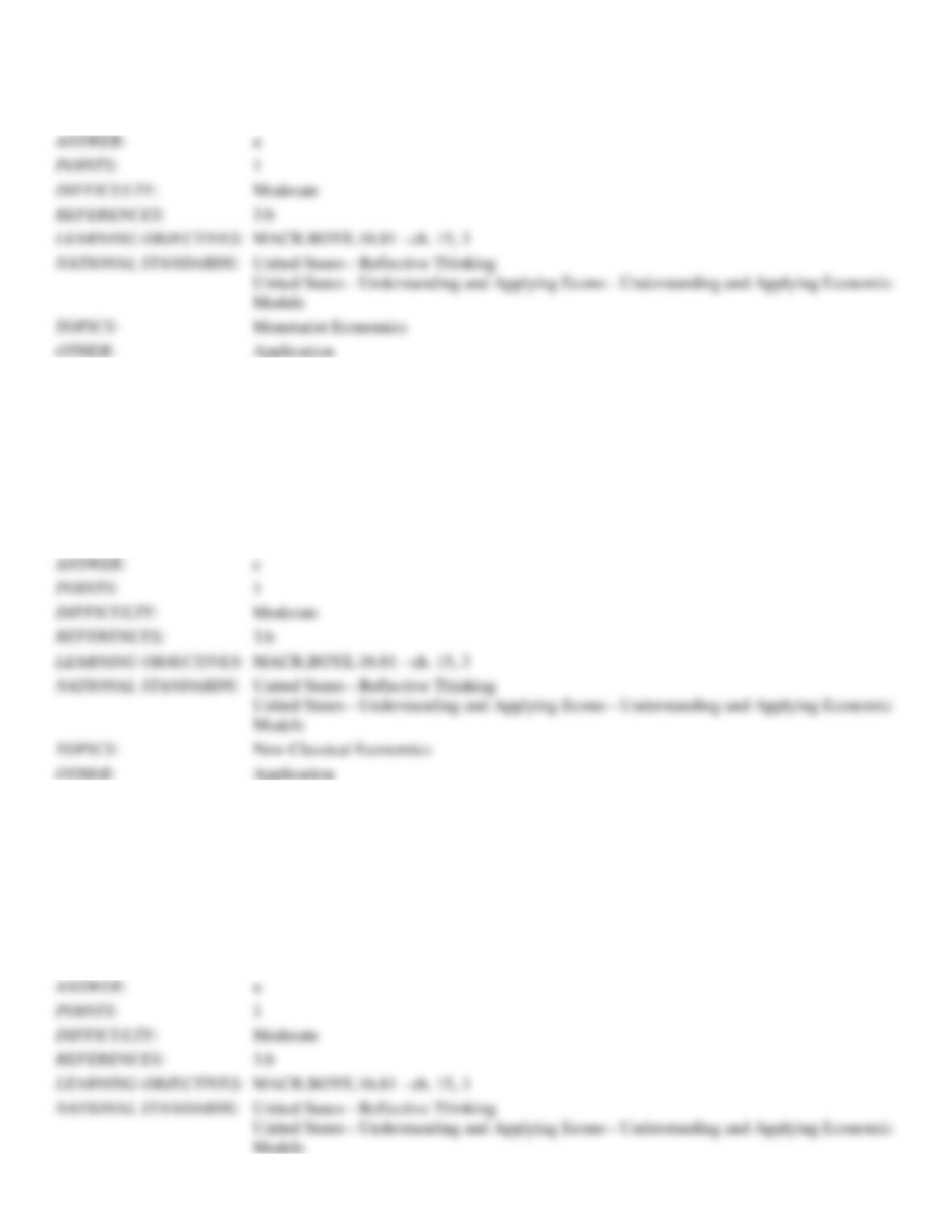
The figure given below represents the new classical long run and short run Phillips curve measuring inflation rate on
vertical axis and unemployment rate on horizontal axis.
Figure 15.2
56. Refer to the Figure 15.2. Assume the economy is currently at point C. According to the new classical school, an
expected increase in government spending:
a.
would move the economy to point A.
b.
would move the economy to point B.
New Classical Economics
c.
would move the economy to point D.
d.
would move the economy above point A.
e.
would move the economy below point C.
57. Refer to the Figure 15.2. If the actual inflation rate is 15 percent and the expected inflation rate was 10 percent, the
economy must currently be at:
a.
point A.
b.
point B.
c.
point C.
d.
point D.
e.
point E.
MACR.BOYE.16.81 – ch. 15, 3
New Classical Economics
58. Refer to Figure 15.2. Assume that the government adopted an unexpected expansionary monetary policy that has the
economy currently at point D. If people expect that this inflation rate will persist next year, the economy will now:
a.
move to point A.
b.
move to point B.
c.
move to point C.
d.
move to point E.
e.
remain at point D.
MACR.BOYE.16.81 – ch. 15, 3
MACR.BOYE.16.81 – ch. 15, 3
Monetarist Economics
59. Refer to Figure 15.2. Assume that the economy is now at point B. If government officials announce and carry out a
policy that will maintain the inflation rate at 15 percent, we would expect:
a.
the economy to move to point A.
b.
the economy to remain at point B.
c.
the economy to move to point C.
d.
the economy to move to point D.
e.
the economy to move to point E.
1
3.b
MACR.BOYE.16.81 – ch. 15, 3
Monetarist Economics
Application
60. According to the new classical school, an expected increase in government spending is associated with:
a.
a downward movement along the long-run Phillips curve.
b.
an upward movement along the short-run Phillips curve.
c.
a parallel outward shift of the long-run Phillips curve.
d.
an upward movement along the long-run Phillips curve.
e.
a downward shift of the short-run Phillips curve.
1
Moderate
MACR.BOYE.16.81 – ch. 15, 3
Analysis
61. Which of the following is the basic tenet of new classical economics?
a.
A change in the fiscal policy affects the equilibrium level of real GDP but has no impact on the equilibrium
price level.
b.
A government-induced shift in aggregate demand affects the real GDP only if they are expected by the
economic agents.
c.
A change in aggregate demand affects the aggregate price level only if the aggregate supply curve is perfectly
elastic.
d.
A change in monetary policy affects the equilibrium level of real GDP only if those changes are unexpected.
e.
An expected change in a monetary or fiscal policy leads to a proportional shift of the long run supply curve.
Monetarist Economics
Application
62. The economic theory that suggested an alternative to the rising unemployment and inflation that the static Phillips
curve analysis could not explain was the:
a.
new classical economic theory.
b.
monetarist economic theory.
c.
new Keynesian economic theory.
d.
classical economic theory.
e.
traditional Keynesian economic theory.
MACR.BOYE.16.82 – ch. 15, 4
Comparison and Influence
63. An economist from which school of thought would most likely accept the following- “The wide acceptance and
practice of activist government fiscal policy.”
a.
Traditional classical economics
b.
Neoclassical economics
c.
Marxist economics
d.
New monetarist economics
e.
Keynesian economics
MACR.BOYE.16.82 – ch. 15, 4
Comparison and Influence
64. Which of the following statements accurately expresses the assumptions on which new Keynesian and new classical
MACR.BOYE.16.81 – ch. 15, 3
New Classical Economics
theory are based?
a.
New Keynesian economics assumes that the economy can reach equilibrium below the
natural rate of unemployment, whereas new classical economics assumes that
macroeconomic equilibrium is always at the natural rate of unemployment.
b.
New Keynesian economics maintains that government intervention is unnecessary,
whereas classical economics supports an active government role.
c.
New Keynesian economics assumes that the long-run Phillips curve is vertical,
whereas new classical economics views the long-run Phillips curve as horizontal.
d.
New Keynesian economics assumes that all prices are flexible, whereas new classical economics applies a
fixed-price model.
e.
New Keynesian economics emphasizes short-run reductions in inflation rates, whereas new classical
economics focuses on short-run reductions in the unemployment rate.
65. Which of the following schools of thought criticized the Fed’s policy of targeting interest rates?
a.
The new Keynesians
b.
The Keynesians
c.
The monetarists
d.
The classical economists
e.
The new classical economists
MACR.BOYE.16.82 – ch. 15, 4
Comparison and Influence
66. Which school calls for more information from policymakers so that people can incorporate government plans into
their outlook for the future?
a.
The new classical school
b.
The new Keynesian school
c.
The traditional Keynesian school
d.
The monetarist school
e.
The classical school
MACR.BOYE.16.82 – ch. 15, 4
Comparison and Influence
67. Which of the following promoted legislation that would give private citizens greater information regarding public
policymaking?
a.
The Keynesians
b.
The monetarists
c.
The new classicals
d.
The traditional classicals
e.
The consumer advocates
MACR.BOYE.16.82 – ch. 15, 4
Comparison and Influence
68. Which of the following economic theories became popular in the 1930s in response to the shortcomings of existing
theories of the Great Depression?
a.
New classical theory
b.
Classical theory
c.
Traditional Keynesian theory
d.
Monetarist theory
e.
New Keynesian theory
MACR.BOYE.16.82 – ch. 15, 4
Comparison and Influence
69. Which of the following schools of thought believes that wages and prices are rigid in the short run?
MACR.BOYE.16.82 – ch. 15, 4
Comparison and Influence
a.
Keynesians and new Keynesians
b.
Only monetarists
c.
Only new classical economists
d.
Monetarists and new classical economists
e.
Monetarists and Keynesians
70. Which of the following economic theories favors an active role for government in promoting low inflation and
economic growth?
a.
New Keynesian
b.
Monetarists
c.
New classical economists
d.
Classical economists
e.
Marxists
Moderate
4
MACR.BOYE.16.82 – ch. 15, 4
Comparison and Influence
Knowledge
71. Which of the following schools of thought believes that the major source of the macroeconomic problems are the
disequilibria in the private labor and goods market?
a.
Keynesians and new Keynesians
b.
Only monetarists
c.
Only new classical economists
d.
Monetarists and new classical economists
e.
Monetarists and Keynesians
1
Moderate
4
MACR.BOYE.16.82 – ch. 15, 4
1
Moderate
4
MACR.BOYE.16.82 – ch. 15, 4
Models
Knowledge
72. According to the Keynesian school of thought, the economy is not self-regulating. That is, to achieve a satisfactory
level of real GDP, the government often has to intervene by managing aggregate demand.
a.
True
b.
False
True
1
Easy
1
Keynesian Economics
Knowledge
73. Traditional Keynesian economics assumes that prices are relatively flexible in response to changes in aggregate
expenditures.
a.
True
b.
False
False
1
Easy
1.a
MACR.BOYE.16.79 – ch. 15, 1
Keynesian Economics
Knowledge
74. Traditional Keynesians would argue that fluctuations in aggregate demand are closely tied to fluctuations in
investment.
a.
True
b.
False
True
1
Easy
MACR.BOYE.16.79 – ch. 15, 1
Keynesian Economics
Knowledge
75. Keynesian economists today favor a model in which the aggregate supply curve is relatively flat at low levels of real
GDP and slopes downward as real GDP approaches its potential level.
a.
True
b.
False
False
1
Easy
1.a
MACR.BOYE.16.79 – ch. 15, 1
Keynesian Economics
Knowledge
76. New Keynesians argue that a decrease in government spending reduces inflation.
a.
True
b.
False
True
1
Moderate
1.a
Keynesian Economics
Knowledge
77. According to the new Keynesian school of thought, fiscal policy is a completely ineffective tool in combating supply-
side shocks.
a.
True
b.
False
False
1
Easy
MACR.BOYE.16.79 – ch. 15, 1
Keynesian Economics
Knowledge
78. The primary difference between new Keynesian economics and traditional Keynesian economics is that the former is
more realistic about international trade, whereas the latter stresses the importance of inward oriented strategies.
Knowledge
a.
True
b.
False
79. Milton Friedman is widely considered to be the father of monetarism.
a.
True
b.
False
True
1
Easy
2
MACR.BOYE.16.80 – ch. 15, 2
Monetarist Economics
Knowledge
80. Monetarists would argue that in the short run, increases in the money supply act to raise both investment and
consumption, while also increasing the price level.
a.
True
b.
False
True
1
Moderate
2.a
Monetarist Economics
Knowledge
81. According to the monetarists, inflation is primarily caused by an increase in the money supply.
a.
True
b.
False
1
False
1
Easy
1.a
MACR.BOYE.16.79 – ch. 15, 1
Keynesian Economics
Knowledge
82. According to monetarists, changes in the money supply have long-lasting effects on the equilibrium level of real GDP.
a.
True
b.
False
False
Easy
2.a
MACR.BOYE.16.80 – ch. 15, 2
Monetarist Economics
Knowledge
83. Monetarists argue that the long-run Phillips curve is negatively sloped.
a.
True
b.
False
False
1
Moderate
MACR.BOYE.16.80 – ch. 15, 2
Monetarist Economics
Knowledge
84. According to the monetarists, government intervention can stabilize the economy and minimize the effect of business
cycles.
a.
True
b.
False
False
1
Easy
MACR.BOYE.16.80 – ch. 15, 2
United States – Understanding and Applying Econo – Understanding and Applying Economic
Moderate
MACR.BOYE.16.80 – ch. 15, 2
Monetarist Economics
Knowledge
85. Monetarists argue that government actions, particularly monetary policy, worsens the negative aspects of the business
cycle.
a.
True
b.
False
True
1
Moderate
MACR.BOYE.16.80 – ch. 15, 2
Models
Monetarist Economics
Knowledge
86. In the early 1960s, monetary theory rather than Keynesian theory dominated economics.
a.
True
b.
False
False
1
MACR.BOYE.16.80 – ch. 15, 2
Economic Insight – Milton Friedman
Knowledge
87. Agreeing with Keynesian economists, monetarists believe that the economy is subject to disequilibrium that must be
corrected by government action.
a.
True
b.
False
False
1
Easy
2.b
MACR.BOYE.16.80 – ch. 15, 2
Knowledge
Models
Monetarist Economics
Knowledge
88. The effect lag occurs because it takes policymakers some time to recognize that a problem exists in an economy.
a.
True
b.
False
89. Reaction lag is the term used to express the fact that some time passes before changes in the money supply are
properly translated into changes in real GDP.
a.
True
b.
False
False
1
Easy
2.b
Monetarist Economics
Knowledge
90. Monetarists believe that discretionary monetary policy, and not discretionary fiscal policy, should be used to correct
disequilibrium.
a.
True
b.
False
False
1
Moderate
2.b
MACR.BOYE.16.80 – ch. 15, 2
Monetarist Economics
Knowledge
91. New classical economics assumes that government has direct control over the equilibrium level of GDP and indirect
control over the money supply.
False
1
Easy
2.b
MACR.BOYE.16.80 – ch. 15, 2
Revised
a.
True
b.
False
92. According to the traditional classical school of thought, aggregate supply is vertical both in the short run and in the
long run.
a.
True
b.
False
True
1
Easy
3
MACR.BOYE.16.81 – ch. 15, 3
New Classical Economics
Knowledge
93. The assumption of wage and price flexibility lead classical economists to conclude that business cycle fluctuations are
short-term in nature.
a.
True
b.
False
True
1
Moderate
3
MACR.BOYE.16.81 – ch. 15, 3
Knowledge
94. New classical economists believe that wages are inflexible.
a.
True
b.
False
False
False
1
Easy
3
MACR.BOYE.16.81 – ch. 15, 3
New Classical Economics
Knowledge
95. The new classical school of thought is usually associated with the theory of rational expectations.
a.
True
b.
False
1
Easy
MACR.BOYE.16.81 – ch. 15, 3
Models
New Classical Economics
Knowledge
96. New classical economists contend that both the short-run and long-run aggregate supply curves are vertical.
a.
True
b.
False
False
1
Moderate
3.b
MACR.BOYE.16.81 – ch. 15, 3
Monetarist Economics
Knowledge
97. According to new classical economics, fiscal policy can change equilibrium real GDP only if it changes the price level
or one of the determinants of aggregate supply, and people expect this change.
a.
True
b.
False
False
1
Easy
MACR.BOYE.16.81 – ch. 15, 3
1
Easy
3.a
MACR.BOYE.16.81 – ch. 15, 3
New Classical Economics
Knowledge
98. According to the new classical school, if macroeconomic policy is perfectly predictable, then the aggregate supply
curve and the Phillips curve must be vertical in both the short run and the long run.
a.
True
b.
False
False
1
Moderate
3.b
MACR.BOYE.16.81 – ch. 15, 3
New Classical Economics
Knowledge
Revised
99. The Federal Reserve System is an independent body, so it does not require to report to Congress on its goals and
money targets.
a.
True
b.
False
False
1
Moderate
4
MACR.BOYE.16.82 – ch. 15, 4
Comparison and Influence
Knowledge
100. A by-product of the acceptance of the Keynesian school was the wide approval and practice of activist government
fiscal policy around the world.
a.
True
b.
False
True
1
4
Models
New Classical Economics
Knowledge
101. Monetarists and new classical economists favor an active role of government in promoting low inflation and
economic growth.
a.
True
b.
False
False
1
Easy
4
MACR.BOYE.16.82 – ch. 15, 4
Comparison and Influence
Knowledge
102. New classical economists advocate less government intervention than the new Keynesian school of thought.
a.
True
b.
False
True
Moderate
4
MACR.BOYE.16.82 – ch. 15, 4
Models
Comparison and Influence
Knowledge
103. Both new classical economists and monetarists disagree with Keynesians about the optimal degree of involvement of
the government in determining the equilibrium level of real GDP.
a.
True
b.
False
True
1
Moderate
4
MACR.BOYE.16.82 – ch. 15, 4
Comparison and Influence
Models
Comparison and Influence
Knowledge
Revised