36) Suppose the Fed increases the money supply. Which of the following is true?
A) At the original interest rate, the quantity of money demanded is equal to the quantity of money
supplied.
B) At the original interest rate, the quantity of money demanded is less than the quantity of money
supplied.
C) At the original interest rate, the quantity of money demanded is greater than the quantity of money
supplied.
D) The interest rate must rise for the money market to clear.
37) When the price of a financial asset ________ its interest rate will ________.
A) rises; rise
B) falls; fall
C) falls; rise
D) rises; remain the same
38) Suppose the Fed decreases the money supply. In response households and firms will ________ short
term assets and this will drive ________ interest rates.
A) buy; up
B) buy; down
C) sell; up
D) sell; down
39) If the Fed buys Treasury bills, this will shift the
A) money supply curve to the right.
B) money supply curve to the left.
C) money demand curve to the right.
D) money demand curve to the left.
40) An increase in the money supply will
A) increase the interest rate.
B) decrease the interest rate.
C) have no affect on the interest rate.
D) decrease the equilibrium quantity of money in the economy.
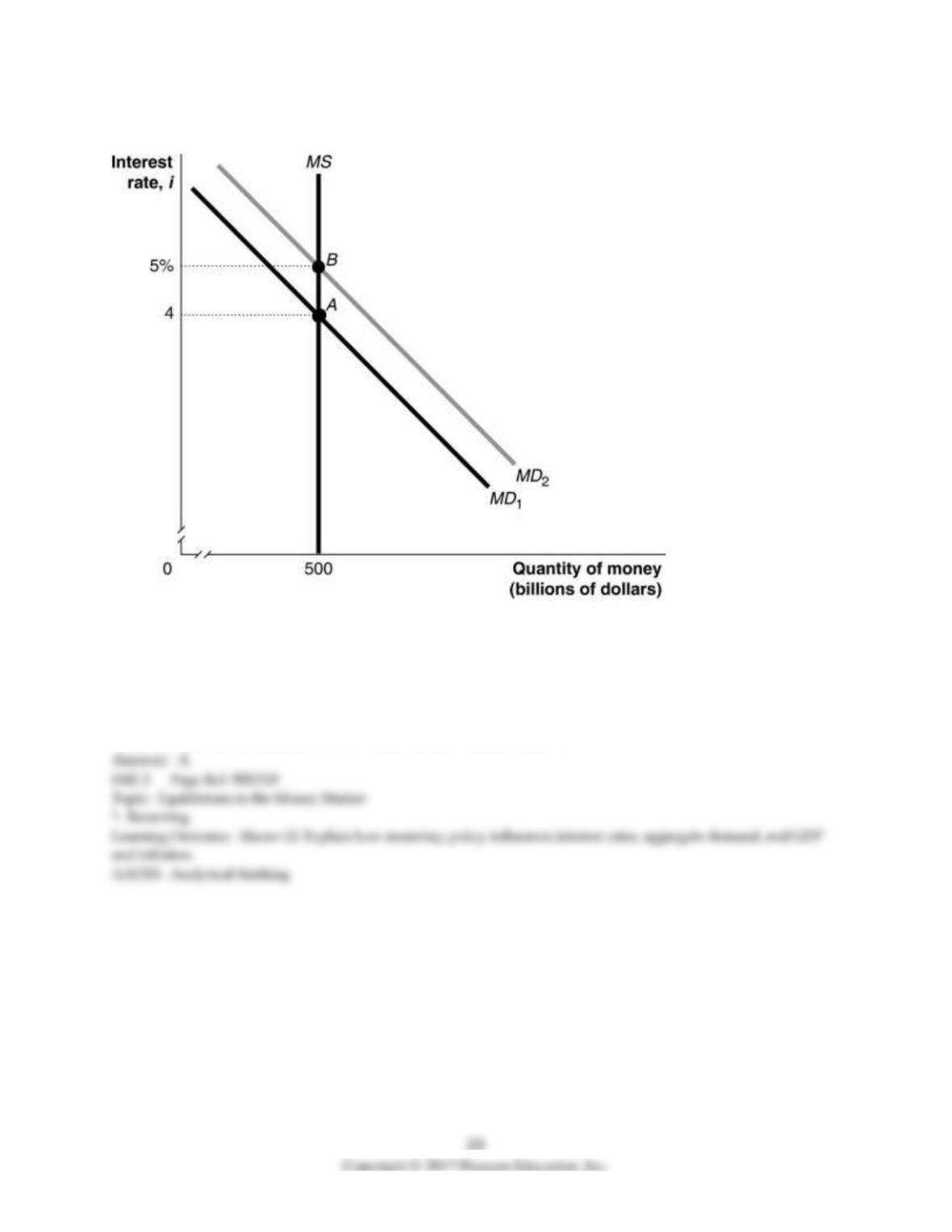
Figure 15-5
41) Refer to Figure 15-5. In the figure above, the movement from point A to point B in the money market
would be caused by
A) an increase in the price level.
B) a decrease in real GDP.
C) an open market sale of Treasury securities by the Federal Reserve.
D) an increase in the required reserve ratio by the Federal Reserve.
42) A decrease in real GDP can
A) shift money demand to the right and decrease the interest rate.
B) shift money demand to the right and increase the interest rate.
C) shift money demand to the left and decrease the interest rate.
D) shift money demand to the left and increase the interest rate.
43) The money market model is concerned with ________ and the loanable funds market model is
concerned with ________.
A) short-term real interest rates; long-term nominal interest rates
B) short-term nominal interest rates; long-term nominal interest rates
C) short-term real interest rates; long-term real interest rates
D) short-term nominal interest rates; long-term real interest rates
44) Which of the following correctly describes what the Fed used as monetary targets in the past?
A) The Fed used M1 and M2 as targets after 1993.
B) The Fed focused on M1 as a target after deregulation of the financial markets.
C) The Fed increased its reliance on interest rate targets since the mid-1990s.
D) After 1980 and before the 1990s, the Fed focused on interest rate targets.
45) The federal funds rate is
A) the interest rate the Fed charges commercial banks.
B) the interest rate a bank charges its best customers.
C) the interest rate banks charge each other for overnight loans.
D) the interest rate on a Treasury Bill.
46) The rate of interest banks charge other banks for overnight loans of reserves is the
A) discount rate.
B) prime rate.
C) federal funds rate.
D) real rate.
47) The federal funds rate
A) is determined administratively by the Fed.
B) is determined by the supply of and demand for bank reserves.
C) is determined directly by household demand for funds.
D) is determined directly by firm demand for funds.
48) Buying a house during a recession may be a good idea if your job is secure because the Federal
Reserve often
A) raises interest rates during recessions.
B) lowers interest rates during recessions.
C) lowers income taxes during recessions.
D) sells Treasury bills to help the housing market.
49) The Fed can directly lower the inflation rate.
50) The Fed can simultaneously reduce the inflation rate and stimulate growth through lowering
interest rates.
51) A monetary policy target is a variable that the Fed can affect directly, which then affects one or more
of the Fed’s policy goals.
52) Ceteris paribus, an increase in the money supply will lower short-term interest rates.
53) Rising nominal GDP will increase the demand for money and short-term interest rates.
54) Buying a house during a recession may be a good idea if your job seems secure because the Federal
Reserve often lowers interest rates during a recession.
55) Does the money demand curve have a positive slope or a negative slope? Why does it have this
slope? Explain why an increase in the variable on the vertical axis of the money demand curve causes
either an increase or a decrease in the variable on the horizontal axis of the money demand curve.
56) Give an example of a monetary policy target. Explain why the Fed uses policy targets.
57) Describe how the Fed uses open market operations to change short-term and long-term interest
rates.
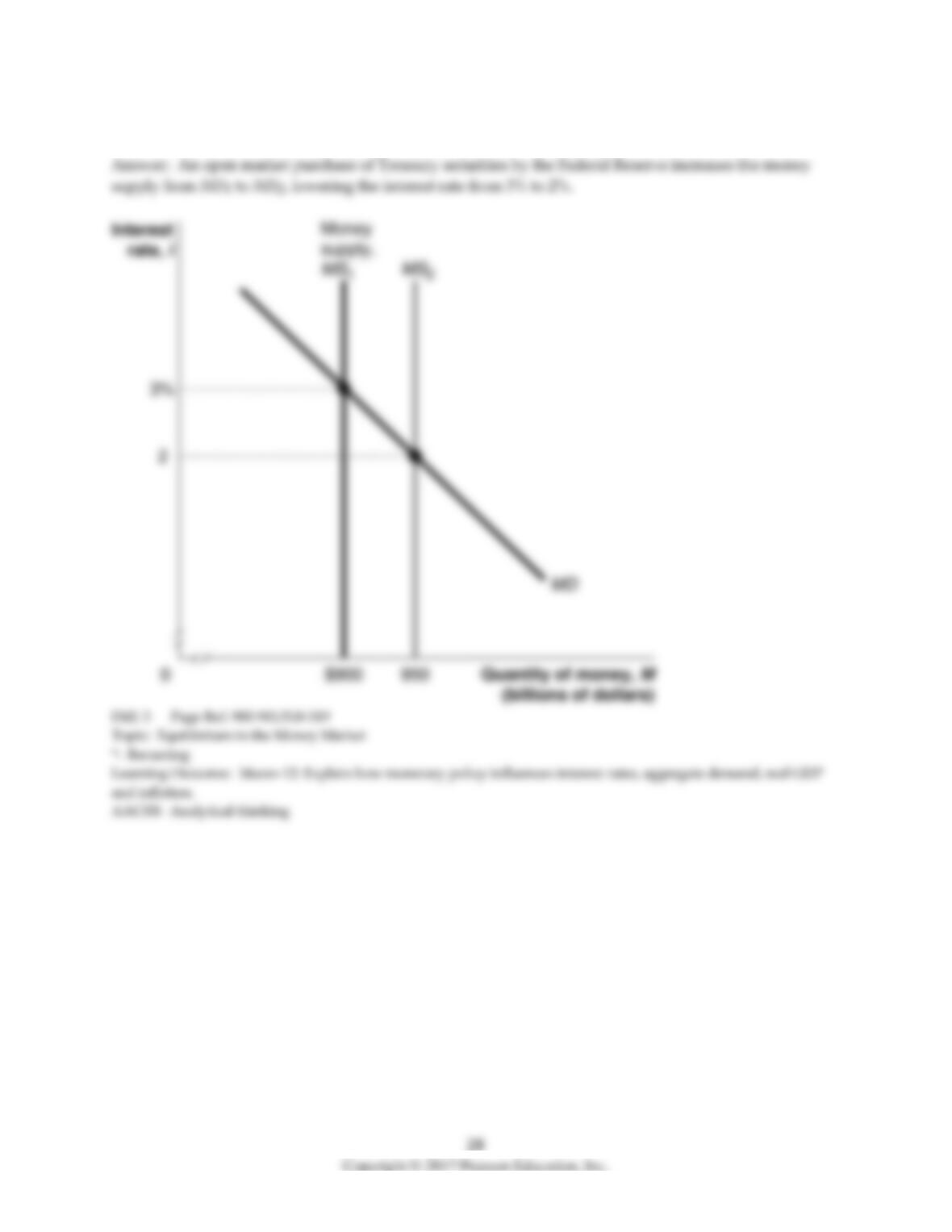
58) Use the money demand and money supply model to show graphically and explain the effect on
interest rates of the Federal Reserve’s open market purchase of Treasury securities.
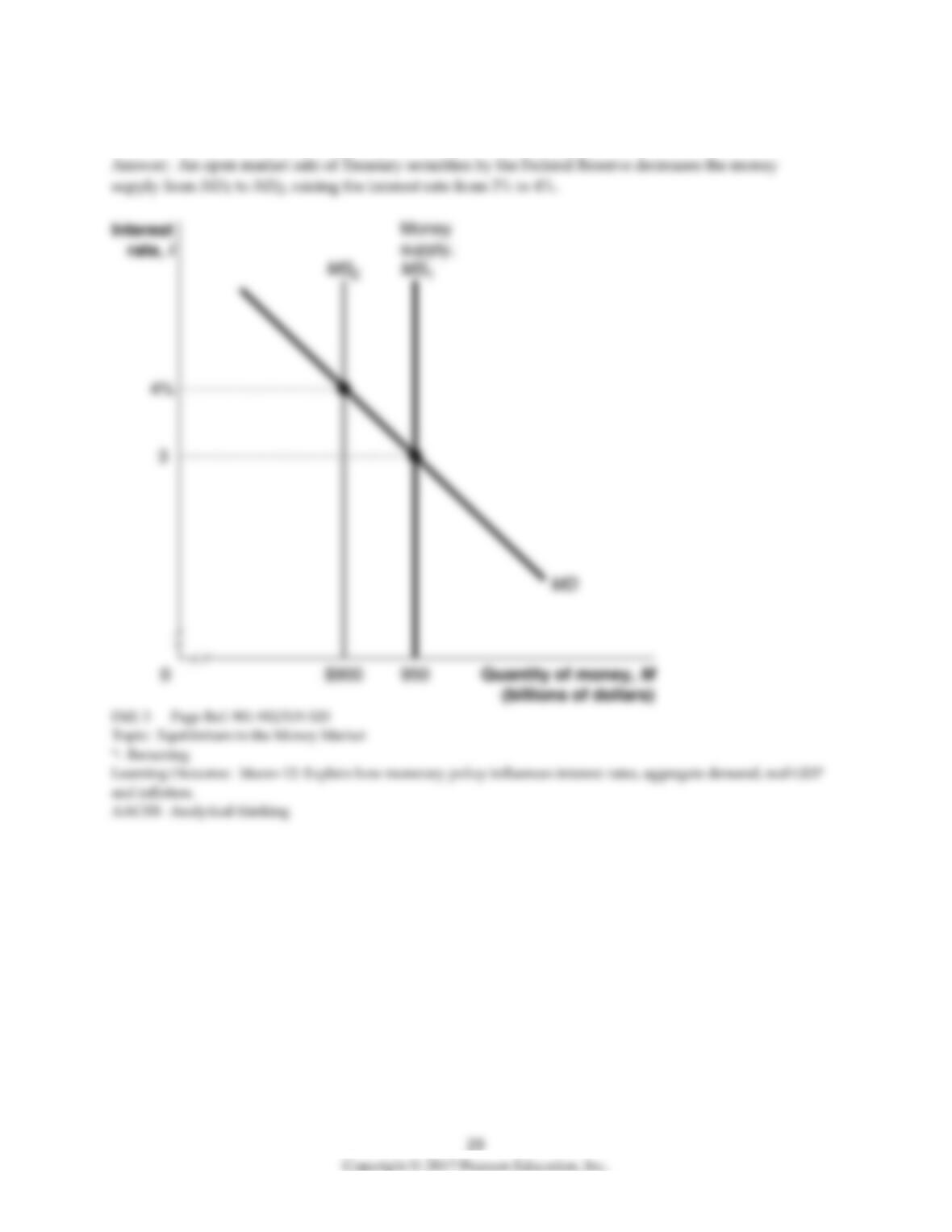
59) Use the money demand and money supply model to show graphically and explain the effect on
interest rates of the Federal Reserve’s open market sale of Treasury securities.
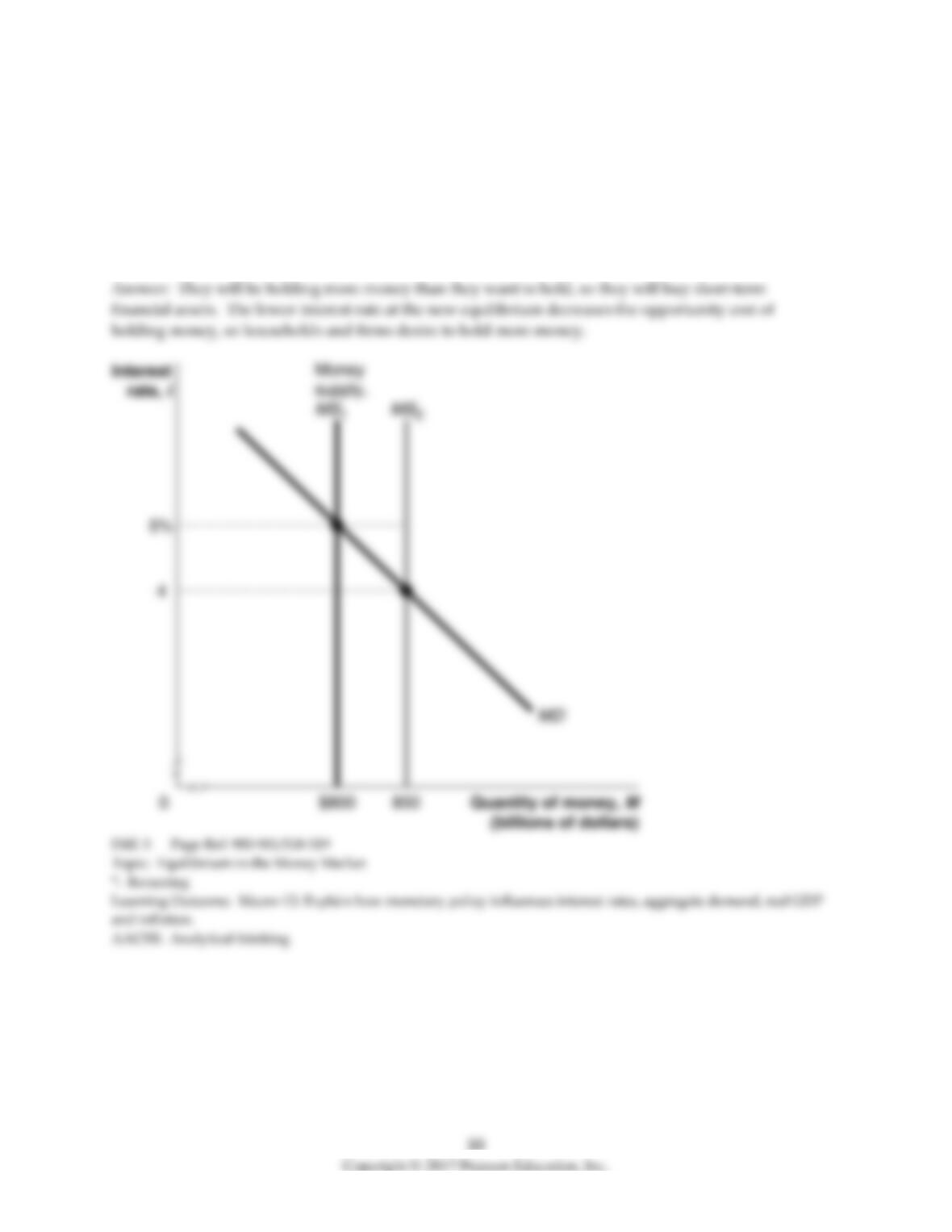
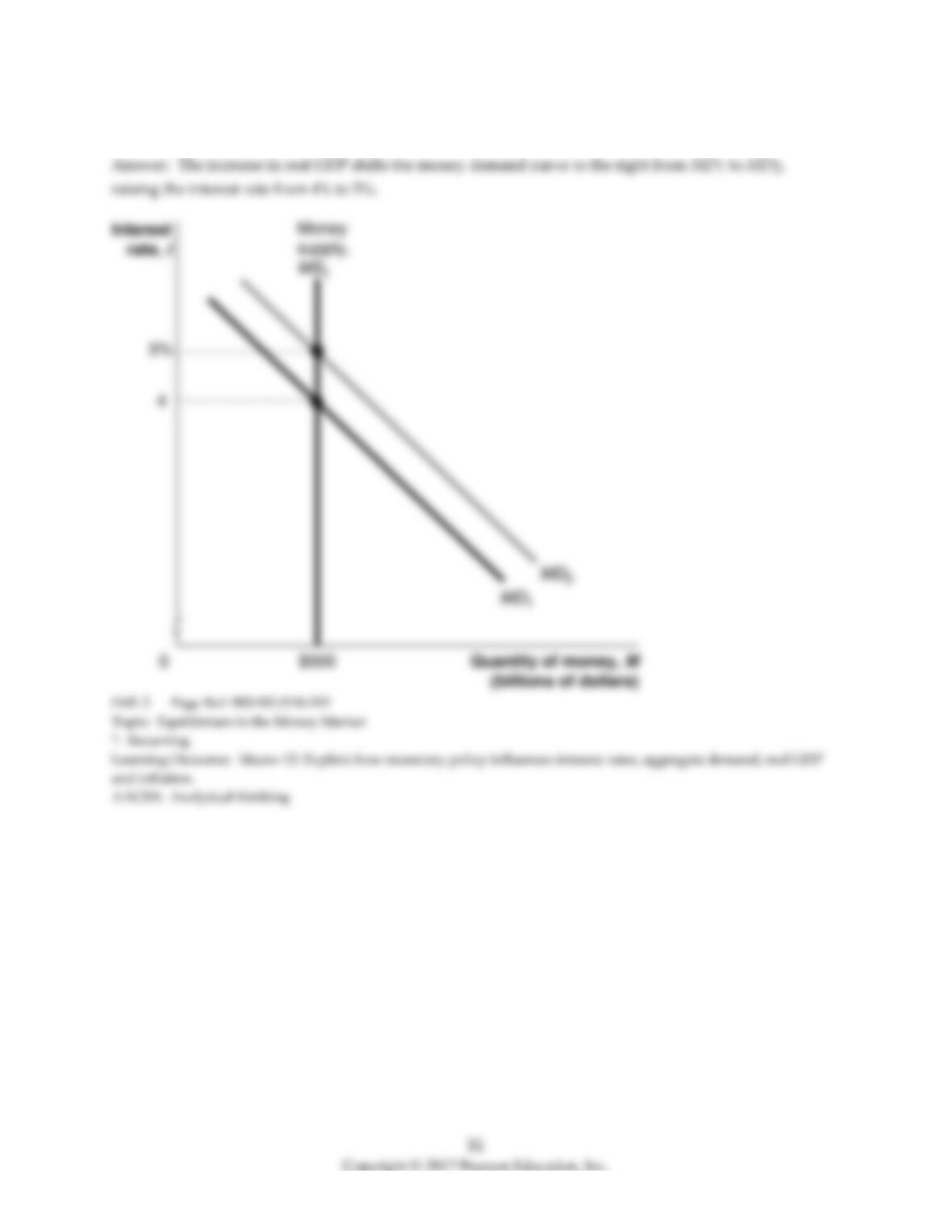
60) Use the money demand and money supply model to show the money market in equilibrium with an
interest rate of 5 percent and the quantity of money of $800 billion. Suppose the Federal Reserve
increases the money supply to $850 billion. At the previous equilibrium interest rate of 5 percent, will
households and firms now be holding more money or less money than they want to hold, and will they
be buying or selling short-term financial assets? At the new equilibrium interest rate, households and
firms will desire to hold the entire $850 billion of the money supply. What causes households and firms
to want to hold the additional $50 billion of the money supply?
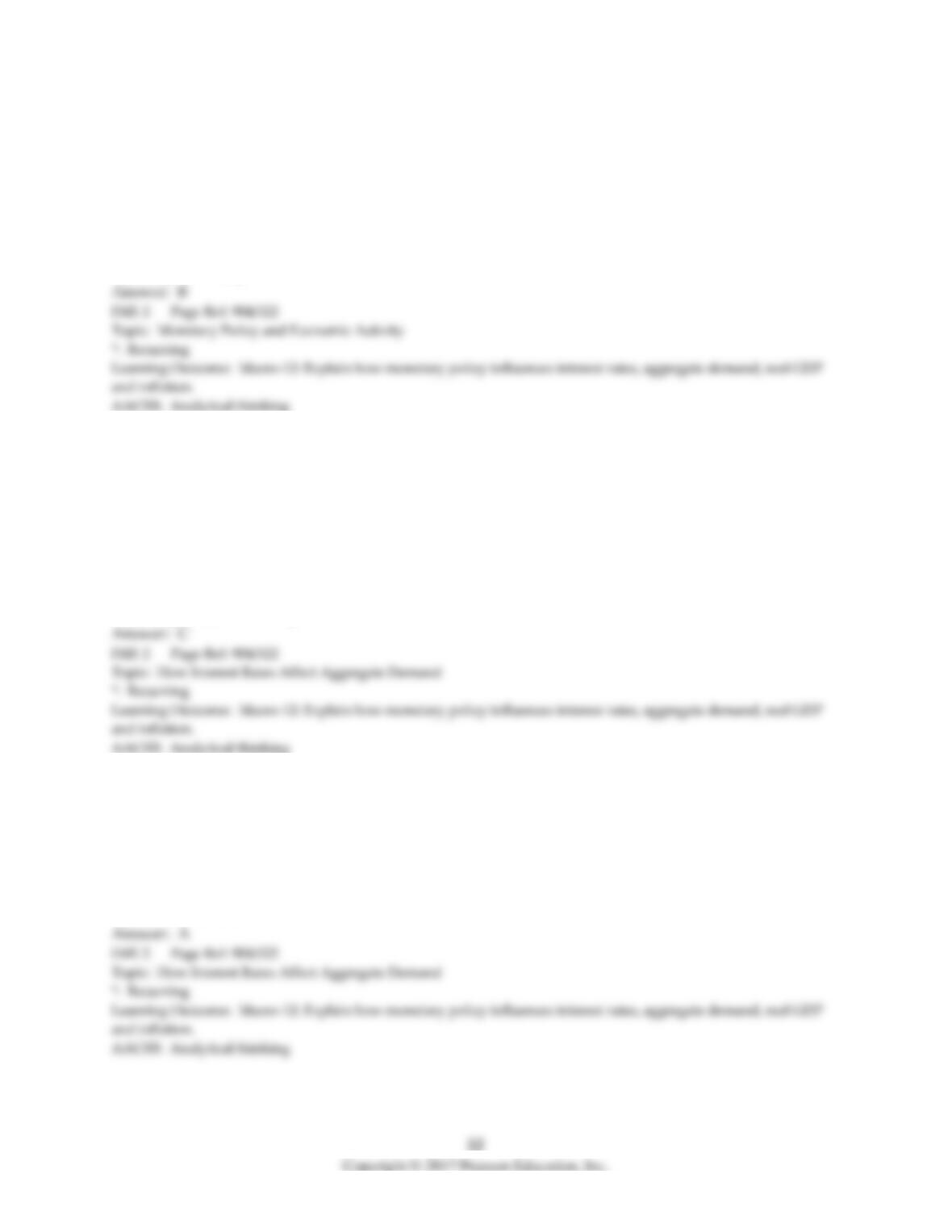
61) Use the money demand and money supply model to show graphically and briefly explain the effect
on the interest rate if real GDP increases.
15.3 Monetary Policy and Economic Activity
1) The ability of the Federal Reserve to use monetary policy to affect economic variables such as real
GDP ultimately depends upon its ability to affect
A) tax rates.
B) real interest rates.
C) nominal interest rates.
D) foreign exchange rates.
2) An increase in interest rates
A) decreases investment spending on machinery, equipment, and factories, but increases consumption
spending on durable goods and net exports.
B) decreases investment spending on machinery, equipment, and factories, and consumption spending
on durable goods, but increases net exports.
C) decreases investment spending on machinery, equipment, and factories, consumption spending on
durable goods, and net exports.
D) increases investment spending on machinery, equipment, and factories, consumption spending on
durable goods, and net exports.
3) A decrease in interest rates can ________ the demand for stocks as stocks become relatively ________
attractive investments as compared to bonds.
A) increase; more
B) decrease; less
C) decrease; more
D) increase; less
E) increase; similar
4) An increase in the interest rate should ________ the demand for dollars and the value of the dollar,
and net exports should ________.
A) decrease; decrease
B) decrease; increase
C) increase; decrease
D) increase; increase
E) increase; not change
5) The situation in which short-term interest rates are pushed to zero, leaving the central bank unable to
lower them further is known as
A) the Taylor rule.
B) a liquidity trap.
C) a zero-sum game.
D) an interest rate panic.
6) With the federal funds rate near zero and the economy still struggling, In response to already low
interest rates doing little to stimulate the economy, the Fed began buying 10-year Treasury notes and
certain mortgage-backed securities to keep interest rates low. This policy is known as
A) inflation targeting.
B) contractionary monetary policy.
C) securities-bubble deflating.
D) quantitative easing.
7) In November 2008, the Fed began its first round of quantitative easing. In total, the Fed conducted
________ rounds of quantitative easing before ending the program in October 2014.
A) 2
B) 3
C) 4
D) 5
8) From an initial long-run macroeconomic equilibrium, if the Federal Reserve anticipated that next year
aggregate demand would grow significantly slower than long-run aggregate supply, then the Federal
Reserve would most likely
A) decrease interest rates.
B) increase interest rates.
C) decrease income tax rates.
D) increase income tax rates.
9) Expansionary monetary policy refers to the ________ to increase real GDP.
A) government’s increasing spending and lowering taxes
B) government’s decreasing spending and raising taxes
C) Federal Reserve’s increasing the money supply and decreasing interest rates
D) Federal Reserve’s decreasing the money supply and increasing interest rates
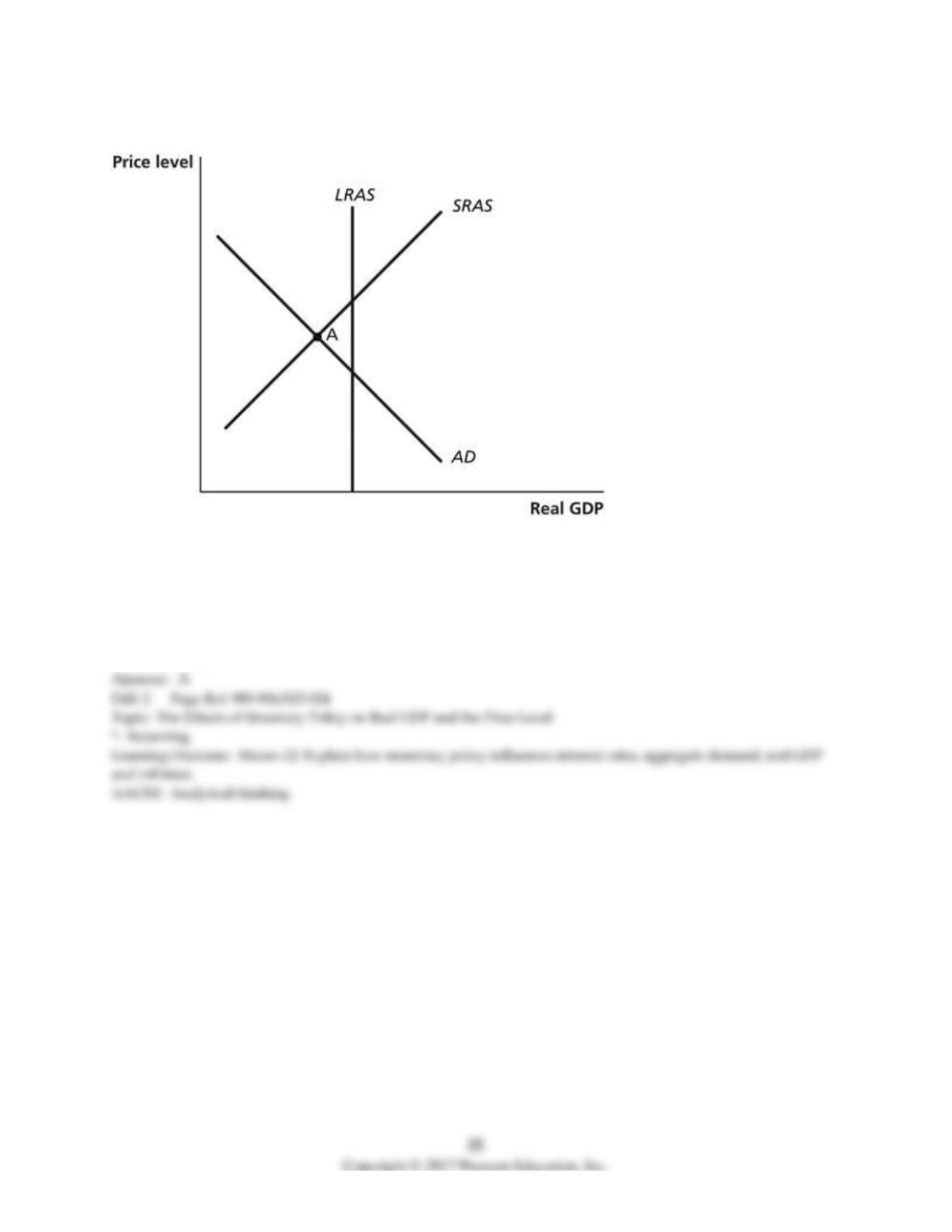
Figure 15-6
10) Refer to Figure 15-6. In the figure above, if the economy is at point A, the appropriate monetary
policy by the Federal Reserve would be to
A) lower interest rates.
B) raise interest rates.
C) lower income taxes.
D) raise income taxes.
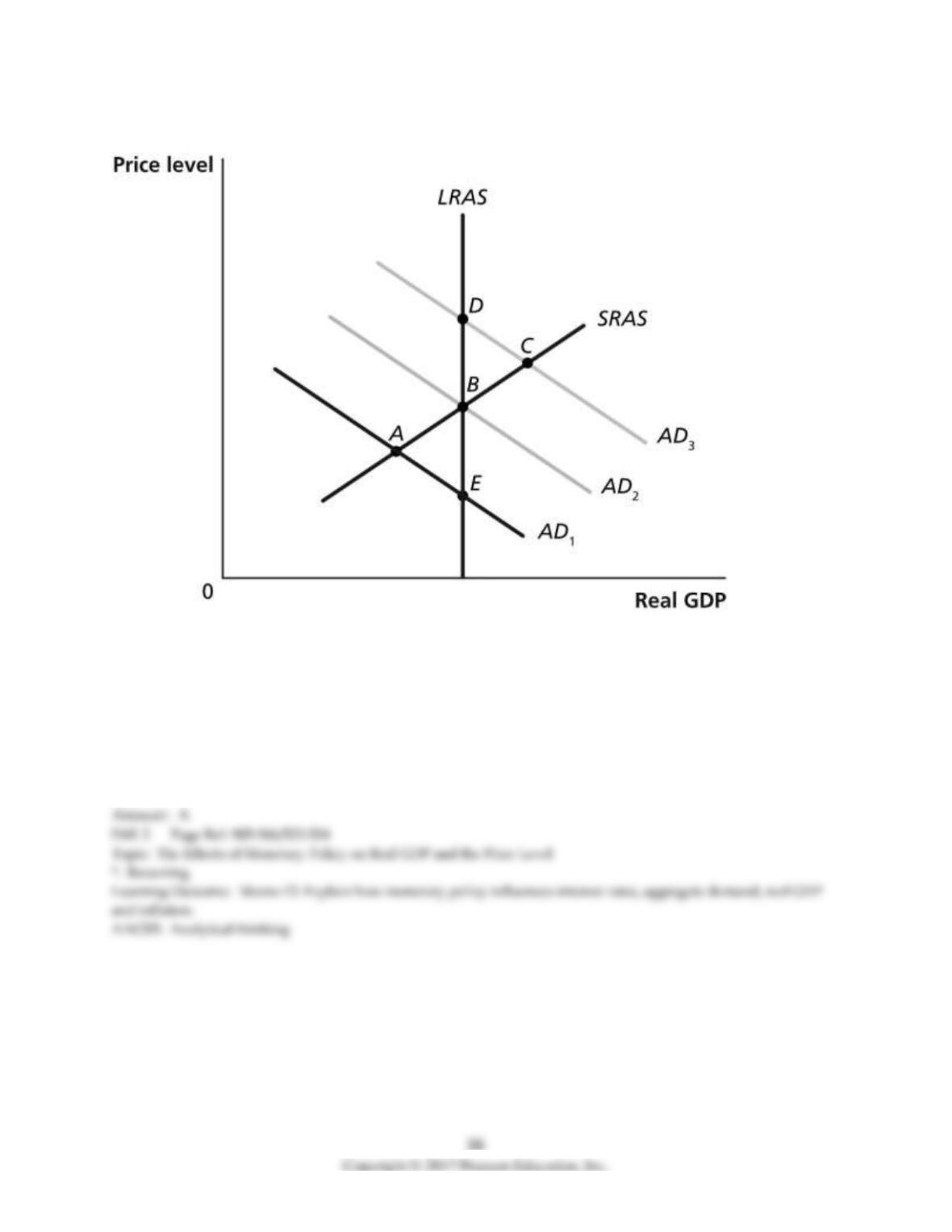
Figure 15-7
11) Refer to Figure 15-7. Suppose the economy is in a recession and the Fed pursues an expansionary
monetary policy. Using the static AD–AS model in the figure above, this would be depicted as a
movement from
A) A to B.
B) B to C.
C) C to B.
D) A to E.
E) C to D.
12) Refer to Figure 15-7. Suppose the economy is in short-run equilibrium above potential GDP, the
unemployment rate is very low, and wages and prices are rising. Using the static AD–AS model in the
figure above, the correct Fed policy for this situation would be depicted as a movement from
A) A to B.
B) B to C.
C) C to B.
D) A to E.
E) C to D.
13) Refer to Figure 15-7. Suppose the Fed lowers its target for the federal funds rate. Using the static
AD–AS model in the figure above, this situation would be depicted as a movement from
A) A to B.
B) B to A.
C) C to B.
D) E to A.
E) C to D.
14) Refer to Figure 15-7. Suppose the Fed sells Treasury Bills in pursuit of contractionary monetary
policy. Using the static AD–AS model in the figure above, this situation would be depicted as a
movement from
A) A to B.
B) B to D.
C) C to B.
D) B to C.
E) C to D.
15) Refer to Figure 15-7. Suppose the economy is in a recession and no policy is pursued. Using the
static AD–AS model in the figure above, this situation would be depicted as a movement from
A) A to B.
B) B to A.
C) C to B.
D) A to E.
E) C to D.
16) Expansionary monetary policy to prevent real GDP from falling below potential real GDP would
cause the inflation rate to be relatively ________ and real GDP to be relatively ________.
A) higher; higher
B) higher; lower
C) lower; higher
D) lower; lower
17) Which of the following describes what the Fed would do to pursue an expansionary monetary
policy?
A) use open market operations to buy Treasury bills
B) use open market operations to sell Treasury bills
C) use discount policy to raise the discount rate
D) raise the reserve requirement
18) Contractionary monetary policy on the part of the Fed results in
A) an increase in the money supply, an increase in interest rates, and an increase in GDP.
B) a decrease in the money supply, an increase in interest rates, and a decrease in GDP.
C) an increase in the money supply, a decrease in interest rates, and an increase in GDP.
D) a decrease in the money supply, a decrease in interest rates, and a decrease in GDP.
19) When the Fed uses contractionary policy,
A) the price level rises higher than it would if the Fed did not pursue policy.
B) the price level rises less than it would if the Fed did not pursue policy.
C) it does not change the price level.
D) it causes inflation.
20) Which of the following would most likely induce the Federal Reserve to conduct expansionary
monetary policy? A significant decrease in
A) oil prices.
B) business taxes.
C) income tax rates.
D) investment spending.
21) The economy suffered a mild recession in 2001. Despite the recession, home sales and durable
goods sales remained high. Which of the following is a plausible explanation?
A) The Fed’s pursuit of contractionary policy stimulated these markets.
B) The Fed caused a reduction in the federal funds rate to its lowest level in 40 years.
C) Rising inflation encouraged many to invest in the real estate market.
D) Home building and consumer durable purchases are always high during a recession.
22) Which of the following is true about the Federal Reserve and its ability to prevent recessions? The
Federal Reserve
A) does not try to eliminate recessions, but instead focuses on preventing inflation.
B) can fine tune the economy and realistically hope to keep the economy from experiencing recessions.
C) cannot realistically fine tune the economy, but seeks to keep recessions shorter and milder than they
would otherwise be.
D) cannot realistically fine tune the economy and has little to no effect on the magnitude and length of
recessions.
23) Your roommate is having trouble grasping how monetary policy works. Which of the following
explanations could you use to correctly describe the mechanism by which the Fed can affect the
economy through monetary policy? Increasing the money supply
A) lowers the interest rate, and firms increase investment spending.
B) causes people to spend more because they know prices will rise in the future.
C) raises the interest rate and consumers decrease spending on durable goods.
D) lowers the interest rate, raises the value of the dollar, lowers the prices of exports, and raises net
exports.