24) If the Federal Reserve raises or lowers interest rates too late, it could result in a ________ policy that
destabilizes the economy.
A) fiscal
B) budgetary
C) procyclical
D) countercyclical
25) Monetary policy could be procyclical if the Federal Reserve
A) is late recognizing that a recession has begun and conducts expansionary monetary policy.
B) is quick to recognize that a recession has begun and conducts expansionary monetary policy.
C) is late recognizing that a recession has begun and does not conduct expansionary monetary policy.
D) is quick to recognize that a recession has begun and does not conduct expansionary monetary policy.
26) When calculating GDP, the Bureau of Economic Analysis revises its quarterly data
A) a total of one time.
B) a total of two times.
C) a total of three times.
D) many times over the next several years.
27) Lowering the interest rate will
A) decrease spending on consumer durables.
B) increase investment projects by firms.
C) decrease spending on new homes.
D) decrease the value of the dollar and lower net exports.
28) If money demand is extremely sensitive to changes in the interest rate, the money demand curve
becomes almost horizontal. If the Fed expands the money supply under these circumstances, then the
interest rate will
A) fall substantially and investment and consumer spending will fall substantially.
B) rise substantially and investment and consumer spending will rise substantially.
C) fall substantially and investment and consumer spending will change very little.
D) change very little and investment and consumer spending will change very little.
29) An increase in the domestic interest rate relative to other interest rates should
A) increase investment spending.
B) decrease consumption spending.
C) increase government spending.
D) increase net exports.
30) Falling interest rates can
A) increase a firm’s stock price, which causes firms to issue more stock shares, and thus increases funds
for investment.
B) raise the cost of borrowing for firms and decrease investment.
C) raise the cost of buying new homes and fewer new homes will be purchased.
D) lower the cost of buying new homes and fewer new homes will be purchased.
31) When the Fed embarked on a policy known as quantitative easing, they
A) slowly lowered the federal funds rate target until it was equal to zero.
B) reduced the required reserve ratio by one-quarter point per month for 12 months.
C) bought longer-term securities than are usually bought in open market operations.
D) opened up lending to primary dealers, commercial banks, and investment banks.
Article Summary
Concerned about low inflation, Federal Reserve Bank of Minneapolis President Narayana
Kocherlakota said the Fed needed a more aggressive stimulus policy than the setting of near-zero
interest rates, and added that negative interest rates could be an effective policy tool. In a September
2015 interview, Kocherlakota stated “Given the inflation outlook, given how low inflation is
expected to be, to ensure the credibility of our inflation target, taking a more accommodative stance
in September would have been totally justified.” While the Federal Open Market Committee chose
to hold rates near zero in their September 2015 meeting, Fed Chair Janet Yellen announced that a rate
increase would be warranted by the end of the year, and that “negative interest rates was not
something that we considered very seriously at all today.”
Source: Alister Bull, “Kocherlakota Says Low Inflation Warrants Further Fed Stimulus,”
bloomberg.com, October 3, 2015.
32) Refer to the Article Summary. Implementing a negative interest rate policy, as was advocated by the
president of the Federal Reserve Bank of Minneapolis, would be an example of ________ monetary
policy designed to ________ aggregate demand.
A) expansionary; increase
B) expansionary; decrease
C) contractionary; increase
D) contractionary; decrease
33) Refer to the Article Summary. Implementing a negative interest rate policy, as was advocated by the
president of the Federal Reserve Bank of Minneapolis, would be designed to ________ the price level
and ________ real GDP.
A) decrease; decrease
B) decrease; increase
C) increase; decrease
D) increase; increase
34) Refer to the Article Summary. When Fed Chair Janet Yellen announced that a rate increase would be
warranted by the end of the year, she was was referring to the
A) prime rate.
B) federal funds rate.
C) long-term real rate of interest.
D) required reserve rate.
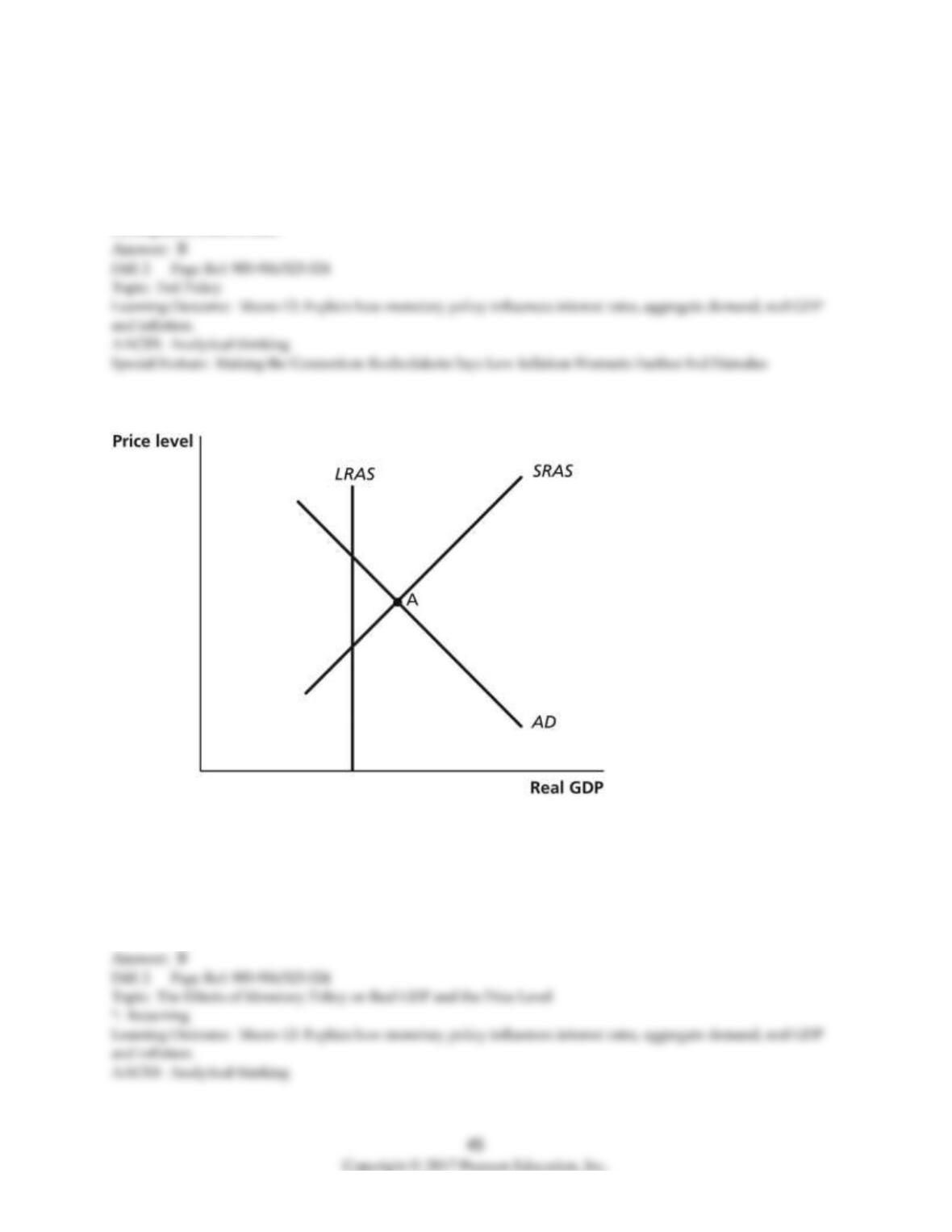
Figure 15-8
35) Refer to Figure 15-8. In the figure above, if the economy is at point A, the appropriate monetary
policy by the Federal Reserve would be to
A) lower interest rates.
B) raise interest rates.
C) lower income taxes.
D) raise income taxes.
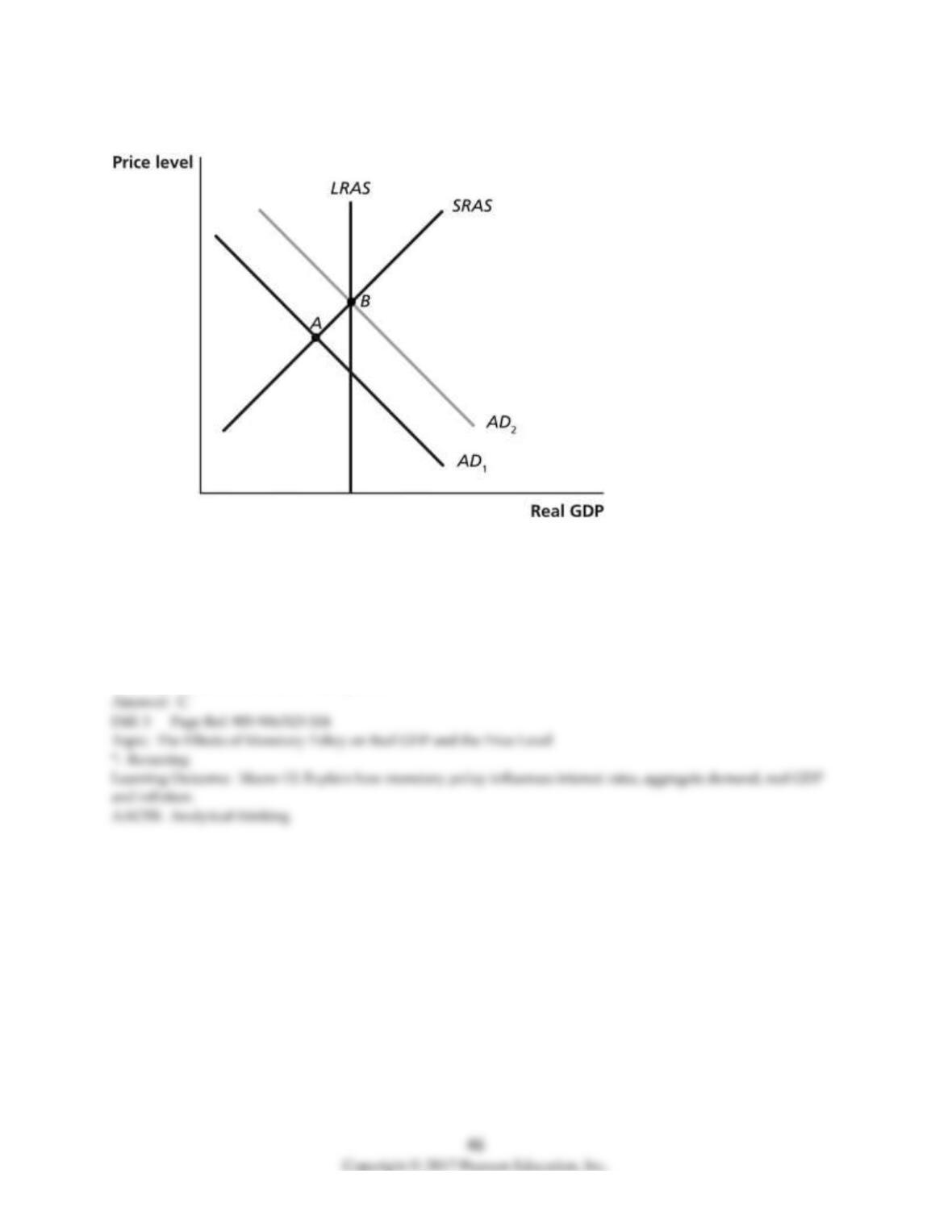
Figure 15-9
36) Refer to Figure 15-9. In the figure above suppose the economy is initially at point A. The movement
of the economy to point B as shown in the graph illustrates the effect of which of the following policy
actions by the Federal Reserve?
A) a decrease in income taxes
B) an increase in the required reserve ratio
C) an open market purchase of Treasury bills
D) an open market sale of Treasury bills
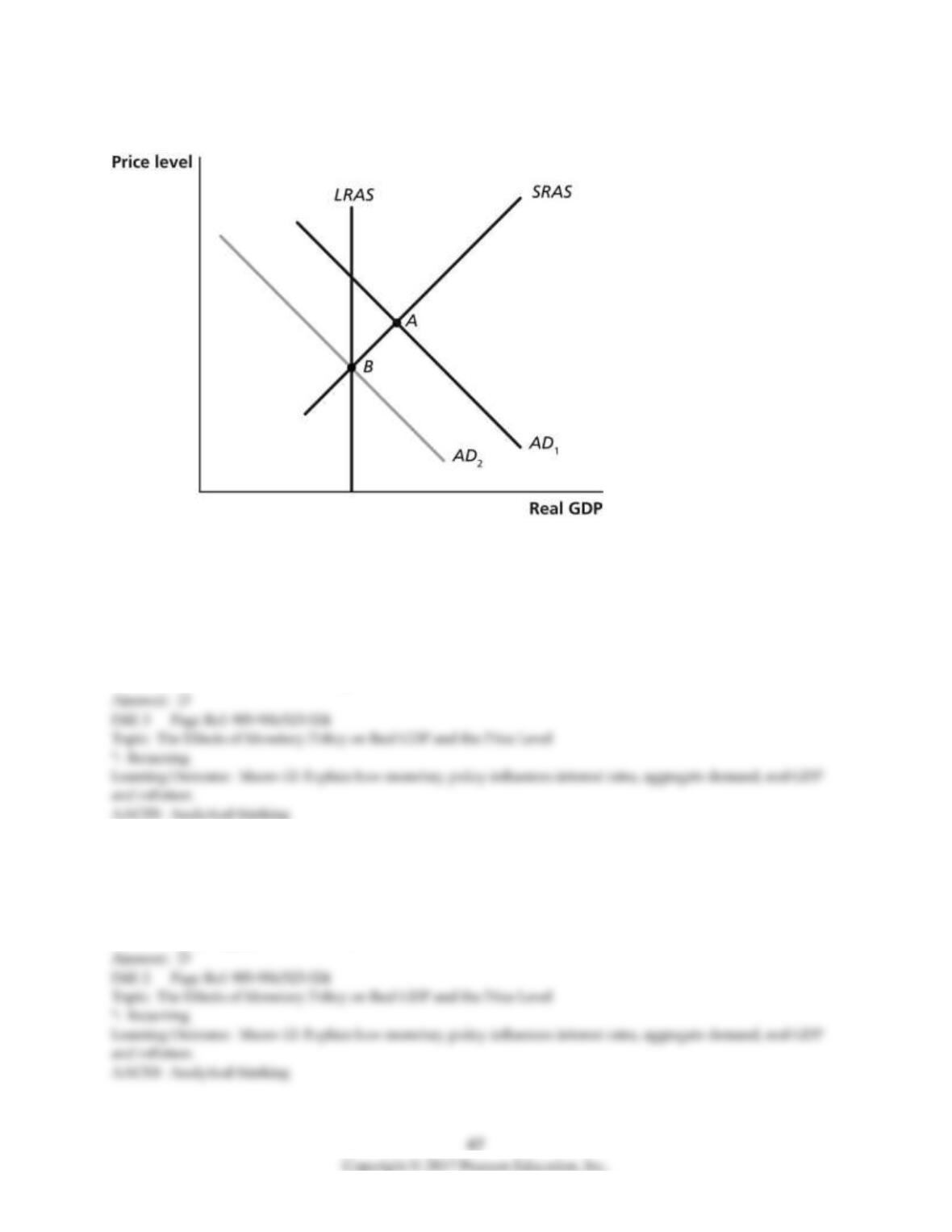
Figure 15-10
37) Refer to Figure 15-10. In the figure above, suppose the economy is initially at point A. The
movement of the economy to point B as shown in the graph illustrates the effect of which of the
following policy actions by the Federal Reserve?
A) an increase in income taxes
B) a decrease in the required reserve ratio
C) an open market purchase of Treasury bills
D) an open market sale of Treasury bills
38) If the Fed pursues expansionary monetary policy then
A) the money supply will decrease, interest rates will rise and GDP will fall.
B) the money supply will decrease, interest rates will fall and GDP will fall.
C) the money supply will increase, interest rates will rise and GDP will rise.
D) the money supply will increase, interest rates will fall and GDP will rise.
39) If the Fed lowers its target for the federal funds rate, this indicates that
A) the Fed is pursuing an expansionary monetary policy.
B) the Fed is pursuing a contractionary monetary policy.
C) the Fed is attempting to combat inflation.
D) the Fed is concerned that the growth in aggregate demand will exceed potential GDP.
40) If the Fed pursues expansionary monetary policy,
A) aggregate demand will rise, and the price level will rise.
B) aggregate demand will fall, and the price level will fall.
C) aggregate demand will rise, and the price level will fall.
D) aggregate demand will fall, and the price level will rise.
41) Which of the following situations is one in which the Fed will potentially pursue expansionary
monetary policy?
A) Potential GDP is forecasted to be higher than equilibrium GDP.
B) Potential GDP is forecasted to be lower than equilibrium GDP.
C) Aggregate demand is growing too fast to keep the economy at full employment.
D) Aggregate demand is growing too slowly and the economy is in danger of producing GDP above
full employment.
42) Which of the following characterizes the Fed’s ability to prevent recessions?
A) The Fed is able to “fine tune” the economy and entirely eliminate recessions.
B) The Fed is incapable of changing aggregate demand through its monetary policy tools.
C) The Fed is able to keep a recession shorter and milder than it would otherwise be.
D) The Fed is able to eliminate the business cycle and achieve absolute price stability.
43) If the Fed raises its target for the federal fund rate, this indicates that
A) the Fed is pursuing an expansionary monetary policy.
B) the Fed is pursuing a contractionary monetary policy.
C) the Fed is attempting to combat deflation.
D) The Fed is concerned that the growth in aggregate demand is too slow to keep up with potential
GDP.
44) Contractionary monetary policy causes
A) aggregate demand to rise and the price level to rise.
B) aggregate demand to fall and the price level to fall.
C) aggregate demand to rise and the price level to fall.
D) aggregate demand to fall and the price level to rise.
45) If the Fed’s policy is contractionary, it will
A) use open market operations to buy Treasury bills.
B) use open market operations to sell Treasury bills.
C) lower the discount rate.
D) lower the reserve requirement.
46) In which of the following situations would the Fed conduct contractionary monetary policy?
A) The Fed believes that aggregate demand was growing too slowly to keep up with potential GDP.
B) The Fed fears that unemployment is climbing above the natural rate.
C) The Fed is concerned that aggregate demand would continue to exceed the growth in potential GDP.
D) The Fed is worried that deflation will become a problem.
47) When the Fed increases the money supply,
A) the interest rate rises and this stimulates consumption spending.
B) people spend less because they have more money.
C) the interest rate falls and this stimulates investment spending.
D) the interest rate rises and this stimulates investment spending.
48) Suppose that the economy is producing below potential GDP and the Fed implements the correct
change in monetary policy, but not until after the economy has passed the trough of the recession. Then
A) the Fed’s contractionary policy will result in too large of a decrease in GDP.
B) the Fed’s contractionary policy will result in too small of a decrease in GDP.
C) the Fed’s expansionary policy will result in too small of a decrease in GDP.
D) the Fed’s expansionary policy will result in too large of an increase in GDP.
49) Suppose that the economy is producing above potential GDP and the Fed implements the correct
change in monetary policy, but not until after the economy has passed the peak of the boom. Then
A) the Fed’s contractionary policy will result in too large of a decrease in GDP.
B) the Fed’s contractionary policy will result in too small of a decrease in GDP.
C) the Fed’s expansionary policy will result in too small of a decrease in GDP.
D) the Fed’s expansionary policy will result in too large of an increase in GDP.
50) The Fed
A) always engages in countercyclical policy.
B) always intends to engage in procyclical policy.
C) can engage in procyclical policy if it mistimes its policy response.
D) never intends to engage in countercyclical policy.
51) The Fed
A) can easily distinguish the minor ups and downs of the economy from a recession.
B) can have difficulty distinguishing the minor ups and downs of the economy from a recession.
C) always times its policy responses correctly.
D) can easily determine if a drop in production means a recession is inevitable.
52) The body that is responsible for dating the beginning and ending dates for a recession is
A) the Fed.
B) the Congress.
C) the National Bureau of Economic Research.
D) the Bureau of Economic Analysis.
53) When calculating GDP, the Bureau of Economic Analysis releases its “advanced estimate” of a
quarter’s GDP approximately
A) three months before the quarter has ended.
B) one month after the quarter has ended.
C) three months after the quarter has ended.
D) one year after the quarter has ended.
54) Changes in interest rates affect all four components of aggregate demand.
55) Expansionary monetary policy refers to the Fed’s increasing the money supply and increasing
interest rates to increase real GDP.
56) When the Federal Reserve increases the money supply, people spend more because interest rates
fall.
57) Contractionary monetary policy refers to the Fed‘s decreasing the money supply and decreasing
interest rates to decrease real GDP.
58) Your income will increase if the Federal Reserve buys a Treasury bill from you and pays you with a
check from the Fed.
59) When the Federal Reserve increases the money supply, people spend more because they now have
more money.
60) What actions should the Fed take if it believes the economy is about to fall into recession?
61) What actions should the Fed take if it believes the economy is about to experience a high rate of
inflation?
62) If the Fed orders an expansionary monetary policy, describe what will happen to the following
variables relative to what would have happened without the policy:
a. The money supply
b. Interest rates
c. Investment
d. Consumption
e. Net Exports
f. The aggregate demand curve
g. Real GDP
h. The price level
63) If the Fed orders a contractionary monetary policy, describe what will happen to the following
variables relative to what would have happened without the policy:
a. The money supply
b. Interest rates
c. Investment
d. Consumption
e. Net Exports
f. The aggregate demand curve
g. Real GDP
h. The price level
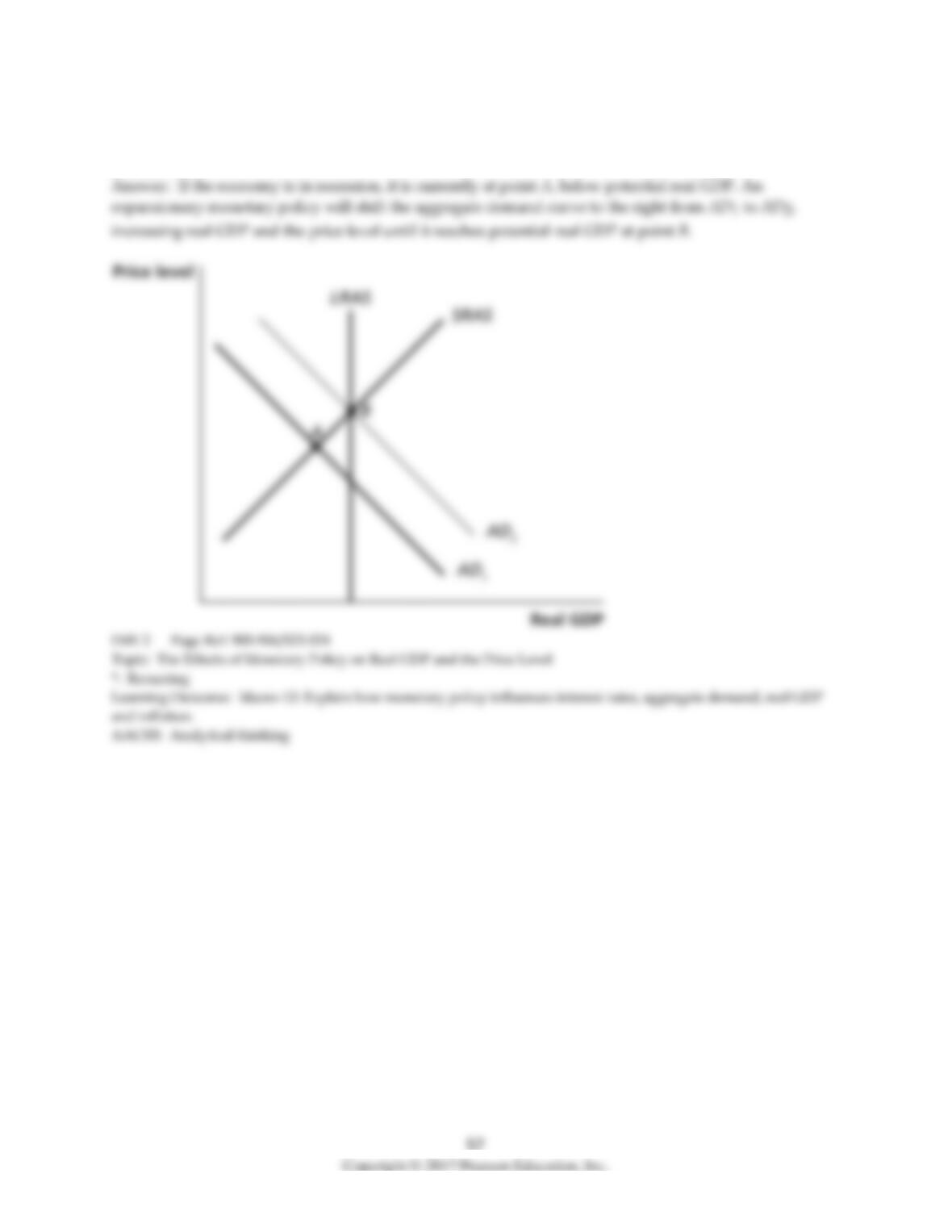
64) Use a graph to show the effects of an expansionary monetary policy moving an economy out of
recession and to potential real GDP. Explain what happens to aggregate demand, real GDP, and the
price level.
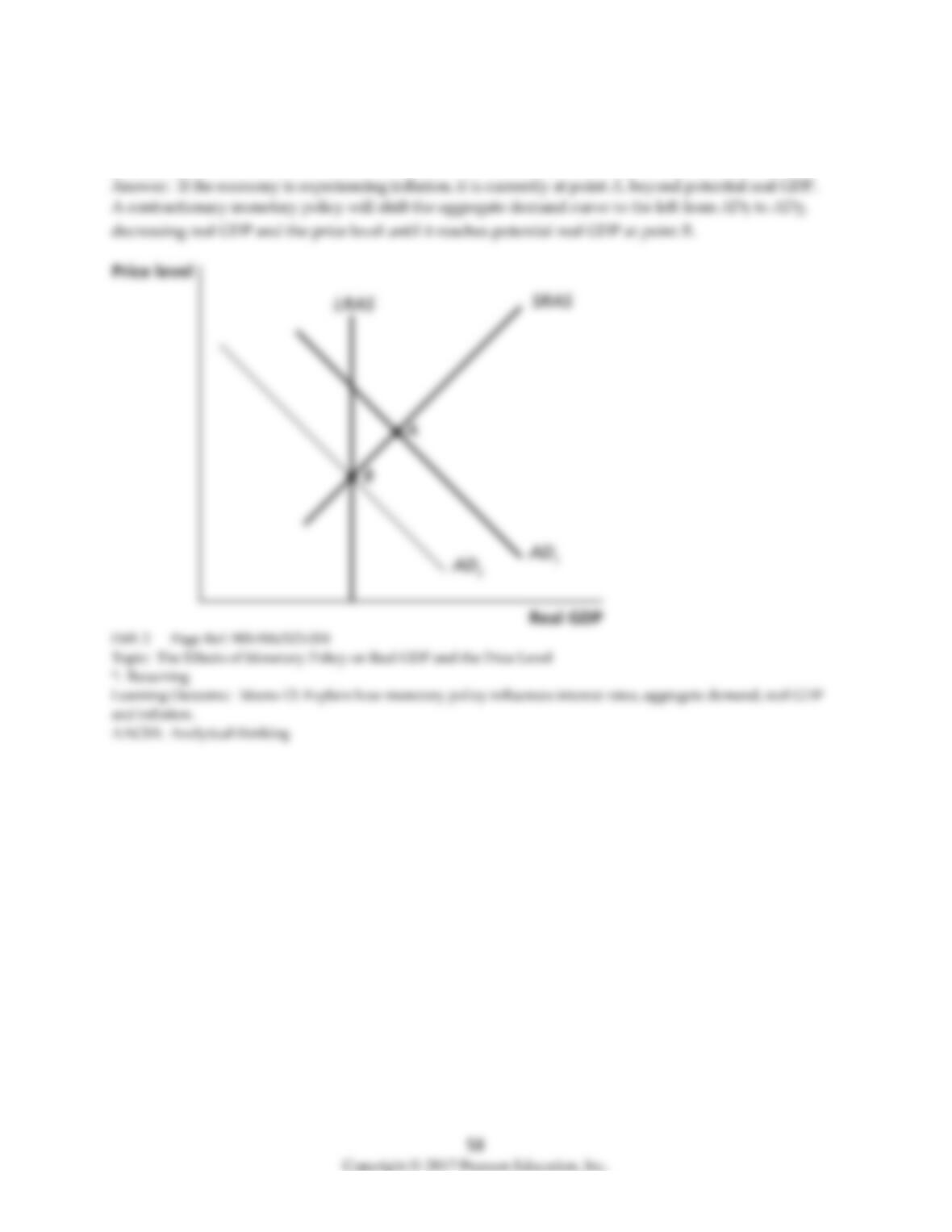
65) Use a graph to show the effects of a contractionary monetary policy to reduce inflation and move an
economy back to potential real GDP. Explain what happens to aggregate demand, real GDP, and the
price level.
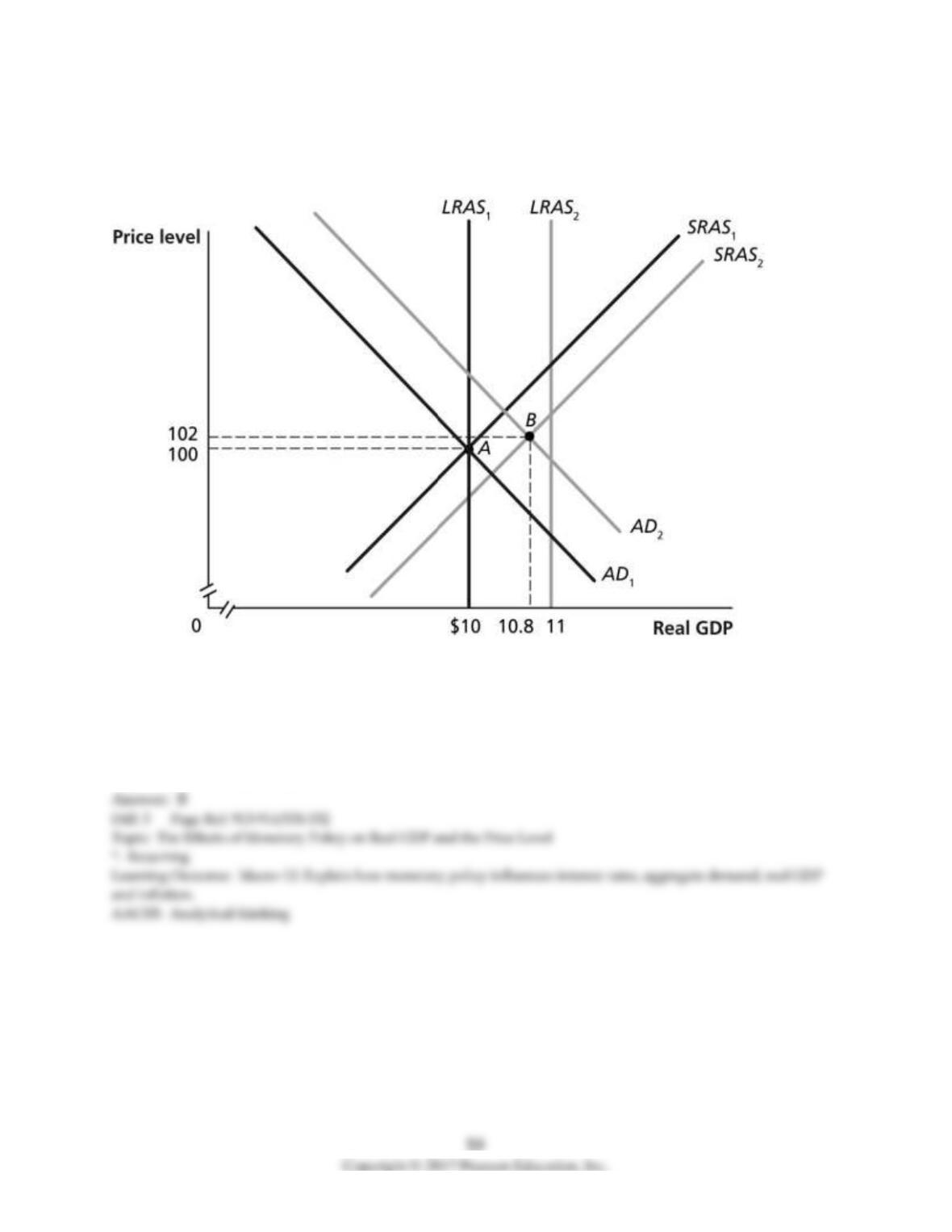
15.4 Monetary Policy in the Dynamic Aggregate Demand and Aggregate Supply Model
Figure 15-11
1) Refer to Figure 15-11. In the dynamic model of AD–AS in the figure above, if the economy is at point
A in year 1 and is expected to go to point B in year 2, the Federal Reserve would most likely
A) increase interest rates.
B) decrease interest rates.
C) not change interest rates.
D) decrease the inflation rate.
2) Refer to Figure 15-11. In the dynamic model of AD–AS in the figure above, if the economy is at point
A in year 1 and is expected to go to point B in year 2, and the Federal Reserve pursues no policy, then at
point B
A) there is pressure on wages and prices to rise.
B) the unemployment rate is very, very low.
C) firms are operating above their normal capacity.
D) the economy is below full employment.
E) incomes and profits are rising.
3) Refer to Figure 15-11. In the dynamic model of AD–AS in the figure above, the economy is at point A
in year 1 and is expected to go to point B in year 2, and the Federal Reserve pursues policy. This will
result in
A) unemployment rates higher than what would occur if no policy had been pursued.
B) inflation higher than what would occur if no policy had been pursued.
C) real GDP lower than what would occur if no policy had been pursued.
D) short-term interest rates higher than what would occur if no policy had been pursued.