
CHAPTER 15: DIVIDEND POLICY
1. The dividend clientele effect concept was originally developed by
a. Myron Gordon
b. Merton Miller and Franco Modigliani
c. Milton Friedman
d. Paul Samuelson
2. Dividend reinvestment plans involve the purchase of
a. newly issued stock
b. existing stock
c. letter stock
d. both newly issued and existing stock
3. Most states limit dividend policy by requiring
a. that dividends may not be paid unless the firm generates net earnings during the most recent year
b. that dividends may only be paid out of retained earnings
c. that dividends may not be paid when the firm is insolvent
d. the firm’s capital to be used to pay dividends
4. The following factors influence a firm’s ability and/or willingness to pay dividends:
a. liquidity
b. borrowing capacity and access to capital markets
c. earnings stability
d. all of these
5. In the theoretical world of Miller and Modigliani
a. a firm should pay out 100 percent of earnings as dividends to maximize shareholder wealth
b. the marginal tax rates facing investors are the most important single determinant of dividend policy
c. dividends are important only for their informational content
d. dividends reduce investors’ uncertainty

Chapter 15: Dividend Policy
6. Finance researcher Myron Gordon argues that
a. risk-averse shareholders may prefer some dividends over the promise of future capital gains if the interest
rate is expected to decline
b. dividends reduce uncertainty, and thus the payment of dividends will increase the firm’s value
c. the clientele effect has no influence on share value
d. the existence of transaction costs has no impact on the dividend decision
7. The passive residual dividend policy asserts that
a. dividends should be paid out only if the firm does not have enough acceptable investment projects to utilize
all earnings internally.
b. dividends should be paid only when the firm has ready access to new equity markets
c. retained earnings, being the residual earnings of the firm, should always be paid out to existing stockholders
d. investment policy and dividend policy decisions should always be made independently
8. The passive residual dividend policy seems to be inconsistent with
a. a world having significant transactions costs associated with new stock issues
b. a stable dividend policy
c. a policy of paying only stock dividends
d. a share-repurchase policy
9. Many firms try to maintain a stable dividend policy
a. because of the informational content of dividend changes
b. in order to satisfy investors who rely on dividends as a primary source of income
c. in order to remain as eligible investments for many financial institutions
d. all of the above
10. The record date in the normal dividend payment procedure is
a. the same day as the declaration date
b. the same day as the ex-dividend date
c. the date when the firm makes a list from its stock transfer books of shareholders eligible to receive the
dividend
d. one day prior to the payment date

Chapter 15: Dividend Policy
11. A passive residual dividend policy suggests that the firm will:
a. pay the same dollar amount of dividends every year
b. pay the same percentage of earnings in dividends every year
c. pay a dividend only after all viable investment projects have been exhausted
d. omit a dividend in the next period
12. Which phrase below best summarizes the arguments supporting a stable dollar dividend policy?
a. earnings stability
b. beta
c. capital structure
d. informational content
13. In a large, widely-held corporation, the financial manager should consider all of the following in establishing a
dividend policy EXCEPT:
a. individual shareholder preferences
b. cash flow needs
c. informational content of dividends
d. investment opportunities
14. Which of the following is not a direct result of a stock dividend?
a. the number of shares outstanding is increased
b. the market price of each outstanding share is increased
c. the amounts shown in the firm’s capital accounts are redistributed
d. the per-share price of the stock goes up
15. Firms carry out share repurchase agreements in a number of ways, including all of the following EXCEPT:
a. buy from shareholders through a tender offer
b. buy outstanding shares in the open market
c. buy treasury shares
d. negotiate a purchase privately from large holders, particularly institutions

Chapter 15: Dividend Policy
16. Rank in chronological sequence the payment date, ex-dividend date, declaration date, and record date.
a. record date, declaration date, ex-dividend date, payment date
b. declaration date, record date, ex-dividend date, payment date
c. declaration date, record date, payment date, ex- dividend date
d. declaration date, ex-dividend date, record date, payment date
17. Firms with the earnings growth tend to have the dividend payout ratio.
a. highest, highest
b. highest, lowest
c. lowest, lowest
d. lowest, highest
18. The value of a firm is influenced by three types of financial decisions including all of the following EXCEPT:
a. dividend decisions
b. financing decisions
c. investment decisions
d. par value decisions
19. The capital impairment restriction, a legal constraint on dividend payments, states that
a. only the current year’s earnings may be used for dividend payments
b. dividends may not be paid out of stockholder’s equity
c. a firm’s permanent capital cannot be used to make dividend payments
d. a firm’s capital surplus can be used to make dividend payments
20. A legal constraint that dividends must be paid out of a firm’s present and past net earnings is known as the
restriction.
a. net earnings
b. net operating earnings
c. initial investment
d. earned capital

Chapter 15: Dividend Policy
21. Restrictive covenants are contained in all of the following except
a. preferred stock agreements
b. lease contracts
c. bond indentures
d. agency restrictions
22. Dividend payments reduce all of the following balance sheet items except
a. cash
b. fixed assets
c. stockholder’s equity
d. retained earnings
23. A firm with stable earnings is usually more willing to
a. retain more earnings
b. have a higher dividend payout ratio
c. have a sinking fund agreement
d. seek aggressive growth
24. All of the following are alternative dividend policies EXCEPT:
a. constant payout
b. stable dollar
c. constant earnings
d. passive residual
25. In order for a stock to qualify for inclusion on the “legal lists,” a firm must
a. register with the Securities Exchange Commission (SEC)
b. have assets in excess of $500,000
c. have 10 continuous profitable quarters
d. have a record of continuous and stable dividends
26. A stock dividend will not affect which of the following balance sheet items.
a. total assets
b. retained earnings
c. contributed capital in excess of par
d. common stock at par

Chapter 15: Dividend Policy
27. One reason why small business concerns have very low dividend payout ratios is that
a. the firm usually is low on cash
b. the firm needs funds for taxes
c. the firm needs the funds to finance growth
d. the small firm prefers stock offerings
28. Dividend payments from foreign subsidiaries represent
a. a movement from a weak to a stronger currency
b. the primary means of transferring funds to the parent company
c. a way to avoid taxes
d. the effects of exchange risk
29. On the ex-dividend date, the
a. seller of the stock is entitled to the dividend
b. buyer has 4 business days to register his/her purchase
c. buyer of the stock is entitled to the dividend
d. corporation records all security owners
30. Under dividend reinvestment plans, shareholders can automatically
a. reduce their taxable income
b. increase their cash inflows
c. use dividends to purchase additional shares
d. transfer from retained earnings accounts to equity accounts.
31. The net effect of a stock dividend is to
a. increase the firm’s total stockholders’ equity
b. increase the number of shares outstanding
c. increase total dividends
d. increase stock prices
32. The fundamental question in dividend policy is
a. the tax consideration
b. the amount of growth the firm considers optimal
c. not violating any restrictive covenants
d. determining what portion of earnings will be paid out

Chapter 15: Dividend Policy
33. The dividend states that investors will tend to be attracted to firms that have dividend policies consistent
with the investor’s objectives
a. “clientele effect”
b. “informational content”
c. signal
d. passive residual theory
34. From an accounting standpoint, stock splits are accomplished by
a. increasing the number of shares authorized
b. increasing par value of existing shares
c. reducing the par value of existing shares
d. reducing the number of shares, and increasing the price of each share
35. According to the dividend policy, a firm that has more funds than it needs should pay a cash dividend to
shareholders.
a. constant payout ratio
b. stable dollar
c. passive residual
d. reinvestment
36. As part of a share repurchase program by a company, a tender offer involves the .
a. purchase of stock on the open market
b. purchase of stock directly from its stockholders
c. private negotiation of purchases from large institutions, such as insurance companies
d. planning for many positive-NPV investments
37. Dividend policy can affect the value of the firm for which of the following reasons?
a. personal taxes
b. flotation costs
c. shareholder transaction costs
d. all of these answers are correct

Chapter 15: Dividend Policy
38. According to Miller and Modigliani, it is that really determines a firm’s value.
a. investment policy
b. dividend policy
c. payout ratio
d. transaction costs
39. All of the following are dividend policies EXCEPT:
a. stockholders want dividends and they want them to be consistent
b. stockholders prefer the delay of the payment of dividends if there is a corresponding increase in capital
gains.
c. stockholders of small firms favor a dividend policy of retention.
d. stockholders who prefer a high dividend payout are unwilling to pay extra for the stock of companies that
provide a higher yield mostly because they are living on a fixed income.
40. The theoretical post-stock dividend price is equal to the pre-stock dividend price .
a. multiplied by 1 minus the percentage stock dividend rate
b. multiplied by 1 plus the percentage stock dividend rate
c. divided by 1 minus the percentage stock dividend rate
d. divided by 1 plus the percentage stock dividend rate
41. Under the Revenue Reconciliation Act of 1993, the tax-paying individual investor may prefer low dividends
and higher expected capital gains because .
a. the top marginal rate is lower on dividend income than on capital gains
b. the taxes on capital gains can be deferred
c. capital gains are more certain than share repurchases
d. the tax on capital gains is 28%
42. All of the following are arguments for the relevance of dividends except:
a. existence of issuance costs
b. reduction of agency costs
c. protection against dilution
d. risk aversion

Chapter 15: Dividend Policy
43. In considering the arguments for the relevance of dividends, which of the following statements is/are correct?
I. Shareholders who are risk averse may prefer some dividends over the promise of future capital gains.
II. Flotation costs on new stock sales make dividend payout more desirable, rather than issuing new stock.
a. I only
b. II only
c. Both I and II
d. Neither I nor II
44. A firm that employs a constant payout ratio dividend policy pays .
a. a constant (fixed) dollar dividend
b. out a certain percentage of each year’s earnings
c. a constant quarterly dividend
d. low payout ratios if the company has low growth rates
45. When a firm purchases its own stock in the open market, the repurchased shares become known as .
a. treasury stock
b. preferred stock
c. option stock
d. reinvestment stock
46. When a firm initiates the repurchase of stock through a tender offer, it is giving the shareholders:
a. treasury stock notification
b. a put option
c. a call option
d. a futures option
47. A foreign subsidiary with good access to capital within the host country, tends to pay dividends to the
parent than subsidiaries with poor access to local capital.
a. smaller
b. larger
c. no
d. none of these answers is correct; dividends are not related to availability of capital
Chapter 15: Dividend Policy
48. All of the following are advantages of share repurchase as a dividend decision EXCEPT:
a. effectively converts dividend income into capital gains income
b. provide firm with greater financial flexibility in timing the payment of returns to shareholders.
c. all current shareholders are able to sell their shares at a higher price
d. they represent a signal to investors that the company expects higher earnings in the future
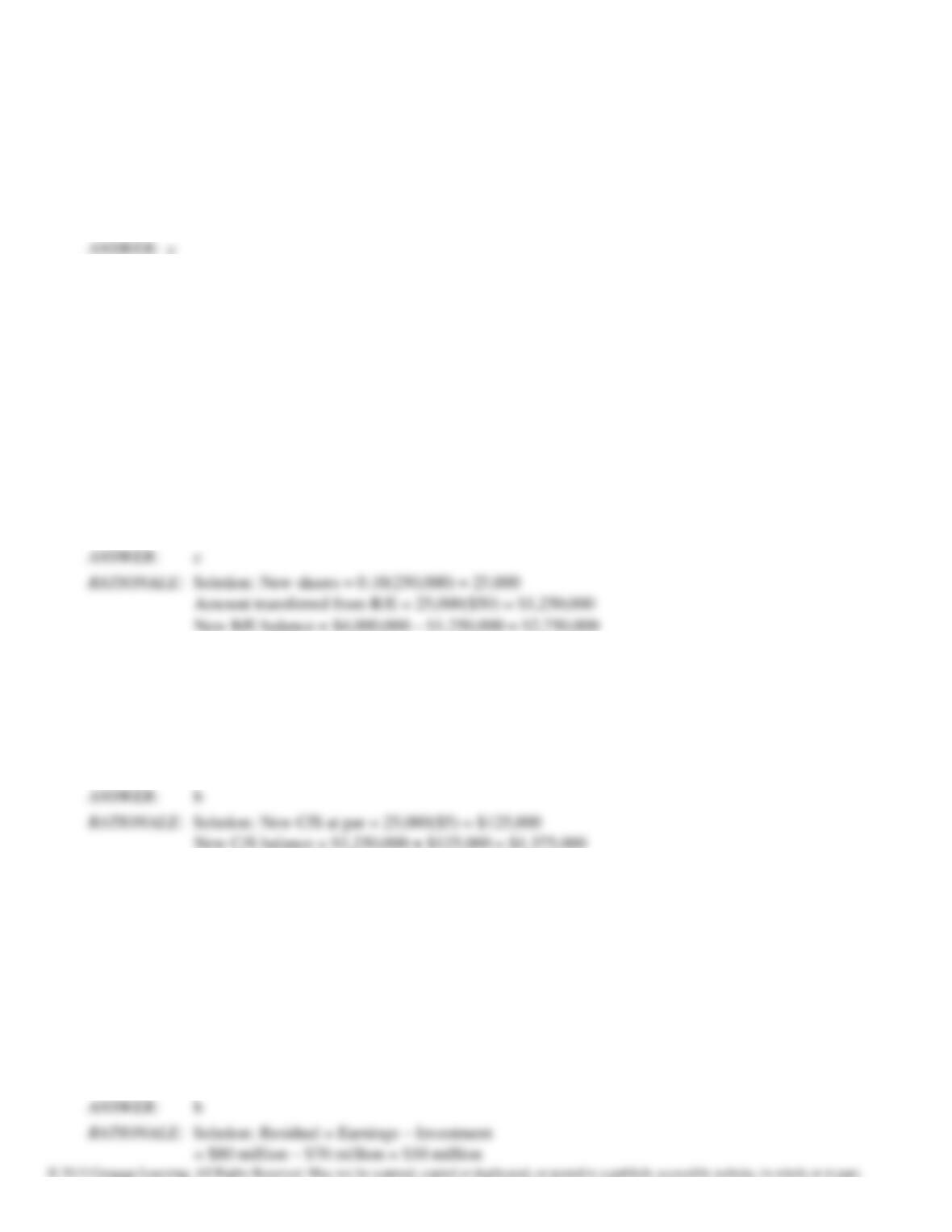
49. The Percolator Company has the following capital structure:
Common stock ($5 par, 250,000 shares)
$1,250,000
Contributed capital in excess of par
$5,000,000
Retained earnings
$4,000,000
The company declares a 10 percent stock dividend. The pre-stock dividend market price of the company’s
stock is $50. Determine the balance in the retained earnings account after the stock dividend.
a. $4,000,000
b. $1,375,000
c. $2,750,000
d. $1,250,000
50. Determine the balance in the common stock account after the stock dividend.
a. $1,250,000
b. $1,375,000
c. $125,000
d. $2,500,000
51. The Wagner Company tries to follow a pure “residual” dividend policy. Earnings and dividends last year were
$100 million and $20 million respectively. Anticipated earnings for this year are $80 million. The company is
financed completely with common equity. The required rate of return on retained earnings is 15 percent and the
cost of new equity is 16 percent. If Wagner has $70 million of investment projects having expected returns
greater than 15 percent, determine the total amount of dividends Wagner should pay.
a. None
b. $10 million
c. $20 million in dividends and raise needed investment funds externally
d. $80 million in dividends and raise needed investment funds externally
Chapter 15: Dividend Policy
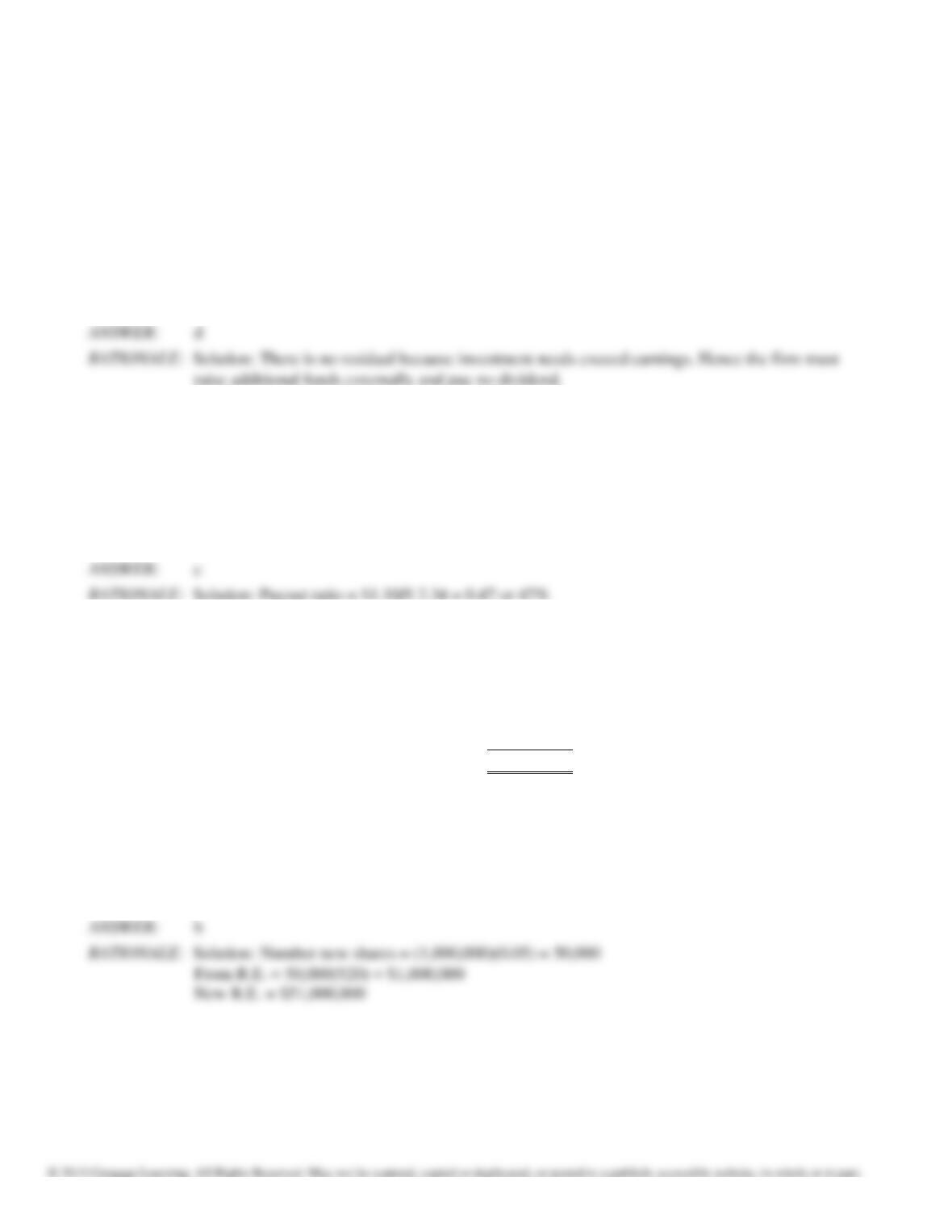
52. The Wagner Company tries to follow a pure “residual” dividend policy. Earnings and dividends last year were
$100 million and $20 million respectively. Anticipated earnings for this year are $80 million. The company is
financed completely with common equity. The required rate of return on retained earnings is 15 percent while
the cost of new equity is 16 percent. If Wagner has $90 million of investment projects having expected returns
greater than 16 percent, determine Wagner’s dividend and investment policies.
a. Pay out $20 million in dividends and raise $30 million externally
b. Pay no dividends and invest only in the first $80 million in projects.
c. Pay out $10 million in dividends and raise $20 million externally
d. Pay no dividends and raise $10 million externally
53. Last year, Quality’s earnings per share were $2.34 and it paid a dividend of $1.10. What was Quality’s
dividend payout ratio?
a. 21.2%
b. 42.7%
c. 47%
d. 53%
54. The Earth Shoe Company, whose stock has a market value of $20, has the following common equity accounts
on its balance sheet:
Common stock ($1 par, 1,000,000 shares)
$ 1,000,000
Contributed capital in excess of par
$14,000,000
Retained earnings
$52,000,000
Total Common stockholders’ equity
$67,000,000
If the firm declares a 5% stock dividend, what will be the retained earnings figure after the dividend is paid?
a. $1,000,000
b. $51,000,000
c. $14,950,000
d. $5,000,000
Chapter 15: Dividend Policy
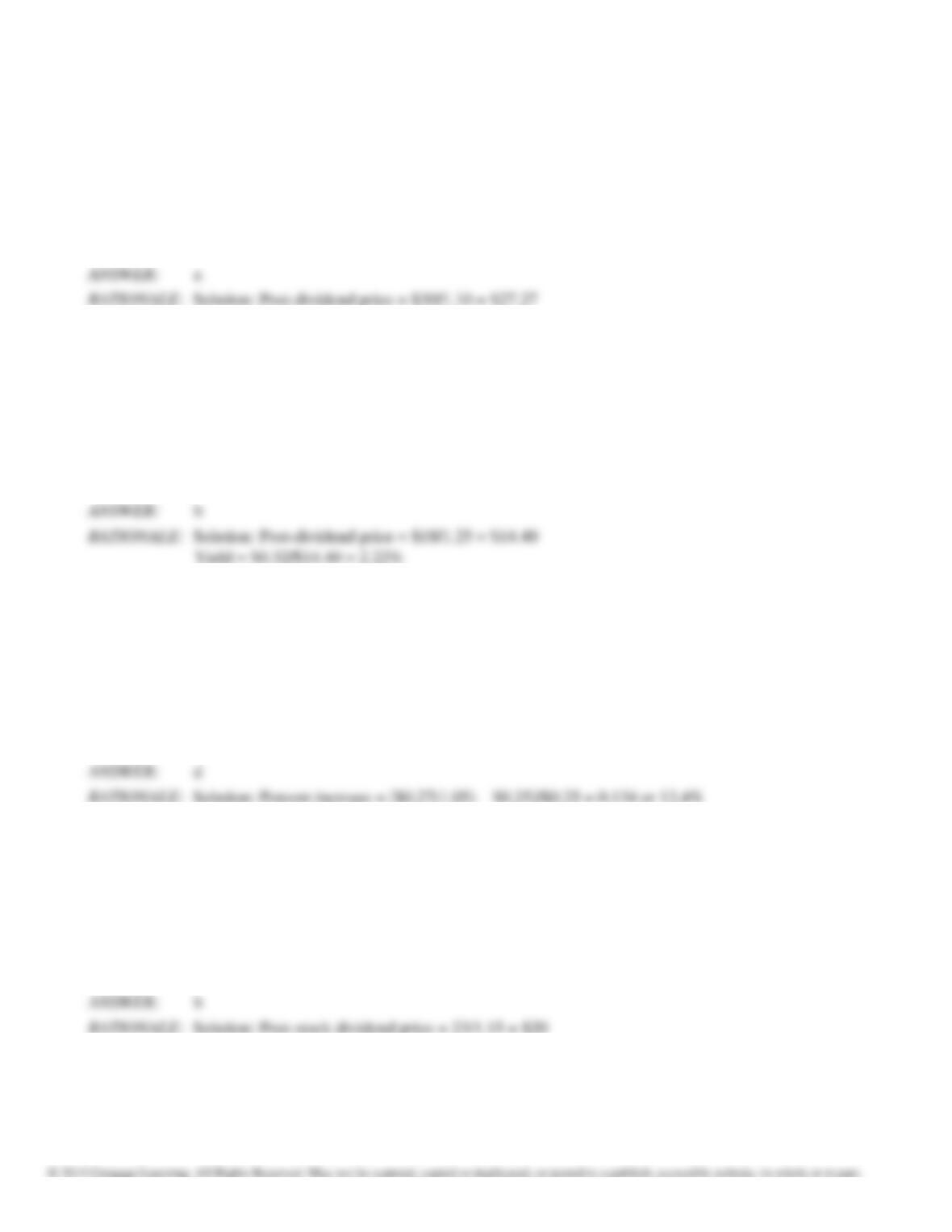
55. HiTec is growing fast and wishes to retain all its earnings to finance future growth. Instead of a cash dividend,
HiTec declares a 10 percent stock dividend. If the price per share of HiTec stock is $30 before the ex-dividend
date, what will be the price on the ex-dividend date?
a. $27.27
b. $27.94
c. $33.00
d. $27.00
56. Saturn Corporation has just declared a 25 percent stock dividend. The stock was selling for $18 before the
stock dividend. The stock will pay a quarterly cash dividend of 8 cents per share after the stock dividend. If the
8-cent dividend is maintained over the next year what is the post-stock dividend yield?
a. 2.13%
b. 2.22%
c. 0.56%
d. 1.44%
57. Last year, Toluca Engineering paid a $0.25 dividend per share each quarter. If Toluca announces both a 5
percent stock dividend and an increase in the quarterly dividend to $0.27, what is the effective rate of the
dividend increase?
a. 13.0%
b. 8.0%
c. 11.2%
d. 13.4%
58. Grabill Aerospace Company has just declared a 15% stock dividend. Immediately prior to the stock dividend,
the stock was selling for $23 and had a P/E ratio of 14. Calculate the post-stock dividend price of Grabill’s
stock.
a. $26.45
b. $20.00
c. $26.22
d. $20.18