CHAPTER 15—PRICING PRACTICES Key
1. The competitive market pricing rule-of-thumb for profit maximization is to set:
2. A 50% markup on cost is equivalent to a markup on price of:
3. A 50% markup on price is equivalent to a markup on cost of:
4. When eP = -2, the optimal markup on cost is:
5. When eP = -1, the optimal markup on price is:
6. During peak periods:
7. A by-product:
8. When transferred products can be sold in perfectly competitive external markets, the optimal transfer price is
9. Consumers’ surplus represents:
10. If a firm charges a price of $6 for a product with a cost of $4, the markup on cost equals:
11. If a firm charges a price of $5 for a product with a cost of $2, the markup on price equals:
12. Profit margin equals:
13. The optimal markup on price will fall following an increase in:
14. When engaging in short-run incremental analysis, managers should ignore:
15. Consumers’ surplus is:
16. With price discrimination, higher prices are charged when:
17. Price discrimination exists when:
18. Successful price discrimination requires:
19. A firm supplying a single product to two distinct submarkets will maximizes profits by equating:
20. When products A and B are produced in fixed proportions, profits will be maximized when marginal cost:
21. If eP = -3, the optimal markup on price is:
22. If eP = -3, the optimal markup on cost is:
23. If the optimal markup on price is 50%, the optimal markup on cost is:

24. If the optimal markup on cost is 25%, the optimal markup on price is:
25. Price discrimination exists when:
26. Optimal Markup. Ralph Kramden is managing partner of Kramden & Associates, Inc., a New York-based
management consulting firm. Kramden has asked you to complete an analysis of profit margins for Ed Norton,
Inc., a client firm. Unfortunately, your predecessor on this project was abruptly transferred, leaving only
sketchy information on the clients’ pricing practices.
A.
Use the available data to complete the following table:
Price
Marginal Cost
Markup on Cost
Markup on Price
$ 1
$ 0.50
100.0%
50.0%
2
1.60
—
—
5
—
400.0
—
10
—
—
25.0
—
15.00
66.7
—
B.
Calculate the optimal markup on cost and optimal markup on price for each product, based on the following estimates of the point price
elasticity of demand:
Product
Price Elasticity of
Demand, eP
Optimal Markup on Cost,
MOC*
Optimal Markup on Price,
MOP*
A
-1.5
B
-2.0
C
-2.5
D
-5.0
E
-10.0
A.
Price
Marginal Cost
Markup on Cost
Markup on Price
2
1.60
25.0
20.0
5
1.00
400.0
80.0
27. Optimal Markup. Cliff Claven is a summer intern at Wicker Works, Inc., a Boston firm that distributes
raw wicker in several grades or categories. Claven has been asked to complete an analysis of profit margins for
each grade of wicker. Unfortunately, his predecessor on this project abruptly left the company, leaving only
sketchy information on his pricing practices.
A.
Use the available data to complete the following table:
Wicker Grade
Price per Bundle
Marginal Cost
Markup on Cost
Markup on Price
B
$15
BB
20
A
35
AA
45
AAA
50
B.
Calculate the optimal markup on cost and optimal markup on price for each grade of wicker, based on the following estimates of the
point price elasticity of demand:
Wicker Grade
Price Elasticity of
Demand, eP
Optimal Markup on Cost,
MOC*
Optimal Markup on Price,
MOP*
B
-1.5
BB
-2.0
A
-2.5
AA
-3.0
AAA
-5.0
A.
Wicker Grade
Price per Bundle
Marginal Cost
Markup on Cost
Markup on Price
B
$15
$ 7
114.3%
53.3%
BB
20
10
100.0
50.0
A
35
15
133.3
57.1
B.
A
-1.5
200.0%
66.7%
B
-2.0
100.0
50.0
C
-2.5
66.7
40.0
D
-5.0
25.0
20.0
E
-10.0
11.1
10.0
28. Optimal Markup. Mary Richards is a pricing manager of Caring Move, Inc., a local visiting nurse firm in
the home care market. Richards has been asked to complete an analysis of profit margins for the firm.
Unfortunately, her predecessor on this project was abruptly terminated, leaving only sketchy information on
existing pricing practices.
A.
Use the available data to complete the following table:
Hours of Visiting
Nurse Care per Day
Price
Marginal Cost of
Service
Markup on Cost
Markup on Price
1
$20
$13
53.8%
35.0%
2
35
26
—
—
3
50
—
28.2
—
4
65
—
—
20.0
5
—
65
23.1
—
B.
Calculate the optimal markup on cost and optimal markup on price for each service, based on the following estimates of the point price
elasticity of demand:
Hours of Visiting
Nurse Care per Day
Price Elasticity of
Demand, eP
Optimal Markup on Cost,
MOC*
Optimal Markup on Price,
MOP*
1
-20.00
2
-10.00
3
-5.00
4
-1.50
5
-1.25
1
$20
$13
53.8%
35.0%
3
50
39
28.2
22.0
4
65
52
25.0
20.0
B
-1.5
200.0%
66.7%
-2.0
100.0
50.0
A
-2.5
66.7
40.0
AA
-3.0
50.0
33.3
-5.0
25.0
20.0
29. Optimal Markup. Carol Vessey is a managing partner of Dry Air, Inc., a New Orleans-based
dehumidifier-systems distribution firm. Vessey has been asked to complete an analysis of profit margins for the
firm. Unfortunately, her predecessor on this project was abruptly transferred, leaving little information on the
firm’s current pricing practices.
A.
Use the available data to complete the following table:
Model
Price
Marginal Cost
Markup on Cost
Markup on Price
220
$200
$ 120
66.7%
40.0%
440
375
200
—
—
660
600
—
20.0
—
880
900
—
—
33.3
1,000
—
1,000
20.0
—
B.
Calculate the optimal markup on cost and optimal markup on price for each model, based on the following estimates of the point price
elasticity of demand:
Model
Price Elasticity of
Demand, eP
Optimal Markup on Cost,
MOC*
Optimal Markup on Price,
MOP*
200
-2
440
-3
660
-4
880
-5
1,000
–10
A.
Model
Price
Marginal Cost
Markup on Cost
Markup on Price
220
$ 200
$ 120
66.7%
40.0%
440
375
200
87.5
46.7
660
600
500
20.0
16.7
1
-20.00
5.3%
5.0%
2
-10.00
11.1
10.0
3
-5.00
25.0
20.0
4
-1.50
200.0
66.7
5
-1.25
400.0
80.0
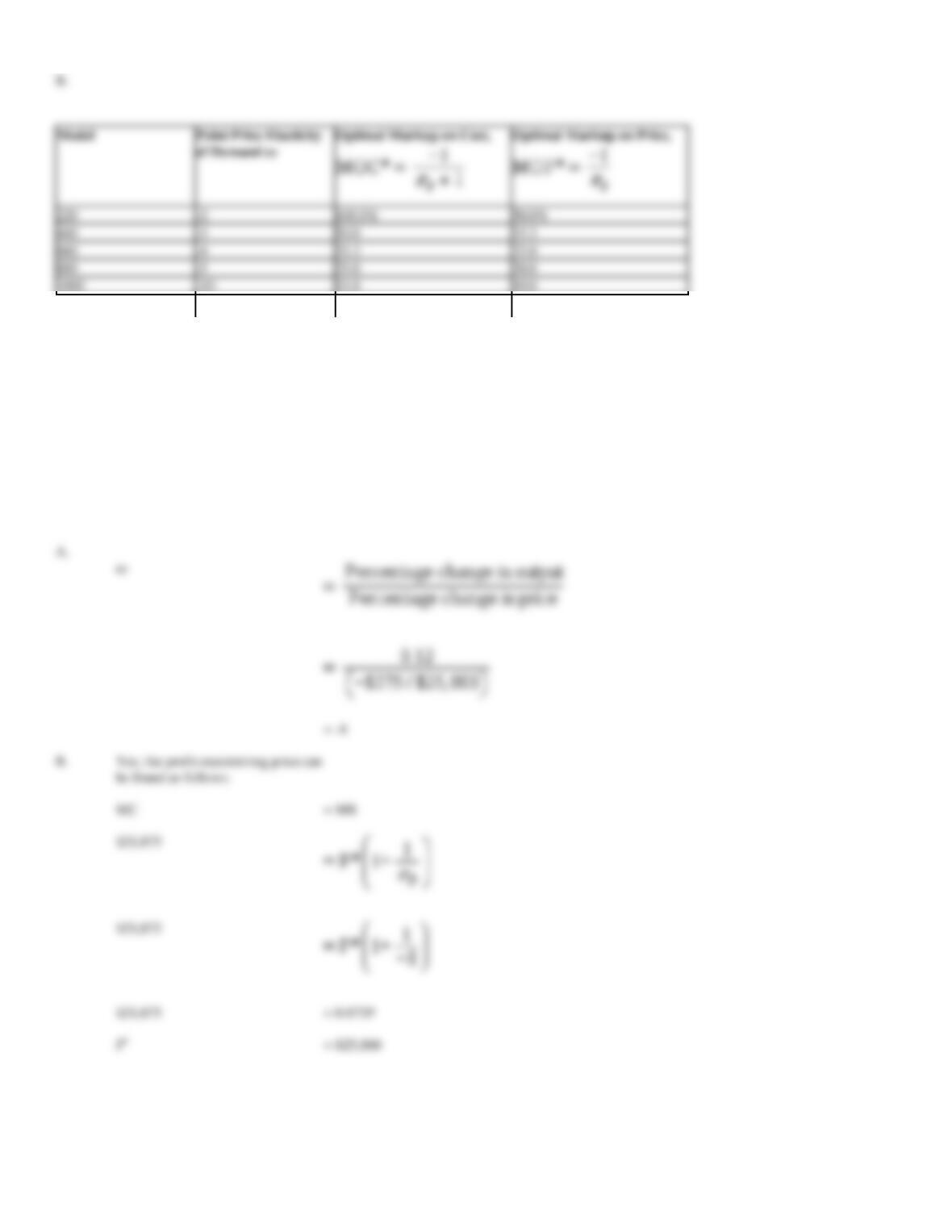
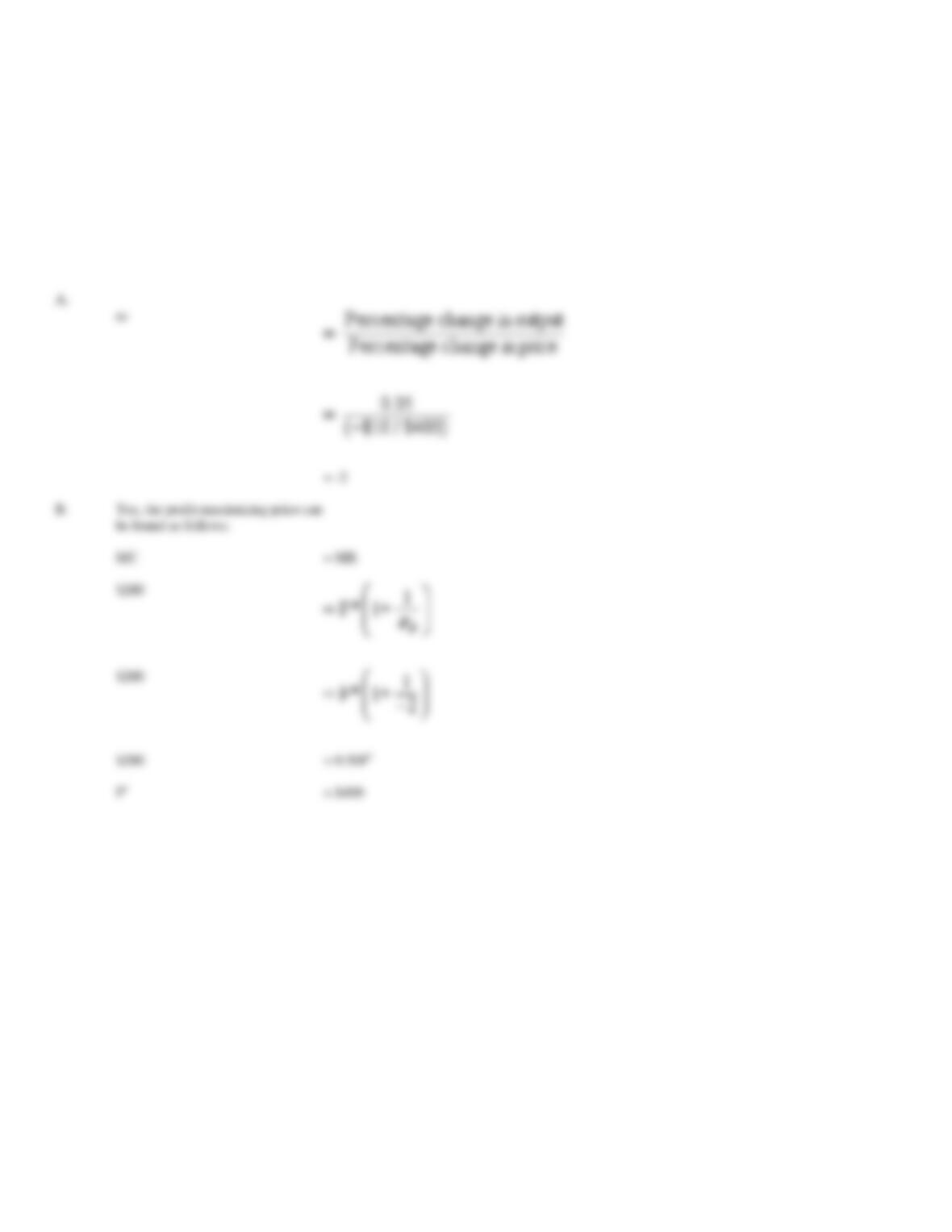
30. Optimal Price. Japanese Imports, Inc., recently offered rebates of $375 off the regular $25,000 price on
Sayonara mini SUVs. Sales responded, rising 12% over the previous month’s level.
A.
Calculate the point price elasticity of demand for Sayonara vehicles.
B.
If marginal cost per unit is $21,875, was the original $25,000 price optimal?
= MR
$21,875
= 0.875P
= $25,000
B.
-2
100.0%
50.0%
-3
50.0
33.3
-4
33.3
25.0
-5
25.0
20.0
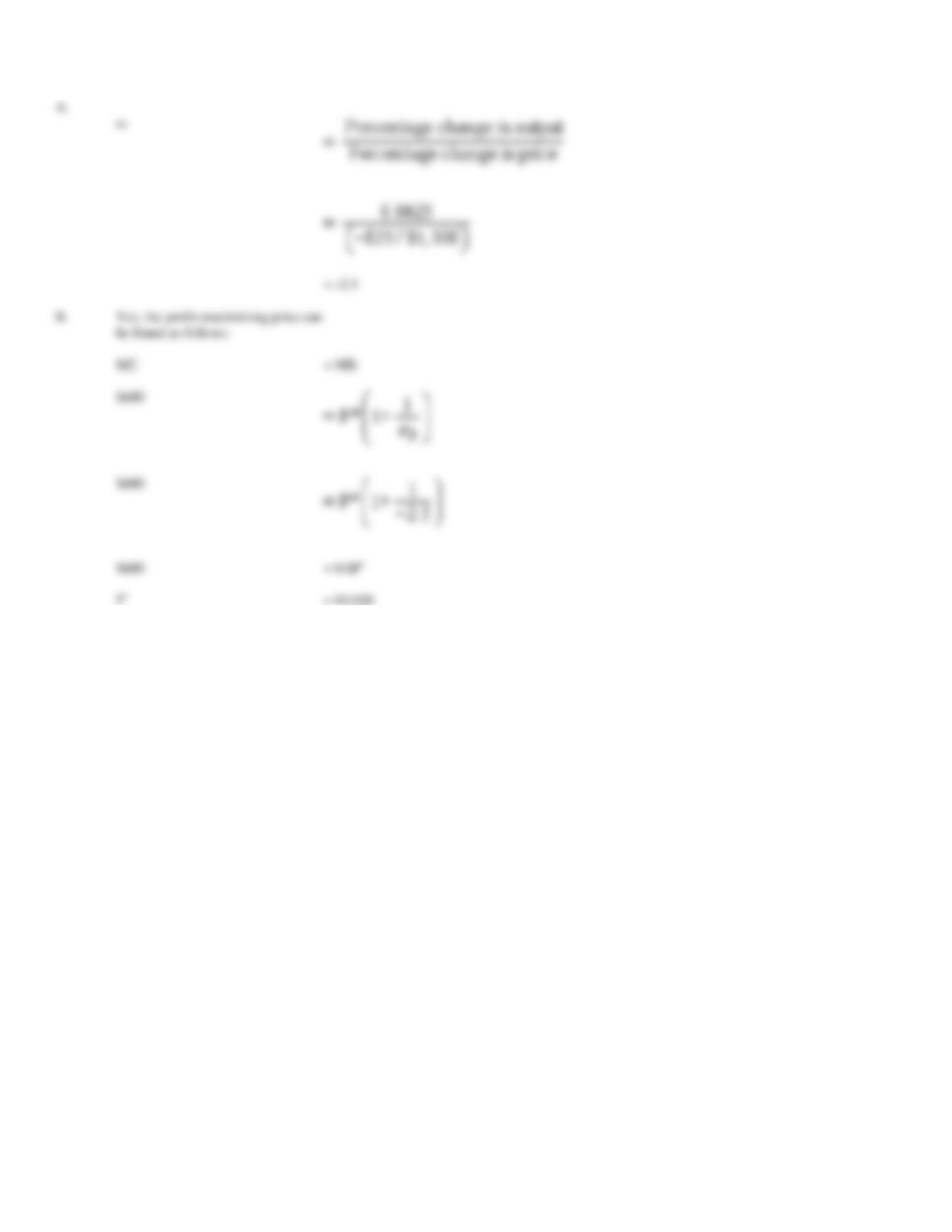
31. Optimal Price. Nice Bicycles, Inc., recently offered rebates of $10 off the regular $400 price on Triath
model bikes. Sales responded, rising 5% over the previous month’s level.
A.
Calculate the point price elasticity of demand for Triath bicycles.
B.
If marginal cost per unit is $200, was the original $400 price optimal?
32. Optimal Price. Woofer-Tweeter, Inc., recently offered instant rebates of $25 off the regular $1,000 price on
Soundman CD players. Sales responded, rising 6.25% over the previous month’s level.
A.
Calculate the point price elasticity of demand for Soundman CD players.
B.
If marginal cost per unit is $600, was the original $1,000 price optimal?
A.
= MR
$200
= $400
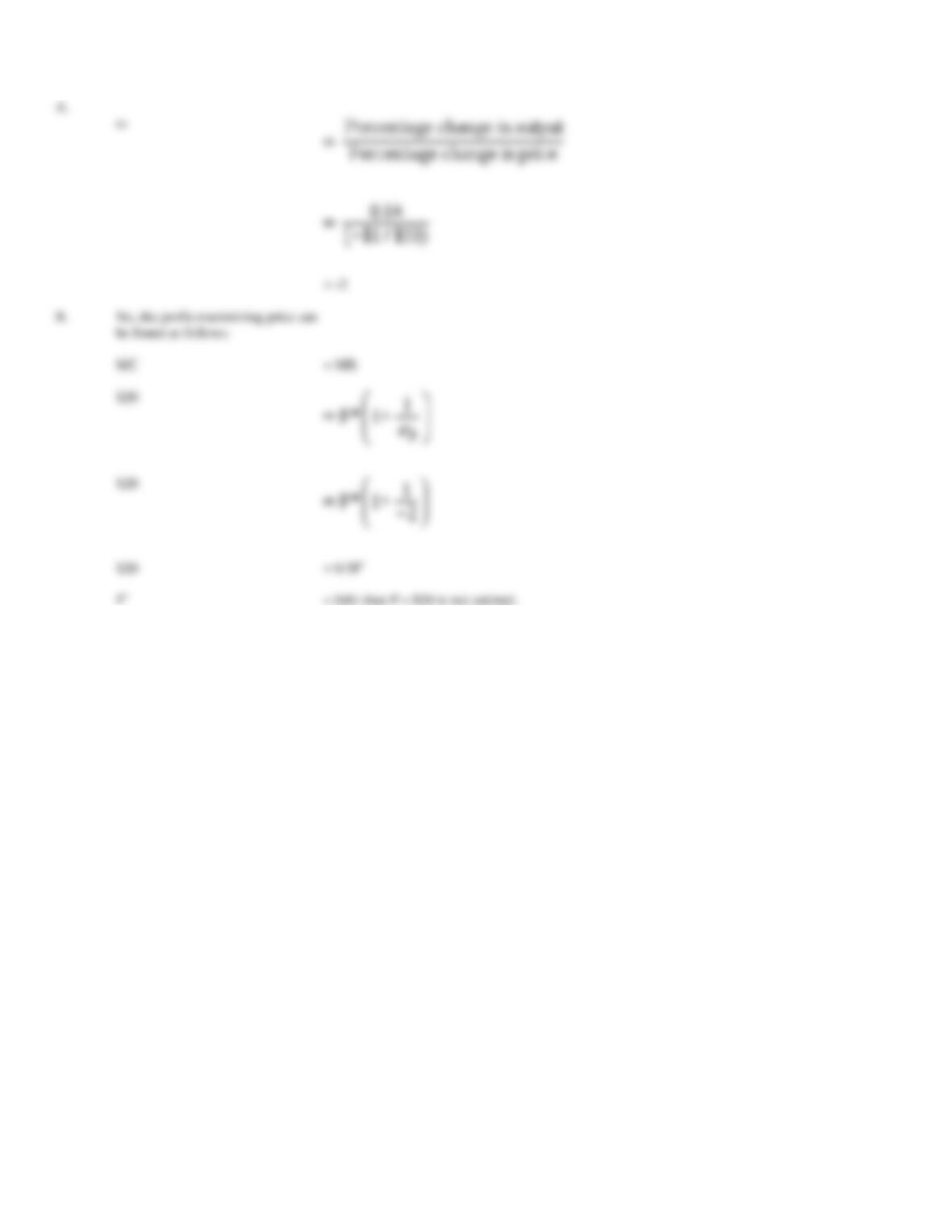
33. Optimal Price. Lean Jeans, Inc., recently offered rebates of $1 off the regular $50 price on their low-rider
jeans. Sales responded, rising 4% over the previous month’s level.
A.
Calculate the point price elasticity of demand for Lean Jeans.
B.
If marginal cost per unit is $20, was the original $50 price optimal?
A.
= MR
$600
= $1,000
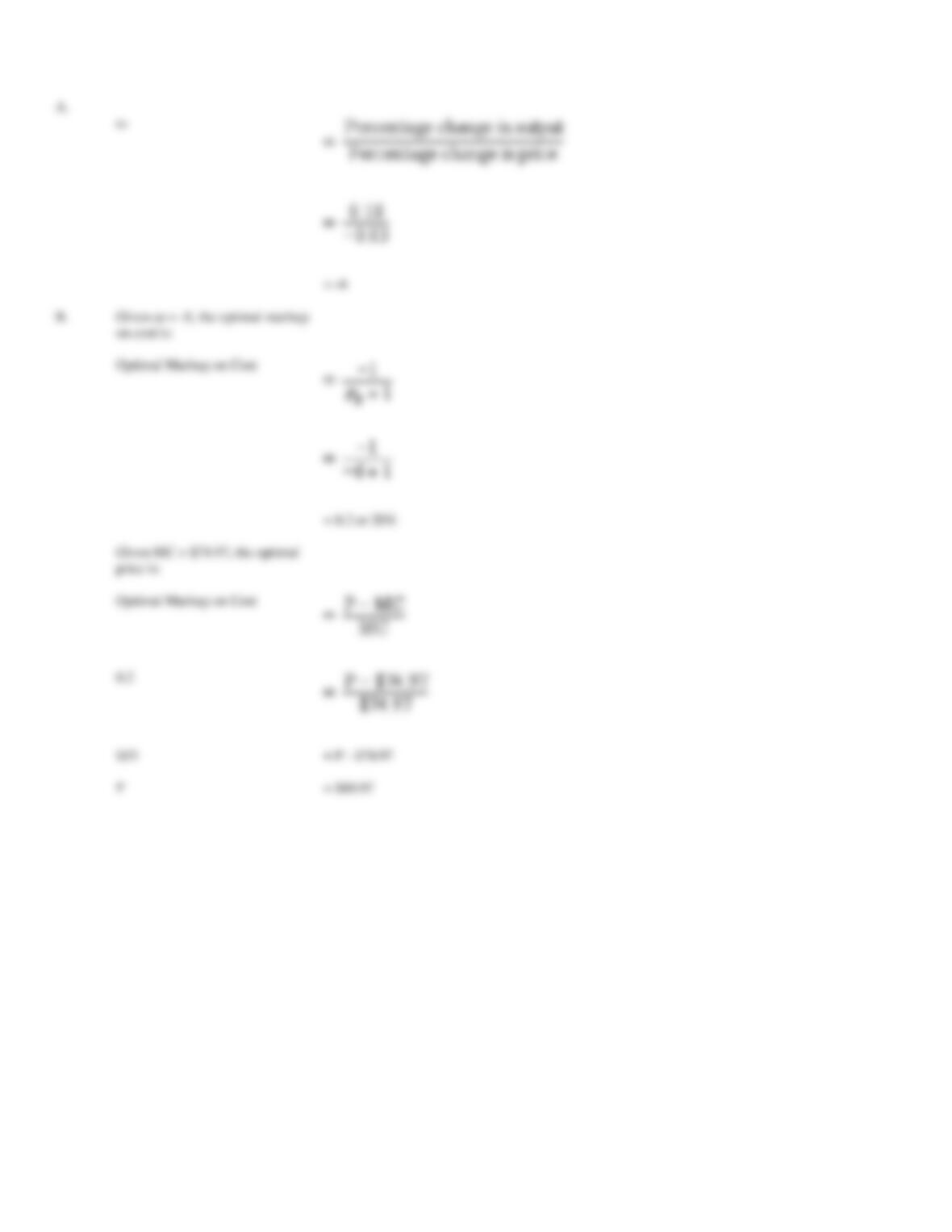
34. Markup on Cost. King Midas Muffler, Inc., offers automobile muffler replacement at a number of outlets
in the greater Boston area. The company recently initiated a policy of matching the lowest advertised
competitor price. As a result, King Midas has been forced to reduce the average price for mufflers by 3%, but
has enjoyed an 18% increase in customer traffic. Meanwhile, marginal costs have held steady at $74.97 per
muffler.
A.
Calculate the point price elasticity of demand for mufflers.
B.
Calculate King Midas’ optimal price and markup on cost.
A.
= MR
= $40; thus P = $50 is not optimal.
35. Markup on Cost. Oil-n-Go, Inc., offers automobile oil changes at a number of outlets in the greater Ann
Arbor area. The company recently initiated a policy of matching the lowest advertised competitor price. As a
result, Oil-n-Go has been forced to reduce the average price for oil changes by 5%, but has enjoyed a 15%
increase in customer traffic. Meanwhile, marginal costs have held steady at $20 per oil change.
A.
Calculate the point price elasticity of demand for oil changes.
B.
Calculate Oil-n-Go’s optimal price and markup on cost.
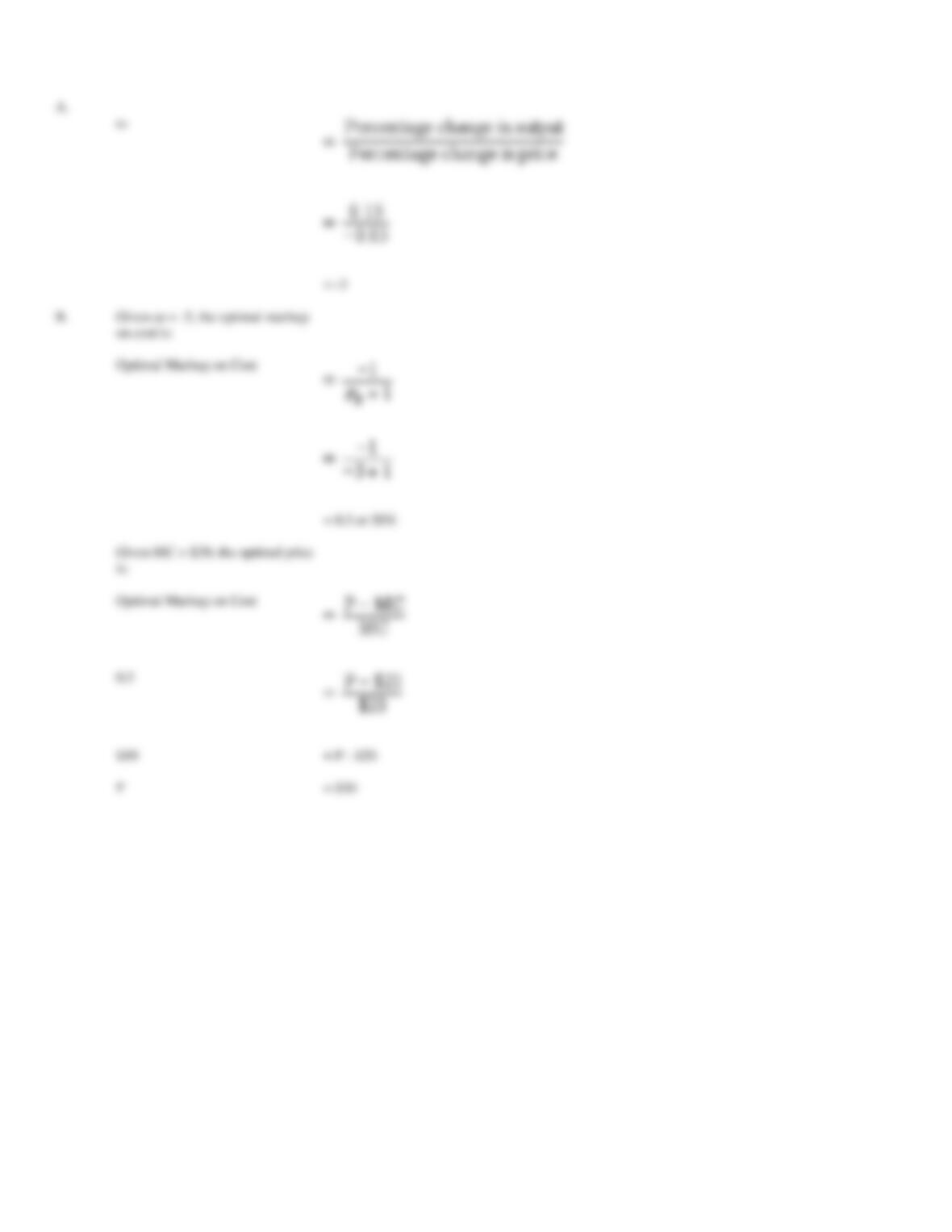
A.
= 0.2 or 20%
= P – $74.97
P
= $89.97
36. Markup on Cost. Chim-Chimery, Inc., offers chimney sweepings in the Montpelier, Vermont area. The
company recently initiated a policy of matching the lowest advertised competitor price. As a result,
Chim-Chimery has been forced to reduce the average price for chimney cleaning by 4%, but has enjoyed an 8%
increase in demand. Meanwhile, marginal costs have held steady at $25 per cleaning.
A.
Calculate the point price elasticity of demand for chimney cleaning.
B.
Calculate Chim-Chimery’s optimal price and markup on cost.
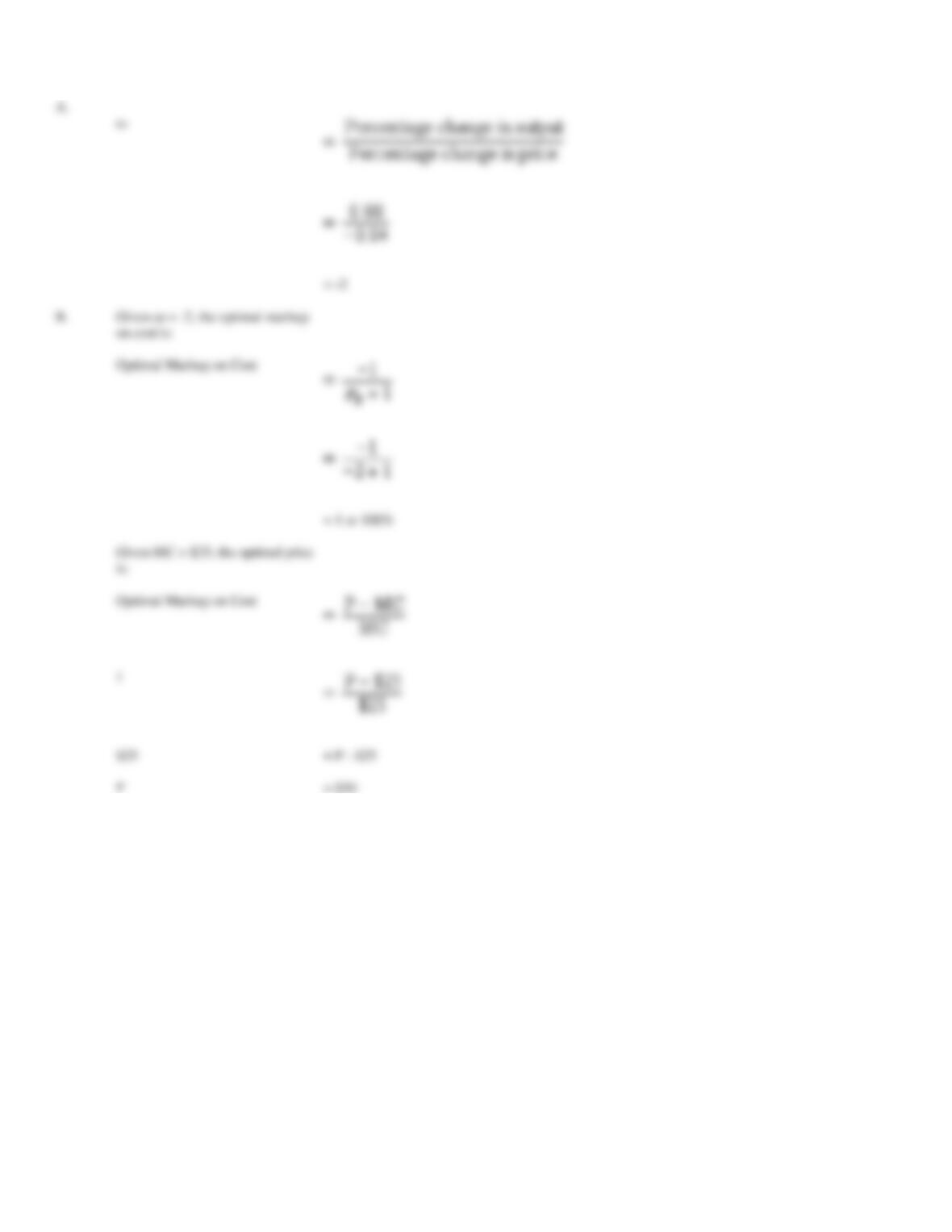
A.
= 0.5 or 50%
= P – $20
P
= $30
37. Markup on Cost. Radon Detectives, Inc., offers radon testing to homeowners in the Bethlehem,
Pennsylvania area. The company recently initiated a policy of matching the lowest advertised competitor price.
As a result, Radon Detectives has been forced to reduce the average price for radon tests by 1%, but has enjoyed
a 3% increase in demand. Meanwhile, marginal costs have held steady at $30 per test.
A.
Calculate the point price elasticity of demand for radon tests.
B.
Calculate Radon Detectives’ optimal price and markup on cost.
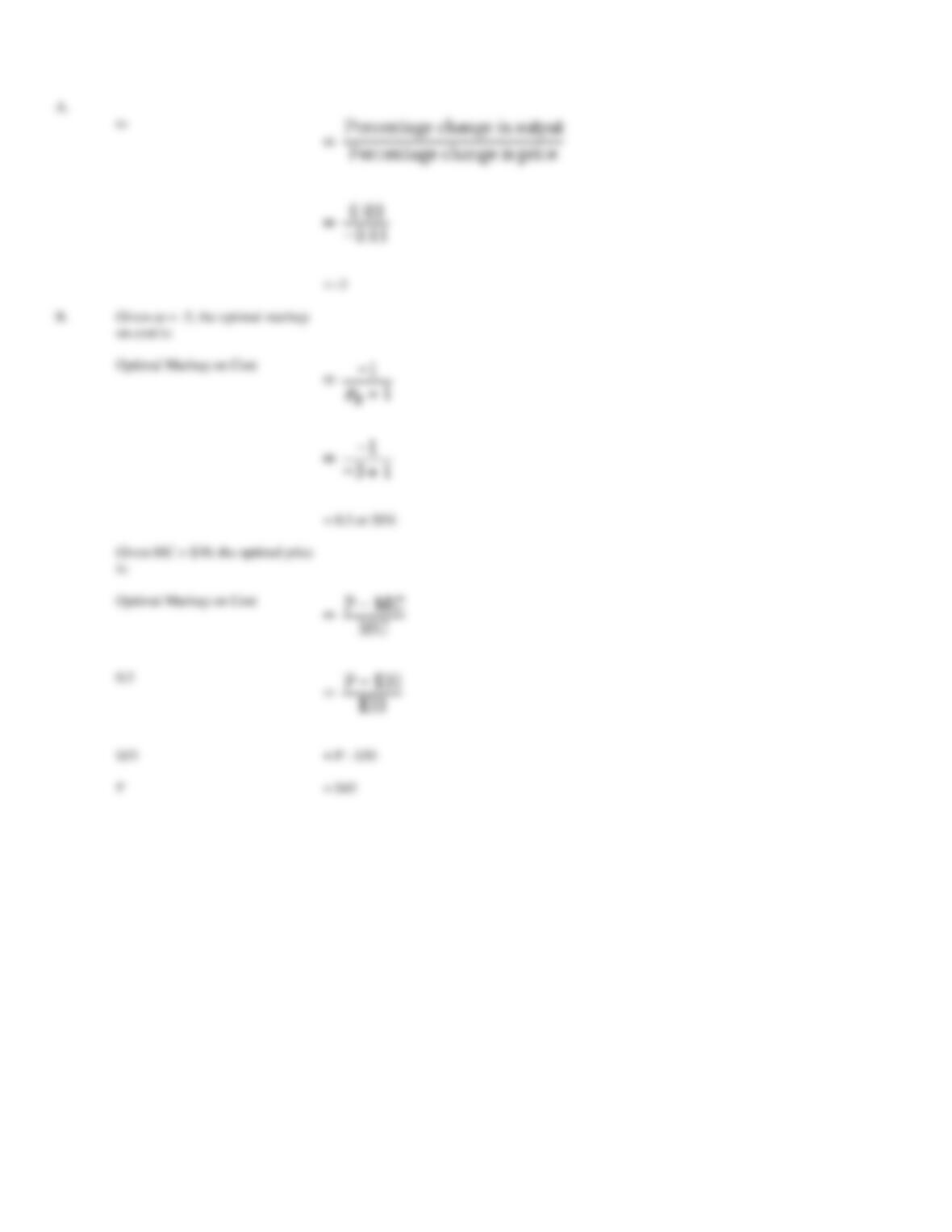
A.
= 1 or 100%
= P – $25
P
= $50
38. Markup on Price. TLC Tree Service, Inc., provides tree spraying services to residential customers in the
Detroit area. The company recently raised its service price from $50 to $60 per tree. As a result, sales fell to
3,900 from 4,900 units in the prior year.
A.
Calculate the arc price elasticity of demand for TLC service.
B.
Assume that the arc price elasticity (from Part A) is the best available estimate of the point price elasticity of demand. If marginal cost
is $12 per unit for labor and materials, calculate TLC’s optimal markup on price and its optimal price.
A.
P
= $45