Macroeconomics, 7e (Abel/Bernanke/Croushore)
Chapter 15 Government Spending and Its Financing
15.1 The Government Budget: Some Facts and Figures
1) Subtracting government investment from government purchases gives us the amount of
government
A) outlays.
B) primary expenditures.
C) secondary spending.
D) consumption expenditures.
2) The three main categories of government outlays are
A) net interest payments, government investment, and government consumption expenditures.
B) net government subsidies, the government deficit, and government purchases.
C) government purchases, transfer payments, and net interest payments.
D) government consumption expenditures, government investment, and transfer payments.
3) Since the late 1960s, the share of GDP devoted to government purchases has
A) drifted gradually upward.
B) drifted gradually downward.
C) remained fairly steady.
D) increased, but only after the onset of a war or a military buildup.
4) From the 1950s to the early 1980s, transfer payments’ share of GDP
A) steadily increased.
B) steadily decreased.
C) remained fairly steady.
D) increased during Democratic administrations and decreased during Republican
administrations.
5) Interest payments by the government as a share of GNP have
A) steadily increased.
B) remained fairly steady.
C) increased, but only to reflect changes in nominal interest rates.
D) increased sharply in the 1940s and 1980s.
6) The largest source of tax receipts for the government is
A) personal taxes.
B) contributions for social insurance.
C) taxes on production and imports.
D) corporate taxes.
7) The type of tax receipts that has shown the largest growth since the end of World War II has
been
A) personal taxes.
B) contributions for social insurance.
C) taxes on production and imports.
D) corporate taxes.
8) The type of tax receipts that has shown the slowest growth since World War II has been
A) personal taxes.
B) contributions for social insurance.
C) taxes on production and imports.
D) corporate taxes.
9) Net interest payments by the government are usually
A) small and sometimes negative for both the federal, and state and local governments.
B) small and sometimes negative for the federal government, but large and positive for state and
local governments.
C) small and sometimes negative for state and local governments, but large and positive for the
federal government.
D) large and positive for both the federal, and state and local governments.
10) State and local governments rely on ________ as their primary source of tax receipts.
A) personal taxes
B) contributions for social insurance
C) indirect business taxes
D) corporate taxes
11) The primary deficit is equal to
A) outlays – tax revenues.
B) government purchases + transfers + net interest – tax revenues.
C) outlays + net interest – tax revenues.
D) government purchases + transfers – tax revenues.
12) The deficit is
A) the amount by which government purchases, transfers, and net interest exceed tax revenues.
B) the amount by which government purchases and transfers exceed tax revenues.
C) the primary deficit minus net interest payments.
D) total tax revenues minus net interest minus government expenditures.
13) The amount by which government purchases and transfers exceed tax revenues is known as
the
A) primary surplus.
B) primary deficit.
C) primary current deficit.
D) government debt.
14) The current deficit is
A) the deficit minus government investment.
B) the deficit plus net interest payments.
C) the deficit minus current expenditures.
D) the deficit minus depreciation.
15) The current deficit is
A) the deficit plus net interest payments.
B) current expenditures minus tax revenues.
C) outlays minus tax revenues.
D) the deficit minus depreciation.
16) The primary current deficit is
A) current expenditures – tax revenues.
B) current expenditures + transfers + net interest – tax revenues.
C) current expenditures – net interest – tax revenues.
D) current expenditures + transfers – tax revenues.
17) The current deficit minus net interest is called the
A) primary deficit.
B) net current deficit.
C) current surplus.
D) primary current deficit.
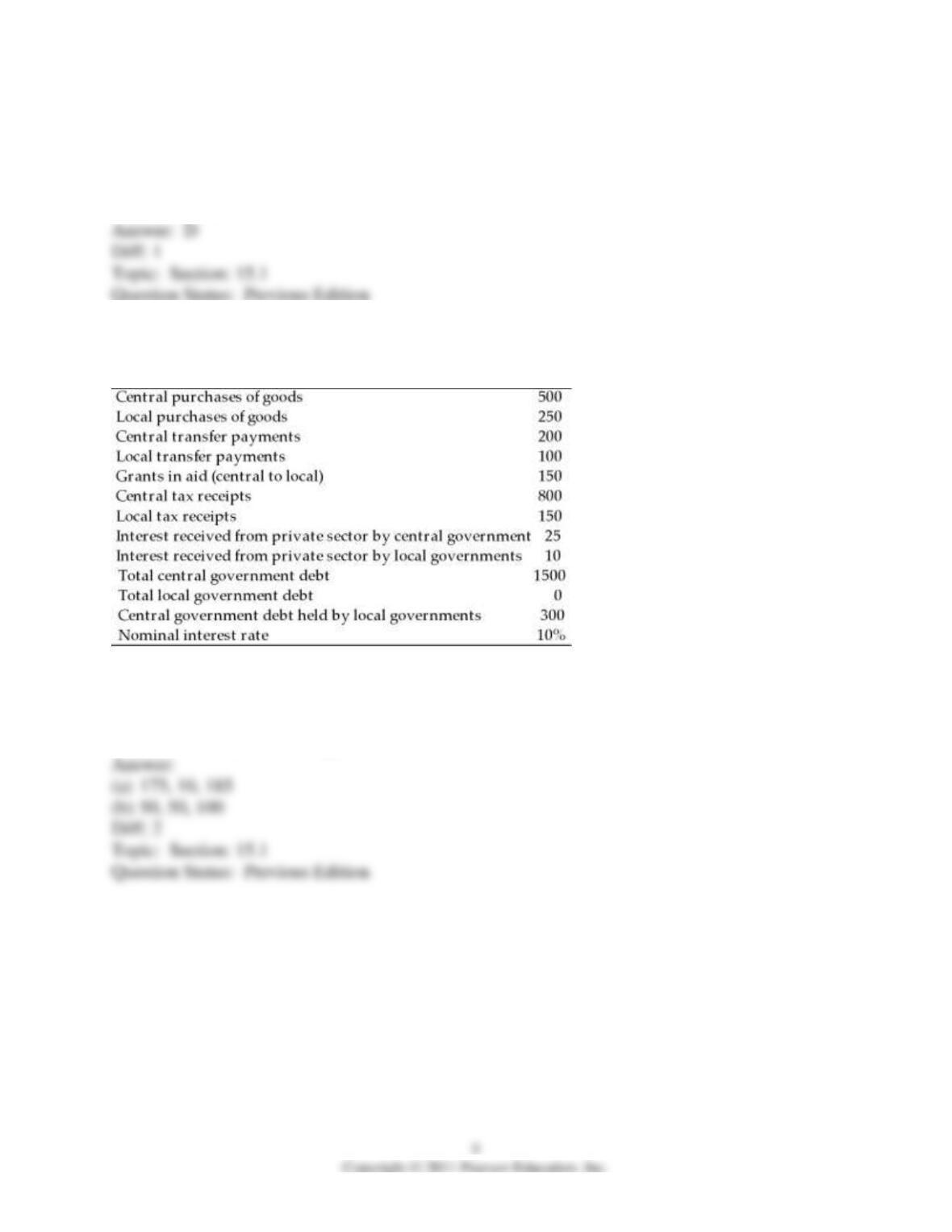
18) You are given the following budget data for a country that has both a central government and
local governments.
(a) How much is the deficit for the central government, the local government, and the total of the
central and local governments?
(b) How much is the primary deficit for the central government, the local government, and the
total of the central and local governments?
19) At the beginning of year one, there is no government debt outstanding. The government runs
a $100 billion deficit in year one. Interest at a nominal rate of 10% must be paid starting in year
two. Assume nominal GDP in year one is $2000 billion and the nominal growth rate of GDP is
4%. Assume the government balances its primary budget in the future and the interest rate and
growth rate do not change.
(a) What will be the government deficit in years two, three, four, and five?
(b) What will be the value of government bonds outstanding at the end of the fifth year?
(c) What will be the debt-GDP ratio at the end of year five?
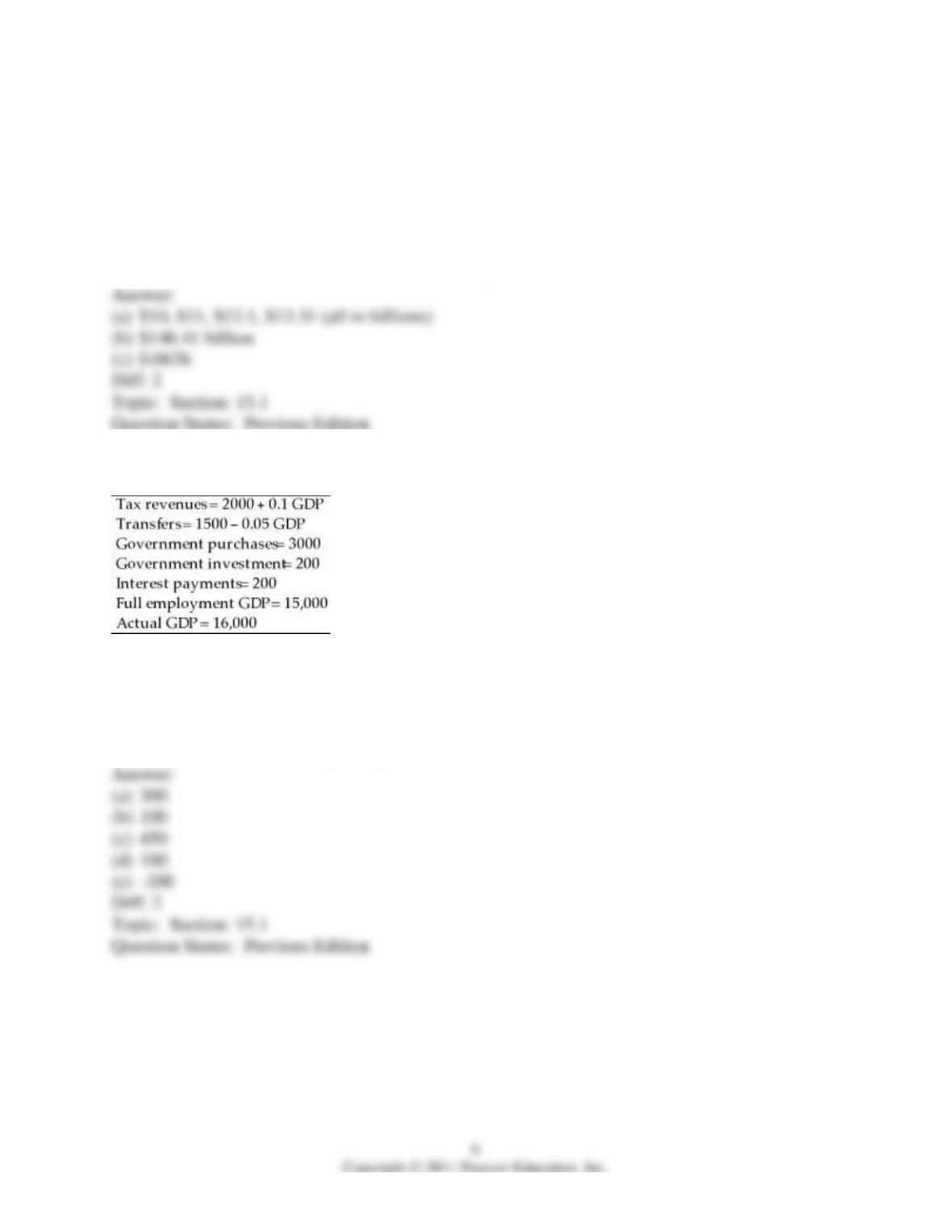
20) The following data describe government spending and revenue.
(a) How much is the budget deficit?
(b) How much is the primary budget deficit?
(c) How much is the full-employment budget deficit?
(d) How much is the current deficit?
(e) How much is the current primary deficit?
15.2 Government Spending, Taxes, and the Macroeconomy
1) Classical economists think that lump-sum tax changes
A) should be used to smooth business cycles.
B) have a powerful effect on the economy.
C) affect aggregate demand after a lag.
D) have no effect because of Ricardian equivalence.
2) The political process by which fiscal policy is made
A) is relatively rapid, contributing to the effectiveness of fiscal policy.
B) requires only that the president approve changes to the budget, a decision that takes several
months.
C) is efficient in reaching a decision within a year.
D) is slow and results in a long time lag for fiscal policy.
3) Provisions in the budget that cause government spending to rise or taxes to fall without
legislation when GDP falls are known as
A) primary deficit enhancers.
B) expansionary fiscal stimulus.
C) non-political fiscal policy.
D) automatic stabilizers.
4) Which of the following would not act as an automatic stabilizer?
A) Unemployment insurance
B) Government purchases
C) Personal income taxes
D) Corporate income taxes
5) Because of automatic stabilizers, in recessions the government budget deficit ________, while
in expansions the deficit ________.
A) falls; rises
B) falls; falls
C) rises; falls
D) rises; rises
6) The amount the government budget deficit would be if the economy were at full employment
is known as the
A) primary deficit.
B) full-employment deficit.
C) natural deficit.
D) current deficit.
7) Since 1960, the only period of several years when the full-employment was negative (that is,
there was a full-employment surplus) was
A) from 2000 to 2005.
B) the late 1990s and early 2000s.
C) the mid 1980s.
D) the early 1970s.
8) Government capital consists of
A) money owned by the government.
B) securities owned by the government.
C) the buildings owned by the government in Washington, D.C.
D) long-lived physical assets owned by the government.
9) All of the following are government capital EXCEPT
A) roads.
B) schools.
C) Treasury securities.
D) mass-transit systems.
10) The total amount of taxes paid divided by before-tax income is the
A) median taxpayer rate.
B) rate of hysteresis.
C) average tax rate.
D) marginal tax rate.
11) The marginal tax rate is
A) the fraction of an additional dollar of income that must be paid in taxes.
B) the total amount of taxes paid divided by after-tax income.
C) the total amount of taxes paid divided by before-tax income.
D) the average amount of government spending that is financed by taxes.
12) An increase in the marginal tax rate, with the average tax rate held constant, will
A) increase the amount of labor supplied at any real wage.
B) not affect the amount of labor supplied at any real wage.
C) decrease the amount of labor supplied at any real wage.
D) increase the amount of labor supplied at any real wage if the average tax rate is above the
marginal tax rate, but decrease the amount of labor supplied at any real wage if the average tax
rate is below the marginal tax rate.
13) A decrease in the average tax rate, with the marginal tax rate held constant, will
A) increase the amount of labor supplied at any real wage.
B) not affect the amount of labor supplied at any real wage.
C) decrease the amount of labor supplied at any real wage.
D) increase the amount of labor supplied at any real wage if the average tax rate is above the
marginal tax rate, but decrease the amount of labor supplied at any real wage if the average tax
rate is below the marginal tax rate.
14) Suppose that all workers place a value on their leisure of 40 goods per day. The production
function relating output per day Y to the number of people working per day N is
Y = 200N – N2
and the marginal product of labor is
MPN = 200 – 2N.
A 20% tax is levied on wages. Output per day would be
A) 5,625.
B) 7,250.
C) 9,375.
D) 11,250.
15) Suppose that all workers place a value on their leisure of 40 goods per day. The production
function relating output per day Y to the number of people working per day N is
Y = 200N – N2
and the marginal product of labor is
MPN = 200 – 2N.
A 20% tax is levied on wages. In terms of lost output, what is the cost of the distortion
introduced by this tax?
A) 25
B) 75
C) 150
D) 225
16) Taxes distort economic behavior because they
A) change the composition of income and spending.
B) cause deviations in economic behavior from the efficient, free-market outcome.
C) change the balance between private and public expenditures.
D) change the composition of consumption, investment, government spending, and net exports.
17) Assume that the lost output due to tax distortions is proportional to the square of the tax rate.
If the average cost of the distortion created by taxes is currently $1000, and the tax rate is
increased from 40% to 50%, the average cost of the distortion created by taxes will increase to
A) $383.33.
B) $450.00.
C) $640.
D) $1562.50.
18) The average cost of the distortion created by taxes
A) increases proportionately with the tax rate.
B) is lower when the tax rate is constant than when it fluctuates.
C) is higher when the tax rate is constant than when it fluctuates.
D) equals the square root of the tax rate.
19) An example of tax smoothing is provided by evidence of
A) temporary changes in defense expenditures by the government.
B) reductions in tax rates prior to presidential elections.
C) Keynesian tax cuts designed to help the economy recover from a recession.
D) reliance on debt financing rather than taxation during World War II.