27) Suppose that the federal income tax on individuals is set up as follows:
Income above Income below Taxes
0 $8000 0.10 × income
$8000 $35,000 $800 + [0.15 × (income – $8000)]
$35,000 & up $4850 + [0.25 × (income – $35,000)]
Calculate the average tax rate and marginal tax rate for workers with the following levels of
income:
(a) $6500
(b) $27,000
(c) $72,000
(d) $250,000
15.3 Government Deficits and Debt
1) The total value of government bonds outstanding at any particular time is called the
A) government debt.
B) government deficit.
C) seignorage revenue.
D) yield curve.
2) From 1945 to 1995, the debt—GDP ratio in the United States
A) steadily fell.
B) steadily increased.
C) fell from 1945 until around 1970 and rose thereafter.
D) fell from 1945 until around 1980 and rose thereafter.
3) From 1995 to 2001, the debt—GDP ratio in the United States
A) steadily fell.
B) steadily increased.
C) was about constant.
D) fell from 1995 to 1998, then rose sharply.
4) From 2001 to 2015, the debt—GDP ratio in the United States
A) steadily fell.
B) steadily increased.
C) was about constant.
D) fell from 1995 to 1998, then rose sharply.
5) Increases in the debt—GDP ratio are primarily caused by
A) a high growth rate of GDP.
B) a high government deficit relative to GDP.
C) increases in government borrowing through bonds.
D) increases in interest rates.
6) If the deficit is 0.02 times GDP, the existing debt—GDP ratio is 0.5, and the growth rate of
nominal GDP is 0.03, then the change in the debt—GDP ratio is
A) +0.05
B) +0.025.
C) 0.
D) -0.025.
7) If the deficit is 0.1 times GDP, the existing debt—GDP ratio is 0.5, and the growth rate of
nominal GDP is 0.04, then the change in the debt—GDP ratio is
A) +0.08
B) +0.075.
C) 0.
D) -0.075.
8) If the deficit is 0.08 times GDP, the existing debt—GDP ratio is 0.8, and the growth rate of
nominal GDP is 0.05, then the change in the debt—GDP ratio is
A) +0.08
B) +0.04.
C) 0.
D) -0.08.
9) A Social Security system in which payroll taxes that workers and their employers pay in go
directly to retirees and other beneficiaries is known as
A) a pay-as-you-go system.
B) an individual-account system.
C) a primary-deficit system.
D) a social-lockbox system.
10) According to current projections, in about 2034, the Social Security trust fund will
A) own all the government bonds that have been issued.
B) own about half of all the stock issued on the New York Stock Exchange.
C) run out of assets.
D) start to run deficits.
11) Which of the following policies would not prevent the Social Security trust fund from
running out of assets?
A) Reduce promised benefits
B) Reduce taxes
C) Increase taxes
D) Earn a higher rate of return
12) Social Security benefits could be reduced in each of the following ways except
A) cutting the promised monthly benefit.
B) increasing the retirement age.
C) investing the trust fund in the stock market.
D) reducing the degree to which benefits are adjusted for inflation.
13) To earn a higher return on the assets in the Social Security trust fund, a suggestion has been
made to allow the trust fund to
A) buy government bonds.
B) sell limited partnerships.
C) sell insurance.
D) invest in the stock market.
14) Recent proposals to allow the Social Security trust fund to invest in the stock market (instead
of buying government bonds) are based on the premise that
A) the returns to stocks are higher than the returns to bonds.
B) the returns to stocks aren’t as risky as the returns to bonds.
C) the transactions costs for investing in stocks are lower than the transactions costs for investing
in bonds.
D) stocks are more liquid than bonds.
15) A decreased government deficit created by a lump-sum tax increase will increase national
saving if
A) the value of government bonds outstanding grows slower than the public’s wealth.
B) it causes consumption to fall.
C) the government runs a primary surplus as a result.
D) the real interest rate is less than the growth rate of real GNP.
16) According to the Ricardian equivalence proposition, current deficits
A) will not affect consumption or national saving.
B) will affect consumption but not national saving.
C) will affect national saving but not consumption.
D) will affect both consumption and national saving.
17) According to the Ricardian equivalence proposition, a government budget deficit created by
a temporary tax cut
A) does not affect desired national saving.
B) does not affect expected future taxes.
C) reduces desired investment spending.
D) increases the real interest rate.
18) Deficits are a burden on future generations if they
A) cause higher rates of inflation to occur.
B) are not used for government capital formation.
C) cause national saving to fall.
D) are always a primary government deficit.
19) The stimulus package of 2009 had the effect of
A) causing higher rates of inflation to occur.
B) giving new foreign aid to help less developed countries.
C) significantly raising the debt to GDP ratio.
D) reducing the primary government deficit.
20) Why is the Social Security system in crisis at a time when it’s running large surpluses?
What’s the source of the problem? What solutions have been proposed?
21) Who bears the burden of the government debt? Explain why. Under what circumstances is
there no burden to be borne?
22) What are the main reasons (give at least three) that Ricardian equivalence might not hold?
23) Suppose that real GDP is 10,000 and remains constant, nominal GDP is initially 30,000,
inflation is 3%, and the debt—GDP ratio is 0.7. Find the largest nominal deficit that the
government can run without raising the debt—GDP ratio.
24) Find the largest nominal deficit that the government can run without raising the debt—GDP
ratio, under each of the following sets of assumptions:
(a) Suppose that real GDP is 20,000 and remains constant, nominal GDP is initially 30,000,
inflation is 4%, and the debt—GDP ratio is 1.2.
(b) Suppose that nominal GDP growth is 5% and outstanding nominal debt is 1500.
1) Seignorage is the revenue a government raises by
A) taxation.
B) printing money.
C) borrowing money.
D) charging fees for services.
2) The revenue that a government raises by printing money is called
A) seignorage.
B) monetary revenue.
C) currency credit.
D) currency inflation.
3) State governments in the United States can raise revenue by all the following means except
A) increasing income taxes.
B) increasing taxes on corporate profits.
C) increasing sales taxes.
D) increasing the money supply.
4) The relationship between the government deficit and the change in the monetary base is
A) deficit equals change in government debt held by the public minus change in monetary base.
B) deficit equals change in government debt held by the public plus change in monetary base.
C) deficit equals change in government debt outstanding plus change in monetary base.
D) deficit equals change in government debt outstanding minus change in monetary base.
5) In which case would you be most likely to expect inflation to occur?
A) The government runs a sustained government deficit by lowering taxes.
B) The government runs a sustained government deficit by increasing purchases.
C) The government runs a sustained primary deficit by increasing purchases.
D) The government funds its sustained deficit by increasing the money supply.
6) In an all-currency economy in which real output and the real interest rate are fixed and the
rates of money growth and inflation are constant, the inflation rate equals
A) the real interest rate.
B) the nominal interest rate.
C) the growth rate of the nominal money supply.
D) the level of real seignorage revenue.
7) The real seignorage collected by the government in an all-currency economy is the product of
A) the rate of inflation and the real supply of government bonds.
B) the rate of inflation and the real money supply.
C) the debt—GDP ratio and the real money supply.
D) the debt—GDP ratio and the rate of inflation.
8) The inflation tax is primarily a tax on
A) government bonds.
B) Social Security recipients.
C) money.
D) real income.
9) Assume that in an all-currency economy the real interest rate is 4%, the expected rate of
inflation is 8%, and the nominal interest rate is 12%. The monetary base equals $50 billion. The
real seignorage revenue collected by the government would equal
A) $4 billion.
B) $6 billion.
C) $8 billion.
D) $12 billion.
10) Real money demand in the economy is given by
L = 0.5Y – 2500i,
where Y is real income and i is the nominal interest rate. In equilibrium, real money demand L
equals real money supply M/P. Suppose that Y equals 1000 and the real interest rate is 0.02. At
what rate of inflation is seignorage maximized?
A) 0.05
B) 0.075
C) 0.09
D) 0.10
11) Real money demand in the economy is given by
L = 0.5Y – 2500i,
where Y is real income and i is the nominal interest rate. In equilibrium, real money demand L
equals real money supply M/P. Suppose that Y equals 1000 and the real interest rate is 0.02.
What is the maximum amount of seignorage revenue?
A) 11.11
B) 20.25
C) 22.25
D) 24.75
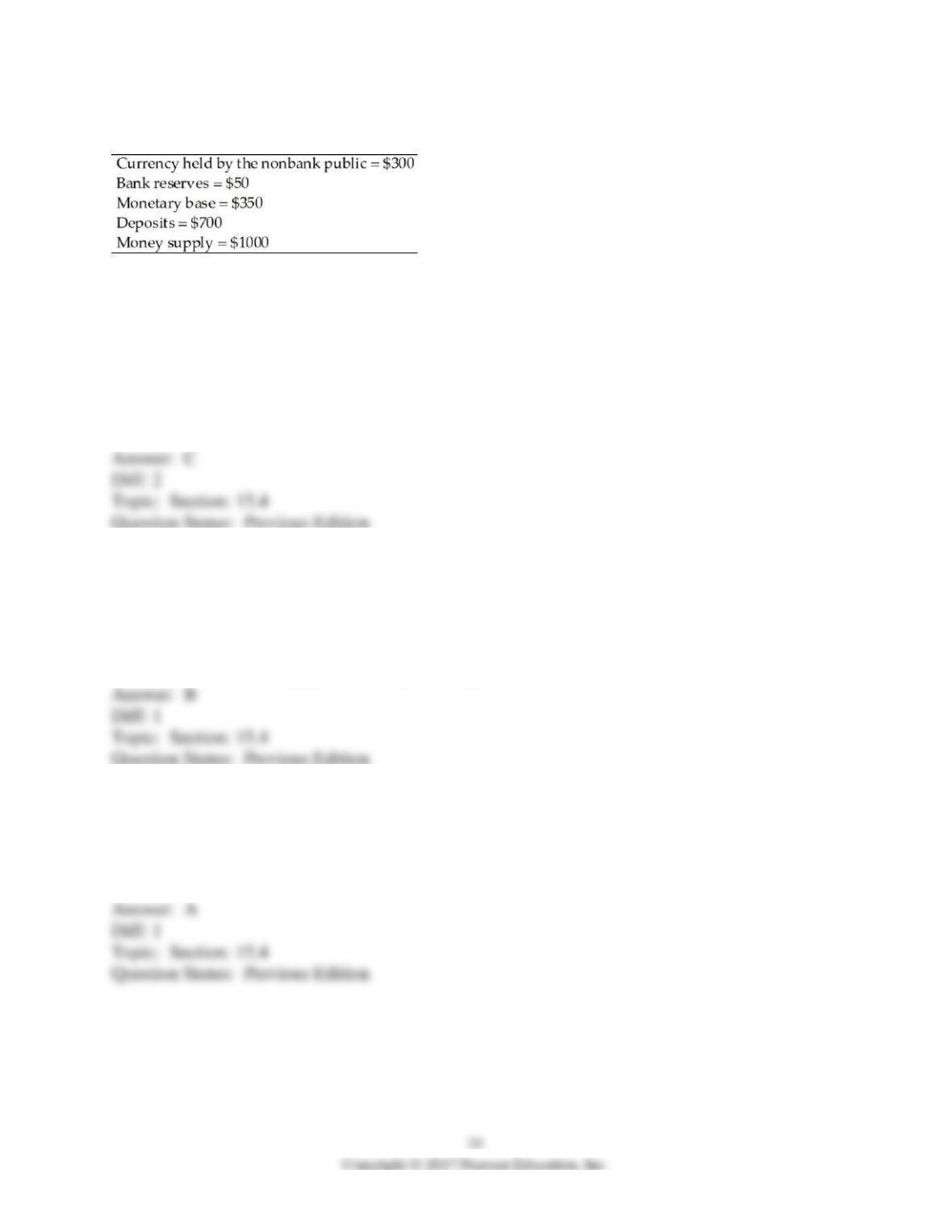
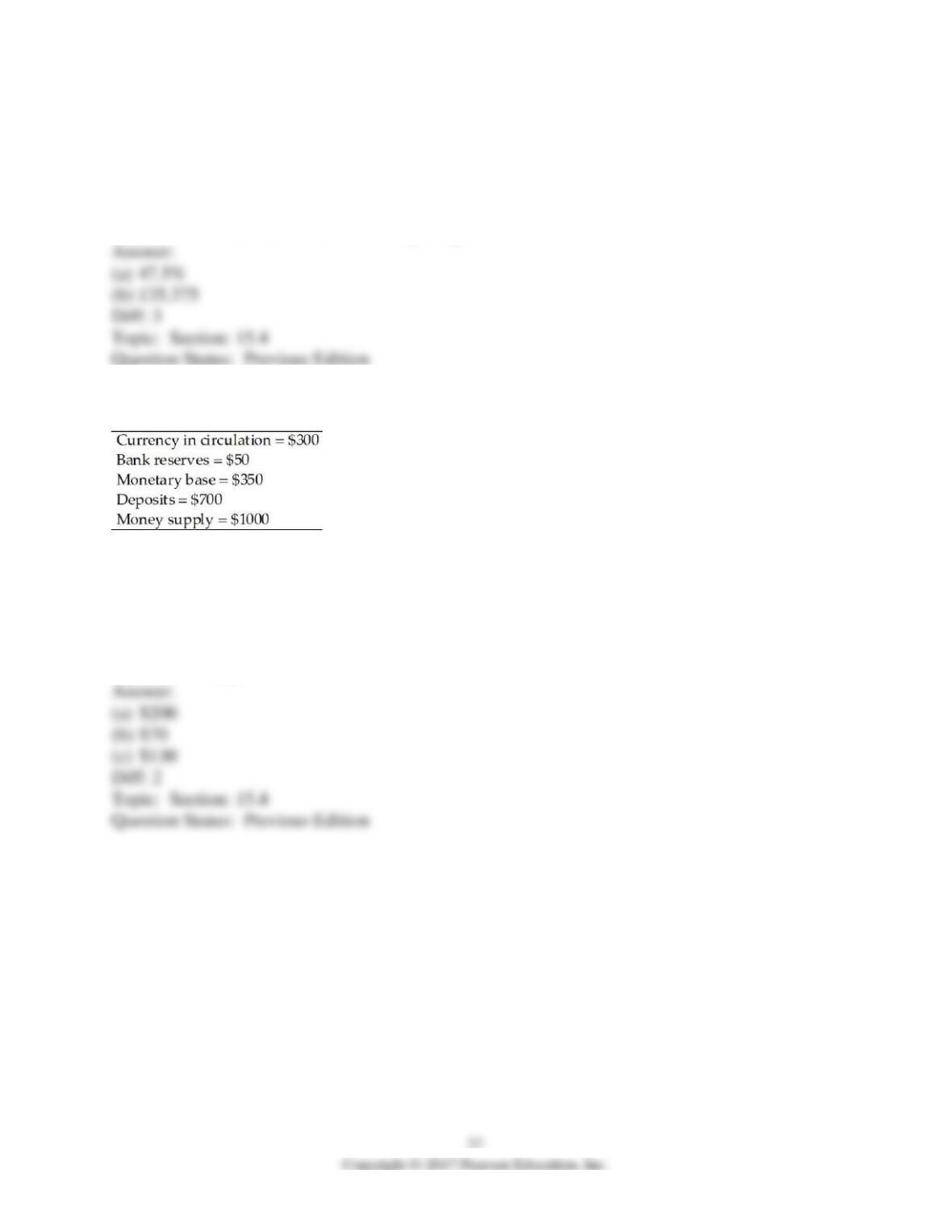
12) Consider an economy that has the following monetary data.
The monetary base and the money supply are expected to grow at a constant rate of 20% per
year. Inflation and expected inflation are 20% per year. Suppose that bank reserves and currency
pay no interest, all currency is held by the public, and bank deposits pay no interest. What is the
cost to the public of the inflation tax?
A) $60
B) $140
C) $190
D) $200
13) Consider an economy that has the following monetary data.
The monetary base and the money supply are expected to grow at a constant rate of 20% per
year. Inflation and expected inflation are 20% per year. Suppose that bank reserves and currency
pay no interest, all currency is held by the public, and bank deposits pay no interest. What is the
nominal value of seignorage over the year?
A) $10
B) $60
C) $70
D) $200
14) Whether real seignorage revenue increases when the rate of money growth increases depends
on whether
A) the rise in real money holdings outweighs the decline in inflation.
B) the rise in inflation outweighs the decline in real money holdings.
C) the rise in inflation ratio outweighs the decline in the real supply of currency.
D) the rise in the real supply of currency outweighs the decline in inflation.
15) When did the United States suffer hyperinflation?
A) Revolutionary War
B) War of 1812
C) World War II
D) Korean War
16) When the United States engaged in quantitative easing from 2008 to 2014, ________ rose
sharply.
A) bank reserves
B) inflation
C) the unemployment rate
D) the money supply
17) When the United States engaged in quantitative easing from 2008 to 2014, why didn’t the
money supply rise sharply?
A) Foreigners wanted all the new dollars created by the Federal Reserve.
B) Banks held the increased monetary base as excess reserves.
C) The Fed offset the increased monetary base by raising reserve requirements.
D) The Fed offset the increased monetary base by buying foreign currency.
18) When the economy strengthens, following the period of quantitative easing, the Federal
Reserve plans to keep a lid on money growth by
A) increasing reserve requirements.
B) selling dollars in foreign-exchange markets.
C) increasing the interest rate paid on reserves.
D) buying dollars in foreign-exchange markets.
19) How is real seignorage revenue related to inflation? How does the quantity of real seignorage
revenue change as inflation rises from zero to a positive level, to still higher levels?
20) Real money demand in the economy is given by
L = 0.3Y – 600i,
where Y is real income and i is the nominal interest rate. In equilibrium, real money demand L
equals real money supply M/P. Suppose that Y equals 2000 and the real interest rate is 5%.
(a) At what rate of inflation is seignorage maximized?
(b) What is the maximum amount of seignorage revenue?
21) Consider an economy that has the following monetary data.
The monetary base and the money supply are expected to grow at a constant rate of 20% per
year. Inflation and expected inflation are 20% per year. Suppose that bank reserves and currency
pay no interest, all currency is held by the public, and bank deposits pay no interest.
(a) What is the cost to the public of the inflation tax?
(b) What is the nominal value of seignorage over the year?
(c) What is the profit to the banks from the inflation?