1. A.W. Phillips collected data on the rate of change in money wages and plotted it against unemployment rates in the
United Kingdom. The curve he fit to the data showed that
a.
the rate of change of money wage rates and unemployment rates were inversely related.
b.
the rate of change of money wage rates and unemployment rates were directly related.
c.
the rate of change of money wage rates and unemployment rates were independent.
d.
as money wage rates increased, the unemployment rate was cut in more than half.
2. The short-run Phillips curve holds that
a.
high inflation and high unemployment can occur together.
b.
low inflation and low unemployment can occur together.
c.
high inflation and low unemployment can occur together.
d.
b and c
1
Easy
United States – BUSPROG: Analytic
Understanding and applying economic models
Bloom’s: Comprehension
3. The Phillips curve that Samuelson and Solow fitted to their data was
a.
upward sloping.
b.
downward sloping.
c.
vertical.
d.
horizontal.
b
1
Easy
United States – BUSPROG: Analytic
Understanding and applying economic models
Bloom’s: Comprehension
4. The Samuelson-Solow version of the Phillips curve showed the relationship between unemployment rates and
a.
Real GDP growth rates.
b.
price inflation rates.
c.
wage inflation rates.
d.
imports.
1
1
Easy
United States – BUSPROG: Analytic
Bloom’s: Comprehension
5. In their 1960 article, Paul Samuelson and Robert Solow found
a.
a direct relationship between inflation and investment expenditures.
b.
an inverse relationship between inflation and investment expenditures.
c.
a direct relationship between inflation and unemployment.
d.
an inverse relationship between inflation and unemployment.
United States – BUSPROG: Analytic
Bloom’s: Knowledge
6. Stagflation is the simultaneous occurrence of
a.
low inflation and high unemployment.
b.
high inflation and low unemployment.
c.
low inflation and low unemployment.
d.
high inflation and high unemployment.
United States – BUSPROG: Analytic
Understanding and applying economic models
Bloom’s: Knowledge
7. Stagflation implies that
a.
a tradeoff between inflation and unemployment may not always exist.
b.
policymakers can choose to have less unemployment if they are willing to accept a higher rate of inflation.
c.
the short-run Phillips curve is stable.
d.
the short-run Phillips curve is vertical.
United States – BUSPROG: Analytic
Bloom’s: Comprehension
8. The simultaneous occurrence of high inflation and high unemployment is called
a.
reverberation.
United States – BUSPROG: Analytic
Bloom’s: Comprehension
b.
disinflation.
c.
stagflation.
d.
“fooling.”
9. Milton Friedman argued that there is a
a.
permanent downward-sloping Phillips curve.
b.
temporary downward-sloping Phillips curve.
c.
temporary upward-sloping Phillips curve.
d.
permanent upward-sloping Phillips curve.
b
1
Moderate
United States – BUSPROG: Analytic
Bloom’s: Knowledge
10. Milton Friedman argued that there
a.
are two Phillips curves, a short-run one and a long-run one.
b.
are three Phillips curves, a short-run one, a long-run one, and one in stagflation.
c.
is one Phillips curve, and it is vertical.
d.
is one Phillips curve, and it is nearly flat or horizontal.
1
Moderate
United States – BUSPROG: Analytic
Understanding and applying economic models
Exhibit 16-1
1
Moderate
United States – BUSPROG: Analytic
Bloom’s: Knowledge
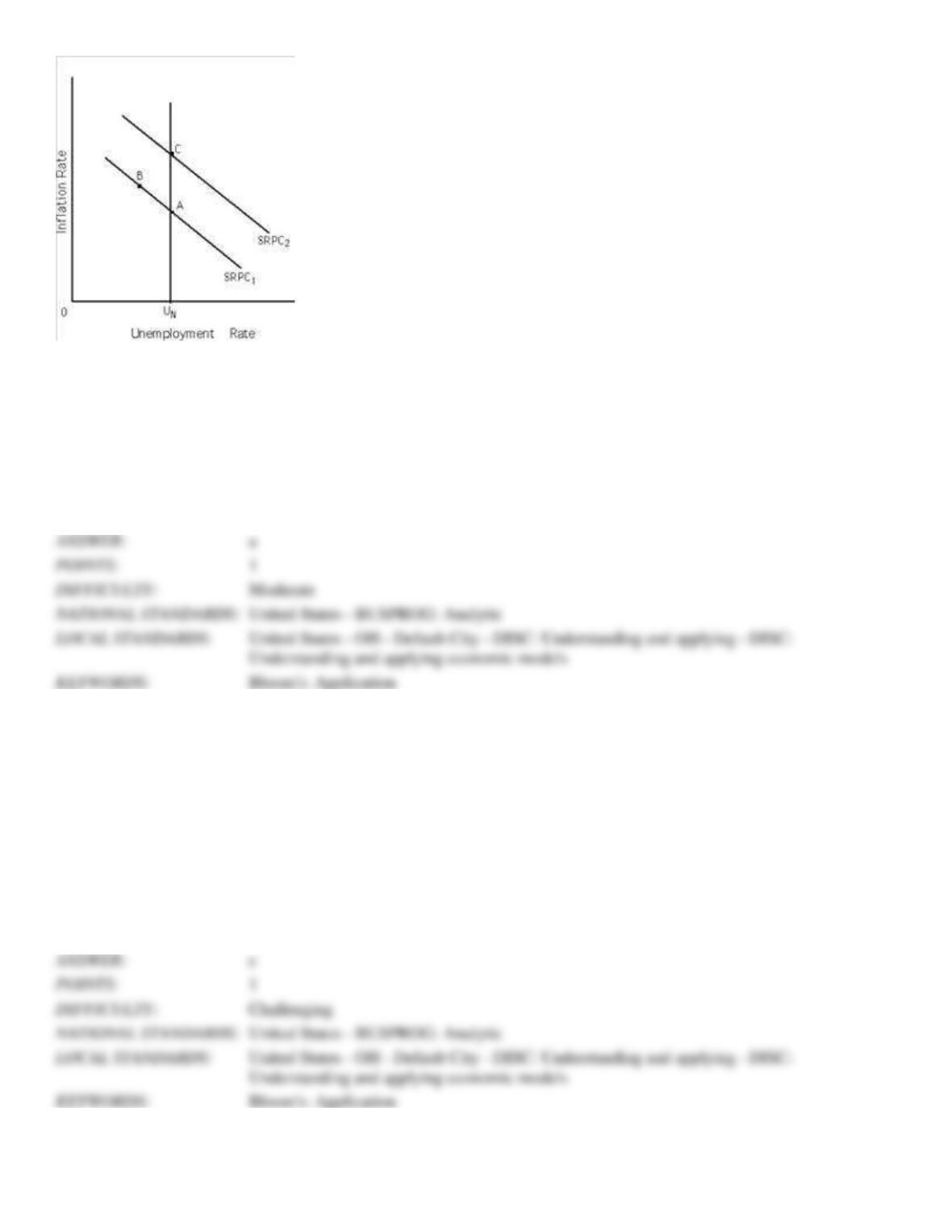
11. Refer to Exhibit 16-1. Suppose the economy is currently at point A on the short-run Phillips curve, SRPC1. What
could get the economy to move to point B?
a.
an increase in aggregate demand combined with an unchanged expected inflation rate
b.
an increase in aggregate demand combined with a rise in the expected inflation rate
c.
a rise in the expected inflation rate
d.
a decrease in aggregate demand combined with an unchanged expected inflation rate
e.
none of the above
12. Refer to Exhibit 16-1. Suppose the economy is currently at point B on the short-run Phillips curve, SRPC1. What
could get the economy to move to point C on SRPC2?
a.
The realization on the part of workers that their currently held expected inflation rate is too high; they revise it
upward, thus shifting the short-run aggregate supply curve rightward.
b.
The realization on the part of workers that their currently held expected inflation rate is too high; they revise it
downward, thus shifting the short-run aggregate supply curve rightward.
c.
The realization on the part of workers that their currently held expected inflation rate is too low; they revise it
upward, thus shifting the short-run aggregate supply curve leftward.
d.
The realization on the part of workers that their currently held expected inflation rate is too low; they revise it
downward, thus shifting the short-run aggregate supply curve rightward.
United States – BUSPROG: Analytic
Bloom’s: Application
13. Refer to Exhibit 16-1. Milton Friedman would most likely have called the vertical line on which points A and C are
United States – BUSPROG: Analytic
Bloom’s: Application
located the
a.
long-run aggregate supply curve.
b.
Friedman curve.
c.
long-run Phillips curve.
d.
short-run aggregate supply curve.
e.
short-run Phillips curve.
14. Refer to Exhibit 16-1. According to new classical macroeconomists, if increases in aggregate demand are correctly
anticipated, then the economy will move from point A to
a.
point B.
b.
point C.
c.
some point on SRPC2, above C.
d.
some point on SRPC1, below A.
United States – BUSPROG: Analytic
Understanding and applying economic models
Bloom’s: Application
15. Refer to Exhibit 16-1. According to new classical macroeconomists, if decreases in aggregate demand are
unanticipated, then the economy will move from point C to
a.
point B.
b.
point A.
c.
some point on SRPC2, below C.
d.
some point on SRPC1, below A.
United States – BUSPROG: Analytic
Understanding and applying economic models
Bloom’s: Application
16. Milton Friedman argued that the economy is not in long-run equilibrium if the expected inflation rate __________ the
actual inflation rate.
a.
is less than
b.
is greater than
United States – BUSPROG: Analytic
Bloom’s: Comprehension
c.
equals
d.
a and b
17. New classical economists believe that there is
a.
a short-run tradeoff between inflation and unemployment when policy is unanticipated.
b.
a short-run tradeoff between inflation and unemployment when policy is correctly anticipated.
c.
no short-run tradeoff between inflation and unemployment when policy is correctly anticipated.
d.
a and b
e.
a and c
Moderate
United States – BUSPROG: Analytic
Bloom’s: Comprehension
18. According to new classical economists, if a decrease in aggregate demand is correctly anticipated, the short-run
aggregate supply curve will shift __________ at the same time the AD curve shifts _________ so that there will be no
change in Real GDP.
a.
rightward; rightward
b.
leftward; rightward
c.
leftward; rightward
d.
rightward; leftward
e.
none of the above
1
Challenging
United States – BUSPROG: Analytic
Understanding and applying economic models
Bloom’s: Comprehension
19. When everyone correctly anticipates that the Fed will buy government securities, then they know that prices will
increase. Which of the following adjustments is not likely to occur?
a.
Workers will negotiate higher wages.
b.
Suppliers of resources will demand higher prices for their resources.
c.
Producers will prevent the price level from increasing and hurting their sales.
d.
Producers will raise prices.
1
United States – BUSPROG: Analytic
Understanding and applying economic models
Bloom’s: Comprehension
20. According to the new classical theory, if the public correctly anticipates a government policy to increase aggregate
demand, then
a.
there will be a short-run tradeoff between inflation and unemployment, but there will not be a long-run
tradeoff.
b.
there will be a long-run tradeoff between inflation and unemployment, but there will not be a short-run
tradeoff.
c.
there will be both a long-run and a short-run tradeoff between inflation and unemployment.
d.
there will be neither a long-run nor a short-run tradeoff between inflation and unemployment.
e.
there may be a short-run tradeoff between inflation and unemployment, but one cannot say for certain whether
there will be a long-run tradeoff.
d
United States – BUSPROG: Analytic
United States – OH – Default City – DISC: Understanding and applying – DISC:
Understanding and applying economic models
Bloom’s: Application
21. According to new classical theory, if the public correctly anticipates a government policy to increase aggregate
demand, then the
a.
short-run Phillips curve will be upward sloping, but the long-run Phillips curve will be downward-sloping.
b.
long-run Phillips curve will be upward sloping, but the short-run Phillips curve will be downward-sloping.
c.
short-run Phillips curve will be upward sloping, but the long-run Phillips curve will be vertical.
d.
long run Phillips curve will be upward sloping, but the short-run Phillips curve will be vertical.
e.
short- and long-run Phillips curves will be vertical.
United States – BUSPROG: Analytic
United States – OH – Default City – DISC: Understanding and applying – DISC:
Understanding and applying economic models
Bloom’s: Application
22. According to rational expectations theory,
a.
every day is a new day and yesterday’s occurrences have no bearing on today’s decisions.
b.
when making decisions a person will consider only information based on past experience.
c.
even though a person considers information related to future events as potentially important for decision
making, he realizes that such information is unreliable and worthless.
d.
past experience is a good guide for decision making, but so is information related to possible future outcomes.
United States – BUSPROG: Analytic
United States – OH – Default City – DISC: Understanding and applying – DISC:
Understanding and applying economic models
Bloom’s: Application
23. If the public has rational expectations,
a.
the only effective policy would be one that is implemented by surprise.
b.
if the public incorrectly anticipates a given policy, there could be adverse results.
c.
if policymakers do not do what they say they are going to do, then there could be adverse results.
d.
a, b, and c
e.
none of the above
United States – BUSPROG: Analytic
Bloom’s: Application
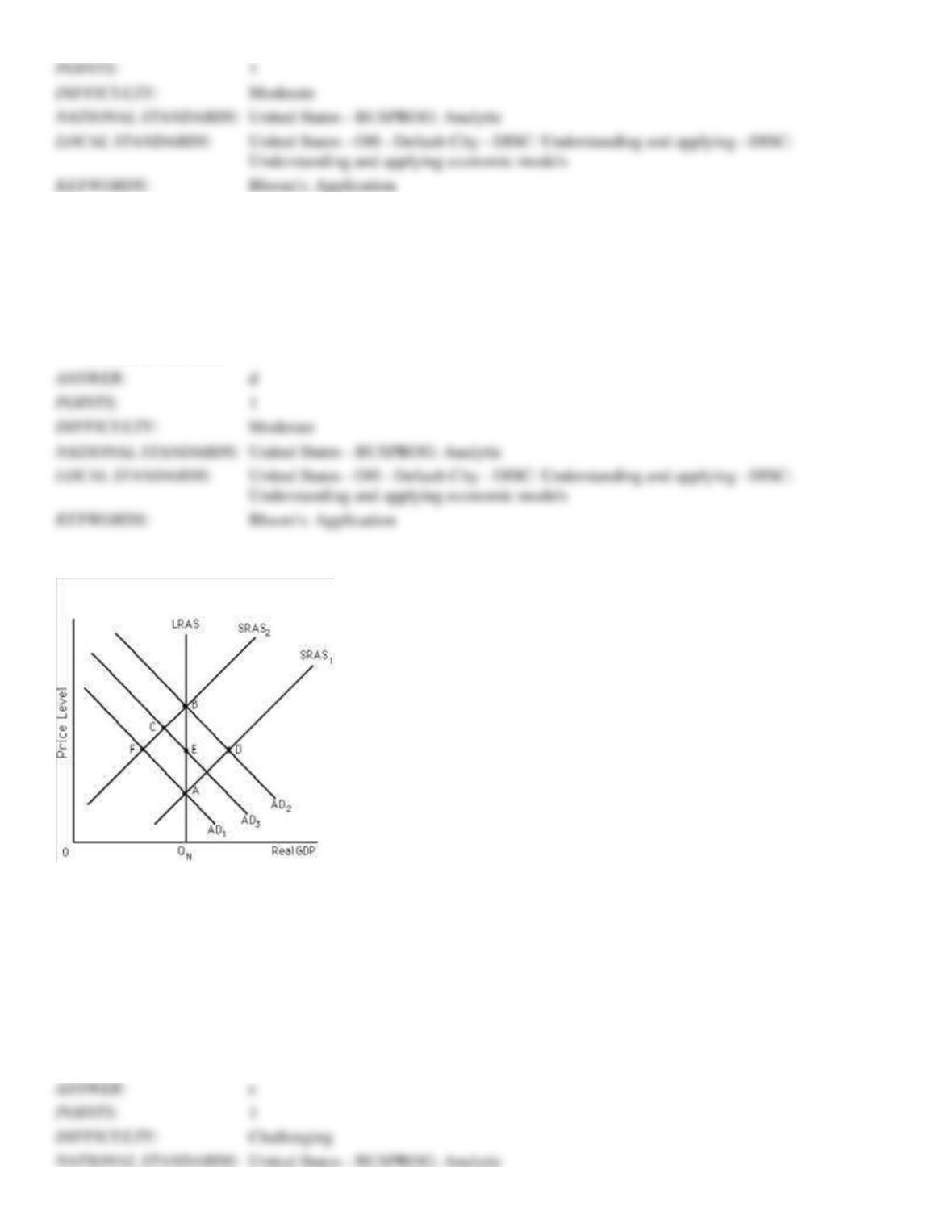
Exhibit 16-2
24. Refer to Exhibit 16-2. Suppose the economy starts out at point A. Next, the public anticipates that the Fed will use
expansionary monetary policy to shift the AD curve from AD1 to AD2. What happens, instead, is that the Fed does not
raise aggregate demand as much as the public expects (bias upward). Instead the Fed pushes the AD curve from AD1 to
AD3. As a result, according to new classical theory in the short run the economy moves to point
a.
A.
b.
B.
c.
C.
d.
D.
United States – BUSPROG: Analytic
United States – BUSPROG: Analytic
Understanding and applying economic models
Bloom’s: Application
25. Refer to Exhibit 16-2. Suppose the economy starts out at point A and the public correctly anticipates that the AD curve
will shift from AD1 to AD2. If wages are temporarily fixed, SRAS1 will __________ and the economy will end up at
point __________.
a.
shift; D
b.
shift; B
c.
not shift; D
d.
not shift; E
United States – BUSPROG: Analytic
Bloom’s: Application
26. Refer to Exhibit 16-2. Suppose the economy starts at point A. The AD curve shifts from AD1 to AD2 and the public
perfectly anticipates this. Under new Keynesian macroeconomic assumptions, the most likely short-run equilibrium point
will be
a.
point B.
b.
point E.
c.
somewhere on the line between point D and point B.
d.
somewhere on the line between point E and point B.
United States – BUSPROG: Analytic
Understanding and applying economic models
Bloom’s: Application
27. Refer to Exhibit 16-2. Suppose the economy starts at point B. Fed monetary policy shifts the AD curve to AD1. If
policy is correctly anticipated and people hold rational expectations, according to new classical theory the economy in the
short run will
a.
move to A.
b.
stay at B.
c.
move to F.
d.
move to E.
Understanding and applying economic models
Bloom’s: Application
28. Refer to Exhibit 16-2. Suppose the economy starts at point B. Fed monetary policy shifts the AD curve to AD1. A
recession is likely if the economy operates under __________ assumptions, which include wage and price __________.
a.
new classical; flexibility
b.
new classical; inflexibilities
c.
new Keynesian; flexibility
d.
new Keynesian; inflexibilities
United States – BUSPROG: Analytic
Bloom’s: Application
29. Refer to Exhibit 16-2. Suppose the economy starts at point A. Fed monetary policy shifts the AD curve to AD2. A rise
in Real GDP is likely if the economy operates under __________ assumptions, such as wage and price __________.
a.
new classical; flexibility
b.
new classical; inflexibilities
c.
new Keynesian; flexibility
d.
new Keynesian; inflexibilities
United States – BUSPROG: Analytic
Bloom’s: Application
30. Refer to Exhibit 16-2. The Policy Ineffectiveness Proposition could be illustrated by a movement between points A
and
a.
D.
b.
B.
c.
C.
d.
F.
United States – BUSPROG: Analytic
Understanding and applying economic models
31. Refer to Exhibit 16-2. Suppose the economy starts out at point A. Next, the public anticipates that the Fed will use
expansionary monetary policy to shift the AD curve from AD1 to AD2. What happens, instead, is that the Fed does not
Bloom’s: Application
raise aggregate demand as much as the public expects (bias upward). Instead the Fed pushes the AD curve from AD1 to
AD3. As a result, according to new classical theory in the long run point _____________ best represents the new state of
the economy.
a.
A
b.
B
c.
C
d.
D
e.
E
32. The difference between new classical theory and new Keynesian theory is that
a.
in new classical theory wages are assumed to be flexible, and in new Keynesian theory wages are assumed to
be somewhat inflexible.
b.
in new classical theory wages are assumed to be somewhat inflexible, and in new Keynesian theory wages are
assumed to be flexible.
c.
adaptive expectations is the dominant expectations theory in new classical theory, and rational expectations is
the dominant expectations theory in new Keynesian theory.
d.
in new Keynesian theory the short-run aggregate supply curve is vertical, and in new classical theory the short-
run aggregate supply curve is upward sloping.
1
Moderate
United States – BUSPROG: Analytic
United States – OH – Default City – DISC: Understanding and applying – DISC:
Understanding and applying economic models
Bloom’s: Application
33. Starting from long-run equilibrium, if the public anticipates that policymakers will increase aggregate demand by less
than policymakers do increase aggregate demand, and if the short-run aggregate supply curve fully adjusts to the
(incorrectly) anticipated increase in aggregate demand, then Real GDP will __________ and the price level will
__________.
a.
rise; rise
b.
decline; fall
c.
stay constant; rise
d.
decline; rise
1
Moderate
United States – BUSPROG: Analytic
Bloom’s: Application
1
Challenging
United States – BUSPROG: Analytic
United States – OH – Default City – DISC: Understanding and applying – DISC:
Understanding and applying economic models
Bloom’s: Application
34. New Keynesian theorists argue that
a.
price and wage adjustments in response to policy changes often overcompensate and cause further price
disruptions.
b.
prices and wages may not be free to adjust in response to policy changes.
c.
unions and big business have considerable power and often choose not to change wages and prices so as to
deliberately offset policy changes enacted by the government.
d.
the Fed and the Congress rarely do what they say they will do, so one should never listen to what they say.
e.
new classical rational expectations theories about how expectations are formed are completely wrong.
35. According to a new Keynesian theorist, a correctly anticipated increase in aggregate demand will
a.
cause the price level to increase by a greater amount in the short run than what a new classical rational
expectations theorist would predict.
b.
cause the price level to increase by a smaller amount in the short run than what a new classical rational
expectations theorist would predict.
c.
cause the price level to increase by the same amount in the short run that a new classical rational expectations
theorist would predict.
d.
leave the price level unchanged in the short run, but Real GDP will increase more than what a new classical
theorist would predict.
e.
leave the price level unchanged in the short run, but Real GDP will increase less than what a new classical
theorist would predict.
United States – BUSPROG: Analytic
United States – OH – Default City – DISC: Understanding and applying – DISC:
Understanding and applying economic models
Bloom’s: Application
36. Suppose that in a new classical model the public anticipates that policymakers will increase aggregate demand.
However, aggregate demand increases by less than what the public anticipated. The result in the short run is that Real
GDP ____________ and the price level ____________.
a.
decreases; decreases
b.
increases; increases
c.
increases; decreases
d.
decreases; increases
United States – BUSPROG: Analytic
United States – BUSPROG: Analytic
Bloom’s: Comprehension
37. Samuelson and Solow, in their 1960 study of the Phillips curve as it applies to the U.S. experience, argued that there
was a tradeoff between inflation and unemployment. Later experience showed their analysis to be
a.
entirely correct in every situation.
b.
generally correct, but it could not explain stagflation.
c.
wholly wrong in every situation.
d.
in general agreement with rational expectations theory.
e.
capable of explaining stagflation, but not other economic scenarios.
United States – BUSPROG: Analytic
Understanding and applying economic models
Bloom’s: Comprehension
38. The original Phillips curve depicted the relationship between
a.
price inflation and unemployment.
b.
price inflation and employment.
c.
wage inflation and unemployment.
d.
wage inflation and employment.
United States – BUSPROG: Analytic
Bloom’s: Knowledge
39. Stagflation
a.
is highly unlikely if the Phillips curve is downward sloping.
b.
implies that a tradeoff between inflation and unemployment may not always exist.
c.
is the simultaneous occurrence of high rates of inflation and unemployment.
d.
b and c
e.
a, b, and c
United States – BUSPROG: Analytic
Bloom’s: Comprehension
40. The Friedman natural rate theory states that
a.
in both the short run and the long run the economy stays at its natural rate of unemployment.
Understanding and applying economic models
Bloom’s: Comprehension
b.
the economy will not return to its natural rate of unemployment in either the short run or the long run.
c.
the economy stays at its natural rate of unemployment in the short run, but not in the long run.
d.
in the long run the economy returns to its natural rate of unemployment.
41. The Friedman natural rate theory implies that there is a tradeoff between inflation and unemployment in
a.
neither the short run nor the long run.
b.
both the short run and the long run.
c.
the short run, but not in the long run.
d.
the long run, but not in the short run.
United States – BUSPROG: Analytic
Bloom’s: Comprehension
42. New classical economists believe that if policy is correctly anticipated and if rational expectations hold, when the Fed
increases the money supply the result will be a(n) ______________ in the price level and
____________________________.
a.
decrease; no change in Real GDP
b.
decrease; decrease in Real GDP
c.
increase; no change in Real GDP
d.
increase; increase in Real GDP
United States – BUSPROG: Analytic
Understanding and applying economic models
Bloom’s: Application
43. Implied in new Keynesian theory is that when policy is correctly anticipated, there is a tradeoff between inflation and
unemployment in
a.
neither the short run nor the long run.
b.
both the short run and the long run.
c.
the short run, but not in the long run.
d.
the long run, but not in the short run.
United States – BUSPROG: Analytic
Bloom’s: Comprehension
44. According to new Keynesian theory, if policy is correctly anticipated, increases in aggregate demand will stimulate
the economy to higher levels of Real GDP and lower levels of unemployment in
a.
the short run or the long run.
b.
neither the short run nor the long run.
c.
the short run, but not in the long run.
d.
the long run, but not in the short run.
United States – BUSPROG: Analytic
Understanding and applying economic models
Bloom’s: Comprehension
45. The difference between the new classical theory and the new Keynesian theory is the assumption of
a.
rational expectations.
b.
adaptive expectations.
c.
complete flexibility of wages and prices in the short run.
d.
a and c
e.
b and c
United States – BUSPROG: Analytic
Bloom’s: Comprehension
46. If expectations are formed rationally, wages and prices are completely flexible in the short run and policy is correctly
anticipated, increases in aggregate demand will
a.
cause lower short-run price level increases than a Keynesian would expect.
b.
cause higher short-run price level increases than a Keynesian would expect.
c.
not impact the general price level.
d.
produce both increases and decreases in the price level at different times.
United States – BUSPROG: Analytic
Bloom’s: Comprehension
United States – BUSPROG: Analytic
Bloom’s: Comprehension
47. If expectations are formed rationally, wages and prices are completely flexible in both the short run and the long run,
and policy is correctly anticipated, increases in aggregate demand will stimulate the economy to higher levels of Real
GDP in
a.
the short run or the long run.
b.
neither the short run nor the long run.
c.
the short run, but not in the long run.
d.
the long run, but not in the short run.
48. If expectations are formed rationally, wages and prices are not completely flexible in the short run, and policy is
correctly anticipated, increases in aggregate demand will stimulate the economy to higher levels of Real GDP and lower
levels of unemployment in
a.
the short run or the long run.
b.
neither the short run nor the long run.
c.
the short run, but not in the long run.
d.
the long run, but in not the short run.
United States – BUSPROG: Analytic
Bloom’s: Application
49. According to the original Phillips curve, the cost of reducing the unemployment rate in the short run is a
a.
fall in Real GDP.
b.
fall in nominal GDP.
c.
lower rate of price inflation.
d.
higher rate of wage inflation.
United States – BUSPROG: Analytic
Bloom’s: Comprehension
50. The original (1958) Phillips curve
a.
showed that stagflation is inevitable.
b.
showed the tradeoff between the use of monetary and fiscal policy.
United States – BUSPROG: Analytic
Bloom’s: Comprehension
c.
has never been used as an important economic policy tool.
d.
suggested a tradeoff between wage inflation and the unemployment rate.
e.
none of the above
51. The original (1958) Phillips curve stated that
a.
unemployment and money wage rates move in the same direction.
b.
unemployment and money wage rates move in opposite directions.
c.
there is an inverse relationship between price inflation and
unemployment.
d.
there is a direct relationship between price inflation and unemployment.
e.
a and c
b
1
Easy
United States – BUSPROG: Analytic
United States – OH – Default City – DISC: Understanding and applying – DISC:
Bloom’s: Comprehension
52. The Samuelson-Solow version of the Phillips curve states that
a.
there is an inverse relationship between the wage inflation rate
and unemployment.
b.
there is a direct relationship between the wage inflation rate
and unemployment.
c.
there is an inverse relationship between price inflation and
unemployment.
d.
there is a direct relationship between price inflation and unemployment.
e.
a and b
1
Moderate
United States – BUSPROG: Analytic
United States – OH – Default City – DISC: Understanding and applying – DISC:
Understanding and applying economic models
Bloom’s: Comprehension
53. In the 1970s and early 1980s, the U.S. economy experienced
a.
stagflation.
b.
low inflation and low unemployment.
c.
high inflation and low unemployment.
d
1
Easy
United States – BUSPROG: Analytic
United States – OH – Default City – DISC: Understanding and applying – DISC:
Understanding and applying economic models
Bloom’s: Knowledge
d.
high inflation and high unemployment.
e.
a and d
Exhibit 16-3
54. Refer to Exhibit 16-3. The economy is at point A. As the result of an unexpected increase in aggregate demand, in the
short run, the Friedman natural rate theory would predict
a.
movement to point B.
b.
movement to point C.
c.
movement to point C’.
d.
no movement from point A.
Moderate
United States – BUSPROG: Analytic
Bloom’s: Application
55. Refer to Exhibit 16-3. The economy is at point A. According to the Friedman natural rate theory, in the long run after
a rise in the money supply, the economy will be at point
a.
A.
b.
B.
c.
C’.
d.
C.
Moderate
United States – BUSPROG: Analytic
Understanding and applying economic models
Bloom’s: Knowledge
56. Refer to Exhibit 16-3. The economy is at point C. If a decrease in aggregate demand is correctly anticipated in the
short run, new classical theory would predict
a.
no movement from point C.
b.
immediate movement to point C’.
c.
immediate movement to point B.
d.
immediate movement to point A.
d
1
Challenging
United States – BUSPROG: Analytic
Bloom’s: Application
57. For the period 1961 to 1969, the Phillips curve for the United States displayed the same shape that A. W. Phillips
found for the United Kingdom for the period 1861 to 1913—it was
a.
horizontal.
b.
vertical.
c.
downward sloping.
d.
upward sloping.
1
Easy
United States – BUSPROG: Analytic
Understanding and applying economic models
Bloom’s: Knowledge
58. Events of the 1970s and early 1980s showed that
a.
the Phillips curve presents policymakers with a stable menu of choices.
b.
cycles of unemployment and inflation rates appear to have gravitated around a 6 percent unemployment rate.
c.
lower inflation rates are consistently accompanied by higher unemployment rates.
d.
a tradeoff between inflation and unemployment may not always exist.
e.
a and c
d
1
Moderate
United States – BUSPROG: Analytic
Understanding and applying economic models
United States – BUSPROG: Analytic
Bloom’s: Application
59. An increase in the actual inflation rate is represented by a
a.
movement up and along a given Phillips curve.
b.
movement down and along a given Phillips curve.
c.
leftward shift in the Phillips curve.
d.
rightward shift in the Phillips curve.
60. One of the ideas that found a permanent place in macroeconomics after Milton Friedman’s presidential address to the
American Economic Association in 1967 was that
a.
there is not only a temporary tradeoff between inflation and unemployment, but a permanent tradeoff as well.
b.
the tradeoff between unemployment and inflation exists only in the long run, but not in the short run.
c.
people’s expectations about economic events affect economic outcomes.
d.
a and b
United States – BUSPROG: Analytic
Understanding and applying economic models
Bloom’s: Knowledge
61. An unexpected decrease in aggregate demand will cause
a.
a movement up the short-run Phillips curve.
b.
a movement down the short-run Phillips curve.
c.
an upward shift in the short-run Phillips curve.
d.
a downward shift in the short-run Phillips curve.
United States – BUSPROG: Analytic
Understanding and applying economic models
Bloom’s: Comprehension
62. As incorrectly low inflation expectations catch up with the higher actual inflation rate, the SRAS curve shifts
__________ and the short-run Phillips curve shifts __________.
a.
leftward; downward
b.
rightward; upward
c.
leftward; upward
d.
rightward; downward
United States – BUSPROG: Analytic
Bloom’s: Comprehension