Efficient Resource Allocation: A Review
76. In a properly functioning free market
a.
the price of any good reflects its marginal utility to consumers.
b.
price will equal marginal cost.
c.
the invisible hand will assure that society’s resources are used efficiently.
d.
All of the above are correct.
Easy
DISC: Markets, market failure, a – DISC: Markets, market failure, and externalities
United States – BPROG: Reflective Thinking – BPROG: Analysis
Markets, market failure, and ext – Markets, market failure, and externalities
Efficient Resource Allocation: A Review
77. The construct used to demonstrate efficient use of society’s resources is the
a.
production possibilities frontier.
b.
payoff matrix.
c.
input-output table.
d.
cost-benefit table.
a
Easy
DISC: Scarcity, tradeoffs, and o – DISC: Scarcity, tradeoffs, and opportunity cost
United States – BPROG: Analytic
Scarcity, tradeoffs, and opportu – Scarcity, tradeoffs, and opportunity cost
Efficient Resource Allocation: A Review
78. Producing more cabbage is efficient if
a.
cabbage production can be increased without reducing production of other goods.
b.
the opportunity cost of more cabbage is less than its marginal utility.
c.
society values the additional cabbage more highly than the lettuce it must give up to produce the extra
cabbage.
d.
All of the above are correct.
Easy
DISC: Costs of production
United States – BPROG: Reflective Thinking – BPROG: Analysis
Costs of production
Efficient Resource Allocation: A Review
79. In an ideal competitive market economy
a.
resources are allocated according to a person’s needs.
b.
resources are allocated according to ability to pay.
c.
social and individual needs are met by the market.
d.
All of the above are true.
DISC: Markets, market failure, a – DISC: Markets, market failure, and externalities
United States – BPROG: Analytic
Markets, market failure, and ext – Markets, market failure, and externalities
Efficient Resource Allocation: A Review
80. In an ideal free unregulated market
a.
supply curves reflect all negative externalities.
b.
external benefits are abundant.
c.
all individual and social needs are met by the market.
d.
optimal quantities of all goods and services are produced.
DISC: Markets, market failure, a – DISC: Markets, market failure, and externalities
United States – BPROG: Reflective Thinking – BPROG: Analysis
Markets, market failure, and ext – Markets, market failure, and externalities
Efficient Resource Allocation: A Review
81. It is efficient to increase the output of computers if
a.
society considers the extra computers more valuable than other goods foregone to produce the computers.
b.
the opportunity cost of more computers is greater than their marginal utility.
c.
computer production can be increased only if production of other goods is decreased.
d.
the price of the computers is equal to their average cost.
DISC: Markets, market failure, a – DISC: Markets, market failure, and externalities
United States – BPROG: Reflective Thinking – BPROG: Analysis
Markets, market failure, and ext – Markets, market failure, and externalities
Efficient Resource Allocation: A Review
82. An economy is operating with optimum efficiency if
a.
the price of the product is greater than marginal cost.
b.
the production of more of commodity A entails the production of less of commodity B.
c.
marginal cost of output is greater than marginal utility of output.
d.
an increase in output would result in a decrease in average cost per unit.
DISC: Costs of production
United States – BPROG: Reflective Thinking – BPROG: Analysis
Costs of production
Efficient Resource Allocation: A Review
83. An externality is an event which
a.
is external to economics.
b.
always brings harm to someone in the economy.
c.
is incidental to some market activity.
d.
harms the economy as a whole rather than a particular person.
DISC: Markets, market failure, a – DISC: Markets, market failure, and externalities
United States – BPROG: Analytic
Markets, market failure, and ext – Markets, market failure, and externalities
Externalities: Getting the Prices Wrong
84. A good is most likely to be inefficiently priced if
a.
some of the resources used in its production are scarce.
b.
the good is private property.
c.
some of the resources used in its production are free.
d.
a corporation produces the good.
DISC: Productivity and growth
United States – BPROG: Analytic
Productivity and growth
Externalities: Getting the Prices Wrong
85. A market transaction causes an externality if someone
a.
directly involved in the transaction receives uncompensated benefits or costs from it.
b.
not directly involved in the transaction receives uncompensated benefits or costs from it.
c.
directly involved in the transaction seeks legal assistance to ensure that the transaction is carried out.
d.
not directly involved in the transaction interferes in it by imposing regulations or product standards.
DISC: Markets, market failure, a – DISC: Markets, market failure, and externalities
United States – BPROG: Analytic
Markets, market failure, and ext – Markets, market failure, and externalities
Externalities: Getting the Prices Wrong
86. If the production of a good generates a detrimental externality, then at that level of production of the good under
perfect competition,
a.
MU = MSC.
b.
P < MPC.
c.
MPC < MSC.
d.
MPC > MSC.
DISC: Markets, market failure, a – DISC: Markets, market failure, and externalities
United States – BPRPOG: Analysis
Markets, market failure, and ext – Markets, market failure, and externalities
Externalities: Getting the Prices Wrong
87. A good’s marginal social cost is defined as its
a.
marginal private cost minus the value of any detrimental externality.
b.
incidental cost.
c.
marginal private cost plus the value of any taxes paid on its production.
d.
marginal private cost plus its incidental cost.
DISC: Marginal costs & benefits
United States – BPROG: Analytic
Marginal costs & benefits
Externalities: Getting the Prices Wrong
88. Which term refers to the share of an activity’s marginal cost that is paid for by the persons who carry out the activity?
a.
Beneficial cost
b.
Incidental cost
c.
Marginal private cost
d.
Marginal social cost
DISC: Marginal costs & benefits
United States – BPROG: Analytic
Marginal costs & benefits
Externalities: Getting the Prices Wrong
89. Which term refers to the share of an activity’s marginal cost that is paid for by people other than those who carry out
the activity?
a.
Beneficial cost
b.
Incidental cost
c.
Marginal private cost
d.
Marginal social cost
DISC: Marginal costs & benefits
United States – BPROG: Analytic
Marginal costs & benefits
Externalities: Getting the Prices Wrong
90. If the production of a good generates a detrimental externality, then at that level of production of the good under
perfect competition,
a.
MSC > P.
b.
MPC > MSC.
c.
P > MU.
d.
MPC > P.
DISC: Markets, market failure, a – DISC: Markets, market failure, and externalities
United States – BPROG: Reflective Thinking – BPROG: Analysis
Markets, market failure, and ext – Markets, market failure, and externalities
Externalities: Getting the Prices Wrong
91. A firm is generating detrimental externalities when
a.
MSC is less than MPC.
b.
MSC is the same as MPC.
c.
MSC is greater than MPC.
d.
MPC includes some incidental costs.
DISC: Markets, market failure, a – DISC: Markets, market failure, and externalities
United States – BPROG: Analytic
Markets, market failure, and ext – Markets, market failure, and externalities
Externalities: Getting the Prices Wrong
92. If production of a good creates beneficial externalities, a perfectly competitive market will produce
a.
less output than would maximize profit.
b.
more output than would maximize profit.
c.
less output than is socially efficient.
d.
more output than is socially efficient.
DISC: Markets, market failure, a – DISC: Markets, market failure, and externalities
United States – BPROG: Analytic
Markets, market failure, and ext – Markets, market failure, and externalities
93. Many detrimental externalities occur because
a.
persons do not pay the full social cost of using a resource.
b.
persons do not pay the full private cost of using a resource.
c.
companies do not pay the market price for natural resources.
d.
companies pay more than the full social cost of using a resource.
DISC: Markets, market failure, a – DISC: Markets, market failure, and externalities
United States – BPROG: Analytic
Markets, market failure, and ext – Markets, market failure, and externalities
Externalities: Getting the Prices Wrong
94. The factor that leads to underpricing and overuse of an economic resource is
a.
human greed and selfishness.
b.
capital markets.
c.
the lack of an enforceable property right.
d.
the lack of understanding of pollution and its effects.
DISC: Markets, market failure, a – DISC: Markets, market failure, and externalities
United States – BPROG: Analytic
Markets, market failure, and ext – Markets, market failure, and externalities
Externalities: Getting the Prices Wrong
95. Land on both sides of the border of Brazil and Venezuela has long been occupied by the Yanomamo people. These
“fierce people” are the last Stone Age tribe left in South America. Following discovery of gold, approximately 45,000
garimperios (gold miners) invaded the Yanomamo territory. The mining process pollutes the rivers and scares away game,
so traditional Yanomamo sources of food, are almost impossible to find now. The Yanomamo are starving. Economists
call this problem
a.
the cost disease.
b.
an externality.
c.
specialization.
d.
rent seeking.
Moderate
DISC: Markets, market failure, a – DISC: Markets, market failure, and externalities
United States – BPRPOG: Analysis BPROG: Reflecti – Reflective
Markets, market failure, and ext – Markets, market failure, and externalities
Externalities: Getting the Prices Wrong
96. The classic example of a detrimental externality is
a.
education.
b.
pollution.
c.
discovery of an AIDS vaccine.
d.
Mrs. Lewis’ prize-winning rose garden.
Easy
DISC: Markets, market failure, a – DISC: Markets, market failure, and externalities
United States – BPROG: Analytic
Markets, market failure, and ext – Markets, market failure, and externalities
Externalities: Getting the Prices Wrong
97. The key explanation for the prevalence of waterway pollution is
a.
the inclusion in production of all costs involving use of the waterway.
b.
that there are private costs but no costs to society.
c.
that waterways are not private property and can be used free of charge.
d.
that waterways are subject to the market’s normal control procedures.
c
Moderate
DISC: Markets, market failure, a – DISC: Markets, market failure, and externalities
United States – BPROG: Reflective Thinking – BPROG: Analysis
Externalities: Getting the Prices Wrong
98. It is true of externalities that they
a.
are always detrimental.
b.
are always beneficial.
c.
arise when all costs, social and private, are included in production cost.
d.
cause the price system to misallocate resources.
DISC: Markets, market failure, a – DISC: Markets, market failure, and externalities
United States – BPROG: Reflective Thinking – BPROG: Analysis
Markets, market failure, and ext – Markets, market failure, and externalities
Externalities: Getting the Prices Wrong
99. It is true of externalities that they
a.
arise when all costs, social and private, are included in production cost.
b.
are always beneficial.
c.
are always detrimental.
d.
None of the above are correct.
DISC: Markets, market failure, a – DISC: Markets, market failure, and externalities
United States – BPROG: Reflective Thinking – BPROG: Analysis
Markets, market failure, and ext – Markets, market failure, and externalities
Externalities: Getting the Prices Wrong
100. An example of a beneficial externality is
a.
airport noise.
b.
a blooming curbside bed of violets.
c.
pollution of a fishing lake.
d.
freeway congestion.
DISC: Markets, market failure, a – DISC: Markets, market failure, and externalities
United States – BPROG: Reflective Thinking – BPROG: Analysis
Markets, market failure, and ext – Markets, market failure, and externalities
Externalities: Getting the Prices Wrong
101. If P = MC for all goods in a free-market economy, then
a.
the desire for utility maximization will lead consumers to buy the amount of each good at which MU = MC.
b.
the desire for profit maximization will lead consumers to buy the amount of each good at which MU = MC.
c.
the desire for utility maximization will lead consumers to buy only those goods that have low opportunity
costs.
d.
the desire for profit maximization will lead all firms to stop producing in the long run (though possibly not in
the short run).
DISC: Marginal costs & benefits
United States – BPROG: Analytic
Marginal costs & benefits
Externalities: Getting the Prices Wrong
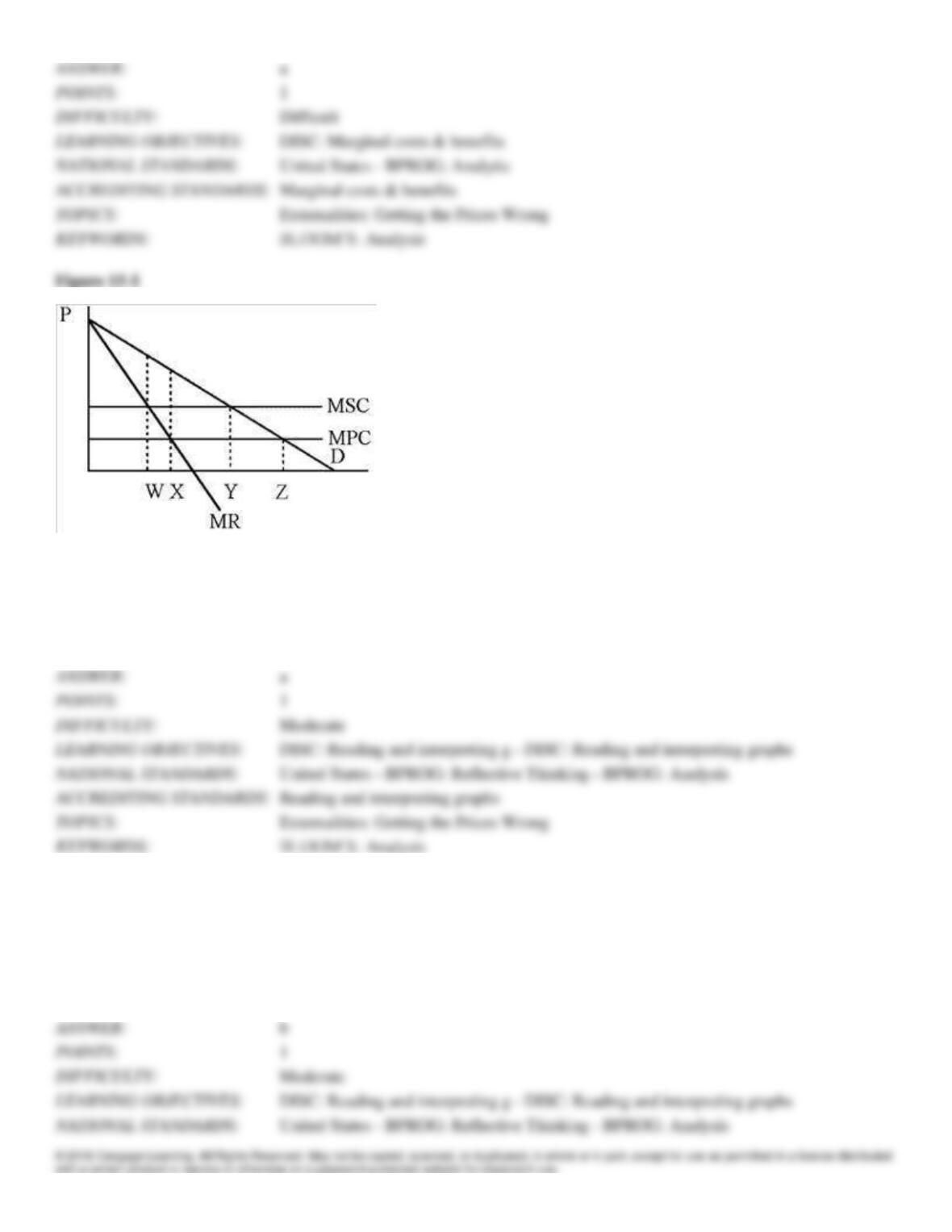
102. Figure 15-1 portrays conditions in the monopolized weezil industry. From the diagram, the production of weezils
a.
must cause a detrimental externality.
b.
must cause a beneficial externality.
c.
must cause either a detrimental or a beneficial externality, more information is needed to determine which one.
d.
may or may not cause an externality.
DISC: Reading and interpreting g – DISC: Reading and interpreting graphs
United States – BPROG: Reflective Thinking – BPROG: Analysis
Reading and interpreting graphs
Externalities: Getting the Prices Wrong
103. Figure 15-1 describes conditions in the monopolized weezil industry. In the absence of government intervention, the
monopolist will produce an output equal to
a.
W.
b.
X.
c.
Y.
d.
Z.
DISC: Reading and interpreting g – DISC: Reading and interpreting graphs
United States – BPROG: Reflective Thinking – BPROG: Analysis
Reading and interpreting graphs
Externalities: Getting the Prices Wrong
104. Figure 15-1 describes conditions in the monopolized weezil industry. If the government replaces the monopolist with
perfectly competitive firms and forces these firms to take account of all the costs and benefits they impose on society, the
industry will produce an output equal to
a.
W.
b.
X.
c.
Y.
d.
Z.
DISC: Reading and interpreting g – DISC: Reading and interpreting graphs
United States – BPROG: Reflective Thinking – BPROG: Analysis
Reading and interpreting graphs
Externalities: Getting the Prices Wrong
105. When beneficial externalities are present in a market, the actual output will be
a.
greater than the optimal output.
b.
smaller than the optimal output.
c.
equal to the optimal output.
d.
either smaller or greater than the optimal output.
DISC: Markets, market failure, a – DISC: Markets, market failure, and externalities
United States – BPROG: Analytic
Markets, market failure, and ext – Markets, market failure, and externalities
Externalities: Getting the Prices Wrong
106. In the case of a beneficial externality
a.
marginal private cost is below marginal social cost.
b.
marginal social cost is above marginal private cost.
c.
marginal social cost and marginal private cost are equal.
d.
the free market price is below the socially efficient price.
DISC: Markets, market failure, a – DISC: Markets, market failure, and externalities
United States – BPROG: Analytic
Markets, market failure, and ext – Markets, market failure, and externalities
Externalities: Getting the Prices Wrong
107. Marginal social cost is defined as marginal private cost
a.
plus opportunity cost.
b.
plus marginal opportunity cost.
c.
minus incidental cost.
d.
plus incidental cost.
DISC: Marginal costs & benefits
United States – BPROG: Analytic
Marginal costs & benefits
Externalities: Getting the Prices Wrong
108. The desirable level of output in a perfectly competitive market if there exists a detrimental externality is
a.
the point at which MSC curve intersects the marginal revenue curve.
b.
the point at which MSC intersects the MPC.
c.
the point at which MSC intersects MPC.
d.
the point at which marginal revenue curve intersects the MPC.
DISC: Marginal costs & benefits
United States – BPROG: Analytic
Marginal costs & benefits
Externalities: Getting the Prices Wrong
109. One of the reasons why firms pollute air and water is that
a.
air and water are often not priced.
b.
managers desire to pollute.
c.
air and water have no value to society.
d.
managers are profit maximizers.
DISC: Markets, market failure, a – DISC: Markets, market failure, and externalities
United States – BPROG: Reflective Thinking – BPROG: Analysis
Markets, market failure, and ext – Markets, market failure, and externalities
Externalities: Getting the Prices Wrong
110. A local flower grower grows products in a plot of land which is exceptionally colorful, and is admired by many
passersby. There is no way to charge for this in the price of the flowers. We can safely conclude that
a.
the florist produces too many flowers.
b.
the florist produces too few flowers.
c.
the florist produces the right amount of flowers.
d.
society pays the socially optimal amount for the flowers.
DISC: Markets, market failure, a – DISC: Markets, market failure, and externalities
United States – BPROG: Reflective Thinking – BPROG: Analysis
Markets, market failure, and ext – Markets, market failure, and externalities
Externalities: Getting the Prices Wrong
111. Which of the following would be classified as an externality?
a.
Smoke from a chimney causes discolored and peeling paint on other houses in the neighborhood.
b.
Noise from an unmuffled car wakes a sleeping person.
c.
A neighbor cleans up a yard and repaints a house.
d.
All of the above are externalities.
DISC: Markets, market failure, a – DISC: Markets, market failure, and externalities
United States – BPROG: Reflective Thinking – BPROG: Analysis
Markets, market failure, and ext – Markets, market failure, and externalities
112. If a detrimental externality is being produced in the course of producing a good, then
a.
P > MSC.
b.
MSC < MPC.
c.
incidental costs are negative.
d.
output is inefficiently large.
DISC: Markets, market failure, a – DISC: Markets, market failure, and externalities
United States – BPROG: Analytic
Markets, market failure, and ext – Markets, market failure, and externalities
Externalities: Getting the Prices Wrong
Figure 15-2
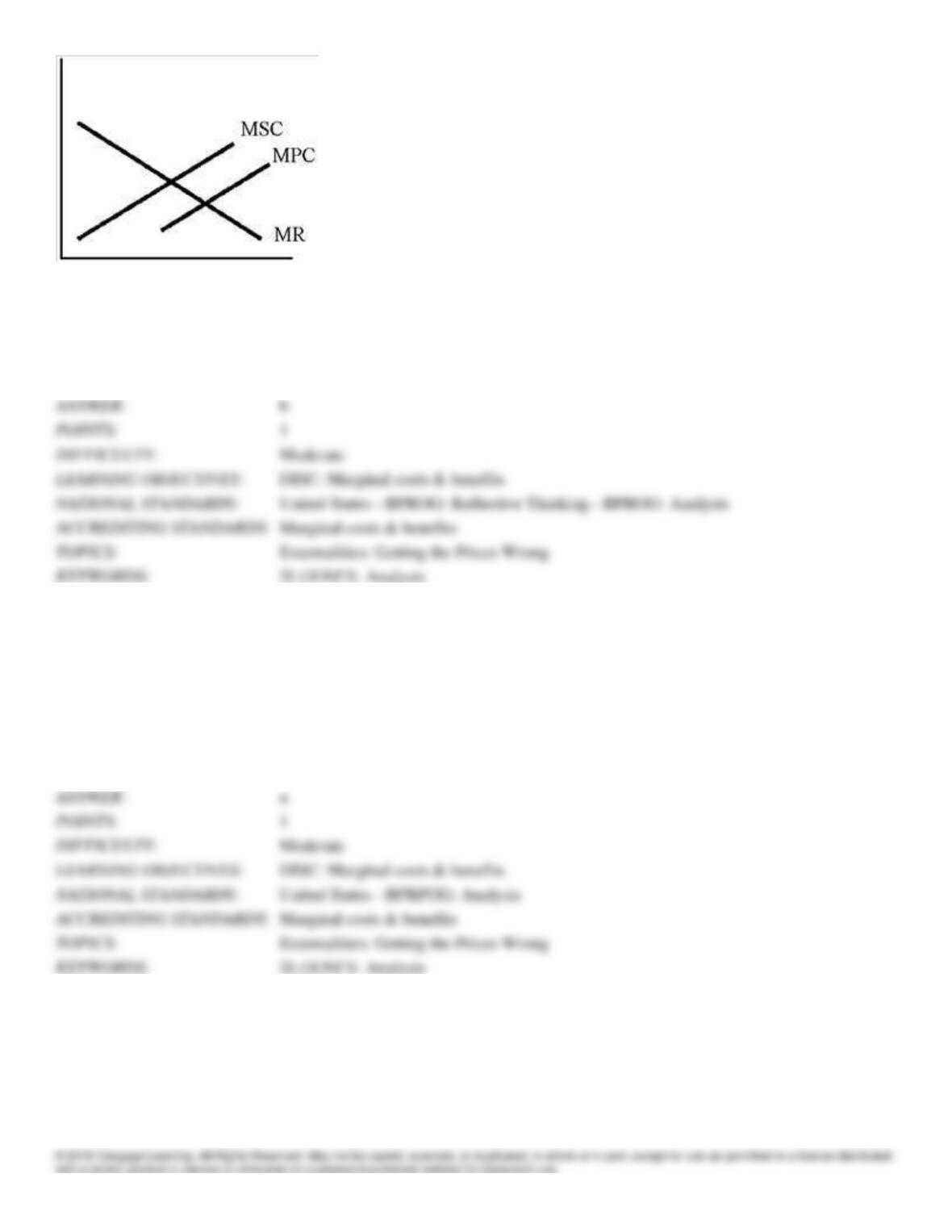
113. The firm illustrated in Figure 15-2 is producing
a.
less than it would if the external costs were internalized.
b.
more than it would if external costs were internalized.
c.
a beneficial externality.
d.
at the socially optimal point.
DISC: Marginal costs & benefits
United States – BPROG: Reflective Thinking – BPROG: Analysis
Marginal costs & benefits
Externalities: Getting the Prices Wrong
114. The Rand Corporation estimates that the external costs imposed by alcohol consumption (for example, deaths caused
by drunk drivers) to be 48 cents per ounce consumed. Taxes on alcohol amount to 23 cents per ounce consumed. This
information suggests: (i) alcohol is overconsumed; (ii) alcohol taxes should be raised. Which of these statements is
correct?
a.
i and ii
b.
i not ii
c.
ii not i
d.
neither i nor ii
DISC: Marginal costs & benefits
United States – BPRPOG: Analysis
Marginal costs & benefits
Externalities: Getting the Prices Wrong
115. Which of the following statements is correct?
a.
Marginal social cost is the share of marginal cost caused by an activity that is paid for by the persons who
carry out the activity.
b.
Marginal private cost is the share of marginal cost caused by an activity that is borne by persons other than
those who carry out the activity.
c.
Marginal social cost is the sum of marginal private cost and incidental cost.
d.
Marginal private cost and incidental cost are one and the same.
DISC: Marginal costs & benefits
United States – BPROG: Analytic
Marginal costs & benefits
Externalities: Getting the Prices Wrong
116. In a free market where a firm’s activity causes detrimental externalities,
a.
marginal benefits will be less than marginal social costs.
b.
smaller outputs than those that maximize profits will be socially desirable.
c.
marginal social cost will be greater than marginal private cost.
d.
All of the above are correct.
DISC: Marginal costs & benefits
United States – BPROG: Reflective Thinking – BPROG: Analysis
Markets, market failure, and ext – Markets, market failure, and externalities
Externalities: Getting the Prices Wrong
117. Where a firm generates beneficial externalities, society would be better off if
a.
the firm produced a larger output level.
b.
the firm reduced its output level.
c.
a tax was levied on the firm equal to the dollar amount of the externalities.
d.
price was reduced below marginal private cost.
DISC: Markets, market failure, a – DISC: Markets, market failure, and externalities
United States – BPROG: Analytic
Markets, market failure, and ext – Markets, market failure, and externalities
Externalities: Getting the Prices Wrong
118. Market economies have air and water pollution, but nonmarket economies
a.
have much less pollution.
b.
have pollution that is much worse than in market economies.
c.
have about the same amount of pollution as market economies.
d.
don’t generally suffer from external effects of any sort.
DISC: Markets, market failure, a – DISC: Markets, market failure, and externalities
United States – BPROG: Analytic
Markets, market failure, and ext – Markets, market failure, and externalities
Externalities: Getting the Prices Wrong
119. Free market economies
a.
often have dirty air and rivers.
b.
acting on their own do not do enough to efficiently deal with externality problems.
c.
while not protecting the environment automatically do offer a powerful tool that may be used for that purpose.
d.
All of the above are correct.
DISC: Markets, market failure, a – DISC: Markets, market failure, and externalities
United States – BPROG: Analytic
Markets, market failure, and ext – Markets, market failure, and externalities
Externalities: Getting the Prices Wrong
120. The former communist countries of eastern Europe and the Soviet Union
a.
have a better track record in environment protection than market economies.
b.
have a dismal environmental record.
c.
epitomize the ability of planned economies to protect the environment.
d.
have no water pollution problems.
DISC: Markets, market failure, a – DISC: Markets, market failure, and externalities
United States – BPROG: Analytic
Markets, market failure, and ext – Markets, market failure, and externalities
Externalities: Getting the Prices Wrong
121. Governments can most effectively encourage a firm to produce the efficient level of output of a good whose
production causes a beneficial externality by
a.
increasing the demand at every price for the good.
b.
subsidizing the production of the good.
c.
taxing the production of the good.
d.
imposing a price ceiling on the good.
DISC: The role of government
United States – BPROG: Analytic
The role of government
Externalities: Getting the Prices Wrong
122. Governments can deal with externalities through the use of
a.
subsidies.
b.
taxes.
c.
price controls.
d.
All of the above are correct.
Easy
DISC: The role of government
United States – BPROG: Analytic
The role of government
Externalities: Getting the Prices Wrong
123. An appropriate government policy toward negative externalities is to
a.
subsidize the activity that creates the negative externality.
b.
impose a tax or fine on the activity that creates the negative externality.
c.
pay money to the party that creates the negative externality.
d.
impose a tax on recipients of the negative externality.
Moderate
DISC: The role of government
United States – BPROG: Analytic
The role of government
Externalities: Getting the Prices Wrong
124. Motorcycle helmet laws have been controversial in some states. Riders prefer the feel of the wind on their faces.
Others, however, point out that riders without helmets are more likely to suffer severe injury and run up hospital bills at
public expense. Which of the following would most likely reduce the incidence of high bills for helmetless riders?
a.
raise insurance rates for helmetless riders
b.
lower insurance rates for helmetless riders
c.
publish information on injury rates for helmetless riders
d.
subsidize hospitals
a
Difficult
DISC: The role of government
United States – BPROG: Analytic
Markets, market failure, and ext – Markets, market failure, and externalities
Externalities: Getting the Prices Wrong
125. The economic justification for public subsidies to university research is based on
a.
the value of this research to the university.
b.
the higher salaries graduate students earn as a result of working with professors involved in research.
c.
the external benefits of research and development to, in particular, high rates of economic growth.
d.
higher incomes earned by those who provide services to university researchers (equipment, supplies, etc.).
DISC: The role of government
United States – BPROG: Reflective Thinking – BPROG: Analysis
Markets, market failure, and ext – Markets, market failure, and externalities
Externalities: Getting the Prices Wrong
126. Because smoking causes illness and disability to smokers, society must maintain more health-service capacity than it
would need in the absence of smoking. Since the cost of maintaining this capacity is covered to a substantial degree by
health insurance, even nonsmokers must pay higher premiums. Also, smokers hurt nonsmokers as a result of “passive
smoke.” The Rand Corporation estimates these costs to be 29 cents per pack of cigarettes. Cigarette taxes average 37 cents
per pack. Based on the economist’s definition of efficiency, it follows that
a.
cigarette taxes are too high, and cigarette production is lower than the efficient amount.
b.
cigarette taxes should be increased until external costs are zero.
c.
since the tax exceeds the marginal cost, we have a better than efficient outcome.
d.
we are overconsuming cigarettes.
DISC: Markets, market failure, a – DISC: Markets, market failure, and externalities
United States – BPROG: Reflective Thinking – BPROG: Analysis
Markets, market failure, and ext – Markets, market failure, and externalities
Externalities: Getting the Prices Wrong
127. Effective methods of dealing with externalities would include
a.
taxing firms that generate beneficial externalities.
b.
imposing fines equal to the difference between MSC and MPC on firms that generate beneficial externalities.
c.
giving a subsidy per unit equal to the difference between MSC and MPC to firms that generate beneficial
externalities.
d.
restricting the output of firms that generate beneficial externalities.
DISC: Markets, market failure, a – DISC: Markets, market failure, and externalities
United States – BPRPOG: Analysis
Markets, market failure, and ext – Markets, market failure, and externalities
Externalities: Getting the Prices Wrong
128. Government often finds it difficult to cope with externalities because
a.
costs and benefits are difficult to assess in monetary terms.
b.
taxes and subsidies are ineffective in equating MSC and MSB.
c.
government has no authority to impose fines for air and water pollution.
d.
marginal private cost curves cannot be shifted.
a
Moderate
DISC: Marginal costs & benefits
United States – BPROG: Reflective Thinking – BPROG: Analysis
Marginal costs & benefits
Externalities: Getting the Prices Wrong
129. A public good is
a.
any good provided by government.
b.
a good that can be most cheaply provided by government, though it may in fact be provided by private
enterprise.
c.
a good whose benefits cannot readily be restricted to a small group of people.
d.
a good whose benefits cannot be enjoyed by an individual alone.
c
Easy
DISC: Markets, market failure, a – DISC: Markets, market failure, and externalities
United States – BPROG: Analytic
Markets, market failure, and ext – Markets, market failure, and externalities
Provision of Public Goods
130. A true public good is characterized by
a.
depletability but not excludability.
b.
excludability but not depletability.
c.
both depletability and excludability.
d.
neither depletability nor excludability.
Moderate
DISC: Markets, market failure, a – DISC: Markets, market failure, and externalities
United States – BPROG: Analytic
Markets, market failure, and ext – Markets, market failure, and externalities
Provision of Public Goods
131. The “free rider” problem occurs when a good is
a.
not available.
b.
not excludable.
c.
not depletable.
d.
not sold in free markets.
DISC: Markets, market failure, a – DISC: Markets, market failure, and externalities
United States – BPROG: Analytic
Markets, market failure, and ext – Markets, market failure, and externalities
Provision of Public Goods
132. Students in a class are assigned to groups to work on a project. A grade will be given for each project, and everyone
in the group will receive that grade. For the members of a particular group, the grade is a
a.
beneficial externality.
b.
public good.
c.
detrimental externality.
d.
moral hazard.
DISC: Markets, market failure, a – DISC: Markets, market failure, and externalities
United States – BPROG: Reflective Thinking – BPROG: Analysis
Markets, market failure, and ext – Markets, market failure, and externalities
Provision of Public Goods
133. A public good is
a.
always depletable and excludable.
b.
always depletable and often excludable.
c.
never depletable and always excludable.
d.
never depletable and always nonexcludable.
DISC: Markets, market failure, a – DISC: Markets, market failure, and externalities
United States – BPROG: Analytic
Markets, market failure, and ext – Markets, market failure, and externalities
Provision of Public Goods
134. There is much world concern over the deteriorating condition of the Pyramids and other historical structures in
Egypt. While people of all nations enjoy visiting these structures, there has been little financial support for preservation
coming from within Egypt or from elsewhere. Economists would describe this as an example of
a.
an externality.
b.
a public good.
c.
a free rider problem.
d.
imperfect information.
c
Moderate
DISC: Markets, market failure, a – DISC: Markets, market failure, and externalities
United States – BPROG: Reflective Thinking – BPROG: Analysis
Markets, market failure, and ext – Markets, market failure, and externalities
Provision of Public Goods
135. The cable and subscription TV business is plagued with the problem of “signal theft.” People use illegal receivers to
capture the company’s signal without paying. Enforcement of the company’s property right is very expensive. This
problem emerges because TV signals are basically
a.
economic goods.
b.
invisible goods.
c.
depletable goods.
d.
public goods.
Difficult
DISC: Markets, market failure, a – DISC: Markets, market failure, and externalities
United States – BPROG: Reflective Thinking – BPROG: Analysis
Markets, market failure, and ext – Markets, market failure, and externalities
Provision of Public Goods
136. Producers of computer software are plagued with the problem of “pirating”, that is, many people copy software
legally purchased by others. The industry estimates that for each legal copy of a program, there are two pirated copies in
use. The industry wants strict laws for the enforcement of its “intellectual property rights,” but enforcement is obviously
very difficult. Economists call this problem
a.
depletability.
b.
externality.
c.
durability.
d.
nonexcludability.
Moderate
DISC: Markets, market failure, a – DISC: Markets, market failure, and externalities
United States – BPROG: Reflective Thinking – BPROG: Analysis
Markets, market failure, and ext – Markets, market failure, and externalities
Provision of Public Goods
137. Public goods are