56) All of the following are functions of the Federal Reserve System (the Fed) EXCEPT
A) supplying currency.
B) check clearing.
C) regulation of the money supply.
D) lender of last resort for consumers.
57) Federal Reserve notes are
A) a liability of the Federal Reserve System.
B) an asset to the Federal Reserve System.
C) both an asset and a liability to the Federal Reserve System.
D) a liability to the United States Treasury.
58) The potential for a financial breakdown at large institutions to spread throughout the
financial system is called
A) a systemic risk.
B) a too-large-to-fail problem.
C) an averse selection problem.
D) a moral hazard.
59) After the financial crisis of the late 2000s, President Obama and Congress considered adding
to the Federal Reserve’s functions by making it the nation’s primary regulator of
A) systemic risk.
B) default risk.
C) credit risk.
D) investment risk.
60) What is the typical role of a central bank?
A) It serves as a bank for the national treasury.
B) It regulates depository institutions.
C) It serves as a lender of last resort.
D) all of the above
61) The potential for a financial breakdown at one financial institution to spread throughout the
financial system is known as a
A) lending risk.
B) moral hazard.
C) liquidity risk.
D) systemic risk.
62) In 2010, President Obama signed into law that made the Federal Reserve as the nation’s
A) largest private bank.
B) federal income tax collector.
C) fiscal policy making unit.
D) regulator of systemic financial risk.
63) The members of the Federal Open Market Committee are
A) the Treasury secretary, the head of the Federal Deposit Insurance Corporation, and the
Comptroller of the Currency.
B) the seven members of the Fed’s Board of Governors and five of the Federal Reserve bank
presidents.
C) the President, the Speaker of the House of Representatives, and the Senate Majority Leader.
D) the five top officials at the Federal Reserve Bank of New York’s Trading Desk.
64) The Fed is the bankers’ bank. What functions of the Fed are involved in this role? What are
the other important functions of the Fed?
65) In the United States, who determines monetary policy? What is the major tool used to
determine monetary policy?
15.4 Fractional Reserve Banking, the Federal Reserve, and the Money Supply
1) Goldsmiths were able to practice an early form of fractional reserve banking because they
knew that
A) people were relatively unsophisticated in their financial transactions.
B) gold was the major form of money.
C) not all depositors would claim their gold at the same time.
D) gold did not serve as a unit of account.
2) A system in which depository institutions hold reserves that are less than the amount of total
deposits is called
A) fiat money banking.
B) fractional reserve banking.
C) central banking system.
D) required reserve banking.
3) Fractional reserve banking refers to a banking system in which
A) bank deposits are less than bank reserves.
B) bank reserves are only a fraction of total deposits.
C) bank reserves are only a fraction of required reserves.
D) bank loans are less than bank reserves.
4) If banks engage in fractional reserve banking, it means that
A) they never run short of currency.
B) they hold less than 100 percent of their deposits as reserves.
C) a fraction of their legal reserves are held as top-grade government securities.
D) they do not hold any excess reserves.
5) Fractional reserve banking can be thought of as a bank
A) withholding a portion of its total deposits that are not loaned out.
B) holding deposits equal to its net worth.
C) paying a fraction of its profit to depositors.
D) loaning out all of its reserves.
6) In the United States, where do depository institutions hold their reserves?
A) in their own vaults in the form of precious metals such as gold and silver
B) in accounts with the U.S. Department of the Treasury
C) either as vault cash or on reserve with Federal Reserve district banks
D) All reserves must be held at a Federal Reserve district bank.
7) A fractional reserve banking system is a system whereby
A) banks keep at least 100 percent of their deposits on hand as reserves.
B) banks keep only a fraction of their deposits on hand as reserves.
C) a central bank tells all banks what fraction of the population they can serve.
D) banks specialize so that one type of bank handles one kind of deposit and another type of
bank handles another type of deposit.
8) With fractional reserve banking
A) banks can not generate profits.
B) monetary policy will be ineffective.
C) banks retain only a portion of their deposits in their vaults or at Federal Reserve banks.
D) banks can act as securities brokers.
9) A bank with $200 million in transaction deposits keeps $20 million in cash in the bank vault,
$10 million in deposits at the Fed, and $10 million in government securities in the bank vault. Its
total reserves equal
A) $200 million.
B) $20 million.
C) $30 million.
D) $235 million.
10) Banks do NOT need to keep all of their deposits on hand as reserves because
A) only a fraction of deposits are withdrawn at any one time.
B) FDIC protects banks from excessive withdrawal demands.
C) there is too much risk of bank robberies.
D) they can always generate new reserves through the money creation process.
11) Total reserves are
A) deposits held by Federal Reserve district banks for depository institutions, plus depository
institutions’ vault cash.
B) reserves that a depository institution must hold in the form of vault cash.
C) reserves that depository institutions are allowed to claim as reserves.
D) any item that legally functions as money.
12) Deposits held by Federal Reserve district banks for depository institutions, plus depository
institutions’ vault cash are known as
A) reserves.
B) a sweep account.
C) adverse selection.
D) the discount rate.
13) Total reserves of private banks are
A) all customer deposits.
B) deposits held at the Fed and vault cash.
C) the minimum amount banks need to hold against time deposits.
D) federal reserve notes.
14) Total reserves are
A) required reserves plus vault cash.
B) required reserves plus excess reserves.
C) required reserves.
D) excess reserves.
15) The reserve ratio is 10% and a bank has $500,000 in transaction deposits. The amount of
reserves equals
A) $5,000.
B) $50,000.
C) $500,000.
D) undeterminable without information on cash reserves.
16) A bank with $200 million in deposits has $15 million of cash in the bank and $10 million in
deposits with the Fed. Its total reserves equal
A) $10 million.
B) $15 million.
C) $25 million.
D) $225 million.
17) Under a fractional reserve banking system
A) banks keep a fraction of their deposits on hand as reserves.
B) banks keep a fraction of their reserves on hand as deposits.
C) banks keep all of their deposits on hand as reserves.
D) banks keep all of their reserves on hand as deposits.
18) A system in which depository institutions hold reserves that are less than the amount of total
deposits is
A) the Federal Reserve System.
B) the federal funds market.
C) sweep accounts.
D) fractional reserve banking.
19) Jane has just deposited $2,000 in her checking account. She knows that the bank will keep
part of these funds on hand and loan out the rest. This is an example of
A) the Federal Reserve System.
B) a sweep account.
C) fractional reserve banking.
D) excess reserves.
20) In a fractional reserve banking system
A) banks are required to keep all deposits on hand so that they can pay their depositors when
they desire to withdraw funds.
B) banks are required to keep a fraction of deposits in bonds.
C) banks are required to keep a fraction of all deposits on hand and send the rest to the Fed.
D) banks do not keep sufficient reserves on hand to cover 100 percent of their depositors’
accounts.
21) Fractional reserve banking began
A) in the early twentieth century.
B) in the early nineteenth century.
C) in the Middle Ages.
D) in ancient Greece.
22) A system in which depository institutions hold reserves that are less than the amount of total
deposits is
A) a fractional reserve banking system.
B) a percentage reserve banking system.
C) a ratio reserve banking system.
D) a legal reserve banking system.
23) The concept of holding reserves, such as gold, that are less than the value of the total
deposits
A) is known as fractional reserve banking.
B) has been illegal since the passage of the Financial Services Modernization Act of 1999.
C) is known as non-credit banking.
D) None of the above are correct.
24) Fractional reserve banking is a system in which
A) depository institutions pay a fraction of advertised interest rates.
B) a fraction of banking services must be provided by depository institutions.
C) depository institutions hold a fraction of total deposits in reserve.
D) the money supply is a set fraction of the U.S. gold reserves.
25) Fractional reserve banking refers to a system in which the depository institution
A) holds reserves equal to its deposits.
B) holds reserves greater than its deposits.
C) holds reserves less than its deposits.
D) holds zero reserves.
26) A statement of assets and liabilities of any business entity is called
A) an income statement.
B) a cash flow statement.
C) a balance sheet.
D) a statement of net worth.
27) Which of the following would NOT be an asset on a bank’s balance sheet?
A) loans outstanding
B) bank building
C) cash in the vault
D) transactions deposits
28) Which of the following actions has no effect on the total money supply?
A) The Federal Open Market Committee buys government securities.
B) The Federal Open Market Committee sells government securities.
C) There is a transfer of deposits from one bank to another bank.
D) There is change in the money multiplier.
29) Given a required reserve ratio of 20 percent, a commercial bank that has received a new
deposit of $100 can make additional loans of
A) $0.
B) $20.
C) $80.
D) $400.
30) Following a new deposit of $500, the loans of a commercial bank increase by $450. In this
situation, the reserve ratio is most likely
A) 9 percent.
B) 10 percent.
C) 20 percent.
D) 90 percent.
31) The reserve ratio is 5 percent. If the bank receives a customer deposit of $100,000, then an
immediate effect is
A) a reduction in the bank’s total assets of exactly $5,000.
B) a reduction in the bank’s total liabilities of exactly $5,000.
C) no change in the bank’s total assets or total liabilities.
D) an increase in the bank’s reserves of exactly $5,000.
32) Other things being equal, if the reserve ratio is raised from 10 percent to 25 percent
A) minimum potential value of the money multiplier rises from 0.10 to 0.25.
B) minimum potential value of the money multiplier falls from 10 to 5.
C) maximum potential value of the money multiplier rises from 10 to 25.
D) maximum potential value of the money multiplier falls from 10 to 4.
33) To reach the maximum money multiplier, it is assumed that
A) commercial banks keep the amount of reserves. equal to total bank deposits.
B) all loans get redeposited in a checkable account.
C) there is insufficient loan demand.
D) loans are diverted into circulating currency.
34) Which of the following will limit the expansion of the money supply following a new
deposit?
A) failure of banks to voluntarily hold excess reserves
B) a strong demand for new loans
C) a re-depositing of all loan proceeds
D) a strong demand for holding currency outside of commercial banks
35) A statement of assets and liabilities of any business entity is
A) a sweep account.
B) a balance sheet.
C) net worth.
D) legal reserves.
36) The difference between assets and liabilities is
A) a sweep account.
B) a balance sheet.
C) net worth.
D) legal reserves.
37) A bank currently has $50 million in deposits, $6 million in cash in the vault, $4 million on
deposit with the Fed, and $5 million in government securities. The reserve ratio is 20 percent. A
new deposit is made of $1 million. What is the maximum size loan the bank can make once the
check clears?
A) 0
B) $800,000
C) $1 million
D) $5.8 million
38) The reserve ratio is 10 percent. A check for $1 million is deposited in Bank A, written on an
account from Bank B. After the check clears what are the new excess reserves at Bank A, and by
how much does the money supply change if all banks make loans so that they have zero excess
reserves?
A) $100,000; $900,000
B) $900,000; $1 million
C) $900,000; $900,000
D) $900,000; 0
39) If all of a bank’s depositors showed up on one day requesting cash withdrawals of all their
deposited funds
A) the bank would pay them all, although reluctantly.
B) the bank would likely fail to have sufficient reserves to honor their requests.
C) the bank could lawfully refuse their demands.
D) the bank would immediately call all outstanding loans.
40) Among the liabilities of a bank are its
A) transaction deposits.
B) total reserves.
C) excess reserves.
D) loans.
41) The balance sheet of a bank shows its
A) profits and losses.
B) assets and liabilities.
C) earnings and expenses.
D) revenues and costs.
42) If a bank receives a new transaction deposit of $10,000 and the reserve ratio is 5 percent,
then the bank could expand its loans by as much as
A) $500.
B) $9,500.
C) $10,000.
D) $200,000
43) If a check written on one bank is deposited in another bank
A) the money supply increases.
B) the money supply remains unchanged.
C) the money supply decreases.
D) new reserves are created for the banking system.
44) Which of the following is a liability to a bank?
A) total reserves
B) transaction deposits
C) government securities
D) loans
45) If a check was written on Bank A for $100 and Bank B presented the check to Bank A for
payment, what will happen to the required reserves for each respective bank after payment is
made?
A) Bank A’s required reserves increase; Bank B’s decrease.
B) Bank B’s required reserves increase; Bank A’s decrease.
C) Both banks will see an increase in their required reserves.
D) Both banks will see a decrease in their required reserves.
46) Which of the following is NOT an asset of a bank?
A) cash
B) loans
C) total reserves
D) transaction deposits
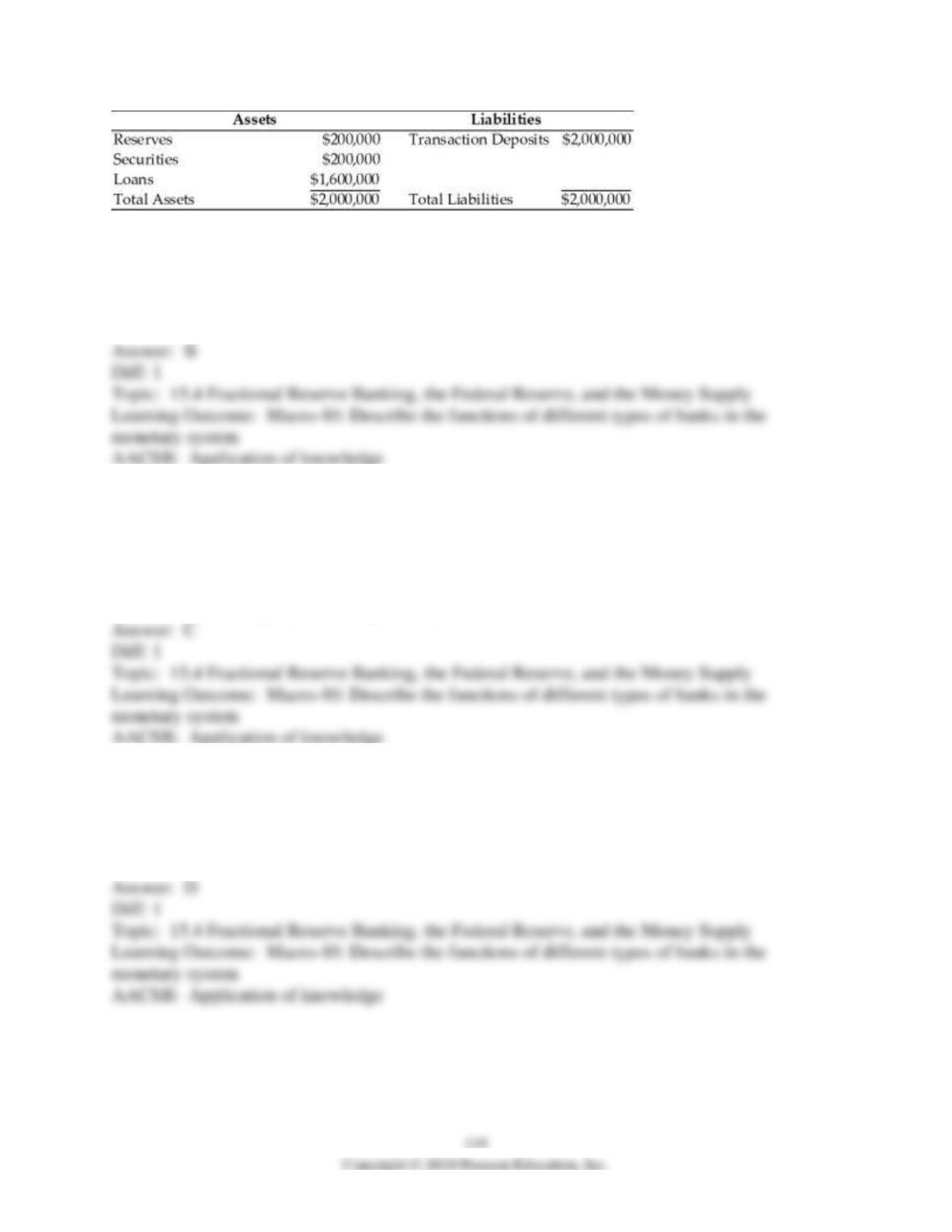
47) Based on the above table, the reserve ratio for the banking system is
A) 20 percent.
B) 10 percent.
C) 15 percent.
D) 1 percent.
48) Based on the above table, an open market operation in which the Fed purchased $200,000 of
government securities would
A) create a reserve deficiency for the banking system.
B) lead to a maximum potential expansion of the money supply of $200,000.
C) lead to a maximum potential expansion of the money supply of $2 million.
D) cause demand deposits to fall by $200,000.
49) The potential money multiplier for the banking system in the above table is
A) 5.
B) 9.
C) 1.
D) 10.
50) When the Federal Reserve sells a government security to a commercial bank
A) the cash reserves of the commercial bank decrease.
B) the net worth of the commercial bank increases.
C) the loans of the commercial bank will increase.
D) the balance sheet of the commercial bank is thrown off balance.
51) If a $1 million open market purchase by the Fed generates a new deposit at a bank that
immediately causes the bank’s reserves held at the Fed to increase by $1 million, then the T-
account effects are that the bank’s assets and liabilities ________ by $1 million and that the Fed’s
assets and liabilities ________ by $1 million.
A) decline; decline
B) increase; decline
C) decline; increase
D) increase; increase
52) The Fed sells a U.S. government security and a bank dealer writes a check for the amount.
When the check clears
A) reserves remain unchanged because the decrease of reserves at the dealer’s bank is offset by
an increase in the reserves at the Fed.
B) reserves have fallen by the amount of the check because the Fed clears the check by reducing
the bank’s deposits at the Fed.
C) reserves increase by the amount of the check because the Fed clears the check by increasing
the amount of the bank’s deposits with the Fed.
D) reserves have fallen by the amount of the reserves times the reserve ratio, and the money
supply falls by the difference between the amount of the check and the fall in the reserves.