Productivity and growth
The Cost Disease of Some Vital Services: Invitation to Government Failure
182. A 2% wage increase for teachers or police officers is:
a.
usually offset by higher output per worker.
b.
leads to increases in municipal budgets.
c.
indicates that teachers and police have became more selfish.
d.
leads to more personalized service.
DISC: The role of government
United States – BPROG: Reflective Thinking – BPROG: Analysis
The role of government
The Cost Disease of Some Vital Services: Invitation to Government Failure
183. The principle of “comparable worth” asserts that people with comparable, if not identical, skills and responsibilities
should receive the same pay. If this principle were to become law, it would tend to
a.
reduce the problem of the “cost disease of services.”
b.
exacerbate the problem of the “cost disease” of the service sector.
c.
be irrelevant to the “cost disease” problem.
d.
eliminate the problem of externalities.
DISC: The role of government
United States – BPROG: Reflective Thinking – BPROG: Analysis
The role of government
The Cost Disease of Some Vital Services: Invitation to Government Failure
184. The cost disease of the service sector is evidenced by
a.
a failure of the market mechanism.
b.
increased quality of public and private services.
c.
dramatic increases in municipal budget burdens for education, health care, and police and fire protection.
d.
the increased productivity in the services area.
DISC: The role of government
United States – BPROG: Reflective Thinking – BPROG: Analysis
The role of government
The Cost Disease of Some Vital Services: Invitation to Government Failure
185. A main cause of the cost disease of personal services is
a.
the change from an agrarian to an industrial society.
b.
labor-saving innovations in the service industries.
c.
the unevenness in growth of productivity in the economy.
d.
massive increases in industrial production at the expense of consumer goods production.
DISC: The role of government
United States – BPROG: Reflective Thinking – BPROG: Analysis
The role of government
The Cost Disease of Some Vital Services: Invitation to Government Failure
186. Increasing productivity in a society
a.
always results in a better quality of life as society views it.
b.
can never make a nation poorer.
c.
guarantees that personal services will cost less.
d.
makes improved personal services available to everyone.
DISC: The role of government
United States – BPROG: Reflective Thinking – BPROG: Analysis
The role of government
The Cost Disease of Some Vital Services: Invitation to Government Failure
187. The concept of “government failure” implies
a.
laissez faire is always best.
b.
government intervention is always justified since government never fails.
c.
no market failure can be corrected by government intervention.
d.
government intervention to correct a “market failure” sometimes fails.
DISC: The role of government
United States – BPROG: Analytic
The role of government
The Cost Disease of Some Vital Services: Invitation to Government Failure
188. AZT is a drug that inhibits the reproduction of the AIDS virus, thus preventing the full development of the disease.
The drug, which is sold in an unregulated market, is very expensive and many AIDS patients who can’t afford it die from
the disease. This case provides ammunition to critics of the market system on the basis of its
a.
fairness.
b.
externalities.
c.
cost disease in services.
d.
inefficiency.
a
Moderate
DISC: Markets, market failure, a – DISC: Markets, market failure, and externalities
United States – BPROG: Reflective Thinking – BPROG: Analysis
Markets, market failure, and ext – Markets, market failure, and externalities
Epilogue: The Unforgiving Market, its Gift of Abundance, and its Dangerous Friends
189. The market’s contribution to the general welfare has been its
a.
stimulation of growth in productivity.
b.
yield of an abundance of consumers’ goods.
c.
contribution to human longevity.
d.
All of the above are correct.
Easy
DISC: Productivity and growth
United States – BPROG: Analytic
Productivity and growth
190. The main shortcoming of the market, in the view of many,
a.
lies in the arena of justice and injustice.
b.
lies in the area of consumer goods production.
c.
is its inability to stimulate the creation of new products.
d.
is its drag on growth in productivity.
a
Moderate
DISC: Markets, market failure, a – DISC: Markets, market failure, and externalities
United States – BPROG: Analytic
Markets, market failure, and ext – Markets, market failure, and externalities
Epilogue: The Unforgiving Market, its Gift of Abundance, and its Dangerous Friends
191. Which of the following is not generally considered a failing of market economies?
a.
Market economies can have severe swings from boom to bust.
b.
Market economies tend to underprovide public goods.
c.
Market economies tend to promote equity at the expense of efficiency.
d.
Market economies can misallocate resources when property rights are ill defined.
c
Difficult
DISC: Markets, market failure, a – DISC: Markets, market failure, and externalities
United States – BPROG: Reflective Thinking – BPROG: Analysis
Markets, market failure, and ext – Markets, market failure, and externalities
Epilogue: The Unforgiving Market, its Gift of Abundance, and its Dangerous Friends
192. The most threatening and damaging detrimental externality at issue today is:
a.
The explosion and oil spill at the Deepwater Horizon
b.
the continued pollution of city air due to factory emissions
c.
water shortages
d.
global warming
Moderate
DISC: Markets, market failure, a – DISC: Markets, market failure, and externalities
United States – BPROG: Reflective Thinking – BPROG: Analysis
Markets, market failure, and ext – Markets, market failure, and externalities
Externalities: Getting the Prices Wrong
193. Regarding government manipulation of the interest rate, all of these statements are correct, except:
a.
To address business fluctuations, governments may reduce interest rates to induce people to borrow.
b.
Such manipulations may give little thought to the effects on resource allocation between present and future.
c.
Economists agree with the concept of using of interest rates to allocate resources among different time periods.
d.
Generally, the price system reflects public preference between present and future resource allocation.
c
Difficult
DISC: Markets, market failure, a – DISC: Markets, market failure, and externalities
Markets, market failure, and ext – Markets, market failure, and externalities
Allocation of Resources between Present and Future
Essay
194. Define the following terms and explain their importance to the study of economics.
a.
public good
b.
externality
c.
irreversible decision
d.
moral hazard
e.
rent seeking
generally think that private markets alone do not handle these sorts of problems well.
DISC: Markets, market failure, a – DISC: Markets, market failure, and externalities
United States – BPROG: Analytic
Markets, market failure, and ext – Markets, market failure, and externalities
What Does the Market Do Poorly?
195. Briefly and concisely define the following concepts and terms.
a.
marginal social cost
b.
detrimental externalities
c.
free-rider problem
d.
cost disease
e.
“defective telescopic faculty”
future, it implies too little tends to be invested for the future.
DISC: Markets, market failure, a – DISC: Markets, market failure, and externalities
United States – BPROG: Analytic
Markets, market failure, and ext – Markets, market failure, and externalities
What Does the Market Do Poorly?
196. SouthState Chemical Co. produces pine oil cleaners in a process that produces emissions that discolor the paint on
nearby houses, although the emissions have been declared nontoxic to humans.
a.
Is the price for the cleaner likely to be allocatively efficient? Use a graphic illustration in
your answer.
b.
If your answer to (a) is no, what is an appropriate government policy to correct the problem?
197. Pleasure boaters enjoy the use of waterways, but sometimes run into problems and need rescue. Coast Guard boats,
supported by tax revenue, are often used for rescue. Is it likely that there will be an efficient amount of boating and
rescuing?
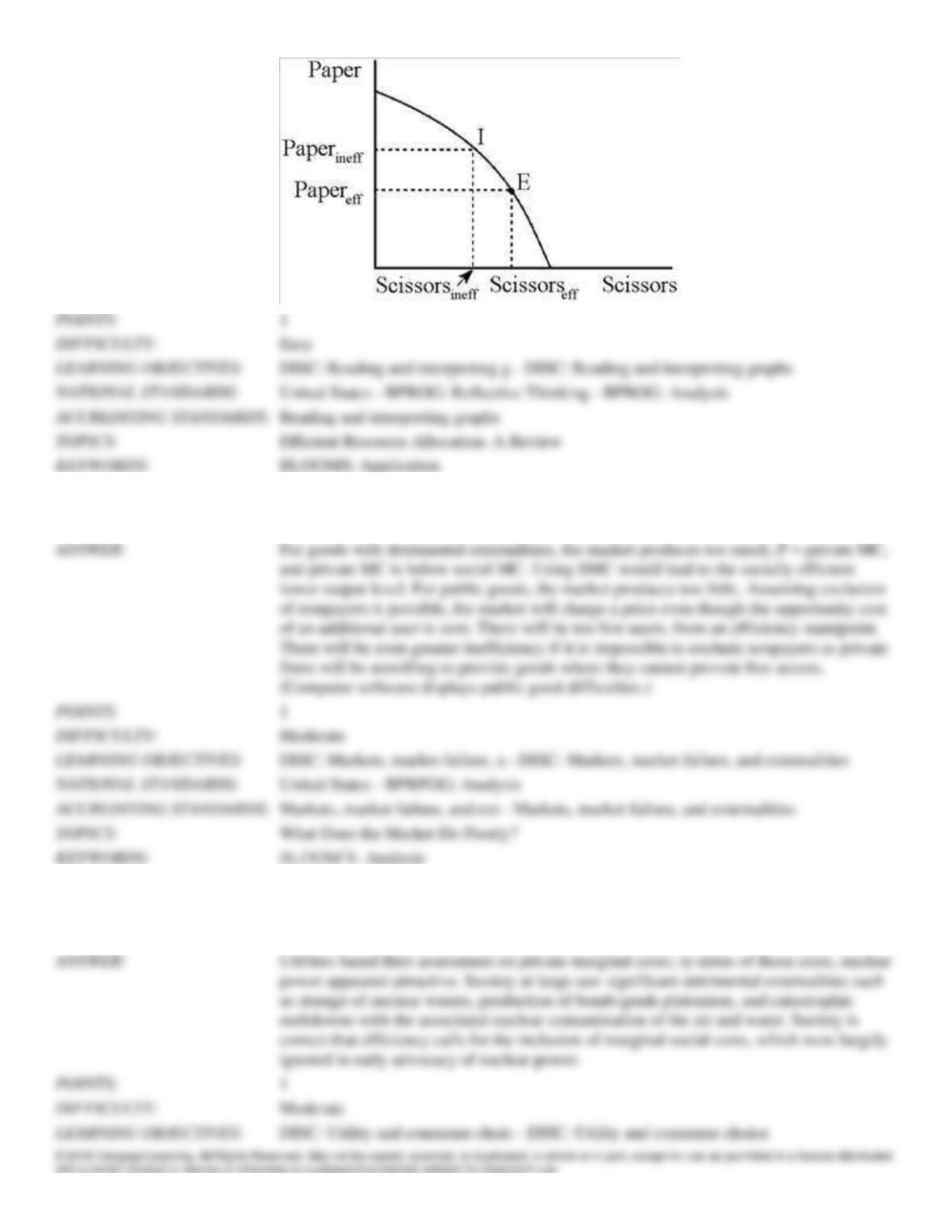
198. An economy produces only two goods, paper and scissors. Dyes from paper production pollute a nearby river. Use a
production possibilities curve to illustrate your explanation of how the unfettered market would fail to provide the
efficient mix of paper and scissors.
199. Explain whether the market produces too little, too much, or the right amount: (a) of goods with detrimental
externalities; (b) of goods with public good characteristics.
200. Electric utilities have trumpeted nuclear power for years, advocating it as lower in production costs than other
alternatives. Yet, society has resisted heavy reliance on nuclear power. Explain the source of the disagreement and suggest
which side (utilities or society) is correct.
201. Give an appropriate remedy for correcting excessive pollution and note any difficulties in implementing it.
202. Explain why government, rather than private firms, is required for efficient mosquito eradication programs.
203. The supply of public goods must be left to government and nonprofit institutions. Why?
204. Many cities have summer pops series in which the local orchestra performs light classical music in a public park.
These performances are free in some areas. Apply the concept of a public good to pops performances and explain whether
an admission charge is efficient.
205. Are national forests public goods? Explain.
206. What do you mean by Coase theorem?
207. It has been said that well-educated citizens are necessary for democracy. Discuss this idea in economic terms. What
market imperfection might occur and what are the appropriate government policies to correct it?
208. Why do markets tend to underproduce public goods?
209. What are private goods? Mention two important attributes of private goods.
210. The interest rate is the opportunity cost of transferring spending power between time periods. However, the market
mechanism may fail to provide adequately for future economic growth. List the reasons why a market might fail.
211. Suppose that the government decided to increase interest rates in order to encourage saving. Would this likely lead to
an increase in investment and higher future economic growth rates? Explain.
DISC: Scarcity, tradeoffs, and o – DISC: Scarcity, tradeoffs, and opportunity cost
United States – BPROG: Analytic
Scarcity, tradeoffs, and opportu – Scarcity, tradeoffs, and opportunity cost
Allocation of Resources between Present and Future
212. Hostile takeovers of corporations have been in the business news for some time now. Several states have passed laws
making it harder for out–of-state corporations to acquire firms headquartered in their states. Several corporations have
established “golden parachutes” to give executives high payoffs in case of hostile takeover. What market imperfection is
likely to be worsened by these actions? Explain.
earnings and share prices in order to make acquisition more difficult. “Golden
parachutes” protect managers from failure and make acquisition more difficult.
DISC: Markets, market failure, a – DISC: Markets, market failure, and externalities
United States – Analytic – BB-Legal
Some Other Sources of Market Failure
213. Discuss the role of trust as a critical piece of any principal-agent situation. In particular, what role did trust play in
the recent stock market scandals?
for themselves are evidence of the pattern of behavior associated with the principal-agent
DISC: Markets, market failure, a – DISC: Markets, market failure, and externalities
United States – BPROG: Reflective Thinking – BPROG: Analysis
Markets, market failure, and ext – Markets, market failure, and externalities
Some Other Sources of Market Failure
214. If, after careful analysis, an economist concludes that there has been a market failure, which of the following possible
corrective actions might the economist favor? Why?
a.
prohibiting the activity
b.
charging fees for continuing the activity
c.
requiring that the public be informed of the activity
d.
government purchase of the item for the public
DISC: Markets, market failure, a – DISC: Markets, market failure, and externalities
United States – BPROG: Reflective Thinking – BPROG: Analysis
Markets, market failure, and ext – Markets, market failure, and externalities
Market Failure and Government Failure
215. During the 1992 presidential campaign, H. Ross Perot made much of the various “special interests” which lobby in
Washington, D.C. How might an economist view this? Which specific market breakdown may occur if there is lobbying?
Relate your answer to the study of monopoly and oligopoly.
DISC: Monopoly
United States – BPROG: Reflective Thinking – BPROG: Analysis
Market Failure and Government Failure
216. Some would cite the purchase of defective products and the rising cost of health care as market failures. Argue that
these are not true market failures.
217. It was once common for people to have servants who helped with the cooking and cleaning. Use the cost disease of
the personal services dilemma to explain why these services have declined, even though one would expect an increased
use in this age of the two-worker household.
218. Explain how stock options can ensure compatibility between the interest of stockholders and managers.
219. Unscrupulous managers have learned ways to manipulate stock options and undermine their benefits to stockholders.
Discuss some provisions that could be built into the process to curb such practices.