Macroeconomics 2017 (Hubbard)
Chapter 15 Monetary Policy
15.1 What Is Monetary Policy?
1) In 2015, some banks in Europe had to make interest payments to borrowers rather than receive
interest payments from borrowers. Which of the following statements describes this situation?
A) For these banks, the loans increased required reserves.
B) These banks were receiving negative nominal interest rates on these loans.
C) For these banks, the loans were liabilities instead of assets.
D) All of the above are correct.
2) If the probability of losing your job remains ________, a recession would be a good time to purchase a
home because the Fed usually ________ interest rates during this time.
A) low; lowers
B) low; raises
C) high; lowers
D) high; raises
E) low; does not change
3) Monetary policy refers to the actions the
A) President and Congress take to manage the money supply and interest rates to pursue their
economic objectives.
B) Federal Reserve takes to manage the money supply and interest rates to pursue its macroeconomic
policy objectives.
C) President and Congress take to manage government spending and taxes to pursue their economic
objectives.
D) Federal Reserve takes to manage government spending and taxes to pursue its economic objectives.
4) The Federal Reserve System’s four monetary policy goals are
A) low government budget deficits, low current account deficits, high employment, and a high foreign
exchange value of the dollar.
B) a low rate of bank failures, high reserve ratios, price stability, and economic growth.
C) price stability, high employment, economic growth, and stability of financial markets and
institutions.
D) price stability, low government budget deficits, low current account deficits, and a low rate of bank
failures.
5) When the Federal Reserve System was established in 1913, its main policy goal was
A) encouraging strong economic growth.
B) promoting price stability.
C) preventing bank panics.
D) keeping employment high.
6) The top policy goal for Paul Volcker when he became chairman of the Federal Reserve’s Board of
Governors in 1979 was
A) fighting inflation.
B) increasing employment.
C) increasing economic growth.
D) increasing regulation of commercial banks.
E) a low current account deficit.
7) During the turmoil in the market for subprime mortgages in 2007 and 2008, the Fed increased the
volume of discount loans. The goal of the Fed was to
A) reduce the rate of inflation.
B) stimulate economic growth.
C) reduce unemployment.
D) reassure financial markets and promote financial stability.
E) reduce the current account deficit.
8) The goals of monetary policy tend to be interrelated. For example, when the Fed pursues the goal of
________, it also can achieve the goal of ________ simultaneously.
A) high employment; economic growth
B) high employment; lowering government spending
C) economic growth; a low current account deficit
D) stability of financial markets; a low current account deficit
9) Monetary policy refers to the actions the Federal Reserve takes to manage
A) the money supply and income tax rates to pursue its economic objectives.
B) the money supply and interest rates to pursue its economic objectives.
C) income tax rates and interest rates to pursue its economic objectives.
D) government spending and income tax rates to pursue its economic objectives.
10) Which of the following are goals of monetary policy?
A) maximizing the value of the dollar relative to other currencies, economic growth, and high
employment
B) price stability, maximizing the value of the dollar relative to other currencies, and high employment
C) price stability, economic growth, and high employment
D) price stability, economic growth, and maximizing the value of the dollar relative to other currencies
11) Rising prices erode the value of money as a ________ and as a ________.
A) unit of barter; unit of account
B) store of value; unit of liquidity
C) medium of exchange; store of value
D) store of value; unit of barter
12) Federal Reserve Board Chairmen Paul Volcker, Alan Greenspan, and Ben Bernanke all have focused
on which of the following as their main goal of monetary policy?
A) high employment
B) price stability
C) economic growth
D) stability of financial markets
13) The Fed seeks to promote stability of financial markets because
A) they want to lift the self-esteem of workers.
B) Congress directed them to do so by the Employment Act of 1946.
C) resources are lost when there is not an efficient matching of savers and borrowers.
D) unstable markets result in increased efficiency.
14) One of the monetary policy goals of the Federal Reserve is price stability.
15) Since World War II, the Federal Reserve has not been involved in carrying out monetary policy.
16) Inflation rates during the years 1979-1981 were the highest the United States has ever experienced
during peacetime.
17) The main goal of monetary policy for recent Fed Chairmen has been to maintain high employment
in labor markets.
18) Monetary policy is conducted by the U.S. Treasury Department.
19) Maintaining a strong dollar in international currency markets is not one of the four monetary policy
goals of the Fed listed in the textbook.
20) List the Fed’s four main monetary goals.
21) What is a banking panic, and what role did banking panics play in the decision by Congress to
establish the Federal Reserve?
22) When Congress established the Federal Reserve in 1913, what was its main responsibility? When did
Congress broaden the Fed’s responsibilities?
23) What problems can high inflation rates cause for the economy?
15.2 The Money Market and the Fed’s Choice of Monetary Policy Targets
1) The Federal Reserve’s two main ________ are the money supply and the interest rate.
A) monetary policy targets
B) policy tools
C) fiscal policy targets
D) fiscal tools
2) The Federal Reserve can directly affect its monetary policy ________, which then affect its monetary
policy ________.
A) goals; targets
B) goals; tools
C) targets; goals
D) targets; tools
3) The money demand curve has a
A) negative slope because an increase in the interest rate decreases the quantity of money demanded.
B) positive slope because an increase in the interest rate increases the quantity of money demanded.
C) negative slope because an increase in the price level decreases the quantity of money demanded.
D) positive slope because an increase in the price level increases the quantity of money demanded.
4) An increase in the interest rate
A) decreases the opportunity cost of holding money.
B) increases the opportunity cost of holding money.
C) decreases the percentage yield of holding money.
D) increases the percentage yield of holding money.
5) An increase in the interest rate causes
A) a movement up along the money demand curve.
B) a movement down along the money demand curve.
C) the money demand curve to shift to the left.
D) the money demand curve to shift to the right.
6) An increase in the price level causes
A) the money demand curve to shift to the left.
B) the money demand curve to shift to the right.
C) a movement up along the money demand curve.
D) a movement down along the money demand curve.
7) Which of the following would cause the money demand curve to shift to the left?
A) an open market purchase of Treasury securities by the Federal Reserve
B) an increase in the interest rate
C) an increase in the price level
D) a decrease in real GDP
9
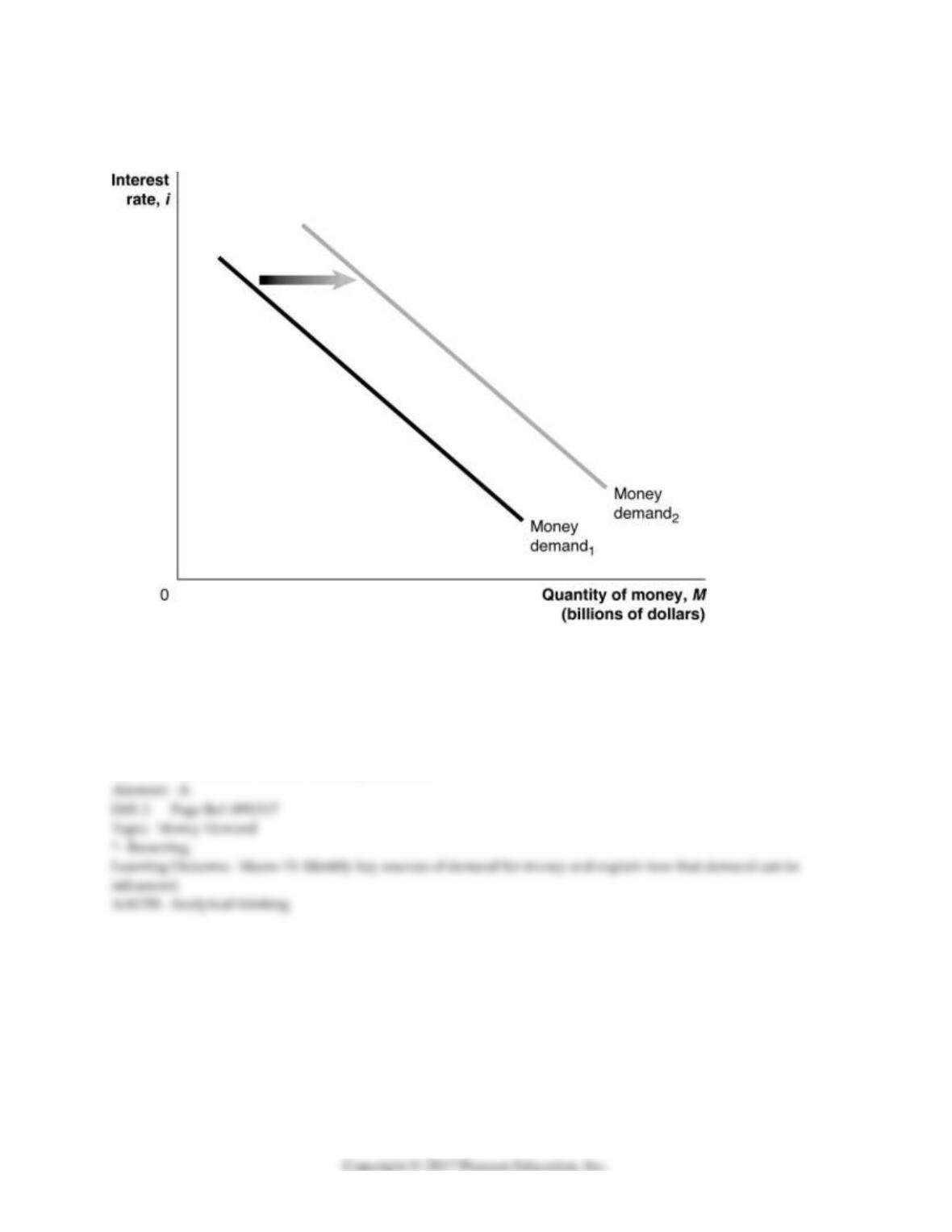
Figure 15-1
8) Refer to Figure 15-1. In the figure, the money demand curve would move from Money demand1 to
Money demand2 if
A) real GDP increased.
B) the price level decreased.
C) the interest rate increased.
D) the Federal Reserve sold Treasury securities.
9) Refer to Figure 15-1. In the figure above, the money demand curve would move from Money
demand1 to Money demand2 if
A) real GDP decreased.
B) the price level increased.
C) the interest rate decreased.
D) the Federal Reserve sold Treasury securities.
10) Using the money demand and money supply model, an open market purchase of Treasury
securities by the Federal Reserve would cause the equilibrium interest rate to
A) increase.
B) decrease.
C) not change.
D) increase if the economy is in a recession.
11) Using the money demand and money supply model, an open market sale of Treasury securities by
the Federal Reserve would cause the equilibrium interest rate to
A) increase.
B) decrease.
C) not change.
D) increase, then decrease.
12) Suppose that households became mistrustful of the banking system and decide to decrease their
checking account balances and increase their holdings of currency. Using the money demand and
money supply model and assuming everything else is held constant, the equilibrium interest rate
should
A) increase.
B) decrease.
C) not change.
D) increase, then decrease.
13) Using the money demand and money supply model, an increase in money demand would cause the
equilibrium interest rate to
A) decrease.
B) increase.
C) not change.
D) increase, then decrease.
14) Which of the following will lead to a decrease in the equilibrium interest rate in the economy?
A) an increase in the price level
B) a sale of government securities by the Fed
C) a decrease in GDP
D) an increase in the discount rate
E) an increase in the reserve requirement
15) An increase in real GDP can shift
A) money demand to the right and decrease the equilibrium interest rate.
B) money demand to the right and increase the equilibrium interest rate.
C) money demand to the left and decrease the equilibrium interest rate.
D) money demand to the left and increase the equilibrium interest rate.
16) When the Federal Reserve increases the money supply, at the previous equilibrium interest rate
households and firms will now have
A) more money than they want to hold.
B) less money than they want to hold.
C) the amount of money that they want to hold.
D) to sell Treasury bills.
17) When the Federal Reserve decreases the money supply, at the previous equilibrium interest rate
households and firms will now want to
A) buy Treasury bills.
B) sell Treasury bills.
C) neither buy nor sell Treasury bills.
D) hold less money.
18) An increase in the demand for Treasury bills will
A) decrease the price of Treasury bills.
B) decrease the interest rate on Treasury bills.
C) increase the opportunity cost of holding money vs. Treasury bills.
D) eventually cause households to hold less money.
13
19) Which of the following is true?
A) The money market model is essentially a model that determines the short-term nominal rate of
interest.
B) The money market model is essentially a model that determines the short-term real rate of interest.
C) The loanable funds model is essentially a model that determines the short-term real rate of interest.
D) The loanable funds model is essentially a model that determines the long-term nominal rate of
interest.
14
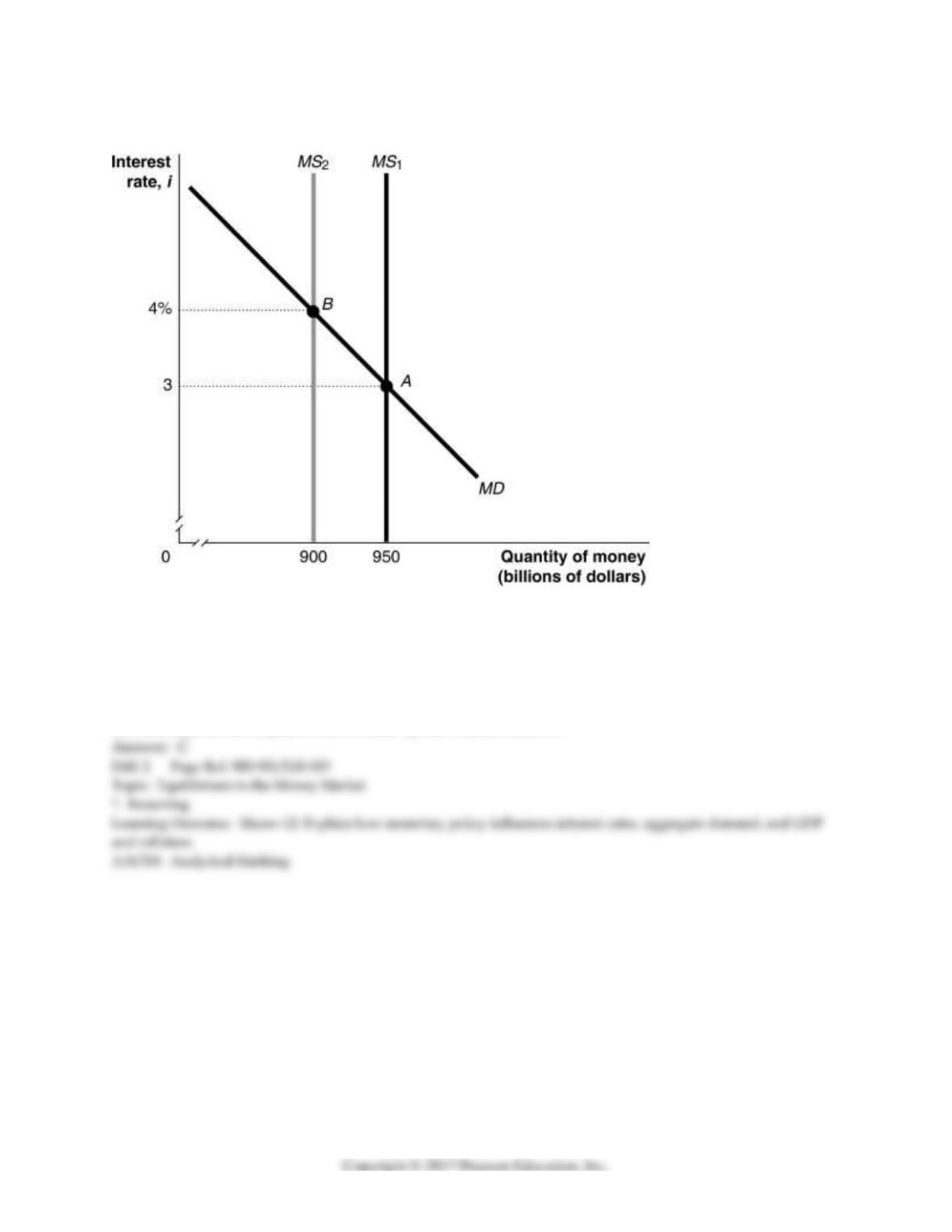
Figure 15-2
20) Refer to Figure 15-2. In the figure above, the movement from point A to point B in the money market
would be caused by
A) an increase in the price level.
B) a decrease in real GDP.
C) an open market sale of Treasury securities by the Federal Reserve.
D) a decrease in the required reserve ratio by the Federal Reserve.
15
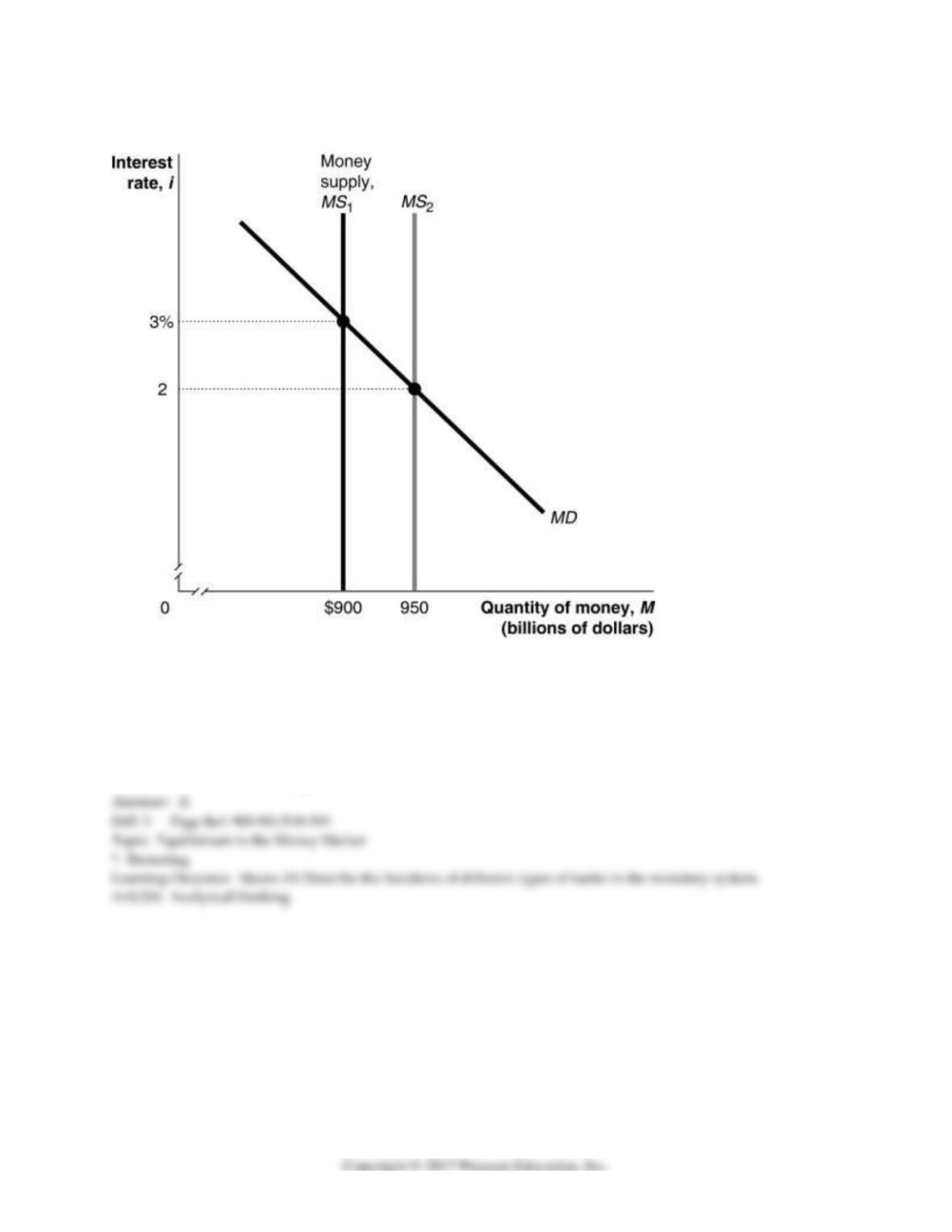
Figure 15-3
21) Refer to Figure 15-3. In the figure above, when the money supply shifts from MS1 to MS2, at the
interest rate of 3 percent households and firms will
A) buy Treasury bills.
B) sell Treasury bills.
C) neither buy nor sell Treasury bills.
D) want to hold more money.
22) For purposes of monetary policy, the Federal Reserve has targeted the interest rate known as the
A) federal funds rate.
B) Treasury bill rate.
C) discount rate.
D) prime rate.
23) The monetary policy target the Federal Reserve focuses primarily on today is
A) the unemployment rate.
B) M1.
C) the inflation rate.
D) the interest rate.
E) M2.
24) The interest rate that banks charge other banks for overnight loans is the
A) prime rate.
B) discount rate.
C) federal funds rate.
D) Treasury bill rate.
25) Changes in the federal funds rate usually result in
A) changes in both short-term and long-term interest rates with more of an effect on short-term interest
rates.
B) changes in both short-term and long-term interest rates with more of an effect on long-term interest
rates.
C) changes in both short-term and long-term interest rates with equal effect on both.
D) no change in either short-term or long-term interest rates.
26) The Fed can increase the federal funds rate by
A) selling Treasury bills, which increases bank reserves.
B) buying Treasury bills, which increases bank reserves.
C) selling Treasury bills, which decreases bank reserves.
D) buying Treasury bills, which decreases bank reserves.
27) The Fed’s two main monetary policy targets are
A) the money supply and the inflation rate.
B) the money supply and the interest rate.
C) the interest rate and real GDP.
D) the inflation rate and real GDP.
28) If the Fed raises the interest rate, this will ________ inflation and ________ real GDP in the short run.
A) reduce; raise
B) increase; lower
C) increase; raise
D) reduce; lower
29) A monetary policy target is a variable that
A) the Fed can affect directly.
B) equals one of the Fed’s main policy goals.
C) the Fed has no ability to change.
D) the Fed cannot affect directly.
30) The money demand curve, against possible levels of interest rates, has a
A) positive slope.
B) negative slope.
C) zero slope.
D) positive slope for low levels of money demand, and a negative slope for high levels of money
demand.
31) The money demand curve has a negative slope because
A) lower interest rates cause households and firms to switch from money to financial assets.
B) lower interest rates cause households and firms to switch from financial assets to money.
C) lower interest rates cause households and firms to switch from money to stocks.
D) lower interest rates cause households and firms to switch from money to bonds.
32) An increase in real GDP
A) increases the buying and selling of goods and increases the demand for money as a medium of
exchange.
B) increases the buying and selling of goods and decreases the demand for money as a medium of
exchange.
C) decreases the buying and selling of goods and increases the demand for money as a medium of
exchange.
D) decreases the buying and selling of goods and decreases the demand for money as a medium of
exchange.
33) Increases in the price level
A) increase the opportunity cost of holding money.
B) decrease the opportunity cost of holding money.
C) increase the quantity of money needed for buying and selling.
D) decrease the quantity of money needed for buying and selling.
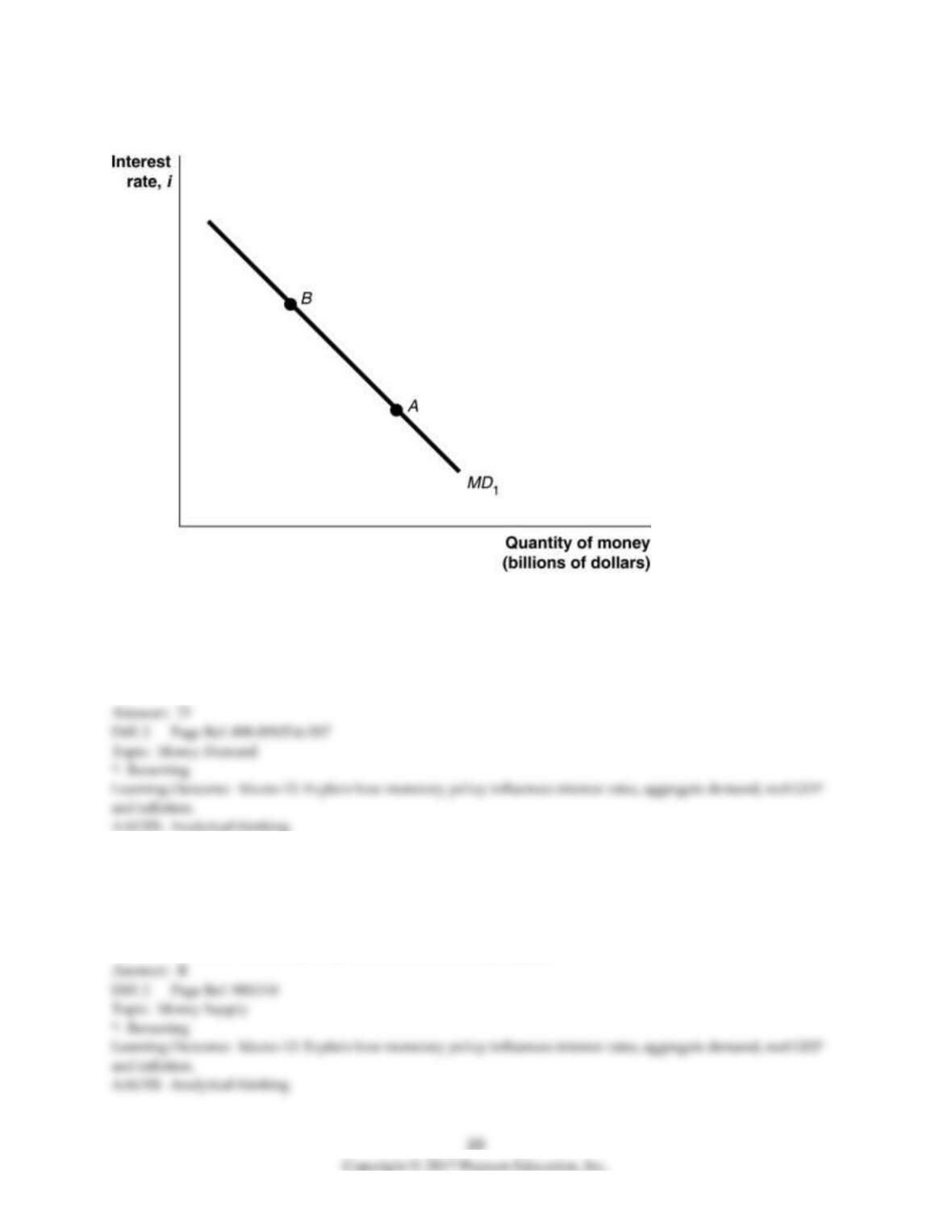
Figure 15-4
34) Refer to Figure 15-4. In the figure above, a movement from point A to point B would be caused by
A) a decrease in real GDP.
B) an increase in the price level.
C) a decrease in the price level.
D) an increase in the interest rate.
35) The money supply curve is vertical if
A) banks and the Fed jointly determine the money supply.
B) the Fed is able to completely determine the money supply.
C) banks and households determine the money supply.
D) households and the Fed jointly determine the money supply.