96
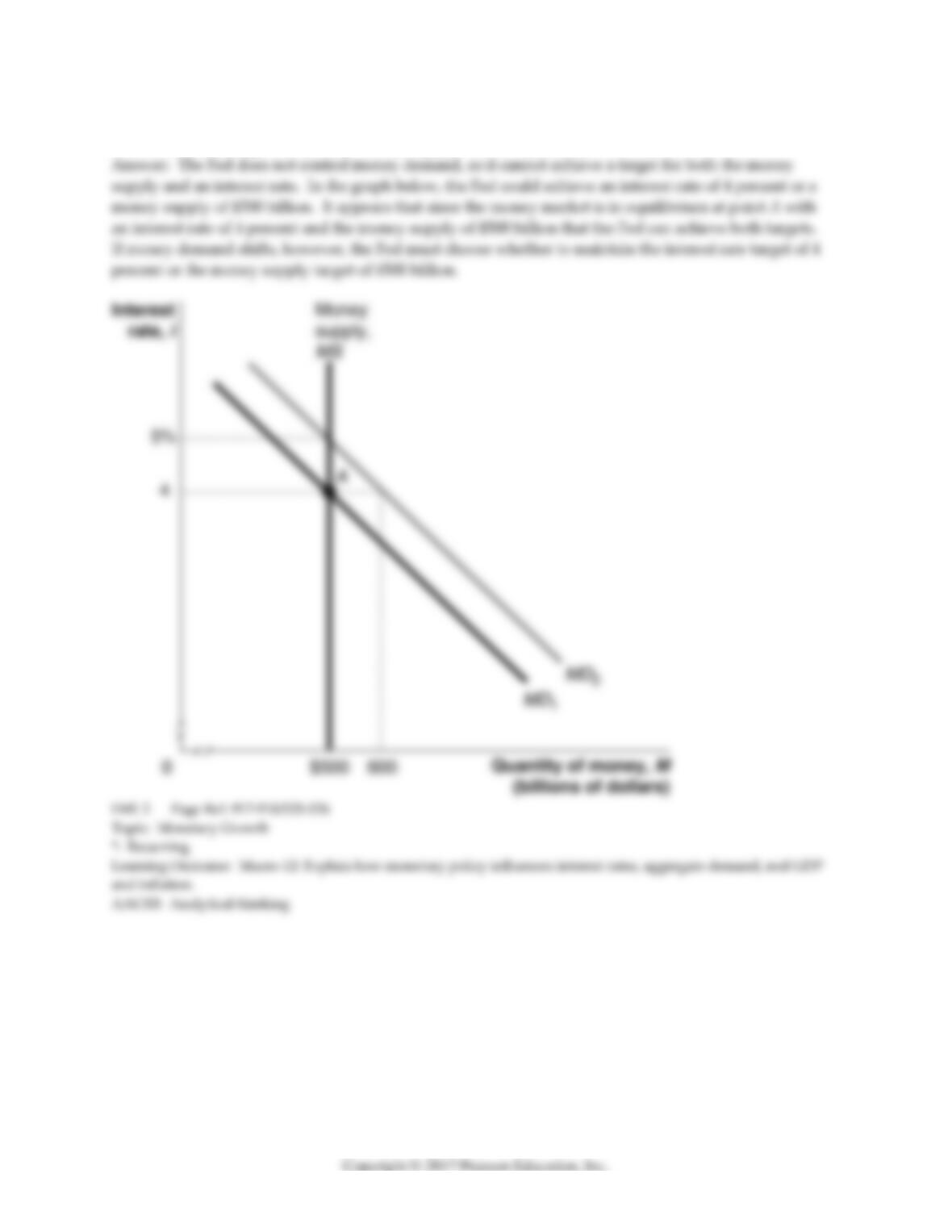
51) Using the money demand and money supply model, show and explain why the Federal Reserve
cannot achieve a target for both the money supply and an interest rate.
15.6 Fed Policies during the 2007-2009 Recession
1) The Federal Reserve cut the federal funds rate seven times between September 2007 and March 2008.
What event led the Fed to make these reductions in the federal funds rate?
A) It was in response to reductions in the discount rate, which was also lowered seven times over the
same time period.
B) The chairman of the Federal Reserve System persuaded members of the Federal Open Market
Committee to lower interest rates in order to reduce the price of oil in international markets.
C) During this period there was a substantial reduction in the demand for housing.
D) Several large investment banks failed during this time period.
2) When housing prices fall, as they did beginning in 2006 following the housing market bubble,
consumption spending on furniture, appliances, and home improvements ________ as many
households found it ________ to borrow against the value of their homes.
A) declined; easier
B) declined; harder
C) increased; easier
D) increased; harder
3) When housing prices fell as they did beginning in 2006 following the housing market bubble, most
banks and other lenders ________ the requirement for borrowers, making it ________ for potential home
buyers to obtain mortgages.
A) tightened; easier
B) tightened; harder
C) eased; easier
D) eased; harder
4) A financial asset is considered a security if
A) the owner of the security receives dividends and realizes a capital gain when the asset is sold.
B) it can be sold in a secondary market.
C) its value increases after it is sold in a primary market.
D) its value is secure; that is, the owner will not suffer a financial loss when the asset is sold.
5) Which of the following explains why mortgages weren’t considered securities prior to 1970?
A) The Federal Reserve Act of 1913 prohibited mortgages from being considered securities. An
amendment to the Act was approved in 1970 that allowed mortgages to be considered securities.
B) Until 1970, the average annual increase in housing prices did not allow the buying and selling of
mortgages to be profitable. There has been a significant annual increase in housing prices and mortgage
values since 1970.
C) Congress passed a law in 1970 stipulating that mortgages could be classified as securities.
D) Prior to 1970, mortgages were rarely resold in the secondary market.
6) To reassure investors who were unwilling to buy mortgages in the secondary market, the U.S.
Congress used two government sponsored enterprises, Fannie Mae and Freddie Mac, to stand between
investors and banks that grant mortgages. Fannie Mae and Freddie Mac
A) sell mortgages to investors and use the funds to purchase bonds from banks.
B) sell bonds to investors and use the funds to purchase mortgages from banks.
C) sell bonds to banks and use the funds to purchase mortgages from investors.
D) sell mortgages to banks and use the funds to purchase bonds from investors.
7) By the 2000s, an important change in the mortgage market had occurred when ________ became
significant participants in the secondary market for mortgages.
A) investment banks
B) Federal Reserve Banks
C) commercial banks
D) savings banks
8) By the height of the housing bubble in 2005 and early 2006, lenders had greatly loosened the
standards for obtaining a mortgage loan, with many mortgages being granted to ________ borrowers
with flawed credit histories and ________ borrowers who did not document their incomes.
A) sub-prime; “Alt-A”
B) adjustable rate; shadow-banking
C) “credit crunch”; black market
D) “fresh-start”; prime rate
9) The Federal Reserve responded to the 2008 financial crisis in several ways. Which of the following is
not one of the ways the Fed responded?
A) The Fed made investment banks eligible for discount loans.
B) The Fed lent investment banks Treasury securities in exchange for mortgage-backed securities.
C) The Fed lowered the required reserve ratio on demand deposit accounts in order to increase the
amount of bank reserves.
D) The Fed helped JP Morgan to acquire Bear Stearns, a nearly bankrupt investment bank.
10) Although the Federal Reserve had traditionally made discount loans only to commercial banks, in
response to the financial crisis in 2008 the Fed made ________ eligible for discount loans as well.
A) the Treasury Department
B) mortgage brokers
C) savings banks
D) primary dealers
11) Firms that participate in regular open market transactions with the Federal Reserve are called
A) secondary market banks.
B) Treasury banks.
C) primary dealers.
D) Federal Reserve partners.
12) In 2008, the Treasury and Federal Reserve took action to save large financial firms such as Bear
Stearns and AIG from failing. Which of the following is one reason why these measures were taken?
A) The Emergency Economic Stabilization Act required the Fed and the Treasury to provide financial
assistance to firms that participated in regular open market actions with the Fed.
B) The bankruptcy of a large financial firm would force the firm to sell its holdings of securities, which
could cause other firms that hold these securities to also fail.
C) The Fed and the Treasury wanted to allow Freddie Mac and Fannie Mae more time to buy the firms
before they went bankrupt.
D) The failure of these firms would have forced the Fed to increase interest rates, which could have led
to a severe recession.
13) While many analysts defended the actions taken by the Fed and the Treasury to respond to the
financial crisis in 2008, others were critical of these actions. The critics were concerned that by not
allowing large firms to fail,
A) smaller firms will resent not receiving similar assistance.
B) stockholders and bondholders of these firms were not allowed to receive the proceeds from the sale
of assets that would have occurred if the firms had declared bankruptcy.
C) there is an increased likelihood that other firms will engage in risky behavior in the future with the
expectation that they will also not be allowed to fail.
D) there will be less competition in the U.S. economy, which could led to higher prices for consumers.
14) In October 2008, Congress passed the ________, under which the Treasury provided funds to banks
in exchange for stock.
A) Bank Rescue Alliance Treaty (BRAT)
B) Mortgage Transfer Agency (MTA)
C) Troubled Asset Relief Program (TARP)
D) Financial Assurance Association (FAA)
15) If the amount you owe on your house is greater than the price of the house, you have
A) no value to your house.
B) a mortgage rate that is too high.
C) negative equity in your house.
D) a reverse mortgage on your house.
16) The larger the fraction of an investment financed by borrowing,
A) the greater the potential return and potential loss on that investment.
B) the smaller the potential return and potential loss on that investment.
C) the greater the potential return and the smaller the potential loss on that investment.
D) the smaller the potential return and the greater the potential loss on that investment.
17) Between September 2007 and March 2008 there was a substantial reduction in the demand for
housing. What action did the Fed take in response to the reduction in the demand for housing?
A) The Federal Reserve decreased the required reserve rate.
B) The Fed conducted open market sales of Treasury securities.
C) The Federal Reserve cut the federal funds rate seven times.
D) The Federal Reserve raised the discount rate by 3 percentage points.
18) When housing prices ________, as they did beginning in 2006 following the housing market bubble,
consumption spending on furniture, appliances, and home improvements decline as many households
find it ________ to borrow against the value of their homes.
A) rise; easier
B) rise; harder
C) fall; easier
D) fall; harder
19) When housing prices ________ as they did beginning in 2006 following the housing market bubble,
most banks and other lenders tightened the requirement for borrowers, making it ________ for potential
home buyers to obtain mortgages.
A) fell; easier
B) fell; harder
C) rose; easier
D) rose; harder
20) A financial asset is considered ________ if it can be sold in a secondary market.
A) a commodity
B) a security
C) a liability
D) durable
21) Prior to 1970, mortgages were ________ resold in the secondary market.
A) never
B) rarely
C) often
D) always
22) To reassure investors who were unwilling to buy mortgages in the secondary market, the U.S.
Congress used two government sponsored enterprises, ________, to sell bonds to investors and use the
funds to purchase mortgages from banks.
A) the Fed and the Treasury Department
B) Fannie Mae and Freddie Mac
C) the Securities and Exchange Commission (SEC) and the Federal Trade Commission (FTC)
D) ACORN and the Federal Housing Administration (FHA)
23) By the 2000s, an important market change occurred when investment banks became significant
participants in the secondary market for
A) mortgages.
B) Treasury securities.
C) corporate bonds.
D) currency.
24) By the height of the housing bubble in 2005 and early 2006, lenders had greatly loosened the
standards for obtaining a mortgage loan, with many mortgages being granted to sub-prime borrowers
________ and “Alt-A” borrowers ________.
A) with flawed credit histories; who did not document their incomes
B) who borrowed money at rates below the prime interest rate; who had AAA credit ratings
C) who borrowed more than 120 percent of the value of the house; with no proof of U.S. citizenship
D) who purchased homes in depressed housing markets; who purchased homes which were
repossessed by government agencies
25) The Federal Reserve responded to the 2008 financial crisis in several ways. Which of the following is
one of the ways the Fed responded?
A) The Fed banned investment banks from obtaining discount loans.
B) The Fed lent investment banks Treasury securities in exchange for mortgage-backed securities.
C) The Fed lowered the required reserve ratio on demand deposit accounts in order to increase the
amount of bank reserves.
D) The Fed helped Citibank to acquire General Motors and Chrysler.
26) Although the Federal Reserve had traditionally made discount loans only to ________, in response
to the financial crisis in 2008 the Fed made primary dealers eligible for discount loans as well.
A) commercial banks
B) government agencies
C) investment banks
D) mortgage lenders
27) Firms that participate in regular open market transactions with ________ are called primary dealers.
A) commercial banks
B) Treasury banks
C) the Federal Reserve
D) mortgage lenders
28) In 2008, the Treasury and Federal Reserve took several actions in response to the deepening
financial crisis. One action was the creation of the Term Securities Lending Facility, under which the
Fed will loan up to $200 billion of treasury securities in exchange for
A) stock.
B) mortgage-backed securities.
C) corporate bonds.
D) required bank reserves.
29) In 2008, the Treasury and Federal Reserve took several actions in response to the deepening
financial crisis. One action was the Treasury’s move to have the federal government take control of
A) the Federal Deposit Insurance Corporation (FDIC).
B) Fannie Mae and Freddie Mac.
C) JPMorgan Chase.
D) Lehman Brothers.
30) In October 2008, Congress passed the Troubled Asset Relief Program (TARP), under which the
Treasury provided ________ to banks in exchange for ________.
A) bonds; cash
B) lines of credit; loan guarantees
C) funds; stock
D) financial advice; promises to expand mortgage lending
31) If the amount you owe on your house is less than the price of the house, you have
A) positive equity in your house.
B) an adjustable-rate mortgage on your house.
C) negative equity in your house.
D) a reverse mortgage on your house.
32) The smaller the fraction of an investment financed by borrowing,
A) the greater the potential return and potential loss on that investment.
B) the smaller the potential return and potential loss on that investment.
C) the greater the potential return and the smaller the potential loss on that investment.
D) the smaller the potential return and the greater the potential loss on that investment.
33) A borrower defaults on a loan when he stops making payments on the loan.
34) The Federal Home Loan Mortgage Corporation and the Federal National Mortgage Association
were established by Congress in order to regulate banks that buy and sell mortgage-backed securities.
35) With the Troubled Asset Relief Program (TARP), the Treasury provided funds to banks in exchange
for stock.
36) In March 2008, the Fed announced that primary dealers would be eligible to receive discount loans.
37) Despite saving Lehman Brothers from failing, the Fed and the Treasury decided to allow Bear
Stearns to go bankrupt, which it did in September, 2008.
38) By the 2000s, investment banks had become significant participants in the secondary market for
mortgages.
39) Mortgage lenders often resell mortgages in secondary markets. How might this make lenders act
differently than if they intended to hold the mortgages themselves?
40) What is a mortgage? What were the important developments in the mortgage market during the
years after 1970?
41) Beginning in 2008, The Federal Reserve and the U.S. Treasury Department responded to the
financial crisis by intervening in financial markets in unprecedented ways. Briefly summarize the
actions of the Fed and Treasury.
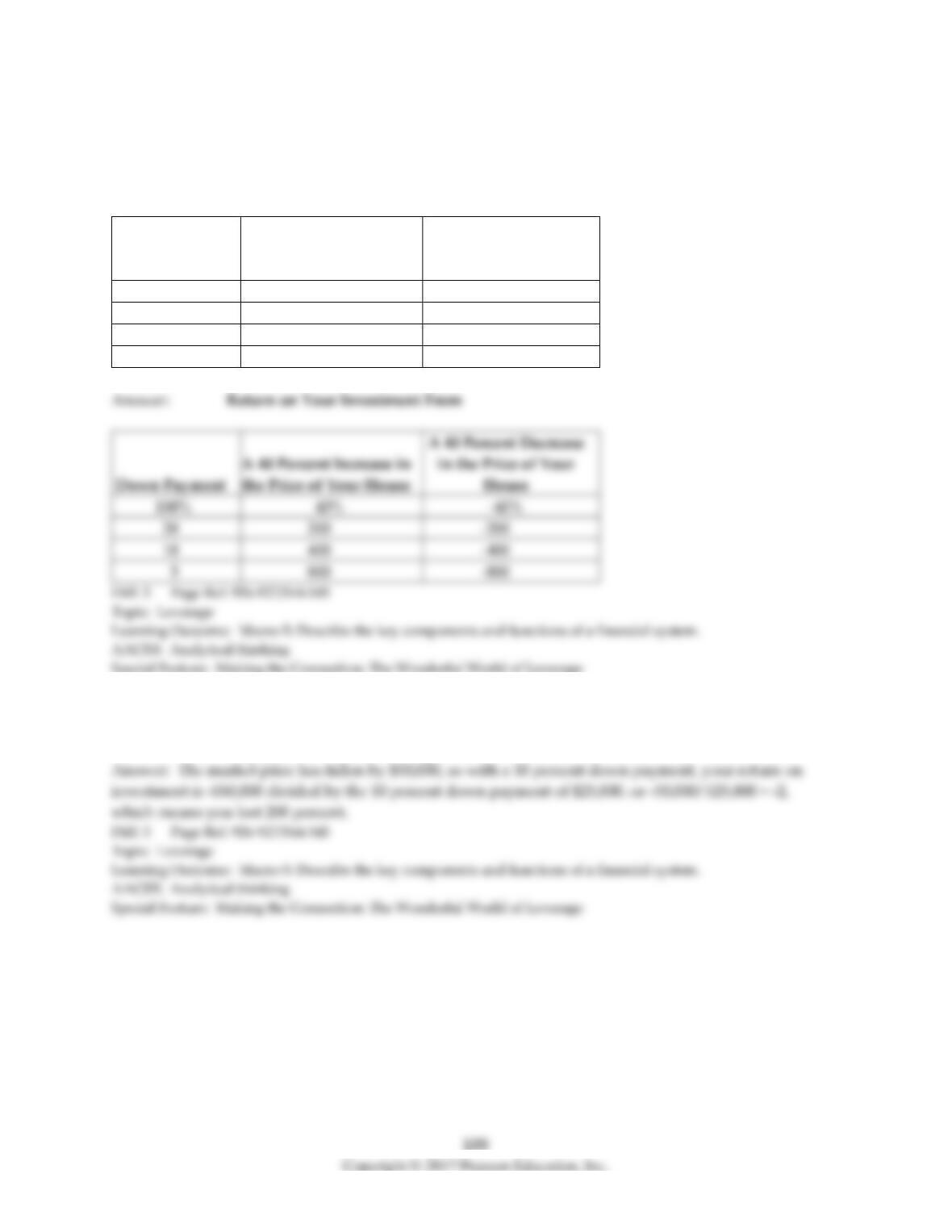
42) In the following table, fill in the columns for your return on investment if the price of your house
increased or decreased by 40 percent, based on the down payments specified in the first column.
Return on Your Investment From
Down Payment
A 40 Percent Increase in
the Price of Your House
A 40 Percent Decrease
in the Price of Your
House
100%
20
10
5
Down Payment
A 40 Percent Increase in
the Price of Your House
A 40 Percent Decrease
in the Price of Your
100%
40%
–40%
20
200
–200
10
400
–400
5
800
–800
43) Suppose you buy a house for $250,000. One year later, the market price for the house has fallen to
$200,000. What is the return on your investment in the house if you made a down payment of 10 percent
and took out a mortgage loan for the other 90 percent?
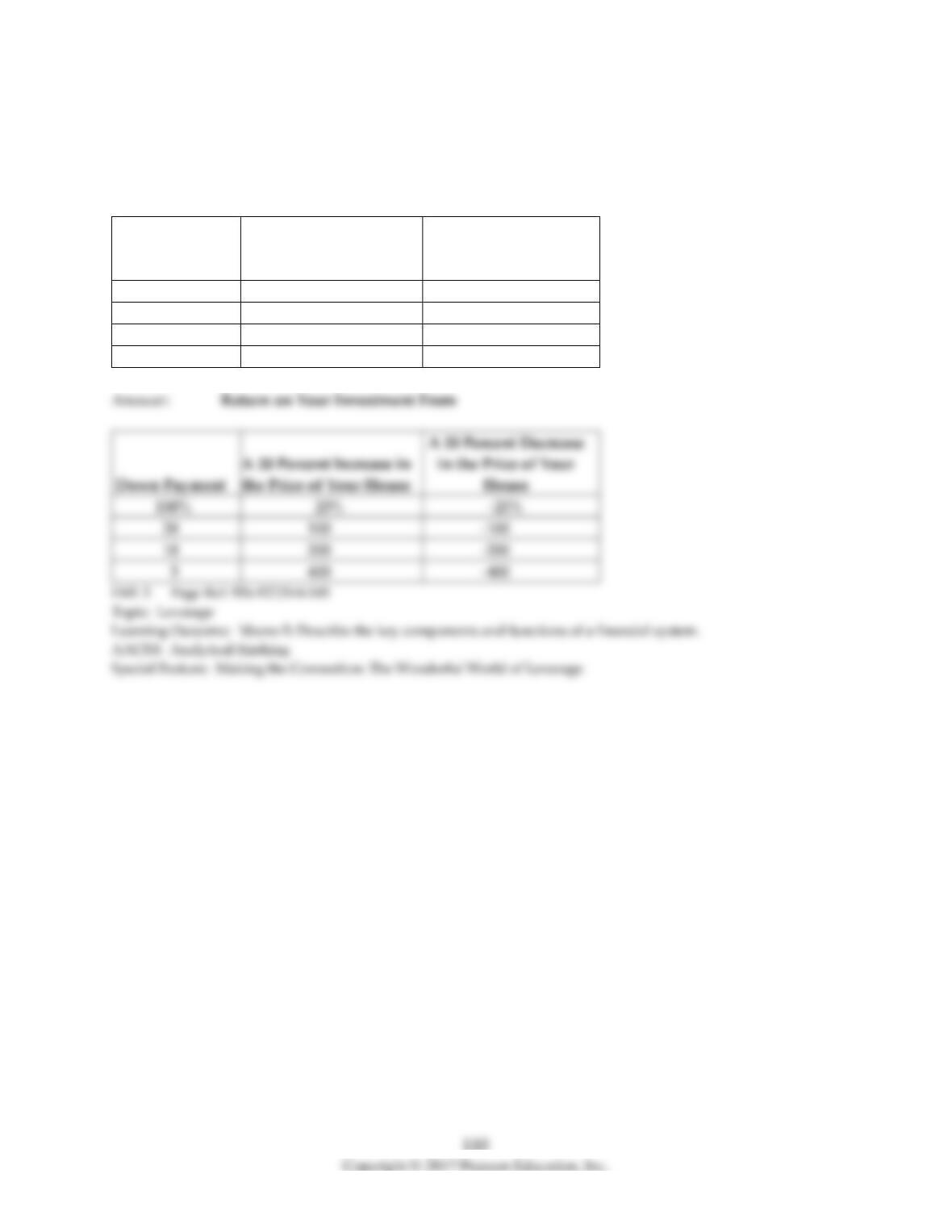
44) In the following table, fill in the columns for your return on investment if the price of your house
increased or decreased by 20 percent, based on the down payments specified in the first column.
Return on Your Investment From
Down Payment
A 20 Percent Increase in
the Price of Your House
A 20 Percent Decrease
in the Price of Your
House
100%
20
10
5
Down Payment
A 20 Percent Increase in
the Price of Your House
A 20 Percent Decrease
in the Price of Your
House
100%
20%
–20%
20
100
–100
10
200
–200
5
400
–400