126) Which of the following is the most liquid?
A) real estate
B) currency
C) government bonds
D) shares of stock
127) An asset is liquid if
A) it earns interest.
B) it is backed by a government guarantee.
C) it can be exchanged for other items of value without high transaction costs.
D) All of the above are correct.
128) Of the items in the following lists, which go from most liquid to least liquid?
A) a checking account, a new vehicle, a six-month certificate of deposit, shares of stock
B) a six-month certificate of deposit, shares of stock, a new vehicle, a checking account
C) a checking account, a certificate of deposit, shares of stock, a new vehicle
D) a new vehicle, a six-month certificate of deposit, shares of stock, a checking account
129) In a fiduciary monetary system
A) coins get their value from the precious metals of which they are made.
B) money gets its value from the confidence that the public has in its acceptability.
C) paper currency does not have value, but balances in checking accounts do.
D) checking account balances do not have value, but paper currency does.
130) The term “fiduciary” comes from the Latin fiducia, which means
A) value.
B) gold.
C) money.
D) trust or confidence.
131) A fiduciary monetary system means
A) that the value of each currency is determined by the amount of gold held by each nation.
B) that the currency is backed by implicit faith in government.
C) that money is legal tender.
D) that money has commodity value.
132) A fiduciary monetary system has to have all of the following EXCEPT
A) trust.
B) a central bank.
C) acceptability.
D) predictability of value.
133) Which one of the following statements is TRUE?
A) Not all forms of currency are accepted equally well by the public as a medium of exchange.
B) Checkable and debitable account balances are not money, but currency is.
C) Checkable and debitable accounts are considered money by law in only 15 states.
D) The value of the dollar rises along with the increases in the consumer price index.
134) To the extent that the value of money is less predictable, it becomes
A) more acceptable as a standard of deferred payment.
B) more acceptable as a unit of account.
C) more acceptable as a store of value.
D) less acceptable as a medium of exchange.
135) Which of the following would be considered a transaction deposit?
A) mutual funds account
B) checking account
C) credit card account
D) 401(k) retirement account
136) The intrinsic value of U.S. currency today is the value of
A) gold.
B) government bonds.
C) none.
D) silver.
137) The money supply in the United States is backed by
A) faith.
B) gold.
C) silver.
D) platinum.
138) United States coins and currency are backed by
A) silver.
B) gold.
C) reserves of foreign currencies.
D) confidence that they will retain their value.
139) Stock market price quotations are an example of money serving as a(n)
A) store of value.
B) medium of exchange.
C) unit of accounting.
D) economic value.
140) A fiduciary monetary system is dependent on
A) acceptability and predictability of value.
B) precious metals backing fiat money.
C) Congressional monetary support.
D) a negative inflation rate.
141) The two basic ways to define money are
A) the transactions approach and the fiduciary approach.
B) the M1 approach and the M2 approach.
C) the transactions approach and the liquidity approach.
D) the liquidity approach and the store of value approach.
142) Which of the following institutions has the responsibility for distributing currency and coins
to the U.S. banking system?
A) the Office of the Comptroller of the Currency
B) the Federal Reserve System
C) the U.S. Bureau of Engraving and Printing
D) the U.S. Treasury Department
143) Which of the following institutions has the responsibility for producing the coins that are
distributed in the United States?
A) the Office of the Comptroller of the Currency
B) the Federal Reserve System
C) the U.S. Treasury Department
D) the U.S. Mint
144) Which approach to measuring money focuses on the value of currency, transaction deposits,
and travelers checks?
A) the transactions approach
B) the liquidity approach
C) near moneys
D) M2
145) The transactions approach to measuring money stresses the role of money as a
A) medium of exchange.
B) unit of accounting.
C) store of value.
D) standard of deferred payment.
146) Which of the following is NOT included using the transactions approach to measuring the
money supply (M1)?
A) currency
B) certificates of deposit
C) transaction deposits
D) traveler’s checks
147) The designate M1 measure of money consists of
A) the most liquid types of money in the U.S. system.
B) small time deposits only.
C) credit cards and ATM cards.
D) gold and gold coins.
148) Checkable deposit account balances are
A) counted in the calculation of the money supply.
B) part of M2 but not part of M1.
C) considered credit, but not money.
D) only a small component of the money supply.
149) Which of the following is NOT part of M1?
A) credit cards
B) checking accounts
C) currency
D) traveler’s checks
150) Which one of the following is NOT a part of the M1 definition of money?
A) paper currency (i.e., Federal Reserve notes)
B) coins
C) savings accounts
D) checkable and debitable accounts
151) When we examine the U.S. money supply, the smallest component of M1 is
A) currency and coins.
B) transaction deposits.
C) certificates of deposit.
D) traveler’s checks.
152) The transactions approach to measuring money includes
A) government bonds.
B) the value of shares of stock in commercial banks.
C) traveler’s checks.
D) all of these.
153) The transactions approach to measuring M1 includes all of the following EXCEPT
A) traveler’s checks.
B) certificates of deposit.
C) checking accounts.
D) currency.
154) All of the following are included in M1 EXCEPT
A) coin and currency.
B) money market mutual fund shares.
C) traveler’s checks.
D) checking account balances.
155) Which of the following is NOT part of M1?
A) money market deposit accounts
B) coin and currency
C) checking deposits
D) traveler’s checks
156) Thrift institutions
A) receive most of their funds from the public’s savings deposits.
B) include commercial banks and investment firms.
C) include credit unions but not savings and loan associations.
D) do not offer transaction deposits.
157) A time deposit with a fixed maturity date offered by banks is called a
A) checking account.
B) savings deposit.
C) small-denomination certificate of deposit.
D) corporate bond.
158) Which of the following is NOT part of M1 but is included in M2?
A) currency
B) small-denomination certificates of deposits
C) traveler’s checks
D) cash
159) Assets that can be easily converted into money without significant loss of value are
A) transactions balances.
B) near monies.
C) currencies.
D) liabilities.
160) Small-denomination time deposits are
A) considered part of near money.
B) included in the definition of both M1 and M2.
C) included in the definition of M1, but not in M2.
D) the same as transaction deposits.
161) Which of the following is included in M2?
I. money market mutual funds
II. small-denomination certificates of deposit
A) I only
B) II only
C) Both I and II
D) Neither I nor II
162) Which of the following would most likely NOT be included in the liquidity approach to
defining the money supply?
A) savings deposits
B) money market mutual fund accounts
C) government bonds
D) traveler’s checks
163) Which of the following is TRUE of M2?
A) It is larger than M1.
B) It excludes savings deposits.
C) It does not include highly liquid components of the money supply.
D) It includes credit limits for credit card transactions.
164) The liquidity approach to measuring money stresses the role of money as a
A) medium of exchange.
B) unit of accounting.
C) temporary store of value.
D) standard of deferred payment.
165) Since 1982, banks and thrift institutions have offered a type of savings account that yields a
market rate of interest with a minimum balance and a limit on transactions. These accounts,
which have no minimum maturity, are known as
A) certificates of deposit.
B) money market mutual funds.
C) mutual funds.
D) repurchase agreements.
166) What differentiates a savings deposit from a small-denomination certificate of deposit
(CD)?
A) A CD has a fixed maturity date; a savings deposit can be withdrawn at any time.
B) A savings deposit cannot be withdrawn before its maturity date without incurring a penalty;
funds in a CD are available at any time with no interest penalty.
C) Only a savings deposit is a time deposit.
D) All depository institutions accept savings deposits, whereas only a thrift institution can issue a
CD.
167) All transaction deposits are included in
A) M1 only.
B) M2 only.
C) both M1 and M2.
D) savings balances only.
168) Which of the following is NOT included in the MZM definition of money?
A) currency.
B) money market funds.
C) travelers checks.
D) small-denomination time deposits.
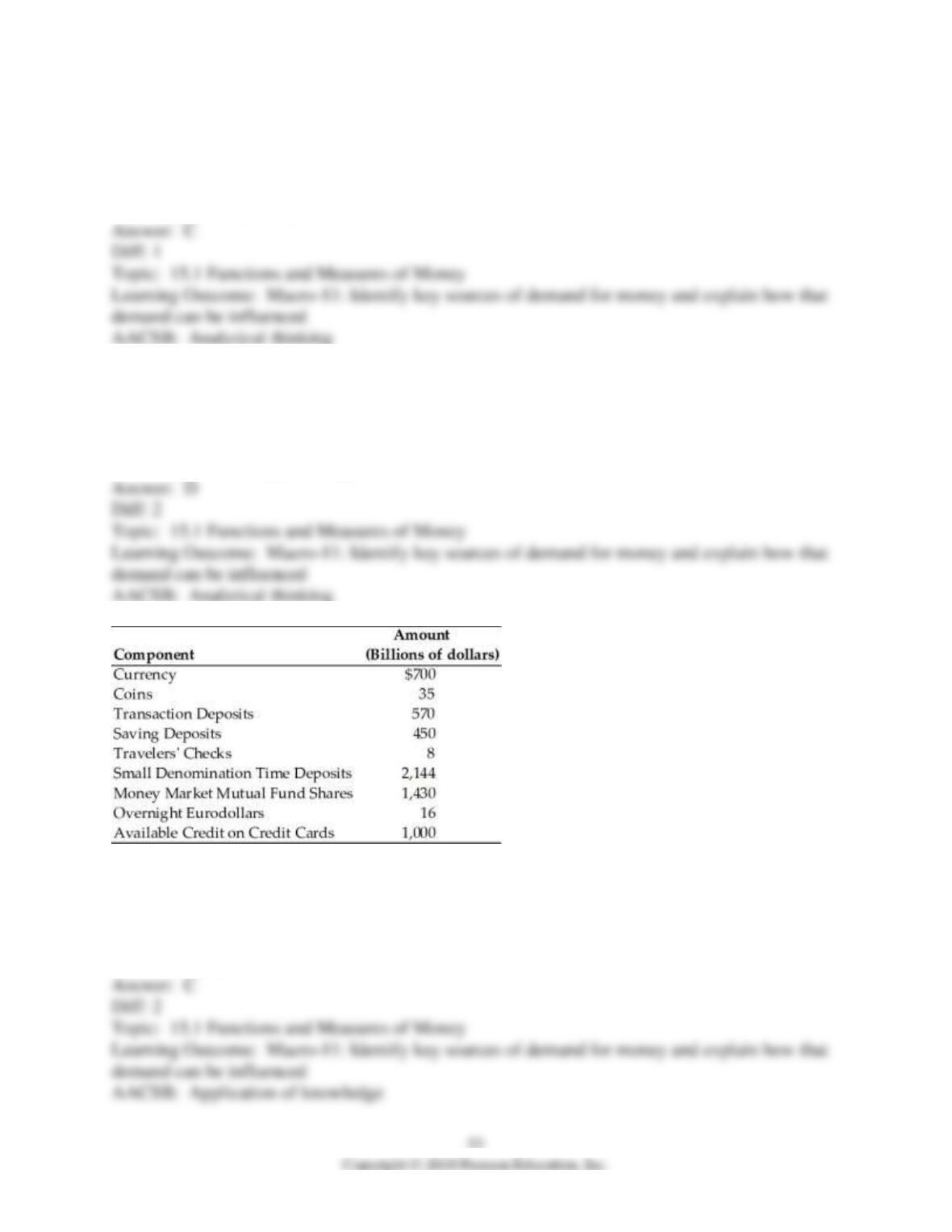
169) According to the above table, the value of M1 is
A) $1,888 billion.
B) $1,629 billion.
C) $1,313 billion.
D) $1,205 billion.
170) According to the above table, the value of M2 is
A) $3,807 billion.
B) $5,337 billion.
C) $6,237 billion.
D) $6,253 billion.
171) The money supply is
A) the rate at which the Federal Reserve Board prints currency.
B) limited to currency and coins.
C) the amount of money in circulation.
D) the rate at which the Federal Reserve Board creates money.
172) The largest component of M1 is
A) currency and coins.
B) traveler’s checks.
C) transaction deposits.
D) time deposit.
173) The best measure of money is
A) coins and currency.
B) the one based on the transactions approach.
C) the one based on the liquidity approach.
D) something economists have never agreed on.
174) The transactions approach to measuring money relies on the role of money primarily as a
A) medium of exchange.
B) unit of account.
C) temporary store of value.
D) standard of deferred payment.
175) A method of measuring the money supply by looking at money as a medium of exchange is
the
A) fiduciary monetary system.
B) capital control.
C) transactions approach.
D) liquidity approach.
176) A method of measuring the money supply by looking at money as a temporary store of
value is the
A) fiduciary monetary system.
B) capital control.
C) transactions approach.
D) liquidity approach.
177) Which function of money does the liquidity approach to measuring money stresses?
A) medium of exchange
B) unit of account
C) store of value
D) standard of deferred payment
178) The key official definition of the money supply is
A) only coins and paper currency in circulation.
B) only transactions deposits at banks.
C) all liquid assets.
D) M2.
179) The money supply that consists of currency, transaction deposits, and traveler’s checks is
A) M1.
B) M2.
C) MZM.
D) L, which stands for liquid assets.
180) Transaction deposits
A) are deposits in a banking institution on which a check may be written.
B) are only deposits that you can check on through the Internet.
C) include savings accounts.
D) are accounts that pay interest to the depositor.
181) Traveler’s check are
A) part of M1 but not M2.
B) part of M2 but not M1.
C) part of M1 and M2.
D) not part of M1 or M2.
182) If the transactions approach to measuring money is used, then the money supply consists of
A) currency only.
B) transaction deposits only.
C) currency and transaction deposits only.
D) currency, checkable and debitable deposits, and traveler’s checks.
183) Which of the following is NOT included in the money supply when the transactions
approach is used?
A) money market deposit accounts
B) traveler’s checks
C) transaction deposits
D) currency
184) Which of the following is NOT included in M1?
A) currency
B) transaction deposits
C) saving deposits
D) traveler’s checks
185) Currency consists of
A) only coins minted by the U.S. Treasury.
B) only Federal Reserve notes.
C) coins minted by the U.S. Treasury and Federal Reserve notes.
D) coins, Federal Reserve Notes and traveler’s checks.
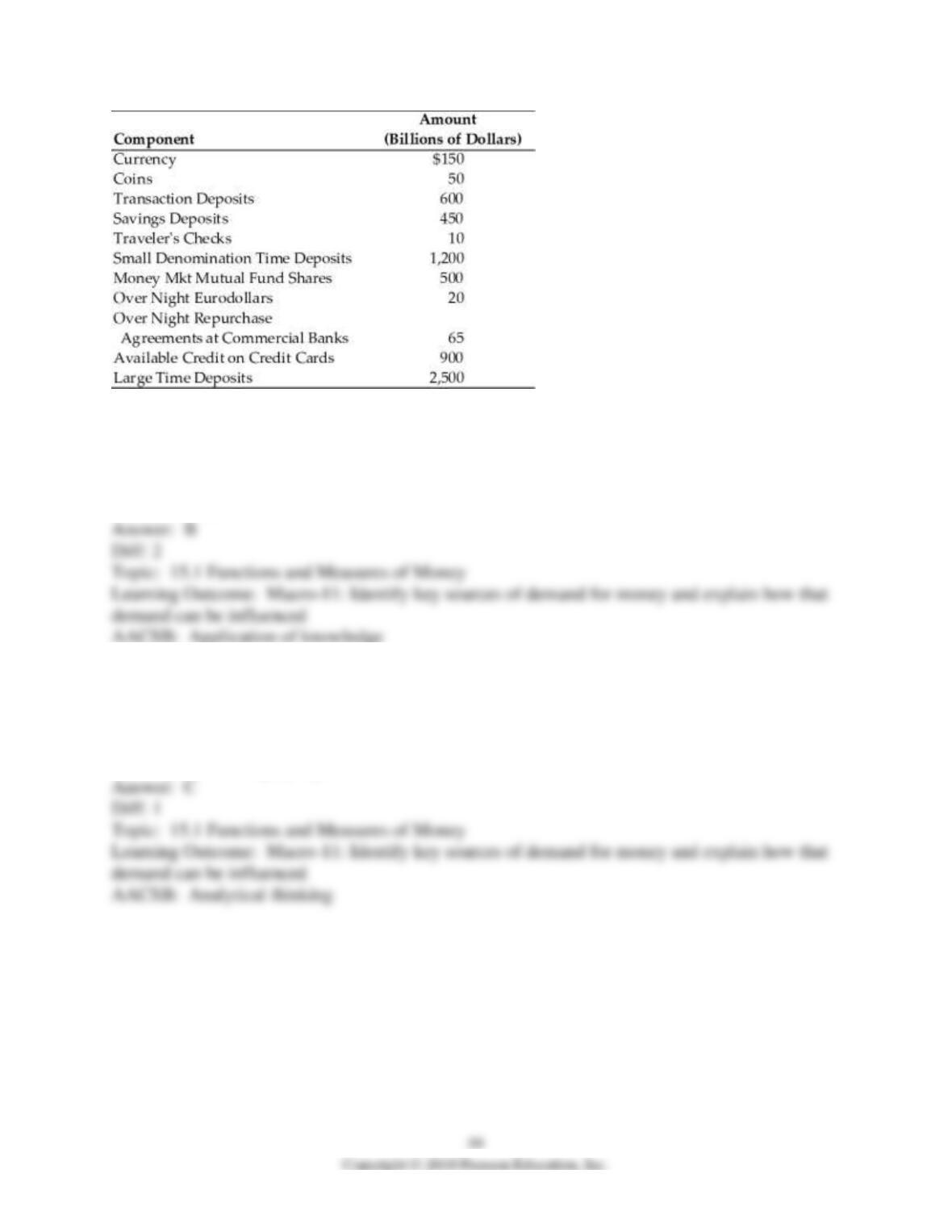
186) Refer to the above table. The value of M1 is
A) $760 billion.
B) $810 billion.
C) $1,260 billion.
D) $2,560 billion.
187) The liquidity approach to measuring the money supply uses
A) M1 only.
B) near moneys only.
C) M1 plus some highly liquid assets.
D) M2 plus some highly liquid assets.
188) An interest-earning account that can be withdrawn at any time without payment of a penalty
is a
A) savings deposit.
B) money market deposit account.
C) government security account.
D) certificate of deposit.
189) An account issued by banks yielding a market rate of interest with a minimum balance
requirement and a limit on transactions is a
A) savings deposit.
B) money market deposit account.
C) mutual funds account.
D) certificate of deposit.
190) A deposit in a financial institution that requires notice of intent to withdraw is a
A) savings deposit.
B) money market deposit account.
C) time deposit.
D) security deposit.