39. Markup on Cost. Stinging Pesticides, Inc., provides scorpion control services, to residential and business
customers in the El Paso area. The company recently raised its service price from $70 to $80 per annual
treatment. As a result, sales fell to 37,500 from 52,500 treatments in the year earlier period.
A.
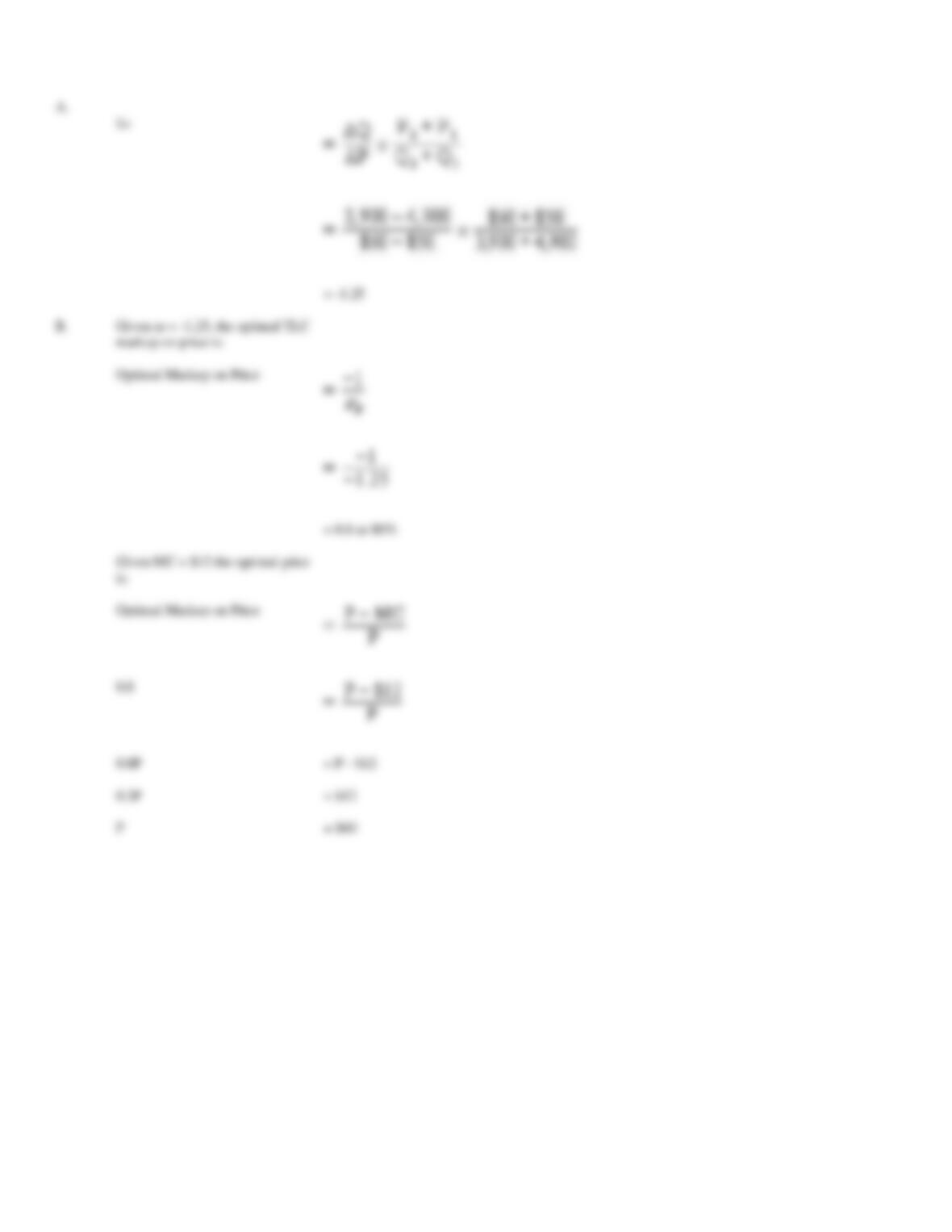
Calculate the arc price elasticity of demand for SPI service.
B.
Assume that the arc price elasticity (from Part A) is the best available estimate of the point price elasticity of demand. If marginal cost
is $48 per unit for labor and materials, calculate SPI’s optimal markup on price and its optimal price.
B.
Given eP = -1.25, the optimal TLC
markup on price is:
= 0.8 or 80%
Given MC = $12 the optimal price
is:
40. Markup on Price. Carpet Magic, Inc., provides professional, in-the-home carpet cleaning services to
residential customers in the Binghamton, New York area. The company recently raised its service price from
$94.50 to $121.50 per room. As a result, sales fell to 5,000 from 7,000 units in the year-earlier period.
A.
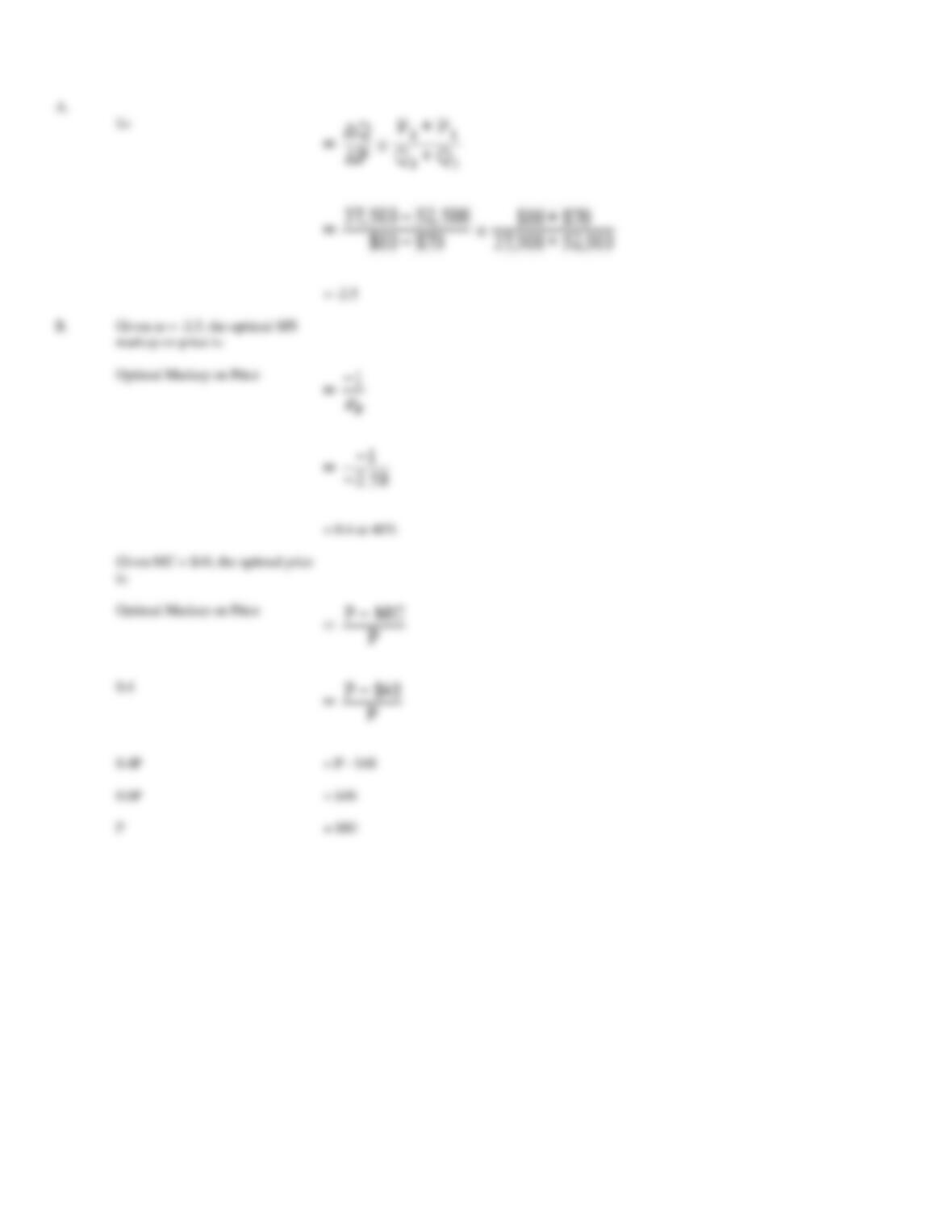
Calculate the arc price elasticity of demand for Carpet Magic service.
B.
Assume that the arc price elasticity (from part A) is the best available estimate of the point price elasticity of demand. If marginal cost is
$30.375 per unit for labor and materials, calculate Carpet Magic’s optimal markup on price and its optimal price.
B.
Given eP = -2.5, the optimal SPI
markup on price is:
= 0.4 or 40%
Given MC = $48, the optimal price
is:
41. Markup on Price. Plan It Right, Inc., provides party planning and catering services for elegant residential
parties in the Louisville area. The company recently raised its service price from $900 to $1,100 per party. As a
result, sales fell to 350 from 450 units in the year earlier period.
A.
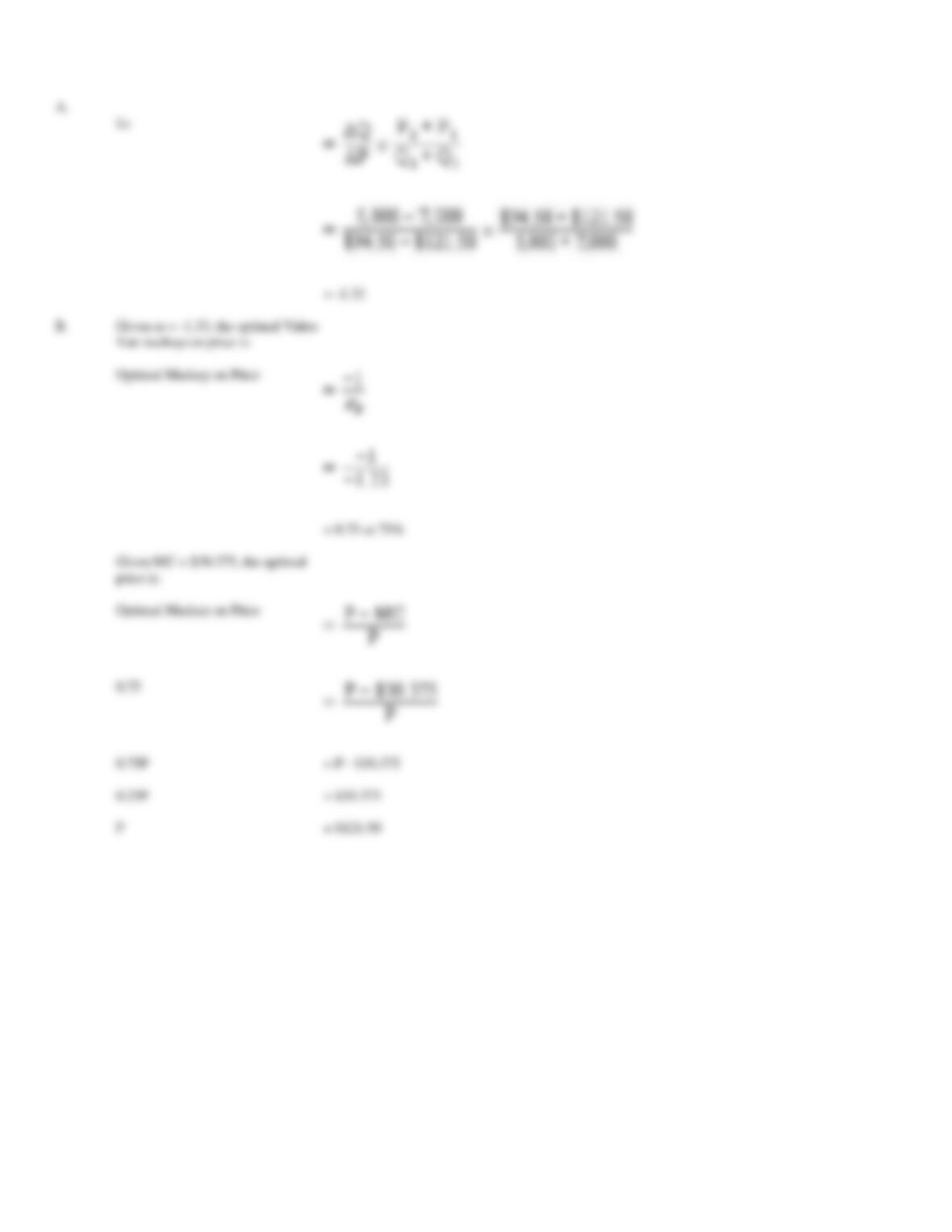
Calculate the arc price elasticity of demand for PIR service.
B.
Assume that the arc price elasticity (from part A) is the best available estimate of the point price elasticity of demand. If marginal cost is
$220 per unit for labor and materials, calculate PIR’s optimal markup on price and its optimal price.
B.
Given eP = -1.33, the optimal Video
Van markup on price is:
= 0.75 or 75%
Given MC = $30.375, the optimal
price is:
42. Incremental Analysis. The Just-for-Kids Daycare Center on Clinton Parkway is considering offering
child-care services from 6:00 to 12:00 P.M. on weekends. Currently, the center only operates Monday through
Friday between the hours of 6 A.M. and 6 P.M. At a price of $20 per night, the Center’s manager projects that
parents of 20 children would take advantage of the new service. Projected costs for each hour the center is open
are:
Cost Category
Costs
(per hour)
Two staff members’ salaries (overtime rate)
$13
(each)
Variable overhead (electricity, heat)
5
Allocated fixed overhead (lease expenses, insurance, etc.)
10
A.
Would the new weekend service be profitable?
B.
Calculate the breakeven price per child for weekend service at a projected attendance of 20 children.
43. Incremental Analysis. The Rainbo Deli is considering offering a homestyle dinner menu from 6:00 to
10:00 P.M. on weekends. Currently, the deli only operates Monday through Friday between the hours of
10:00 A.M. and 4:00 P.M. At an average price of $14 per diner, the deli’s manager projects that 100 diners per
evening would take advantage of the new service. Projected costs for each night the deli is open are:
Cost Category
Costs
(per hour)
Four waitresses’ and busboy’s salaries (each)
$10
Two cooks salaries (each)
20
Variable overhead (electricity, heat)
30
Allocated fixed overhead (lease expenses, insurance, etc.)
80
A.
Would the new weekend service be profitable?
B.
Calculate the breakeven price per dinner for evening dining at a projected attendance of 100 dinners.
A.
Yes, on a per night basis, an analysis of incremental revenues and costs reveals the following:
Incremental revenue ($14 ´ 100)
$1,400
Incremental Costs
Waitress and busboy salaries (4 ´ $10 ´ 4 hours)
$160
Cook salaries (2 ´ $20 ´ 4 hours)
160
Variable overhead ($30 ´ 4 hours)
120
(440)
Incremental profit per night
$960
A.
Yes, on a per night basis, an analysis of incremental revenues and costs reveals the following:
Incremental revenue ($20 ´ 20)
$400
Incremental costs
Staff salaries (2 ´ $13 ´ 6 hours)
$156
Variable overhead ($5 ´ 6 hours)
(186)
Incremental profit per night
$214
B.
The breakeven price for weekend service is:
Incremental costs
$186
Breakeven price per child
$9.30
44. Incremental Analysis. Sanford & Sons Construction Company is a building contractor serving the
Mid-Atlantic region. The company recently bid on construction of a new office building in Richmond, Virginia.
Sanford & Sons has incurred bid development and marketing expenses of $50,000 prior to submission of the
bid. The bid was based on the following projected costs:
Bid development and marketing expenses
$ 50,000
Materials
1,750,000
Labor (50,000 hours @ $40)
2,000,000
Variable overhead (40% of direct labor)
800,000
Allocated fixed overhead (8% of total costs)
400,000
Total costs
$5,000,000
A.
What is Sanford & Son’s minimum acceptable contract price, assuming the company is operating at peak capacity?
B.
What is the company’s minimum acceptable contract price if an economic downturn has left the company with substantial excess
capacity?
Because the $50,000 bid development and marketing expenses were incurred prior to submission of the bid, they are sunk costs and
irrelevant in determining a minimum acceptable contract price.
away other profitable business.
be accepted.
45. Incremental Analysis. St. Thomas Printing Company is a small printer serving the greater Minneapolis-St.
Paul metropolitan area. The company recently bid on a government contract for the printing of a new pamphlet
explaining phone scams. St. Thomas Printing has incurred bid development and marketing expenses of $250
prior to submission of the bid. The bid was based on the following projected costs:
Bid development and marketing expenses
$ 250
Materials
980
Labor (200 hours @ $15)
3,000
Variable overhead (35% of direct labor)
1,050
Allocated fixed overhead (12% of total costs)
720
Total costs
$6,000
A.
What is St. Thomas’ minimum acceptable contract price, assuming the company is operating at peak capacity?
B.
What is the company’s minimum acceptable contract price if an economic downturn has left the company with substantial excess
capacity?
Incremental costs
$440
Breakeven price per dinner
$4.40
46. Incremental Analysis. Fan Diego, Inc., manufactures a hand-held electric hair dryer. Sales have increased
steadily during recent years and, because of a recently completed expansion program, annual capacity is now
250,000 units. Production and sales during the coming year are forecast at 150,000 units, and standard
production costs have been estimated as:
Materials
$3.00
Direct labor
2.00
Variable indirect labor
0.50
Fixed overhead
1.00
Allocated cost per unit
$6.50
In addition to production costs, Fan Diego incurs fixed selling expenses of 50¢ per unit, and variable warranty repair expenses of 75¢ per unit. Fan
Diego currently receives $8.25 per unit from its customers (primarily retail department stores) and expects this price to hold during the coming year.
After making the above projections, Fan Diego received an inquiry concerning the purchase of a large number of units by a discount department
store. The inquiry contained two purchase offers:
·
Offer 1: The department store would purchase 100,000 units at $8 per unit. These units would bear the Fan Diego label, and the Fan
Diego warranty would cover them.
·
Offer 2: The department store would purchase 150,000 units at $7 per unit. These units would be sold under the buyer’s private label
and Fan Diego would not provide warranty service.
A.
Evaluate the incremental net income from each offer.
B.
What other factors should Fan Diego consider in deciding which offer to accept?
C.
Which offer (if either) should Fan Diego accept. Why?
The incremental net income from these offers can be determined as follows:
$6,000 – $250 – $720). Any price above that level will make a positive contribution to overhead and should be accepted.
47. Price Discrimination. The Do-Drop-Inn, Inc., provides vacation lodging services to both family and senior
citizen customers. Yearly demand and marginal revenue relations for overnight lodging services, Q, are as
follows:
Family
PF
= $40 – $0.0004QF
MRF
= TRF/ QF = $40 – $0.0008QF
Senior Citizens
PS
= $30 – $0.00025QS
MRS
= TRS/ QS = $30 – $0.0005QS
Unit price
$8.00
$7.00
Unit variable costs:
Materials
$3.00
$3.00
Direct labor
2.00
2.00
Variable indirect labor
0.50
0.50
Variable warranty expense
0.75
6.25
0.00
5.50
Unit incremental profit
1.75
1.50
Units to be sold
´ 100,000
´ 150,000
Total variable profit on units sold at
special price
$175,000
$225,000
Less variable profit lost on regular sales:
Regular price
$8.25
Regular variable costs
-6.25
Regular variable profit
$2.00
Units that cannot be sold at regular price
if offer 2 is accepted
´ 50,000
Opportunity cost of lost regular sales
($0)
($100,000)
Incremental profit
$175,000
$125,000
Thus, both offers would involve a substantial incremental profit, but offer 1 appears to be more attractive on a simple dollar basis.
(iii)
The sales lost if Fan Diego accepts offer 2 may affect future orders from regular customers.
Average variable costs for labor and materials are constant at $20 per unit.
A.
Assuming the company can discriminate in price between family and senior citizen customers, calculate the profit-maximizing price,
output, and total profit contribution levels.
B.
Calculate point price elasticities of demand for each customer class at the activity levels identified in part A. Are the differences in these
elasticities consistent with your recommended price differential? Explain.
The profit contribution earned by the
48. Price Discrimination. The Fun-Land Amusement Park is a 40-acre fun park full of rides, shows, and shops.
Fun-Land’s marketing department segments its customer base into two parts: local patrons and tourists.
Fun-Land assumes local patrons are more price sensitive than out-of-town tourists. Yearly demand and
marginal revenue relations for overnight lodging services, Q, are as follows:
Locals
PL
= $40 – $0.0005QL
MRL
= TRL/ QL = $40 – $0.001QL
Tourists
PT
= $50 – $0.0004QT
MRT
= TRT/ QT = $50 – $0.0008QT
Average variable costs for labor and materials are constant at $20 per unit.
A.
Assuming the company can discriminate in pricing between locals and tourist customers through coupons distributed to locals via local
shops, calculate the profit-maximizing price, output, and total profit contribution levels.
B.
Calculate point price elasticities of demand for each customer class at the activity levels identified in part A. Are the differences in these
elasticities consistent with your recommended price differential? Explain.
Families
= 100,000 – 2,500PF
= QF/ PF ´ PF/QF
= -2,500 ´ ($30/25,000)
Senior Citizens
= 120,000 – 4,000PS
= QS/ PS ´ PS/QS
= -4,000 ´ ($25/20,000)
49. Joint Product Pricing. The Frank Boulger Mining Company operates the Million Dollar Mine in Leadville,
Colorado. Each ton of mined ore yields one ounce of silver and one pound of lead in a fixed 1:1 ratio. Marginal
costs are $8 per ton of ore mined.
The demand and marginal revenue curves for silver are:
PS
= $10 – $0.00002QS
MRS
= TR S/ QS = $10 – $0.00004QS
and those for lead are:
PL
= $1 – $0.000005QL
MRL
= TR L/ QL = $1 – $0.00001QL
where QS is ounces of silver and QL is pounds of lead.
A.
Calculate profit-maximizing sales quantities and prices for silver and lead.
B.
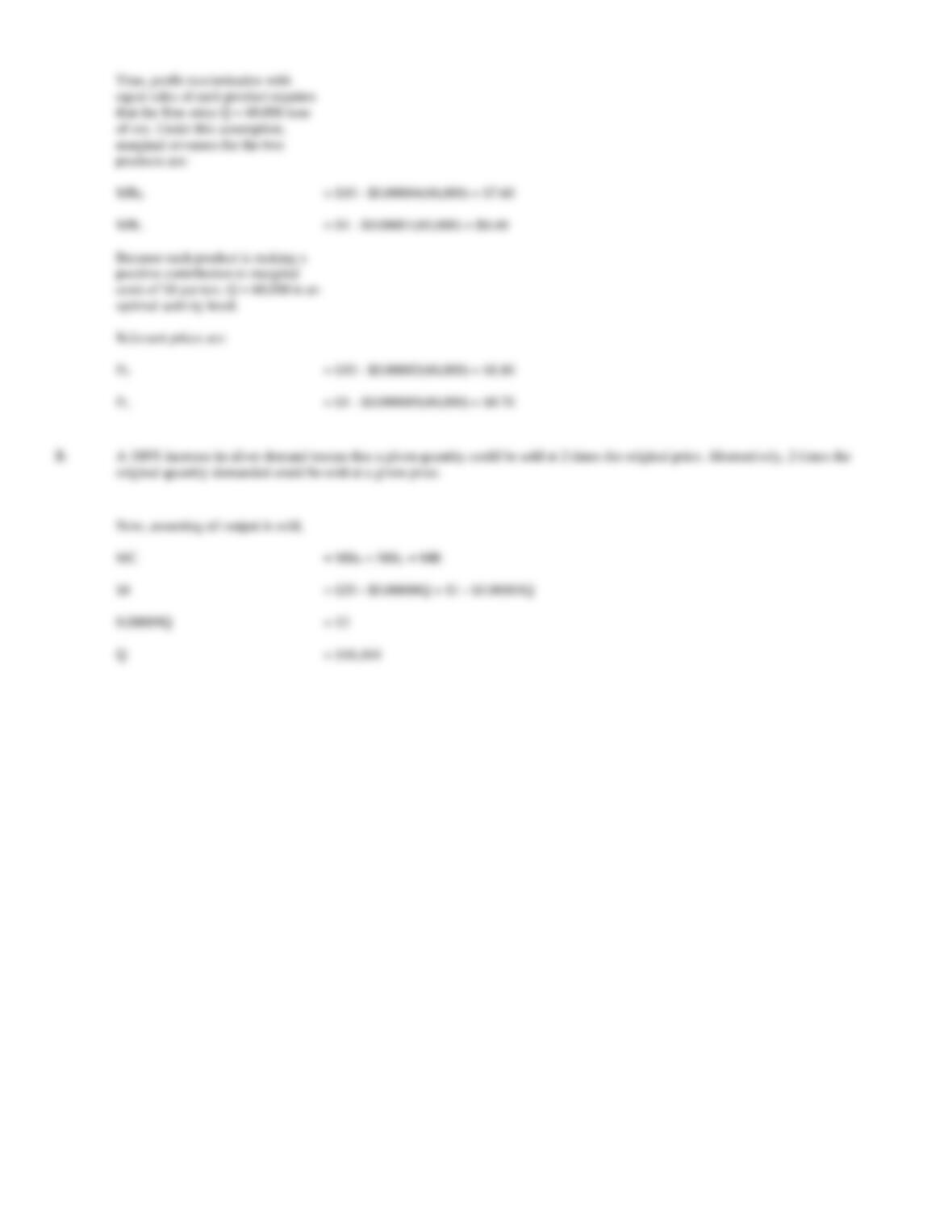
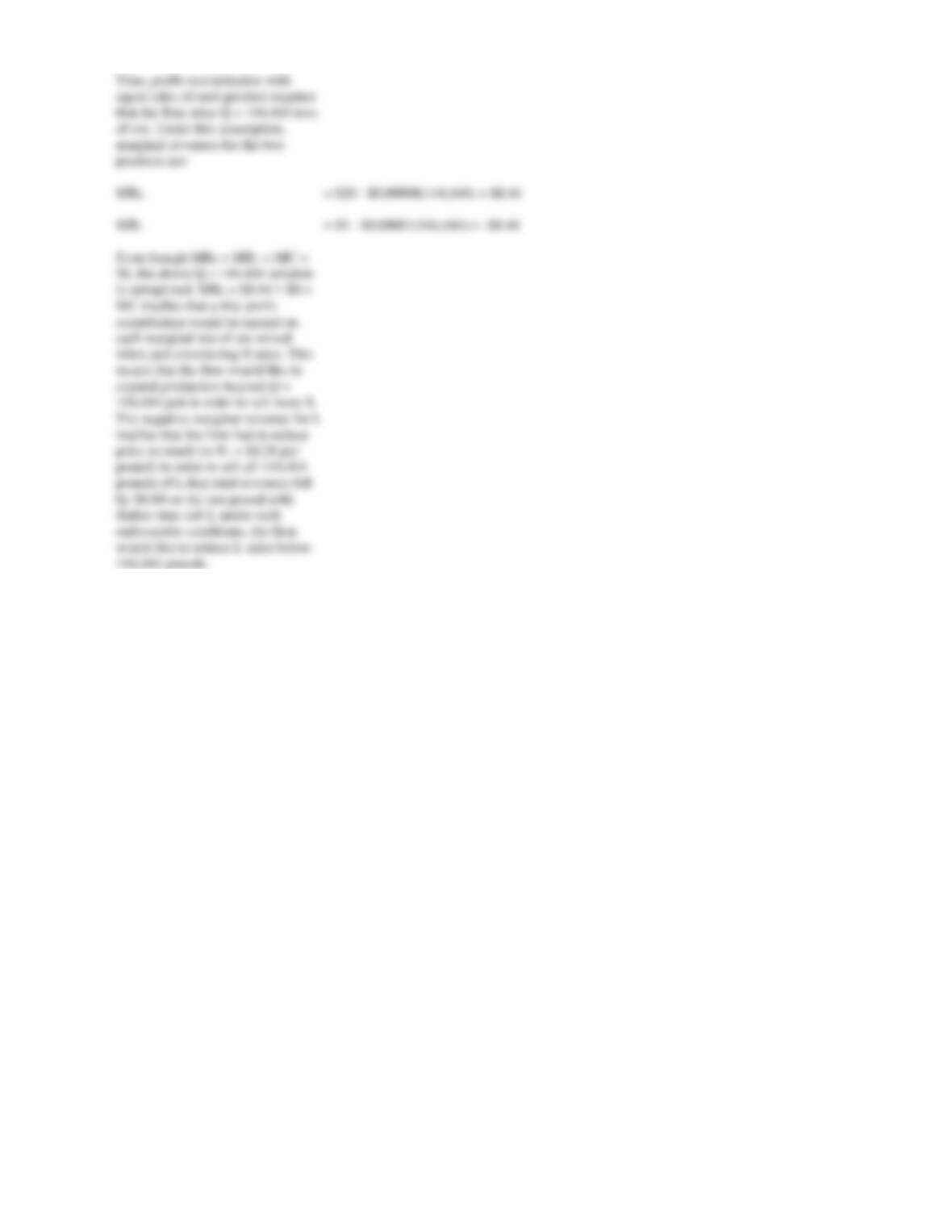
Assume that speculation in the silver market has created a doubling (or 100%) increase in silver demand. Now:
= 2($10 – $0.00002QS)
= $20 – $0.00004QS
= 2($10 – $0.00004QS)
= $20 – $0.00008QS
and all other relations remain as before.
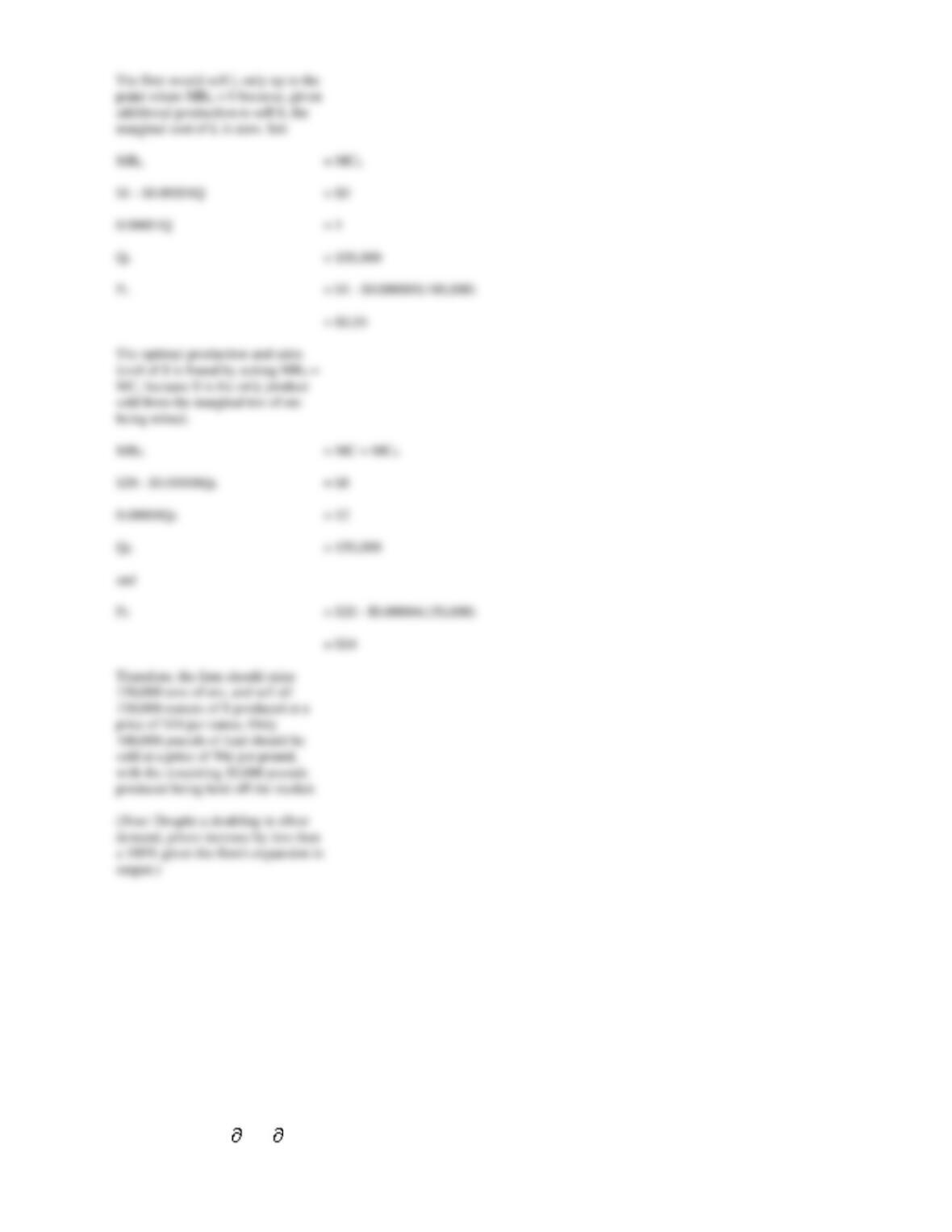
Calculate optimal sales quantities and prices for both silver and lead under these conditions.
= MRS + MRL = MR
= $10 – $0.00004Q + $1 – $0.00001Q
0.00005Q
= 3
Q
= 60,000
50. Joint Product Pricing. The Golden State Mining Company operates a small gold and copper mine in a
remote region of the Sierra Nevadas. Each ton of mined ore yields one ounce of gold and one pound of copper
in a fixed 1:1 ratio. Marginal costs are $450 per ton of ore mined, plus a $30 per ton state land reclamation tax.
The demand and marginal revenue curves for gold are:
PG
= $500 – $0.001QG
MRG
= TR G/ QG = $500 – $0.002QG
= $0
= 100,000
= $0.50
= MC = MCS
= 12
and
= $20 – $0.00004(150,000)
and those for copper are:
PC
= $5 – $0.00025QC
MRC
= TR C/ QC = $5 – $0.0005QC
where QG is ounces of gold and QC is pounds of copper.
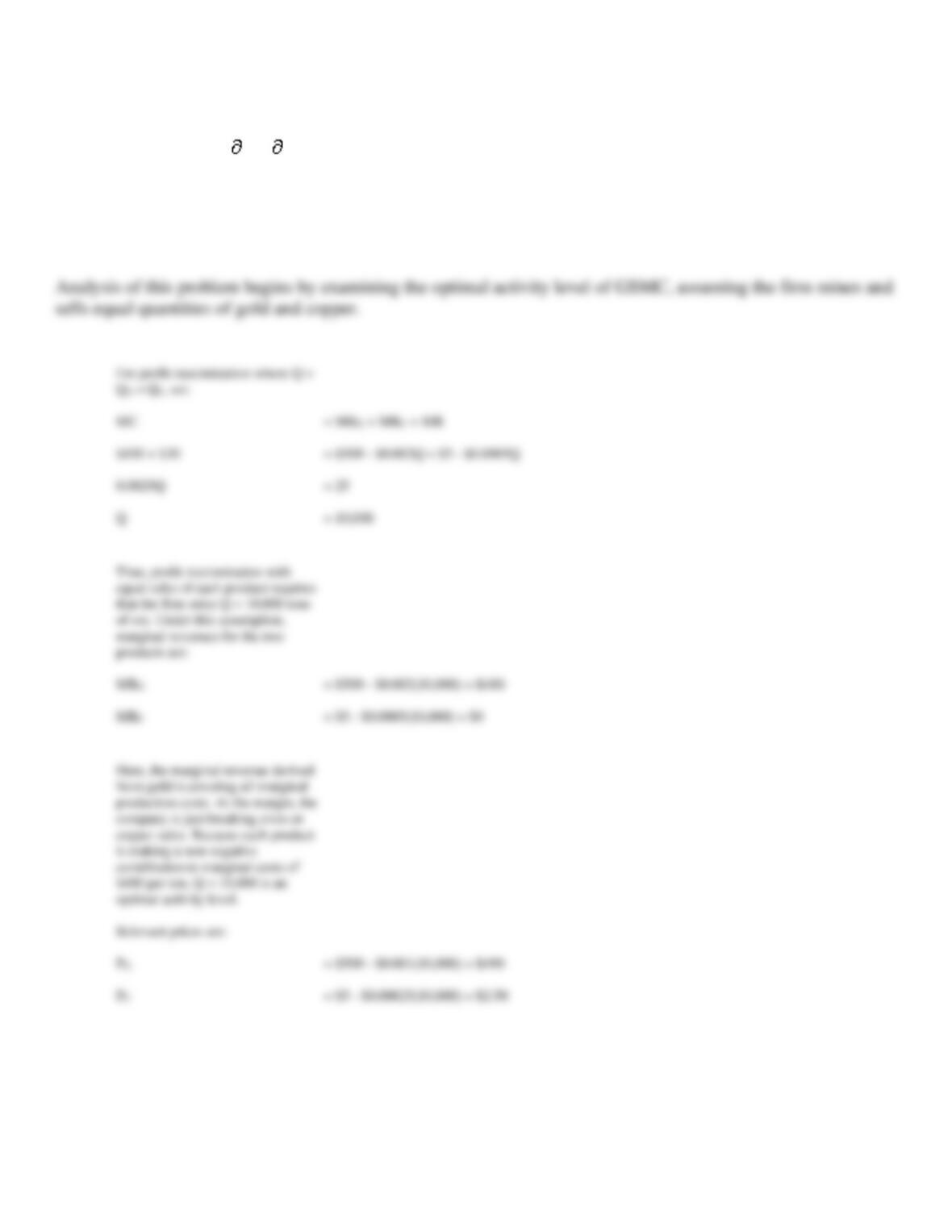
Calculate profit-maximizing sales quantities and prices for gold and copper.
= MRG + MRC = MR
0.0025Q
= 25
= $500 – $0.002(10,000) = $480
= $5 – $0.0005(10,000) = $0
Relevant prices are:
PG
= $500 – $0.001(10,000) = $490
PC
= $5 – $0.00025(10,000) = $2.50