112) If the reserve ratio is raised, the money multiplier
A) is lowered.
B) is increased.
C) stays the same.
D) is doubled.
113) The maximum potential money multiplier is equal to
A) the reserve ratio.
B) the inverse of the required reserve ratio.
C) one minus the reserve ratio
D) the number of dollars on reserve.
114) If the reserve ratio is 100 percent, the maximum potential money multiplier is
A) 0.
B) 1.
C) 10.
D) 100.
115) With a reserve ratio of 0 percent, the maximum potential money multiplier is
A) 0.
B) 1.
C) 100.
D) infinitely large.
142
116) For the past several decades, the U.S. M1 multiplier has been between
A) 1.0 and 2.0.
B) 2.5 and 3.0.
C) 3.0 and 6.0.
D) 6.5 and 10.0.
117) The larger is the reserve ratio
A) the greater is the increase in the money supply for an increase in bank deposits.
B) the more likely it is there will be currency drains.
C) the smaller is the maximum potential money multiplier.
D) the more difficult it is for the Federal Reserve to control the money supply.
118) By affecting the amount of reserves in the banking system, the Fed can
A) affect the size of the money supply.
B) change the marginal tax rates.
C) increase government purchases.
D) reduce government purchases.
119) Initially, the reserve ratio is 10 percent. Now banks decide they want an additional 10
percent of deposits as reserves. There are no currency drains. If the Fed buys $1 million of U.S.
government securities, the money supply will
A) not change because of the excess reserves banks keep on hand.
B) increase by $1 million.
C) increase by $5 million.
D) increase by $10 million.
120) Following a new deposit of $100 at a bank, drawn on funds previously held on deposit at
another bank, when the reserve ratio is 10 percent, the maximum potential increase in the money
supply will be
A) $0.
B) $50.
C) $90.
D) $1,000.
121) If the reserve ratio is 20 percent and reserves in the commercial banking system increase by
$10,000, the maximum possible expansion of demand deposits is
A) $10,000.
B) $80,000.
C) $50,000.
D) $500,000.
122) When the Federal Reserve sells a government security to a bond dealer, which transmits
payment from a transactions deposit account at a bank
A) the cash of the Federal Reserve will decrease.
B) the net worth of the commercial bank will decrease.
C) the loans of the commercial bank will increase.
D) the money supply will decrease.
123) If the Federal Reserve sells $200 of securities through a commercial bank when the reserve
requirement is 10 percent, the maximum potential change in the money supply is
A) a $200 increase.
B) a $2,000 increase.
C) a $200 decrease.
D) a $2,000 decrease.
124) If the Federal Reserve buys $500 of government securities when the required reserve ratio
is 50 percent, the maximum potential change in the money supply is a(n)
A) increase by $500.
B) increase by $1,000.
C) decrease by $500.
D) decrease by $1,000.
125) Which of the following would reduce the money multiplier?
A) reducing the reserve ratio
B) bond purchases by the Fed
C) cash drains from banks
D) bank reductions in desired reserve holdings
126) Which of the following would reduce the money multiplier?
A) the purchase of bonds by the Fed
B) lowering the reserve ratio
C) increases in the reserve ratio
D) a flow of currency into the banking system
127) According to the text, the actual M1 multiplier in the U.S. today is
A) between 0 and 1.
B) between 1.5 and 2.0.
C) negative.
D) over 10.
128) According to the text, the actual M2 multiplier in the United States today is
A) about 5.
B) between 1.0 and 2.0.
C) negative.
D) over 10.
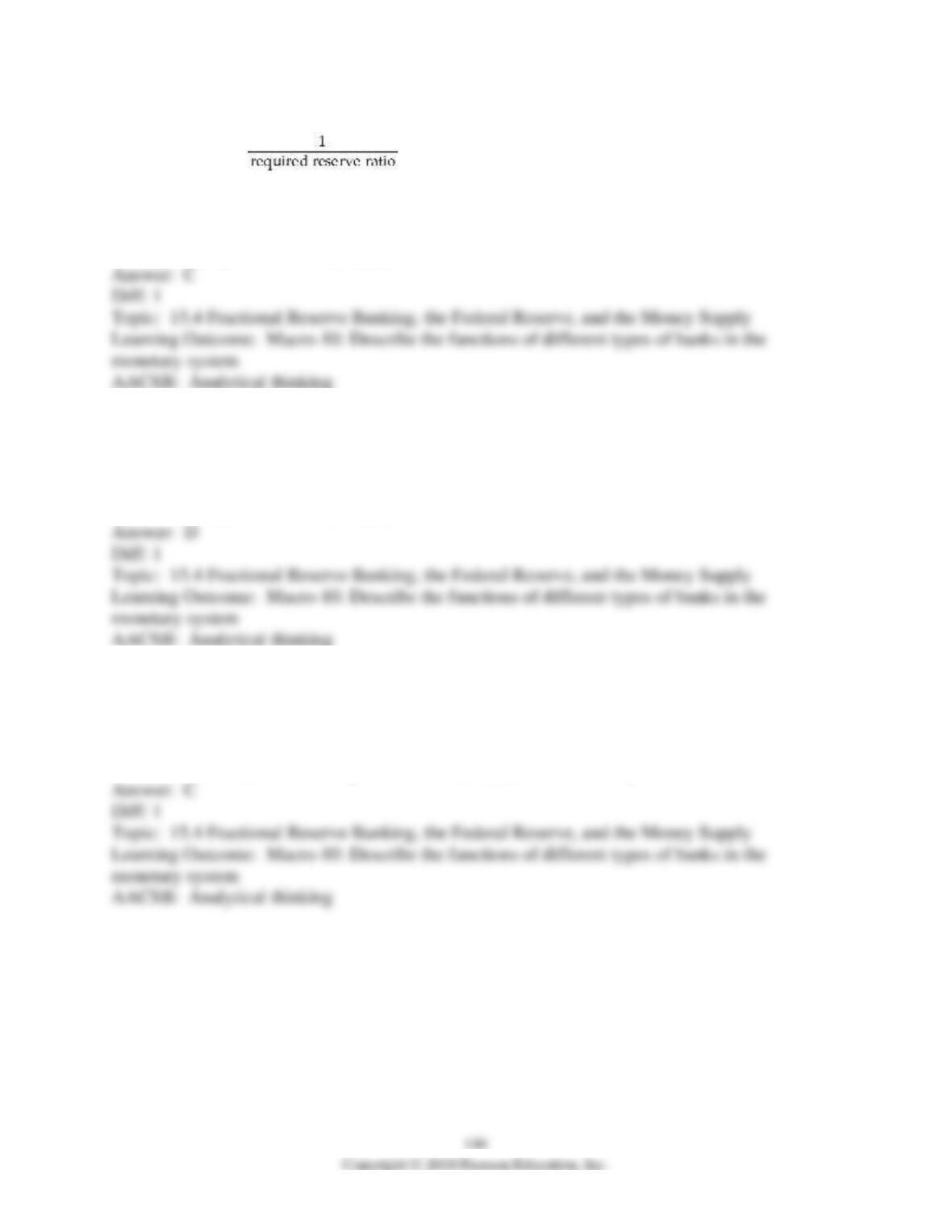
129) The formula is the
A) federal funds rate.
B) discount rate.
C) potential money multiplier.
D) actual change in the money supply.
130) The actual money multiplier multiplied by the change in total reserves is the
A) federal funds rate.
B) discount rate.
C) potential money multiplier.
D) actual change in the money supply.
131) The potential money multiplier gives us
A) the growth in real national income when the money supply increases.
B) the growth in the money supply when income increases.
C) the maximum potential change in the money supply due to a change in reserves.
D) the maximum potential change in the money supply due to a change in income.
132) When people decide to increase the amount of currency they are currently holding
A) the potential money multiplier will increase.
B) the potential money multiplier will decrease.
C) the actual money multiplier will increase.
D) the actual money multiplier will decrease.
133) When banks reduce the reserve ratio, the potential money multiplier
A) increases.
B) decreases.
C) remains unchanged.
D) sometimes increases, and sometimes decreases depending on the rate of inflation.
134) If proceeds from loans are NOT deposited back in the banking system, then
A) the magnitude of the multiplier process is reduced.
B) there is no effect on the magnitude of the multiplier process.
C) the magnitude of the multiplier process is increased.
D) the Fed intervenes by selling more Federal government bonds.
135) The value of the money multiplier depends on
A) the reserve ratio.
B) the ratio of total assets to total liabilities for the banking system as a whole.
C) the interest rate offered on bonds currently being sold by the Fed.
D) the interest rate offered on bonds currently being purchased by the Fed.
148
136) If the reserve ratio decreases from 20 percent to 10 percent, then the potential money
multiplier
A) increases from 5 to 10.
B) decreases from 10 to 5.
C) does not change.
D) decreases from 20 to 10.
137) An increase in the reserve ratio
A) has an expansionary effect on the money supply.
B) has a contractionary effect on the money supply.
C) increases the money multiplier.
D) will cause banks to make more loans.
138) Suppose that the Fed purchases $1,000,000 worth of bonds and that the reserve ratio is 100
percent. Then, the maximum potential expansion of deposits is
A) $1,000,000.
B) $0.
C) $100 million.
D) none of the above.
139) What is a fractional reserve banking system? How long has the fractional reserve banking
system been in existence?
140) What are reserves? Discuss the various types of reserves used in the U.S. banking system.
141) As far as reserves and deposits are concerned, describe the assets and liabilities of a bank.
142) Explain what happens to the money supply when the Fed sells bonds on the open market.
What happens to the assets and liabilities of the Fed?
143) Suppose the Fed purchases $1 million in bonds in the open market. Explain how the money
supply can increase by more than $1 million.
144) Why does the money supply increase when the Fed buys a bond but does NOT change
when a business buys a bond?
145) Explain how the Fed increases the money supply when it buys bonds in the open market.
146) How are the assets and liabilities changed for a bond dealer, the bond dealer’s bank, and the
Fed when the Fed buys $100,000 in bonds?
147) Suppose a person deposits a paycheck in a bank. The transaction deposits are money, so has
the money supply increased? Explain.
15.5 Federal Deposit Insurance
1) The Federal Deposit Insurance Corporation insures
A) banks against lawsuits.
B) the federal funds market.
C) the deposits held in member banks.
D) the deposits held in the Fed.