2) Kellogg’s and General Mills are two of the dominant breakfast cereal manufactures in the U.S.
Each firm can either sign or not sign an exclusive contract with an Olympian gold-medal athlete
to appear on the cover of a cereal box. Both Kellogg’s and General Mills have signed athletes in
2008, Michael Phelps and Nastia Liukin, respectively. What does this suggest about the outcome
of the oligopoly game?
A) The highest profits are when both companies sign.
B) The best outcome, in terms of profit, is where both companies sign.
C) The Nash equilibrium must be that both companies sign.
D) The Nash equilibrium must be that both companies sign and this always leads to the highest
profits.
3) Kellogg’s and General Mills are two of the dominant breakfast cereal manufactures in the U.S.
Each firm can either sign or not sign an exclusive contract with an Olympian gold-medal athlete
to appear on the cover of a cereal box. If both companies sign an athlete, they will each make $5
million in economic profit. If only firm signs, they earn $8 million in economic profit and the
other firm incurs an economic loss of $1 million. If neither firm signs, they break even. What are
the strategies in this game?
A) Do not sign exclusive contract with an Olympian gold-medal athlete to appear on the cover of
a cereal box and make $8 million in profit.
B) Sign an exclusive contract with an Olympian gold-medal athlete to appear on the cover of a
cereal box and do not sign exclusive contract with an Olympian gold-medal athlete to appear on
the cover of a cereal box.
C) Sign an exclusive contract with an Olympian gold-medal athlete to appear on the cover of a
cereal box and make $8 million in profit.
D) Make $5 million or $8 million in profit.
4) Kellogg’s and General Mills are two of the dominant breakfast cereal manufactures in the U.S.
Each firm can either sign or not sign an exclusive contract with an Olympian gold-medal athlete
to appear on the cover of a cereal box. If both companies sign an athlete, they will each make $5
million in economic profit. If only firm signs, they earn $8 million in economic profit and the
other firm incurs an economic loss of $1 million. If neither firm signs, they break even. Which of
the following pairs of payoffs would NOT appear together in a square of the payoff matrix?
A) $5 million; $5 million
B) $0 million; $0 million
C) $8 million; $5 million
D) -$1 million; $8 million
5) Kellogg’s and General Mills are two of the dominant breakfast cereal manufactures in the U.S.
Each firm can either sign or not sign an exclusive contract with an Olympian gold-medal athlete
to appear on the cover of a cereal box. If both companies sign an athlete, they will each make $5
million in economic profit. If only firm signs, they earn $8 million in economic profit and the
other firm incurs an economic loss of $1 million. If neither firm signs, they break even. What is
the outcome of this game if it is only played once?
A) Neither Kellogg’s nor General Mills will sign an athlete.
B) Kellogg’s will sign an athlete and General Mills will not sign an athlete.
C) Both Kellogg’s and General Mills will sign an athlete.
D) General Mills will sign an athlete and Kellogg’s will not sign an athlete.
6) In 2008, a former Intel engineer has been charged with stealing trade secrets worth $1 billion.
Intel owns 90 percent of the worldwide market for microprocessors, AMD has the rest.
Conducting R&D is very expensive so suppose that each of these firms can either steal R&D or
develop their own R&D. If both firms develop their own R&D, economic profit will be $50
million each. If one company steals R&D, that firm earns $100 million in economic profit while
the other firm earns $10 million. If both firms steal R&D, each firm breaks even. What is the
outcome of this game?
A) Both firms will conduct R&D.
B) Both firms will steal R&D.
C) The outcome will be a dominant strategy equilibrium.
D) Only one firm will conduct R&D, but we cannot predict which firm will conduct R&D.
7) In 2008, a former Intel engineer has been charged with stealing trade secrets worth $1 billion.
Intel owns 90 percent of the worldwide market for microprocessors, AMD has the rest. The
microprocessor market is most like an example of
A) monopoly.
B) oligopoly.
C) perfect competition.
D) monopolistic competition.
8) In 2008, a former Intel engineer has been charged with stealing trade secrets worth $1 billion.
Intel owns 90 percent of the worldwide market for microprocessors, AMD has the rest.
Conducting R&D is very expensive so suppose that each of these firms can either steal R&D or
develop their own R&D. If both firms develop their own R&D, economic profit will be $50
million each. If one company steals R&D, that firm earns $100 million in economic profit while
the other firm earns $10 million. If both firms steal R&D, each firm breaks even. What is NOT
true about this game?
A) The outcome will not be a dominant strategy equilibrium.
B) A strategy is to steal R&D.
C) A firm will make more profit if it steals R&D.
D) A strategy is to conduct R&D.
9) Russia, Iran and Qatar made the first serious moves in October 2008 toward forming an
OPEC-style cartel on natural gas. What is the goal of a cartel?
A) restrict output
B) raise prices
C) increase sales
D) increase profits
10) Russia, Iran and Qatar made the first serious moves in October 2008 toward forming an
OPEC-style cartel for natural gas. Each of the countries can comply with the cartel agreement or
to cheat on the cartel agreement. If all countries comply, the economic profit for each will be
$140 million. If one country cheats, that country earns $200 million in economic profit and the
other countries will have economic losses of $10 million. If all countries cheat, they break even.
What are the strategies in this game?
A) Comply with the cartel agreement or to cheat on the cartel agreement.
B) Comply with the agreement and earn $140 million in profit.
C) Cheat on the cartel agreement and earn -$10 million in profits.
D) Earn between $140 and $200 million in profits.
11) Russia and Qatar made the first serious moves in October 2008 toward forming an OPEC-
style cartel for natural gas. The two strategies these countries face are to comply with the cartel
agreement or to cheat on the cartel agreement. If both countries comply, the economic profit for
each will be $140 million. If one country cheats, that country earns $200 million in economic
profit and the other country will have an economic loss of $10 million. If all countries cheat, they
break even. What is the outcome of this game if it is only played once?
A) Each country will comply with the cartel agreement.
B) Two countries will comply and one will cheat, but we cannot predict which one will cheat.
C) One country will comply and two will cheat, but we cannot predict which ones will cheat.
D) None of the countries will comply with the cartel agreement.
12) Russia and Qatar made the first serious moves in October 2008 toward forming an OPEC-
style cartel for natural gas. The two strategies these countries face are to comply with the cartel
agreement or to cheat on the cartel agreement. If all countries comply, the economic profit for
both will be $140 million. If one country cheats, that country earns $200 million in economic
profit and the other country has an economic loss of $10 million. If all countries cheat, they
break even. What is the the likely outcome of this game if it is repeated as a tit-for-tat game?
A) If there are periods of cheating and colluding, then the countries’ profits will be more than if
they always colluded.
B) If the countries never collude, the outcome will be the monopoly outcome.
C) The countries will collude.
D) If the countries always collude, the outcome will be the perfectly competitive outcome.
13) The EU’s antitrust chief in November 2008 fined car glass producers Asahi, Pilkington,
Saint-Gobain and Soliver more than 1.3 billion euros ($1.66 billion) for price-fixing, the largest
sum ever levied by the EU for a cartel. What is the reason why Asahi, Pilkington, Saint-Gobain
and Soliver would price fix?
A) restrict output
B) increase profits
C) raise prices
D) increase sales
14) The EU’s antitrust chief in November 2008 fined car glass producers Asahi, Pilkington,
Saint-Gobain and Soliver more than 1.3 billion euros ($1.66 billion) for price-fixing, the largest
sum ever levied by the EU for a cartel. What are the economic justifications of making price
fixing illegal?
A) Consumers suffer because of decreased consumer surplus and the outcome is inefficient
because of deadweight loss.
B) An oligopoly cartel can maximize profit and behave like a natural monopoly.
C) The cartel increases quantity supplied in the market causing a shortage.
D) The cartel increases quantity supplied in the market causing a surplus and therefore harming
other producers.
15) The EU’s antitrust chief in November 2008 fined car glass producers Asahi, Pilkington,
Saint-Gobain and Soliver more than 1.3 billion euros ($1.66 billion) for price-fixing, the largest
sum ever levied by the EU for a cartel. Price fixing is a violation of ________.
A) price fixing legislation
B) antitrust law
C) Federal Trade Commission
D) Division of the U.S. Department of Justice
16) The EU’s antitrust chief in November 2008 fined car glass producers Asahi, Pilkington,
Saint-Gobain and Soliver more than 1.3 billion euros ($1.66 billion) for price-fixing, the largest
sum ever levied by the EU for a cartel. Cartels tend to arise in ________ markets.
A) monopolistic
B) perfectly competitive
C) oligopolistic
D) monopolistically competitive
17) Iran called on OPEC in November 2008 to cut production by a further 1 million to 1.5
million barrels per day when it meets in Cairo later this month. Why would OPEC, a cartel,
restrict production?
A) to decrease demand
B) to increase supply
C) to decrease quantity supplied
D) to increase profits
6 Essay Questions
1) Describe the characteristics of an oligopoly.
2) What is a natural oligopoly? How does it arise? Give an example.
3) “Because firms in an oligopoly are so large, they do not need to consider each other’s actions.”
Is the previous statement correct or incorrect? Explain your answer.
4) What market structures other than oligopoly have the characteristic of one firm’s actions
affecting the actions of its competitors? Explain your answer.
5) What is a cartel?
6) Is collusion possible in monopolistic competition? Why or why not?
7) Explain what a cartel is and the difficulties faced in maintaining a cartel.
8) In the United States, why are cartels among firms usually kept secret?
9) “If firms in an oligopoly enter into a collusive agreement to operate as a monopoly, the
industry produces the most output and if they operate as perfect competitors, the industry
produces the least output.” Is the previous statement correct or incorrect? Why?
10) “If firms in duopoly collude and operate as a monopoly, the industry produces more output
compared to the Nash equilibrium.” True or false? Explain.
11) What is the best outcome for society: when firms in an oligopoly enter into a collusive
agreement to operate as a monopoly or when they act as perfect competitors? Briefly explain
your answer.
12) What is game theory and what light does it shed on the issues faced by duopolists?
13) What is a Nash equilibrium? Is this equilibrium necessarily the best outcome for the players?
Give an example.
14) “A Nash equilibrium occurs when both parties to a game end up worse off as a result of the
decisions that are made.” Is the previous definition of a Nash equilibrium correct or incorrect?
15) What is the real dilemma facing the prisoners in the prisoners’ dilemma game?
16) OPEC, the Organization of Petroleum Exporting Countries, was formed in Baghdad in 1960.
Since its formation, this cartel has suffered from a major problem with respect to the quota
(limit) of output it assigns each member nation. What is OPEC’s goal and what sort of quota do
you think the cartel assigns? How and why do nations cheat on their quota? What happens when
a nation cheats on its quota?
17) Why do most collusive agreements have difficulty surviving?
18) Why do firms in an oligopoly find it difficult to cooperate and not cheat on a cartel
agreement?
19) What is the dilemma faced by firms in collusive agreement to restrict output and boost price?
20) Does an oligopoly produce the efficient quantity of output or does it create a deadweight
loss? Do the firms want to produce the efficient quantity of output? Explain your answer.
21) Why would a profit maximizing monopolist in a contestable market set its price at a level
below that which maximizes short run profits?
22) How is a contestable market similar to a perfectly competitive one?
23) What is the Sherman Act and what is its purpose?
24) Does section 2 of the Sherman Act make it a felony to “attempt” to monopolize an industry
or must the attempt succeed before it is a felony?
25) “The Clayton Act repealed the Sherman Act so that only the Clayton Act remains in force.”
Is the previous statement correct or incorrect?
26) What are the actions that are prohibited according to the Clayton Act and its amendments?
What conditions must be met for these actions to be prohibited?
27) What is meant by the term “exclusive dealing”? Give an example of an exclusive deal. When
is it illegal?
28) If Sony required all its retailers not to sell televisions from other companies, Sony would be
engaging in what kind of activity? Is Sony’s requirement legal or does it violate the Clayton Act?
29) Explain how the courts have ruled on price fixing.
30) If price fixing by competitors is necessary because without it a firm will go bankrupt, is the
price fixing legal?
31) What is resale price maintenance? Is resale price maintenance legal in the United States?
32) What are the current merger guidelines as developed and administered by the Federal Trade
Commission?
33) In a market with a Herfindahl-Hirschman Index of 2,000, according to their guidelines will
the Department of Justice challenge a merger that would increase the index by 100?
34) “If an industry’s Herfindahl-Hirschman Index is below 1,000, a merger between any two
firms in that industry will be disallowed.” Comment on the accuracy of the previous statement.
7 Numeric and Graphing Questions
Price
(dollars per unit)
Quantity demanded
(units)
30
0
25
10
20
20
15
30
10
40
5
50
0
60
1) The table above has the market demand schedule in an industry that has two firms in it. The
marginal cost of this product is zero because these two firms have exclusive ownership of the
resource and it does not cost any additional amount to produce additional units.
a) If the firms cooperate with each other so that they operate as a monopoly, what price will
they charge and what (total) output will they produce?
b) If the firms cannot cooperate but instead behave as perfect competitors, what will be the
price and the (total) output they produce?
2) Suppose the industry for washing machines has only four firms. The market shares are: Firm
A, 40 percent; Firm B, 20 percent; Firm C 20, percent; and Firm D, 20 percent.
a) What is the Herfindahl-Hirschman Index (HHI)?
b) If Firms C and D were to announce a merger, would the Department of Justice oppose the
merger?
Firm
Marginal
share
(percent)
A
15
B
15
C
15
D
10
E
10
F
10
G
10
H
5
I
5
J
5
3) A market has ten firms, whose market shares are given in the table above.
a) If firms I and J wanted to merge, according to the Department of Justice guidelines, would
the Department of Justice challenge the merger?
b) If firms A and B wanted to merge, according to the Department of Justice guidelines, would
the Department of Justice challenge the merger?
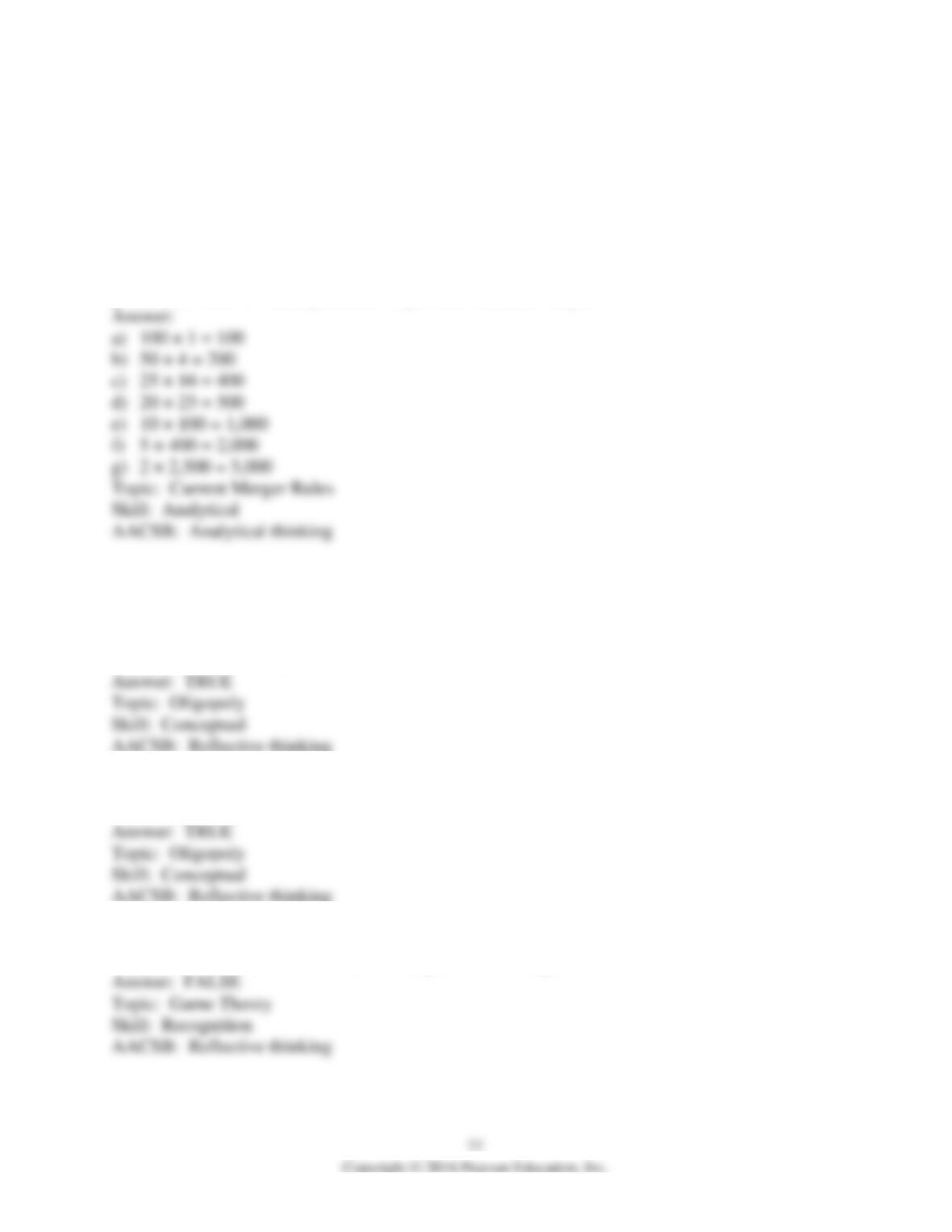
4) The Herfindahl-Hirschman Index is used as a guideline to determine if a market is competitive
or concentrated. Calculate the index value for each market described below.
a) 100 firms, each of which produces 1 per cent of market output
b) 50 firms, each of which produces 2 per cent of market output
c) 25 firms, each of which produces 4 per cent of market output
d) 20 firms, each of which produces 5 per cent of market output
e) 10 firms, each of which produces 10 per cent of market output
f) 5 firms, each of which produces 20 per cent of market output
g) 2 firms, each of which produces 50 per cent of market output
8 True or False
1) Oligopoly differs from perfect competition because a single competitive firm’s behavior does
not affect the behavior of its competitors while the behavior of a single oligopolistic firm does
affect the behavior of its rivals.
2) Economies of scale and limited demand can form a natural barrier to entry that can create a
natural oligopoly.
3) Game theory is a tool for studying competitive behavior between firms in monopolistic
competition because of the mutual interdependence among the firms.
4) In the prisoners’ dilemma game, each player has only one possible strategy.
5) In a Nash equilibrium, each player takes the best possible action given the actions of the other
players.
6) In game theory, a Nash equilibrium is the equilibrium that always yields the best result.
7) Collusive agreements tend to break apart because the incentive to cheat is so great.
8) A contestable market is a market in which there are one or a few firms and entry into the
market is not costly.
9) Limit pricing is a strategy which is intended to deter entry into an industry.
10) The first federal antitrust law ever passed was the Sherman Act.
11) The Clayton Act of 1914 was passed to prohibit, in part, price discrimination if the effect is
to substantially lessen competition or create monopoly.
12) Tying arrangements are always held to be illegal under U.S. antitrust law.
13) The sum of the squares of the market share for the fifty largest firms in a market is the basis
of the government’s current merger guidelines.
9 Extended Problems
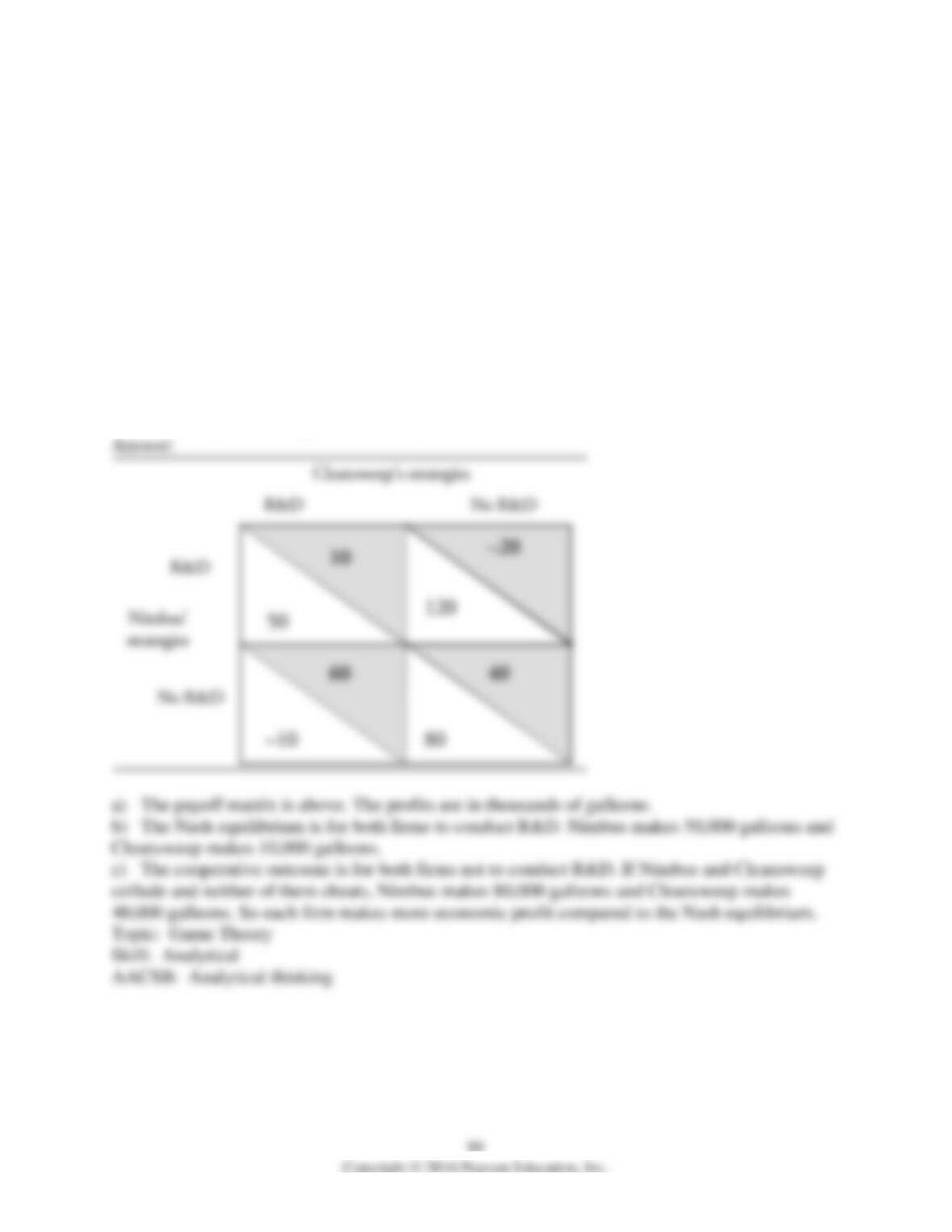
1) Nimbus, Inc., and Cleansweep, Inc., are the only producers of flying brooms. Each firm has
two strategies: Spend 30,000 galleons a year on research and development (R&D) or spend
nothing on R&D. If neither firm spends on R&D, Nimbus’ economic profit is 80, 000 galleons
and Cleansweep’s economic profit is 40,000 galleons. If each firm conducts R&D, market shares
are maintained, but each firm’s profit is lower by the amount spent on R&D. If Nimbus conducts
R&D and Cleansweep does not, Nimbus makes an economic profit of 120,000 galleons, while
Cleansweep incurs an economic loss of 20,000 galleons. If Cleansweep conducts R&D and
Nimbus does not, Cleansweep makes a profit of 60,000 galleons while Nimbus loses 10,000
galleons.
a) Construct a payoff matrix for the game that Nimbus and Cleansweep must play.
b) Find the Nash equilibrium. In the Nash equilibrium, what is each firm’s equilibrium profit?
c) What is the cooperative outcome? Would the firms make more economic profit if they
collude to achieve the cooperative outcome?