13) Price wars are ________ likely to occur when the industry is ________
A) more; a monopoly.
B) more; an oligopoly.
C) more; perfect competition.
D) equally; monopoly, oligopoly, and perfect competition.
14) A contestable market is similar to a perfectly competitive market in that there
A) are barriers to entry.
B) are no barriers to entry.
C) can be only one firm in the market.
D) will be no entry if the existing firm earns an economic profit.
15) A market with one or a small number of firms but no barriers to entry is known as
A) a natural monopoly.
B) a contestable market.
C) a perfectly competitive market.
D) monopolistic competition.
16) A market in which firms can enter and leave so easily that firms in the market face
competition from potential entrants is called a
A) contestable market.
B) cartel.
C) limit pricing market.
D) monopolistic competition market.
17) Which of the following statements is TRUE about contestable markets?
A) There are significant barriers to entry.
B) Firms earn large economic profits.
C) Each firm faces a perfectly elastic demand.
D) There are few firms in the industry.
18) A contestable market is one in which
A) one dominant firm sets the market price, and all other firms are price takers.
B) if a firm cuts its price, all other firms will follow the price cut.
C) one or a small number of firms operate, but faces competition from potential entrants.
D) a group of firms enter into an agreement to restrict output and raise prices.
19) A contestable market is one in which there are
A) one or a few firms, and entry into the market is costly.
B) one or a few firms, and entry into the market is not costly.
C) many firms, and entry into the market is costly.
D) many firms, and entry into the market is not costly.
20) Of the following, the best example of firm that might operate in a contestable market is a
A) cable TV company.
B) wheat farmer.
C) ship owner operating on a major waterway.
D) private college operating in a state with many public colleges.
21) In a contestable market the Herfindahl-Hirschman Index is ________ and the market
behaves as if it is ________.
A) low; perfectly competitive
B) low; a monopoly
C) high; perfectly competitive
D) high; a monopoly
22) In a sequential contestable market game
A) a small number of firms can behave like firms in perfect competition.
B) the outcome is always a monopoly equilibrium.
C) the dominant firm always makes a monopoly profit, while other firms make zero economic
profits.
D) a firm that enters the market first is protected from potential entrants by natural barriers.
23) A single firm in a contestable market is limited in the amount of economic profit it can earn
because there
A) are barriers to entry.
B) are no barriers to entry.
C) is collusion.
D) are government regulations limiting its profit.
24) In a contestable market with one firm in the market, the existing firm will
A) set its price equal to the monopoly price.
B) set its price lower than the monopoly price.
C) set its price higher than the monopoly price.
D) have a demand curve that is horizontal at the price that will attract new firms to enter the
market.
25) The price in a contestable market is similar to that in a perfectly competitive market because
A) there are barriers to entry.
B) there are no barriers to entry.
C) there are many firms in the market.
D) the firm can earn an economic profit in the long run.
26) In a contestable market
A) two or more firms are competing.
B) the Herfindahl-Hirschman Index exceeds 1,800.
C) the four-firm concentration ratio exceeds 50 percent.
D) potential entry holds down prices.
27) One of the reasons that concentration ratios are not a perfect measure of competitiveness is
that they
A) do not measure how high the industry’s prices are.
B) cannot be measured.
C) ignore potential competition.
D) tell nothing about how high prices were in the past.
28) The Herfindahl-Hirschman Index will indicate that a contestable market is ________.
A) a sequential market
B) competitive
C) uncompetitive
D) a prisoners’ dilemma
29) In a contestable market
A) the HHI is usually quite low.
B) the firm in the market usually earns a large economic profit.
C) the firm in the market may play an entry-deterrence game.
D) there are high barriers to entry.
30) Adkins Air is the only seller offering service directly from Milwaukee to Greensboro. The
market is contestable. Thus the Nash Equilibrium for a game between Adkins Air and a potential
entrant is when the potential entrant
A) enters and Adkins earns a normal profit.
B) enters and Adkins earns an economic profit.
C) does not enter and Adkins earns a normal profit.
D) does not enter and Adkins earns an economic profit.
31) The practice of the only seller in a market charging a price at the highest level that would
still inflict a loss on a new entrant into the market is called
A) limit pricing.
B) collusive pricing.
C) agile pricing.
D) trigger pricing.
32) Limit pricing in a contestable market sets the price at the highest level that ________.
A) maximizes the profit of an entrant
B) maximizes the profit of the existing firm
C) maximizes the profit of both the existing firm and the entering firm
D) inflicts a loss on an entrant
33) A strategy of setting price below the monopoly profit-maximizing price but at the highest
level that will still result in a loss for a potential entrant into the market is known as
A) entry pricing.
B) contestable pricing.
C) limit pricing.
D) unlimited pricing.
34) A strategy called “limit pricing” sets the price
A) below the competitive level.
B) at the monopoly level.
C) at the lowest level that inflicts a loss on the entrant.
D) at the highest level that inflicts a loss on the entrant.
35) Limit pricing is a strategy used by a firm to
A) deter entry.
B) enhance short run profits.
C) raise its prices.
D) lower its costs.
36) Price wars can be the result of
A) a cooperative equilibrium.
B) a firm playing a tit-for-tat strategy in which last period the competitors complied with a
collusive agreement.
C) new firms entering the industry and immediately agreeing to abide by a collusive agreement.
D) new firms entering an industry and all firms then finding themselves in a prisoners’ dilemma.
37) Limit pricing refers to
A) the fact that a monopoly firm always sets the highest price possible.
B) how the price is determined in a kinked demand curve model of oligopoly.
C) a situation in which a firm might lower its price to keep potential competitors from entering
its market.
D) none of the above.
4 Antitrust Law
1) Antitrust law is law that
A) does not allow individuals to open trust savings accounts.
B) prohibits competition in certain industries.
C) prohibits certain kinds of market behavior by firms.
D) allows firms under special circumstances to be a monopoly.
2) When the government prohibits certain kinds of market behavior such as monopoly and
monopolistic practices it generally does so through
A) regulatory agencies such as the Interstate Commerce Commission or the Federal
Communications Commission.
B) antitrust law.
C) the police powers of the states.
D) use of the capture theory of regulation.
3) A law that prohibits certain kinds of market behavior such as monopoly and monopolistic
practices is called ________.
A) a consumer surplus law
B) a trust law
C) an antitrust law
D) an anti-monopoly law
4) Antitrust laws attempt to
A) support prices at high levels so firms can earn profits.
B) establish minimum wages.
C) prevent monopolies or collusion.
D) enforce fair trade laws.
5) In part, an antitrust laws
A) provide for strict product liability.
B) prohibit charging prices that customers think are too high.
C) require firms with profits to pay dividends.
D) prohibit monopolistic practices.
6) Antitrust law is the law that regulates ________ and prevents them from becoming ________.
A) oligopolies; monopolies
B) monopolies; oligopolies
C) monopolistically competitive firms; oligopolies
D) oligopolies; monopolistically competitive firms
7) The main purpose of antitrust law is to
A) prohibit monopoly practices such as restricting output.
B) regulate advertising.
C) encourage the formation of cartels.
D) regulate the stock and bond markets.
8) The first antitrust law passed was the ________.
A) Federal Trade Commission Act
B) Sherman Act
C) Clayton Act
D) Robinson-Patman Amendment
9) The Sherman Act
A) which deregulated banking, was enacted in 1890.
B) which deregulated banking, was enacted in 1980.
C) the first antitrust law, was enacted in 1890.
D) the first antitrust law, was enacted in 1980.
10) The beginning of antitrust law is found in the
A) 1914 Clayton Act.
B) 1890 Sherman Act.
C) 1947 Taft-Hartley Act.
D) 1950 Cellar-Kefauver Act.
11) The Sherman Act
A) was the first federal tariff.
B) prohibited attempts to monopolize.
C) outlawed natural monopolies.
D) abolished tariffs.
12) The Sherman Act of 1890 was passed to prohibit
A) combinations, trusts, or conspiracies to restrict interstate or international trade.
B) monopolization or attempts to monopolize interstate or international trade.
C) both of the above.
D) neither of the above.
13) The Sherman Act makes it illegal to
A) increase market share.
B) merge firms in the same industry.
C) attempt to monopolize an industry.
D) price below competitors.
14) The second federal antitrust law was passed in 1914. This antitrust law is the
A) Clayton Act.
B) Robinson-Patman Amendment.
C) Cellar-Kefauver Amendment.
D) Taft-Hartley Act.
15) The Clayton Act of 1914 was passed to prohibit, in part
A) price discrimination if the effect is to substantially lessen competition or create monopoly.
B) unfair methods of competition and unfair or deceptive business practices.
C) combinations, trusts, or conspiracies that restrict interstate or international trade.
D) business practices that allow one firm to profit at the expense of another whenever the first
firm is a monopoly.
16) The Clayton Act of 1914 prohibits ________ if it substantially lessens competition or creates
a monopoly.
A) people from serving on the board of directors of competing firms
B) contracts that force other goods to be bought from the same firm
C) both of the above
D) neither of the above
17) The iPhone no longer comes pre-loaded with Google Maps but instead has the Apple map
application pre-loaded. Regulators might be concerned with this requirement because they might
see it as an example of
A) resale price maintenance.
B) a tying arrangement.
C) predatory pricing.
D) collusion to create a monopoly.
18) The Federal Trade Commission is an agency charged with
A) regulating interstate commerce.
B) enforcing product safety laws.
C) regulating international commerce.
D) enforcing antitrust laws.
19) Which of the following business practices, if proven to exist, is always illegal under U.S.
antitrust law?
A) tying arrangements
B) price fixing among competitors
C) exclusive dealing
D) all of the above
20) Which of the following is always a violation of the antitrust law?
A) price fixing among competitors
B) resale price maintenance
C) tying arrangements
D) predatory pricing
21) When is price fixing among competitors not a violation of the antitrust laws?
A) Price fixing among competitors is always a violation of the antitrust law.
B) when a cartel can maximize profit without behaving like a monopoly
C) when price fixing leads to a more efficient outcome
D) when price fixing does not result in predatory pricing
22) Suppose that two soft drink manufacturers, Fizzy Pop and Spritzy Soda, agree to charge the
same prices for their soft drinks. This practice is
A) always legal under the antitrust laws.
B) legal as long as Herfindahl-Hirschman index is less than 1,000.
C) legal as long as the firms had a cost justification for setting prices.
D) always illegal under the antitrust laws.
23) If McDonald’s, Wendy’s, and Burger King agree with each other not to sell hamburgers for
less than $3.95 apiece, all three could be found guilty of
A) an interlocking directorship under the Clayton Act.
B) price fixing under the Sherman Act.
C) a deceptive business practice under the Clayton Act.
D) None of the above answers is correct.
24) Which of the following is illegal under the Sherman Act?
I. A competitor agrees with another competitor on the price at which the product will be sold.
II. A manufacturer refuses to supply a retailer who does not accept the manufacturer’s guidance
on the price.
A) only I
B) only II
C) both I and II
D) neither I nor II
25) Under current guidelines, the Federal Trade Commission will likely challenge
A) all mergers if the Herfindahl-Hirschman index (HHI) is 2500 or higher.
B) a merger if the HHI is 2500 or higher and the merger increases the HHI by more than 200
points.
C) a merger if the HHI is 2500 or higher and the merger increases the HHI by more than 50
points.
D) a merger if the HHI is 1500 or higher and the merger increases the HHI by more than 300
points.
26) Under current guidelines, the Federal Trade Commission will likely challenge
A) all mergers if the Herfindahl-Hirschman index (HHI) is greater than 1500.
B) a merger if the HHI is between 1500 and 2500 and the merger increases the HHI by 50 points
or more.
C) a merger if the HHI is between 1500 and 2500 and the merger increases the HHI by 100
points or more.
D) a merger if the HHI is below 1500 and the merger increases the HHI by less than 100 points.
27) A merger will be challenged by the FTC in a market where the Herfindahl-Hirschman Index
(HHI) is ________, and the merger would increase it to ________.
A) 2,900; 3,100.
B) 1,700; 1,760
C) 800; 950
D) 2,000; 2,040
28) Under Federal Trade Commission merger guidelines, an industry with a Herfindahl-
Hirschman index (HHI) of 800 points is considered
A) competitive.
B) moderately concentrated.
C) concentrated.
D) a monopoly.
29) As the Federal Trade Commission currently interprets the Herfindahl-Hirschman index
(HHI), an industry is considered to be moderately concentrated if the HHI value is
A) between 100 and 1,500.
B) between 1,500 and 2,500.
C) between 1,000 and 3,500.
D) between 3,000 and 6,000.
30) A market in which the Herfindahl-Hirschman Index is 1,000 is regarded by the Federal Trade
Commission as
A) moderately concentrated.
B) concentrated.
C) competitive.
D) monopolistic.
31) As the Federal Trade Commission currently interprets the Herfindahl-Hirschman index
(HHI), an industry is considered to be highly concentrated if the HHI value is above
A) 100.
B) 1,000.
C) 2,500.
D) 5,000.
32) In the market for bottled water, Fresh Springs has a 30 percent share of the market, Swiss
Springs has a 27 percent share, L’eau de France has a 13 percent share, and Mountain Water has
a 10 percent share. The rest of the market consists of 20 firms with a 1 percent share of the
market each. What is the value of the Herfindahl-Hirschman index?
A) 2,418
B) 80
C) 1,918
D) 2,818
33) An industry is made up of 8 firms with the following percent market shares: 29, 20, 11, 10, 9,
8, 7, 6. What is the Herfindahl-Hirschman index in this industry?
A) 70
B) 100
C) 1462
D) 1692
34) An industry is made up of 8 firms with the following percent market shares: 29, 20, 11, 10, 9,
8, 7, 6. The firms with 8 and 7 percent market share are proposing to merge. What is the new
Herfindahl-Hirschman index if the merger takes place?
A) 225
B) 1462
C) 1692
D) 1804
35) Suppose that two clothing manufacturers, Frederick’s Fashions and Stephan’s Styles,
announce that they plan to merge. The Herfindahl-Hirschman index is currently 1,500. After the
merger, the HHI will rise to 1,560. This market is
A) highly concentrated and so the government will definitely challenge the merger.
B) moderately concentrated and because the merger increases the HHI by more than 50 points,
the government will definitely challenge the merger.
C) moderately concentrated, but because the merger increases the HHI by less than 100 points,
the government will probably not challenge the merger.
D) competitive and so the government will not challenge the merger.
36) If the Herfindahl-Hirschman index (HHI) among the firms in the long distance
telecommunications market were equal to 1755, when would the Federal Trade Commission
probably challenge a proposed merger between any two of the firms?
A) It would challenge if the HHI would increase by more than 50 points.
B) It would challenge if the HHI would increase by more than 100 points.
C) It would challenge no matter what happened to the HHI because the market has so few firms.
D) It would not challenge because the HHI is less than 1800.
37) If the Herfindahl-Hirschman Index (HHI) among the firms in the long distance
telecommunications market is equal to 855, when would the Federal Trade Commission
probably challenge a proposed merger between any two of the firms?
A) It would challenge if the HHI would increase by more than 50 points.
B) It would challenge if the HHI would increase by more than 100 points.
C) It would challenge no matter what happened to the HHI because the market has so few firms.
D) It would not challenge because the HHI is less than 1500.
38) The local pizza delivery industry currently has a Herfindahl-Hirschman index (HHI) value of
999 and two of the competing pizza shops have considered merging. Because the merger would
raise the HHI by 55 points, the Federal Trade Commission would likely
A) not challenge the merger.
B) challenge the merger.
C) allow the merger under the condition that HHI does not rise by more than 55 points as
promised.
D) allow the merger under the condition that the HHI remain at the premerger level of 999.
39) The local banking industry currently has a Herfindahl-Hirschman index (HHI) value of 1575
and two of the competing banks have considered merging. Because the merger would raise the
HHI by 55 points, the Federal Trade Commission would likely
A) challenge the merger.
B) not challenge the merger.
C) allow the merger under the condition that HHI does not rise by more than 55 points as
promised.
D) allow the merger under the condition that the HHI remain at the premerger level of 1575.
40) The local banking industry currently has a Herfindahl-Hirschman index (HHI) value of 1575
and two of the competing banks have considered merging. Because the merger would raise the
HHI by 215 points, the Federal Trade Commission would likely
A) challenge the merger.
B) not challenge the merger.
C) allow the merger under the condition that HHI does not rise by more than 215 points as
promised.
D) allow the merger under the condition that the HHI remain at the premerger level of 1575.
41) The local banking industry currently has a Herfindahl-Hirschman index (HHI) value of 2175
and two of the competing banks have considered merging. Because the merger would raise the
HHI by 25 points, the Federal Trade Commission would likely
A) challenge the merger.
B) not challenge the merger.
C) allow the merger under the condition that HHI does not rise by more than 25 points as
promised.
D) allow the merger under the condition that the HHI remain at the premerger level of 2175.
42) The local banking industry currently has a Herfindahl-Hirschman index (HHI) value of 1945
and two of the competing banks have considered merging. Because the merger would raise the
HHI by 155 points, the Federal Trade Commission would likely
A) challenge the merger.
B) not challenge the merger.
C) allow the merger as long as the HHI did not increase by more than 155 points as promised.
D) allow the merger under the condition that the HHI remain at the premerger level of 1875.
43) Suppose the Herfindahl-Hirschman Index (HHI) in the market for chocolate is 3,200. Two
companies want to merge. The FTC definitely will challenge the merger if it increases the HHI
by more than
A) 150 points.
B) 100 points.
C) 40 points.
D) 200 points.
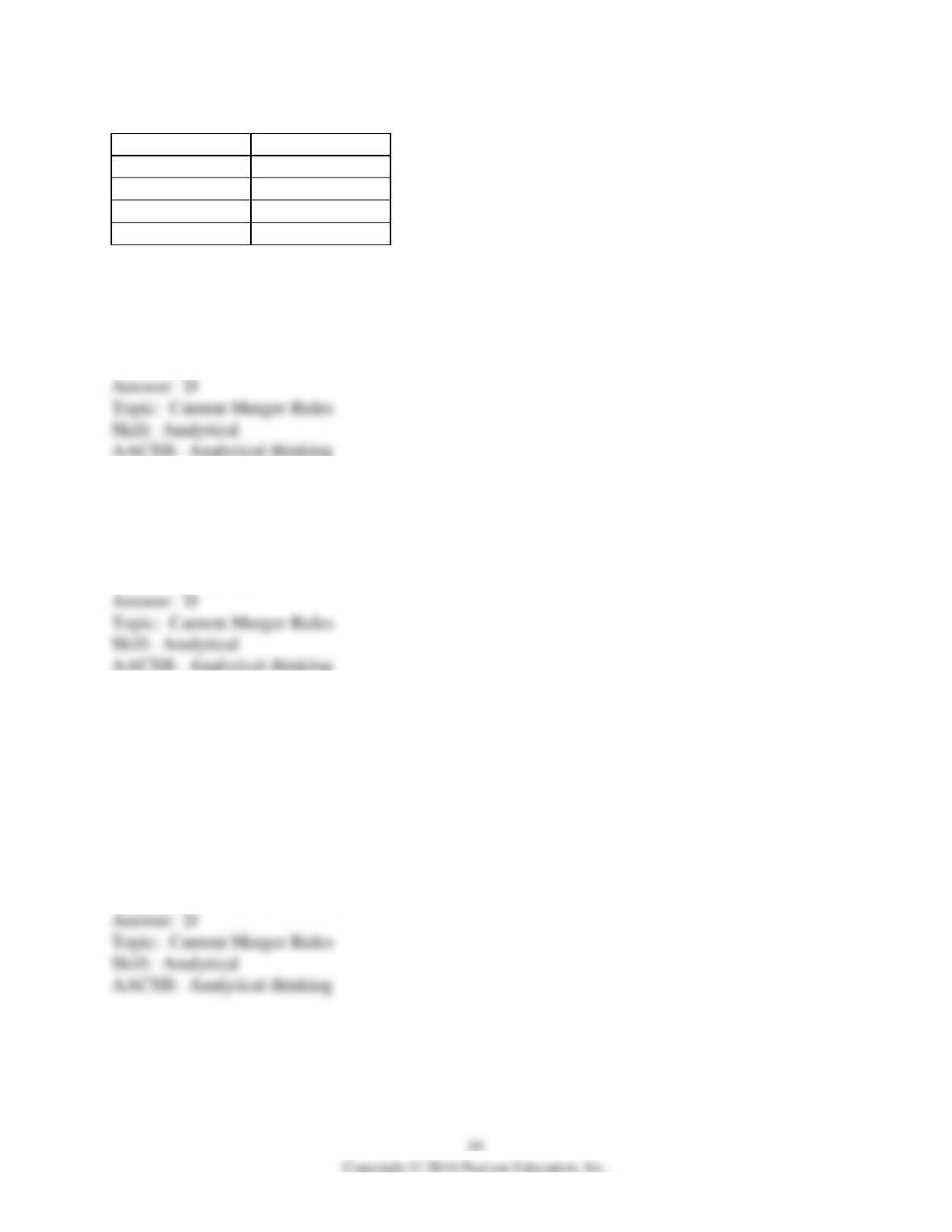
Market share in the Widget industry
Firm name
Market share
Big W
50
Widico
40
Widgotech
9
Widgette
1
44) In the table above, the Herfindahl-Hirschman Index in the widget industry is
A) 100 points.
B) 742 points.
C) 2842 points.
D) 4182 points.
45) Using the market shares in the table above, if Widgotech buys Widgette the HHI will
A) stay the same.
B) rise by 1 point.
C) rise by 10 points.
D) rise by 18 points.
46) Using the market shares in the table above, if Big W wants to buy Widgette, the Federal
Trade Commission will probably
A) approve the merger because the industry is moderately concentrated and the increase in the
Herfindahl-Hirschman index (HHI) is small enough.
B) block the merger because the industry is moderately concentrated (HHI between 1,500 and
2,500) and the increase in the HHI is too much.
C) approve the merger because the industry is highly concentrated (HHI exceeds 2,500) but the
increase in the HHI is small enough.
D) block the merger because the industry is highly concentrated (HHI exceeds 2,500) and the
increase in the HHI is too much.
47) Which of the following statements about the Sherman Act is CORRECT?
A) The Sherman Act was the second federal antitrust law.
B) The Sherman act legalized monopolization if the company behaved “reasonably” once it
became a monopoly.
C) The Sherman Act outlawed natural monopolies.
D) The Sherman Act made restriction of interstate trade illegal.
48) The Hirschman-Herfindahl index (HHI) in an industry is 50. A merger is proposed that will
raise the HHI to 100. In this case, the
A) Sherman Act will prohibit the merger.
B) Federal Trade Commission will challenge the merger.
C) Federal Trade Commission will not challenge the merger.
D) rule of reason will prevent the merger if it represents a horizontal merger.
5 News Based Questions
1) Two firms make most of the consumer alkaline batteries in the country: Duracell and
Energizer. The market for batteries is most likely
A) a monopoly.
B) an oligopoly.
C) perfectly competitive.
D) monopolistically competitive.