109. A defining characteristic of an oligopoly is:
110. An oligopoly with two firms is known as:
111. A duopoly is:
112. Competition between oligopolists drives:
113. Oligopolists need to consider:
114. In an oligopoly, the price effect is:
115. In an oligopoly, when the quantity effect outweighs the price effect:
116. For an oligopoly, when the quantity effect does not outweigh the price effect, the firm:
117. For an oligopoly, when the quantity effect outweighs the price effect, firms may have the incentive
to:
118. For an oligopoly, when the quantity effect outweighs the price effect, the typical firm may find it
optimal to:
119. The more firms there are in a market, the:
120. An oligopolist’s production decision affects:
121. Because the price effect is smaller when there are _________ firms, each firm will increase its
quantity by __________ before the price effect and quantity effect are equal.
122. The price effect is smaller when there:
123. When a single firm in an oligopoly market decides to increase output, that firm:
15–40
124. The act of firms working together to make decisions about price and quantity is called:
125. Collusion is:
126. Collusion is:
127. One way for firms to analyze their choices in an oligopoly is by using:
128. This prisoner’s dilemma game shows the payoffs associated with two firms, A and B, in an oligopoly
and their choices to either collude with one another or not.
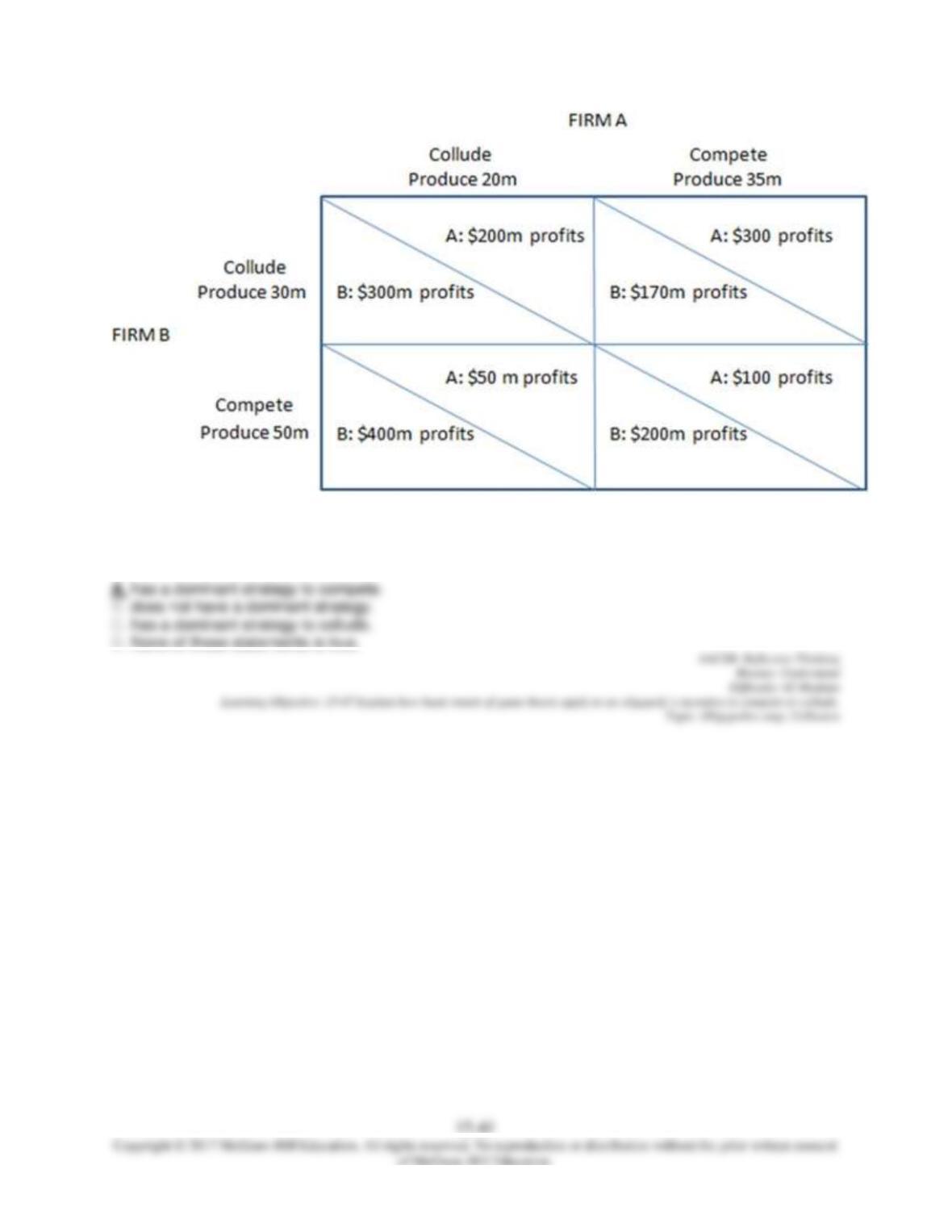
Given the payoffs in the matrix shown, Firm A:
15–42
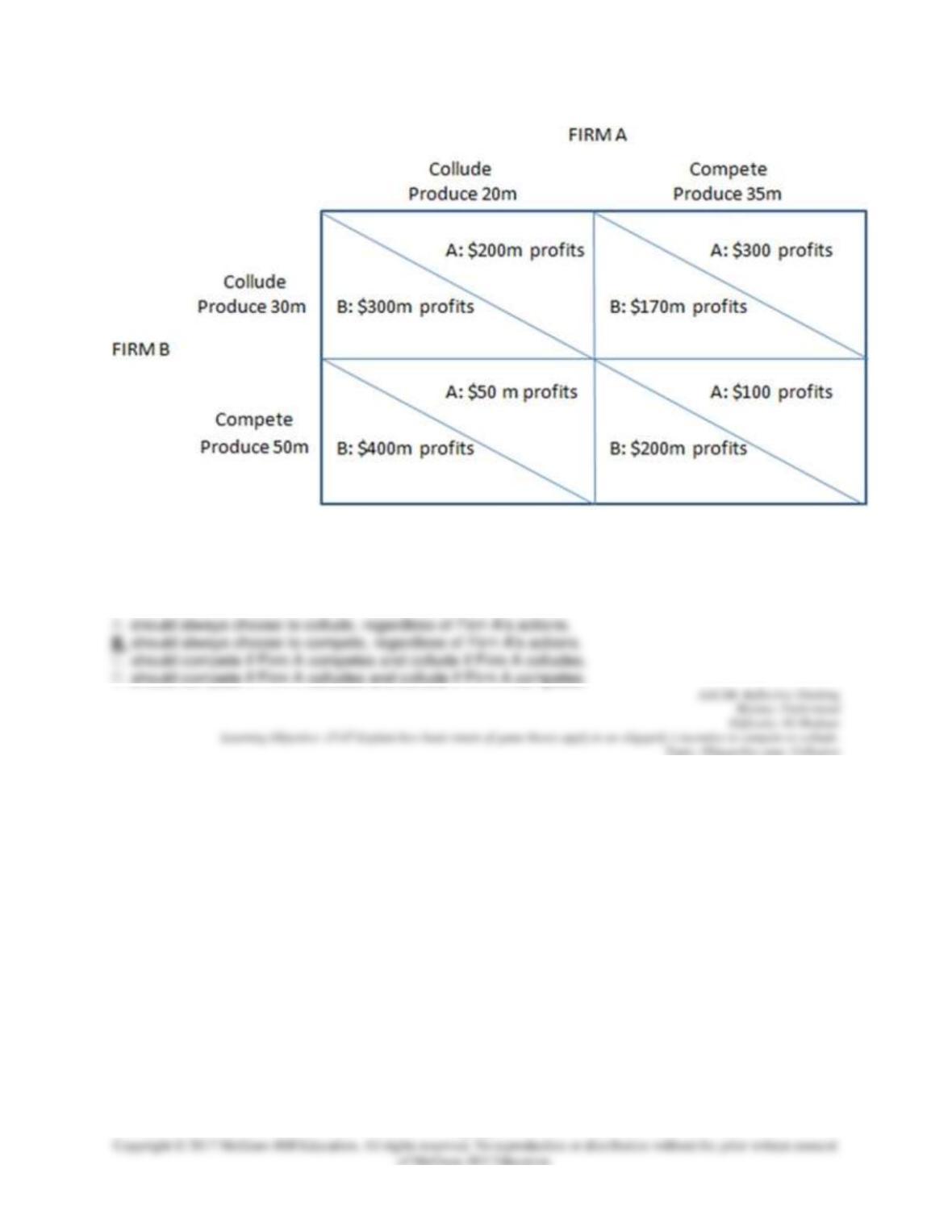
129. This prisoner’s dilemma game shows the payoffs associated with two firms, A and B, in an oligopoly
and their choices to either collude with one another or not.
Given the payoffs in the matrix shown, Firm B:
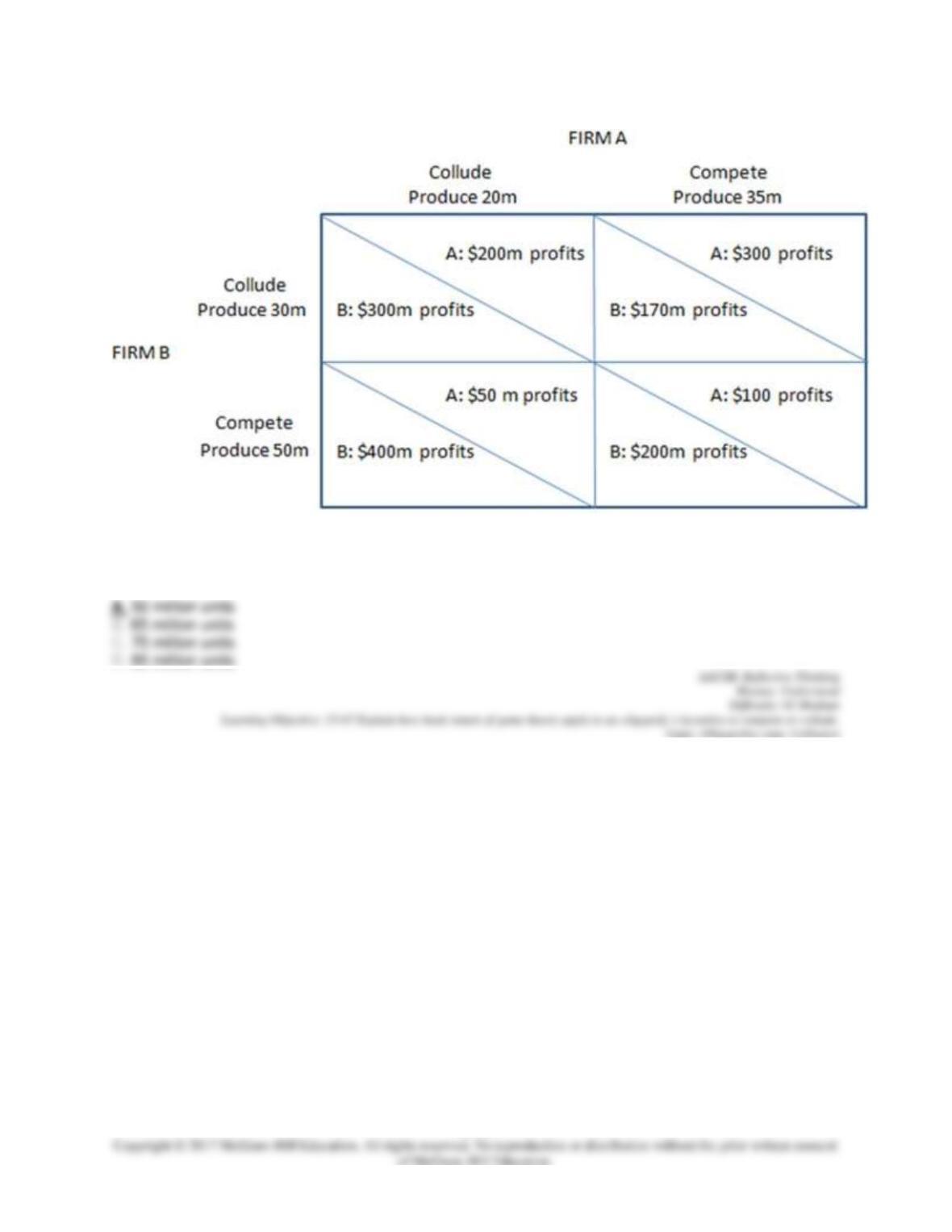
130. This prisoner’s dilemma game shows the payoffs associated with two firms, A and B, in an oligopoly
and their choices to either collude with one another or not.
15–43
According to the matrix shown, how much will be produced if both firms collude?
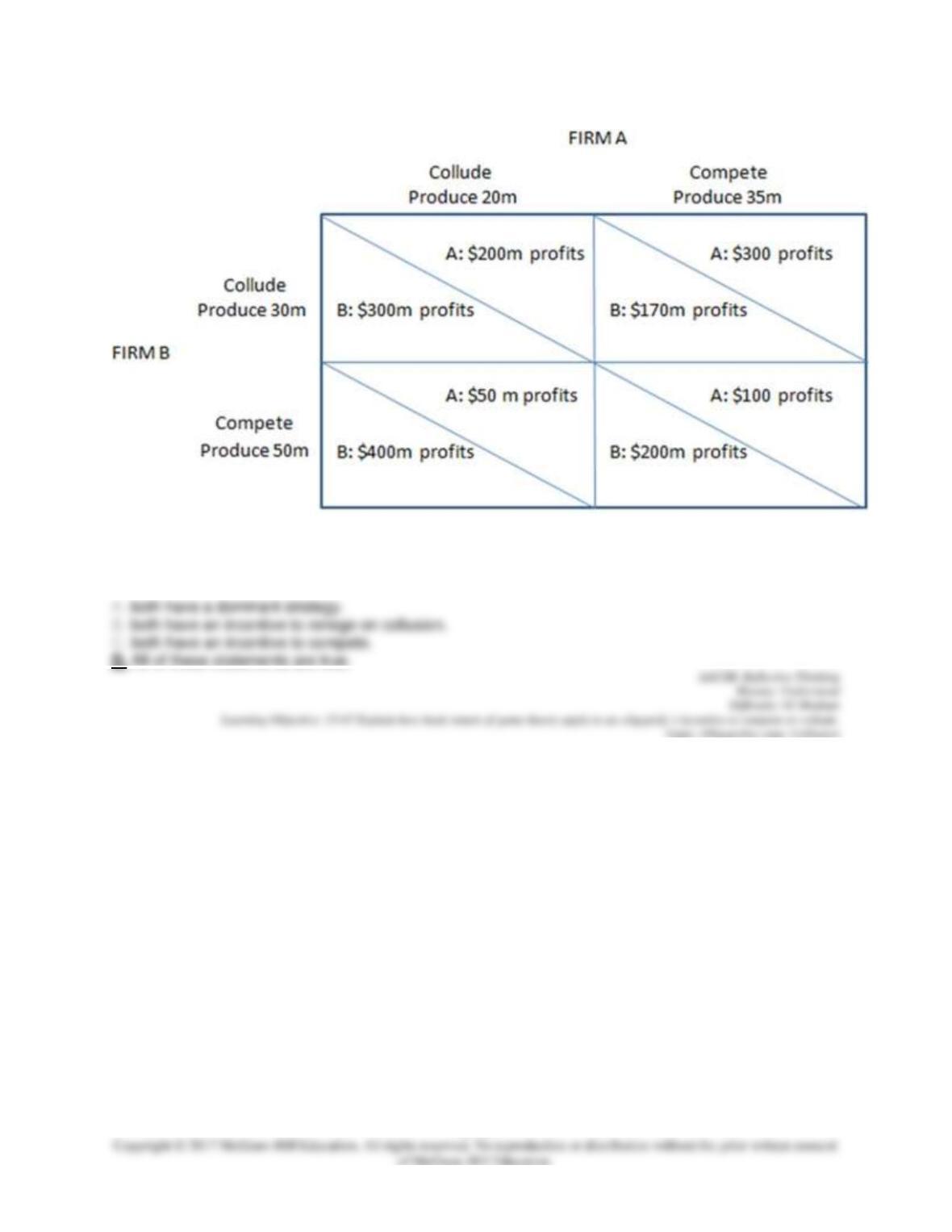
131. This prisoner’s dilemma game shows the payoffs associated with two firms, A and B, in an oligopoly
and their choices to either collude with one another or not.
15–44
According to the matrix shown, the firms:
132. This prisoner’s dilemma game shows the payoffs associated with two firms, A and B, in an oligopoly
and their choices to either collude with one another or not.
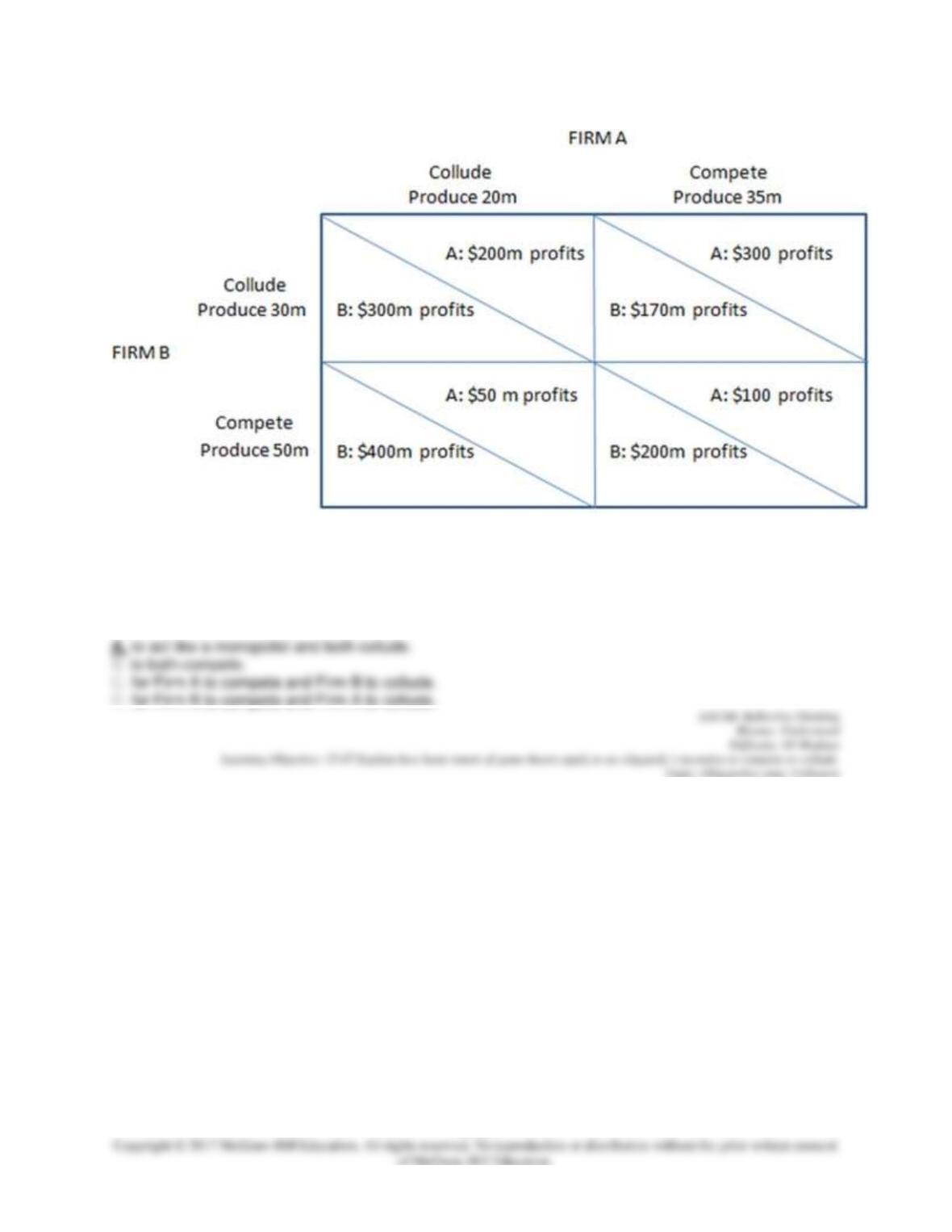
15–45
According to the matrix shown, the profit-maximizing outcome for the firms is:
133. This prisoner’s dilemma game shows the payoffs associated with two firms, A and B, in an oligopoly
and their choices to either collude with one another or not.
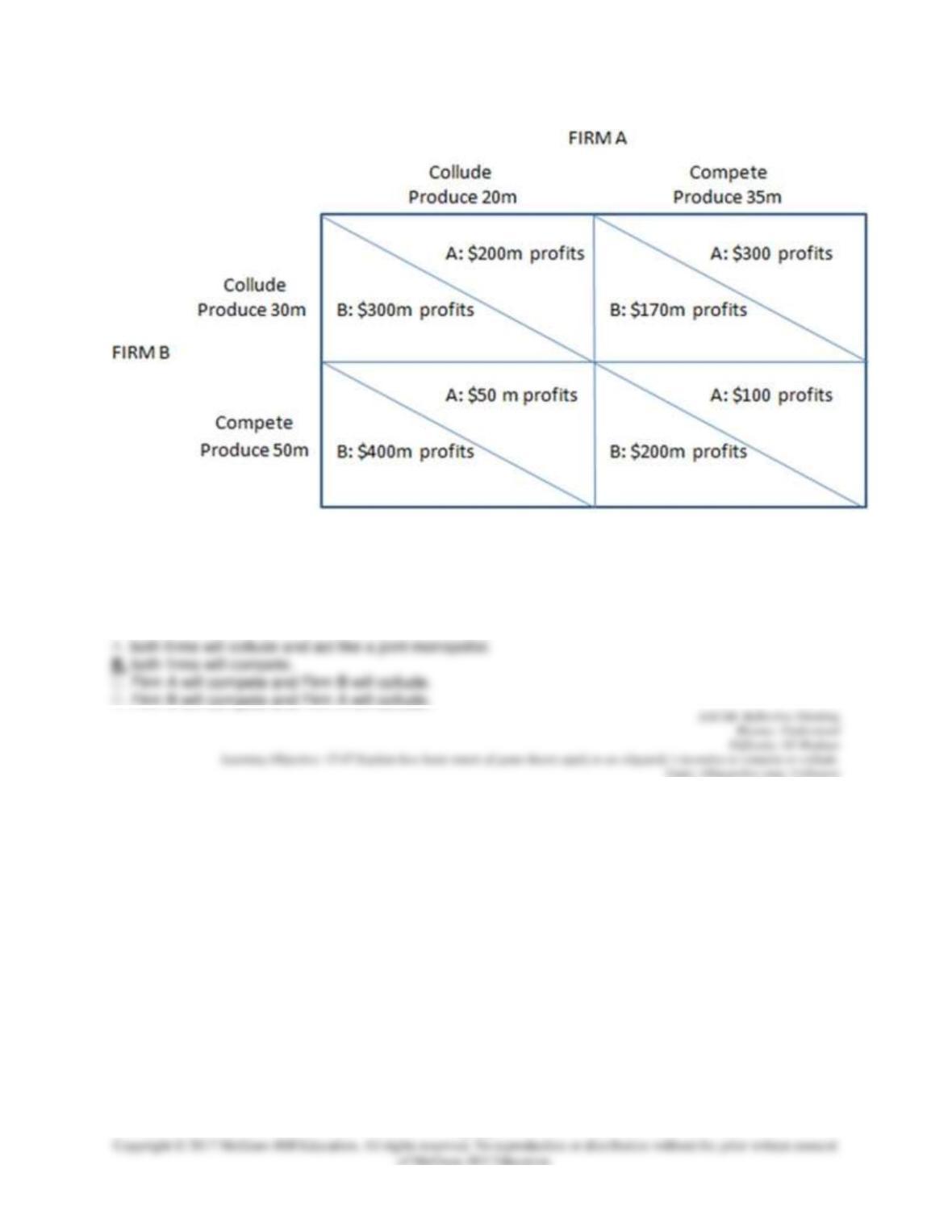
15–46
According to the matrix shown, the outcome of the “game” will be:
134. This prisoner’s dilemma game shows the payoffs associated with two firms, A and B, in an oligopoly
and their choices to either collude with one another or not.
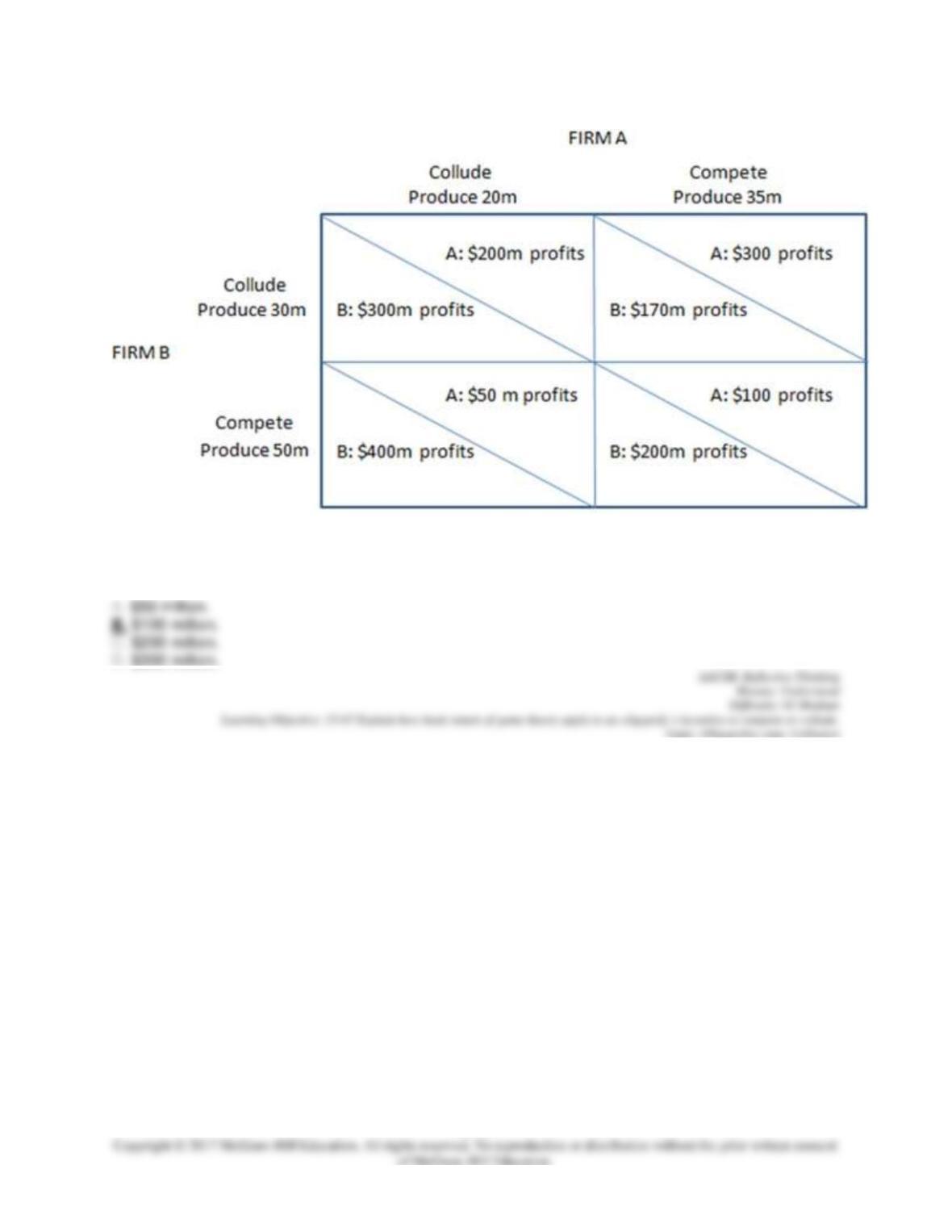
15–47
Given the situation in the matrix shown, we can predict that Firm A‘s profits will be:
135. This prisoner’s dilemma game shows the payoffs associated with two firms, A and B, in an oligopoly
and their choices to either collude with one another or not.
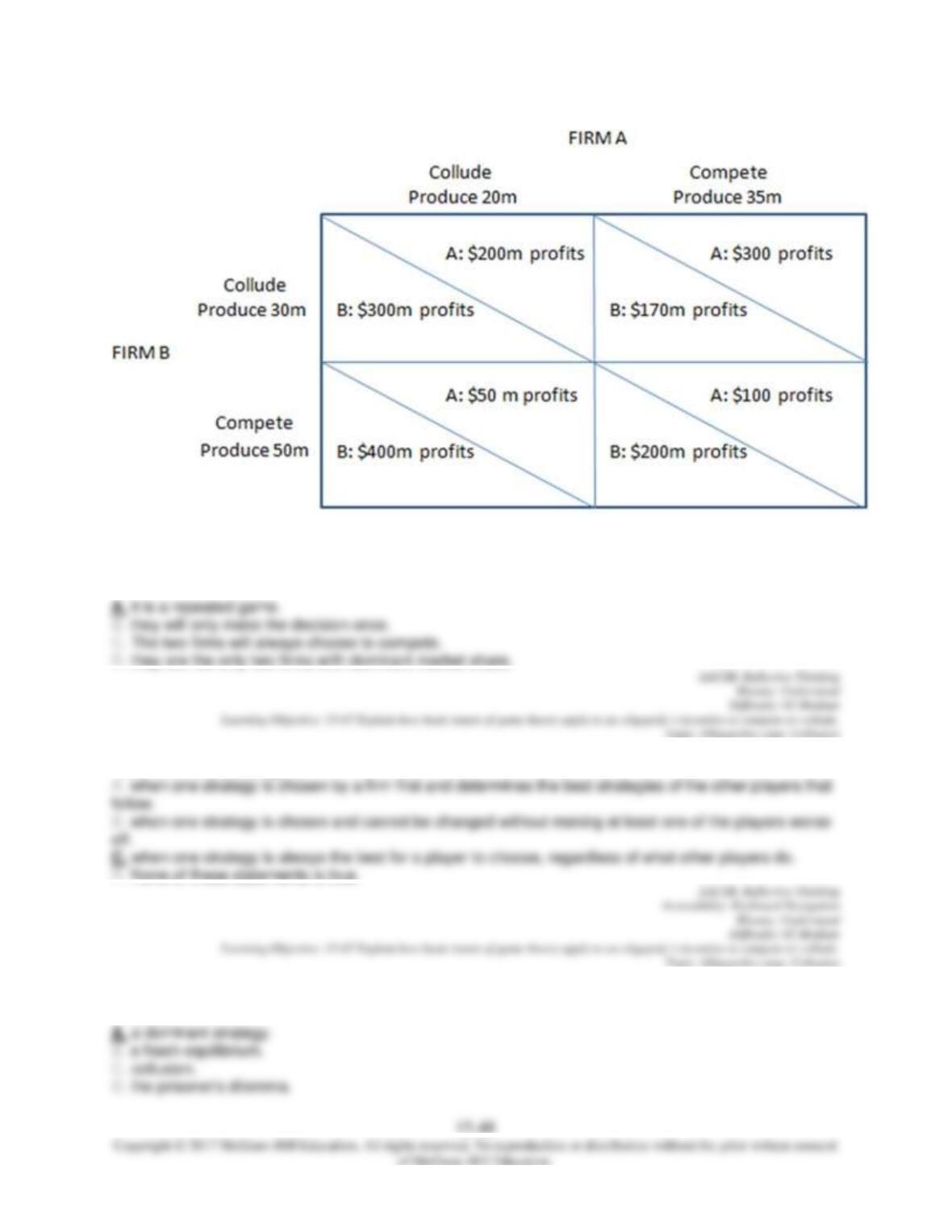
Given the situation in the matrix shown, the two firms are likely to collude only if:
136. A dominant strategy is:
137. When one strategy is always the best for a player to choose, regardless of what other players do, it
is called:
138. A Nash equilibrium is:
139. An outcome in which all players choose the best strategy they can, given the choices of all other
players, is called:
140. When a Nash equilibrium is reached:
141. A cartel is:
142. A number of firms who collude to make collective production decisions about quantities or prices is
called:
143. Cartels:
144. When firms are faced with repeating games, such as the prisoner’s dilemma, they:
145. Most countries:
146. The outcome of a competitive oligopoly:
147. The outcome of a colluding oligopoly:
15–51
148. The welfare loss associated with the outcome in a competitive oligopoly is:
149. The welfare loss associated with the outcome in a colluding oligopoly is:
Chapter 15 Test Bank Summary
Category
# of Ques
tions
AACSB: Analytical Thinking
9
AACSB: Knowledge Application
22
AACSB: Reflective Thinking
118
Accessibility: Keyboard Navigation
122
Blooms: Analyze
9
Blooms: Apply
22
Blooms: Remember
25
Blooms: Understand
93
Difficulty: 01 Easy
25
Difficulty: 02 Medium
93
Difficulty: 03 Hard
31

15–52
Learning Objective: 15-
01 Name the defining features of oligopoly and monopolistic competition.
25
Learning Objective: 15-02 Calculate the profit-
maximizing price and quantity for a monopolistically competitive firm in the short run.
22
Learning Objective: 15-
03 Describe a monopolistically competitive market in the long run.
41
Learning Objective: 15-04 Analyze the welfare costs of monopolistic competition.
9
Learning Objective: 15-
05 Explain how product differentiation motivates advertising and branding.
10
Learning Objective: 15-
06 Describe the strategic production decision of firms in an oligopoly.
16
Learning Objective: 15-
07 Explain how basic tenets of game theory apply to an oligopoly’s incentive to compet
e or collude.
22
Learning Objective: 15-
08 Compare the welfare of producers, consumers, and society as a whole in an oligopol
y to monopoly and perfect competition.
4
Topic: Advertising and Branding
10
Topic: Imperfect Competition
25
Topic: Monopolistic Competition in the Long Run
41
Topic: Monopolistic Competition in the Short Run
22
Topic: Oligopolies
4
Topic: Oligopolies amp; Collusion
22
Topic: Oligopolies amp; Welfare Loss
4
Topic: Oligopolies’ Production Decisions
12
Topic: Welfare Costs of Monopolistic Competition
9