Chapter 15: Working Capital Management
94.
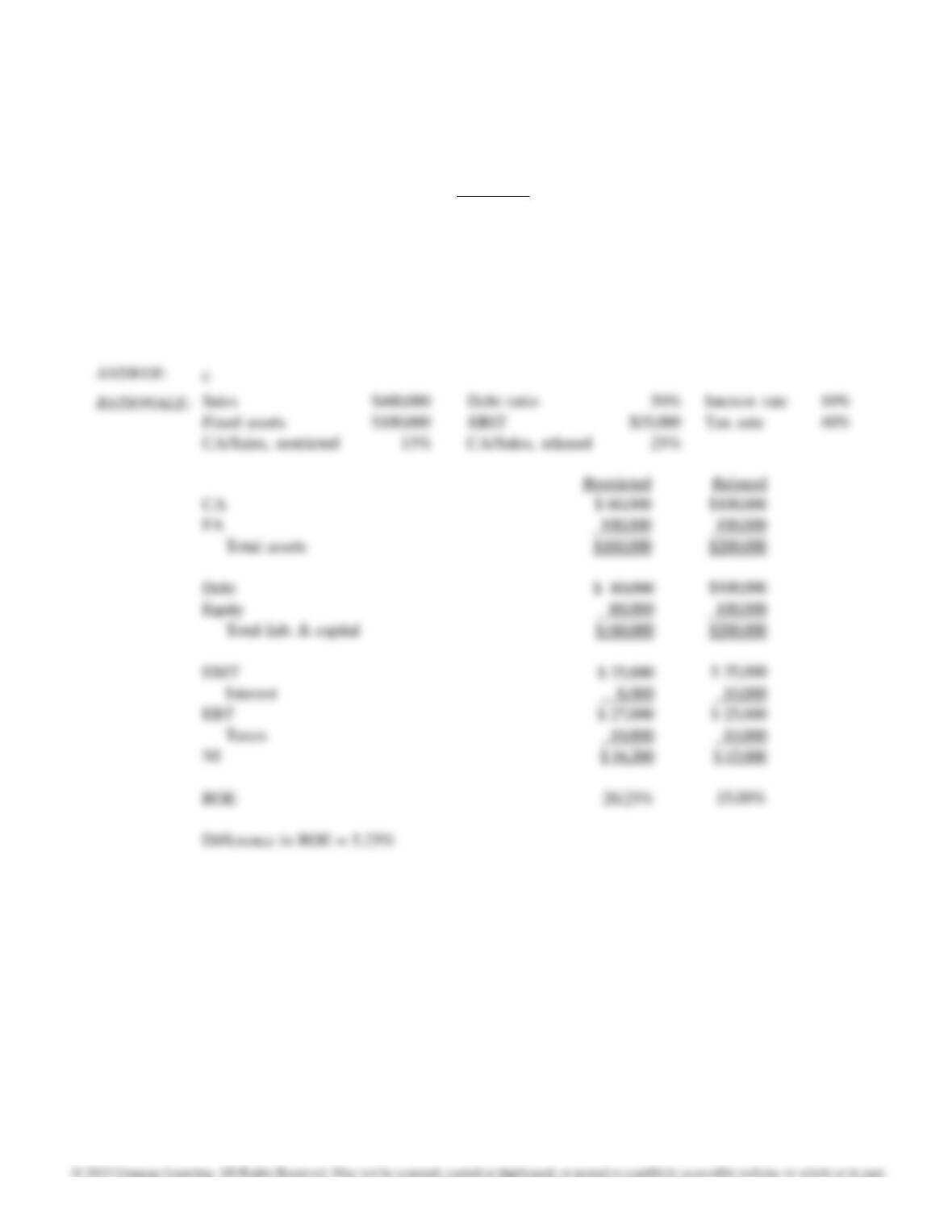
Edwards Enterprises follows a moderate current asset investment policy, but it is now considering a change,
perhaps to a restricted or maybe to a relaxed policy. The firm‘s annual sales are $400,000; its fixed assets are
$100,000; its target capital structure calls for 50% debt and 50% equity; its EBIT is $35,000; the interest rate on its
debt is 10%; and its tax rate is 40%. With a restricted policy, current assets will be 15% of sales, while under a
relaxed policy they will be 25% of sales. What is the difference in the projected ROEs between the restricted and
relaxed policies.
a. 4.25%
b. 4.73%
c. 5.25%
d. 5.78%
e. 6.35%
95.
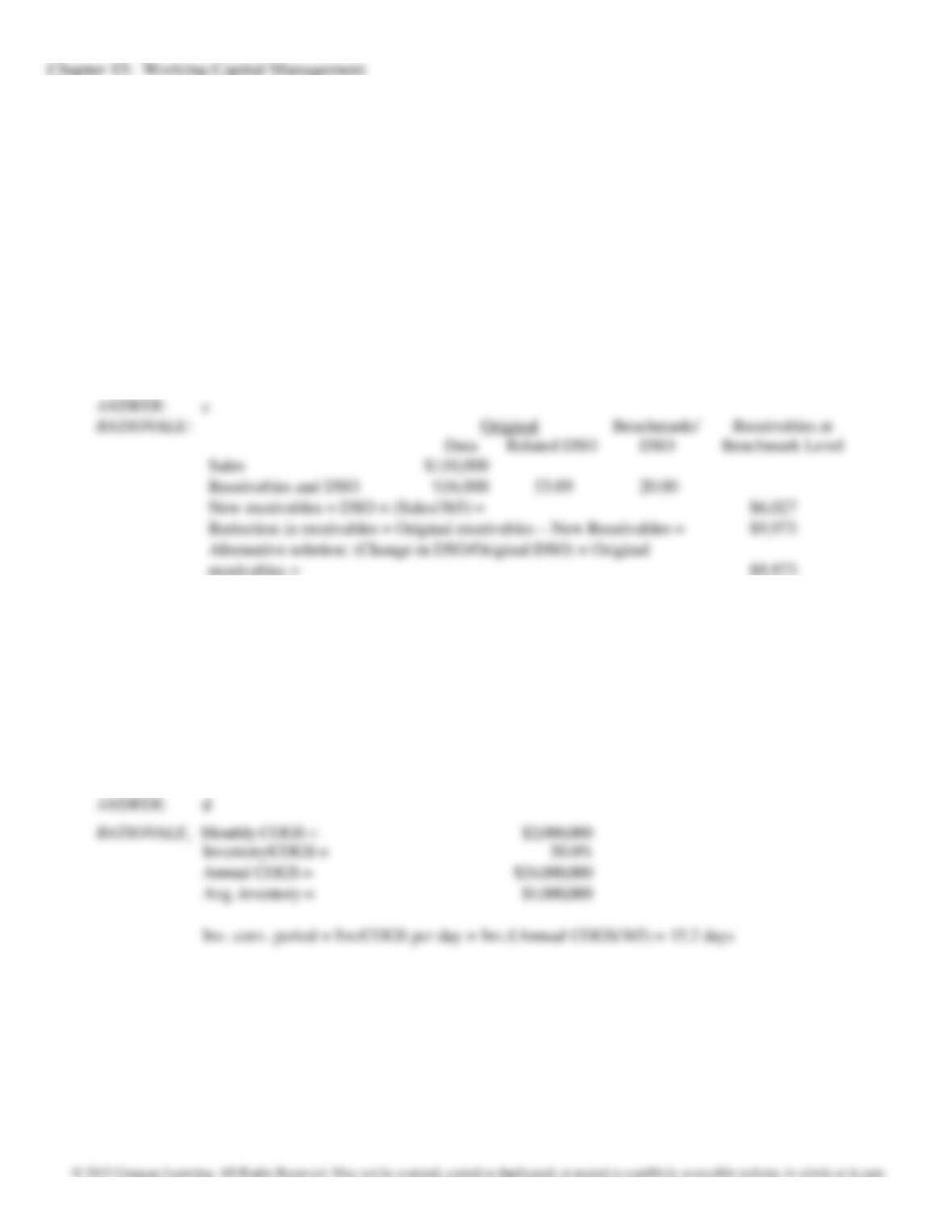
Data on Shick Inc. for 2013 are shown below, along with the days sales outstanding of the firms against which it
benchmarks. The firm’s new CFO believes that the company could reduce its receivables enough to reduce its
DSO to the benchmarks‘ average. If this were done, by how much would receivables decline? Use a 365-day year.
Sales
$110,000
Accounts receivable
$16,000
Days sales outstanding (DSO)
53.09
Benchmarks’ days sales outstanding (DSO)
20.00
a. $ 8,078
b. $ 8,975
c. $ 9,973
d. $10,970
e. $12,067
96.
Your firm’s cost of goods sold (COGS) average $2,000,000 per month, and it keeps inventory equal to 50% of its
monthly COGS on hand at all times. Using a 365–day year, what is its inventory conversion period?
a.
11.7 days
b.
13.0 days
c.
14.4 days
d.
15.2 days
e.
16.7 days
97.
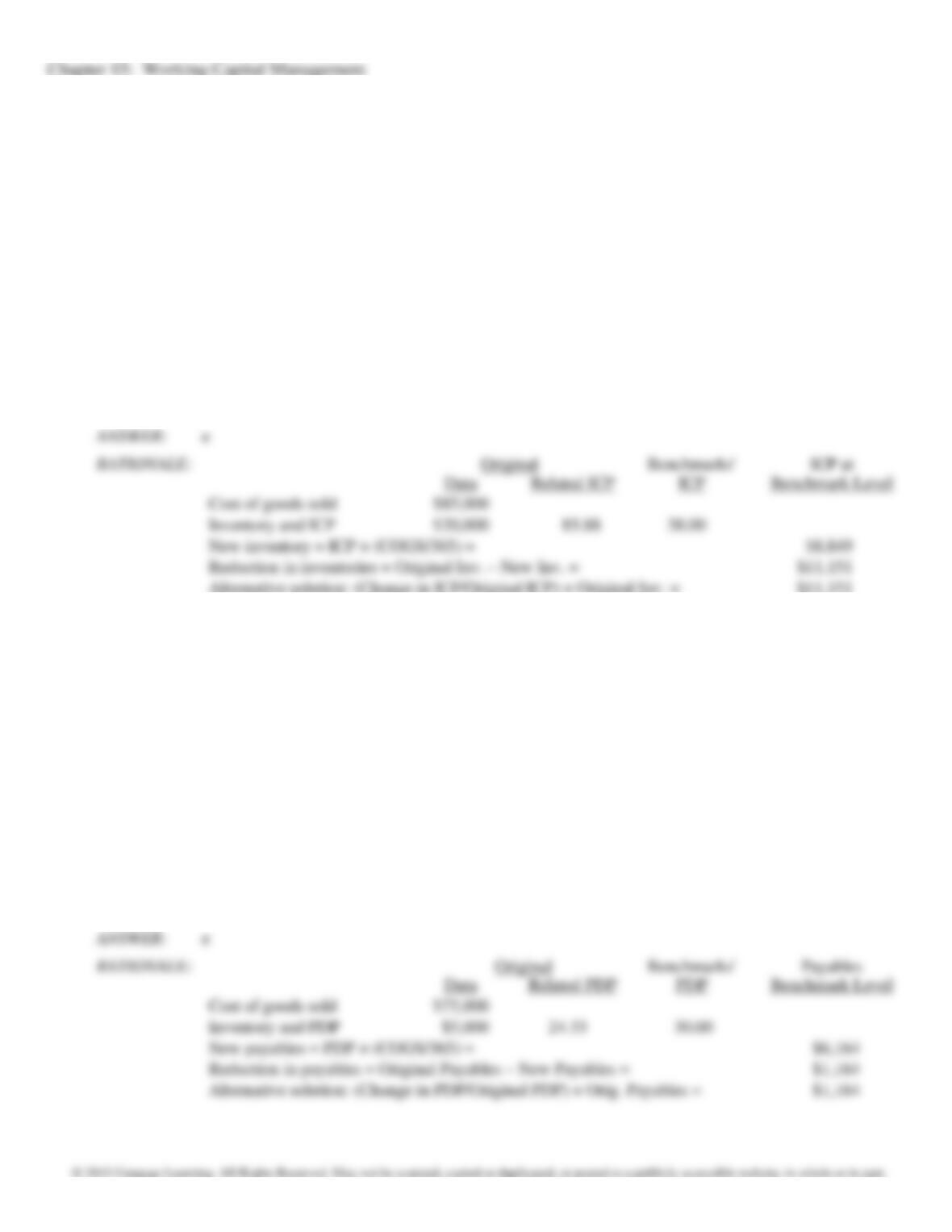
Data on Shin Inc for 2013 are shown below, along with the inventory conversion period (ICP) of the firms against w
it benchmarks. The firm’s new CFO believes that the company could reduce its inventory enough to reduce its ICP
benchmarks’ average. If this were done, by how much would inventories decline? Use a 365-day year.
Cost of goods sold =
$85,000
Inventory =
$20,000
Inventory conversion period (ICP) =
85.88
Benchmark inventory conversion period (ICP) =
38.00
a. $ 7,316
b. $ 8,129
c. $ 9,032
d. $10,036
e. $11,151
98.
Data on Wentz Inc. for 2013 are shown below, along with the payables deferral period (PDP) for the firms against
which it benchmarks. The firm‘s new CFO believes that the company could delay payments enough to increase its
PDP to the benchmarks‘ average. If this were done, by how much would payables increase? Use a 365-day year.
Cost of goods sold = $75,000
Payables = $5,000
Payables deferral period (PDP) = 24.33
Benchmark payables deferral period = 30.00
a. $ 764
b. $ 849
c. $ 943
d. $1,048
e. $1,164
99.
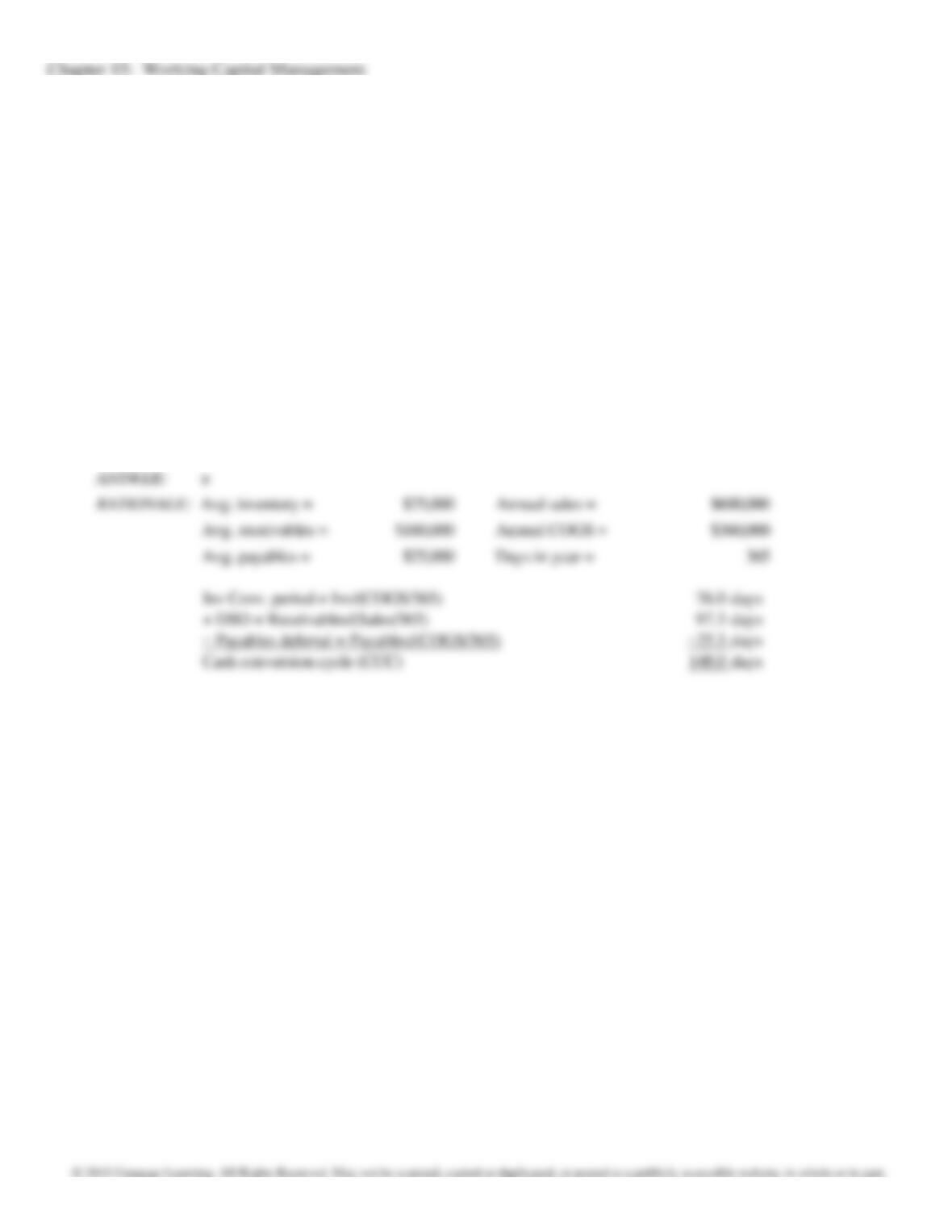
Your consulting firm was recently hired to improve the performance of Shin-Soenen Inc, which is highly profitable
but has been experiencing cash shortages due to its high growth rate. As one part of your analysis, you want to
determine the firm‘s cash conversion cycle. Using the following information and a 365-day year, what is the firm‘s
present cash conversion cycle?
Average inventory =
$75,000
Annual sales =
$600,000
Annual cost of goods sold =
$360,000
Average accounts receivable =
$160,000
Average accounts payable =
$25,000
a.
120.6 days
b.
126.9 days
c.
133.6 days
d.
140.6 days
e.
148.0 days
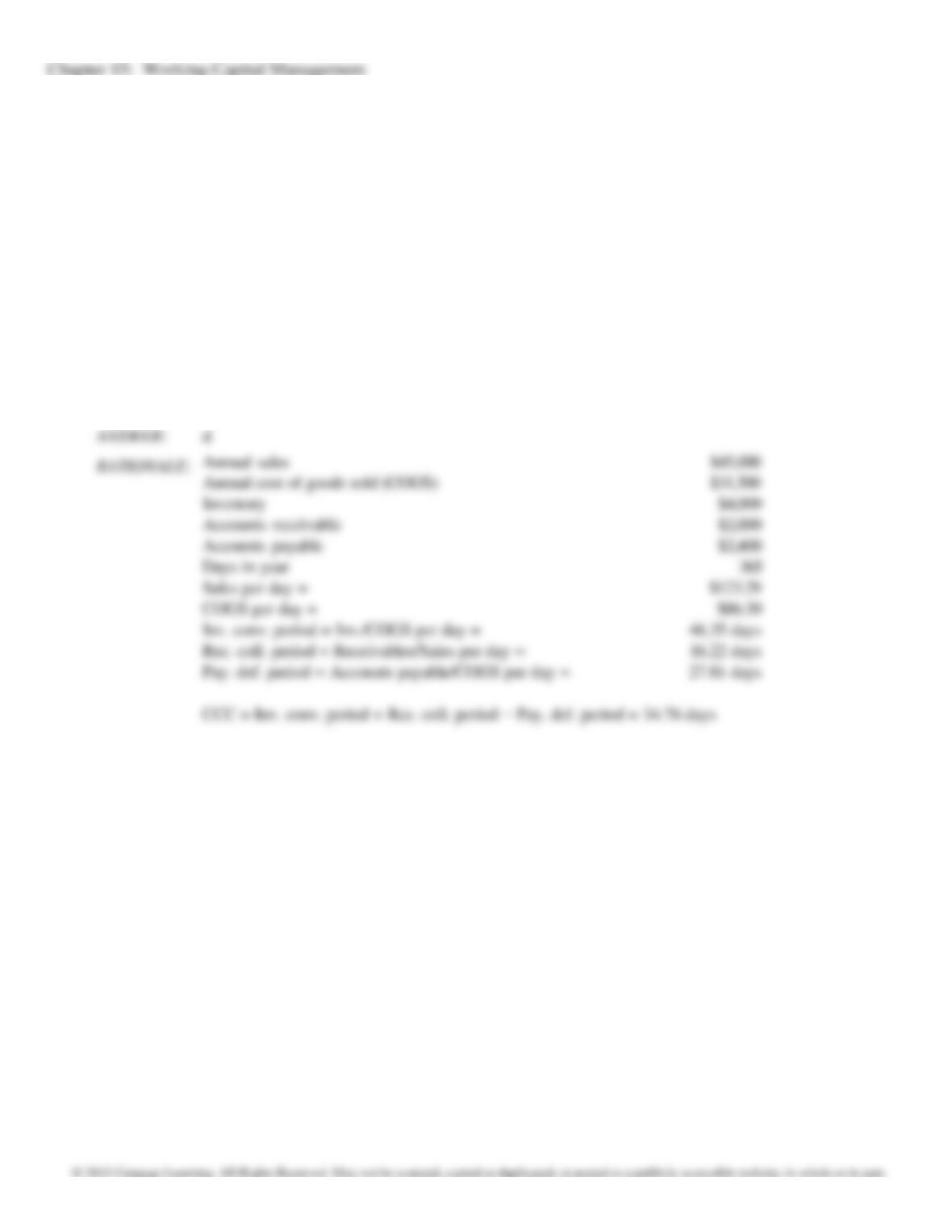
Annual sales
Annual cost of goods sold (COGS)
Inventory
Accounts receivable
Accounts payable
Days in year
Sales per day =
COGS per day =
Inv. conv. period = Inv./COGS per day =
Rec. coll. period = Receivables/Sales per day =
Pay. def. period = Accounts payable/COGS per day =
100.
Dewey Corporation has the following data, in thousands. Assuming a 365-day year, what is the firm’s cash
conversion cycle?
Annual sales =
$45,000
Annual cost of goods sold =
$31,500
Inventory =
$4,000
Accounts receivable =
$2,000
Accounts payable =
$2,400
a.
25 days
b.
28 days
c.
31 days
d.
35 days
e.
38 days
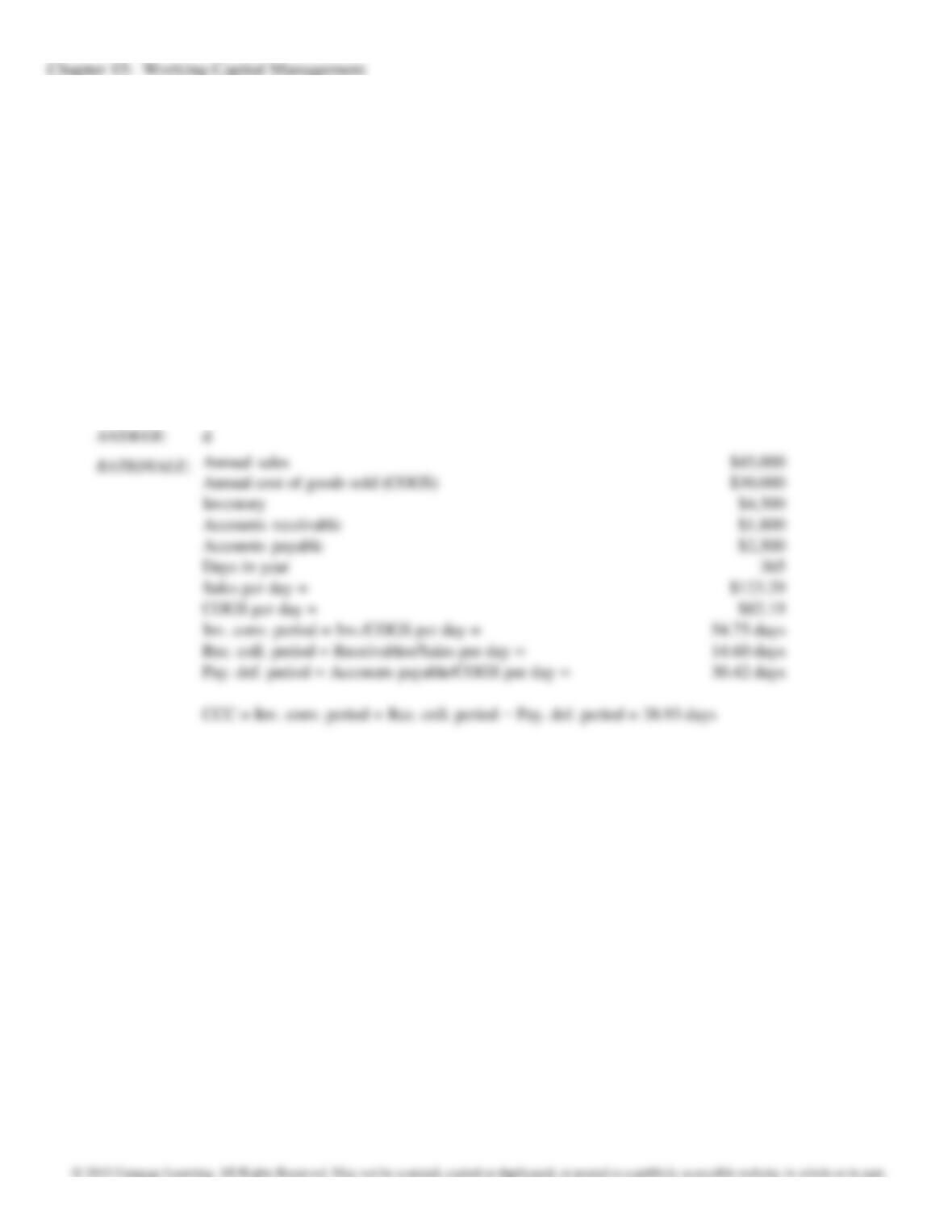
Annual sales
Annual cost of goods sold (COGS)
Inventory
Accounts receivable
Accounts payable
Days in year
Sales per day =
COGS per day =
Inv. conv. period = Inv./COGS per day =
54.75 days
Rec. coll. period = Receivables/Sales per day =
14.60 days
Pay. def. period = Accounts payable/COGS per day =
30.42 days
101.
Desai Inc. has the following data, in thousands. Assuming a 365-day year, what is the firm‘s cash conversion
cycle?
Annual sales =
$45,000
Annual cost of goods sold =
$30,000
Inventory =
$4,500
Accounts receivable =
$1,800
Accounts payable =
$2,500
a.
28 days
b.
32 days
c.
35 days
d.
39 days
e.
43 days
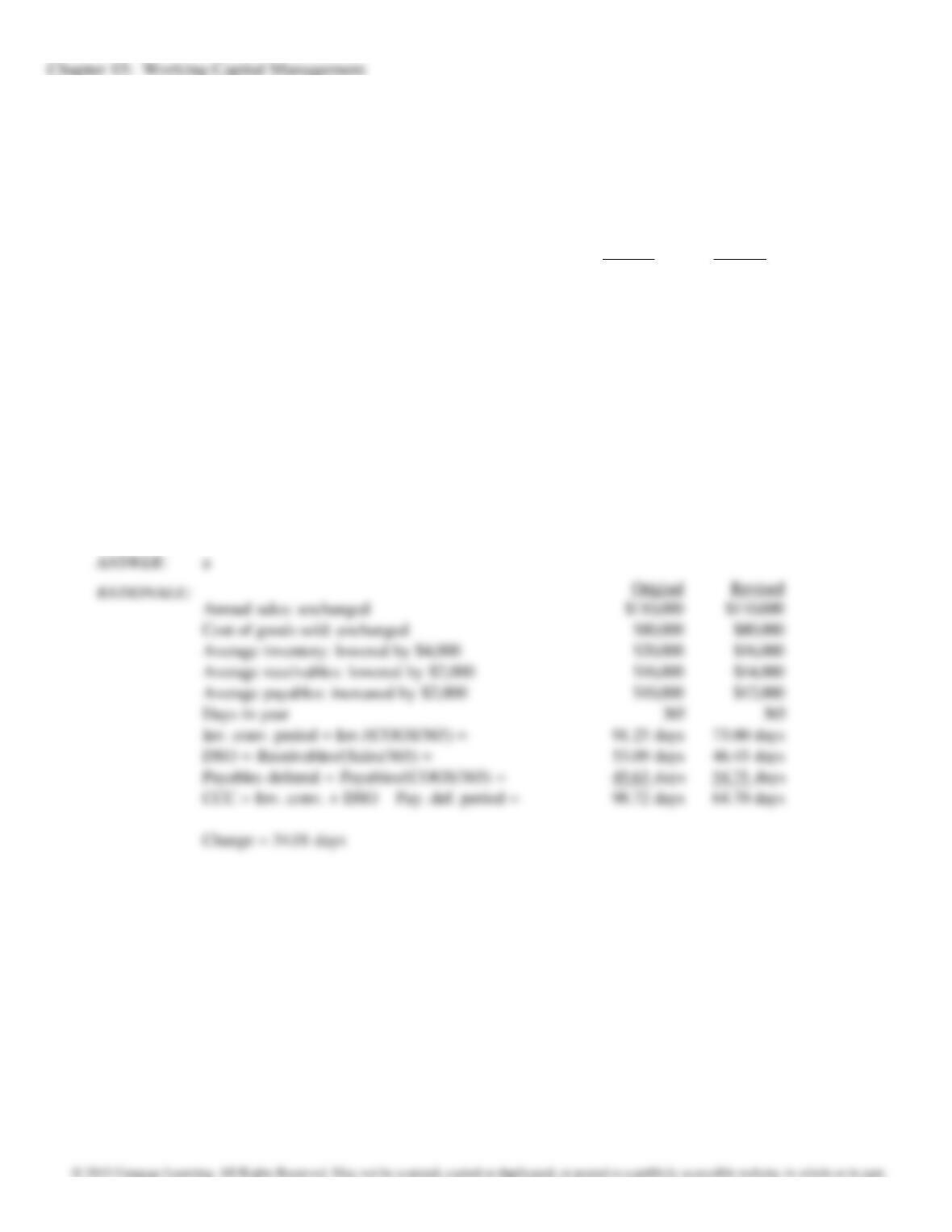
Annual sales: unchanged
$110,000
Cost of goods sold: unchanged
$80,000
Average inventory: lowered by $4,000
$16,000
Average receivables: lowered by $2,000
$14,000
Average payables: increased by $2,000
$12,000
102.
Zervos Inc. had the following data for 2013 (in millions). The new CFO believes (1) that an improved inventory
management system could lower the average inventory by $4,000, (2) that improvements in the credit department
could reduce receivables by $2,000, and (3) that the purchasing department could negotiate better credit terms and
thereby increase accounts payable by $2,000. Furthermore, she thinks that these changes would not affect either
sales or the costs of goods sold. If these changes were made, by how many days would the cash conversion cycle
be lowered?
Original
Revised
Annual sales: unchanged
$110,000
$110,000
Cost of goods sold: unchanged
$80,000
$80,000
Average inventory: lowered by $4,000
$20,000
$16,000
Average receivables: lowered by $2,000
$16,000
$14,000
Average payables: increased by $2,000
$10,000
$12,000
Days in year
365
365
a.
34.0 days
b.
37.4 days
c.
41.2 days
d.
45.3 days
e.
49.8 days
103.
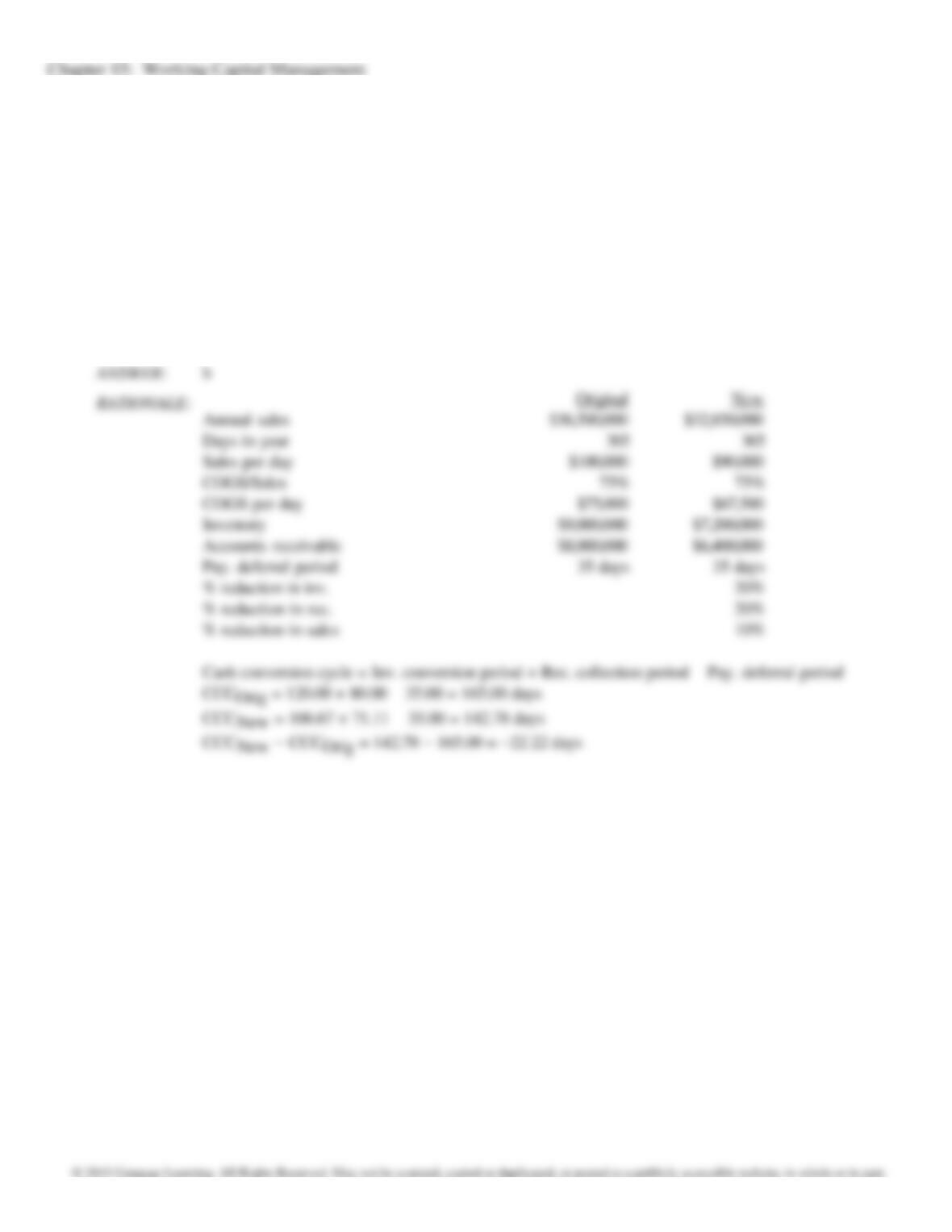
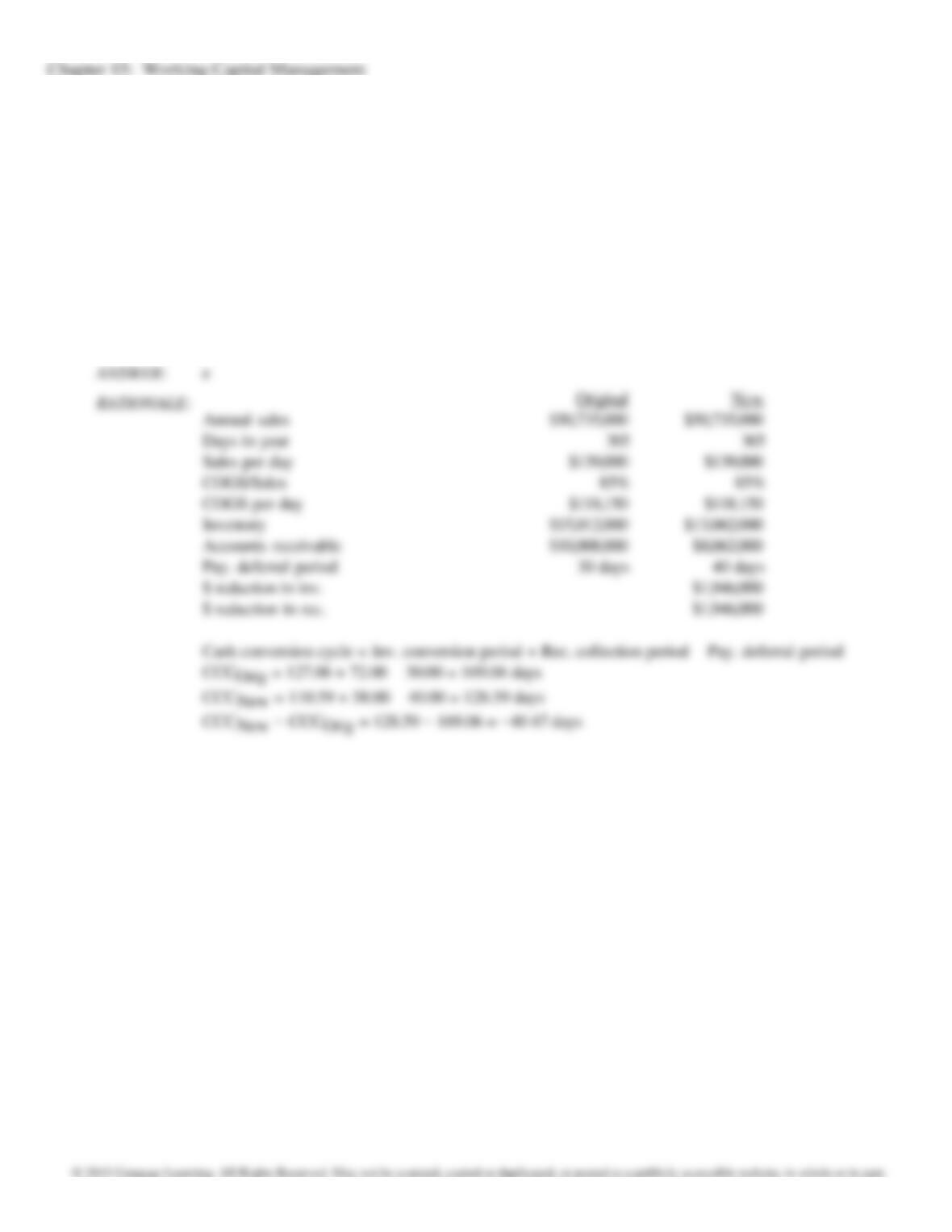
Edison Inc. has annual sales of $36,500,000, or $100,000 a day on a 365-day basis. The firm‘s cost of goods sold is
75% of sales. On average, the company has $9,000,000 in inventory and $8,000,000 in accounts receivable. The
firm is looking for ways to shorten its cash conversion cycle. Its CFO has proposed new policies that would result
in a 20% reduction in both average inventories and accounts receivable. She also anticipates that these policies
would reduce sales by 10%, while the payables deferral period would remain unchanged at 35 days. What effect
would these policies have on the company’s cash conversion cycle? Round to the nearest whole day.
a.
−26 days
b.
−22 days
c.
−18 days
d.
−14 days
e.
−11 days
104.
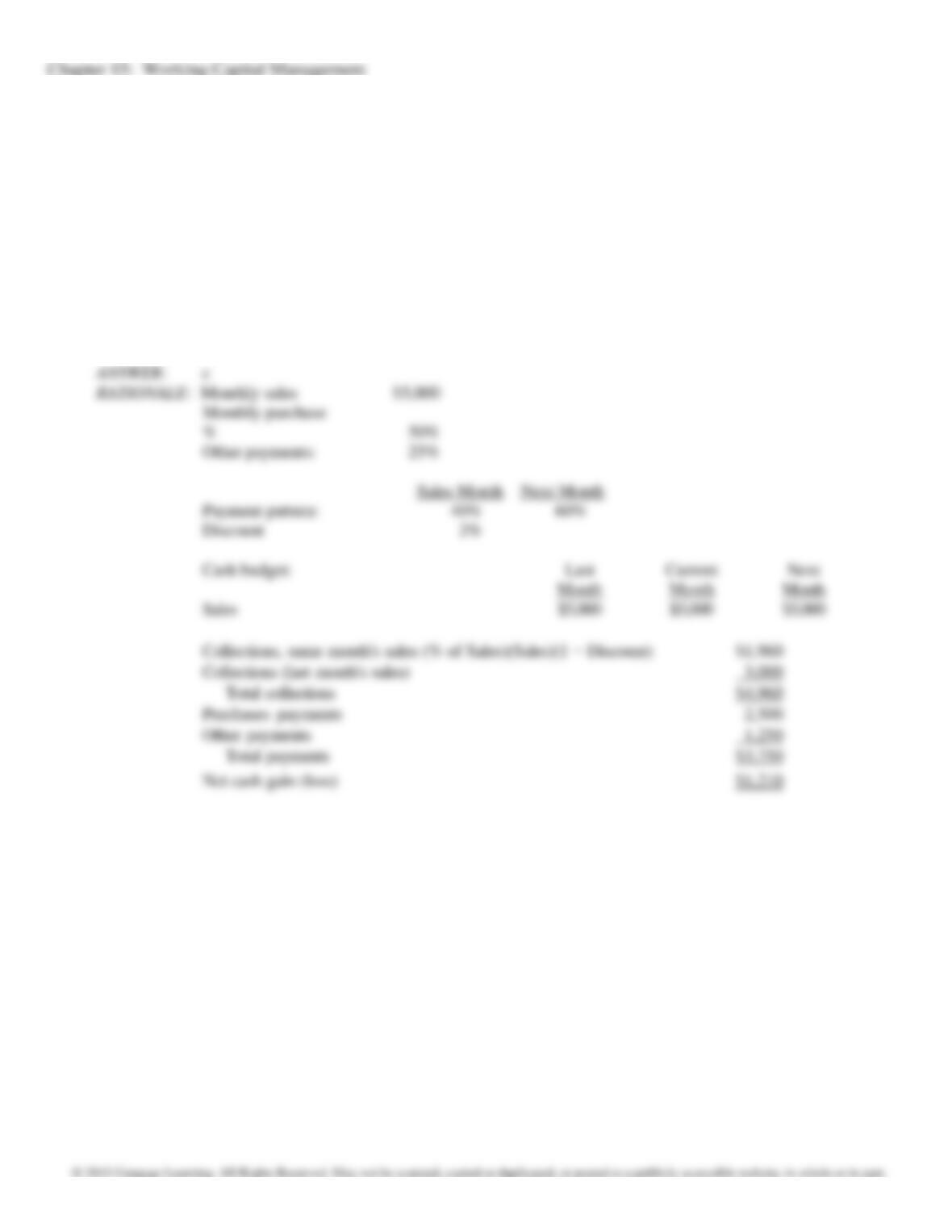
Van Den Borsh Corp. has annual sales of $50,735,000, an average inventory level of $15,012,000, and average
accounts receivable of $10,008,000. The firm‘s cost of goods sold is 85% of sales. The company makes all
purchases on credit and has always paid on the 30th day. However, it now plans to take full advantage of trade
credit and to pay its suppliers on the 40th day. The CFO also believes that sales can be maintained at the existing
level but inventory can be lowered by $1,946,000 and accounts receivable by $1,946,000. What will be the net
change in the cash conversion cycle, assuming a 365-day year?
a.
−26.6 days
b.
−29.5 days
c.
−32.8 days
d.
−36.4 days
e.
−40.5 days
105.
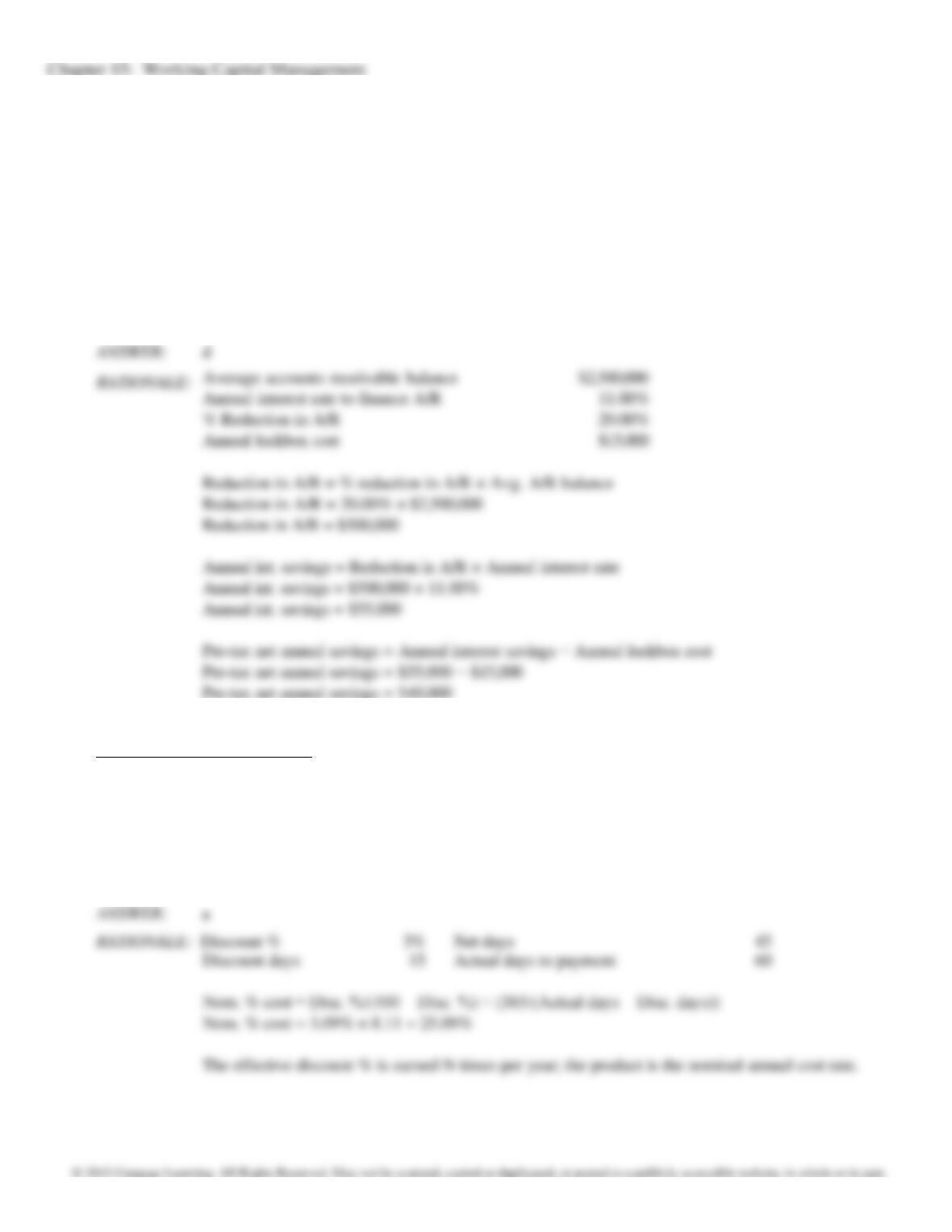
Nogueiras Corp’s budgeted monthly sales are $5,000, and they are constant from month to month. 40% of its
customers pay in the first month and take the 2% discount, while the remaining 60% pay in the month following the
sale and do not receive a discount. The firm has no bad debts. Purchases for next month’s sales are constant at
50% of projected sales for the next month. “Other payments,” which include wages, rent, and taxes, are 25% of
sales for the current month. Construct a cash budget for a typical month and calculate the average cash gain or loss
during the month.
a. $1,092
b. $1,150
c. $1,210
d. $1,271
e. $1,334
106.
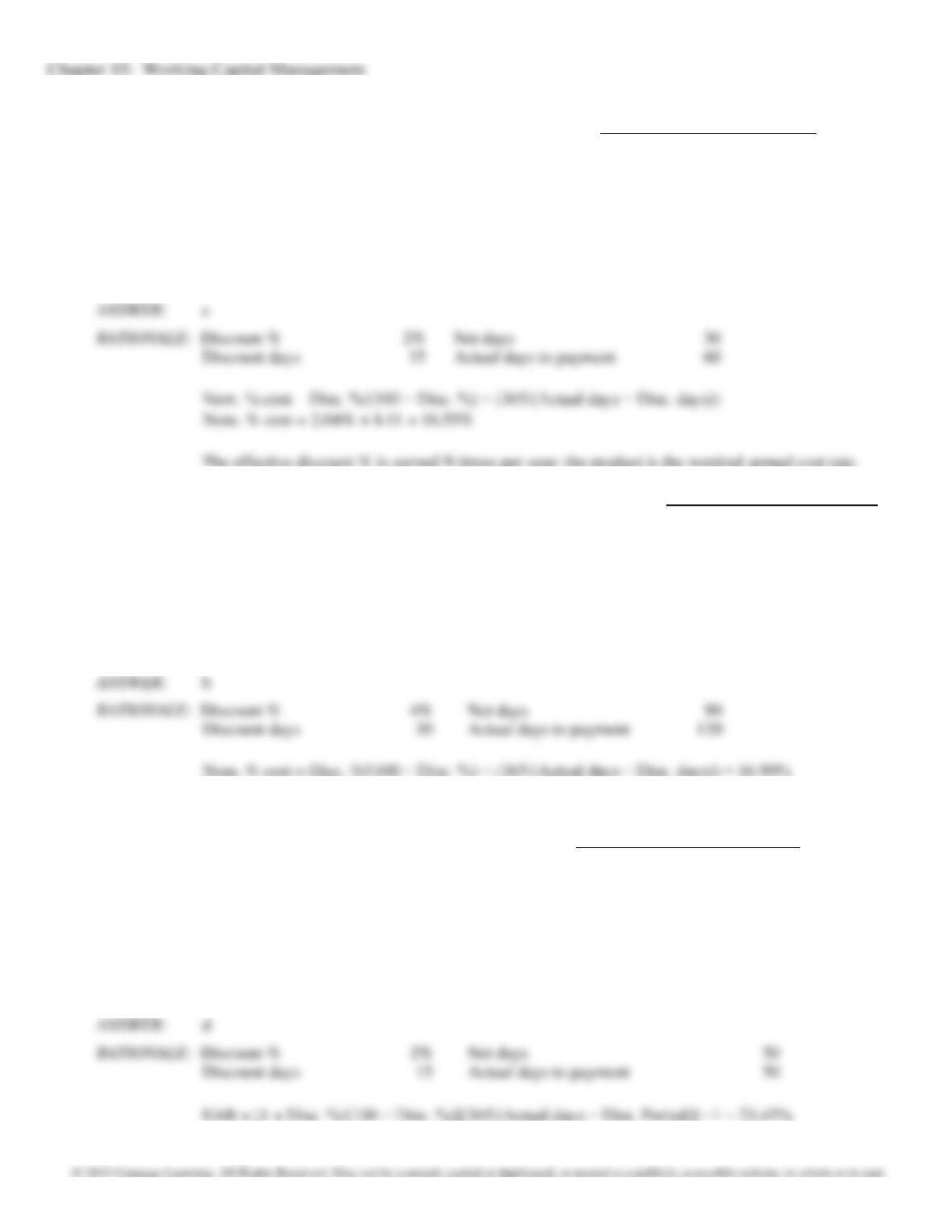
Whitmer Inc. sells to customers all over the U.S., and all receipts come in to its headquarters in New York City.
The firm‘s average accounts receivable balance is $2.5 million, and they are financed by a bank loan at an 11%
annual interest rate. The firm is considering setting up a regional lockbox system to speed up collections, and it
believes this would reduce receivables by 20%. If the annual cost of the system is $15,000, what pre-tax net annual
savings would be realized?
a. $29,160
b. $32,400
c. $36,000
d. $40,000
e. $44,000
107.
A firm buys on terms of 3/15, net 45. It does not take the discount, and it generally pays after 60 days. What is the
nominal annual percentage cost of its non-free trade credit, based on a 365-day year?
a. 25.09%
b. 27.59%
c. 30.35%
d. 33.39%
e. 36.73%
108.
Atlanta Cement, Inc. buys on terms of 2/15, net 30. It does not take discounts, and it typically pays 60 days after
the invoice date. Net purchases amount to $720,000 per year. What is the nominal annual percentage cost of its
non-free trade credit, based on a 365-day year?
a. 10.86%
b. 12.07%
c. 13.41%
d. 14.90%
e. 16.55%
109.
Your company has been offered credit terms of 4/30, net 90 days. What will be the nominal annual percentage cost
of its non-free trade credit if it pays 120 days after the purchase? (Assume a 365-day year.)
a. 16.05%
b. 16.90%
c. 17.74%
d. 18.63%
e. 19.56%
110.
Bumpas Enterprises purchases $4,562,500 in goods per year from its sole supplier on terms of 2/15, net 50. If the
firm chooses to pay on time but does not take the discount, what is the effective annual percentage cost of its non–
free trade credit? (Assume a 365-day year.)
a. 20.11%
b. 21.17%
c. 22.28%
d. 23.45%
e. 24.63%