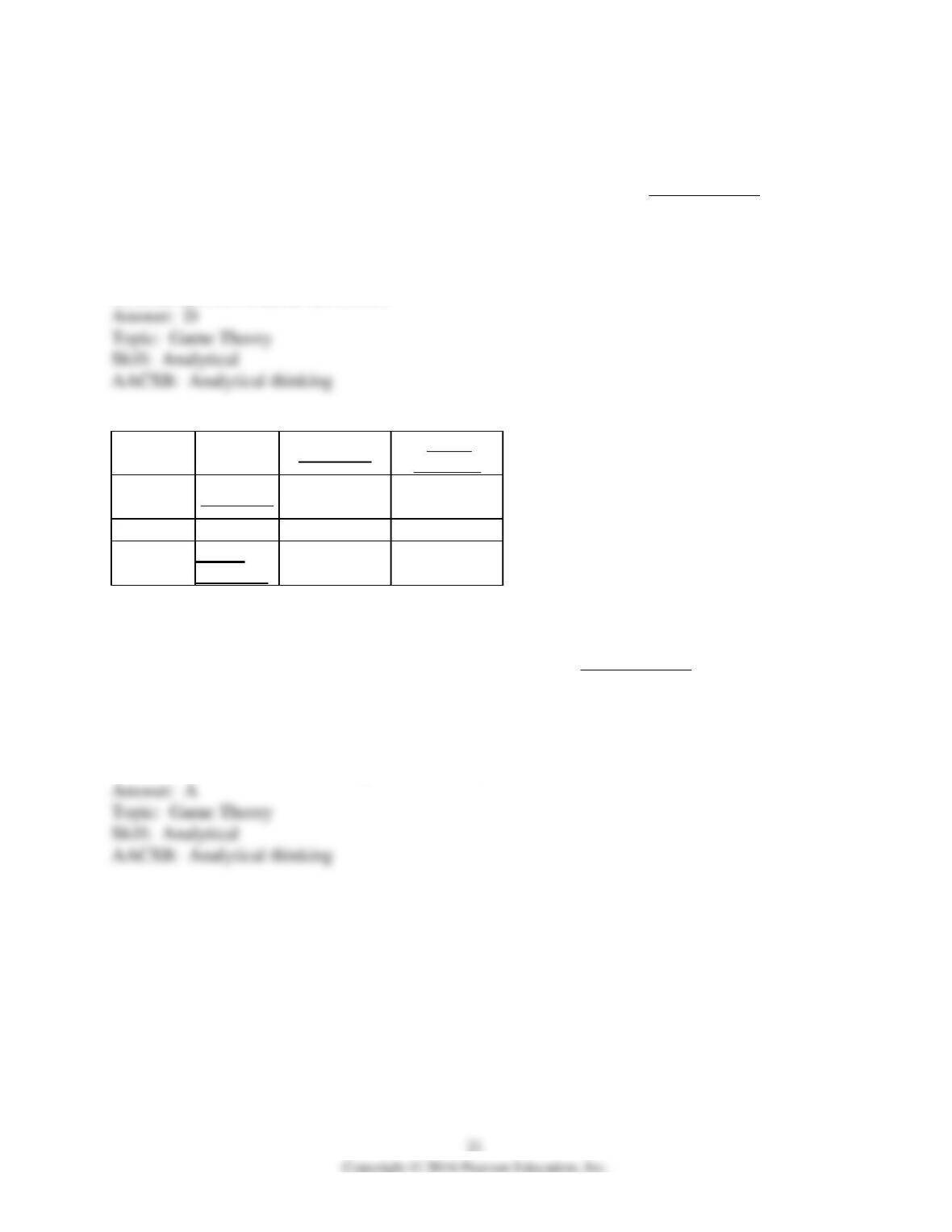
33) Disney and Fox must decide when to release their next films. The revenues received by each
studio depend in part on when the other studio releases its film. Each studio can release its film
at Thanksgiving or at Christmas. The revenues received by each studio, in millions of dollars, are
depicted in the payoff matrix above. Which of the following statements CORRECTLY describes
Disney’s strategy given what Fox’s release choice may be?
A) If Fox chooses a Thanksgiving release, Disney should choose a Christmas release.
B) If Fox chooses a Christmas release, Disney should choose a Thanksgiving release.
C) Disney should release on Thanksgiving regardless of what Fox does.
D) Both answers A and B are correct.
Dr. Smith
Advertise
Don’t
advertise
Advertise
S: $80
J: $70
S: $60
J: $110
Dr. Jones
Don’t
advertise
S: $120
J: $60
S: $100
J: $90
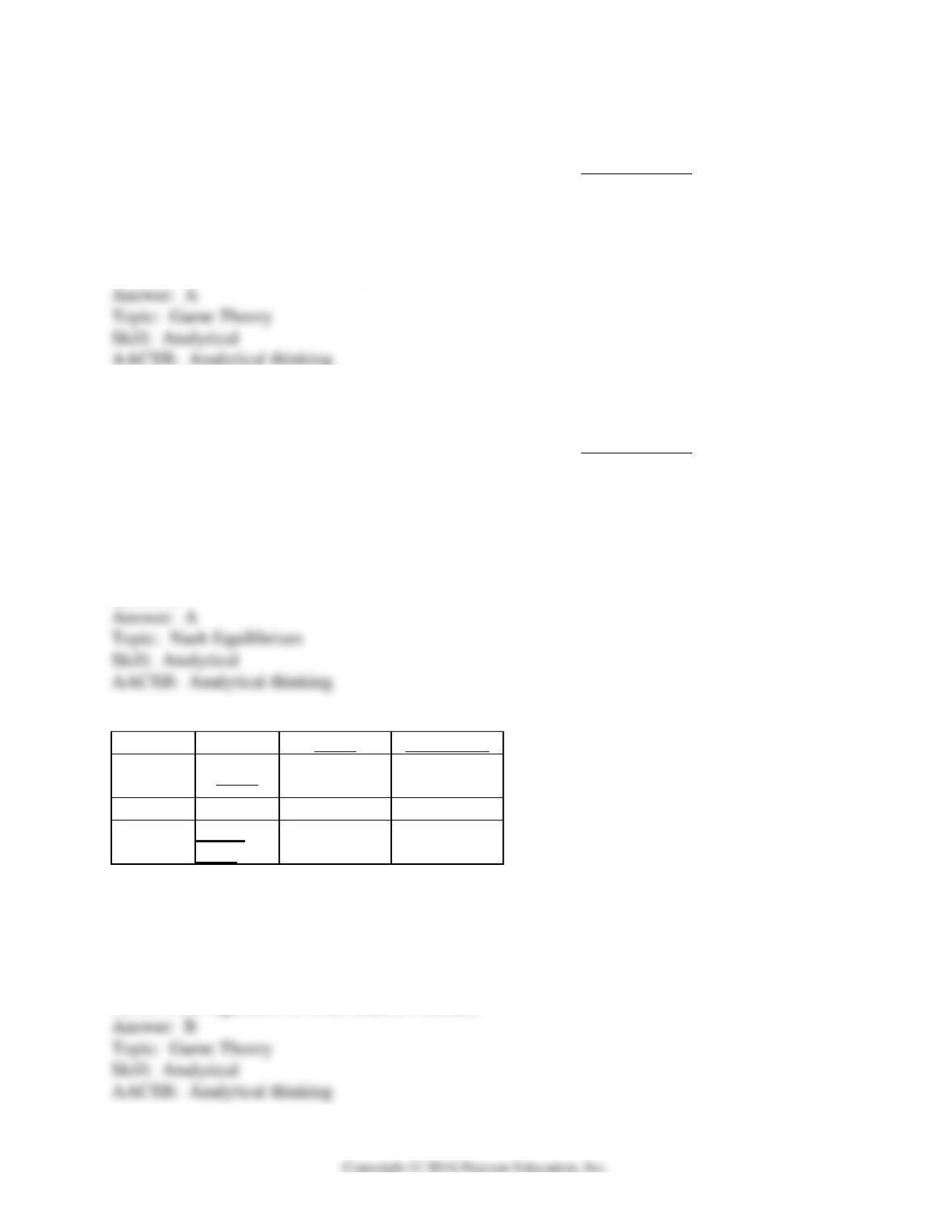
34) Libertyville has two optometrists, Dr. Smith and Dr. Jones. Each optometrist can choose to
advertise his service or not. The incomes of each optometrist, in thousands of dollars, are given
in the payoff matrix above. Which of the following statements CORRECTLY describes Dr.
Smith’s strategy given what Dr. Jones may do?
A) Dr. Smith should advertise no matter what Dr. Jones does.
B) Dr. Smith should not advertise no matter what Dr. Jones does.
C) Dr. Smith should advertise only if Dr. Jones doesn’t advertise.
D) Dr. Smith should advertise only if Dr. Jones advertises.
22
35) Libertyville has two optometrists, Dr. Smith and Dr. Jones. Each optometrist can choose to
advertise his service or not. The incomes of each optometrist, in thousands of dollars, are given
in the payoff matrix above. Which of the following statements CORRECTLY describes Dr.
Jones’ strategy given what Dr. Smith may do?
A) Dr. Jones should advertise no matter what Dr. Smith does.
B) Dr. Jones should not advertise no matter what Dr. Smith does.
C) Dr. Jones should advertise only if Dr. Smith doesn’t advertise.
D) Dr. Jones should advertise only if Dr. Smith advertises.
36) Libertyville has two optometrists, Dr. Smith and Dr. Jones. Each optometrist can choose to
advertise his service or not. The incomes of each optometrist, in thousands of dollars, are given
in the payoff matrix above. Which of the following statements CORRECTLY categorizes the
Nash equilibrium for the game?
A) The game has a Nash equilibrium in which both optometrists advertise.
B) The game has a Nash equilibrium in which both optometrists do not advertise.
C) The game has a Nash equilibrium in which Dr. Smith advertises and Dr. Jones does not
advertise.
D) The game has a Nash equilibrium in which Dr. Smith does not advertise and Dr. Jones does
advertise.
Student 1
Work
Don’t work
Work
1: +10
2: +10
1: +5
2: +5
Student 2
Don’t
work
1: +5
2: +50
1: 0
2: 0
37) Two students are assigned a group project. Each has the option to work or not work to
achieve a high grade. The payoffs are shown in the above table. Student 1 should
A) work only if student 2 works.
B) work regardless of the decision made by student 2.
C) not work if student 2 works.
D) not work regardless of what student 2 decides.
38) For a Nash equilibrium to be possible, all players must ________.
A) be able to predict their outcomes associated with all possible actions of the other players
B) have a way to communicate with the other players
C) have a strategy which allows for collusion
D) Both A and B
39) In an oligopoly price-fixing game, each player tries to
A) minimize the market shares of its opponents.
B) maximize its own market share.
C) minimize the profits of its opponents.
D) maximize its own profit.
40) In the oligopoly price-fixing game, the payoffs are the
A) profits of the firms.
B) market shares of the firms.
C) sales of the firms.
D) reputations of the firms.
41) A group of firms that has entered into a collusive agreement to restrict output and increase
prices and profits is called
A) a compliance.
B) a cartel.
C) an oligopoly.
D) a duopoly.
42) In what type of market is a cartel possible?
A) a market in which there are only a few firms and barriers to entry exist
B) a market in which firms sell a homogeneous good
C) a market in which firms sell a differentiated good
D) a market in which there are many firms
43) A cartel usually has a collusive agreement to
A) restrict output.
B) boost output.
C) lower the price.
D) increase the number of firms in the industry.
44) A cartel is a group of firms that
A) produce differentiated products.
B) produce products that are complements.
C) agree to restrict output to boost their profit.
D) agree to boost output to boost their profit.
45) A cartel is a group of firms which agree to
A) behave competitively.
B) raise the price of their product.
C) lower the price of their product.
D) increase the amount they produce.
46) A cartel is an agreement
A) among firms to flood the market and eliminate competition.
B) among firms to steal industrial processes from rival firms.
C) among firms to decrease output and raise price.
D) by the government to restrict imports.
47) In the United States, a collusive agreement to restrict output and increases prices is
A) legal.
B) the key tool used by oligopolists.
C) illegal.
D) the key tool used by monopolistic competitors.
48) Which of the following is TRUE regarding a collusive agreement?
I. It is illegal in the United States.
II. Two or more producers agree to restrict output or raise prices.
III. Firms’ profits are never maximized under this sort of agreement.
A) I and II
B) I and III
C) II and III
D) I, II and III
49) If two duopolists can collude successfully, then both will
A) earn greater profits than if they did not collude.
B) price at marginal cost.
C) price below average total cost.
D) lower their economic profits.
50) If firms in a duopoly can successfully collude
A) each firm can earn an economic profit.
B) the industry, that is, both firms taken together, can earn the maximum economic profit.
C) the firms achieve a cooperative equilibrium.
D) All of the above answers are true.
51) If there is a collusive agreement in a duopoly to maximize profit, then the price will
A) equal the marginal cost of production.
B) equal the average total cost of production.
C) be the same as the price set by a monopoly.
D) be the same as the price set by a competitive industry.
52) The maximum economic profit that can be made by a duopoly that colludes is equal to the
________.
A) economic profit made by duopolists who cheat
B) normal profit made by an oligopoly
C) economic profit made by a monopoly
D) normal profit made by firms in perfect competition
53) Two firms, Alpha and Beta, produce identical computer hard drives. They have identical
costs, and the hard drives they produce are identical. The industry is a natural duopoly. Alpha
and Beta enter into a collusive agreement, according to which they split the market equally. If
both firms comply with the agreement
A) together they will operate in a way indistinguishable from a monopoly.
B) the price of a hard drive will be equal to marginal cost.
C) each firm will make zero economic profit.
D) the oligopoly will produce more hard drives than a profit-maximizing monopoly would
produce.
54) Two firms, Alpha and Beta, produce identical computer hard drives. They have identical
costs, and the hard drives they produce are identical. The industry is a natural duopoly. Alpha
and Beta enter into a collusive agreement, according to which they split the market equally. If
both firms cheat on the agreement so the market is the same as a competitive market
A) they will operate in a way indistinguishable from a monopoly.
B) each firm will make zero economic profit.
C) each firm will increase its economic profit.
D) the price of a hard drive will be above marginal cost.
55) When two firms collude to maximize profit the total quantity produced by both firms taken
together is determined at the quantity where ________.
A) excess capacity is minimized
B) industry marginal cost equals industry marginal revenue
C) the price equals the industry’s marginal cost
D) excess capacity is as large as possible zero
56) The maximum total economic profit that can be made by colluding duopolists
A) is less than the economic profit made by a monopolist.
B) equals the economic profit made by a monopolist.
C) exceeds the economic profit made by a monopolist.
D) bears no necessary relation to the economic profit made by a monopolist.
57) Two duopoly firms that sell an identical good form a cartel. They decide to collude and fix
the price of their good. In this prisoners’ dilemma type situation, the likely outcome is
A) both will cheat.
B) neither one will cheat.
C) only one will cheat.
D) It is impossible to say.
58) Two duopoly firms form a cartel. They decide to collude and fix the price of their good. Each
individual firm will earn the highest profit if
A) it cheats and the other sticks with the agreement.
B) both stick with the agreement.
C) it sticks with the agreement and the other cheats.
D) they both cheat.
59) Cartels are typically subject to cheating by their members because
A) if the other firms stick to the agreement, a firm can increase its profits by cutting its price.
B) barriers to entry do not exist so new entrants will join.
C) the U.S. Justice Department will punish any cartel agreement before the cartel has had a
chance to operate.
D) product differentiation allows the firms in the cartel to cheat.
60) Once a cartel determines the profit-maximizing price
A) each firm faces the temptation to cheat by raising its price.
B) each firm faces the temptation to cheat by lowering its price.
C) changes in the output of any member firm will not affect the market price.
D) entry into the industry by rival firms will not affect the profit of the cartel.
61) In a cartel
A) each firm has an incentive to decrease its own production below the level set by the cartel.
B) the firms’ marginal cost equals the price set by the cartel.
C) each firm has an incentive to lower its price below the level set by the cartel.
D) each firm has an incentive to raise its price above the level set by the cartel.
62) In a collusive agreement between two duopolists in an oligopoly, each firm has an incentive
to cheat on the agreement because the firm’s price
A) exceeds its marginal cost.
B) exceeds its marginal revenue.
C) is less than its average total cost.
D) None of the above answers is correct.
63) A firm might be tempted to cheat on a collusive price-fixing agreement by setting a
________ price and producing ________ than agreed upon.
A) lower; more
B) lower; less
C) higher; more
D) higher; less
64) If both firms in a duopoly cheat on a collusive agreement, the price ________ and both firms
are ________.
A) falls; better off
B) rises; worse off
C) falls; worse off
D) rises; better off
65) In a duopoly with a collusive agreement and in a one-time only game, a firm’s profit is
largest if it ________ the agreement and if the other firm ________ the agreement.
A) complies with; complies with
B) complies with; cheats on
C) cheats on; complies with
D) cheats on; cheats on
66) The ABC Nail Company has entered into a collusive agreement with the other firm in the
industry, the DC Nail Company. What occurs in the nail industry if ABC decides to cheat on the
agreement?
A) ABC lowers the price of its nails.
B) The total industry output increases.
C) The total profits in the nail industry will decrease.
D) All of the above answers are correct.
67) In a duopoly game we observe the following payouts: if the two firms collude they will each
earn $50,000. If one firm cheats then he earns $60,000 and the other firm earns -$10,000. If both
firms cheat then they each earn zero economic profit. In this game what is the Nash equilibrium?
A) Both firms cheat.
B) Only one firm will cheat.
C) Neither firm will cheat.
D) It is impossible to say.
Suppose two firms, FastNet and SmartCast are the only fast Internet providers in a city. They
have identical costs and one firm’s service is a perfect substitute for the other’s. The industry is a
natural duopoly. Suppose that FastNet and SmartCast collude and agree to share the market
equally.
68) In the scenario above, which of the following actions will maximize the industry’s economic
profit?
A) Both firms comply with the agreement.
B) Both firms cheat on the agreement, producing more than the agreed amount.
C) One of the firms complies with the agreement while the other firm cheats, producing more
than the agreed amount.
D) Because the firms are colluding, the profit does not change regardless of whether the firms
comply with agreement or cheat on the agreement.
69) In the scenario above, if both firms cheat on the agreement, producing more than the agreed
amount, then
A) each firm makes zero economic profit.
B) the outcome is identical to a monopoly.
C) the industry’s economic profit is the maximum profit that can be made by the duopoly.
D) each firm makes a greater economic profit than it would make if it complied with the
agreement.
70) In the scenario above, in Nash equilibrium
A) both firms cheat to produce more than the agreed amount.
B) both firms comply with the agreement.
C) one firm complies with the agreement while the other cheats to produce more than the agreed
amount.
D) both firms cheat to produce less than the agreed amount.
M&M
Regular
Candy
Holiday Candy
Regular
Candy
M&M: $1250
Dove: $1250
M&M: $1400
Dove: $650
Dove
Holiday
Candy
M&M: $650
Dove: $1400
M&M: $1000
Dove: $1000
71) M&M and Dove are both considering issuing themed holiday candy. The profits for each
strategy, regular candy or holiday candy, are summarized in the payoff matrix above.
The Nash Equilibrium in this game is that Dove produces ________ and M&M produces
________.
A) holiday candy; regular candy
B) regular candy; holiday candy
C) regular candy; regular candy
D) holiday candy; holiday candy
Orange
Pink
Orange
Gap: $120M
AT: $100M
Gap: $50M
AT: $70M
Ann
Taylor
Pink
Gap: $70M
AT: $50M
Gap: $100M
AT: $120M
72) Ann Taylor and Gap are two clothing companies that must decide on the leading color
palette for next season. Their sales depend on the choice of color they make as well as the choice
their competitor makes. Their sales are summarized in the payoff matrix above. Using the payoff
matrix
A) the only Nash Equilibrium is for both companies to choose pink.
B) the only Nash Equilibrium is for both companies to choose orange.
C) the Nash Equilibrium is for one company to choose pink while the other company chooses
orange.
D) there are two Nash Equilibria: either both companies choose pink or both choose orange.
American
Cheat
Comply
Cheat
A: $0
N: $0
A: -$2,000
N: $4,000
National
Comply
A: $4,000
N: -$2,000
A: $3,000
N: $3,000
73) There are two can companies, American and National, which have entered into a collusive
agreement. The payoff matrix of economic profits is above. If both firms cheat on the collusive
agreement, what amount of economic profit is made by American?
A) $0
B) $3,000
C) $4,000
D) -$2,000
74) There are two can companies, American and National, which have entered into a collusive
agreement. The payoff matrix of economic profits is above. If National is able to cheat on the
agreement but American complies with the agreement, what amount of economic profit is made
by National?
A) $2,000
B) $3,000
C) $4,000
D) $6,000
Sears
Lower prices
Don’t lower prices
Lower prices
S: $5 million
W: $5 million
S: $1 million
W: $30 million
Wal-Mart
Don’t lower
prices
S: $30 million
W: $1 million
S: $20 million
W: $20 million
75) Sears and Wal-Mart must decide whether to lower their prices, based on the economic profits
shown in the table above. Which of the following is TRUE?
A) This situation is not a prisoners’ dilemma.
B) If Sears lowers its prices and Wal-Mart does not, Sears will make a $20 million economic
profit.
C) If Wal-Mart lowers its prices, Sears should keep its prices high.
D) Both Sears and Wal-Mart would jointly be better off if they could each keep their prices high.
76) Refer to the payoffs in the table above. Sears and Wal-Mart must decide whether to lower
their prices based on the profits shown in the table. This game has
A) no Nash equilibrium.
B) a Nash equilibrium: Sears keeps its prices high and Wal-Mart lowers its prices.
C) a Nash equilibrium: both Sears and Wal-Mart keep prices high.
D) a Nash equilibrium: both Sears and Wal-Mart lower prices.
Firm A
Monopoly
price
Competitive
price
Monopoly
price
A: $5
B: $5
A: $8
B: -$1
Firm
B
Competitive
price
A: -$1
B: $8
A: $0
B: $0
77) The above payoff matrix shows the economic profits (in millions of dollars) of two firms in a
duopoly that have agreed to a cartel agreement to restrict their output and set their prices equal to
the monopoly price. Assuming the game is played once, the equilibrium outcome is where
A) both choose the monopoly price.
B) both choose the competitive price.
C) firm A chooses the monopoly price and firm B chooses the competitive price.
D) firm B chooses the monopoly price and firm A chooses the competitive price.
Oscar
Cheat
Comply
Cheat
O: $1 M
F: $1 M
O: -$2 M
F: $12 M
Felix
Comply
O: $12 M
F: -$2 M
O: $10 M
F: $10 M
78) Oscar and Felix are the only firms that clean offices in a large city. They agree to operate as
a cartel. The payoff matrix above gives the economic profit that each firm can make. If Felix
cheats on the agreement but Oscar complies, Felix makes an economic profit of ________ and
Oscar makes an economic profit of ________.
A) $10 million; $10 million
B) $1 million; $1 million
C) -$2 million; $12 million
D) $12 million; -$2 million
79) Oscar and Felix are the only firms that clean offices in a large city. They agree to operate as
a cartel. The payoff matrix above shows the economic profit that each firm can make. If the
game is played only once, then ________.
A) Felix and Oscar will each make $10 million economic profit
B) Felix will comply and Oscar will make $12 million economic profit
C) Felix and Oscar will each make $1 million economic profit
D) Felix will cheat and Oscar will make -$2 million economic profit
80) Oscar and Felix are the only firms that clean offices in a large city. They agree to operate as
a cartel. The payoff matrix shows the economic profit that each firm can make. If the game is
played repeatedly and Felix and Oscar both use a tit-for-tat strategy, then ________.
A) Felix will make $10 million of economic profit and Oscar will cheat
B) Felix and Oscar will each make $1 million of economic profit
C) Felix will make -$2 million economic of profit and Oscar will cheat
D) Felix and Oscar will each make $10 million of economic profit
Gateway
Cut price
Hold price
Cut price
G: $10
D: $10
G: $5
D: $20
Dell
Hold price
G: $20
D: $5
G: $15
D: $15
81) Dell and Gateway must decide whether to lower their prices, based on the potential economic
profits shown in the payoff matrix above. (The profits are in millions of dollars.) In the Nash
equilibrium
A) Dell keeps its prices high and Gateway lowers its prices.
B) both Dell and Gateway lower prices.
C) Gateway keeps its prices high and Dell lowers its prices.
D) both Dell and Gateway keep prices high.
82) Dell and Gateway must decide whether to lower their prices, based on the potential economic
profits shown in the payoff matrix above. (The profits are in millions of dollars.) In the Nash
equilibrium, Dell’s profit is ________ million and Gateway’s profit is ________ million.
A) $10; $10
B) $15; $15
C) $5; $20
D) $20; $5
83) Dell and Gateway must decide whether to lower their prices, based on the potential economic
profits shown in the payoff matrix above. (The profits are in millions of dollars.) If the firms
collude and don’t cheat, Dell’s profit is ________ million and Gateway’s profit is ________
million.
A) $10; $10
B) $15; $15
C) $5; $20
D) $20; $5
84) A collusive agreement between two duopolists is similar to the prisoners’ dilemma because
in both games
A) the best outcome is always achieved.
B) each players strategy depends on what the other player does.
C) the Nash equilibrium is not the best outcome for the players.
D) All of the above answers are correct.
85) Suppose two firms are trying to decide how much to budget for research and development.
Once a new discovery is made, each firm benefits regardless of which firm developed the
innovation. In this R&D game of chicken, the Nash equilibrium will be that
A) either both firms conduct the R&D or neither firm conducts the R&D.
B) only one firm conducts the R&D but which firm conducts the R&D cannot be determined.
C) both firms conduct the R&D.
D) neither firm conducts the R&D.
86) There are two firms that compete against each other and each needs to decide if they will
undertake research and development to improve their product. The payoffs are as follows:
If Firm 1 does undertake R&D then Firm 2 will earn $25 million if they also do R&D or $50
million if not
If Firm 1 does not undertake R&D then Firm 2 will earn $2 million if they do R&D or $0 million
if not
If Firm 2 does undertake R&D then Firm 1 will earn $10 million if they also do R&D or $20
million if not
If Firm 2 does not undertake R&D then Firm 1 will earn $2 million if they do R&D or $0 million
if not
Regarding this game, which of the following is TRUE?
A) Only one will do R&D but we cannot say which one.
B) Both firms will do R&D.
C) Both firms will not do R&D.
D) Firm 1 will do R&D and Firm 2 will not.
87) In an oligopoly with a collusive agreement, the total industry profits will be smallest when
A) all firms comply with the agreement.
B) one firm cheats on the agreement and the other firms do not cheat.
C) all firms cheat on the agreement.
D) the firms act as a monopoly.
88) When a cartel maximizes its profit,
A) each firm necessarily produces the same amount.
B) the industry level of output is efficient.
C) industry marginal revenue equals industry marginal cost at the level of total output.
D) total output is greater than it would be without collusion.
3 Repeated Games and Sequential Games
1) In a repeated game, punishments that result in heavy damages are an incentive for players to
adopt the strategies that result in a ________ equilibrium.
A) contestable
B) strategic
C) cooperative
D) winner-share-all
2) An equilibrium in game theory in which the players make and share the monopoly profit is
called
A) the Nash equilibrium.
B) the cooperative equilibrium.
C) a contestable market equilibrium.
D) limit pricing.
3) From the social perspective, a major criticism of oligopolies is that
A) successful collusion leads to a monopoly-like outcome.
B) price wars usually break out.
C) advertising hardly ever occurs.
D) cartels are unstable.
4) If a duopolists’ collusive price-fixing game can be played repeatedly,
A) one possible equilibrium is that both firms cheat.
B) players can signal their willingness to cooperate.
C) players can punish cheaters in the following game.
D) All of the above answers are correct.
5) A tit-for-tat strategy can be used in
A) a single-play game or a repeated game.
B) a single-play game but not a repeated game.
C) a repeated game but not a single-play game.
D) neither a repeated game nor a single-play game.
6) A trigger strategy can be used in
A) a single-play game or a repeated game.
B) a single-play game but not a repeated game.
C) a repeated game but not a single-play game.
D) neither a single-play game nor a repeated game.
7) A strategy in which a player cooperates in the current period if the other player cooperated in
the previous period, but the player cheats in the current period if the other player cheated in the
previous period is called a
A) tit-for-tat strategy.
B) trigger strategy.
C) duopoly strategy.
D) dominant firm strategy.
8) A trigger strategy is one in which a player
A) cooperates in the current period if the other player cooperated in the previous period, but
cheats in the current period only if the other player cheated in the previous period.
B) cheats in the current period if the other player cooperated in the previous period, but
cooperates in the current period if the other player cheated in the previous period.
C) cooperates in the current period if the other player has always cooperated, but cheats forever
if the other player ever cheats.
D) cheats in the current period if the other player has always cheated, but cooperates forever if
the other player has ever cooperated.
9) Sarah’s Soothing Diapers, Inc. and Orville’s Odorless Diapers, Inc. are duopolists, who have
agreed to collude. Orville has decided that he will comply with the collusive agreement as long
as Sarah cooperated in the previous period. But if Sarah cheated in the previous period, Orville
will punish Sarah by cheating in the current period. Orville’s strategy is referred to as a
A) Nash strategy.
B) tit-for-tat strategy.
C) trigger strategy.
D) monkey-see, monkey-do strategy.
10) A cooperative equilibrium is most likely to arise in a
A) single-play game with a large number of players.
B) single-play game without communication.
C) repeated game with a large number of players.
D) repeated game with a small number of players.
11) Which of the following games provides the best way to model price wars?
A) a repeated duopoly game
B) a game of chicken
C) a sequential entry game in a noncontestable market
D) a sequential entry game in a contestable market
12) With barriers to the entry of new firms
A) a cartel is guaranteed to earn an economic profit greater than zero.
B) a cartel’s members have no incentive to cheat.
C) the cartel will likely earn an economic profit greater than zero.
D) industry supply will expand if the firms form a cartel.