b. hiatus e. cessation
c. binding arbitration
98. At several local supermarkets, employees are dissatisfied with wages and working conditions.
Individual negotiations with managers have produced no changes. These workers may decide
to form a(n)
a. collateral. d. union.
b. support group. e. underground economy.
c. think tank.
99. Rachelle graduated from a university with a degree in chemical engineering. During her years of
employment, she became proficient in a particular type of process automation software. In
addition, she spent countless hours outside of work amassing training certifications that augmented
her work experience. Her collection of education, skills, and experience is defined as her
a. human capital. d. work history.
b. résumé. e. capital investment.
c. training.
100. Firms are concerned with “effectiveness of effort.” They examine how much output they receive
from every unit of input, described simply as
a. efficacy. d. efficiency wages.
b. productivity. e. human capital.
c. proactivity.
101. All of the following contribute to wage discrimination, EXCEPT
a. race. d. sex.
b. in-kind transfers. e. age.
c. differences in human capital.
102. San Francisco is a beautiful city with great weather. It also has limited real estate, creating a higher
cost of living. How do firms account for these two conflicting compensating differentials when
determining wages?
a. When in conflict, the cost of living is always the determining factor for wages.
b. The market will reach an equilibrium price that takes both of these factors into consideration
while ensuring an adequate supply of necessary labor.
c. Individuals who are attracted to the prospect of living in San Francisco will accept a much
lower wage, despite the increased cost of living.
d. In most cases, firms can rely on government-subsidized housing in order to relieve the upward
pressure on wages.
e. This conflict produces a wage mismatch, resulting in an economy where certain jobs cannot be
staffed.
103. Based on research into wage discrimination, economists believe
a. it was a common problem of the past that has since disappeared.
b. broader factors beyond bias play the major roles.
c. women actually earn more over their lifetimes than men.
d. it has intensified since the passage of the Equal Pay Act of 1963.
e. it is only caused by racial and gender bias.
104. When workers with the same ability as others are not paid the same because of their race, ethnic
origin, sex, age, or religion, it is defined as
a. injustice. d. binding arbitration.
b. wage discrimination. e. class incentives.
c. inefficiency wages.
105. “For every $1 men make, women make, on average, 82 cents,” is used to describe the gender wage
gap. Which is the best description for this statement?
a. Women are paid 82 percent of the wages men earn for doing the same work, all other factors
being equal.
b. Wages earned by women are the market wage, but men are targeted for efficiency wages
because of perceived differences in potential productivity.
c. The increased cost associated with raising a family suppresses a woman’s effective earning
capacity.
d. Based on differences in profession, education, and lifestyle—as well as gender bias and other
factors—women earn, on average, 82 percent as much as their male counterparts.
e. There is no relationship between the two pieces of data.
106. In professions where beauty is considered a necessary element of the job, such as modeling, a high
value placed on the attribute is most likely
a. occupational crowding. d. overt discrimination.
b. efficiency wages. e. winner-take-all.
c. a compensating differential.
107. The reversal of occupational crowding has an interesting side effect: the increased supply of
female labor in traditionally male-dominated occupations will result in a(n) ________ in wages.
a. stagnation d. decrease
b. discrimination e. efficiency
c. increase
108. The ________ gives victims of wage discrimination more time to file a complaint with the
government.
a. Goodyear Compensation Act d. Fair Labor Practices Act
b. Equal Pay Act of 1963 e. Stop Wage Discrimination Act
c. Lilly Ledbetter Fair Pay Act
109. When certain groups or classes are relegated to a narrow range of jobs in the economy, it is called
a. occupational hazard. d. occupational crowding.
b. occupational formulation. e. funneling.
c. occupational narrowing.
110. Why might occupational crowding persist in certain industries, despite educational parity and an
elimination of discrimination?
a. New forms of discrimination always emerge to suppress certain groups of individuals.
b. Wages are not high enough in other industries to attract those in more crowded occupations.
c. Colleges and universities usher gender and minority groups toward certain fields of study,
perpetuating the crowding problem.
d. Workers don’t view occupational crowding as a problem, preventing any incentive for
mobility.
e. Personal preferences for certain types of jobs means that some groups will always have higher
representation in those industries.
111. The life-cycle wage pattern is a type of ________ that is facilitated by increases in ________.
a. efficiency wage; compensating differentials
b. efficiency wage; wage discrimination
c. wage discrimination; human capital
d. wage discrimination; occupational crowding
e. human capital; productivity
112. According to the text, three women for every two men are enrolled in postsecondary education.
This might lead to a reduction in the gender gap for all of the following reasons, EXCEPT that
a. sex discrimination still may persist in traditionally male-dominated professions.
b. graduation, not enrollment in college, will make the more appreciable difference.
c. women may choose majors of study that won’t result in high-paying jobs.
d. a diminishing quantity supplied of college-educated males will shift the labor demand to the
right.
e. increased competition from new females in the workforce will drive down the wages in
male-dominated jobs.
113. Diminishing marginal returns explain the reduction of value in additional exertions of effort. The
concept of ________ indicates the opposite—that the ultimate marginal production can result in
disproportionate wage increases.
a. productivity discrimination d. inclining marginal utility
b. winner-take-all e. maximum human capital
c. efficiency wages
114. Which of the following factors does not lead to income inequality?
a. ability d. discrimination
b. income mobility e. corruption
c. wealth
115. Of the five factors that lead to income inequality, over which one does an individual actually have
direct control?
a. privileged background d. ability
b. discrimination e. training and education
c. widespread corruption
116. In some less developed economies, property rights aren’t guaranteed and bribing public officials is
often necessary to engage in commerce. In this system, economists would point to ________ as an
obstacle to greater income equality.
a. discrimination d. wealth
b. instability e. corruption
c. anarchy
117. Organizations like 5th Pillar, which report attempted bribery to authorities, are combating the
forces of ________ in society.
a. corruption d. compliance
b. lawlessness e. poverty
c. wealth
118. Why might a less developed country have a greater degree of income inequality?
a. Greater income mobility in these nations creates large gaps in income, as individuals rapidly
increase in their standard of living.
b. Class systems always persist in less developed countries, where wealth is redistributed to the
preferred class.
c. Reduced access to advanced technology produces a more equitable distribution of income.
d. Less developed nations often have widespread poverty, with wealth concentrated among only a
few individuals.
e. Less developed nations receive large amounts of foreign aid, which isn’t taken into account
with calculations of income inequality.
119. How can measurements of income inequality be misleading to politicians and economists?
a. There is no agreement as to what constitutes income inequality.
b. All statistics regarding income inequality give disproportionate weight to factors like
corruption and wealth.
c. Since all forms of discrimination can be accurately quantified, policy makers may assume that
other factors can be accounted for in the same manner.
d. Most developed economies employ wealth redistribution systems, which skew the effect
wealth has on income inequality.
e. Income inequality is difficult to measure and easy to misinterpret.
120. The ________ is a comparison of the wealth in the top and bottom quintiles of an economy.
a. income inequality ratio d. income parity ratio
b. wealth distribution index e. economic freedom index
c. poverty production percentage
121. Developed countries tend to have ________ in income inequality when compared to less
developed countries.
a. greater degrees d. imperceptible levels
b. equivalent levels e. lesser degrees
c. indeterminate differences
122. An income inequality ratio of 10.0 means that
a. the income in an economy is 10 times that of other comparable economies.
b. individuals in the top fifth of the economy earn 10 times as much as those in the other four
income groups.
c. individuals in the top fifth of the economy earn 10 times as much as those in the lowest income
group.
d. individuals in the top fifth of the economy earn 10 times as much as those in the
second-highest income group.
e. each income quintile in an economy earns 10 percent more than the immediately lower
quintile.
123. The ________ is an incomplete picture because a single number cannot fully reflect the sources of
the underlying differences in income.
a. income inequality ratio d. poverty rate
b. poverty threshold e. Lorenz curve
c. income distribution index
124. The income level below which a person or family is considered impoverished is the
a. poverty rate. d. poverty ratio.
b. poverty threshold. e. income inequality line.
c. poverty index.
125. The ________ is a measurement of the income distribution of a country’s residents.
a. Lorenz curve d. OECD ratio
b. pillar coefficient e. income ladder
c. Gini index
126. The average Gini index is approximately
a. 50. d. 60.
b. 25. e. 40.
c. 75.
127. A Gini index of ________ represents perfect income equality, while an index of ________
indicates income consolidated among a single individual.
a. 0; 100 d. 99; 1
b. 100; 0 e. 1; 99
c. 25; 75
128. Norway has a Gini index less than 30, while South Africa has one greater than 60. Both of these
countries represent worldwide extremes. What conclusion can be drawn from this information?
a. Widespread corruption in Norway has produced a high level of income inequality.
b. The wealthy in South Africa are generally wealthier than in any other country, while the poor
are generally poorer than in any other country.
c. A superior social structure in Norway has produced a more equitable distribution of income
than in almost any other nation.
d. There is a significant gap in South Africa between the wealthiest and the poorest individuals.
e. There is a significant gap in Norway between the wealthiest and the poorest individuals.
129. The Gini index can be calculated by determining the areas above and below the Lorenz curve and
using the expression ________.
a. d.
b. e.
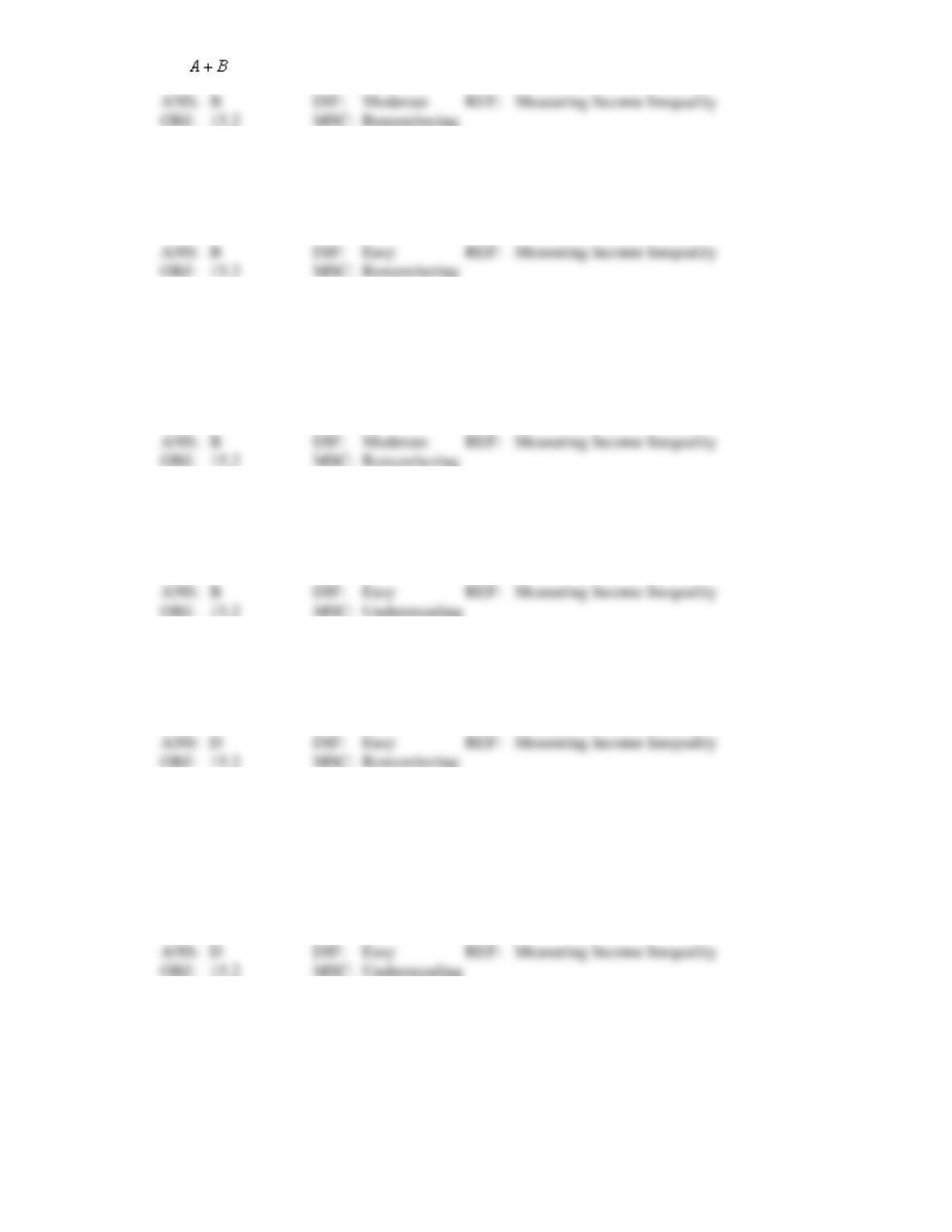
c.
130. The ________ is a visual representation of the Gini index.
a. Color-Coded Inequality Map (CCIM) d. Laffer curve
b. Lorenz curve e. OECD Poverty Diagram
c. Income Quintile Graph
131. The Lorenz curve is especially helpful for seeing how income inequality
a. varies in each country.
b. has changed over time.
c. reflects the different causational factors.
d. always decreases in developed economies.
e. can be resolved through public policy.
132. Government programs that subsidize housing or Internet access are an example of
a. underground economies. d. in-cash transfers.
b. in-kind transfers. e. income supplements.
c. disposable income.
133. ________ are transfers (mostly to the poor) in the form of goods and services instead of cash.
a. In-cash transfers d. In-kind transfers
b. Commodity transactions e. Social aid transfers
c. Government transactions
134. Beginning in 2012, Venezuela experienced a surge in prices, despite an official government
exchange rate that didn’t reflect the economic realities. As a result, many citizens went through
illegal channels in order to change the local currency, bolivars, into U.S. dollars. This behavior
describes a(n)
a. in-kind transfer. d. underground economy.
b. in-cash transfer. e. repurposed income.
c. result of corruption.
135. ________ are composed of markets in which goods or services are traded illegally.
a. Illegitimate operations
b. Underground economies
c. Government-monitored transactions
d. In-cash transfers
e. Under-the-table economies
136. Why is income inequality data unreliable in developing countries?
a. The relative lack of computers means that most forms of record keeping are impossible.
b. Less developed countries have larger underground economies than developed ones.
c. Poorly developed infrastructures mean that data systems within developing nations are not
connected to outside economic agencies via the Internet.
d. Almost all developing economies have tightly controlled borders, preventing international
economic auditors from entering the country.
e. The data maintained by the United Nations reflects only the 20 largest economies, as those are
deemed most crucial to international stability.
137. Comparing U.S. income inequality in 1980 and 2010 produces a distorted picture for all EXCEPT
which of the following reasons?
a. There have been dramatic shifts in the U.S. labor force.
b. It violates the principle of ceteris paribus.
c. A wider gap between years measured produces a more easily perceived trend in income
inequality.
d. A surge in in-kind transfers means poorer individuals have greater disposable income.
e. Changes in tax rates alter the wealth composition in the economy.
138. The terms “marginal poor” and “long–term poor” categorize differing potentials for
a. income inequality d. in-kind transfers
b. income equality e. wage discrimination
c. income mobility
139. Economic mobility reduces ________ over long periods of time.
a. income inequality d. wealth
b. wage discrimination e. occupational crowding
c. in-kind transfers
140. In the late nineteenth-century United States, sharecropping was a common occupation among
newly freed slaves and poor whites. The structure of the system left sharecroppers barely
subsisting from their production, and deeply indebted to the landowners. This economic
arrangement prevented the concept of
a. income mobility. d. human capital.
b. the life-cycle wage pattern. e. income differentials.
c. compensating differentials.

141. Which of the following best explains why younger individuals have a high level of spending fueled
by borrowing?
a. The future seems uncertain, and younger people decide to spend in the present in case later
opportunities are limited.
b. Many are college graduates who took out loans to attend school, so younger people are more
comfortable with the idea of borrowing for consumption.
c. The life-cycle wage pattern predicts income mobility for younger individuals and makes
borrowing feasible for large purchases associated with living independently for the first time.
d. Most younger individuals are irresponsible with money, so the high levels of spending and
borrowing are the product of irrational decision making.
e. Since younger individuals have the longest time until retirement, they are the least sensitive to
increases in interest rates.
142. According to government data, close to ________ percent of all households in the United States
are below the poverty threshold.
a. 5 d. 30
b. 19 e. 15
c. 35
143. What makes the Earned Income Tax Credit (EITC) different from other poverty-fighting
programs?
a. The tax credit is phased out gradually, rather than at a specific income cutoff point.
b. The amount of the credit is not determined by the number of dependent children in the
household.
c. The amount of the credit is doubled if the head of household is attending college.
d. The EITC doesn’t require the recipient to pay a minimum amount of income tax in order to
receive the credit.
e. It creates less of an incentive to work than other programs.
144. The ________ program is the largest poverty-fighting tool in the United States, affecting more
than 25 million families.
a. Temporary Assistance for Needy Families (TANF)
b. Subsidized Nutritional Assistance Program (SNAP)
c. Universal Stipend for Equality (USE)
d. Earned Income Tax Credit (EITC)
e. Supplemental Security Income (SSI)
145. ________ is/are often mistakenly viewed as an antipoverty measure.
a. Minimum wage d. Charity
b. Medicaid e. Regressive income taxes
c. In-kind transfers

146. According to the text, in the time since the passage of the Equal Opportunity Act in 1964, the
poverty rate has gone up, while economic output has roughly doubled. What is the most likely
reason for this phenomenon?
a. Skills, training, and education among the poorest citizens have been insufficient to capture
much of the benefit from economic expansion.
b. Generally, only the wealthy benefit from economic prosperity, and that period was no different
than any other.
c. Over a 50-year period, people move up and down the economic ladder, so that level of poverty
is just natural and will always exist.
d. The law had unintended consequences and proved to serve as an effective tax on the poor,
transferring wealth to the affluent and the middle class.
e. The poverty threshold, as determined by the federal government, has outpaced the rate of
economic growth.
147. Which social welfare policy is most likely to produce unemployment?
a. Subsidized Nutritional Assistance Program (SNAP)
b. Earned Income Tax Credit (EITC)
c. minimum wage
d. Medicaid
e. Supplemental Security Income (SSI)
148. The minimum wage is an ineffective antipoverty measure for all EXCEPT which of the following
reasons?
a. The wage ceiling created by minimum wage laws falls below the equilibrium price, producing
a shortage of labor.
b. The wage mandated by law often exceeds the value created by low-skill workers, resulting in a
move away from labor-intensive processes.
c. The wage floor created by minimum wage laws lies above the equilibrium price, producing a
surplus of labor.
d. Increased wages can force small businesses, who are less able to adapt to changes in costs, to
close their operations, reducing the total quantity of jobs.
e. An increase in wages may cause employees to lose working hours, resulting in a net change in
pay that is negative.
149. Why are job training programs a better tool to combat poverty than cash or in-kind transfer
programs?
a. Of the factors that lead to income inequality, training and education is the only one that
individuals have any direct control over.
b. They aren’t; job training does nothing to satisfy individual needs for survival.
c. Cash transfers force individuals to pay income taxes, and taxing the poor only perpetuates
poverty.
d. In–kind transfer programs can be abused and may fuel a person’s gambling, drug, or drinking
habit.

e. Job training leads to greater employability, and as hours worked and pay increases, the Earned
Income Tax Credit continues to grow.
150. When an act of charity creates disincentives for recipients to take care of themselves, it is often
called a(n)
a. cyclical subsistence. d. samaritan’s dilemma.
b. welfare career. e. disincentives dilemma.
c. social dilemma.
SHORT ANSWER
1. What are some of the causes of income inequality in the United States?
2. Wages are determined by a variety of factors. Describe the nonmonetary determinants of wages
and specifically how these determinants could reduce wages.
3. Does hiring more beautiful workers always reflect discrimination?
4. Gabrielle and her identical twin earn different levels of income despite having received the same
educational degrees from the same institutions. What might be the causes of this difference in
income?

5. Using the theory of compensating differentials, explain why many internships offered to college
students are often unpaid.
6. Why is it unlikely that those who place a higher priority on pay are not employed by a nonprofit
organization?
7. After an extensive interview process, Tiffany has been offered a position with her dream company.
If her goal is to maximize her annual salary, what advice emerges from compensating differential
theory in terms of how she should handle the negotiation process?
8. Why might an employer be reluctant to pay for an employee to get a master’s degree when the
knowledge could be used by that employee to work for another employer?

9. What role does bargaining power in a unionized workplace have on the wage in comparison to the
wage in a nonunionized workplace?
10. Why are unions more prevalent in the public sector than in the private sector?
11. How is it that unions capture bargaining power and convert this bargaining power into higher
wages?
12. If Kareem thinks his boss is discriminating against him based on his gender or race, what kind of
evidence would he need to collect to prove discrimination to his friend, who is an economist?
13. Has the gender gap in earnings increased or decreased over the past 40 years? What are some
explanations for the trend?
14. How does occupational crowding explain why women might earn less than men?
15. Why do major league sports teams compensate their players so much more than minor league
sports teams do, even though all the players have roughly similar skill sets?
16. Why do government officials in developing countries often try to reduce corruption?
17. Why does a high inequality ratio often indicate the presence of poverty?
18. What is a limitation when using poverty rate data to understand the extent of the poverty problem
in the United States?
19. Why do some economists believe that income inequality and poverty statistics might overstate the
income inequality problem of poverty?
20. Why is it problematic to compare the income inequality ratio over a lengthy period of time but
more valid to make such a comparison over a shorter period of time?
21. If the income inequality ratio suggests a greater inequality ratio in the country of Econoland than in
Philosophyville, why might individuals still choose to live in Econoland?

22. How does the concept of income mobility help us understand the severity of the problem of
poverty?
23. In terms of income mobility, why might Rashida be concerned about the fact that her 45-year-old
uncle earns the minimum wage at a 30-hour-per-week job in a fast-food restaurant?
24. Why does annual income inequality data create misperceptions of spending in a country with
income mobility?
25. What are some limitations in the way the U.S. Census Bureau measures the poverty threshold?
26. Over the past 40 years, the rate of poverty in the United States has actually increased. How does
this trend run counter to expectations?
27. Why has poverty been a long-term problem in the United States? What might explain why poverty
has been such a persistent problem over time? What can policy makers do to reduce poverty?
28. How do government programs affect the distribution of income in the United States?
29. Why are in-kind transfers, rather than cash, sometimes used to aid the poor?
30. What is the motivation behind a negative income tax?
31. Why is the minimum wage an ineffective means of reducing poverty?
32. Using the concept of the samaritan’s dilemma, explain why it might be advisable to place a limit
on the time that one can receive government help.
33. Briefly describe microcredit and the role it plays in a developing economy.
34. How has the samaritan’s dilemma informed the creation of the earned income tax credit? Be sure
to define the samaritan’s dilemma in your answer.