8) If the interest rate is 10%, then $1 today is worth how much one year from now?
A) $1.10
B) $1
C) 91¢
D) 90¢
9) You place $100 in a bank account that pays 8%. If you remove the interest you receive each year you
can turn your stock into a flow of
A) $108 per year.
B) $100 per year.
C) $80 per year.
D) $8 per year.
10) You can put your $100 in Bank A that pays 8% at the end of the year. You can also put your $100 in
Bank B that pays 4% at the end of six months and then 4% again at the end of the year. You will keep
your $100 and all interest in the bank. At the end of the year
A) the total will be the same at both banks.
B) the total at Bank A will be greater.
C) the total at Bank B will be greater.
D) the total could be larger at either bank.
11) You invest an amount today for four years that pays 6% annually. The bank compounds annually. At
the end of the four years you will have $150. What amount must you invest today?
A) $148.81
B) $138.81
C) $128.81
D) $118.81
12) Four banks are offering the same interest rate of 4%. Where do you invest?
A) Bank A compounds interest on a yearly basis.
B) Bank B compounds interest on a monthly basis.
C) Bank C compounds interest on a daily basis.
D) I am indifferent between banks.
13) As the interest rate rises, the present value of a given perpetual stream of income
A) increases.
B) decreases.
C) does not change.
D) approaches infinity.
14) As the interest rate increases, the present value of a future payment
A) increases.
B) decreases.
C) does not change.
D) approaches infinity.
15) A firm should make an investment if the expected return is greater than
A) the marginal cost of the investment.
B) the fixed cost of the investment.
C) the opportunity cost of the investment.
D) the expected rate of inflation.
16) The Net Present Value approach to investment results in an investment being undertaken only if
A) its net present value is positive.
B) its net present value is zero.
C) it has positive cash flow.
D) its internal rate of return equals the rate of interest.
17) Suppose a new cost-saving device will generate $1,000 net savings per year to a firm. The device costs
$10,000. Should the firm purchase the device?
A) definitely
B) absolutely not
C) The firm is indifferent between buying the device and not.
D) More information is required to answer.
18) Suppose a new cost-saving device will forever generate $1,000 net savings per year to a firm. The
device costs $10,000. Using the Internal Rate of Return approach, will the firm make the investment?
A) definitely
B) definitely not
C) if the interest rate exceeds 10%
D) if the interest rate is less than 10%
19) In using the Internal Rate of Return approach, one must first calculate the discount rate on the
investment that makes
A) the net present value equal zero.
B) the interest rate equal zero.
C) the interest rate equal the discount rate.
D) the first year’s return positive.
20) Using the Internal Rate of Return approach to investment, one would undertake an investment if the
internal rate of return
A) equals zero.
B) equals the interest rate.
C) exceeds the interest rate.
D) is less than the interest rate.
21) To calculate the internal rate of return on a factory that would yield a perpetual future stream of
income, one would divide
A) the annual future payment by the cost of the factory.
B) the sum of the future payments by the cost of the factory.
C) the cost of the factory by the rate of interest.
D) the cost of the factory by the annual future payment.
22) A bond issuer agrees to pay a stated nominal amount each year. An increase in the nominal interest
rate will cause
A) the price of the bond to fall.
B) the price of the bond to rise.
C) the nominal value of the bond’s coupon to rise.
D) the nominal value of the bond’s coupon to fall.
23) If a bond’s coupon adjusts to pay a constant real rate of return, then an increase in inflation would
cause
A) the nominal coupon payment to rise.
B) the nominal coupon payment to fall.
C) the nominal coupon payment to remain unchanged.
D) the bond’s price to fluctuate wildly.
24) If a firm needs one machine to produce a product, and must replace the machine when it wears out,
then the firm should pick a durability level of the machine that
A) minimizes the expense today.
B) minimizes the present discounted cost of having the machine forever.
C) maximizes the future value of the machine.
D) minimizes the future value of the machine.
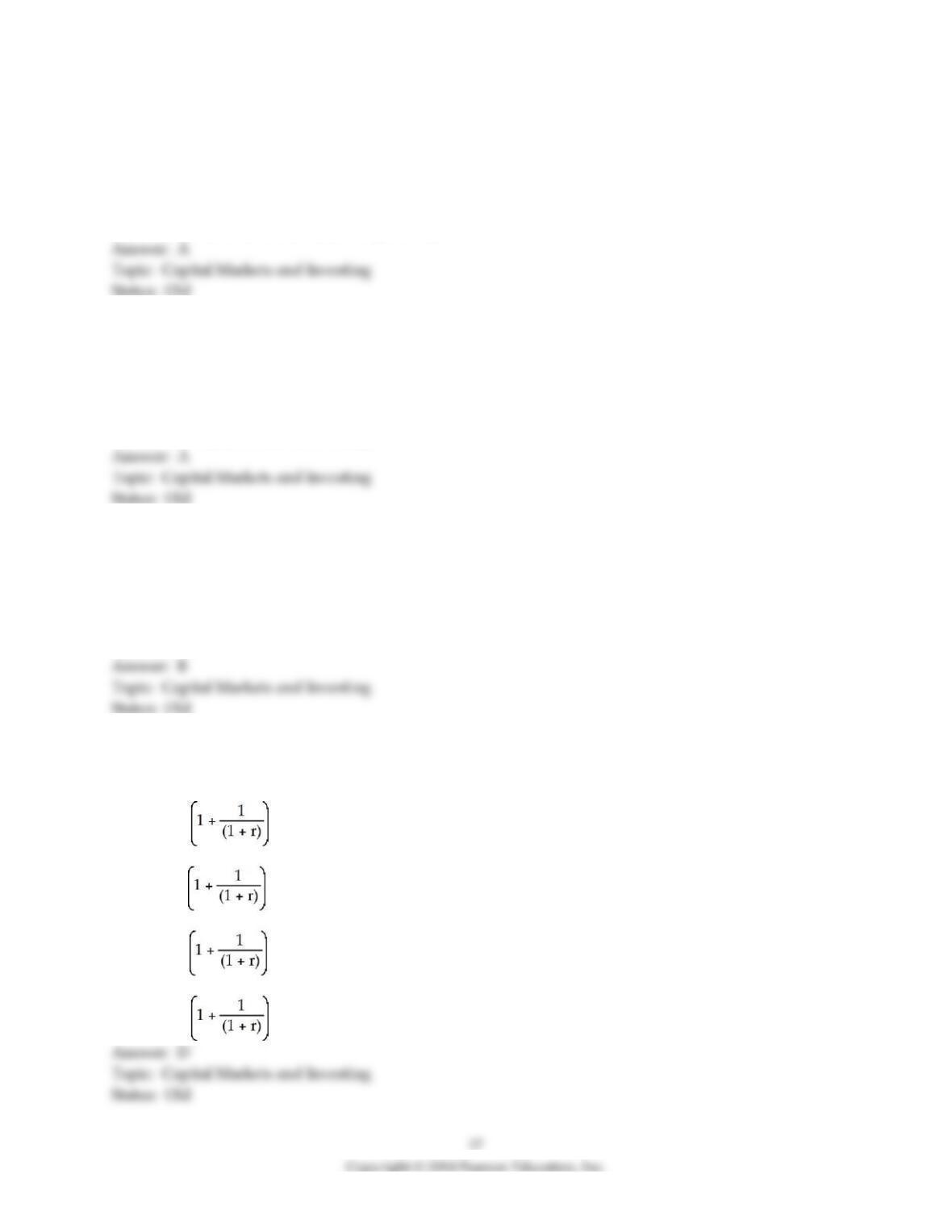
25) At age 40, Joe is considering quitting his job and going back for a college degree. He needs two more
years full-time. Tuition is $10,000 per year. He earns $30,000 per year. A college degree would raise his
annual income by $10,000 per year. He will retire at age 70. His cost of going back to college is
A) 10,000 × .
B) 20,000 × .
C) 30,000 × .
D) 40,000 × .
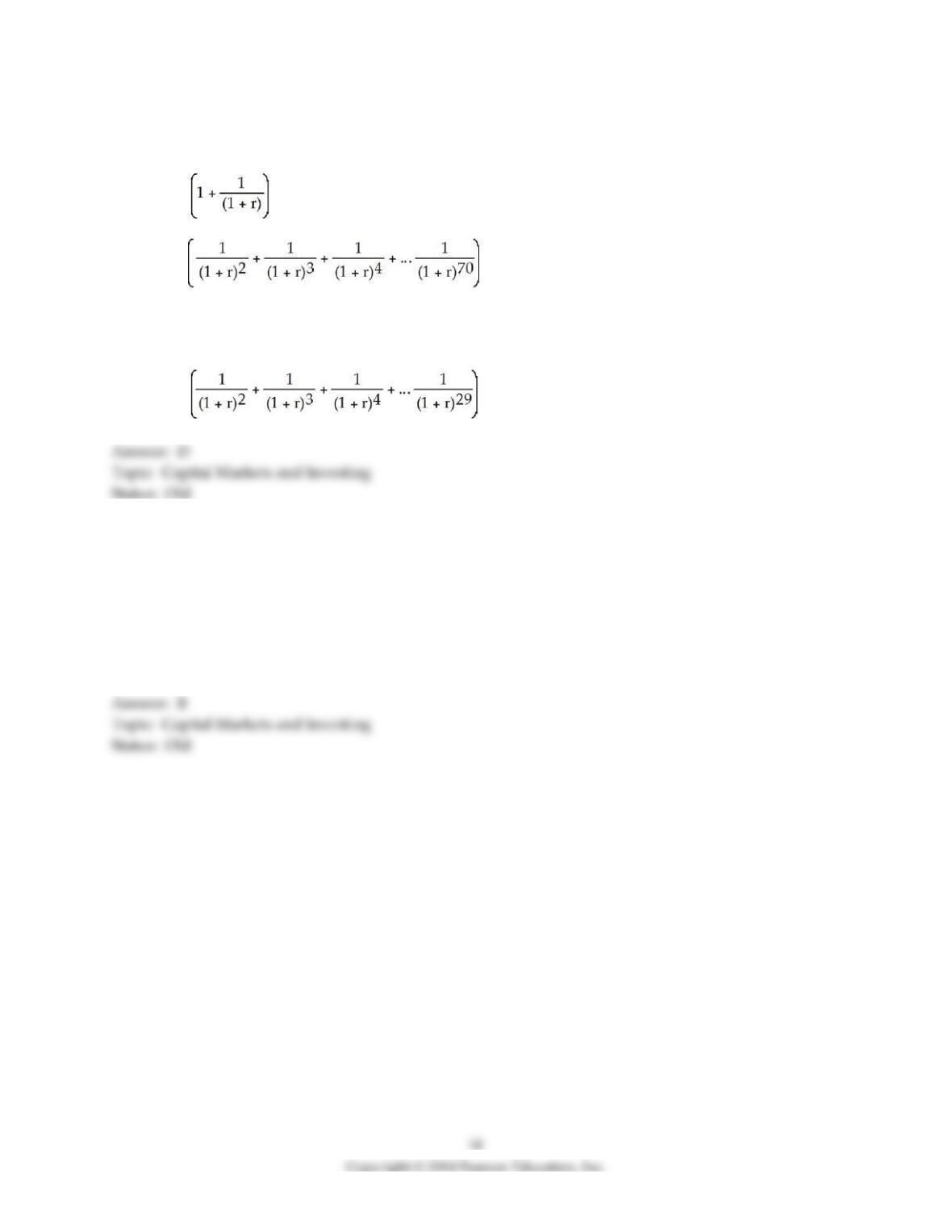
26) At age 40, Joe is considering quitting his job and going back for a college degree. He needs two more
years full-time. Tuition is $10,000 per year. He earns $30,000 per year. A college degree would raise his
annual income by $10,000 per year. He will retire at age 70. His benefit of a degree would be
A) 10,000 × .
B) 10,000 × .
C) 10,000/r.
D) 10,000 × .
27) At age 40, Joe is considering quitting his job and going back for a college degree. He needs two more
years full-time. Tuition is $10,000 per year. He earns $30,000 per year. A college degree would raise his
annual income by $10,000 per year. He will retire at age 70. If these are real amounts (adjusted for
inflation), then the discount rate to be used should be
A) the nominal rate of interest.
B) the real rate of interest.
C) the rate of inflation.
D) zero.
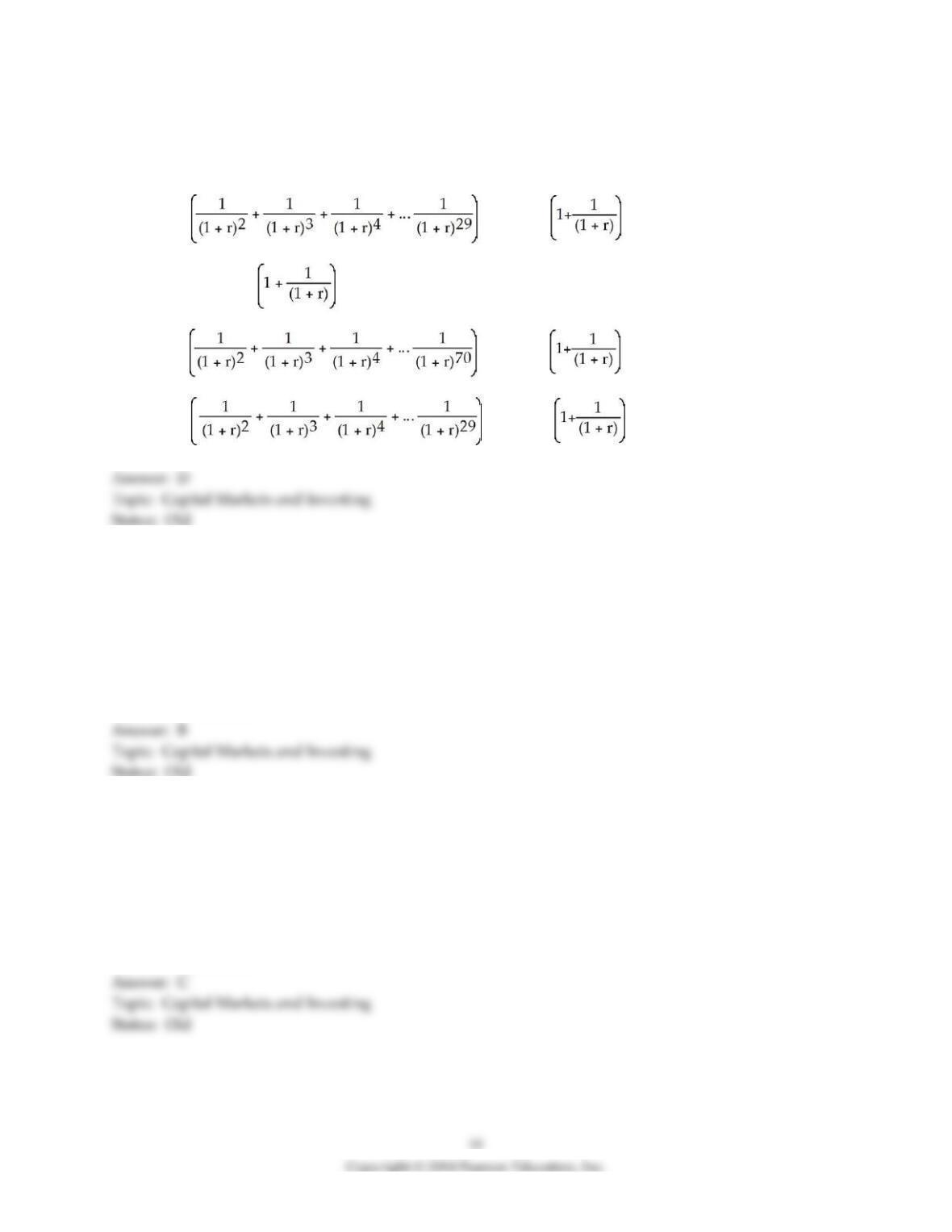
28) At age 40, Joe is considering quitting his job and going back for a college degree. He needs two more
years full-time. Tuition is $10,000 per year. He earns $30,000 per year. A college degree would raise his
annual income by $10,000 per year. He will retire at age 70. From an investment standpoint, Joe will go
back full-time if
A) 10,000 × = 40,000 × .
B) 10,000/r > 10,000 × .
C) 10,000 × > 40,000 × .
D) 10,000 × > 40,000 × .
29) At age 40, Joe is considering quitting his job and going back for a college degree. He needs two more
years full-time. Tuition is $10,000 per year. He earns $30,000 per year. A college degree would raise his
annual income by $10,000 per year. He will retire at age 70. Which of the following makes it more likely
that Joe will decide to go back to college full-time?
A) The rate of interest increases.
B) The rate of interest decreases.
C) The government enacts mandatory retirement at age 60.
D) Tuition increases.
30) At age 40, Joe is considering quitting his job and going back for a college degree. He needs two more
years full-time. Tuition is $10,000 per year. He earns $30,000 per year. A college degree would raise his
annual income by $10,000 per year. He will retire at age 70. Which of the following makes it less likely
that Joe will decide to go back to college full-time?
A) The extra income due to a college degree rises.
B) The rate of interest decreases.
C) The government enacts mandatory retirement at age 60.
D) Tuition decreases.
31) The real internal rate of return on a college education is about
A) 0%.
B) 2.5%.
C) 6.9%.
D) 15%.
32) Today John says, “I will start working out tomorrow.” Yet as tomorrow arrives, he doesn’t. This is an
example of
A) time inconsistent preferences.
B) time consistent preferences.
C) exponential discounting.
D) future-biased preferences.
33) With respect to events like global warming, some economists suggest using falling discount rates
because
A) exponential discounting virtually gives no weight to (large) costs incurred far into the future.
B) exponential discounting weights (large) costs incurred far into the future heavily.
C) events far in the future do not affect us.
D) we should not care about costs far in the future.
34) One explanation that behavioral economists give for procrastination and other time-inconsistent
behavior is
A) people’s personal discount rate is greater in the far future than in the near future.
B) people’s personal discount rate is smaller in the far future than in the near future.
C) people’s personal discount rate is the same in the far future as in the near future.
D) None of the above.
35) If the government wants to borrow money to build new highways; then the
A) interest rate will be higher.
B) quantity of funds available in the market will increase.
C) private investment will decrease.
D) All of the above.
For the following, please answer “True” or “False” and explain why.
36) Suppose $100 is deposited in a bank account paying 5% compounded annually. If the interest earned
is X after five years, then the interest earned will be 2X after 10 years.
37) If the interest rate is positive, the future value of an interest bearing investment is always larger than
the present value.
38) Interest rates are positive because inflation makes purchases more expensive in the future than today.
39) A recent purchaser of a bond that agrees to pay an annual nominal amount would hope that interest
rates do not rise.
40) An investment is profitable as long as its internal rate of return is equal to the rate of interest.
41) Jerry wishes to retire in five years with $1 million in his bank account. If the account pays 4% and his
current balance is $500,000, how much must he deposit at the beginning of each of the next five years for
his wish to come true? The amount must be the same each year.
42) In an economy with no inflation, explain why interest rates are positive.
43) A state lottery has a Million Dollar Lottery game that pays $1,000 a week for life. Assuming a 6%
nominal rate of interest and generously assuming an infinite lifetime, can this game be called a “Million
Dollar Lottery”?
44) A major corporation hires high school students on a part-time basis. It offers a reward of $5,000 to any
of its high school seniors who graduate college in four years. What is the present value of that reward to a
student who just finished her junior year of high school, assuming a nominal rate of interest of 8%?
45) Explain why a firm may rationally make an investment when its cash flow from the investment is not
positive each year.
46) Suppose that your college offers you two payment plans. You may either pay tuition of $10,000 per
year at the beginning of each of the next four years, or pay just $38,000 before the start of freshman year.
If the interest rate is 10%, what would you do? If the interest rate were 2%, what would you do?
Intuitively explain the difference in your answer.
47) Suppose that your college offers you two payment plans for your last two years of college. You may
either pay tuition of $20,000 per year at the beginning of each of the next two years, or pay just $38,000
before the start of freshman year. What would the interest rate have to be for you to be indifferent
between these two deals? Explain.
48) A financial services company offers to pay you $1,000 a year for life in exchange for $20,000 today.
What factors affect your decision to take this offer?
49) What is the internal rate of return on a new $2,000 heater that would reduce your heating costs by
$200 a year forever? Under what conditions would you make the purchase?
50) You grow poplar trees. The lumber yard purchases cut trees from you. The trees grow 1 foot per year.
Assuming a constant real price per foot for poplar and a real interest rate of 3%, would you sell a 20-foot
tree today?
15.3 Exhaustible Resources
1) If an exhaustible resource is scarce, has constant marginal cost over time, and is sold in a competitive
market, then
A) its price increases over time.
B) its price will not be a function of the interest rate.
C) its price moves independently of past prices.
D) its price equals marginal cost.
2) If an exhaustible resource is priced at marginal cost that remains constant over time, then
A) all owners of that resource earn rent.
B) the price will stay constant over time.
C) the percent price increase each year equals the rate of interest.
D) the good is relatively scarce.
3) An exhaustible resource with a very large known reserve will most likely exhibit
A) a highly variable price in the near future.
B) a decreasing price in the near future.
C) an increasing price in the near future.
D) a constant price in the near future.
4) If a non-renewable resource is scarce, has constant marginal cost of production, and is sold in a
competitive market,
A) its price will increase over time.
B) its price will exceed marginal cost.
C) its price will increase by the rate of interest.
D) All of the above.
5) In reality, according to the model developed in Section 15.5 of the textbook, prices of non-renewable
resources have not increased continually because of
A) abundance of the resource.
B) technological Progress changing marginal cost.
C) changing market power of producers.
D) All of the above.
6) Suppose an exhaustible resource can be sold only this period or next period. The resource owner is
considering selling 100 tons of the resource this period. The future value of the resource when 100 tons
are sold this period is less than the present value of the 100 tons sold this period multiplied by one plus
the interest rate. What should the resource owner do?
A) She should sell more than 100 tons this period.
B) She should sell only 100 tons this period.
C) She should sell less than 100 tons this period.
D) She should not sell any of the resource in either period.
7) Technological improvements in coal mining will
A) increase the price of coal.
B) decrease the price of coal.
C) increase the interest rate.
D) decrease the interest rate.
8) The growth over time in the spread between price and marginal cost of an exhaustible resource is equal
to
A) zero.
B) one.
C) the interest rate.
D) the present value of the reserves.
9) The spread between price and marginal cost of an exhaustible resource must grow by the rate of
interest so that
A) resource owners earn a profit.
B) resource owners are willing to sell some of the resource in the future.
C) the price of the resource remains constant in real terms.
D) the marginal cost of extracting the resource declines.
For the following, please answer “True” or “False” and explain why.
10) As in all other competitive markets price equals marginal cost in a market for a scarce, non-renewable
resource that is traded in a competitive market.
11) Why is the price of a scarce exhaustible resource in a competitive market above the marginal cost of
providing a unit of the resource?
12) Explain how continuing technical progress may cause the price of scarce, exhaustible resources to fall
over time.
13) Suppose coal sells for $50 per ton and can be mined at a constant marginal cost of $20 per ton.
Forecasters predict that the price of coal next year will be $55. If your marginal cost next year will still be
$20 and the interest rate is 10%, do you sell coal today?