Microeconomics, 12e (Parkin)
Chapter 15 Oligopoly
1 What Is Oligopoly?
1) An oligopoly is a market structure in which there are
A) only a few buyers but many sellers.
B) only a few sellers selling either an identical or differentiated product.
C) many sellers selling a differentiated product.
D) a few products sold by many sellers.
2) Which of the following is a distinguishing characteristic of oligopoly?
A) A small number of firms compete.
B) No one firm’s actions directly affect the actions of the other firms.
C) Firms are free to enter and exit the industry.
D) Natural barriers cannot prevent the entry of new firms.
3) When only a small number of producers compete with each other is a defining characteristic
of
A) inelastic supply.
B) monopolistic competition.
C) efficient competition.
D) oligopoly.
4) In oligopolistic markets
A) there are many firms.
B) there are no barriers to entry.
C) there are only a few firms.
D) all firms are price takers.
5) A market structure in which a small number of firms compete is called ________.
A) a monopoly
B) a small-number market
C) an oligopoly
D) monopolistic competition
6) The key feature of an oligopoly is that there
A) are many buyers and sellers.
B) is one seller.
C) exists product differentiation.
D) are only a few sellers.
7) In an oligopoly
A) there are only a few firms.
B) there is no product differentiation.
C) there is free entry and exit.
D) firms’ decisions are unrelated to each other.
8) A market structure in which a small number of producers compete against each other is
A) monopolistic competition.
B) oligopoly.
C) monopoly.
D) perfect competition.
9) If firms in an industry differentiated their products and made economic profits in the short-
run, what other characteristic would be important to determine if this is an oligopoly or a
monopolistically competitive market?
A) the number of firms in the market
B) the number of close substitutes for the good being produced
C) the number of buyers in the market
D) if the good being sold is a normal or inferior good
10) The distinguishing features of oligopoly are ________ and a ________ in the industry.
A) barriers to entry; large number of firms
B) no barriers to entry; few firms
C) barriers to entry; few firms
D) no barriers to entry; large number of firms
11) Oligopoly is
A) like monopoly because there are barriers to entry.
B) like perfect competition because oligopoly firms all sell homogeneous goods.
C) like monopolistic competition because oligopoly firms all sell differentiated goods.
D) like perfect competition because there are many firms in the industry.
12) Which of the following is a distinguishing characteristic of oligopoly?
A) A large number of firms compete.
B) No one firm’s actions directly affect the actions of the other firms.
C) Firms are free to enter and exit the industry.
D) Natural or legal barriers prevent the entry of new firms.
13) Which of the following is a defining characteristic of oligopoly?
A) barriers to entry
B) selling a homogeneous good
C) selling a differentiated good
D) collusion
14) Natural oligopoly is a situation where
A) the level of demand can support only a few firms.
B) there is only one firm.
C) there are only two firms.
D) there are legal barriers to entry.
15) A natural oligopoly can form
A) if there are economies of scale.
B) only if firms sell a differentiated good.
C) only if firms sell a homogeneous good.
D) if there is only one firm in the industry.
16) In a small town the level of demand is capable of supporting only two gas stations. This
market is
A) a natural duopoly.
B) perfectly competitive because a homogeneous good is being sold.
C) operating as if it was a monopoly.
D) an example of monopolistic competition.
17) Suppose that all pizza companies have the same costs and the minimum average total cost is
$12 per pizza. The pizza companies have an efficient scale of 100 pies per night. In the small
town of Coatsville, at the price of $12 per pizza the quantity demanded is approximately 300
pizzas per night. This market, therefore, can best be characterized as
A) perfectly competitive.
B) a natural monopoly.
C) a natural duopoly.
D) a natural oligopoly.
18) One difference between oligopoly and monopolistic competition is that
A) a monopolistically competitive industry has fewer firms.
B) in monopolistic competition, the products are identical.
C) monopolistic competition has barriers to entry.
D) fewer firms compete in oligopoly than in monopolistic competition.
19) Which of the following is a distinguishing characteristic of oligopoly?
A) A large number of firms compete.
B) Each firm’s actions influence the profits of all the other firms.
C) Firms are free to enter and exit the industry.
D) Natural barriers cannot prevent the entry of new firms.
20) Consider a market in which each firm must predict the price and quantity decisions of other
firms, as well as how those price and quantity decisions will affect the first firm’s revenue and
profit. This market is best described as
A) an oligopoly.
B) monopolistic competition.
C) a monopoly.
D) perfect competition.

21) In ________ market structure, a firm’s output depends ________.
A) an oligopoly; only on its own marginal revenue and marginal cost curves
B) a monopolistically competitive; in part on its competitors’ price and quantity decisions
C) an oligopoly; in part on its competitors’ price and quantity decisions
D) a monopolistically competitive; only on its marginal revenue curve
22) If firms in an industry make output decisions that are partially based on the price and output
decisions of their competitors, then these firms are in ________ market have ________ with the
other firms in the market.
A) an oligopoly; interdependence
B) an oligopoly; no interdependence
C) an oligopoly or monopolistically competitive; interdependence
D) a monopolistically competitive; no interdependence
23) The small town of Narberth has two pizza stores. Which of the following statements are
CORRECT?
I. The profits of each store depend on the price of the pizza at the other store.
II. Both stores would increase their profit if they cooperated in setting their prices.
A) I only
B) II only
C) Both I and II
D) Neither I nor II
24) Of the following market structures, which has the fewest number of firms competing against
each other?
A) monopolistic competition
B) oligopoly
C) perfect competition
D) Both answers A and C are correct.
25) A duopoly occurs when ________.
A) there are only two producers of a particular good competing in the same market
B) there are two producers of two goods competing in an oligopoly market
C) there are numerous producers of two goods competing in a competitive market
D) the one producer of two goods sells the goods in a monopoly market
26) A duopoly is a form of
A) perfect competition.
B) monopolistic competition.
C) oligopoly.
D) monopoly.
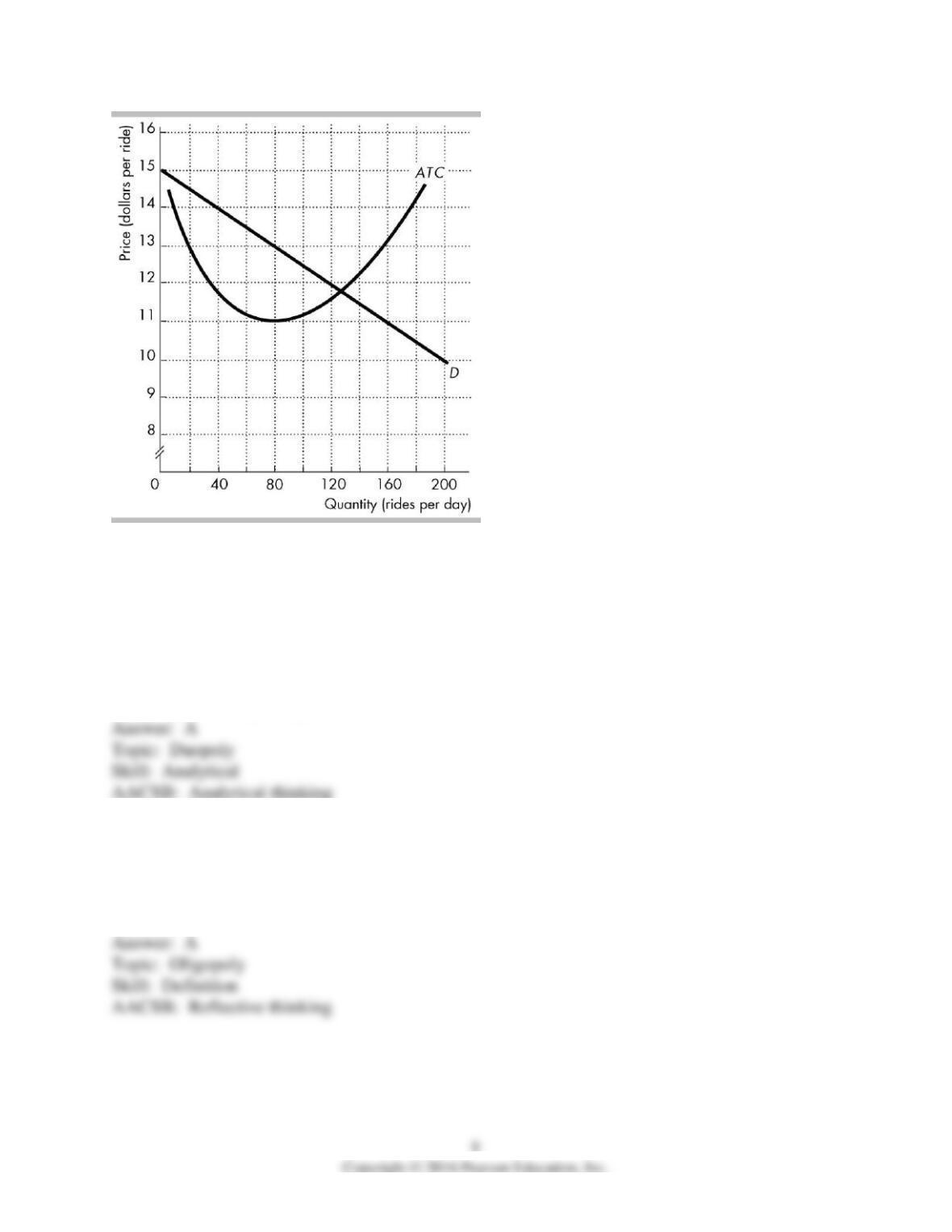
In the figure, D is the demand curve for taxi rides in a town, and ATC is the average total cost
curve of a taxi company.
27) In the scenario above, the market is
A) a natural duopoly.
B) a natural oligopoly with three firms.
C) a natural monopoly.
D) monopolistically competitive.
28) In an oligopoly market, the Herfindahl-Hirschman Index is usually
A) greater than 2,500.
B) below 1,000.
C) between 100 and 1,000.
D) between 200 and 2,000.
29) An market in which the Herfindahl-Hirschman Index (HHI) is 2,500 is considered to be
A) an oligopoly.
B) monopolistically competitive.
C) a monopoly.
D) perfectly competitive.
30) In the market for batteries, the three largest firms earn 90% of the total revenue and there are
35 firms in the industry. This industry is best described as
A) oligopoly.
B) monopoly.
C) monopolistic competition.
D) perfect competition.
31) Of the following, the best example of oligopoly is
A) wheat farming.
B) the restaurant industry.
C) the cigarette industry.
D) the clothing industry.
32) When producers agree to restrict output, raise the price, and increase profits, the agreement is
called ________.
A) a pricing agreement
B) an oligopoly agreement
C) a collusive agreement
D) a monopoly agreement
33) ________ is a group of firms that have colluded to limit their output and raise their price.
A) A cartel
B) An oligopoly
C) A strategy
D) A duopoly
34) Which of the following is characteristic of oligopoly, but NOT of monopolistic competition?
A) The choices made by one firm have a significant effect on other firms.
B) Each firm faces a downward-sloping demand curve.
C) Firms are profit-maximizers.
D) There is more than one firm in the industry.
35) A monopolistically competitive firm is like an oligopolistic firm insofar as
A) both face perfectly elastic demand.
B) both can earn an economic profit in the long run.
C) both have MR curves that lie beneath their demand curves.
D) neither is protected by high barriers to entry.
2 Oligopoly Games
1) Game theory is most useful for analyzing
A) perfect competition.
B) monopolistic competition.
C) oligopoly.
D) monopoly.
2) Game theory can be used for studying which of the following types of market structure?
A) monopoly
B) monopolistic competition
C) oligopoly
D) perfect competition
3) Game theory is most useful for determining the outcome when ________.
A) the market structure is oligopoly
B) monopolistic competition exists
C) prison terms are involved
D) the market is dominated by a monopoly
4) Game theory is used to explain firms’ decisions in
A) a monopoly.
B) an oligopoly.
C) a perfectly competitive market.
D) a monopolistically competitive market.
5) Game theory is applicable to oligopoly behavior because oligopolists
A) use strategic behavior.
B) ignore rival firms.
C) are price takers.
D) can only be profitable if they collude.
6) Game theory is distinctive in that its elements are
A) costs, prices, and profits.
B) revenues, elasticity, and profits.
C) rules, strategies, payoffs, and outcomes.
D) patents, copyrights, and barriers to entry.
7) Which group of features is shared by all games?
A) rules, strategies, payoffs, outcome
B) rules, profit, payoffs, outcome
C) profit, strategies, payoffs, cheating
D) rules, cheating, payoffs, outcome
8) Game theory is a tool for studying ________.
A) Nash behavior
B) payoff dilemmas
C) rational dilemmas
D) strategic behavior
9) In game theory, strategies include ________.
A) all possible actions of each player
B) only the winning action of each player
C) all possible actions and payoffs of each player
D) the payoff matrix
10) The prisoners’ dilemma describes a single-play game that features
A) an outcome in which the participants collude.
B) a large number of rivals cooperating with each other.
C) a situation in which one player has better odds than the other.
D) two players who are unable to communicate with each other.
11) The simplest prisoners’ dilemma is a game that, in part, requires
A) two players who are able to communicate with each other.
B) two players who are unable to communicate with each other.
C) monopolistic competition.
D) an oligopoly with one very large firm.
12) In the prisoners’ dilemma game, each player
A) has only one possible strategy.
B) can choose from two strategies.
C) can choose from three strategies.
D) can choose from four strategies.
13) In a prisoner’s dilemma game, each person will pick
A) their best outcome given what the other person will do.
B) their best outcome.
C) their worse outcome.
D) their best outcome after consulting with the other person.
14) In the prisoners’ dilemma game, when each player takes the best possible action given the
action of the other player, ________.
A) a competitive equilibrium is reached
B) one player denies and one player confesses
C) both players deny
D) a Nash equilibrium is reached
15) The outcome of a prisoners’ dilemma game with a Nash equilibrium is that ________.
A) both players deny
B) one player denies and one player confesses
C) both players confess
D) there is no equilibrium
16) In a prisoner’s dilemma, the Nash equilibrium occurs where
A) neither person ends up with their best outcome.
B) both end up with their best outcome.
C) only one ends up with his best outcome.
D) the one who goes first ends up with his best outcome.
17) The prisoners’ dilemma has an equilibrium in which
A) both players deny.
B) both players confess.
C) the player who confesses wins.
D) the player who denies wins.
18) In a prisoners’ dilemma game, which of the following strategies gives the best outcome for
both prisoners?
A) Both deny (collusion).
B) Both confess (not collude).
C) One confesses while the other denies.
D) none of the above
19) In a prisoners’ dilemma game, in the Nash equilibrium
A) both players have another outcome that does not occur but is more favorable.
B) neither player has another outcome that does not occur and is more favorable.
C) one player has another outcome that does not occur and is more favorable.
D) collusion would not alter the outcome.
20) The prisoners’ dilemma has an equilibrium that is
A) a Nash equilibrium and both players confess.
B) not a Nash equilibrium and both players confess.
C) a Nash equilibrium and both players deny.
D) not a Nash equilibrium and both players deny.
21) Ann and Lynn have been arrested by the police, who have evidence that will convict them of
robbing a bank. If convicted, each will receive a sentence of 6 years for the robbery. During
questioning, the police suspect that Ann and Lynn are responsible for a series of bank robberies.
If both confess to the series, each will receive 12 years in jail. If only one confesses, she will
receive 4 years and the one who does not confess will receive 14 years. What is the equilibrium
for this game?
A) Both confess.
B) Ann confesses and Lynn does not confess.
C) Lynn confesses and Ann does not confess.
D) Neither confess.

22) Consider the prisoner’s dilemma model where two criminals have two options (confess or
deny), and each criminal must make their decision without speaking to the other criminal first. If
they both confess they each get 3 years, if only one confesses then he gets 1 and his partner gets
10, and if neither confesses then they each get 0. They are in fact both guilty. In this game, the
Nash equilibrium is where
A) both confess.
B) neither one confesses.
C) only one will confess.
D) It is impossible to say.
Bob
Confess
Don’t
Confess
Confess
B: 10 years
J: 10 years
B: 20 years
J: 1 year
Joe
Don’t
Confess
B: 1 year
J: 20 years
B: 2 years
J: 2 years
23) The table above displays the possible outcomes for Bob and Joe, who have been arrested for
armed robbery and car theft. Which of the following is TRUE?
A) If Joe confesses, Bob should not confess.
B) If Bob confesses, Joe should confess.
C) The dominant equilibrium is that Joe and Bob both serve 2 years.
D) If Joe does not confess, Bob should not confess.
Player A
Confess
Don’t confess
Confess
A: 3 years
B: 3 years
A: 10 years
B: 1 year
Player B
Don’t
confess
A: 1 year
B: 10 years
A: 2 years
B: 2 years
24) The table above shows the payoff matrix for a prisoners’ dilemma game. The Nash
equilibrium is that
A) both prisoners do not confess.
B) both prisoners confess.
C) prisoner A confesses while prisoner B does not confess.
D) prisoner A does not confess while prisoner B confesses.
25) The table above shows the payoff matrix for a prisoners’ dilemma. In the Nash equilibrium
A) both prisoners get 3 years in jail.
B) both prisoners get 2 years in jail.
C) both prisoners get 1 year in jail.
D) both prisoners get 10 years in jail.
26) The problem for the prisoners in the prisoners’ dilemma game in the above table is that
A) the Nash equilibrium is not the best outcome.
B) there is no equilibrium outcome.
C) neither prisoner has a workable strategy.
D) None of the above answers is correct.

Firm 1
Sell
Give away
Sell
1: $3
2: $3
1: $4
2: -$1
Firm 2
Give away
1: -$1
2: $4
1: $2
2: $2
27) Two software firms have developed an identical new software application. They are debating
whether to give the new app away free and then sell add-ons or sell the application at $30 a copy.
The payoff matrix is above and the payoffs are profits in millions of dollars. What is Firm 1’s
best strategy?
A) Give away the application regardless of what Firm 2 does.
B) Sell the application at $30 a copy regardless of what Firm 2 does.
C) Give away the application only if Firm 2 sells the application.
D) Give away the application only if Firm 2 gives away the application.
28) Two software firms have developed an identical new software application. They are debating
whether to give the new app away free and then sell add-ons or sell the application at $30 a copy.
The payoff matrix is above and the payoffs are profits in millions of dollars. What is the Nash
equilibrium of the game?
A) Both Firm 1 and 2 will sell the software application at $30 a copy.
B) Both Firm 1 and 2 will give the software application away free.
C) Firm 1 will give the application away free and Firm 2 will sell it at $30.
D) There is no Nash equilibrium to this game.
Jane
Advertise
Don’t
advertise
Advertise
J: $6,000
B: $10,000
J: $3,000
B: $20,000
Bob
Don’t
advertise
J: $12,000
B: $5,000
J $10,000
B: $15,000
29) The payoff matrix of economic profits above displays the possible outcomes for Bob and
Jane who are involved in game of whether or not to advertise. After each player chooses his or
her best strategy and sees the result
A) only Bob would like to change his decision.
B) neither player would be willing to change his or her decision unless the other player also
changes his or her decision.
C) if Jane does not change her decision, Bob would like to change his.
D) if Bob does not change his decision, Jane would like to change hers.
Firm A
R&D
No R&D
R & D
A: $25
B: $15
A: -$3
B: $60
Firm
B
No R&D
A: $60
B: -$3
A: $50
B: $35
30) Firms A and B can conduct research and development (R&D) or not conduct it. R&D is
costly but can increase the quality of the product and increase sales. The payoff matrix is the
economic profits of the two firms and is given above, where the numbers are millions of dollars.
A’s best strategy is to
A) conduct R&D regardless of what B does.
B) not conduct R&D regardless of what B does.
C) conduct R&D only if B conducts R&D.
D) conduct R&D only if B does not conduction R&D.

31) Firms A and B can conduct research and development (R&D) or not conduct it. R&D is
costly but can increase the quality of the product and increase sales. The payoff matrix is the
economic profits of the two firms and is given above, where the numbers are millions of dollars.
The Nash equilibrium occurs when
A) both A and B conduct R&D.
B) only A conducts R&D.
C) only B conducts R&D.
D) neither A nor B conduct R&D.
Disney
Thanksgiving
release
Christmas
release
Thanksgiving
release
D: $100
F: $80
D: $105
F: $95
Fox
Christmas
release
D: $110
F: $100
D: $95
F: $85
32) Disney and Fox must decide when to release their next films. The revenues received by each
studio depend in part on when the other studio releases its film. Each studio can release its film
at Thanksgiving or at Christmas. The revenues received by each studio, in millions of dollars, are
depicted in the payoff matrix above. Which of the following statements CORRECTLY describes
Fox’s strategy given what Disney’s release choice may be?
A) If Disney chooses a Thanksgiving release, Fox should choose a Christmas release.
B) If Disney chooses a Christmas release, Fox should choose a Thanksgiving release.
C) Fox should release on Christmas regardless of what Disney does.
D) Both answers A and B are correct.