Chapter 15: Principal–Agent Issues and Managerial Compensation
MULTIPLE CHOICE
1. The principal–agent problem occurs as a result of:
a.
the absence of a contract between managers and owners.
b.
the separation of ownership from management.
c.
the difficulty of identifying the principal agent with whom to negotiate.
d.
competition between managers at various levels.
e.
none of the above.
2. Donald has a beach house on the Outer Banks of North Carolina that was severely damaged in the
most recent hurricane to strike the coast. Due to beach erosion, he has rebuilt twice in the past 20
years. He is intent on rebuilding, confident that government-provided flood insurance will cover his
expenses. This is an example of:
a.
how market-based solutions to problems are superior to government solutions.
b.
moral hazard.
c.
adverse selection.
d.
asset substitution.
e.
none of the above.
3. Principal–agent problems can exist between:
a.
workers and managers.
b.
workers and owners.
c.
workers and customers.
d.
owners and customers.
e.
all the above.
4. Suppose that Wilma’s utility function is given by
U(E) = 100 – 2E2,
where E = Wilma’s work effort in producing homemade dinners, measured in hours per day. If Wilma
is forced to work an 8-hour day producing homemade dinners, her total utility will be:
a.
100.
b.
–28.
c.
–128.
d.
228.
e.
none of the above.
5. Use the following profit function (per worker) for the Blue Delta Faucet Company to answer this
question. P(e) = 40e – (2e2 + 100)
Note that P = firm profits and e = worker-hours per day. Assume that effort is observed perfectly. At
this profit-maximizing level of effort for the firm, profits per worker will be:
a.
$40.
b.
$100.
c.
$300.
d.
$400.
e.
none of the above.
6. Use the following profit function (per worker) for the Blue Delta Faucet Company to answer this
question. P(e) = 40e – (2e2 + 100)
Note that P = firm profits and e = worker-hours per day. Assume that effort is observed perfectly. At
the profit-maximizing level of effort for the firm, daily per-worker compensation will be:
a.
$100.
b.
$200.
c.
$300.
d.
$340.
e.
none of the above.
7. Suppose that Wilma’s utility function is given by
U(E) = 100 – 2E2,
where E = Wilma’s work effort in producing homemade dinners, measured in hours per day. The
marginal utility of effort for Wilma is:
a.
2E2.
b.
–2E.
c.
100.
d.
–4E.
e.
none of the above.
8. Use the following profit function (per worker) for the Blue Delta Faucet Company to answer this
question. P(e) = 40e – (2e2 + 100)
Note that P = firm profits and e = worker-hours per day. Assume that effort is observed perfectly.
What is the profit-maximizing level of effort for the firm to set for workers?
a.
There is no effort level that maximizes profits in this case.
b.
3.16 hours per day.
c.
8 hours per day.
d.
10 hours per day.
e.
12 hours per day.
9. Suppose that Wilma’s utility function is given by
U(E) = 100 – 2E2,
where E = Wilma’s work effort in producing homemade dinners, measured in hours per day. Given her
utility function, Wilma has an incentive to supply:
a.
maximum effort, because working hard is important to her.
b.
maximum effort, because she is afraid of getting fired.
c.
minimum effort, because she knows she will get fired under any circumstances.
d.
minimum effort, because her utility decreases as effort increases.
e.
maximum effort, because she can increase her salary by working harder.
10. If effort is unobservable and revenues are riskless, firms can design incentive-compatible
compensation schemes by offering workers:
a.
profit shares.
b.
increased nonmonetary benefits.
c.
increased fixed salary.
d.
decreased effort requirements.
e.
increased future compensation in the form of retirement pay.
11. Incentive-compatible employment contracts exist when:
a.
the firm and workers have the same objective.
b.
owners and managers have the same level of income.
c.
incentives of owners and managers are compatible with, though not necessarily the same
as, one another.
d.
owners and managers have the same objectives as consumers of the products they
produce.
e.
base pay for managers is equal to the profit share they realize.
12. A manager has a utility function U = C 0.5 if she doesn’t work hard and U = C 0.5 – 1 if she does.
Expected profit will increase from 1,400 to 1,600 if she works hard. The manager receives
compensation C equal to 82 plus a portion x of any profit in excess of 1,400. What is the value of x
that will make the manager indifferent between shirking and working hard?
a.
0.095.
b.
0.105.
c.
0.19.
d.
0.242.
e.
None of the above.
13. A manager has a utility function U = C 0.5 if she doesn’t work hard and U = C 0.5 – 1 if she does.
Expected profit will increase from 1,500 to 1,600 if she works hard. The manager receives
compensation C equal to 81 plus a portion x of any profit in excess of 1,500. What is the value of x
that will make the manager indifferent between shirking and working hard?
a.
0.09.
b.
0.105.
c.
0.19.
d.
0.242.
e.
None of the above.
14. A manager has a utility function U = C 0.5 if she doesn’t work hard and U = C 0.5 – 3 if she does.
Expected profit will increase from 1,000 to 1,500 if she works hard. The manager receives
compensation C equal to 144 plus a portion x of any profit in excess of 1,000. What is the value of x
that will make the manager indifferent between shirking and working hard?
a.
0.09.
b.
0.105.
c.
0.19.
d.
0.162.
e.
None of the above.
15. Optimal employment contracts for managers, given revenue risk and unobservable output, consist of:
a.
a flat salary alone.
b.
a flat salary plus some return to estimates of effort.
c.
only a profit share.
d.
a flat salary plus a profit share related only indirectly to individual effort.
e.
a flat salary plus a profit share that is equal to the share accruing to owners.
16. A technique for dealing with the principal–agent problem is to:
a.
require managers to purchase shares of stock in the firm.
b.
establish a profit-sharing plan for managers.
c.
establish year-end bonuses based on the profits of the firm.
d.
all the above.
e.
none of the above.
17. The moral-hazard problem occurs when:
a.
a consumer of insurance changes his or her behavior in such a way as to decrease the
probability of a payoff.
b.
a consumer of insurance changes his or her behavior in such a way as to increase the
probability of a payoff.
c.
insurance companies change their behaviors in such a way as to increase the probabilities
of a payoff.
d.
insurance companies change their behaviors in such a way as to decrease the probabilities
of a payoff.
e.
none of the above.
18. The savings and loan crisis of the early 1990s was caused by a moral-hazard problem because:
a.
government insurance encouraged bank managers to take on more risk than they would
have without such insurance.
b.
bank managers no longer attempted to maximize the profits of the firm.
c.
insurance attracted depositors who would not have used banks otherwise.
d.
depositors had more information about the banks than shareholders had.
e.
government insurance encouraged bank managers to take on less risk than they would
have without such insurance.
19. Consider Mr. Ed, who purchases an insurance policy on a thoroughbred that he has acquired. He then
proceeds to run the horse even though the horse has tendinitis. This is an example of:
a.
an adverse-selection problem.
b.
a moral-hazard problem.
c.
coinsurance.
d.
signaling.
e.
all the above.
20. Creditors and shareholders may have an incentive incompatibility because:
a.
shareholders can declare bankruptcy and hence have limited liability.
b.
creditors must bear less risk than shareholders.
c.
creditors can call debt if better opportunities arise.
d.
shareholders choose projects with less risk than creditors would like.
e.
none of the above; creditors and shareholders are both interested in maximizing the profits
of the enterprise.
21. Consider this decision tree, which represents the outcomes of two alternative projects that Ink, Inc., a
producer of printers, might pursue. Ink, Inc., needs to borrow $1,000 to pursue either project and is
going to sell bonds to finance the venture.
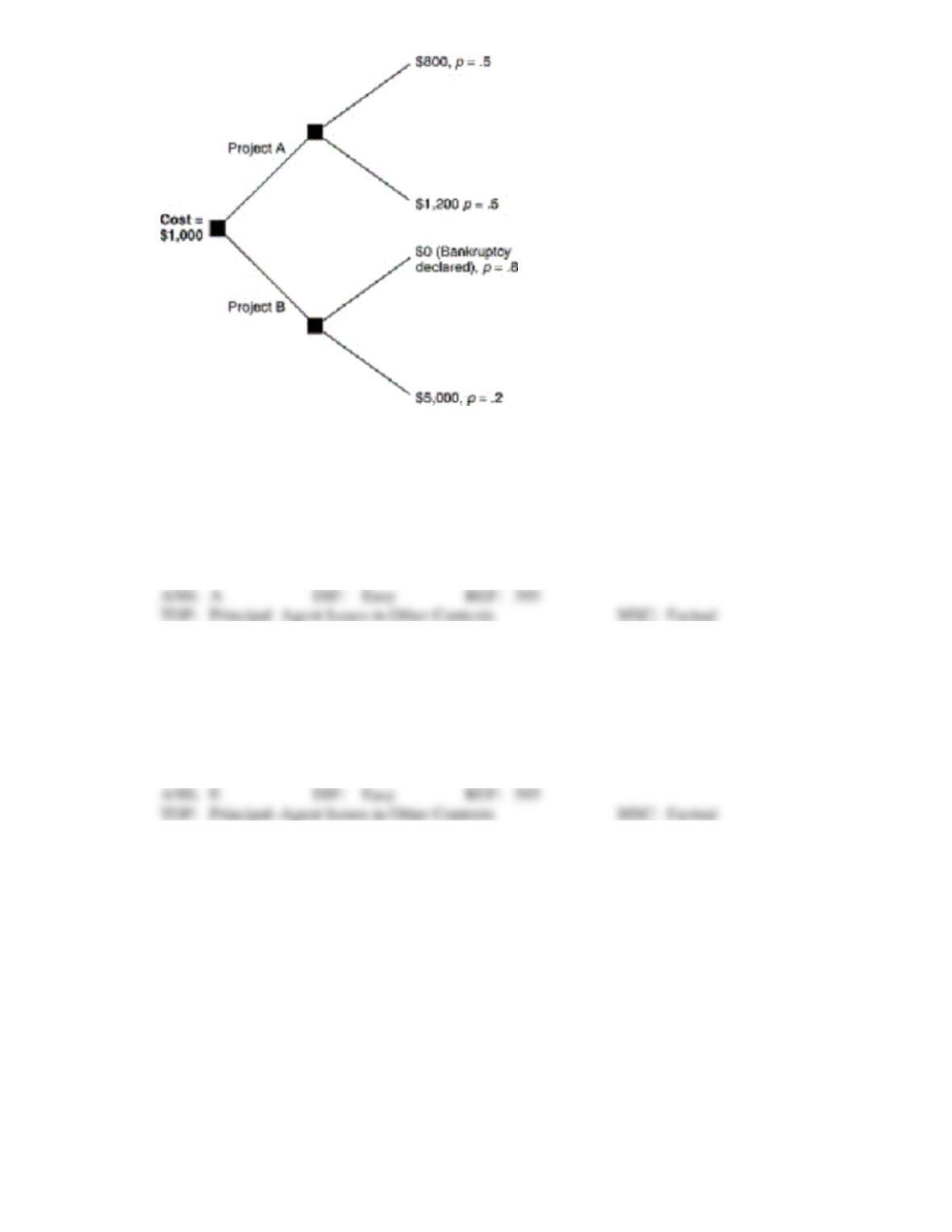
Under these circumstances, bondholders and shareholders may have incompatible incentives because:
a.
shareholders know that they have limited liability because of their ability to declare
bankruptcy.
b.
bondholders are not profit maximizers.
c.
shareholders are not profit maximizers.
d.
bondholders have limited liability because insurance against risk is provided by the federal
government.
e.
shareholders insure bondholders against risk.
22. Firms can avoid or limit the asset substitution problem by:
a.
funding with equity.
b.
establishing a reputation for protecting creditors.
c.
insuring bondholders against risk.
d.
applying to the government for insurance for bondholders.
e.
a, b, and c.
23. Consider this decision tree, which represents the outcomes of two alternative projects that Ink Inc., a
producer of printers, might pursue. Ink Inc., needs to borrow $1,000 to pursue either project and is
going to sell bonds to finance the venture.
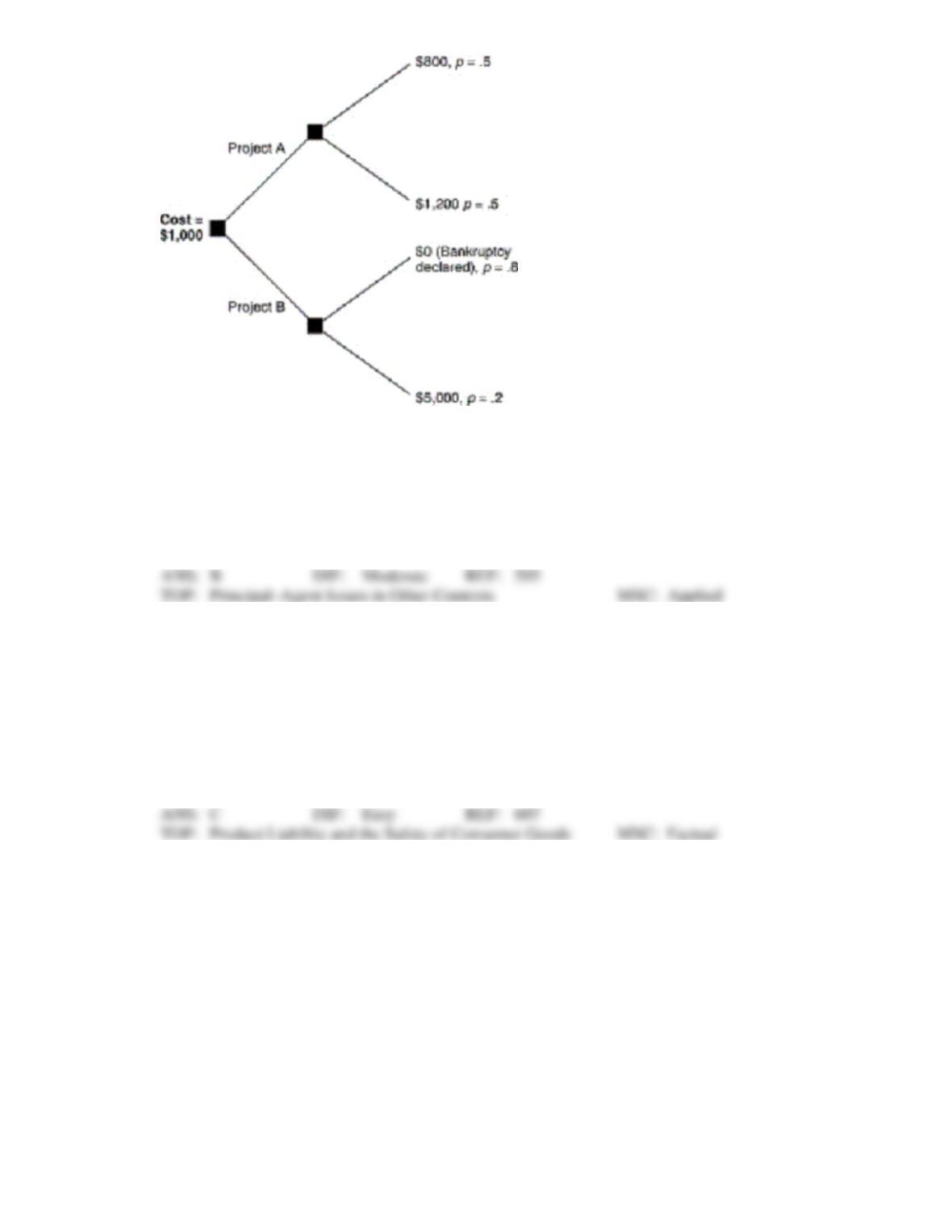
Ink, Inc., is carrying a large amount of debt because of overexpansion during the dot-com explosion.
Under these circumstances, the shareholders would tend to choose:
a.
project A, because it has the highest expected value.
b.
project B, because it has the greatest degree of risk.
c.
project A, because it has the lowest degree of risk.
d.
neither project A nor B, because both are risky.
e.
either project A or B; both have the same degree of risk.
24. In recent years, individuals and state governments have sued various tobacco companies to
compensate for illness and injury allegedly caused by cigarette smoking. Courts have awarded millions
of dollars to victims in these cases. This product liability law:
a.
encourages firms to ignore safety issues when developing products.
b.
creates an incentive incompatibility between producers and consumers.
c.
encourages incentive compatibility between producers and consumers.
d.
is the only way to achieve compatible incentives when consumer safety is at issue.
e.
forces firms to declare bankruptcy and to default on bondholders.