
Microeconomics: Theory and Applications with Calculus, 3e (Perloff)
Chapter 15 Factor Markets
15.1 Factor Markets
1) If a firm is a price taker in both the labor market and the output market, it will
A) earn zero economic profit in the short run.
B) hire labor until the marginal product of labor equals zero.
C) hire labor until the marginal revenue product equals the output price.
D) hire labor until the marginal revenue product equals the wage rate.
2) The increase in total revenue due to increasing the amount of labor employed by one unit is called the
A) Marginal Product.
B) Marginal Revenue Product.
C) Average Revenue Product.
D) Total Revenue Product.
3) Suppose the marginal product of labor equals 1/L. If the firm can sell its output for $10 per unit, and
the wage is $1 per unit, how many units of labor will the firm hire?
A) 0
B) 1
C) 10
D) 100
4) Suppose the marginal product of labor equals 1/L. If the wage is $1 per unit of labor, what is the short–
run effect on the firm’s labor demand if the price of output were to double?
A) The firm will demand half as much labor.
B) The firm will demand twice as much labor.
C) The firm will demand the same quantity of labor.
D) There is not enough information to determine.
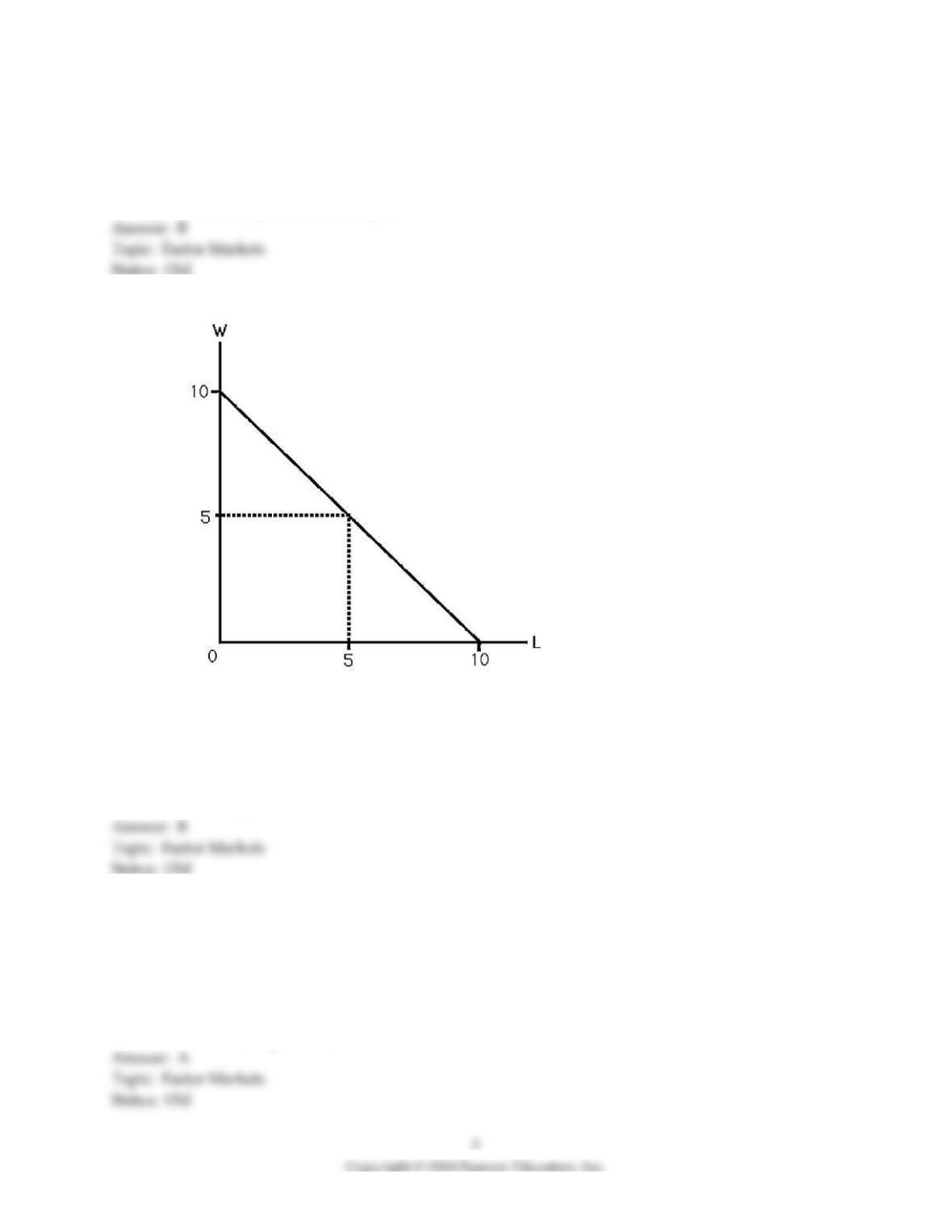
5) In the short run, the competitive firm will hire more labor if
A) the wage rate increases.
B) the price the firm receives for the output increases.
C) the price the firm receives for the output decreases.
D) a specific tax is imposed on the output.
6) The above figure shows a competitive firm’s demand for labor assuming that the firm’s output sells for
$1 per unit. If the wage is $5 per hour, the firm will hire
A) 10 units of labor per hour.
B) 5 units of labor per hour.
C) 2.5 units of labor per hour.
D) 0 units of labor per hour.
7) The above figure shows a competitive firm’s demand for labor assuming that the firm’s output sells for
$1 per unit. If the wage is $5 per hour, a ten cent specific tax on the good sold by the firm will cause the
firm to
A) demand less labor.
B) demand more labor.
C) offer its workers only $4.90 per hour.
D) hire 0 units of labor per hour.
8) The above figure shows a competitive firm’s demand for labor assuming that the firm’s output sells for
$1 per unit. If the wage is $5 per hour, a ten cent per unit subsidy on the good sold by the firm will cause
the firm to
A) demand less labor.
B) demand more labor.
C) raise the wage for workers to $5.10.
D) None of the above.
9) The above figure shows a competitive firm’s demand for labor assuming that the firm’s output sells for
$1 per unit. If the wage is $5 per hour, a 2 percent cut in all the workers‘ income tax will cause the firm to
A) demand less labor.
B) demand more labor.
C) raise the wage paid to the worker.
D) None of above.
10) If a competitive firm faces a competitive labor market, it will hire labor until
A) w = p.
B) w = MPL.
C) w = MPL ∗ p.
D) MPL = 0.
11) If a firm buys its labor in a competitive market, then a short–run increase in the price of the firm’s
output will cause the firm to
A) offer a higher wage.
B) hire fewer workers.
C) hire more workers.
D) offer a lower wage.
12) If a firm buys its labor in a competitive market, then in the short run, a decrease of the demand for the
firm’s product will cause the firm to
A) offer a higher wage.
B) hire fewer workers.
C) hire more workers.
D) offer a lower wage.
13) If wages for a certain type of labor were higher in one market than in another, then
A) the differential would exist into the long run.
B) labor would move from the high wage market to the low wage market until wages were equal.
C) labor would move from the low wage market to the high wage market until wages were equal.
D) firms would not be acting as profit maximizers.
14) In the short run, a competitive firm has a marginal product of labor, MPL = 5L-0.5. The output price is
$10 per unit and the wage is $7 per hour. The short-run labor demand curve for the firm is
A) 5L-0.5.
B) 15L-0.5.
C) 35L-0.5.
D) 50L-0.5.
15) In the long run, a competitive firm has a marginal product of labor, MPL = L-1. The output price is $20
per unit and the wage is $7.25 per hour. The long-run labor demand curve for the firm is
A) 20 L–0.05.
B) 7.25L–0.05.
C) 20L-1
D) 7.25L-1.
16) Suppose a perfectly competitive firm’s production function is q = L0.2K0.6 and it takes the wage and
price as given. Then the firm’s long-run demand for labor as a function of K, w, and p is
A) p5((0.2/w)2(0.6/r)3).
B) p5((0.2/w)4(0.6/r)5).
C) p5((0.2/w)5(0.6/r)4).
D) p5((0.2/w)3(0.6/r)2).
17) A firm’s demand for labor is downward sloping because of
A) diminishing marginal productivity of labor.
B) diminishing marginal utility.
C) price pressure.
D) workers’ increased willingness to work at a higher wage.
18) The profit maximizing condition for a firm selling its output in a competitive market and buying its
resources in a competitive market is
A) P = MC only.
B) MRP = wage only.
C) both A and B.
D) neither A nor B.
19) In a perfectly competitive resource market, the Marginal Revenue Product Curve is
A) vertical.
B) horizontal.
C) downward-sloping.
D) upward sloping.
20) In a perfectly competitive resource market, the labor supply curve facing the single firm is
A) vertical.
B) horizontal.
C) downward sloping.
D) upward sloping.

21) In the short run, which one of the following causes a competitive firm to hire more labor?
A) an increase in wage rate
B) an increase in the output price
C) a specific tax imposed on the firm’s output
D) a decrease in the output price
22) The amount of labor a firm employs depends on
A) the market wage.
B) the market price for the good produced.
C) Both A and B.
D) None of the above.
23) A change in the wage causes a shift in the supply curve for labor and a
A) movement along the demand curve for labor.
B) shift in the demand curve for labor.
C) rotation in the demand curve for labor.
D) It cannot be determined by the information provided.
24) The long-run labor demand curve is relatively flatter than the short-run labor demand curve because,
in the short run,
A) the wage rate is fixed.
B) the firm cannot vary the amount of capital used.
C) the firm is a price taker.
D) All of the above.
25) In the long-run, a fall in the input price causes less of an increase in factor demand
A) if the increase of product supply affected price.
B) if the market price will decrease too.
C) if the market price remain constant.
D) if the factor demand is more elastic.
26) A monopoly’s demand curve for labor
A) is below that of a competitive market.
B) is the same as that of a competitive market.
C) is above that of a competitive market.
D) equals p ∗ MPL.
27) For a monopoly, the value of the next worker equals
A) MR ∗ MPL.
B) p ∗ MPL.
C) MPL.
D) w/MPL.
28) For a monopoly, the value of the next worker equals
A) MR ∗ MPL.
B) p ∗ MPL.
C) MPL.
D) w/MPL.
29) For a monopoly, the value of the next worker equals
A) MR ∗ MPL.
B) (price + the effect of increased output on price) ∗ MPL.
C) P(1+1/e) * MPL
D) all of the above.
30) The demand for a monopoly’s output is p = 100 – Q. The firm’s production function is Q = 2L. Which
of the following is the firm’s demand for labor?
A) w = 200 – 8L
B) w = 200 – 4L
C) w = 100 – L
D) w = 2L
31) If the market demand elasticity is constant at -3 and a monopolist’s MPL = 1.2L-0.5, then the labor
demand for the monopoly is
A) 0.8PL-0.5.
B) 0.4PL-0.5.
C) 0.8PL-2.
D) 0.4PL–2.
32) Suppose the market demand elasticity is constant at –2, and there are three identical firms in the
oligopolistic market. A Cournot firm’s MPL = 1.2L-0.5, then the labor demand for a Cournot firm is
A) PL-0.5.
B) 0.6PL-0.5.
C) 0.2PL-2.
D) PL-2.
33) If the labor market is competitive, a monopoly output market will result in
A) a lower wage than that of a competitive output market.
B) a higher wage than that of a competitive output market.
C) less labor hired than in a competitive output market.
D) more labor hired than in a competitive output market.
For the following, please answer “True” or “False” and explain why.
34) If the price of a competitive firm’s output increases, the firm responds in the short run by demanding
more labor.
35) If the competitive firm maximizes profit by selecting labor rather than output, it will earn greater
economic profit.
36) The marginal revenue product of labor is usually downward sloping.
37) To derive the labor market demand curve, the labor demand curves for each firm in the output
market of interest are summed.
38) If a firm has market power in the output market but buys labor in a competitive market, it will hire
the same quantity of labor that a competitive firm will.
39) Because of market power, wages are higher under monopsony than under competitive conditions.
40) How does a competitive firm’s demand for labor react to a specific tax on each unit of output it sells?
41) XYZ Co. operates in a competitive market. Its production function is q = . The exponents, α and
β, are both less than one. The firm’s capital is fixed, and it takes the wage and price as given. Derive the
firm’s short-run demand for labor as a function of K, w, and p. How does the firm react to an increase in
the wage rate?
42) XYZ Co. operates in a competitive market. Its marginal product of labor is 1/L, and it takes the wage
and price as given. Derive the firm’s short-run demand for labor as a function of w and p. How much
labor will the firm hire if w = 2 and p = 10?
43) Suppose there are profit maximizing, competitive buyers and sellers of labor in an industry, and the
amount of capital is fixed for each firm. Explain under what condition the output price will equal the
wage rate.
44) Why is the short-run demand curve for labor downward sloping?
45) Explain why a decrease in an input price causes less of an increase in the quantity demanded of the
factor if we assumed that product price remained constant.
46) Jon runs a bar in New York City. A city law prevents smoking in New York bars, but Jon is able to
convince a friend in city hall to grant his bar a smoking permit by exploiting some fancy loopholes in the
law. While smoking enables Jon to charge a premium to the customers (higher drink prices), his workers
are subject to second-hand smoke. Therefore Jon has to pay his workers a wage higher than he otherwise
would. Assuming Jon’s production function is f(L,K) = LaK1-a, where L is the quantity of workers and K
is the quantity of capital, how does Jon’s optimal capital-to–labor ratio compare to similar bars without
smoking?
47) Suppose the labor market is competitive, the supply curve of labor is upward sloping, and the
amount of capital is fixed. If the output market changes from a competitive market to a monopoly, what
is the effect on its demand for labor? Explain.
48) Suppose n identical Cournot firms purchase labor in a competitive labor market. How is the market
demand for labor affected by the number of firms in the market?
49) Why does a monopsonist’s marginal expenditure curve lie above the labor supply curve?
50) Suppose a monopoly producer is also a monopsonist in the labor market. Demand for the output is p
= 100 – Q. The production function is Q = L, and the labor supply curve is w = 10 + L. How much labor
does the firm hire? What wage is paid?
51) Suppose that a mining company employs 80% of the available laborers in a town. Explain what will
happen to the number of laborers hired and the wage rate paid by the mine if a minimum wage is set at
the competitive level.
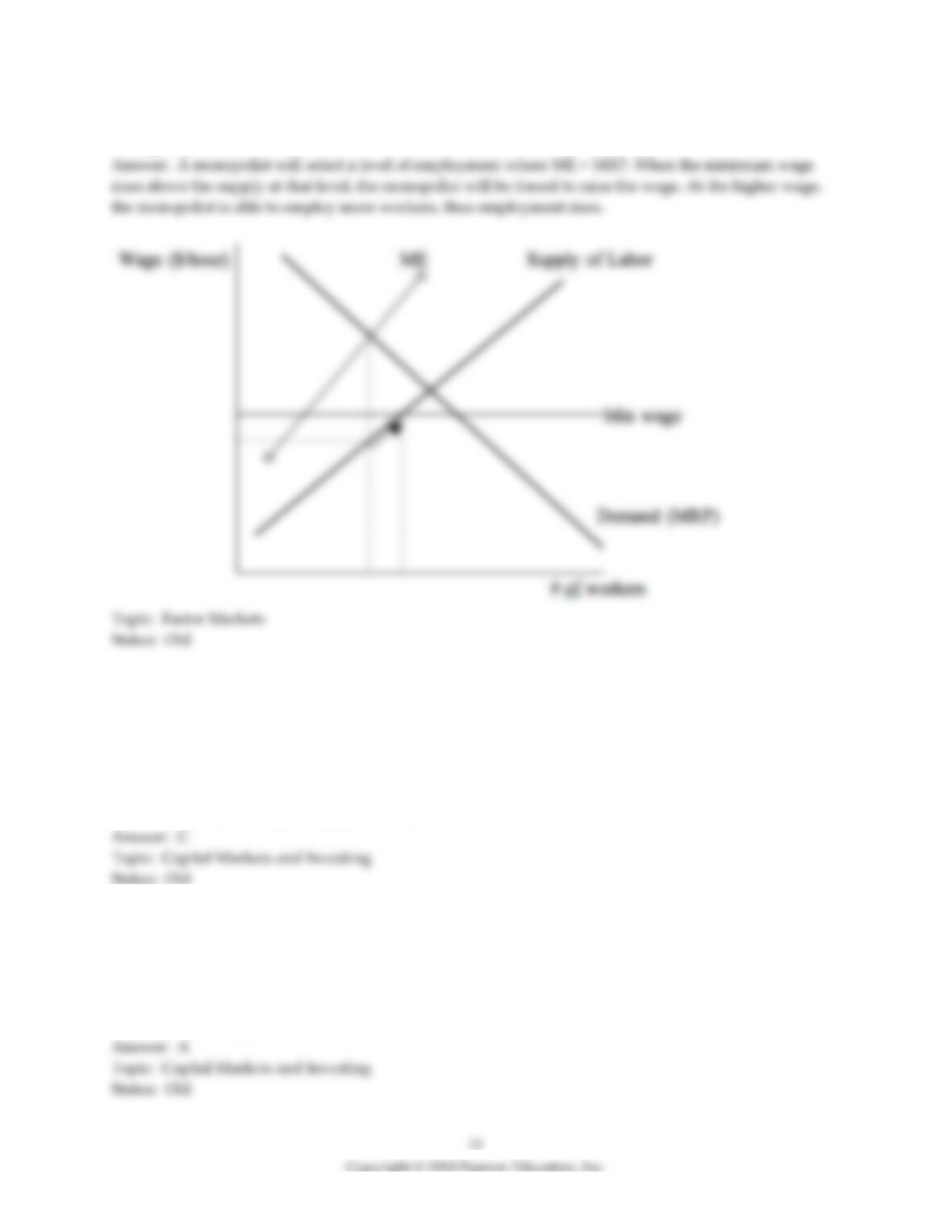
52) Show with a graph that an increase in the minimum wage can increase the level of employment in a
monopsony market.
15.2 Capital Markets and Investing
1) Suppose a person has a discount rate of zero. This implies she
A) places no value on the future.
B) places no value on the present.
C) values the present and the future equally.
D) would not lend money at any positive interest rate.
2) Suppose two people with the same level of income and wealth have different discount rates. Joe has a
very high discount rate and Jim has a very low discount rate. Which one of the following is TRUE?
A) Joe is more likely to borrow than Jim.
B) Joe is less likely to borrow than Jim.
C) Joe and Jim will borrow the same amount.
D) Neither Joe nor Jim would be borrowers.

3) Interest rates are positive mainly because
A) of inflation.
B) people tend to prefer the present to the future.
C) people tend to prefer the future to the present.
D) bankers are greedy.
4) If you place $100 in a bank account that pays 6% at the end of each year, and you leave your $100 and
all your interest in the bank, how much will you have in the bank at the end of seven years with annual
compounding?
A) (106)7.
B) 7 ∗ (106).
C) 100 ∗ (1.60)7.
D) 100 ∗ (1.06)7.
5) If you invest $500 today, and the value one year from today is $1000, then the annual interest rate must
be
A) 10%.
B) 50%.
C) 100%.
D) 200%.
6) For a given rate of interest, the total interest you receive from lending money
A) increases with the frequency of compounding.
B) decreases with the frequency of compounding.
C) is independent of the frequency of compounding.
D) is greatest when there is no compounding.
7) If the interest rate is 10%, then $1 received one year from now is worth how much today?
A) $1.10
B) $1
C) 91¢
D) 90¢