Chapter 14 – Rent, Interest, and Profit
92. Refer to the above table. The equilibrium interest rate and quantity of loanable funds
demanded and supplied in this market will be:
93. Refer to the above table. If the government passes a usury law that sets the interest rate
4% below the market equilibrium, the interest rate will be:
94. Refer to the above table. A usury law that sets the interest rate 2% below the market rate
of interest will result in a shortage of funds of:
Chapter 14 – Rent, Interest, and Profit
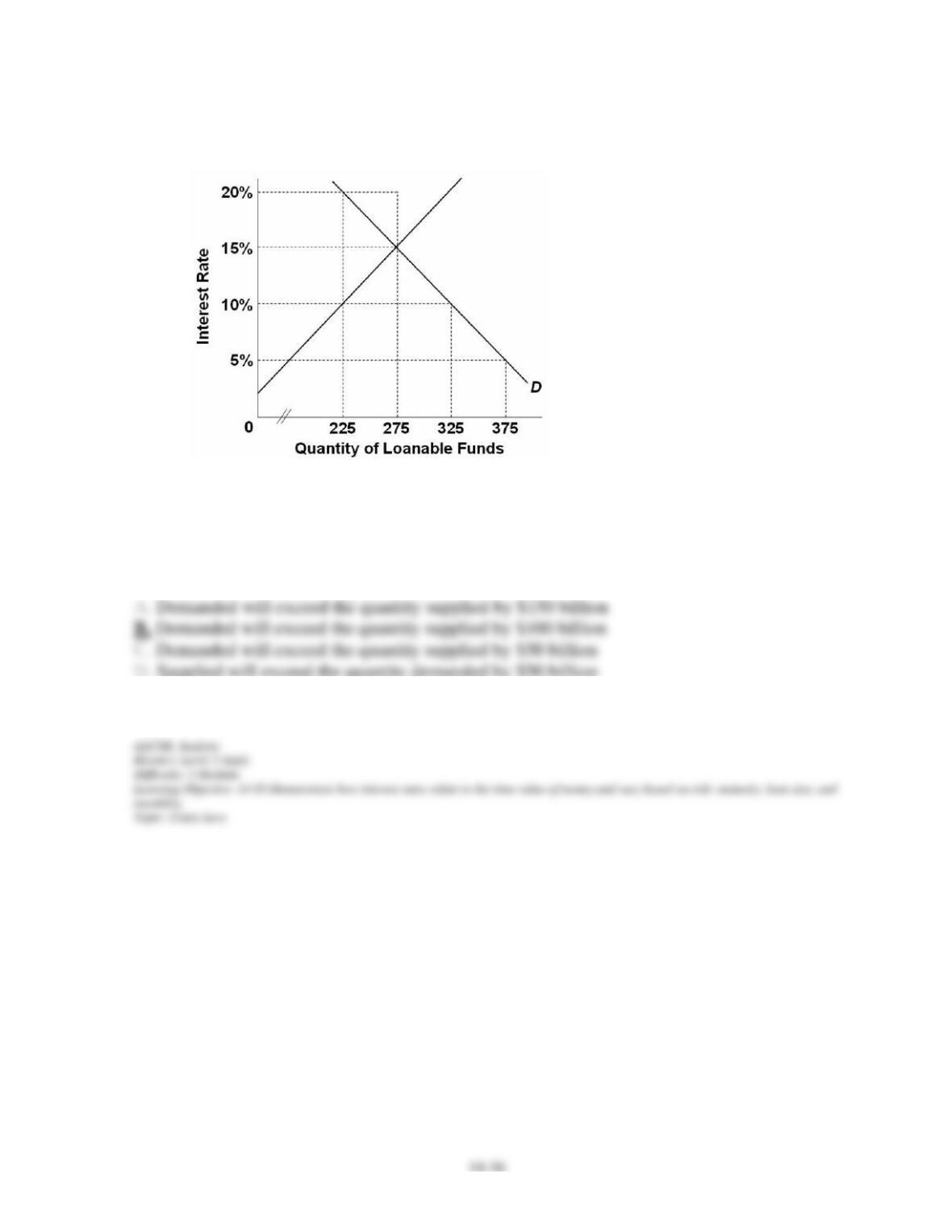
95. Refer to the above graph of the supply and demand for loanable funds. Assume that the
government sets a 10% limit on the interest rate that banks can charge to customers for credit
card loans. In this case, the quantity of loanable funds:
Chapter 14 – Rent, Interest, and Profit
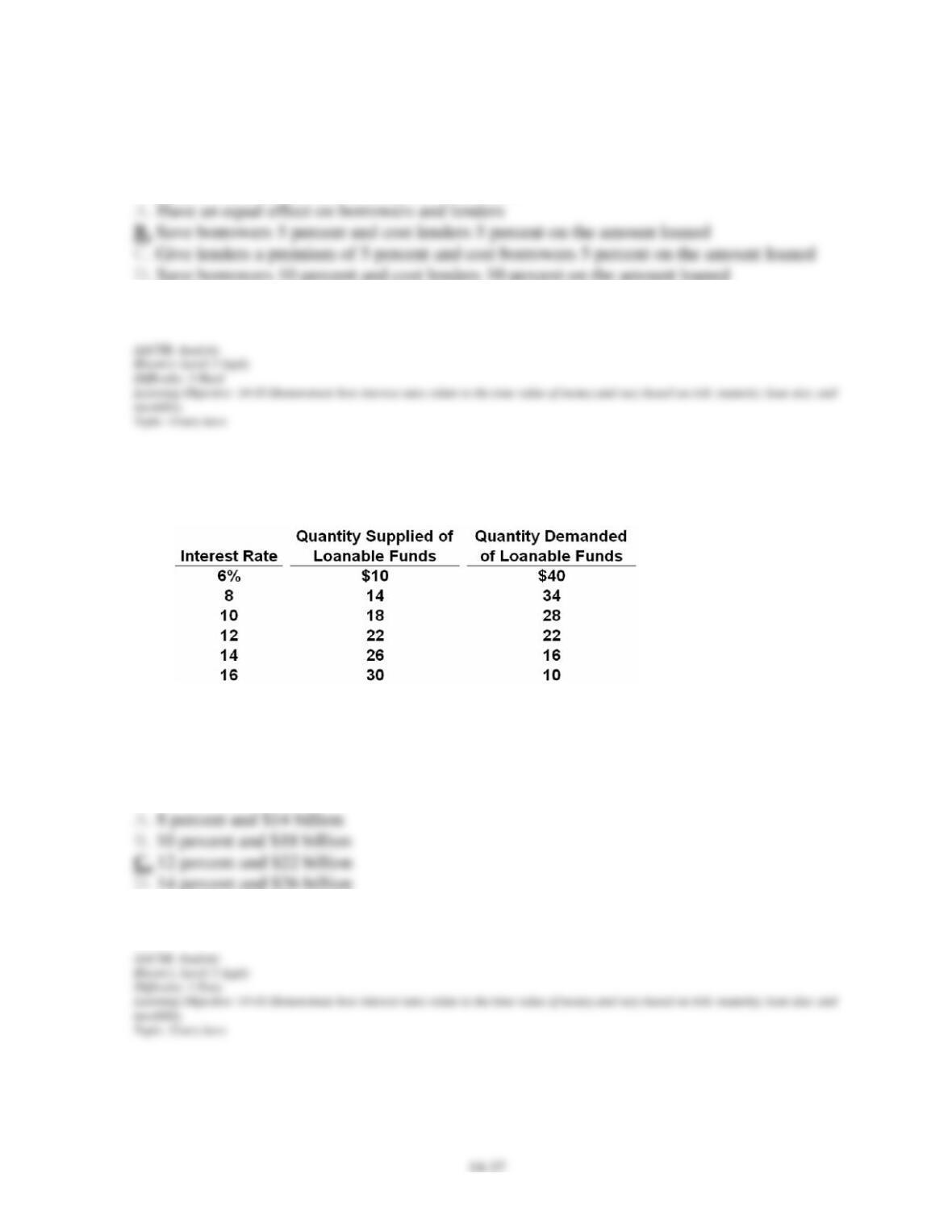
96. Refer to the above graph of the supply and demand for loanable funds. A limit of 10% on
the interest rate that banks can charge for loans will:
Figures are in billions of dollars.
97. Refer to the above table. The equilibrium interest rate and quantity of loanable funds
demanded and supplied in this market will be:
Chapter 14 – Rent, Interest, and Profit
98. Refer to the above table. If the government passes a usury law that sets the interest rate 6
percent below the market equilibrium, the interest rate will be:
99. Refer to the above table. A usury law that sets the interest rate 4 percent below the market
rate of interest will result in a shortage of loanable funds of:
100. Economists claim that a farmer who owns her land and provides all her own labor, and
calculates her profits from the farm by subtracting explicit costs from total revenues, will
always:
Chapter 14 – Rent, Interest, and Profit
101. Entrepreneurs normally do all of the following except:
102. Economic profits are not payments received for:
103. The minimum rate of return or payment necessary to keep an entrepreneur in some
specific enterprise is referred to as:
Chapter 14 – Rent, Interest, and Profit
104. Economic profits:
105. Which would usually not be an entrepreneurial function?
106. Entrepreneurs can generate economic profits by all of the following, except:
Chapter 14 – Rent, Interest, and Profit
107. All of the following are insurable business risks, except:
108. All of the following statements about economic profits are correct, except that they:
109. “Proprietor’s income” refers to income received by:
Chapter 14 – Rent, Interest, and Profit
110. Since 1900, the relative share of income earned by Americans as “wages and salaries” in
a typical year has been about:
111. The share of total income for “capitalists” in America (in the form of rent, interest, and
profits) has been about:
112. Interest rates are the payments needed to entice individuals to:
Chapter 14 – Rent, Interest, and Profit
113. Economists who have studied the composition of “proprietor’s income” have found that
this income item is made up of:
114. Economic rent is the payment to a resource which has a perfectly inelastic demand
curve.
115. Reducing the payment of economic rents to land will decrease the quantity of land
supplied.
Chapter 14 – Rent, Interest, and Profit
116. As viewed by society, economic rent is not a cost but rather a surplus payment.
117. The demand side, not supply, is the major factor determining how high land’s rent will
be.
118. The demand for loanable funds represents the lenders or savers.
119. The quantity of loanable funds supplied is inversely related to the interest rate.
Chapter 14 – Rent, Interest, and Profit
120. An increase in the demand for loanable funds would tend to lower the interest rate.
121. If people become thriftier and save more, the loanable funds theory predicts that the
equilibrium interest rate would decrease.
122. If the expected rates of return on investments increase, the loanable funds theory predicts
that the equilibrium interest rate would decrease.
123. An increase in the rates of return on investments would most likely increase the supply
of loanable funds.
Chapter 14 – Rent, Interest, and Profit
124. Other things equal, short-term loans usually have lower rates of interest than do long-
term loans.
125. For a given future value, the higher is the interest rate, the higher will be the present
value.
126. In time-value of money calculations, discounting is the reverse of discounting.
127. For a given future value and interest rate, the discounted present value will become
larger as the time period gets longer.
Chapter 14 – Rent, Interest, and Profit
128. A firm will undertake investments as long as the expected rate of return is less than the
interest rate.
129. When the inflation rate is 4 percent and the nominal interest rate on long-term
government bonds is 8 percent, the real interest rate is 12 percent.
130. If the nominal rate of interest is 8 percent and the inflation rate is 4 percent, the real rate
of interest is 4 percent.
131. Usury laws will result in a surplus of loanable funds and nonmarket rationing in credit
markets.
Chapter 14 – Rent, Interest, and Profit
132. Normal profit is considered an economic cost.
133. The payment for taking risks in owning and running a business is economic profit.
134. Labor’s share of income earned by Americans is smaller than the share of capital.