Chapter 14 – Rent, Interest, and Profit
1. Economic or pure rent is:
2. To say that land rent performs no incentive function means that:
Chapter 14 – Rent, Interest, and Profit
3. Which of the following statements is correct?
4. Economic rent refers to the price paid for land and other natural resources that:
Chapter 14 – Rent, Interest, and Profit
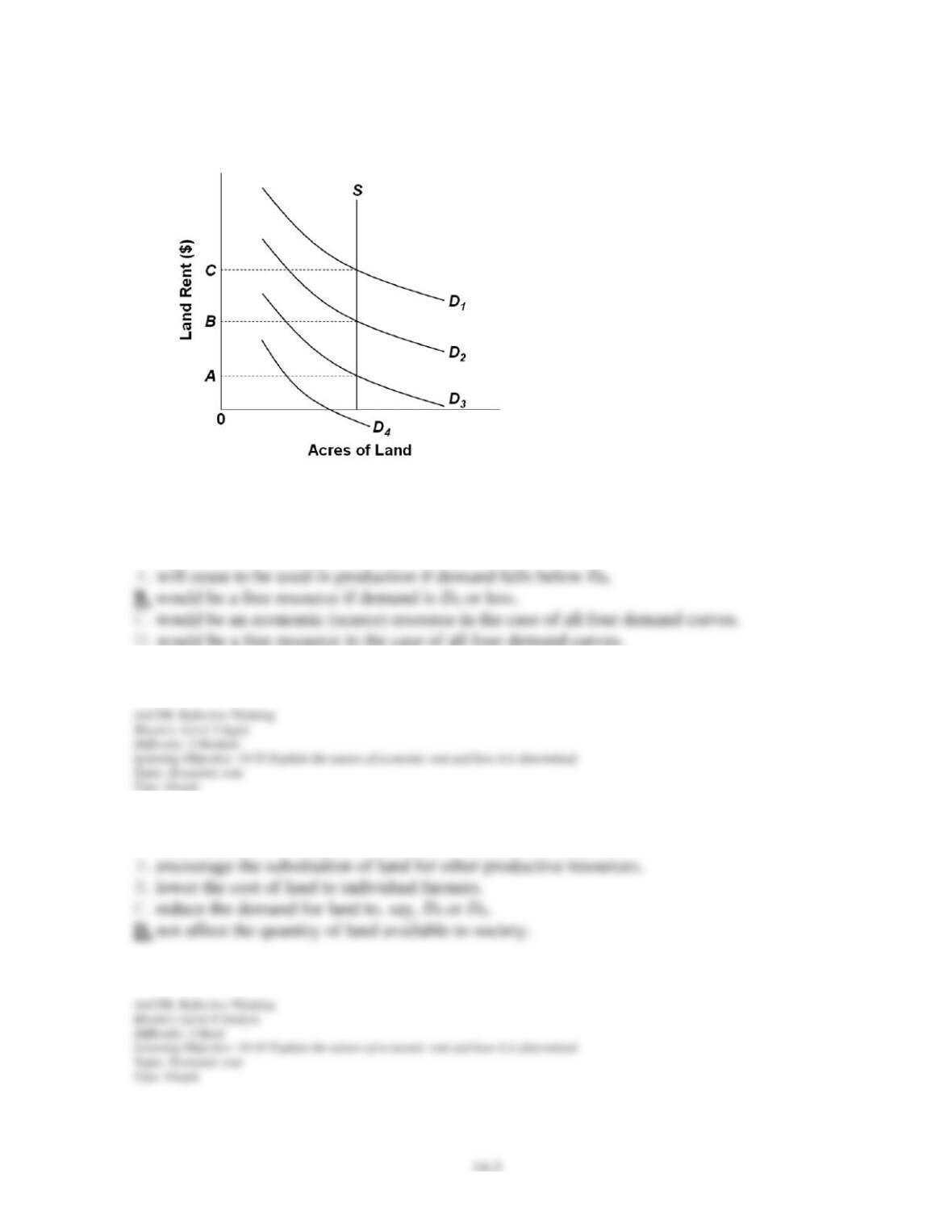
5. Refer to the above diagram. Land:
6. Refer to the above diagram. If demand is D2, a tax of A per acre will:
Chapter 14 – Rent, Interest, and Profit
7. Landowners will not receive any rent so long as:
8. The incentive function of prices:
9. The demand for farmland will increase if:
Chapter 14 – Rent, Interest, and Profit
10. The supply of land is:
11. Which of the following is correct?
12. The total supply of land is:
Chapter 14 – Rent, Interest, and Profit
13. The rent paid for the pasture land used to graze cattle would increase if:
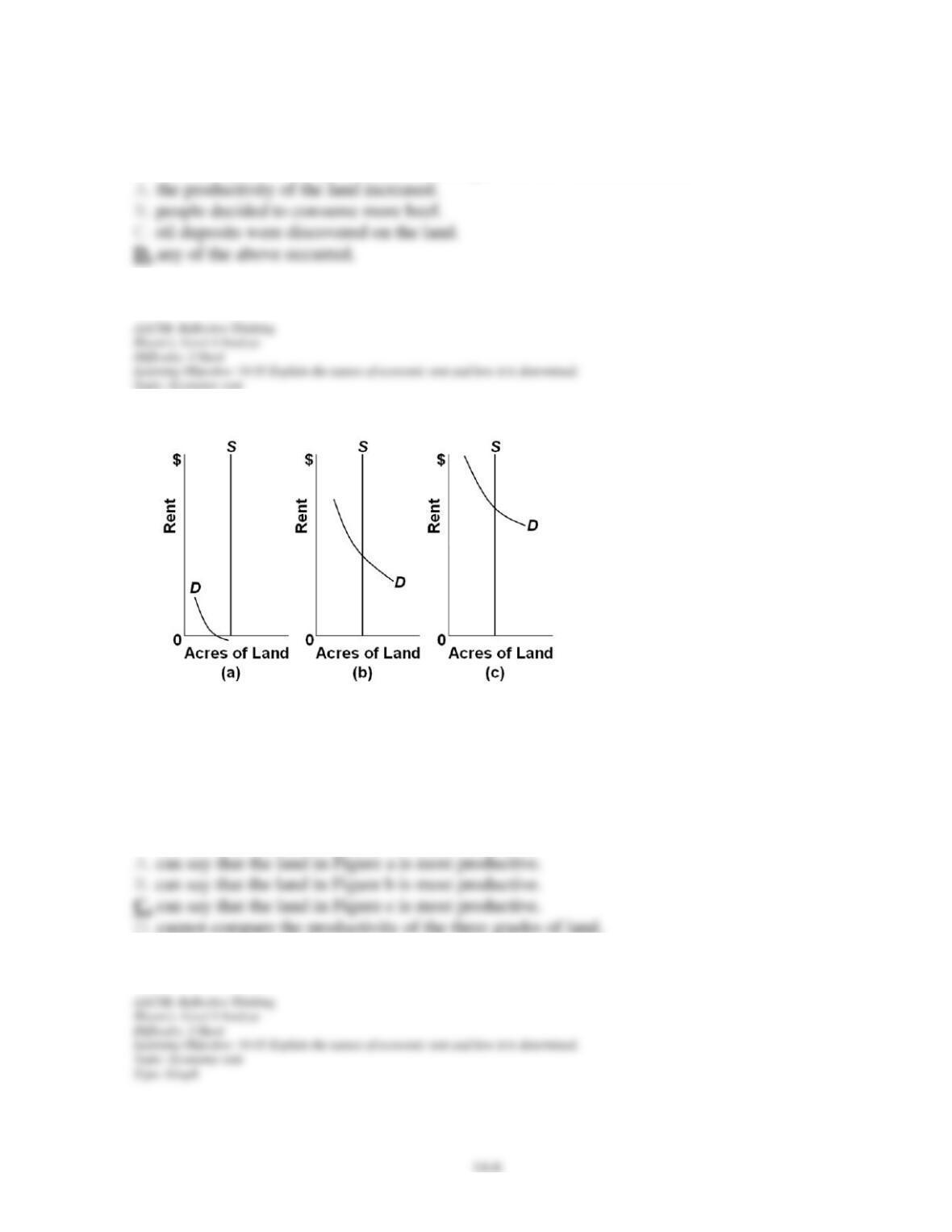
14. Refer to the above diagrams. Assume that only wheat can be grown on the three grades of
land shown in Figures a, b, and c. Also assume that identical amounts of labor, capital, and
other needed inputs are used in farming each grade of land. On the basis of these three figures
we:
Chapter 14 – Rent, Interest, and Profit
15. Refer to the above diagrams. Assume that only wheat can be grown on the three grades of
land shown in Figures a, b, and c. Also assume that identical amounts of labor, capital, and
other needed inputs are used in farming each grade of land. On the basis of these three figures
we can say that:
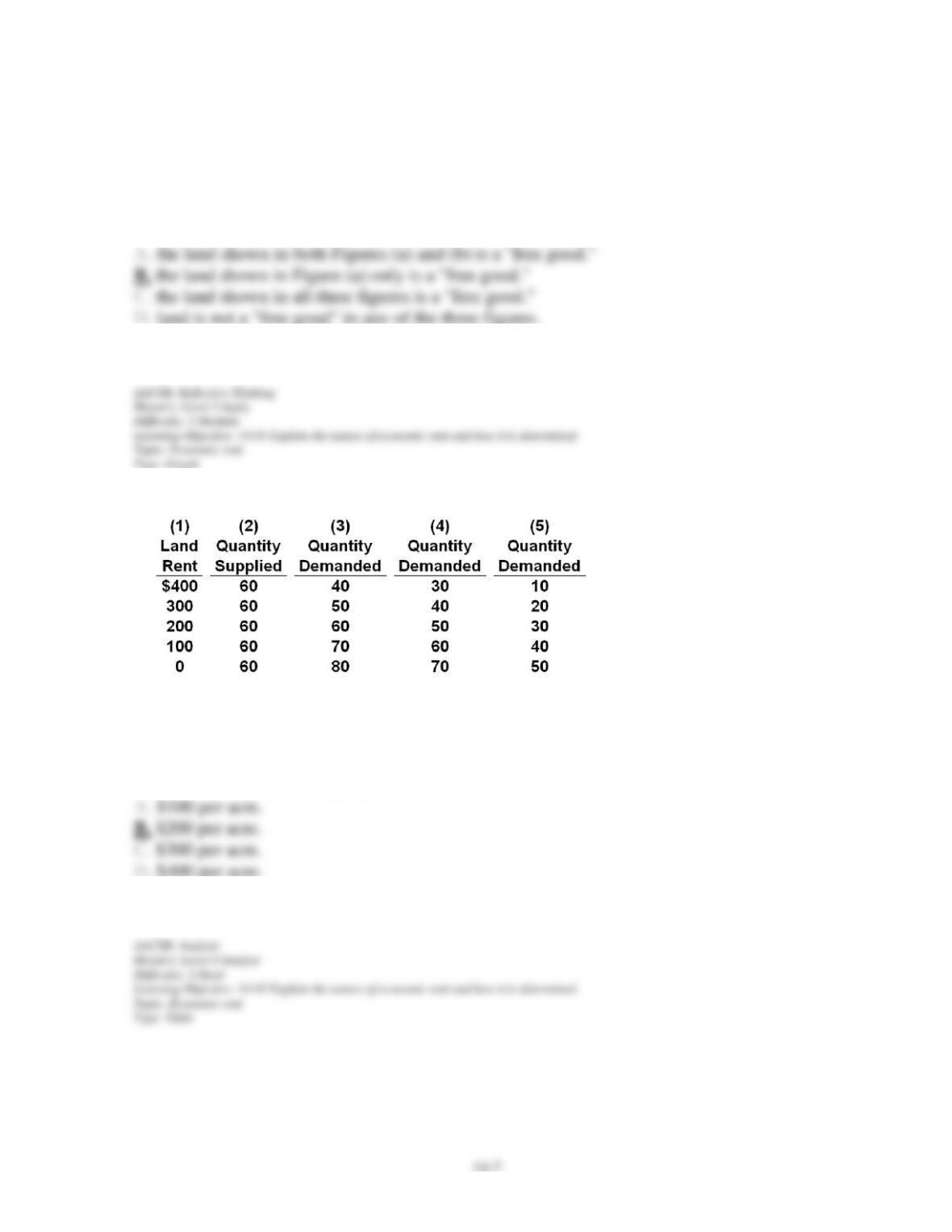
16. Refer to the above table, in which the values for columns (2) through (5) are in acres. If
the relevant columns are (1), (2), and (3), land rent will be:
Chapter 14 – Rent, Interest, and Profit
17. Refer to the above table, in which the values for columns (2) through (5) are in acres. If
the relevant columns are (1), (2), and (4), land rent will be:
18. Refer to the above table, in which the values for columns (2) through (5) are in acres. If
the relevant columns are (1), (2), and (5), land rent will be:
19. Refer to the above table, in which the values for columns (2) through (5) are in acres.
Positive land rent will occur if the relevant columns are:
Chapter 14 – Rent, Interest, and Profit
20. The demand for land is:
21. The marginal revenue product (MRP) of land declines as more land is brought into use.
As a result the:
22. The marginal revenue product (MRP) of land declines as more land is brought into
production because:
Chapter 14 – Rent, Interest, and Profit
23. The economist who advocated a single tax on land was:
24. A unique characteristic of taxes on economic rents is that such taxes:
25. Henry George’s single tax movement was based on the argument that:
Chapter 14 – Rent, Interest, and Profit
26. In his book Progress and Poverty, Henry George argued that:
27. Henry George advocated a single tax on:
28. Some economists advocate taxes on land because such taxes:
Chapter 14 – Rent, Interest, and Profit
29. Critics of a single tax on land oppose the idea because:
30. Interest is the:
31. Suppose a person pays $80 of annual interest on a loan that has a 5 percent annual interest
rate. The loan amount is:
Chapter 14 – Rent, Interest, and Profit
32. Suppose that interest payments are $140 per year on a $1,000 loan and $1,188 per year on
a $8,485 loan. The interest rates on the two loans are:
33. Which of the following is correct?
34. The equilibrium interest rate equates:
Chapter 14 – Rent, Interest, and Profit
35. The supply curve of loanable funds is upsloping because:
36. The fact that people prefer present consumption to future consumption results in:
37. Which of the following is not a source of loanable funds?
Chapter 14 – Rent, Interest, and Profit
38. Which of the following is not a component of the demand for loanable funds?
39. The demand for loanable funds is downsloping:
40. Other things equal, an increase in the productivity of capital goods will:
Chapter 14 – Rent, Interest, and Profit
41. If Congress were to pass a law exempting interest on saving from taxation, the:
42. In the market for loanable funds:
Chapter 14 – Rent, Interest, and Profit
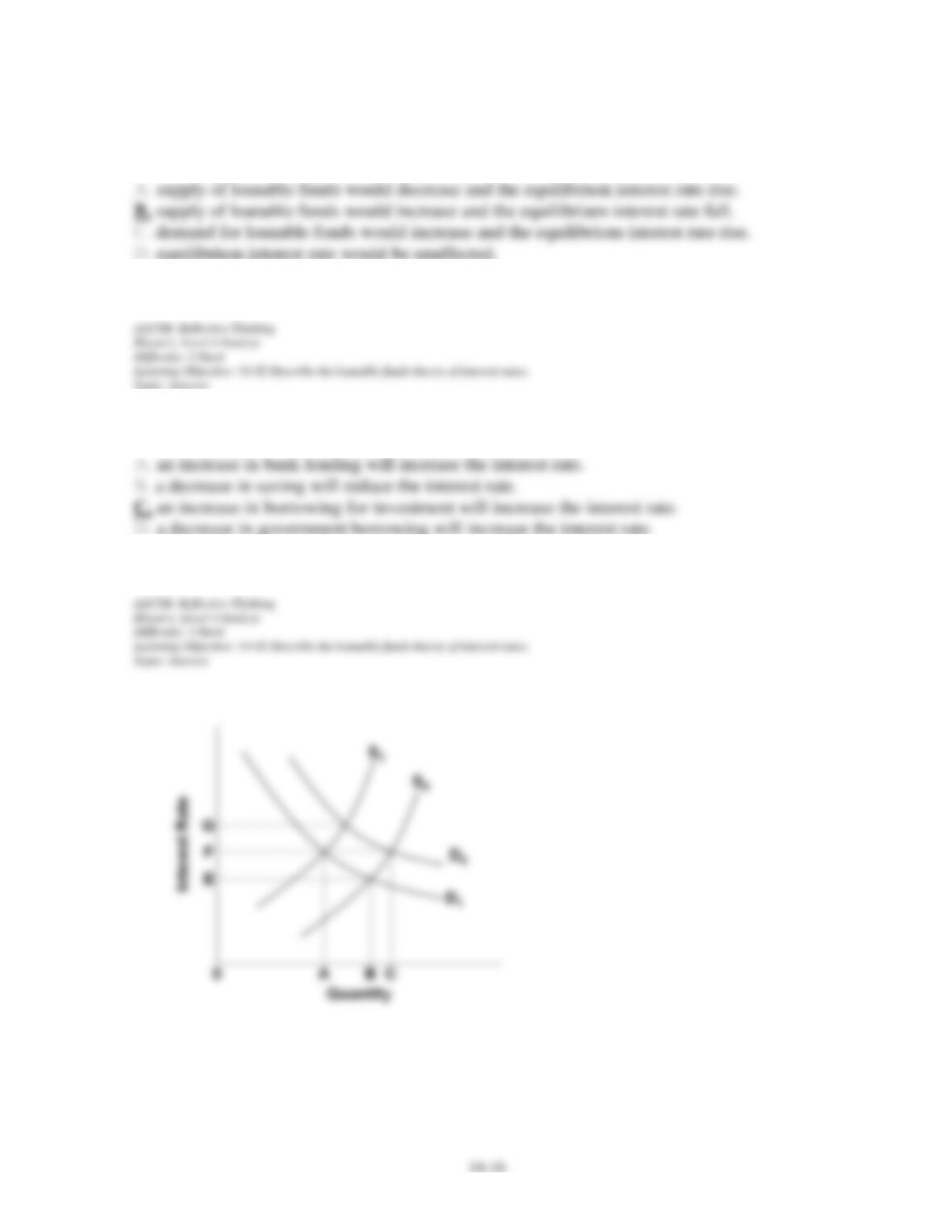
43. Refer to the above diagram. If the supply of loanable funds is S1 and the demand for
loanable funds is D1, the equilibrium interest rate and quantity of funds borrowed will be:
44. Refer to the above diagram. If the supply of loanable funds is S0 and the demand for
loanable funds is D0, the equilibrium interest rate and quantity of funds borrowed will be:
45. Refer to the above diagram. Suppose that the demand for loanable funds is D0 and the
supply of loanable funds initially is S0. If the supply of loanable funds declines to S1, the
equilibrium interest rate will:
Chapter 14 – Rent, Interest, and Profit
46. The “time-value of money” refers to the fact that:
47. Which of the following statements best illustrates the time-value of money concept?
48. On January 1, 2010, Alex deposited $5,000 into a savings account that pays interest of 5
percent, compounded annually. If he makes no further deposits or withdrawals, how much
will Alex have in his account on December 31, 2012 (3 years later)?
Chapter 14 – Rent, Interest, and Profit
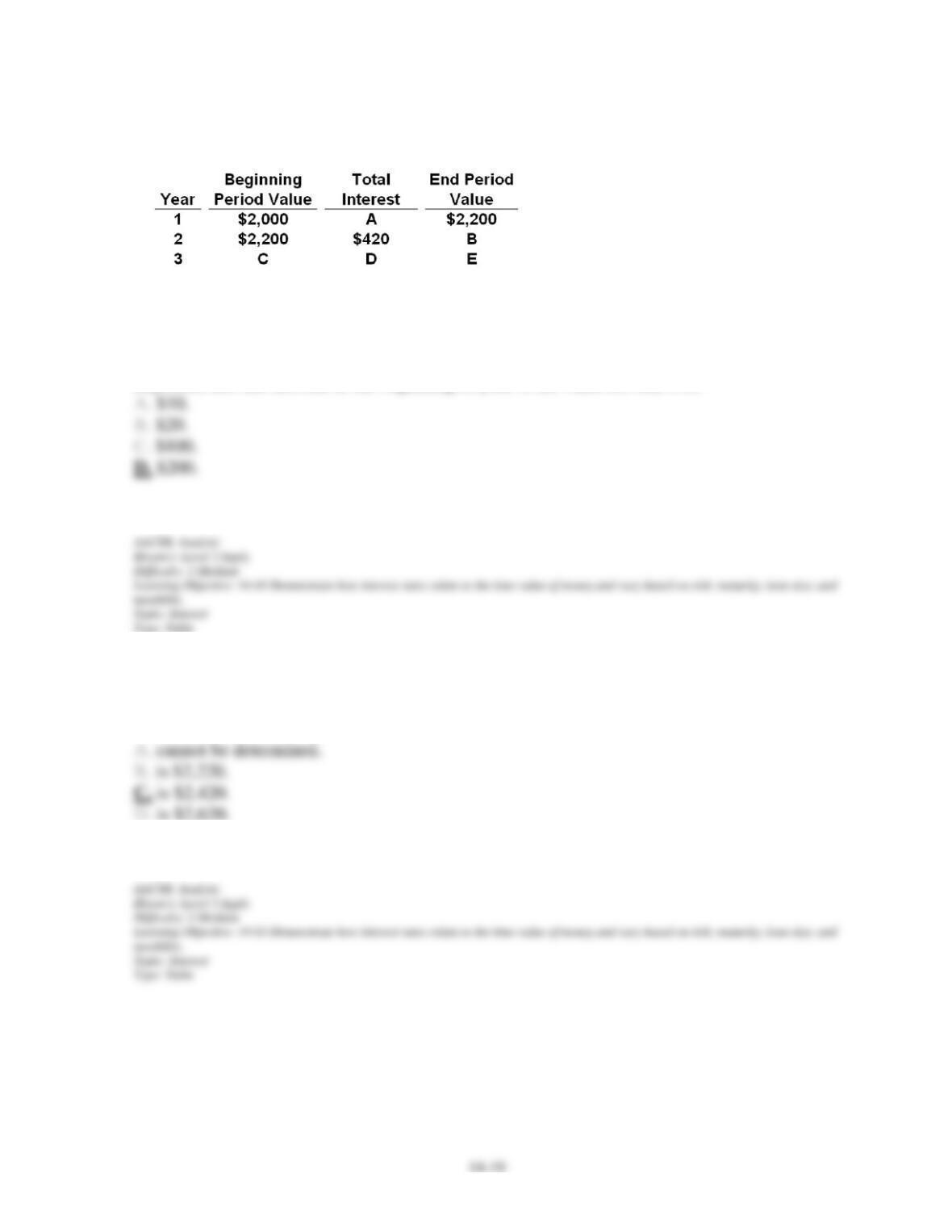
49. Refer to the above table representing Kara’s bank account. Assuming that $2000 was
deposited into her account at the beginning of year 1, the value for cell A is:
50. Refer to the above table representing Kara’s bank account. Assuming that $2000 was
deposited into her account at the beginning of year 1, and no further deposits or withdrawals
were made, the value for cell B:
Chapter 14 – Rent, Interest, and Profit
51. Refer to the above table representing Kara’s bank account. Assuming that $2000 was
deposited into her account at the beginning of year 1, and no further deposits or withdrawals
were made, the value for cell D:
52. Refer to the above table representing Kara’s bank account. Assuming that $2,000 was
deposited into her account at the beginning of year 1, and no further deposits or withdrawals
were made, the value for cell E: