Chapter 14 – Rent, Interest, and Profit
1. If a factor of production has a fixed total supply, then payments to that factor constitute:
2. Which of the following resources is a “free and non-reproducible gift of nature”?
Chapter 14 – Rent, Interest, and Profit
3. Pure economic rent is the price of a resource with a perfectly:
4. Which of the following factors does not cause changes in land rent?
Chapter 14 – Rent, Interest, and Profit
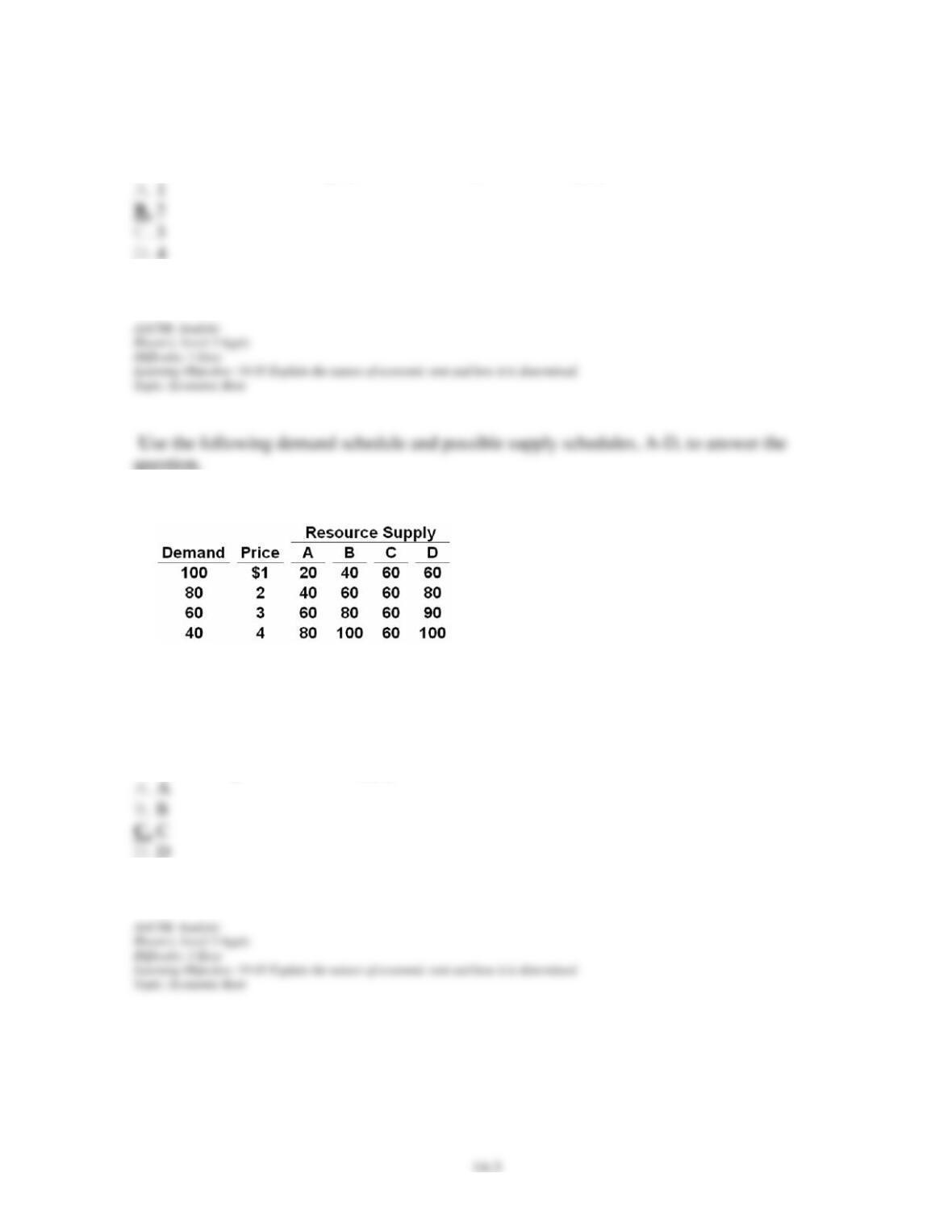
5. What line in the above graph would best represent the supply curve for land?
6. Refer to the above schedules. There would be no incentive function performed by price in
which of the given resource supply schedules?
Chapter 14 – Rent, Interest, and Profit
7. Refer to the above schedules. Suppose that price influences the availability of the economic
resource, and the equilibrium price is $2. Which resource supply schedule would apply in this
case?
8. Refer to the above schedules. Suppose that the supply of a resource is given by the schedule
that exhibits a zero price elasticity. If demand for the resource increases from the original
demand schedule by 20 units at each price, then the equilibrium economic rent would be:
9. Which of the following does not explain differences in rent for different parcels of land?
Chapter 14 – Rent, Interest, and Profit
10. If the payment to an input is a pure economic rent, then reducing that payment will:
11. The supply curve for a productive resource wherein price provides an incentive function
is:
12. The aggregate economic rent received by a productive resource will decrease, ceteris
paribus, whenever the:
Chapter 14 – Rent, Interest, and Profit
13. Which of the following resource payments is considered by economists as surplus
payments?
14. Which statement is correct?
15. David Ricardo, a nineteenth-century economist, wrote, “The price of corn is not high
because a rent is paid, but a rent is paid because the price of the corn is high.” Which of the
following correctly explains Ricardo’s assertion?
Chapter 14 – Rent, Interest, and Profit
16. The reason why socialists favor the nationalization of land is that:
17. In a market system, private ownership of land leads to the following results, except:
18. The prices paid to a productive resource usually perform an incentive function except with
what resource?
Chapter 14 – Rent, Interest, and Profit
19. In Progress and Poverty, Henry George argued for:
20. What economist is associated with the “single-tax” movement?
21. Henry George and the single-tax movement believed in all of the following, except:
Chapter 14 – Rent, Interest, and Profit
14-9
22. Henry George claimed that land-rent taxes would not impair economic efficiency
because:
23. Major criticism of the single-tax movement include the following, except:
Suppose that the quantity of a certain type of farmland available is 400,000 acres, and the
demand for this land is given in the table below.
Chapter 14 – Rent, Interest, and Profit
24. Refer to the above table. What will be the equilibrium economic rent per acre?
25. Refer to the above table. How much of the farmland will be rented?
26. Refer to the above table. If landowners were taxed at a rate of $150 per acre for their land,
what would be the economic rent on this land after taxes and how many acres would be
rented?
Chapter 14 – Rent, Interest, and Profit
27. To an individual firm or landowner, land rents do not appear to be a surplus because:
28. The price paid for the use of money is:
29. If you pay $2,640 annually on a $22,000 loan A and pay $1,800 on a $12,000 loan B, then
the interest rate is:
Chapter 14 – Rent, Interest, and Profit
30. Which would be considered to be an economic resource?
31. Economists would not consider which one of the following to be a productive economic
resource?
32. Most borrowers value money for:
Chapter 14 – Rent, Interest, and Profit
33. Which of the following interest rates is usually the highest?
34. Interest rates of various loans vary over a wide range due to differences in:
35. Other things equal, the interest rate on a loan will be smaller:
Chapter 14 – Rent, Interest, and Profit
36. Other things equal, the interest rate on a loan will be larger:
37. Other things equal, the interest rate on a loan will be larger:
38. A bank charges one borrower (A) 8 percent interest per year and another borrower (B) 10
percent interest per year. Which of the following is a reason for the higher interest rate for B?
Chapter 14 – Rent, Interest, and Profit
40. The demand curve for loanable funds represents the behavior of:
41. The supply curve for loanable funds is upward-sloping because:
Chapter 14 – Rent, Interest, and Profit
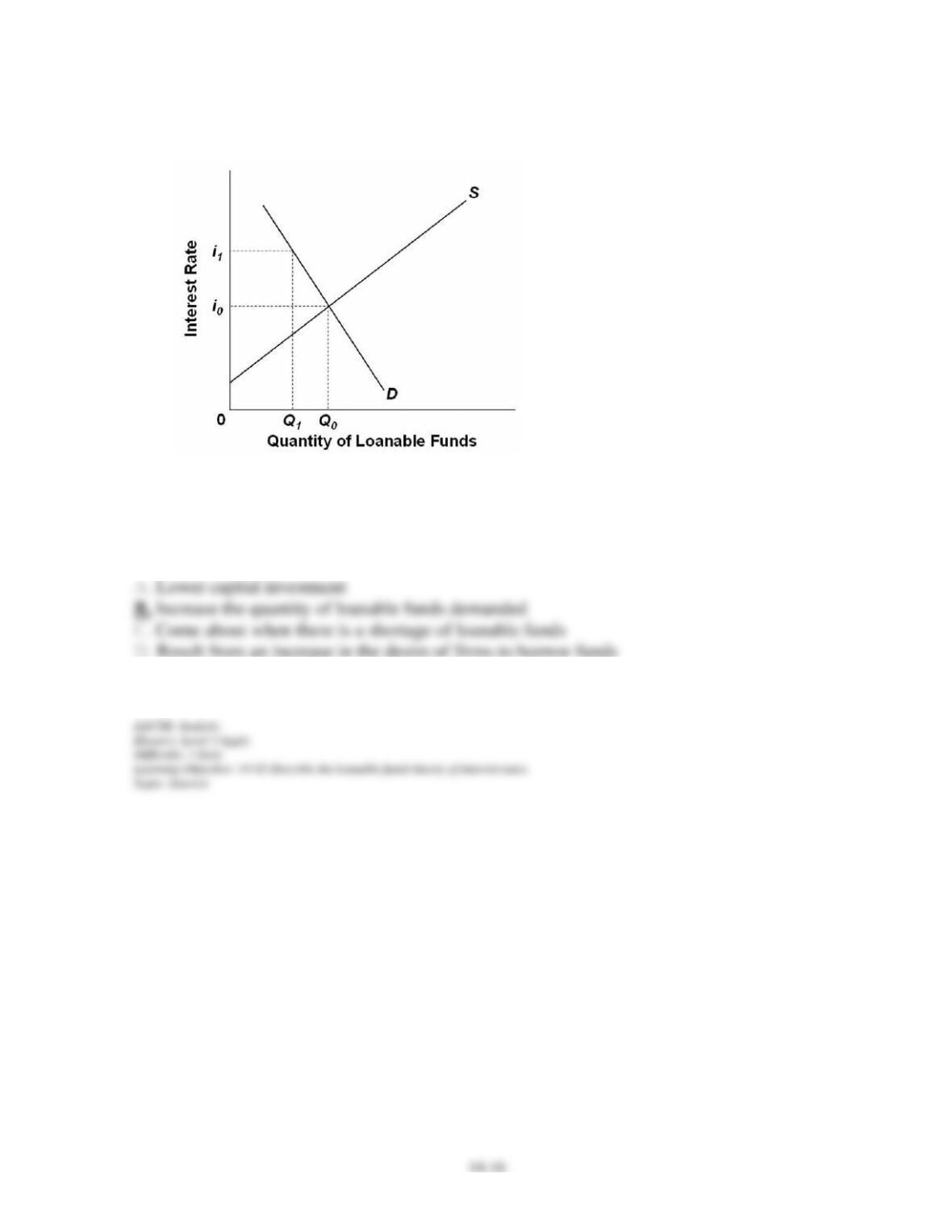
42. Refer to the market for loanable funds, as shown in the above graph. A decline in the
interest rate is likely to:
Chapter 14 – Rent, Interest, and Profit
14–17
43. Refer to the market for loanable funds, as shown in the above graph. Suppose investors
who borrow money in the loanable funds market become quite nervous and pessimistic about
the economy in general, and expected returns on investments in particular. We would expect
to see a(n):
44. Refer to the market for loanable funds, as shown in the above graph. Suppose the market
for loanable funds is originally in equilibrium at interest rate i0 and quantity Q0. In the next
period, the equilibrium interest rate increases to i1 and quantity decreases to Q1. Which of the
following could be the cause of this shift?
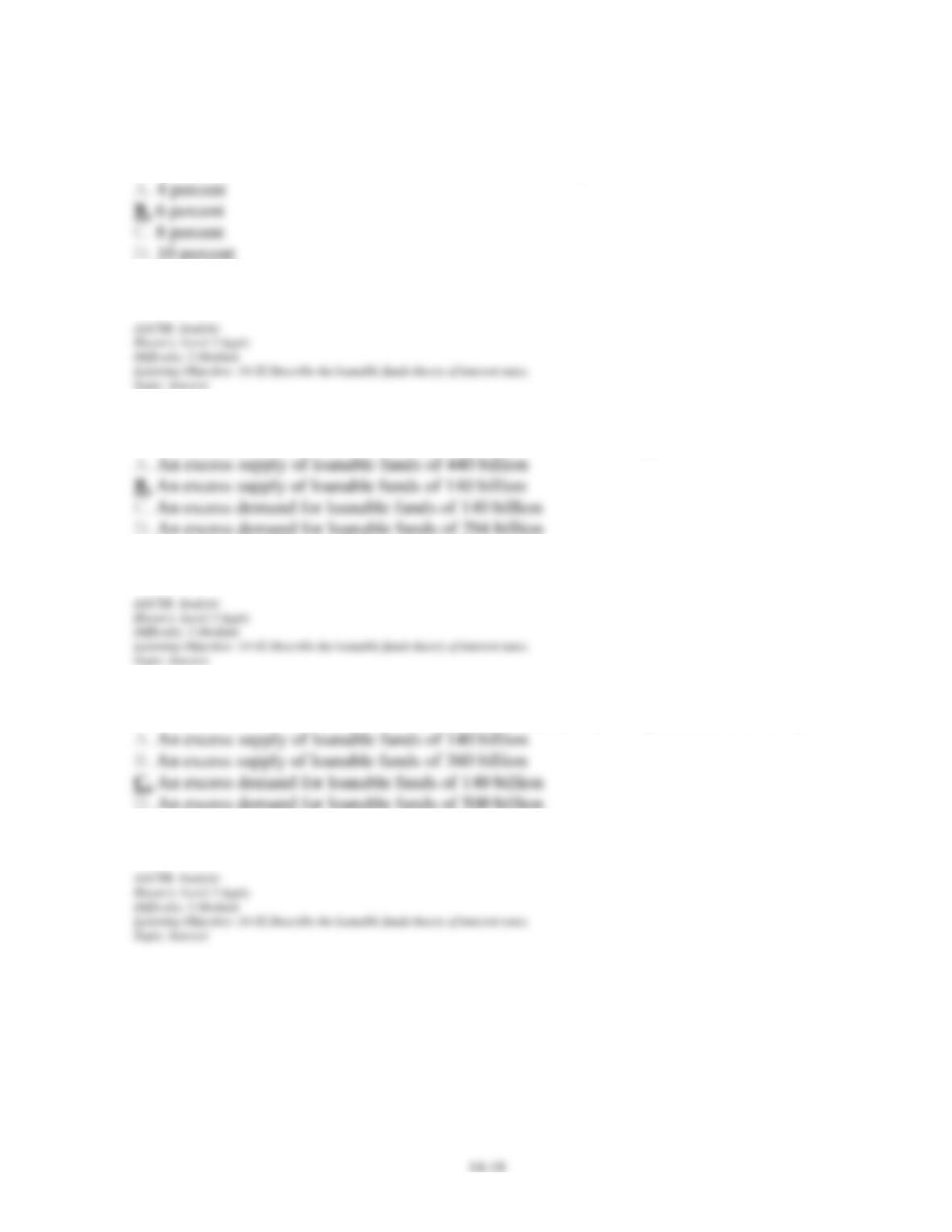
The schedule shows various interest rates, the associated quantity demanded of loanable
funds, and the quantity supplied of loanable funds in billions of dollars at those interest rates.
Chapter 14 – Rent, Interest, and Profit
45. Refer to the above table and information. What is the equilibrium interest rate?
46. Refer to the above table and information. At an interest rate of 8 percent, there will be:
47. Refer to the above table and information. At an interest rate of 4 percent, there will be:
Chapter 14 – Rent, Interest, and Profit
48. Refer to the above table and information. If technology improved and the demand for
loanable funds increases by $140 billion at each interest rate, the new equilibrium interest rate
will be:
49. Refer to the above table and information. If changes in tax laws make households save
more by $140 billion at each interest rate, then the new equilibrium interest rate would be:
50. The supply of loanable funds is an upward-sloping curve because the:
Chapter 14 – Rent, Interest, and Profit
51. Suppose a firm is considering the purchase of a machine which when used will increase its
total revenues by $10,000 for the year. The machine costs $8,000 and has a useful life of one
year. The interest rate is 20 percent. This investment should:
52. Which will increase the supply of loanable funds? An increase in the:
53. Which factor will increase the demand for loanable funds?